

Selection Questionnaires (SQ) and PQQs: The Complete Guide to Getting Shortlisted in 2026
Master Selection Questionnaires and Pre-Qualification Questionnaires to get shortlisted for high-value public sector tenders. Covers the Procurement Act 2023 changes, scoring criteria, common mistakes, and how AI can streamline your SQ responses.
Evie
Procurement Specialist
You have found the perfect tender opportunity. The contract value is right, the scope matches your capabilities, and the deadline gives you enough time to put together a strong response. There is just one problem: before you can even submit a bid, you need to pass the Selection Questionnaire.
For thousands of suppliers across the UK, the Selection Questionnaire — or SQ, as it is commonly known — is the first real hurdle in the public sector procurement process. It is the gatekeeper that determines whether you make it to the shortlist or get filtered out before your proposal is ever read. And yet, despite its importance, it remains one of the most misunderstood and poorly handled stages of the tendering process.
This guide covers everything you need to know about Selection Questionnaires and their predecessor, the Pre-Qualification Questionnaire (PQQ): what they are, how they have changed under the Procurement Act 2023, how they are scored, the mistakes that get suppliers eliminated, and how to approach each section strategically.

A procurement team reviewing selection questionnaire documents at a boardroom table with evaluation criteria visible
What Is a Selection Questionnaire?
A Selection Questionnaire is a standardised assessment that public sector buyers use to evaluate whether a supplier is suitable to be invited to tender for a contract. Think of it as the qualifying round before the main competition. The SQ does not ask you to price the work or describe how you would deliver it. Instead, it assesses whether you meet the minimum requirements to be considered: legal standing, financial stability, technical capability, and relevant experience.
The SQ was introduced by the Crown Commercial Service (CCS) in 2016 as a standardised replacement for the old Pre-Qualification Questionnaire (PQQ). Before standardisation, every contracting authority created its own PQQ with different formats, different questions, and different requirements — a frustrating and expensive process for suppliers who had to reinvent their responses for every opportunity. The standard SQ brought consistency, reducing the administrative burden on both sides.
Under the Procurement Act 2023, which came into full effect in February 2025, the selection stage has been further refined. The Act introduced the concept of "associated tender documents" and reinforced the principle that selection criteria must be proportionate to the contract. The terminology has shifted somewhat — the Act refers to "conditions of participation" and "selection criteria" rather than explicitly mandating a specific questionnaire format — but in practice, the SQ remains the dominant mechanism for pre-qualifying suppliers in above-threshold procurements.
SQ vs PQQ: What Changed and What Did Not
Many suppliers still refer to the process as "the PQQ" despite the official shift to "Selection Questionnaire" a decade ago. The terms are often used interchangeably in conversation, though there are meaningful differences worth understanding.
The old PQQ was bespoke. Each buyer designed their own, often with inconsistent question numbering, idiosyncratic scoring, and requirements that bore little relation to the actual contract. One local authority might ask for five years of accounts while another asked for three. One might require specific ISO certifications while another accepted equivalent standards. Suppliers spent enormous amounts of time decoding each new format.
The standardised SQ changed this by introducing a fixed structure with mandatory and optional sections. Part 1 covers supplier information. Part 2 addresses exclusion grounds (both mandatory and discretionary). Part 3 covers selection criteria including economic and financial standing, technical and professional ability, and additional questions specific to the procurement.
Under the Procurement Act 2023, the key changes for suppliers are:
Conditions of participation must be proportionate. Buyers cannot impose requirements that are disproportionate to the nature or value of the contract. If you are bidding for a £200,000 cleaning contract, the buyer should not demand the same financial turnover thresholds as they would for a £20 million infrastructure project. This principle existed before, but the Act strengthens it and gives suppliers clearer grounds to challenge disproportionate requirements. Exclusion grounds have been updated. The Act introduces a revised list of mandatory and discretionary exclusion grounds, including new grounds related to modern slavery, tax evasion, and sanctions. The mandatory exclusion period is five years, and discretionary exclusion is three years, unless the supplier can demonstrate "self-cleaning" measures. The Central Digital Platform changes information flow. Supplier data held on the Central Digital Platform (CDP) can be referenced during the selection stage, reducing the need to re-submit the same information for every procurement. Over time, this should mean less repetitive form-filling for suppliers who maintain up-to-date profiles. The debarment list introduces new consequences. Under the Act, suppliers who meet mandatory exclusion grounds can be placed on a centrally maintained debarment list. This is a significant escalation from the previous regime, where exclusion decisions were made on a procurement-by-procurement basis.When Are Selection Questionnaires Used?
Not every procurement uses an SQ. Understanding when one is required — and when it is not — helps you plan your bid pipeline and allocate resources effectively.
Above-threshold restricted procedures: SQs are most commonly used in restricted procedures for contracts above the relevant procurement thresholds (currently around £139,688 for central government goods and services, and £5,372,016 for works contracts, though these thresholds are updated periodically). In a restricted procedure, the SQ serves as the gateway: only suppliers who pass will be invited to tender. Below-threshold procurements: For contracts below the threshold, buyers may still use a simplified selection process, but a full standardised SQ is not required. Many buyers use a lighter-touch approach — perhaps a few qualifying questions or a supplier registration check. Open procedures: In an open procedure, there is no separate pre-qualification stage. All interested suppliers can submit a full tender, and selection criteria are assessed alongside the tender evaluation. However, the selection criteria themselves are often very similar to what you would find in an SQ. Dynamic Purchasing Systems (DPS): DPS arrangements typically have an ongoing qualification process. Suppliers can apply to join at any time, and the qualification criteria are assessed on a pass/fail basis. The questions are similar to SQ questions, though the format may differ. Framework agreements: Frameworks often use an SQ or equivalent at the initial competition stage. Once you are on the framework, individual call-offs may not require further pre-qualification — one of the key benefits of framework membership.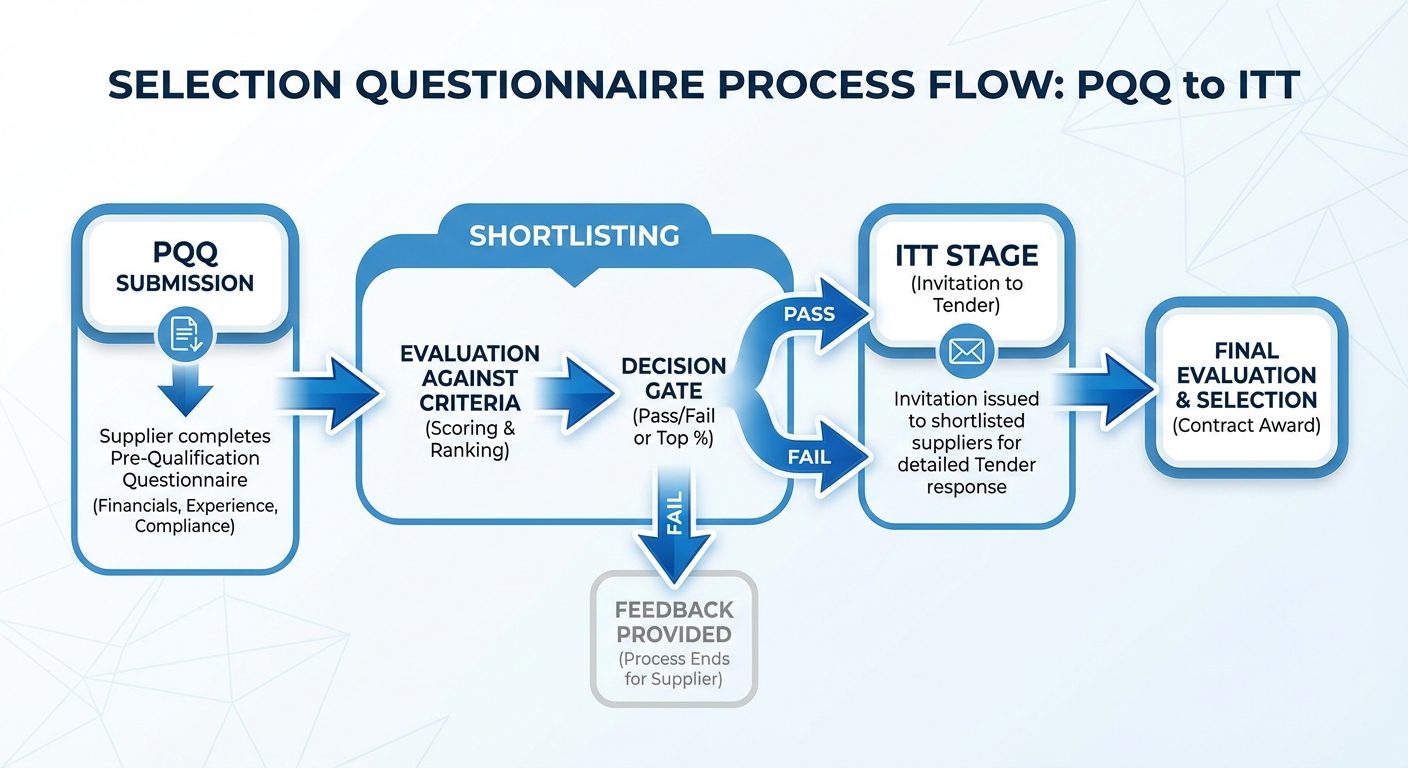
The selection questionnaire process flow from submission through to shortlisting and ITT stage
Anatomy of a Selection Questionnaire
The standardised SQ has a clear structure. Understanding each section — what it asks, why it matters, and how it is assessed — is the foundation of a strong response.
Part 1: Supplier Information
This is the administrative section. It captures basic details about your organisation: company name, registered address, contact details, company registration number, VAT number, trading status (sole trader, partnership, limited company, etc.), and details of any parent company or group structure.
Part 1 is largely factual and is not scored. However, accuracy matters. Inconsistencies between your SQ response and publicly available information (Companies House records, for instance) raise red flags. If your company has recently changed name, restructured, or been acquired, explain the circumstances clearly rather than leaving the buyer to guess.
If you are bidding as a consortium or joint venture, this section is where you declare the arrangement and identify the lead partner. Consortium bids add complexity — each member may need to satisfy certain selection criteria independently, and the combined entity needs to demonstrate collective capability.
Part 2: Exclusion Grounds
This is the pass/fail section that trips up more suppliers than any other. Part 2 asks whether any mandatory or discretionary exclusion grounds apply to your organisation, its directors, or anyone with significant control.
Mandatory exclusion grounds include serious criminal offences: participation in a criminal organisation, corruption, fraud, terrorist offences, money laundering, child labour and human trafficking offences, and non-payment of taxes or social security contributions where this has been established by a judicial or administrative decision. If any mandatory exclusion ground applies and you cannot demonstrate self-cleaning, you will be excluded. There is no discretion here. Discretionary exclusion grounds cover a broader range of issues: professional misconduct, agreements to distort competition, conflicts of interest, significant or persistent deficiencies in performance of a prior public contract, misrepresentation, and attempts to unduly influence the procurement process. The buyer has discretion over whether to exclude you on these grounds, and you have the opportunity to explain the circumstances and any remedial measures.The critical point: exclusion grounds apply to the organisation and to individual directors and persons of significant control (PSCs). If a director of your company was convicted of fraud at a previous employer, that is a mandatory exclusion ground that attaches to your current organisation while they remain in post. Many suppliers are caught out by this — they answer "no" to exclusion questions without checking the histories of all relevant individuals.
Self-cleaning is the mechanism by which a supplier who would otherwise be excluded can demonstrate that they have taken sufficient remedial action to be considered reliable despite the exclusion ground. This might include paying compensation, cooperating with investigating authorities, implementing compliance programmes, or removing the individuals concerned. Self-cleaning arguments must be specific, evidenced, and compelling. A vague statement that you have "improved your processes" will not suffice.Part 3: Selection Criteria
This is where the real competition happens. Part 3 is split into several subsections, and the questions here are typically scored rather than assessed on a pass/fail basis.
Economic and financial standing: Buyers assess whether you have the financial capacity to deliver the contract. Common requirements include minimum annual turnover (often set at 1.5 to 2 times the annual contract value), positive net assets, and evidence of financial stability through accounts, bank references, or credit reports. Under the Procurement Act 2023, new Economic and Financial Standing (EFS) guidance was issued in January 2026, introducing a tiered approach based on contract impact and value. Buyers should be proportionate — and you should challenge requirements that are not. Insurance: Most SQs require confirmation of adequate insurance cover: employer's liability (minimum £5 million is standard), public liability, professional indemnity (where relevant), and sometimes product liability or cyber insurance. If your current cover does not meet the specified levels, you can usually confirm willingness to obtain the required cover if awarded the contract — but check whether the SQ requires current cover or a commitment to obtain it. Technical and professional ability: This is the section where you demonstrate relevant experience, qualifications, and capability. Common questions include:- Provide examples of similar contracts you have delivered (typically two or three, within the last three to five years)
- Describe your approach to quality management (ISO 9001 or equivalent)
- Detail your health and safety management systems (ISO 45001 or equivalent)
- Explain your environmental management approach (ISO 14001 or equivalent)
- Describe your supply chain management approach
- Outline your approach to data protection and information security
The "relevant experience" questions are the most important. Buyers are looking for evidence that you have successfully delivered contracts of comparable scope, scale, and complexity. Each case study should clearly demonstrate the relevance to the current opportunity, quantify the outcomes, and show that you delivered on time, on budget, and to the required quality standard.

A supplier preparing compliance documents for a government tender with certificates and financial statements
How Selection Questionnaires Are Scored
Understanding how SQs are scored is essential for prioritising your effort and writing responses that maximise your marks.
Pass/Fail Elements
Parts 1 and 2 are essentially pass/fail. You either meet the exclusion and eligibility criteria or you do not. There is no partial credit for being "mostly" compliant with mandatory exclusion grounds.
Financial standing is also often assessed on a pass/fail basis: you either meet the minimum turnover threshold or you do not; your accounts either demonstrate adequate financial health or they do not. Some buyers apply a more nuanced financial assessment, scoring financial strength on a sliding scale, but the majority use a threshold approach.
Insurance requirements are pass/fail. You either have the required cover (or confirm willingness to obtain it) or you do not.
Scored Elements
Technical and professional ability questions are typically scored on a scale. A common approach uses a 0 to 5 scoring matrix:
0 — Unacceptable: No response, or a response that is completely irrelevant or demonstrates no capability. 1 — Poor: Significant concerns about capability. Response lacks relevant evidence and raises doubts about the supplier's ability to deliver. 2 — Acceptable: Response addresses some requirements but with gaps. Evidence is limited or partially relevant. 3 — Good: Response addresses all key requirements with relevant evidence. A competent submission that meets expectations. 4 — Very Good: Response demonstrates strong capability with detailed, relevant evidence that exceeds basic requirements. Clear understanding of the buyer's needs. 5 — Excellent: Outstanding response with comprehensive, highly relevant evidence. Demonstrates innovative thinking, exceptional capability, and deep understanding of the contract requirements. Case studies are directly comparable and outcomes are clearly quantified.Most buyers will set a minimum score threshold — typically 3 out of 5 on each scored question — below which a supplier is eliminated regardless of their overall score. The top-scoring suppliers (usually between three and six) are then invited to tender.

A scoring matrix for tender evaluation with weighted criteria and percentage scores on a computer screen
Weighting
Not all scored questions carry equal weight. Buyers typically weight questions according to the importance of each criterion to the specific contract. Relevant experience might carry 40% of the total score, while quality management accounts for 20%, health and safety for 15%, environmental management for 10%, and social value for 15%.
Understanding the weighting is critical because it tells you where to focus your effort. If relevant experience is weighted at 40%, that question deserves proportionally more attention, more detailed case studies, and more rigorous evidence than a question weighted at 10%.
Always check whether the weighting is published. In most above-threshold procurements, it should be. If it is not, ask during the clarification period — buyers are required to be transparent about evaluation criteria and methodology.
The Most Common Reasons Suppliers Fail
Having reviewed thousands of SQ responses over the years, the failure patterns are remarkably consistent. Avoiding these mistakes puts you ahead of a significant proportion of your competition.
1. Generic Responses That Ignore the Question
The single most common mistake is submitting boilerplate text that describes your general capabilities without addressing the specific question asked. If the buyer asks how you would manage quality on a facilities management contract for a portfolio of healthcare buildings, they do not want a generic description of your ISO 9001 certification. They want to know how you would apply quality management to their specific context — healthcare compliance, infection control, CQC requirements, planned preventative maintenance schedules, and responsive repairs.
Every answer should be tailored to the procurement. Reference the specific contract, the specific sector, and the specific requirements described in the tender documents. Evaluators can spot copy-paste responses immediately, and they score accordingly.
2. Case Studies That Do Not Demonstrate Relevance
The experience questions are where most marks are won or lost, and the most common error is selecting case studies that demonstrate general experience rather than relevant experience. If you are bidding for a construction contract to build a school, your strongest case study is another school or educational building project, not a warehouse fit-out. If you are bidding for an IT managed services contract in the NHS, your case study should be NHS or healthcare IT, not generic corporate IT support.
For each case study, structure your response to demonstrate:
Comparable scope and scale. Contract value, number of sites, number of users, geographic spread — whatever metrics are relevant. The closer the match to the current opportunity, the higher you will score. Specific challenges and how you overcame them. Evaluators want to see that you can handle complexity, not just routine delivery. Did you manage a phased transition? Navigate challenging stakeholder relationships? Deliver to compressed timescales? Solve an unexpected technical problem? Quantified outcomes. Numbers matter. Instead of "we achieved high customer satisfaction," write "we maintained a 97.3% customer satisfaction rating across a 36-month contract period, measured through quarterly NPS surveys." Instead of "we delivered on time," write "we completed all 47 site installations ahead of schedule, with an average of 3.2 days early per site." Client reference availability. If you can name the client and provide a reference, do so. Anonymous case studies score lower because they cannot be verified.3. Failing to Declare Exclusion Grounds
Some suppliers are genuinely unaware that an exclusion ground applies to them. Others are aware but hope it will not be noticed. Neither approach works.
Contracting authorities are increasingly conducting due diligence checks against Companies House, court records, and other public databases. If you fail to declare an exclusion ground and it is subsequently discovered, you face not only exclusion from the current procurement but potential inclusion on the debarment list — which affects your ability to bid for any above-threshold public contract.
If an exclusion ground applies, declare it and make a self-cleaning case. Being upfront demonstrates integrity and gives you the opportunity to explain the remedial steps you have taken. Trying to hide it demonstrates the opposite.
4. Financial Thresholds and Turnover Gaps
If the SQ requires a minimum annual turnover of £2 million and your turnover is £1.8 million, you fail. There is rarely flexibility on financial thresholds, and trying to argue that you are "close enough" wastes everyone's time.
Before investing effort in an SQ response, check the financial requirements and be honest about whether you meet them. If you do not, consider whether a consortium or subcontracting arrangement could bridge the gap. Some buyers allow suppliers to rely on the economic and financial standing of a parent company, a subcontractor, or another entity within a consortium — but this must be declared and evidenced.
Under the Procurement Act 2023, there is a stronger emphasis on proportionate financial requirements. If you believe a turnover threshold is disproportionate to the contract value, raise this during the clarification period. The Act gives you grounds to challenge, and responsible buyers will consider adjusting unreasonable requirements.
5. Missing or Expired Certifications
If the SQ requires ISO 9001 certification and yours expired two months ago, you have a problem. If it requires Cyber Essentials Plus and you only hold basic Cyber Essentials, you have a problem. Certifications are binary: you either hold the required standard or you do not.
Maintain a tracker of all certifications and their expiry dates. Build in a renewal buffer — start the recertification process at least three months before expiry. If you are working towards a certification but do not yet hold it, some SQs will accept "currently working towards" with a credible timeline, but many will not.
6. Word Count Violations and Format Errors
If the SQ specifies a 500-word limit per answer, exceeding it by even a single word gives the buyer grounds to disregard the excess content — or reject the response entirely. Some e-procurement portals enforce word limits technically, cutting off your text at the limit. Others rely on manual checking.
Treat word limits as absolute constraints. If you have 500 words, make every word count. Cut filler phrases, eliminate repetition, and prioritise the highest-scoring content. A concise, focused 500-word response will always outscore a rambling 495-word response that takes 300 words to get to the point.
Sector-Specific SQ Considerations
While the SQ structure is standardised, the questions within Part 3 vary significantly by sector. Understanding what evaluators look for in your specific sector gives you a meaningful advantage.
Construction and Infrastructure
Construction SQs typically emphasise:
- SSIP (Safety Schemes in Procurement) accreditation or equivalent
- CSCS card compliance for operatives
- CDM (Construction Design and Management) Regulations compliance
- Building Safety Act 2022 awareness and compliance
- Environmental management and waste reduction
- Supply chain management and use of local subcontractors
- BIM (Building Information Modelling) capability
- Previous experience on similarly valued works contracts
Case studies should reference specific project types (new build, refurbishment, heritage, education, healthcare), delivery methods (traditional, design and build, management contracting), and quantified outcomes (completion dates, defect rates, accident frequency rates).
Facilities Management
FM SQs focus on:
- TUPE (Transfer of Undertakings) experience and management
- Multi-site service delivery capability
- Mobilisation and transition planning
- Technology and CAFM (Computer Aided Facilities Management) systems
- Planned and reactive maintenance track record
- Customer satisfaction measurement
- Sustainability and environmental performance
- Modern slavery due diligence in cleaning and security supply chains
The FM sector is particularly competitive at the SQ stage because many contracts attract large numbers of applicants. Your case studies need to be precisely matched to the contract type: hard FM, soft FM, total FM, or bundled services.
IT and Digital Services
IT SQs increasingly require:
- Cyber Essentials Plus certification (often mandatory for government contracts)
- ISO 27001 information security management
- Data protection and GDPR compliance evidence
- Cloud hosting arrangements (UK data residency is often required)
- Accessibility compliance (WCAG 2.2 AA)
- Service level agreement track record
- Agile delivery methodology experience
- G-Cloud or Digital Outcomes and Specialists framework membership
Healthcare and NHS
Healthcare SQs have unique requirements:
- CQC registration (where applicable)
- NHS Data Security and Protection Toolkit compliance
- Clinical governance frameworks
- Safeguarding policies and DBS checking procedures
- From April 2026, Evergreen Level 1 sustainability information
- Infection prevention and control capabilities
- Patient safety and quality improvement track record
Strategic Approaches to SQ Success
Beyond avoiding common mistakes, there are strategic approaches that consistently improve shortlisting rates.
Build and Maintain an SQ Library
The most efficient approach to SQ responses is maintaining a library of pre-written, evidence-rich answers that can be tailored to each opportunity. Your library should include:
- Core company information (updated quarterly)
- Exclusion ground declarations (reviewed annually by legal)
- Financial summary and key metrics (updated with each set of accounts)
- Insurance schedule with current cover levels
- A portfolio of case studies (minimum 10 to 15, covering different sectors, contract values, and service types)
- Policy summaries for quality, H&S, environmental, data protection, social value, and modern slavery
- Certification tracker with expiry dates and renewal schedules
Each time you submit an SQ, add the tailored responses to your library. Over time, you build a comprehensive resource that dramatically reduces response time while maintaining quality.
Invest in Case Study Development
Your case studies are your most valuable SQ asset. Invest time in developing them properly rather than writing them hastily for each submission.
For each case study, gather:
- Contract details: client name, value, duration, scope
- Specific challenges and how you addressed them
- Quantified outcomes with supporting data
- Client testimonial or reference (obtain permission in advance)
- Lessons learned and how they improved subsequent delivery
Ideally, obtain written permission from clients to use their name and project details. Named case studies are significantly more credible than anonymous ones.
Update your case studies as contracts progress. A case study that references outcomes from two years ago is less compelling than one that includes recent performance data from an ongoing contract.
Use Clarification Questions Strategically
Every above-threshold procurement includes a clarification period during which suppliers can ask questions. Use this period strategically:
- Clarify any ambiguous requirements before you start writing
- Ask about weighting if it is not published
- Query financial thresholds that appear disproportionate
- Check whether consortium or subcontractor reliance is permitted
- Request additional information about the buyer's priorities
Your clarification questions and the buyer's responses are typically shared with all bidders, so avoid asking questions that reveal your competitive strategy. Focus on questions that help you understand the requirements and write a better response.
Align Social Value to the Contract
Social value has become a significant scoring factor in most SQs, often accounting for 10 to 20% of the weighted score. The most common mistake is providing a generic social value statement that lists your CSR activities without connecting them to the specific contract and its geographic location.
Strong social value responses:
- Reference the specific communities affected by the contract
- Quantify commitments (number of apprenticeships, local spend percentages, volunteer hours)
- Align to the buyer's social value priorities (often published in the tender documentation or the buyer's social value policy)
- Include measurement and reporting proposals
- Reference the Social Value Model (for central government procurements) or TOMs (Themes, Outcomes, Measures) framework

A diverse business team celebrating successful tender shortlisting in a modern office setting
How AI Is Changing the SQ Process
The SQ process has historically been labour-intensive, involving significant manual effort to tailor responses, update case studies, and ensure compliance with each procurement's specific requirements. AI-powered bid management tools are fundamentally changing this equation.
Automated First Drafts
Modern AI bid writing platforms like mytender.io can generate intelligent first drafts of SQ responses based on your organisation's knowledge base — previous successful submissions, case studies, policy documents, and accreditation records. Instead of starting each SQ from scratch or manually searching through your document library, the AI retrieves relevant content and assembles a draft response that is already tailored to the specific question.
This does not replace human expertise. An AI-generated draft still needs review, refinement, and strategic input from someone who understands the procurement context. But it reduces the initial drafting time from hours to minutes, freeing your bid team to focus on the strategic and creative elements that differentiate a good response from an excellent one.
Compliance Checking
AI tools can cross-reference your SQ responses against the published requirements and evaluation criteria, flagging gaps, inconsistencies, or areas where your response does not fully address the question. This automated compliance check catches errors that manual review often misses, particularly when working under time pressure.
Case Study Matching
One of the most powerful applications is automated case study selection. Given the requirements of a specific procurement, AI can analyse your portfolio of case studies and recommend the ones that are most relevant — considering factors like contract value, sector, scope, geographic location, and specific requirements mentioned in the tender documentation.
Knowledge Management
The underlying challenge for most suppliers is not writing ability but knowledge management. The information needed for a compelling SQ response exists somewhere in the organisation — in previous submissions, project reports, client feedback, financial records — but finding and assembling it is time-consuming.
AI-powered knowledge management systems address this by creating a searchable, structured repository of your bid-relevant content. When you need a case study about healthcare FM in the southeast, or your latest environmental management data, or the specific qualifications held by your proposed project team, the system retrieves it instantly.
mytender.io's Smart Content Library does exactly this. It connects to your existing documents, organises them automatically, and makes relevant content instantly retrievable. Teams using the platform report reducing their SQ response time by 75% while maintaining or improving the quality of their submissions.
A Practical SQ Response Process
Bringing together all the strategic and tactical advice above, here is a practical process for approaching each SQ opportunity:
Week 1: Assess and Plan
Day 1-2: Opportunity assessment. Read the full procurement documentation. Assess fit: do you meet the mandatory requirements (exclusion grounds, financial standing, insurance, certifications)? Is the contract a genuine strategic target? Do you have relevant case studies? Day 3-4: Clarification questions. Identify anything unclear in the requirements. Submit clarification questions before the deadline. While waiting for responses, begin gathering internal information. Day 5: Response planning. Map each question to your best available evidence. Identify gaps that need to be filled — new data to gather, case studies to refresh, policies to update. Assign writing responsibilities if working as a team.Week 2: Draft and Review
Day 6-8: First drafts. Write first drafts of all scored responses. Use your SQ library as a starting point, tailoring each response to the specific procurement. If using AI tools like mytender.io, generate initial drafts and refine them. Day 9: Internal review. Have someone who did not write the responses review them against the scoring criteria. Check that every question is fully answered, evidence is specific and quantified, case studies are relevant, and word counts are within limits. Day 10: Final refinement. Incorporate review feedback. Polish language and formatting. Check all attachments and supporting documents. Complete the administrative sections.Week 3: Submit and Learn
Day 11: Final checks and submission. Verify all required documents are attached. Check the submission portal for any technical requirements. Submit well before the deadline — at least 24 hours early if possible. Portal crashes and technical issues near deadlines are common, and late submissions are almost never accepted. Post-submission: Debrief. Whether you are shortlisted or not, request feedback from the buyer. Understanding how your response was scored — and where you lost marks — is invaluable for improving future submissions. Update your SQ library with the tailored content from this submission.The Procurement Act 2023 and the Future of Selection
The Procurement Act 2023 signals a direction of travel for the selection stage that suppliers should prepare for.
Greater standardisation through the CDP. As the Central Digital Platform matures, more supplier information will be held centrally and shared across procurements. This should reduce repetitive form-filling but requires suppliers to maintain accurate, up-to-date profiles. Treat your CDP profile as a living document, not a one-time registration. Proportionality as an enforceable principle. The Act's emphasis on proportionate conditions of participation gives suppliers stronger grounds to challenge unreasonable requirements. If a buyer sets turnover thresholds at five times the annual contract value, or demands certifications that are not relevant to the scope of work, you have a basis for objection. Use it — it improves the procurement landscape for everyone. Transparency and accountability. Published KPI data, the debarment list, and increased transparency requirements mean that your track record is becoming more visible to more buyers. This is an opportunity for good suppliers: a strong, verifiable track record becomes a competitive advantage that is harder for weaker competitors to match. Social value as standard. The weighting given to social value in the selection stage will continue to increase. Suppliers who treat social value as an afterthought will find themselves consistently outscored by those who integrate it into their business operations and can demonstrate measurable impact.Conclusion
The Selection Questionnaire is not a bureaucratic hurdle to be overcome with minimal effort. It is the first opportunity to demonstrate your capability, credibility, and strategic fit to a buyer. Suppliers who approach it strategically — with tailored responses, relevant evidence, and a clear understanding of what evaluators are looking for — consistently outperform those who treat it as a box-ticking exercise.
The fundamentals have not changed: understand the requirements, provide specific evidence, quantify your outcomes, and tailor everything to the specific procurement. What has changed is the technology available to help you do this faster and more consistently. AI-powered tools like mytender.io are making it possible for bid teams of all sizes to produce SQ responses that compete with the largest incumbents, levelling a playing field that has historically favoured organisations with dedicated bid resources.
Whether you are responding to your first SQ or your hundredth, the advice is the same: be specific, be relevant, be honest, and submit early. The shortlist is waiting.
Tags
Ready to Transform Your Tender Writing?
See how MyTender's AI can help you write winning tenders in a fraction of the time.