

Bid Library Governance in the Age of AI: How to Keep Tender Content Accurate, Useful and Safe
AI bid tools are only as good as the content they can trust. Here is how to govern your bid library so old answers, expired policies and weak evidence do not quietly damage your tender scores.
mytender.io Research Team
Tender Writing & Bid Management Specialists
Bid Library Governance in the Age of AI
Most bid libraries do not fail loudly. They fail quietly.
A policy expires. A case study gets reused after the client relationship has changed. A carbon figure from 2023 makes its way into a 2026 tender. Nobody notices until an evaluator spots the gap, or worse, until the submission is already in.
AI makes this problem sharper. It can find and reuse content faster than any human bid writer, but speed is only useful if the source material is worth trusting. If your library is stale, duplicated or badly labelled, AI will simply help you repeat mistakes at scale.
That is why bid library governance has moved from nice-to-have admin to core bid management work.

Bid team maintaining an AI-ready tender content library with verified evidence cards
Why Bid Library Governance Matters More in 2026
The bid library used to be a folder problem. Someone had a SharePoint, a set of gold-standard answers and a spreadsheet of case studies. It was messy, but experienced bid writers knew where the good material lived.
Now the library is becoming part of the production system.
AI drafting tools, internal search, answer suggestion and compliance checks all depend on stored content. If the library says your ISO 27001 certificate expires in 2027, that claim may appear in a draft. If three different versions of your safeguarding policy exist, the tool has to choose one. If the strongest project evidence sits in somebody's inbox, it will not be used at all.
The result is simple: your bid library is now part of your quality control system.
Poor governance creates four risks:
- Wrong facts get reused in live submissions
- Strong evidence is missed because it is buried or mislabelled
- Bid writers waste time checking content that should already be trusted
- AI drafts sound confident but rely on weak source material
Good governance does the opposite. It gives your team a library they can use without second-guessing every paragraph.
What Good Governance Actually Means
Governance sounds heavier than it is. It does not mean turning your bid team into librarians. It means deciding which content is trusted, who owns it, when it expires and how it should be used.
For a tender content library, every reusable asset should answer six questions:
- What is this content for?
- Who owns it?
- When was it last checked?
- When does it expire?
- Which tenders or sectors is it suitable for?
- What evidence supports it?
If a piece of content cannot answer those questions, it should not be treated as ready-to-use.
That does not mean deleting everything imperfect. Some content is still useful as raw material. The key is to separate approved content from draft, archived or reference-only material.
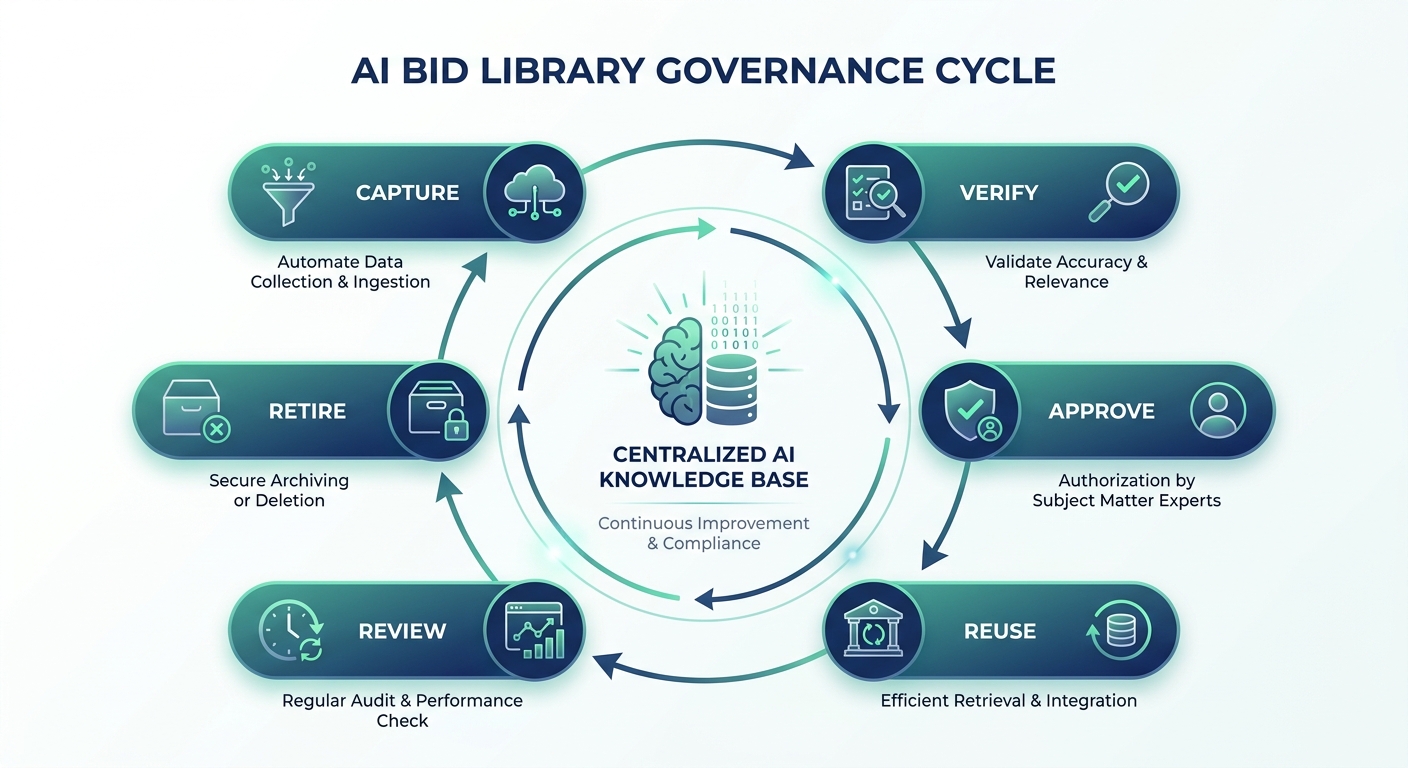
AI bid library governance cycle showing capture, verify, approve, reuse, review and retire
The Six-Part Governance Cycle
A strong bid library runs on a simple cycle: capture, verify, approve, reuse, review and retire.
1. Capture
Good content comes from live bids, project teams, policies, accreditations, contract reviews and customer success stories. The problem is that most of it arrives in unstructured form.
Capture is the act of getting it into the library before it disappears.
Examples include:
- A strong social value answer from a winning bid
- A new environmental policy from operations
- A mobilisation lesson learned after contract go-live
- A client testimonial from an account manager
- Updated insurance, ISO or cyber security evidence
- A project completion summary from delivery teams
The rule is simple: if it might help a future tender, capture it. Do not worry about polishing it at this stage.
2. Verify
Verification is where weak libraries usually break.
Someone needs to check whether the content is factually correct, current and supported by evidence. That person may be in bids, compliance, finance, HR, operations, SHEQ or delivery. It depends on the topic.
A bid manager should not be the sole authority on every policy, certificate and operational claim. They can manage the library, but they need named owners for specialist content.
Verification should cover:
- Dates and expiry points
- Named accreditations and certificates
- Client permissions for case studies
- Measured outcomes and performance claims
- Legal or compliance wording
- Whether the content reflects current practice
This is where AI governance and bid governance overlap. If AI can access the content, the content needs a trust status.
3. Approve
Approval means the content is safe to reuse within defined limits.
It does not mean copy and paste blindly. A safeguarding policy summary may be approved for education bids, but still need tailoring for a local authority framework. A project case study may be approved for construction bids, but unsuitable for healthcare.
Approved content should have metadata that makes the limits clear:
- Sector
- Service line
- Geography
- Client type
- Last review date
- Expiry date
- Owner
- Evidence location
- Approved use notes
This sounds like admin. It is actually what stops bid writers wasting hours asking "can we still say this?"
4. Reuse
Reuse is where the value appears.
A governed library lets bid writers start from evidence rather than memory. It gives AI tools clean source material. It gives reviewers confidence that the first draft is not full of ancient claims.
The best reuse is selective. A good bid writer still adapts the answer to the scoring criteria, buyer priorities and contract context. The library provides the ingredients, not the finished meal.
In mytender.io, for example, teams can connect existing content sources and use them to generate first drafts, analyse requirements and reduce manual searching. The important point is the same whatever tool you use: AI should pull from the best available evidence, not from a digital attic. Learn more about mytender.io.
5. Review
Review is where most libraries fall apart because nobody owns the rhythm.
Do not review everything at the same frequency. That creates a huge job that nobody wants to start. Review by risk.
High-risk content should be reviewed more often:
- Compliance statements
- Policies and certificates
- Insurance levels
- Cyber security claims
- Health and safety statistics
- Carbon and ESG performance figures
- Client references and case study permissions
Lower-risk content can be reviewed less often:
- Boilerplate company history
- Generic process descriptions
- Standard team biographies
- Older but still relevant project summaries
The cadence matters less than consistency. A quarterly review that actually happens beats an annual audit that exists only in a process document.
6. Retire
Retirement is underrated.
Old content often feels harmless because it is familiar. But stale content is dangerous precisely because it looks usable. It has the right tone. It sounds polished. It has survived many bids before.
Retire content when:
- The evidence has expired
- The client reference is no longer approved
- The policy has been replaced
- The service model has changed
- The claim can no longer be proven
- The answer has repeatedly needed heavy rewriting
Do not leave retired content in the same place as approved content. Archive it clearly or remove it from the AI-accessible library.
Build a Risk Matrix for Your Content
Not all bid library content carries the same risk. A mistake in your company overview is annoying. A mistake in your insurance cover, Modern Slavery statement or safeguarding process can be disqualifying.
Use two questions to classify content:
- How often is this reused?
- How closely will evaluators scrutinise it?
The highest priority content is reused often and scrutinised closely. That is where governance has the biggest impact.
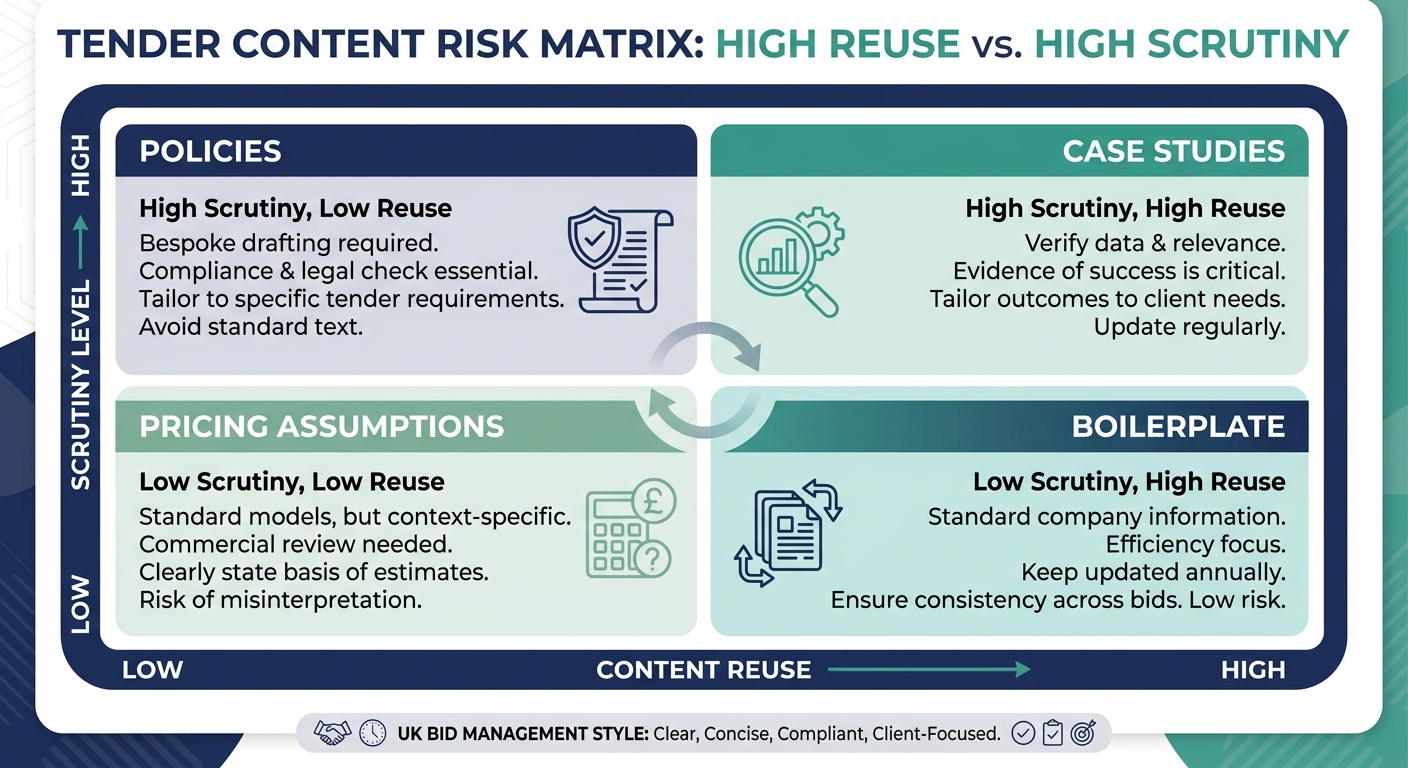
Bid library content risk matrix showing high reuse and high scrutiny categories
High Reuse, High Scrutiny
This is your critical library.
Typical examples include:
- Health and safety policy summaries
- Quality assurance processes
- ESG and carbon reduction evidence
- Cyber security and data protection answers
- Mobilisation methodology
- TUPE approach
- Social value commitments
- Financial stability statements
- Case studies used across multiple bids
These items need named owners, review dates and evidence links.
High Reuse, Low Scrutiny
This is useful boilerplate.
Examples include company history, office locations, leadership bios and standard service introductions. It still needs tidying, but it is less likely to create serious risk.
Review it annually unless something material changes.
Low Reuse, High Scrutiny
This content is often sector-specific or contract-specific.
Examples include clinical governance for healthcare bids, Building Safety Act competence evidence for construction, food waste compliance for waste tenders or security vetting for FM contracts.
The mistake here is treating specialist evidence like general boilerplate. It needs expert review even if it is not used often.
Low Reuse, Low Scrutiny
This is archive material.
Keep it if it helps future research, but do not let it pollute approved content. AI tools should not draw from archive folders unless a user deliberately asks them to.
The Minimum Metadata Every Bid Library Needs
Metadata is not glamorous, but it is what makes a library usable.
At minimum, every approved asset should have:
- Title
- Content type
- Owner
- Department
- Sector
- Service line
- Last reviewed date
- Next review date
- Expiry date if relevant
- Evidence source
- Approval status
- Notes on where it can and cannot be used
The trick is to make this lightweight enough that people actually maintain it. If the metadata form takes ten minutes per answer, nobody will use it. Start with the fields that prevent mistakes.
For most teams, the most important fields are owner, review date, expiry date, sector and evidence source.
Owner Beats Folder
Most bid libraries are organised around folders. Governance should be organised around owners.
A folder can tell you where content lives. It cannot tell you whether the content is still true.
Every high-risk content area should have a named owner:
- HR owns people, training and employee policies
- SHEQ owns safety, quality and environmental evidence
- Finance owns financial claims and insurance levels
- IT owns cyber security and data protection evidence
- Operations owns delivery models and mobilisation claims
- Commercial owns pricing assumptions and contract caveats
- Bids owns structure, usability and tender relevance
This does not mean each owner edits the library every week. It means they are accountable for confirming that their content is accurate when reviewed.
Without owners, bid libraries become communal spaces where everyone assumes someone else is checking the important bits.
Review Cadence: What to Check and When
The easiest way to govern a library is to split reviews into monthly, quarterly and annual checks.
Monthly checks should be quick. Look for content that is expiring soon, content added from recent bids and evidence that has been flagged by reviewers.
Quarterly checks should focus on high-risk reusable content. Policies, certificates, case studies, performance statistics and standard compliance answers belong here.
Annual checks should cover the broader library. Remove duplicates, archive old material, review naming conventions and check whether the taxonomy still matches your bid pipeline.
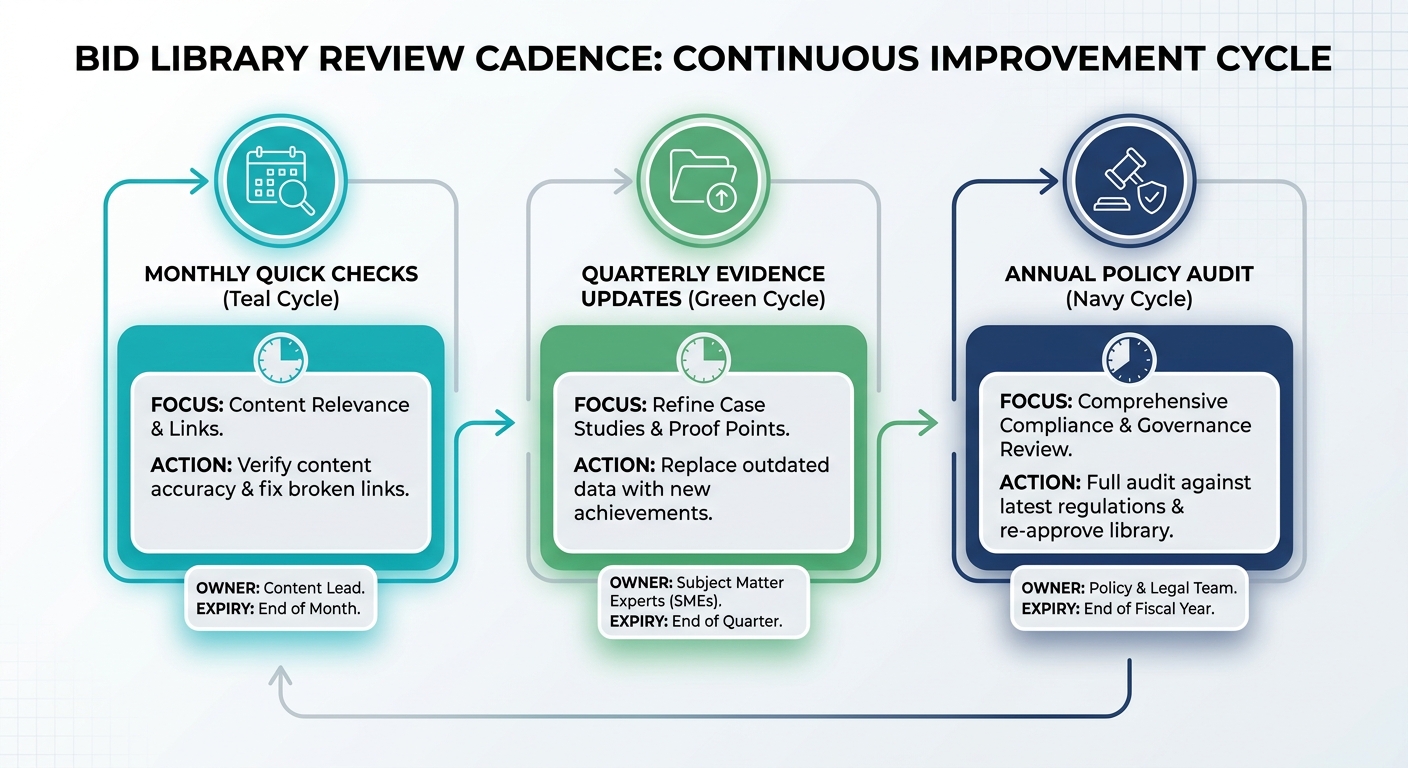
Bid library review cadence showing monthly checks, quarterly evidence updates and annual policy audit
Monthly
Use monthly reviews to keep the library clean:
- Approve or reject newly captured content
- Check upcoming expiry dates
- Remove duplicate answers created during live bids
- Add lessons learned from recent submissions
- Flag any content reviewers questioned
This should be a 30 to 45 minute job, not a half-day meeting.
Quarterly
Quarterly reviews are for trust.
Ask each owner to check their high-risk content. The bid team should prepare the list. Owners should confirm whether the content is approved, needs updating or should be retired.
The output should be practical:
- Approved
- Update required
- Evidence missing
- Retire
Avoid vague statuses like "under review" unless there is a named deadline.
Annually
Annual reviews are for structure.
Ask whether the library still reflects what you actually bid for. If your company has moved into a new sector, won a new framework or changed delivery model, the library needs to follow.
Annual review is also the time to clean up the graveyard: duplicate folders, old drafts, expired case studies and policy versions nobody should touch.
How to Make AI Use the Right Content
AI does not understand your organisation's politics, risk appetite or recent operating changes unless you encode them somewhere.
That is why governance needs to include access rules.
At a basic level:
- Approved content can be used for first drafts
- Draft content can be searched but should be clearly marked
- Archived content should not be used unless requested
- Expired content should be blocked from reuse
- High-risk content should show its owner and review date
For AI-assisted bid writing, your library should also separate source evidence from polished answers.
Source evidence is the fact base: certificates, policies, project data, CVs, KPIs and testimonials. Polished answers are examples of how those facts have been used in previous bids.
Both are useful, but they serve different purposes. If AI only sees polished answers, it may repeat wording without understanding the evidence behind it. If it sees source evidence too, it can build a fresher response that fits the question.
The Biggest Governance Mistakes
The mistakes are boring, which is why they are so common.
Keeping Everything Approved Forever
Approval is not permanent. Every approved answer should have a review date. If nobody has checked a compliance answer for two years, it is not approved. It is historic.
Treating Winning Answers as Untouchable
Winning answers are useful, but they are not sacred. A response that won in 2022 may be too vague for a 2026 tender, especially under newer public procurement expectations around transparency, KPIs and evidence.
Keep the structure if it works. Refresh the facts.
Mixing Source Evidence and Submission Copy
Source evidence and submission wording should not blur together. If a case study says "reduced response times by 18%", the source should show where that figure came from. Do not let a nicely written answer become the only proof that a claim exists.
Letting Live Bid Panic Create Permanent Mess
Every bid creates temporary content: drafts, alternative answers, marked-up versions, reviewer comments and emergency rewrites.
Do not dump all of that into the library. Capture useful learning after submission, then clean up the rest.
No Retirement Process
If deleting or archiving content feels risky, people avoid it. Create a simple retirement status so teams can remove content from active use without losing history.
A Practical 30-Day Reset Plan
If your bid library is already messy, do not try to fix everything at once.
Start with a 30-day reset.
Week 1: Map the Current Library
List the places content lives:
- SharePoint folders
- Google Drive
- Past submissions
- CRM notes
- Case study decks
- Policy folders
- Individual desktops
- Email threads
Then identify your top 20 reused answers. These are the pieces most likely to appear in future tenders, so they deserve attention first.
Week 2: Assign Owners
Give each high-risk content category an owner. Do not overcomplicate it. One owner per area is enough.
Start with:
- SHEQ
- HR
- IT
- Finance
- Operations
- Commercial
- Bids
Ask each owner to confirm what content they are comfortable approving.
Week 3: Set Review Statuses
Create four simple statuses:
- Approved
- Needs update
- Draft
- Retired
Then apply them to the top 20 reused answers. This immediately reduces risk because bid writers can see what is trusted.
Week 4: Connect the Library to Live Bids
Governance only matters if it changes how people work.
Set a rule: before a response goes into a live bid, writers check whether an approved library asset exists. After submission, the team decides whether any new answer, evidence or lesson should be captured.
This creates a loop. Live bids improve the library, and the library improves future bids.
What to Measure
You do not need a giant reporting dashboard. Track a few useful signals:
- Number of approved high-risk assets
- Number of expired assets still in active folders
- Percentage of top reused answers with named owners
- Number of live bids using approved library content
- Reviewer comments caused by outdated or unsupported claims
- Time spent searching for evidence
The final metric is important. A governed library should save time, not create bureaucracy. If bid writers still spend hours hunting through old submissions, the governance model is not working.
Where mytender.io Fits
The best AI bid tools do not replace governance. They make governance more valuable.
When your content is organised, approved and connected to evidence, AI can help draft faster, surface relevant past answers and reduce the blank-page problem. When the library is chaotic, AI can only accelerate the chaos.
mytender.io is built for teams that need tender-specific AI, not a generic chatbot sitting beside a messy folder structure. It helps teams use their own knowledge, analyse requirements and create stronger first drafts from reusable content. But the same principle still applies: the better the library, the better the output.
If you want to see live opportunities matched to your sector, the Tender Finder is free to use. It is a useful next step if you are trying to build a pipeline where your bid library can actually compound over time. Explore the Tender Finder.
Final Thought
Bid library governance is not admin for admin's sake. It is how you stop old content from quietly weakening new bids.
AI has made the upside bigger. A well-governed library can now feed faster drafting, better evidence retrieval and more consistent quality. But it has also made the downside bigger. Bad content travels further when machines can reuse it instantly.
The winning teams will not be the ones with the biggest libraries. They will be the ones with the most trusted libraries.
Tags
Ready to Transform Your Tender Writing?
See how MyTender's AI can help you write winning tenders in a fraction of the time.