

Economic and Financial Standing in Tenders: How to Pass the Checks Without Weakening Your Bid
Economic and financial standing checks are becoming more structured under the Procurement Act. Here is how suppliers should prepare the evidence, explain risk, and avoid failing for the wrong reason.
mytender.io Research Team
Tender Writing & Bid Management Specialists
Economic and Financial Standing in Tenders
A strong technical response can still lose before anyone reads it.
That is the brutal bit about economic and financial standing. You may have the right team, the right method, the right price, and three excellent case studies. But if the buyer decides your balance sheet cannot support the contract, the bid is in trouble before quality scoring starts.
For years, many suppliers treated financial standing as admin. Upload the accounts. Add the insurance certificate. Tick the box. Move on.
That approach is getting risky.
Under the Procurement Act 2023, and the wider push for better transparency and contract management in 2026, buyers are looking harder at whether suppliers can actually carry the contract they are bidding for. Government guidance has also put more structure around economic and financial standing assessments. Buyers are expected to scale the depth of the check to the size and risk of the contract.
That is sensible. It also means suppliers need to prepare better.

Finance lead and bid manager reviewing economic and financial standing evidence for a public sector tender
This guide is for commercial leaders, finance teams and bid managers who need to pass financial standing checks without weakening the bid. It covers what buyers are really testing, where suppliers get caught, how to explain risk properly, and how to build an evidence pack before the tender lands.
What Economic and Financial Standing Actually Means
Economic and financial standing, often shortened to EFS, is the buyer's test of whether you have the financial capacity to deliver the contract.
It is not a beauty contest for the biggest balance sheet. A smaller supplier can pass. A larger supplier can fail if the contract risk does not fit the numbers.
Buyers are usually trying to answer five questions:
- Can this supplier survive the mobilisation period?
- Can it fund payroll, materials, subcontractors and overhead before payment arrives?
- Is the contract too large compared with turnover?
- Are there warning signs in the accounts?
- If something goes wrong, does the supplier have enough financial resilience to keep delivering?
That last point matters. Public buyers are not only buying an output. They are buying continuity. A council cannot have waste collections collapse because the supplier mispriced working capital. A housing provider cannot have repairs services fail mid-winter because subcontractors were not paid. A hospital cannot tolerate a facilities contract that becomes unstable after month three.
So the financial check is not separate from service risk. It is part of it.
Why This Matters More in 2026
Public procurement has moved into a more transparent phase.
The Central Digital Platform is becoming the main source of procurement notices. Buyers have more obligations around notices, payment information and contract performance. Higher value contracts face more scrutiny around KPIs and supplier performance. Late payment reporting and payment transparency are also moving up the agenda.
For suppliers, the practical effect is simple: financial resilience is becoming more visible.
Buyers are under pressure to choose suppliers that can deliver, not just suppliers that submit attractive promises. That means EFS checks are more likely to be treated as a real risk assessment rather than a paperwork exercise.
The strongest bidders will not wait until the questionnaire asks for evidence. They will already know what their accounts say, what might worry a buyer, and how to explain the position clearly.
The Mistake Most Suppliers Make
The common mistake is treating EFS as a finance-only task.
Finance uploads the accounts. The bid team writes the rest of the response. Nobody connects the two.
That creates avoidable problems.
A mobilisation plan may promise heavy upfront recruitment, vehicles, equipment and systems. The pricing model may carry the cost across the contract term. The implementation timetable may create a three-month cash gap. Meanwhile, the financial standing section simply says the business is stable and attaches the latest accounts.
That is not joined up.
If the buyer sees a demanding mobilisation plan, they may ask whether you can fund it. If your accounts show tight liquidity, falling margins, high debtor days or a recent restructuring, they will look even harder.
The answer is not to hide the problem. The answer is to align the bid.
Your financial standing evidence, mobilisation plan, payment assumptions, risk register and pricing narrative should all tell the same story.
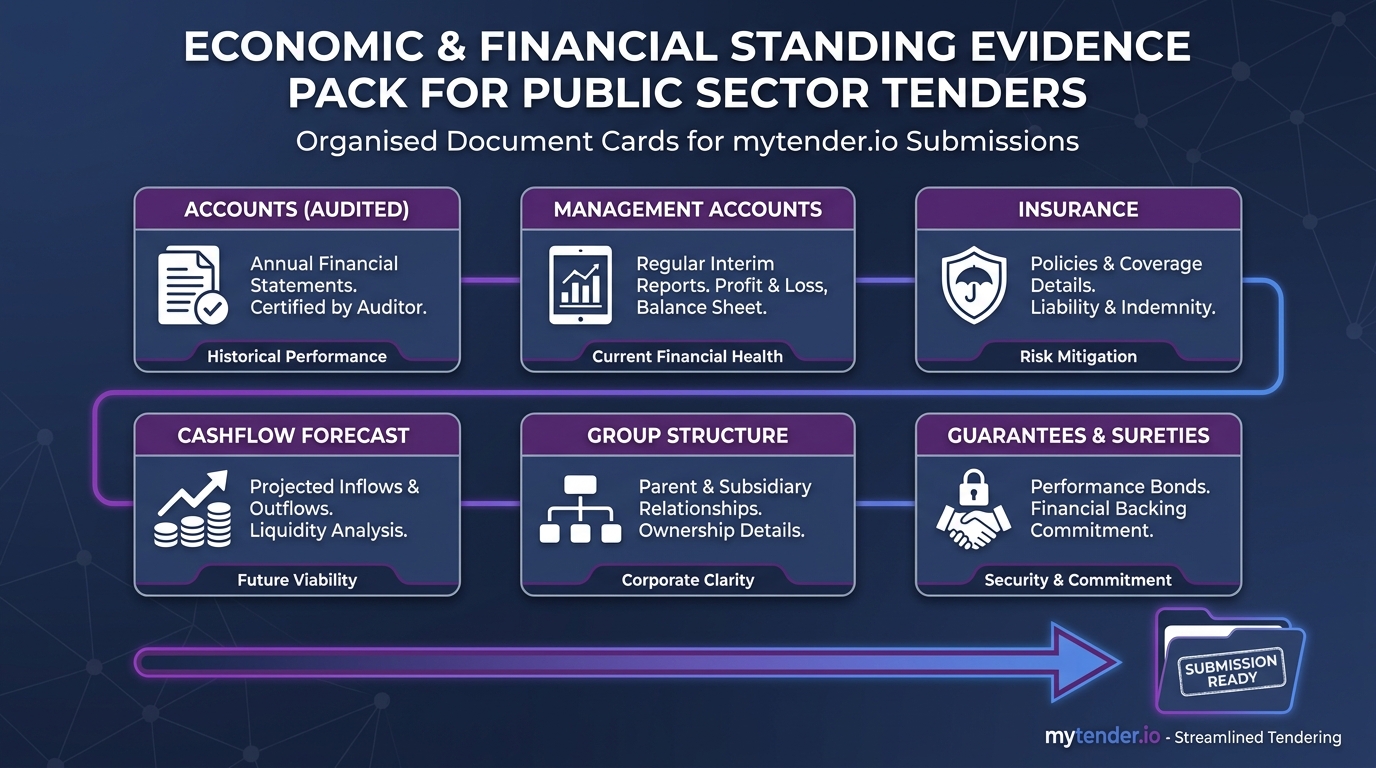
Economic and financial standing evidence pack showing accounts, ratios, cashflow, insurance and supporting explanations
What Buyers Usually Ask For
EFS requirements vary by buyer and contract risk, but the same evidence appears again and again.
Accounts
Most tenders ask for two or three years of audited accounts, filed accounts, management accounts or equivalent financial statements.
If you are a newer business, they may ask for alternative evidence. That might include bank references, investor backing, management accounts, parent company support or a statement from your accountant.
Do not leave this until the deadline week. If the latest accounts are not filed, if the trading position has changed, or if the group structure is messy, you need time to prepare the explanation.
Turnover
Some buyers set a minimum annual turnover threshold. Others compare contract value with turnover as part of a wider risk assessment.
A common red flag is a contract that represents a large share of your annual revenue. That does not automatically mean you fail. It does mean the buyer may want comfort that you can absorb the scale.
The wrong answer is: "We are confident we can deliver."
The better answer explains the operating model. For example, you might show that the contract is delivered through existing infrastructure, that mobilisation spend is modest, that subcontractor exposure is controlled, or that the contract ramps up in phases rather than landing all at once.
Liquidity
Buyers may look at cash, current assets, current liabilities and short-term funding pressure.
They are asking whether you can survive the timing gap between cost and payment. That matters most in labour-intensive contracts, construction, facilities management, security, cleaning, waste, social care, transport and maintenance.
If your liquidity is tight, explain the controls. Cashflow forecasting, committed facilities, staged mobilisation, supplier payment terms and parent support can all help. Vague reassurance will not.
Profitability
One weak year is not always fatal. Many healthy businesses have unusual years because of investment, restructuring, acquisitions, delayed work or one-off costs.
But unexplained losses worry buyers.
If there is a dip in profitability, give context. Keep it factual. Do not sound defensive. Explain what happened, what changed, and why the contract being tendered is still safe.
Insurance
Insurance is often bundled into financial standing, even though it is not the same thing.
Check the required levels early. Public liability, employers' liability, professional indemnity, cyber insurance, product liability and motor cover all come up depending on the sector.
If you need to increase cover on award, say so only if the tender allows it. Some buyers accept a broker letter confirming that cover can be arranged. Others require cover already in place at submission.
Parent Company Guarantees and Bonds
For higher risk contracts, buyers may ask for a parent company guarantee, performance bond or other security.
This is not just legal admin. It affects commercial risk.
A guarantee can make a bid viable where the trading company alone looks too small. It can also create group-level exposure that needs senior approval before submission.
Do not discover that requirement on the final review call.
The Red Flags That Need an Explanation
Most EFS problems are not caused by a single bad number. They are caused by a bad number with no explanation.
Here are the red flags to prepare for.
Turnover Looks Low Against Contract Value
If the contract value is high relative to turnover, explain why delivery is still manageable.
Useful evidence includes:
- Existing contracts of similar operational scale
- A phased mobilisation plan
- Confirmed subcontractor capacity
- Low capital expenditure requirements
- Framework or lot structure that limits actual annual exposure
- Management accounts showing growth since the last filed accounts
Do not overclaim. If the contract would genuinely stretch the business, say how you will control that stretch.
Recent Losses
A loss-making year is not the end of the world. An unexplained loss-making year is a problem.
Give the buyer a clean commercial explanation. Was it caused by investment? A discontinued division? Exceptional legal costs? A delayed contract start? A one-off bad debt? A planned restructuring?
Then explain what has changed.
The buyer wants to know whether the issue is historic or still active.
Thin Cash Reserves
If cash reserves are thin, the buyer will worry about mobilisation and payment timing.
This is where your cashflow evidence matters. Show that you understand the funding requirement of the contract. Reference available facilities if appropriate. Explain how mobilisation costs will be staged. If the contract has payment in arrears, show that your model accounts for it.
The aim is not to pretend cashflow risk does not exist. The aim is to show you manage it deliberately.
Fast Growth
Fast growth can look positive to sales teams and risky to buyers.
A business that doubles revenue quickly may also stretch management capacity, working capital, systems and quality control.
If you are growing fast, explain the operating controls that make growth safe: finance oversight, governance, contract review boards, recruitment plans, delivery assurance, quality checks and senior account management.
Group Complexity
Group structures confuse tenders more often than they should.
If the bidding entity is not the main trading company, or the accounts sit at parent level, explain the relationship in plain English. Who signs the contract? Who employs the staff? Who owns the assets? Who provides financial support if needed?
Do not make evaluators piece it together from Companies House.
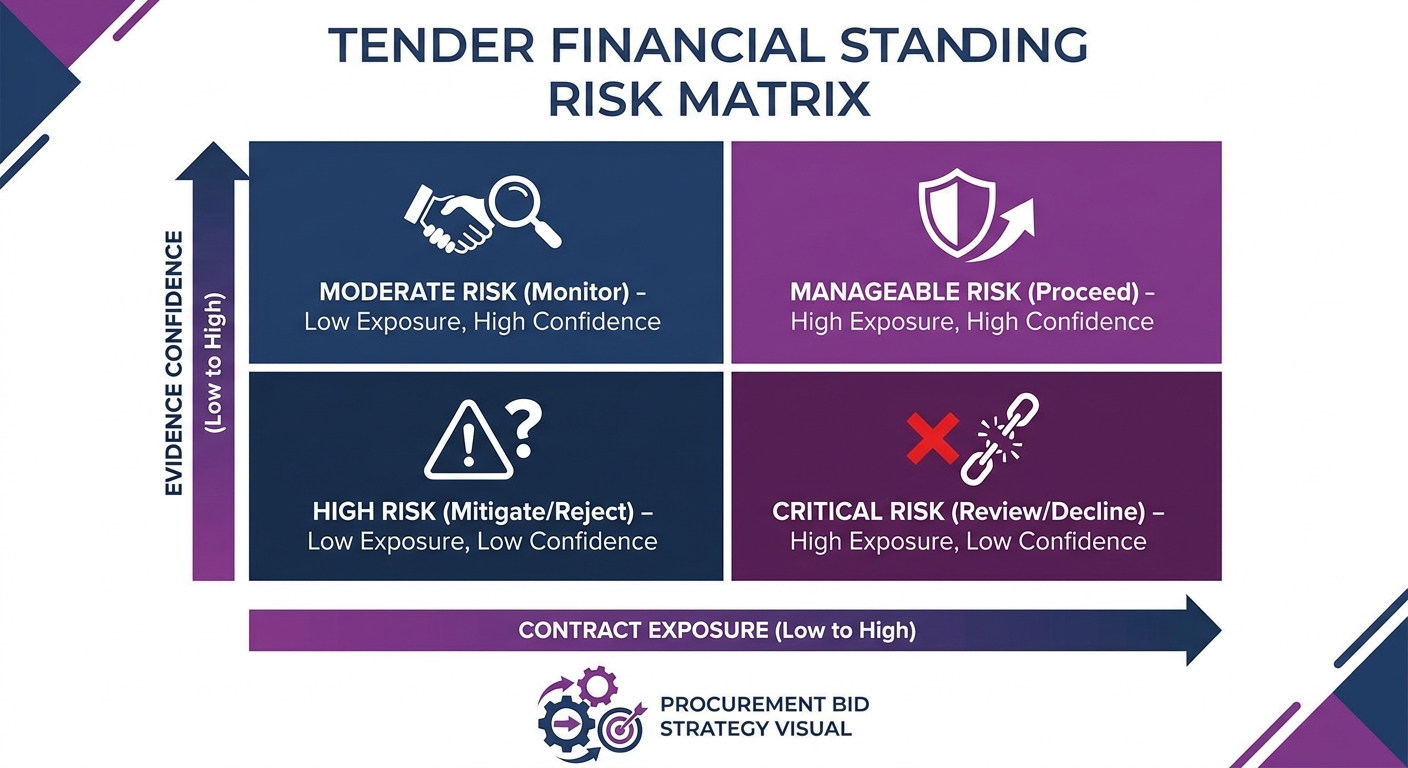
Risk matrix for matching tender contract value, mobilisation exposure and financial standing evidence
Build an EFS Risk Matrix Before Bid No-Bid
EFS should be part of the bid no-bid decision. Not an afterthought.
Use a simple matrix with two axes:
- Contract exposure: how much cash, delivery capacity and balance sheet strength the contract needs
- Evidence confidence: how easily your accounts and supporting documents prove you can carry it
That gives four outcomes.
Low Exposure, High Evidence Confidence
Bid normally. Keep the evidence tidy, but EFS should not drive the decision.
These are usually smaller contracts, renewals, call-offs, low mobilisation services or work that sits inside your existing delivery model.
High Exposure, High Evidence Confidence
This is often worth bidding.
The contract may be large, but your evidence is strong. You have similar contracts, enough liquidity, a credible mobilisation model and clean accounts.
Still, run a cashflow stress test. A contract can pass EFS and still create a working capital squeeze.
Low Exposure, Low Evidence Confidence
This is frustrating but fixable.
The contract itself may not be risky, but the paperwork does not prove your position clearly. Maybe accounts are old. Maybe the trading entity is new. Maybe the tender asks for turnover in a way that does not fit your group structure.
Do not abandon these bids too quickly. Prepare the explanation and ask a clarification question if the tender allows it.
High Exposure, Low Evidence Confidence
This is the danger quadrant.
You may still bid, but only with senior approval and a plan. That plan might include a parent guarantee, staged mobilisation, a joint venture, reduced lot selection, subcontractor structure, revised payment assumptions or a decision not to bid.
Walking away from the wrong contract is not a failure. It is one of the few bid decisions that saves money immediately.
How to Write the Financial Standing Response
The best EFS responses are calm, specific and boring in a good way.
They do not sound like marketing. They do not bury the buyer in finance jargon. They answer the concern directly.
Start With the Headline
Open with a plain statement of capacity.
For example:
> We have reviewed the financial requirements of this contract against our latest filed accounts, current management accounts and mobilisation cashflow forecast. We are satisfied that the contract is within our financial capacity, including the mobilisation period and the expected payment profile.
Then support it.
Link Evidence to Contract Risk
Do not just list documents. Explain why they matter.
A weak response says:
> Please see attached accounts and insurance certificates.
A stronger response says:
> The attached accounts show a stable trading position over the last three financial years. The proposed contract represents approximately 8% of current annual turnover and will be delivered through our existing regional team, with no major capital purchase required before service commencement.
That is much more useful to the evaluator.
Explain Exceptions Before They Become Concerns
If there is an obvious issue, address it.
You do not need to over-share. You do need to avoid looking evasive.
For example:
> The reduction in operating profit in FY2025 was caused by the closure of a non-core service line and associated one-off costs. That activity has now ceased. Current management accounts for FY2026 show trading has returned to normal levels, and the proposed contract will be delivered by the core division that remained profitable throughout the period.
That kind of paragraph can rescue a bid that would otherwise raise questions.
Keep the Tone Factual
Avoid phrases like "we are financially robust" unless the evidence makes it obvious.
Use numbers, ratios, contract percentages and practical controls. Buyers trust evidence more than adjectives.
What to Prepare Before the Tender Lands
The best time to prepare EFS evidence is not during a live bid.
Create a standing pack and update it quarterly.
Include:
- Latest filed accounts
- Latest management accounts
- Insurance certificates
- Broker letter, if increased cover can be arranged on award
- Group structure chart
- Parent company support statement, if relevant
- Standard explanation of any historic one-off financial events
- Cashflow model template for mobilisation-heavy contracts
- Contract value versus turnover calculator
- List of comparable contracts by size and mobilisation profile
- Approval route for guarantees, bonds and unusual payment terms
This pack saves time. More importantly, it stops rushed finance explanations from being written at 11pm by someone who should be polishing the quality response.
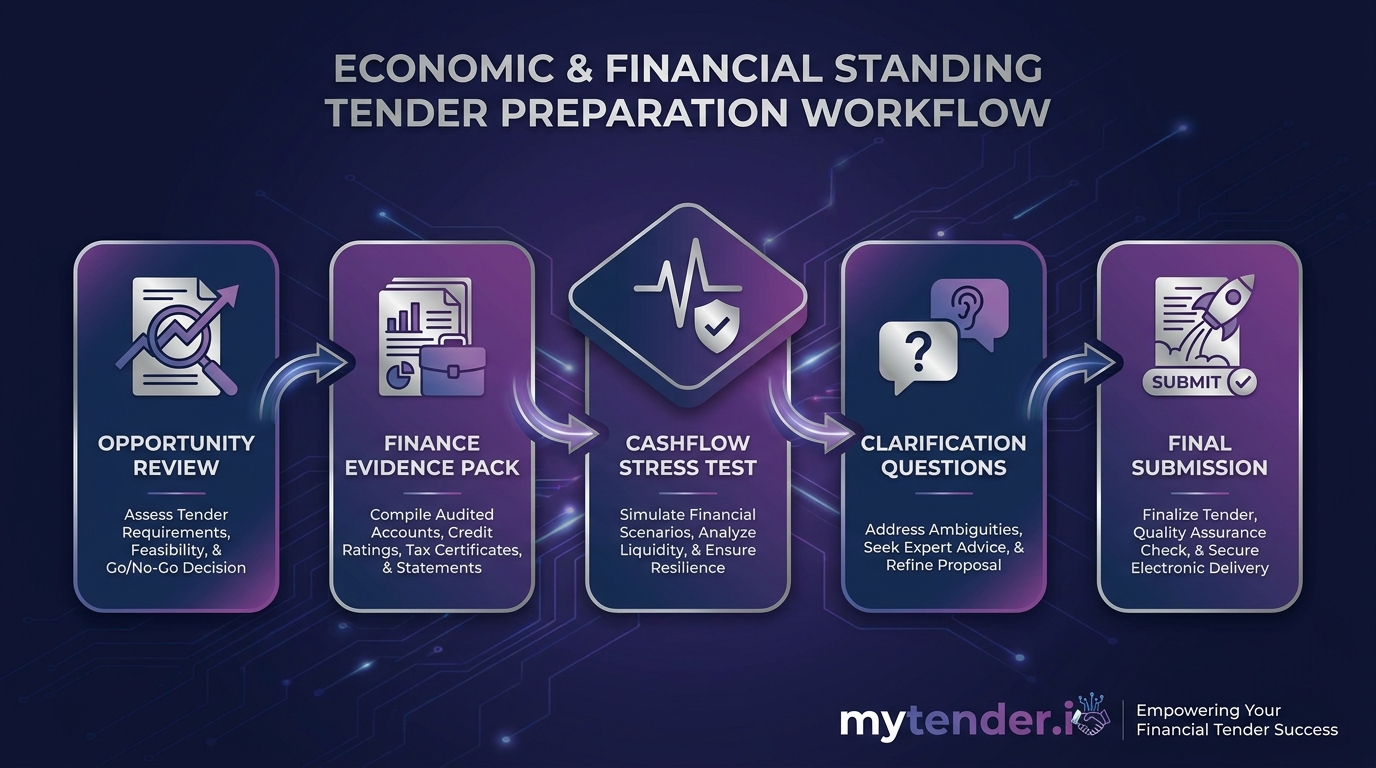
EFS preparation workflow from opportunity review to clarification, evidence pack, cashflow test and final submission
The Clarification Questions Worth Asking
Suppliers often avoid clarification questions because they worry about looking weak.
That is usually the wrong instinct.
A good clarification question can protect your bid. It can also reveal whether the buyer is applying the requirement sensibly.
Useful questions include:
- Will the authority accept management accounts where the latest filed accounts do not reflect current trading?
- Can turnover be assessed at group level if a parent guarantee is provided?
- Is the minimum turnover requirement applied to the lot value, total framework value or expected annual spend?
- Will a broker letter be accepted where insurance limits will be increased on contract award?
- Are parent company guarantees required at submission or only before contract signature?
- How will the authority assess newly formed entities, joint ventures or special purpose vehicles?
Ask early. A clarification answer two days before deadline is rarely useful.
EFS for SMEs: How to Avoid Being Marked Out Too Early
SMEs are often the suppliers most affected by EFS checks.
That is not because they cannot deliver. Many can. The problem is that smaller businesses often have thinner paperwork, shorter trading histories, lower turnover against contract value, and less spare finance capacity than larger competitors.
The way to handle this is not to apologise for being small. It is to make the delivery risk easy to understand.
For SMEs, the strongest evidence usually comes from:
- Similar contracts delivered successfully
- Named operational leads with relevant experience
- Phased mobilisation plans
- Low overhead delivery models
- Confirmed supplier and subcontractor arrangements
- Clear cashflow forecasting
- Accountant or bank letters where allowed
- Parent, investor or director support where appropriate
If a tender sets a turnover threshold that feels disproportionate, use the clarification process. Public procurement policy is meant to reduce unnecessary barriers for SMEs. Buyers still need assurance, but they should not create arbitrary hurdles that exclude capable suppliers for no good reason.
How EFS Links to Your Quality Score
EFS may sit in the selection stage, but it affects the quality response too.
A buyer who is worried about financial capacity will read the rest of your bid through that lens.
If your mobilisation plan sounds expensive and vague, the financial concern grows. If your risk register ignores working capital, the concern grows. If your supply chain plan depends on subcontractors but never explains payment discipline, the concern grows.
A strong bid does the opposite.
It shows that the contract is financially controlled through:
- Realistic mobilisation phasing
- Clear governance
- Named finance ownership
- Supplier payment controls
- Early warning triggers
- Contract review meetings
- KPI reporting that connects performance and commercial risk
This is not finance filler. It is delivery assurance.
Common Mistakes That Cost Suppliers
Uploading Accounts Without Commentary
Accounts are evidence, not explanation.
If the numbers are obvious and strong, brief commentary is enough. If there is anything unusual, explain it before the buyer has to guess.
Ignoring the Bidding Entity
If the contract is with one company but the accounts belong to another, clarify the legal and financial relationship.
This is especially important for groups, subsidiaries, newly formed entities and joint ventures.
Forgetting Working Capital
Profit is not cash.
A profitable contract can still hurt if you fund wages, materials and mobilisation costs before payment arrives. Your bid model should test the cash gap, not just the margin.
Over-Bidding the Wrong Lot
On frameworks and multi-lot tenders, ambition can become a problem.
If your EFS evidence comfortably supports one region but looks stretched across five, choose the lot strategy that matches your financial capacity. A focused win is better than a broad rejection.
Leaving Guarantees Too Late
Parent guarantees and bonds need internal approval. Sometimes they need board approval. If legal and finance see them after the submission draft is finished, you have created a deadline problem for no reason.
A Practical EFS Checklist
Before you approve the bid, answer these questions.
Contract exposure- What is the estimated annual contract value?
- What percentage of turnover does it represent?
- What cash leaves the business before first payment?
- What happens if the first invoice is delayed by 30 days?
- Are subcontractors paid before we are paid?
- Do our latest accounts support the contract value?
- Do management accounts tell a better or more current story?
- Are there losses, low cash reserves or major changes to explain?
- Do we need group support, a guarantee or a bond?
- Are insurance levels already in place or confirmed by a broker?
- Should we bid all lots or focus on fewer?
- Does the mobilisation plan match the cashflow model?
- Have we asked clarification questions early enough?
- Does the risk register mention financial delivery risk?
- Has finance approved the final commercial position?
Where mytender.io Fits
A lot of EFS failure is not really finance failure. It is information failure.
The accounts exist. The insurance exists. The case studies exist. The explanation of last year's one-off cost exists somewhere in an email from finance. But when the tender lands, the bid team cannot find the right evidence quickly enough.
That is where a structured bid library helps. If your financial standing statements, insurance documents, mobilisation assumptions, risk language and approved explanations are stored properly, you are not rebuilding the same section every time.
Tools like mytender.io are useful because they connect live tender requirements to your approved evidence. The point is not to make financial judgement automatic. The point is to stop good evidence going missing under deadline pressure.
The Bottom Line
Economic and financial standing is not a box-tick. It is the buyer asking whether your business can carry the contract you want to win.
Treat it early and it becomes manageable. Treat it late and it becomes a nasty surprise.
The best suppliers do three things well. They understand the financial exposure of the contract. They prepare evidence before the tender arrives. And they explain risk calmly, with numbers, rather than hoping the buyer will not notice.
That is how you pass the check without sounding defensive.
If you want to see live public sector opportunities that match your sector and bid capacity, try the Tender Finder. It is a useful way to spot tenders early enough to run the financial checks properly, before the deadline starts breathing down your neck.
Tags
Ready to Transform Your Tender Writing?
See how MyTender's AI can help you write winning tenders in a fraction of the time.