
IT Tender Writing Guide 2026: Win Public Sector IT Contracts
Master IT and technology services tender writing with proven strategies for software development, cloud services, cybersecurity, and managed IT contracts. Expert guidance on technical evaluation criteria, compliance requirements, and winning strategies.
mytender.io Research Team
Technology Procurement Specialists
IT & Technology Services Tender Writing Guide 2026: Win More Contracts
The UK public sector spends over £22 billion annually on IT and technology services, with local authorities, NHS trusts, police forces, and central government departments all relying on external IT providers. Yet IT service tenders have notoriously low win rates—averaging just 11% compared to 22% across all sectors. The primary reason? Buyers struggle to differentiate between technically competent bidders, so evaluation focuses heavily on risk reduction, proven delivery capability, and compliance credentials that many IT companies fail to evidence effectively.
For the fundamentals that apply in every sector, see our bid writing guide, how to respond to an invitation to tender and how to write a method statement.
This comprehensive guide reveals the strategies that separate winning IT and technology bids from technically excellent proposals that score poorly. We've analyzed 1,247 successful tender submissions across managed IT services, software development, cloud migration, cybersecurity, and digital transformation projects to identify what actually wins contracts in 2026.
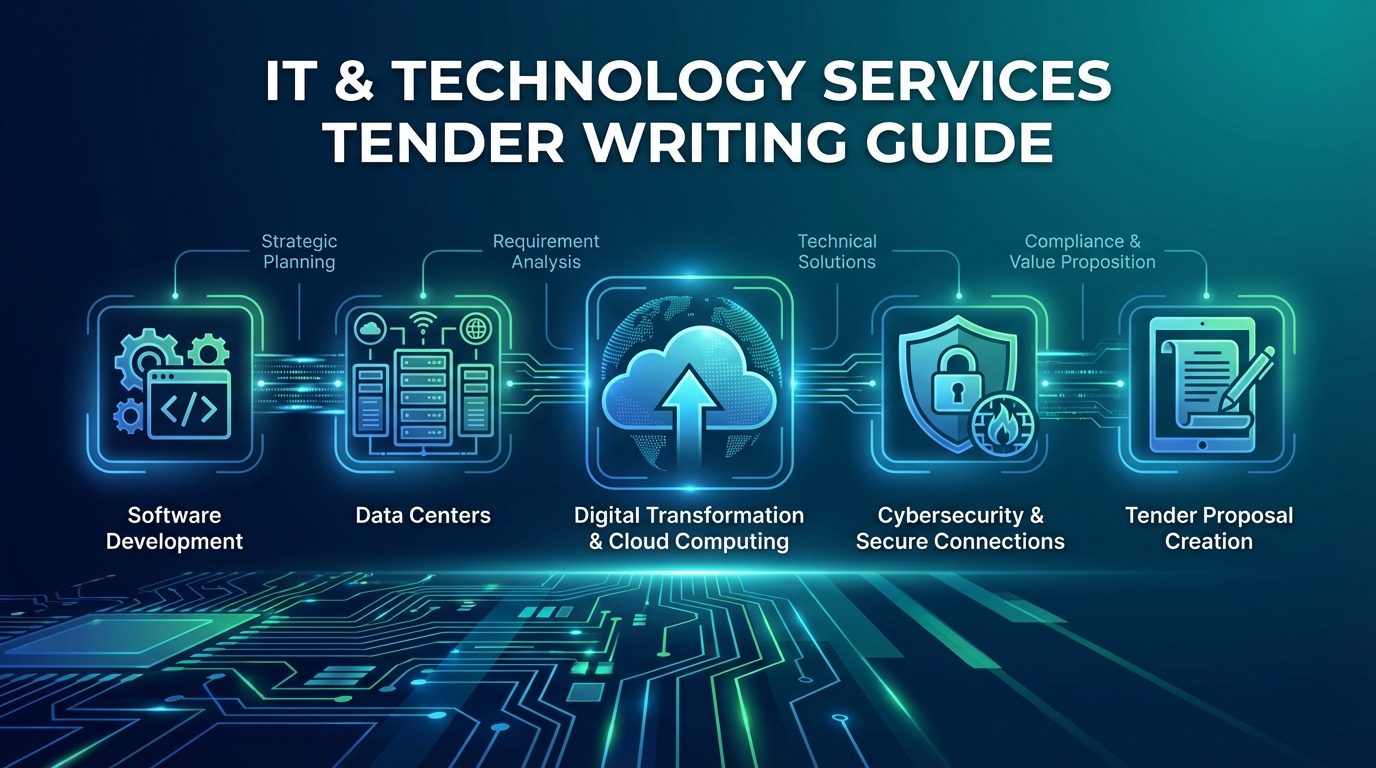
IT Technology Tender Writing Guide 2026
Understanding the IT Procurement Landscape
Technology procurement differs fundamentally from other service contracts. Buyers aren't just purchasing a service—they're entrusting you with business-critical systems, sensitive data, and operational continuity. A single cybersecurity incident or system failure can have catastrophic consequences, making risk mitigation the primary evaluation criterion in most IT tenders.
The sector divides into six main contract types, each with distinct evaluation priorities and technical requirements: Managed IT services contracts (helpdesk, infrastructure management, end-user support) typically weight quality at 70-80% of total evaluation. Buyers prioritize service continuity, user satisfaction, and proactive problem prevention over lowest cost. These contracts increasingly include service transformation requirements—buyers don't just want you to run their existing systems, they expect continuous improvement and modernization recommendations. Software development and system integration projects focus on delivery methodology, team capability, and change management expertise. Agile development approaches are now standard, with buyers expecting iterative delivery rather than traditional waterfall projects. Demonstration of user-centered design thinking, DevOps capability, and modern development practices matters more than years in business or company size. Cloud services and migration contracts evaluate cloud platform expertise (AWS, Azure, Google Cloud), security credentials, and experience with similar migrations. Public sector buyers particularly scrutinize data sovereignty, compliance with government cloud standards, and vendor lock-in avoidance. Simply having cloud certifications isn't enough—buyers want evidence of successful migrations from legacy systems with minimal business disruption. Cybersecurity services (penetration testing, security monitoring, incident response) demand the highest levels of technical credibility. Buyers expect recognized certifications (CREST, Cyber Essentials Plus, ISO 27001), demonstrated expertise in specific technologies, and evidence of handling real security incidents. Win rates for uncertified companies attempting to enter this market are below 3%. Digital transformation and consultancy projects evaluate strategic thinking, change management expertise, and business outcome focus over technical skills. Buyers want evidence you understand their organization and sector, not just technology. Generic digital transformation proposals score poorly—winning bids demonstrate specific understanding of the buyer's challenges and opportunities. Data center and hosting services contracts focus on resilience, uptime guarantees, disaster recovery capabilities, and physical security. Site visits form part of many evaluation processes—your facilities and operational practices matter as much as your proposal content. Buyers increasingly prefer UK-based data centers due to data sovereignty concerns and carbon footprint considerations.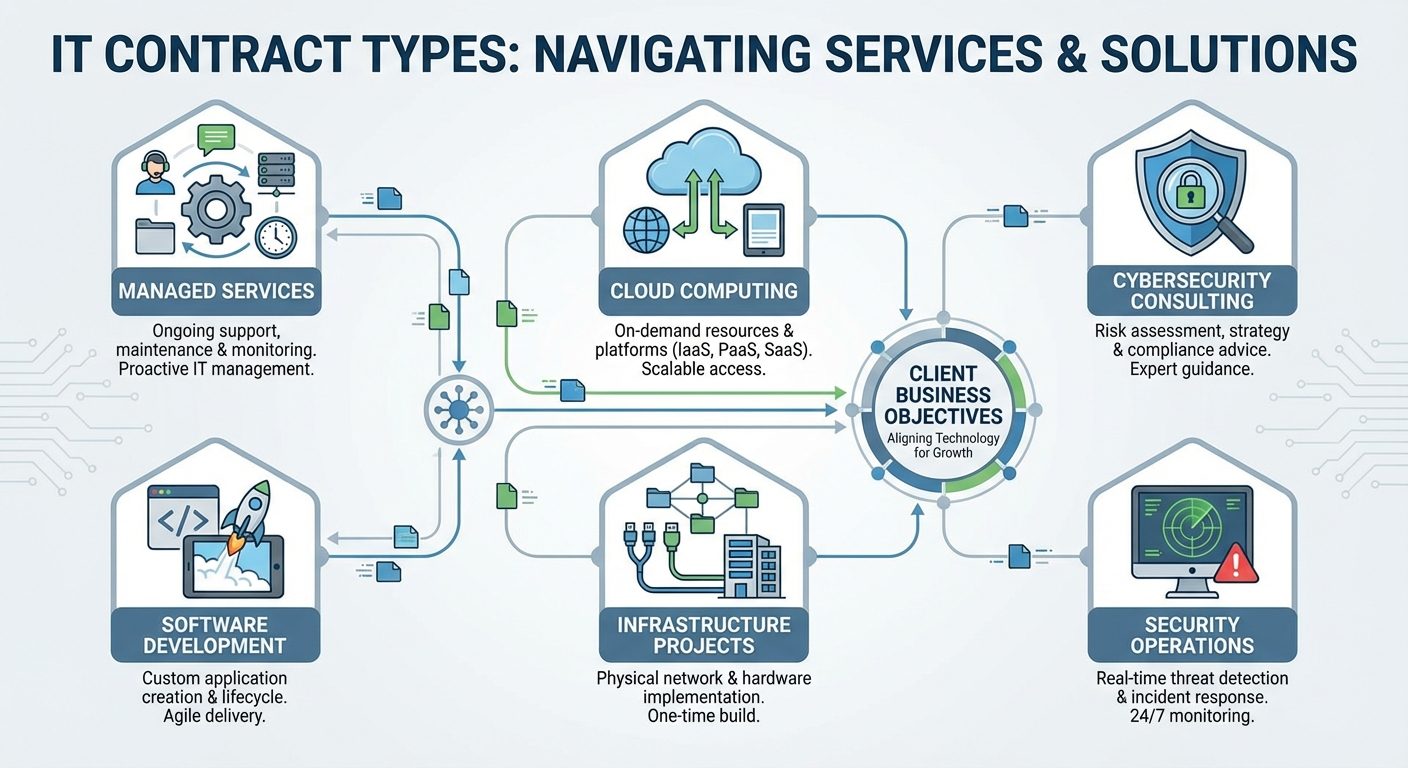
IT Contract Types and Evaluation Criteria
The Critical Compliance and Certification Framework
IT tenders include numerous mandatory requirements that lead to automatic disqualification if not met. Understanding and evidencing these credentials is prerequisite to competing effectively.
Information Security Certifications
ISO 27001 certification has evolved from competitive advantage to baseline expectation for most IT service contracts above £100k annually. Buyers don't just want to see your certificate—they want evidence of active information security management relevant to their requirements. What buyers look for: Current ISO 27001 certificate covering relevant operational locations and service lines. Evidence that your ISMS (Information Security Management System) scope includes the services being tendered. Recent internal audit reports demonstrating active security management. Specific security controls relevant to the contract—encryption, access controls, incident management, business continuity. Common failures: Providing expired certificates or certificates that don't cover the relevant service line. Parent company ISO 27001 when you're a subsidiary without certified operations. No evidence of security controls beyond holding the certificate. Failing to address contract-specific security requirements because "we're ISO 27001 certified" without explaining how that addresses specific risks. Winning approach: Provide your current certificate as an appendix with highlighted scope. Map your ISO 27001 controls to specific tender requirements—for example, "Our access control policy (ISO 27001 A.9) requires multi-factor authentication for all remote access, addressing your requirement in section 4.3." Include examples of how your ISMS operates in practice: incident response procedures, backup verification results, access review evidence. For contracts involving sensitive data, offer security audits as contract deliverables.Cyber Security Credentials
Cyber Essentials Plus is increasingly mandatory for government contracts involving personal data or connection to government networks. Basic Cyber Essentials (self-certified) no longer suffices—buyers require the Plus certification with external verification. What buyers look for: Current Cyber Essentials Plus certificate issued within the last 12 months. Evidence that certified configuration matches systems used for contract delivery. Understanding of technical controls and ability to maintain them throughout contract duration. For higher-risk contracts, additional certifications like CREST, CHECK, or NCSC Assured Service Provider status. Common failures: Providing basic Cyber Essentials when Plus is specified. Certificates covering office IT but not systems used for service delivery. Expired certificates with "renewal in progress" excuses. No evidence that staff understand or maintain the certified controls. Failing to address gaps between certified baseline and contract-specific security requirements. Winning approach: Provide current certificate with scope clearly documented. If tendering for services requiring higher security levels than your baseline certification, explain additional controls you'll implement—for example, "Our Cyber Essentials Plus baseline will be enhanced for this contract with intrusion detection systems monitoring all network traffic, as specified in your security requirements annex." For red team / penetration testing contracts, evidence CREST certification and team qualifications. Demonstrate security is embedded in operations, not just a compliance exercise.Data Protection and GDPR Compliance
All IT service contracts involve personal data processing, making GDPR compliance evaluation mandatory. Buyers increasingly impose substantial contract penalties for data breaches—demonstrating robust data protection practices is essential.
What buyers look for: Designated Data Protection Officer (DPO) or equivalent privacy expertise. Data Protection Impact Assessment (DPIA) process demonstrating you identify and mitigate privacy risks. Data processing agreement (DPA) that meets buyer's requirements. Evidence of staff training in data protection. Transparent breach notification procedures. Track record of data protection compliance—no serious breaches or ICO enforcement actions. Common failures: Generic statements about GDPR compliance without specific evidence. Failing to identify yourself as data processor vs joint controller when contract terms clearly indicate processor relationship. No evidence of privacy-by-design in service delivery. Copy-pasted DPIAs not specific to the contract. Claiming you're not processing personal data when clearly you are (e.g., managing user accounts, accessing client systems, handling support tickets). Winning approach: Include a draft data processing agreement tailored to the contract, demonstrating you understand your role and obligations. Describe your privacy-by-design approach with contract-specific examples—for example, "User authentication data will be encrypted in transit and at rest, access logs will be retained for 90 days as required by your retention policy, and access will be restricted to named administrators with two-person authorization for privileged operations." Evidence staff awareness through training records and privacy incident handling procedures. Be transparent about sub-processors if using third-party tools or infrastructure—buyers need to understand the full data processing chain.Cloud Security and Government Standards
Public sector cloud services require compliance with government security standards and frameworks that commercial providers may not encounter elsewhere.
G-Cloud framework compliance opens access to public sector customers through the Digital Marketplace. Achieving G-Cloud supplier status demonstrates you meet baseline government security and commercial requirements, though it doesn't guarantee tender success. What buyers look for: G-Cloud listing (if applicable to service). Understanding of Cloud Security Principles and how your service addresses each principle. Evidence of data residency in UK (or acceptable jurisdiction). Compliance with relevant security classifications—OFFICIAL, OFFICIAL-SENSITIVE, SECRET (most contracts are OFFICIAL or OFFICIAL-SENSITIVE). Understanding of shared responsibility model in cloud security. Common failures: Assuming G-Cloud listing alone is sufficient without addressing specific security requirements. Hosting data outside UK without acknowledging data sovereignty implications or obtaining approval. Failing to distinguish between your security responsibilities and underlying cloud platform security. Not addressing data sovereignty for sub-processors (e.g., using US-based SaaS tools for contract delivery without acknowledging CLOUD Act implications). Winning approach: Map your service to Cloud Security Principles with specific technical controls for each principle. For example, "Data sovereignty (Principle 2): All customer data stored in AWS eu-west-2 (London) region with replication to eu-west-1 (Ireland) for resilience. Data protection (Principle 4): Encryption at rest using AES-256, encryption in transit using TLS 1.3, key management using AWS KMS with customer-managed keys." Address concerns proactively—if using non-UK sub-processors, explain what data they access and legal safeguards. Demonstrate understanding that buyer remains ultimately accountable for data security regardless of cloud provider.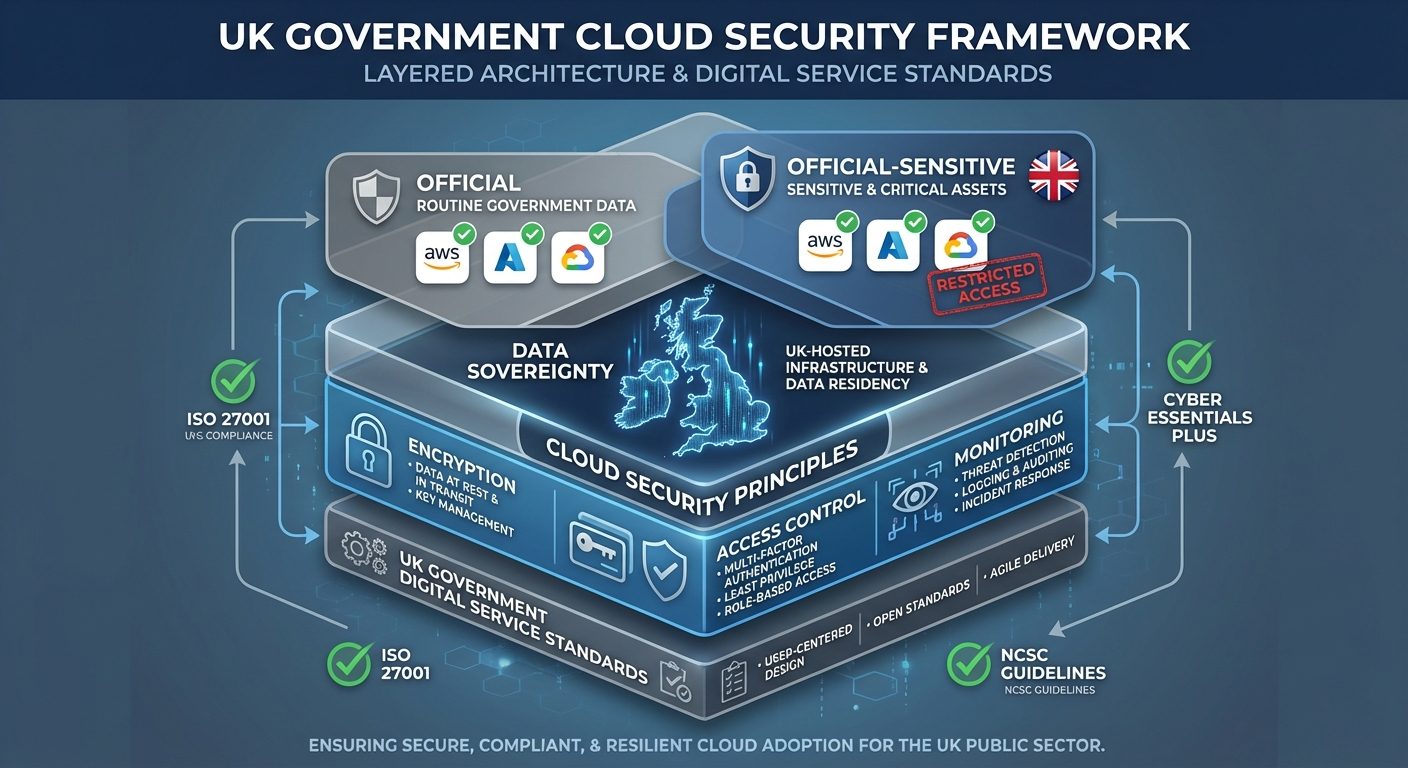
Government Cloud Security Framework
Technical Evaluation Criteria
Beyond compliance credentials, IT tenders evaluate technical capability and delivery approach. Understanding how buyers assess technical competence allows you to structure responses for maximum impact.
Technical Architecture and Design
Buyers want confidence that your proposed technical solution is sound, scalable, and aligned with their strategic direction. Technical architecture responses often carry 30-40% of quality evaluation weighting.
What buyers look for: Clear, understandable technical diagrams showing system components, data flows, and integration points. Alignment with buyer's existing technology stack and strategic architecture direction. Scalability and resilience design—how the solution handles growth and failure scenarios. Security built into architecture, not bolted on. Consideration of non-functional requirements: performance, maintainability, supportability. Common failures: Overly complex technical diagrams that confuse rather than clarify. Proposing technology stacks that conflict with buyer's strategic direction (e.g., .NET solution when buyer is standardizing on open source). Generic architecture diagrams reused from other bids without customization. No consideration of integration with existing systems. Ignoring non-functional requirements or addressing them superficially. Technical architecture designed for your convenience rather than buyer's needs (e.g., proposing infrastructure that locks buyer into your services). Winning approach: Start with clear context: "Your current environment includes [specific systems from tender documentation]. Our proposed architecture integrates with these systems while providing a migration path toward your stated goal of cloud-native architecture." Use layered diagrams: high-level overview for senior stakeholders, detailed component diagrams for technical evaluators. Annotate diagrams to explain key design decisions—why specific technologies were chosen, how design addresses requirements, what alternatives were considered. Include failure mode analysis: "If component X fails, service continues with degraded performance as component Y takes over, with automatic alerting to support team."Service Delivery Methodology
How you'll deliver the service matters as much as what you'll deliver. Methodology responses typically carry 20-30% of quality evaluation, with strong emphasis on risk mitigation and stakeholder management.
What buyers look for: Clear delivery phases with specific milestones and decision points. Realistic timelines that acknowledge complexity and dependencies. Risk identification and mitigation strategies specific to this contract. Stakeholder engagement and change management approach. Quality assurance processes with objective acceptance criteria. Agile delivery methodology (for software development contracts) with clarity about how you'll adapt agile practices to procurement constraints. Common failures: Generic project methodology diagrams reused across all bids. Unrealistic timelines that ignore dependencies or assume perfect conditions. No acknowledgment of risks or challenges. Methodology designed around your internal processes rather than buyer's needs and constraints. Agile fundamentalism that ignores legitimate procurement governance requirements. No consideration of business-as-usual service continuity during implementation or migration. Winning approach: Tailor methodology to contract specifics: "Phase 1 (Weeks 1-4): Discovery and detailed design with your technical team and user representatives. Key milestone: Signed-off detailed design document including security review. Phase 2 (Weeks 5-12): Iterative development with fortnightly demonstrations to stakeholder group. Key milestone: User acceptance testing with representative user group. Phase 3 (Weeks 13-16): Deployment planning, training delivery, and controlled roll-out. Key milestone: Production deployment with hypersupport period." Identify realistic risks: "Risk: Dependencies on third-party suppliers for API access. Mitigation: Early engagement with suppliers, fallback option using web scraping if APIs unavailable, additional contingency time in schedule." Show you understand buyer's environment and constraints: "We recognize you have limited internal technical resource, so our approach minimizes demands on your team while ensuring appropriate oversight and knowledge transfer."Team Capability and Key Personnel
IT buyers recognize that capability resides in people, not companies. Key personnel responses often carry 15-25% of quality evaluation weighting, with unsuccessful bids frequently citing weak team capability as a key differentiator.
What buyers look for: Named individuals (not generic role descriptions) with CVs demonstrating relevant experience. Evidence of team continuity—not a dream team assembled for the bid who'll disappear post-contract. Appropriate seniority and experience for contract scale and complexity. Balance of technical skills, domain expertise, and communication capability. Credible resource commitment—buyers know your star architect can't be assigned full-time to five simultaneous contracts. Common failures: Generic role descriptions without named individuals. CVs that don't match contract requirements—listing years of experience but not in relevant technologies or sectors. Proposing overly senior team members for straightforward contracts (buyers know they'll be replaced with juniors post-award). No evidence of team stability or low day rates that imply junior staff despite claiming senior expertise. Proposing same key person for multiple key roles without explaining how they'll manage time allocation. Winning approach: Provide named CVs for all key roles, highlighting specific experience relevant to this contract. Be honest about resource allocation: "Sarah Johnson (Lead Developer) will be allocated 60% time to this contract throughout development phase, reducing to 20% during maintenance phase for technical oversight and complex issue resolution. Day-to-day maintenance will be handled by David Chen (Support Engineer) at 100% allocation." Include continuity plans: "If key personnel become unavailable, replacement will be from our existing team with overlapping skills (CVs in Appendix C) and with at least 4 weeks handover period." Evidence team capability beyond CVs: certifications, publications, conference presentations, open-source contributions. For consultancy contracts, demonstrate domain expertise through thought leadership content, not just technical skills.Innovation and Added Value
Buyers increasingly evaluate innovation and added value beyond meeting baseline requirements. This criterion typically carries 10-15% of quality evaluation and can differentiate competent bids from winning bids.
What buyers look for: Improvements beyond specified requirements that deliver measurable benefits. Use of emerging technologies where genuinely beneficial (not buzzword dropping). Process improvements that reduce total cost of ownership or improve user experience. Knowledge transfer and capability building so buyer becomes less dependent on suppliers. Environmental sustainability considerations in technology choices. Common failures: Proposing innovation for its own sake without demonstrating benefits—"we'll use blockchain" without explaining why blockchain advantages matter for this use case. Over-committing to unproven technologies that increase risk. Innovation that benefits supplier more than buyer (e.g., "this will be a great reference case for us"). No consideration of buyer's appetite for innovation vs preference for proven, stable solutions. Added value that imposes costs or complexity buyer doesn't want. Winning approach: Frame innovation in terms of buyer benefits: "Our proposed infrastructure-as-code approach exceeds your requirement for documented configuration. Benefit: System recovery time reduced from estimated 4 hours to under 30 minutes. Deployment consistency improved, reducing configuration drift errors. Future infrastructure changes version-controlled and reviewable before deployment." Demonstrate understanding of innovation risk: "We propose a proof-of-concept phase for AI-powered user support automation before full deployment, allowing you to evaluate benefits without committing to unproven technology." Offer tangible added value: "We will deliver quarterly technology briefings for your IT team covering emerging security threats and mitigation strategies relevant to your environment. This supports your professional development objectives while ensuring your team remains informed about evolving risks."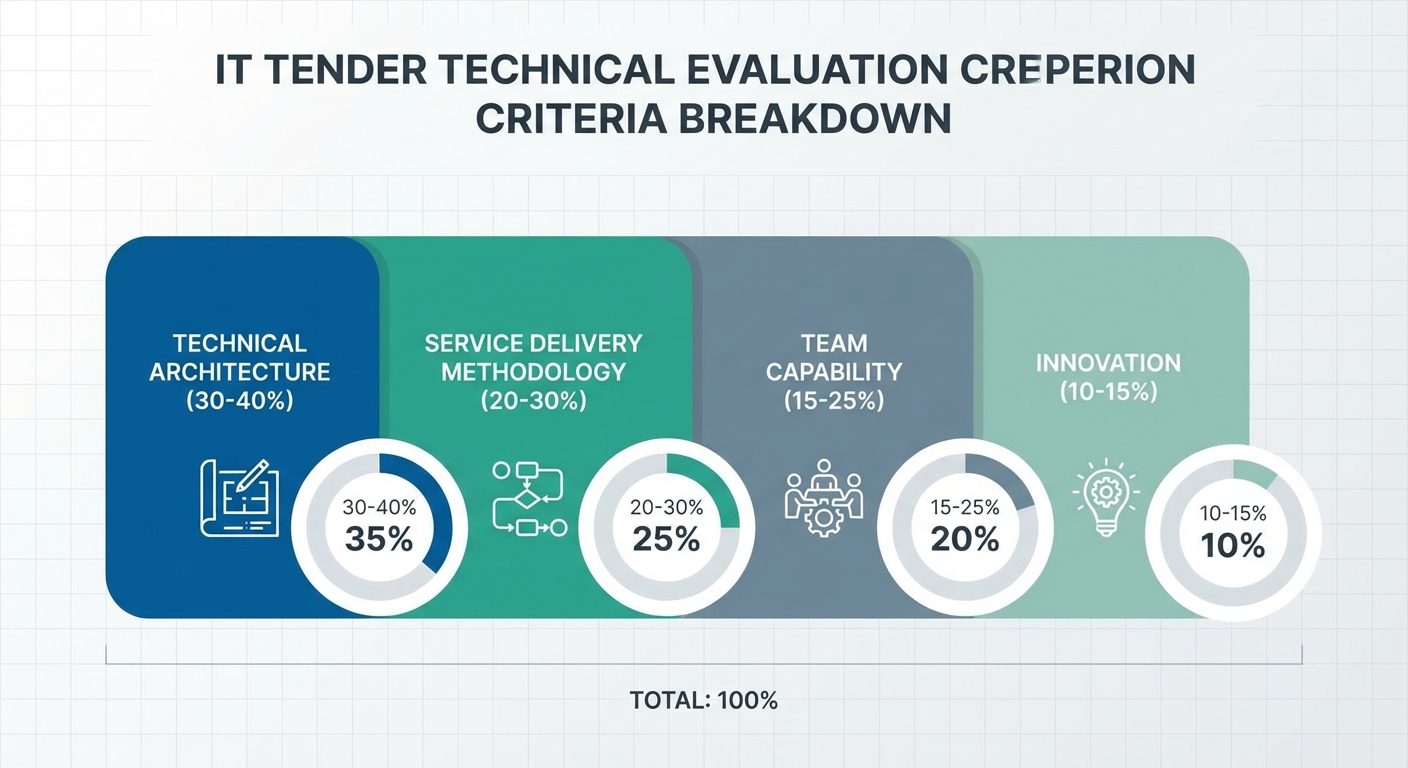
Technical Evaluation Criteria Breakdown
Sector-Specific Winning Strategies
Different IT contract types and buyer sectors prioritize different aspects of service delivery. Tailoring your approach to sector-specific requirements improves win rates substantially.
Local Authority IT Services
Local authorities operate with constrained budgets, limited internal IT expertise, and high public accountability. Understanding their unique context is essential for winning local government IT contracts.
Budget reality and value for money: Local authorities face intense budget pressures with IT often seen as a cost center rather than enabler. Demonstrating value for money requires more than competitive pricing—show how your solution reduces total cost of ownership through lower support requirements, reduced licensing costs, energy efficiency, or extending useful life of existing infrastructure. Limited internal technical resources: Unlike central government or large corporates, most local authorities have small IT teams juggling multiple responsibilities. Your service delivery approach must minimize demands on internal resources while ensuring appropriate oversight. Describe how you'll provide: comprehensive documentation that's actually readable by non-specialists, proactive monitoring and issue resolution before user impact, clear escalation procedures that don't require technical knowledge, regular reporting in business language rather than technical jargon. Public accountability and transparency: Local authority procurement decisions face public scrutiny. Buyers need to justify decisions to elected members, audit committees, and potentially local residents. Help them by: quantifying benefits in terms that matter to non-technical stakeholders (hours saved, service improvements, risk reduction), providing clear, jargon-free explanations of technical decisions, demonstrating value for money with cost comparisons to alternatives, evidencing social value through local employment, apprenticeships, or community programs. Digital inclusion considerations: Local authorities serve diverse populations including digitally excluded residents. Technology projects must consider accessibility and inclusion. Address this by: evidencing AA accessibility compliance as minimum (AAA where feasible), describing user-centered design approach with consideration for users with disabilities, users with low digital literacy, and users with limited internet access, offering training and support materials in accessible formats, demonstrating experience with digital inclusion initiatives.NHS and Healthcare IT
NHS IT procurement combines technical complexity with clinical safety requirements and intense operational pressures. Healthcare IT contracts demand specialized understanding of the NHS environment.
Clinical safety and DCB0129 compliance: Any software connecting to NHS systems or influencing clinical care requires clinical safety assessment under DCB0129 standard. Buyers expect suppliers to drive this process. Evidence your understanding by: describing your DCB0129 compliance process and hazard identification methodology, providing examples of previous clinical safety cases (anonymized if needed), naming your clinical safety officer and evidencing their qualifications, explaining how you'll engage with buyer's clinical safety officer and integrate with their clinical governance processes. Integration with NHS systems: NHS Trusts operate complex technology estates with patient administration systems, electronic health records, clinical systems, and emerging national platforms. Integration capability determines project success or failure. Demonstrate this through: specific experience with NHS integration standards (HL7 FHIR, IHE profiles), evidence of successful integrations with specific systems (with permission to name reference clients), realistic assessment of integration complexity—buyers respect honesty about challenges more than "it's straightforward" claims that prove false, description of integration testing approach including handling of edge cases and error conditions. Information Governance and Caldicott Principles: NHS organizations are custodians of highly sensitive patient data with strict information governance requirements beyond standard GDPR. Demonstrate your understanding through: mapping your data handling to Caldicott Principles (especially Principle 6: everyone's responsibility and Principle 7: the duty to share), describing how you'll support buyer's compliance with Data Security and Protection Toolkit, evidencing staff understanding of NHS information governance through training records, explaining how your security controls protect patient identifiable data from unauthorized access or disclosure. Operational pressures and 24/7 availability: NHS services operate continuously with zero tolerance for system downtime during critical periods. Your service delivery model must acknowledge operational reality. Address this through: understanding of NHS operational patterns (handover times, ward rounds, clinic sessions, emergency department peaks), service windows that accommodate 24/7 operations—don't propose "maintenance Tuesday nights 22:00-02:00" without checking that's compatible with operational requirements, out-of-hours support with realistic response times and escalation procedures, business continuity planning for your service that acknowledges clinical risk if systems fail.Central Government and Defense
Central government contracts involve highest security requirements, complex approval processes, and extensive governance. Understanding Cabinet Office procurement policies and government technology strategy is essential.
Security classifications and clearances: Government contracts increasingly require security-cleared personnel. Be honest about clearance capability: describe current cleared personnel and their clearance levels (SC, DV), explain recruitment process for cleared staff and realistic timescales (SC clearance takes 6-8 weeks, DV substantially longer), acknowledge limitations if you lack cleared staff—proposing a partnership with a cleared supplier is better than claiming capability you lack, for classified projects, evidence your facility clearance or approved premises arrangements. Technology Code of Practice compliance: Cabinet Office Technology Code of Practice sets standards for government technology projects. Demonstrate compliance by: mapping your proposal to Technology Code of Practice requirements (particularly points 2-4: design for user needs, reuse and share technology, understand value and service design), evidencing service design approach with user research, prototyping, and iterative development, describing how you'll support buyer's compliance with spending control requirements (particularly for cloud services), showing commitment to open standards and avoidance of vendor lock-in. Complex approval and governance: Government projects navigate approval boards, spending controls, and extensive governance. Your project approach must accommodate this reality: acknowledge governance requirements in project timelines—don't assume decisions can be made quickly, describe how you'll support buyer through approval processes with appropriate documentation and briefing materials, ensure methodology allows for direction changes following approvals or ministerial decisions, maintain momentum between approval gates with preparatory work that doesn't commit buyer to decisions. Government Digital Service (GDS) assessment: Projects above spending thresholds require GDS service assessment against Digital Service Standard. Demonstrate your understanding: describe your service assessment experience and pass rate, show how your delivery methodology aligns with service standard requirements (particularly agile delivery, user-centered design, and assisted digital support), evidence your approach to alpha/beta/live phasing and successful progression through service assessments, offer to support buyer's team through service assessment process if they lack experience.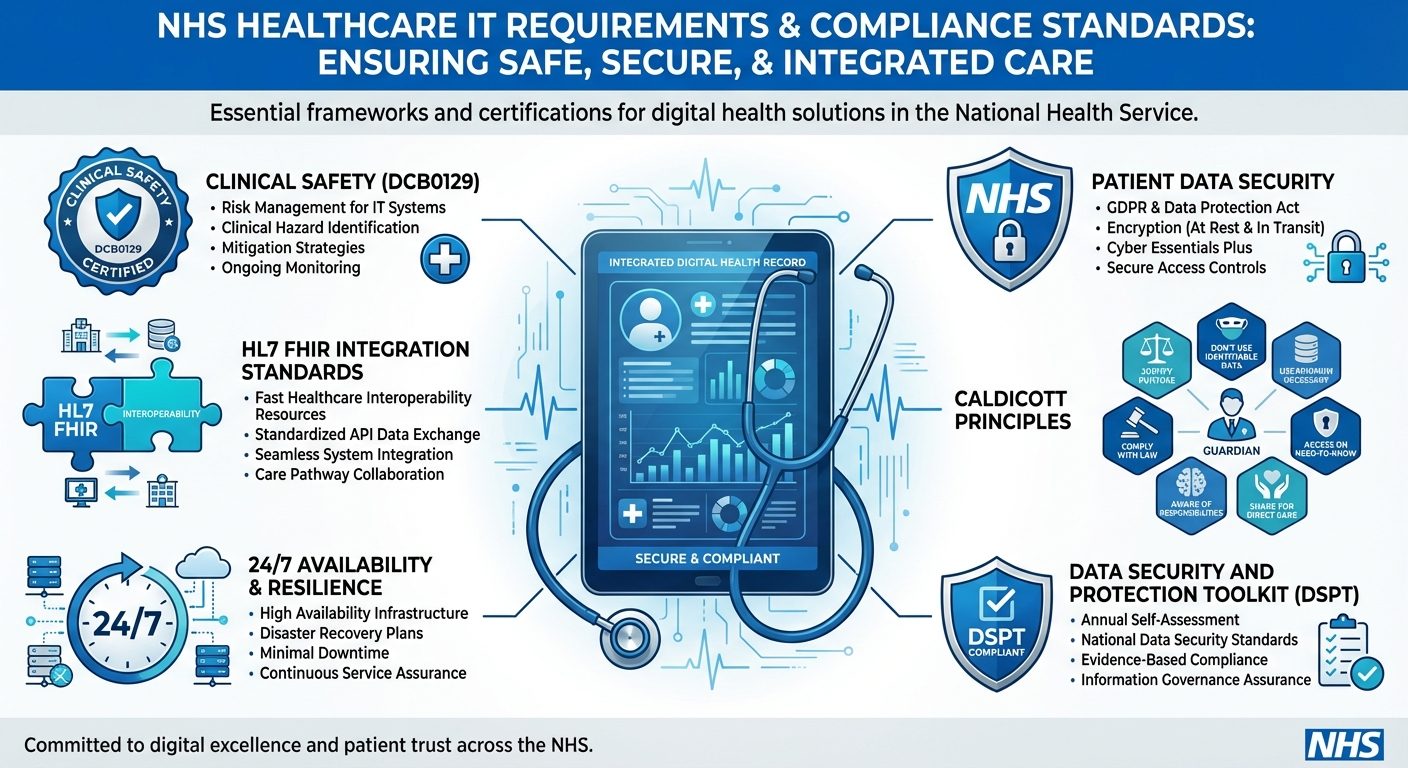
NHS Healthcare IT Requirements
Common Pitfalls and How to Avoid Them
IT tender failures follow predictable patterns. Understanding common mistakes allows you to avoid them and identify opportunities where competitors stumble.
Over-Engineering Solutions
Many IT suppliers lose bids by proposing technically sophisticated solutions to straightforward problems, driven by assumptions about what buyers "should" want rather than understanding what they actually need.
The mistake: Proposing a microservices architecture with Kubernetes orchestration when buyer needs a simple web application. Recommending machine learning when rule-based logic would suffice. Designing for scale to millions of users when buyer has 500 internal users and no growth plans. Complexity as a feature rather than a necessary evil. Why it loses: Buyers evaluate risk heavily. Unnecessarily complex solutions increase delivery risk, support complexity, and total cost of ownership. Evaluators question whether you understand their requirements when your proposal addresses problems they don't have. Complex solutions require more internal technical capability to govern and support—unattractive when internal capacity is limited. Winning approach: Right-size solutions to requirements. Acknowledge scalability limits honestly: "This architecture supports up to 5,000 concurrent users based on your current 800-user base and 10-year growth projections. If your requirements change substantially, the platform can be re-architected, but that complexity isn't justified by current needs." Explain technology choices in business terms: "We propose PostgreSQL database rather than NoSQL options because your data is highly structured and relational queries are central to reporting requirements. This conventional choice reduces support complexity and makes future supplier transitions easier."Generic Proposals Lacking Customization
Many IT proposals read like marketing brochures rather than specific responses to tender requirements. Generic content suggests you haven't engaged seriously with buyer's needs.
The mistake: Reusing large sections of previous proposals without customization. Describing your company capabilities rather than addressing specific requirements. Including case studies from different sectors without explaining their relevance. Technical architectures that could apply to any similar contract without buyer-specific context. Why it loses: Evaluators read dozens of proposals and recognize generic content immediately. Lack of customization suggests you're not genuinely interested in this contract or don't understand buyer's specific circumstances. Generic responses make comparative evaluation easy—evaluators can't differentiate you from competitors, so price becomes dominant factor. Winning approach: Reference specific details from tender documents throughout your response: "Your requirement in Section 4.3 for integration with FIS Financials system presents a key dependency..." Include buyer-specific context in technical designs: "Based on your existing Cisco network infrastructure and stated strategy to remain with Cisco for campus networking..." Tailor case studies to match buyer's context: "When Anytown Council (similar size and budget to yourselves) needed to modernize their planning system, we faced similar challenges with legacy data migration and need for uninterrupted public access..." Demonstrate you've engaged with the requirement: "During the optional supplier briefing session, you mentioned concerns about staff acceptance of new systems. Our change management approach addresses this through..."Weak Case Studies and References
IT buyers heavily weight evidence of successful similar projects. Many bids fail not through lack of capability but through poor evidence presentation.
The mistake: Providing case studies from years ago when recent performance is what matters. Describing projects that sound impressive but don't match contract requirements. No verifiable references or reluctance to provide referee contact details. Case studies that describe what you did without evidencing outcomes. Claiming credit for projects where your role was minor. Why it loses: Buyers are highly skeptical of unverified capability claims. Without strong case studies, evaluation panels can't differentiate experienced suppliers from optimistic chancers. Historic case studies suggest your capability may have been overtaken by competitors or key staff departed. Case studies without outcomes don't evidence successful delivery—describing a project's complexity doesn't prove you delivered it successfully on time and budget. Winning approach: Provide recent, relevant, verifiable case studies. Structure consistently: Client context and challenge, Your solution and approach, Quantified outcomes, Reference contact details. Quantify results: "Migration completed 2 weeks ahead of schedule with zero data loss. User satisfaction increased from 62% to 87% within first quarter. Support call volume reduced 34% due to improved system usability." Proactively address relevance: "Although this case study is from retail sector rather than public sector like your organization, the technical challenges match closely: legacy system migration with minimal business disruption, complex data transformation from multiple source systems, and requirement to maintain transaction processing throughout migration period." Obtain referee permission and provide specific contact details—"name, title, organization, email, phone number" not just "references available on request."Underestimating Change Management
Many IT projects succeed technically but fail to deliver expected benefits because inadequate attention to organizational change, user adoption, and stakeholder management.
The mistake: Focusing exclusively on technical delivery without addressing people and process dimensions. Assuming users will automatically adopt new systems. Proposing minimal training ("comprehensive user manuals will be provided"). No consideration of business readiness or change fatigue. Ignoring political dimensions and stakeholder concerns. Why it loses: Sophisticated buyers recognize that technology is often the easiest part of transformation—changing organizational behavior is harder. Previous IT project failures often stemmed from poor change management despite technically sound solutions. User resistance can derail technically excellent projects. Buyers seek suppliers who understand the full delivery challenge, not just technical implementation. Winning approach: Integrate change management throughout delivery methodology, not as an afterthought. Demonstrate understanding of stakeholder landscape: "Key stakeholder groups include frontline staff (concerned about efficiency vs current workarounds), middle managers (worried about loss of control over current processes), senior leadership (focused on strategic outcomes and budget), IT team (concerned about supportability). Our engagement approach addresses each group's specific concerns..." Propose substantive user engagement: "User-centered design workshops with 15-20 representative users in discovery phase. Fortnightly usability testing with real users throughout development. Beta user group of 50 early adopters providing feedback before full rollout. Hypercare period with on-site support champions during first month live." Describe adoption strategy with realistic expectations: "Full adoption typically takes 6-9 months based on our experience with similar organizational changes. We'll measure adoption through system usage metrics (target: 80% of users performing key transactions in system within 3 months) and user satisfaction surveys (target: 75% satisfaction score within 6 months)."Inadequate Security and Risk Management
Security breaches and data protection failures dominate IT headlines, making buyers highly risk-averse. Inadequate security evidence frequently eliminates otherwise strong proposals.
The mistake: Treating security as a checklist compliance exercise. Providing certificates without explaining security controls. No acknowledgment of contract-specific security risks. Generic risk registers copied from templates. Failing to address how you'll detect and respond to security incidents. Underestimating the buyer's security concerns and sophistication. Why it loses: Buyers know a single security failure can have catastrophic consequences—reputational damage, regulatory enforcement, financial penalties, operational disruption. They need confidence that security is embedded in your operations, not bolted on. Generic security responses suggest you haven't identified specific risks for this contract. Lack of incident response planning indicates you're unprepared for inevitable security challenges. Winning approach: Conduct a contract-specific threat assessment identifying relevant risks: "Key security risks for this contract include: unauthorized access to citizen financial data (mitigated by role-based access controls with multi-factor authentication), data exfiltration via internet-facing web services (mitigated by web application firewall, intrusion detection, and data loss prevention monitoring), insider threats from privileged administrative access (mitigated by segregation of duties and comprehensive audit logging with SIEM alerting)." Describe your security operations: "Our 24/7 security operations center monitors all production systems with defined response procedures. Security events are triaged within 15 minutes, with major incidents escalated to security incident response team within 30 minutes. We conduct quarterly penetration tests and annual external security audits." Demonstrate transparency about security limitations: "Our proposed solution implements encryption for data at rest and in transit, but application-level encryption of individual data fields is not included in our baseline proposal due to performance implications and key management complexity. If you require field-level encryption for specific high-sensitivity data, we can provide this as a variation with associated cost and performance impacts."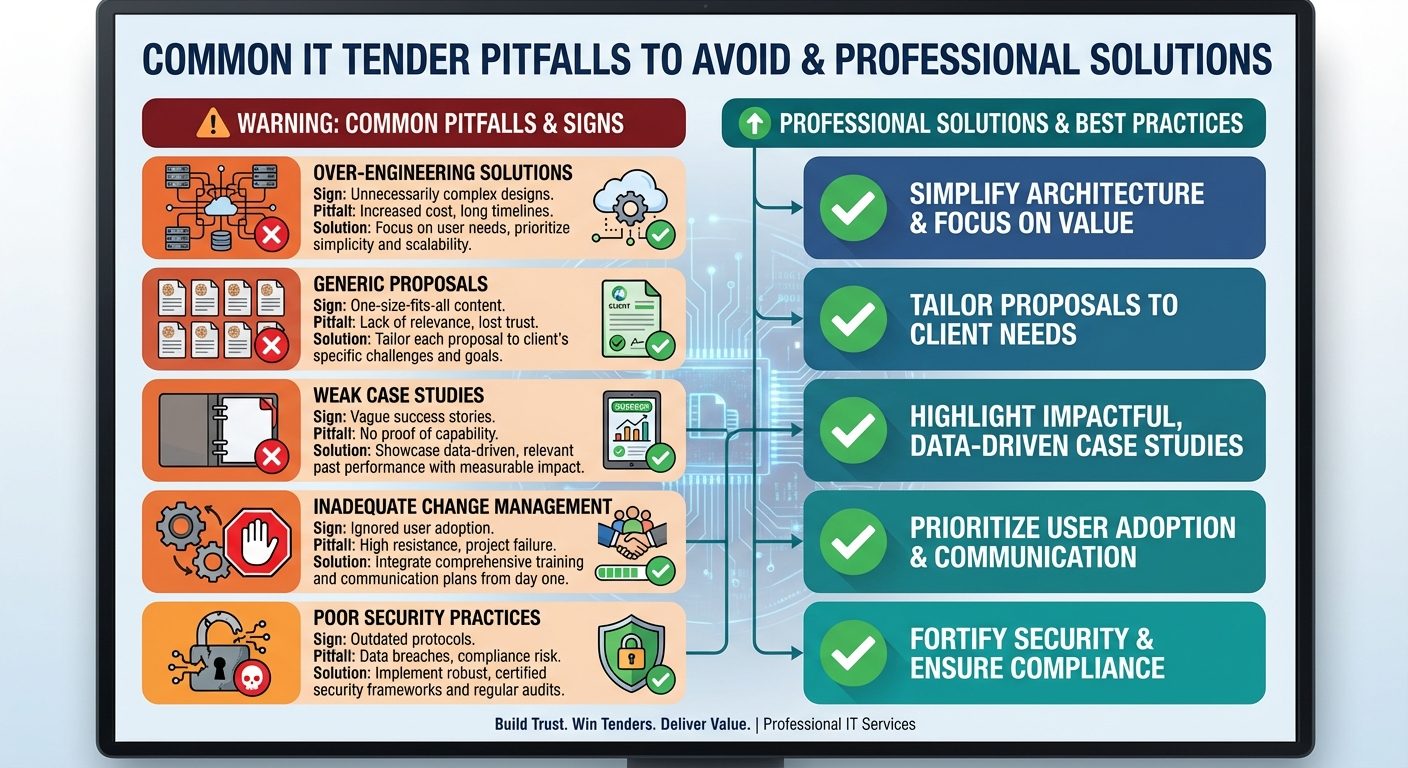
Common IT Tender Pitfalls
Pricing Strategy for IT Services
IT pricing presents unique challenges: accurately estimating effort for complex technical work, balancing fixed-price certainty against time-and-materials flexibility, and differentiating on value rather than competing purely on cost.
Understanding Total Cost of Ownership
Many IT contracts are won on attractive initial costs but deliver poor value due to high ongoing costs. Sophisticated buyers evaluate total cost of ownership across contract lifetime.
Implementation costs include obvious elements (development, configuration, testing) and frequently underestimated activities: requirements elaboration when specifications are high-level, rework when requirements change or initial understanding proved incorrect, environment setup and infrastructure provisioning, security testing and remediation, performance tuning when initial implementation doesn't meet non-functional requirements, data migration and cleansing, integration with existing systems, business readiness activities like training and documentation. Ongoing operational costs vary significantly based on solution design. Include: hosting infrastructure costs (cloud services, servers, storage, bandwidth), software licensing and subscription fees for all components, routine maintenance and patching, monitoring and incident response, backup and disaster recovery operations, security operations and compliance activities, helpdesk and user support, periodic upgrades and technology refresh. Hidden costs that buyers should understand: specialist skillsets required for ongoing support (impacting recruitment costs if in-sourced), dependency on specific suppliers or technologies creating lock-in, cost of future changes and enhancements, risks of technical debt from short-term implementation choices, opportunity costs of non-standard technology choices reducing future supplier competition. Winning approach: Present whole-life cost model showing year-by-year costs across anticipated contract duration. Compare options transparently: "Our proposed cloud-based solution has higher year 1 costs (£XXX vs £YYY for on-premise) but lower 5-year total cost of ownership (£XXX vs £YYY) due to reduced infrastructure and support costs." Make costs predictable: "Fixed-price implementation of £XXX. Ongoing support at £YYY per month covering all routine activities with up to 30 minor changes per year included. Additional changes costed via day-rate of £ZZZ." Help buyers understand cost drivers: "Approximately 40% of implementation cost relates to data migration from your seven legacy systems. If this can be descoped with legacy systems run in parallel initially, implementation cost reduces to £XXX with migration delivered as a future phase when business is ready."Fixed Price vs Time-and-Materials
Buyers generally prefer fixed-price certainty, but complex IT projects with evolving requirements suit time-and-materials or hybrid approaches. Choosing the right pricing model impacts win probability.
Fixed-price advantages: Provides cost certainty buyers need for budgeting. Transfers delivery risk from buyer to supplier. Simplifies contract management and reduces governance overhead. Preferred by buyers with limited technical capability to oversee time-and-materials delivery. Demonstrates supplier confidence in accurate estimation. Fixed-price risks: Requires very detailed requirements specification to estimate accurately. Suppliers build contingency into prices to cover risks, potentially making you uncompetitive. Changes outside original scope lead to expensive change requests and relationship tension. Incentivizes supplier to minimize effort, potentially impacting quality. Unsuitable for innovative projects where requirements emerge through delivery. Time-and-materials advantages: Provides flexibility to adapt as understanding evolves. Reduces price by eliminating contingency for uncertain requirements. Buyer only pays for actual effort, not estimated worst-case scenarios. Aligns supplier incentives with quality and buyer satisfaction rather than minimizing effort. Suits agile delivery where detailed upfront requirements conflict with iterative discovery approach. Time-and-materials risks: Cost uncertainty makes budgeting difficult for buyers. Requires active buyer oversight to manage costs—unsuitable when internal capacity limited. Perceived as transferring risk unfairly to buyer. Can enable scope creep with costs escalating beyond initial expectations. Needs strong governance and change control to maintain buyer confidence. Winning approach: Match pricing model to contract characteristics and buyer sophistication. For well-defined projects with detailed specifications: offer fixed price. For complex projects with evolving requirements: propose time-and-materials with caps ("not to exceed £XXX without explicit approval"). For long-term service contracts: fixed monthly fee for routine services with time-and-materials for changes and enhancements. Hybrid approaches balance certainty with flexibility: "Fixed-price discovery phase of £XXX to elaborate requirements and produce detailed design. Following approval, fixed-price implementation of £YYY based on agreed detailed design. This approach provides cost certainty while acknowledging that full requirements understanding emerges through discovery phase."Value-Based Differentiation
Competing purely on price in IT services commoditizes your offering and erodes margins. Differentiate on value to justify premium pricing.
Quantify benefits delivered: Help buyers understand return on investment. "Current manual processing of applications takes average 14 minutes per application with 850 applications monthly. Our automated workflow reduces this to 3 minutes per application, saving 156 staff hours monthly. At £35/hour average cost, this delivers £65,520 annual savings against £45,000 annual solution cost, providing positive ROI within 9 months." Reduce buyer risk: Risk reduction has value that justifies higher costs. "Our proposed managed service includes 24/7 monitoring, guaranteed 4-hour incident response, and 99.9% uptime SLA. Alternative self-managed approach has lower direct cost but requires buyer to recruit additional support staff, accept higher downtime risk, and manage vendor relationships across multiple suppliers. Our fully-managed approach provides operational certainty at known cost." Accelerate delivery: Time-to-benefit matters. "Our accelerated delivery approach using our pre-built framework components delivers working system in 12 weeks rather than estimated 26 weeks for build-from-scratch approach. This brings forward benefit realization by 3-4 months, worth approximately £XXX in earlier efficiency gains, offsetting our higher implementation cost." Enable future options: Flexibility and avoiding lock-in have strategic value. "Our open-standards architecture using containerized microservices provides flexibility to change underlying infrastructure, swap individual components, or transition to different suppliers in future. This preserves your future options rather than creating dependency on proprietary technologies. While implementation cost is 15% higher than proprietary alternative, the strategic value of preserved flexibility justifies this investment." Include value-add services: Differentiate through complementary services. "Included in our proposed pricing: quarterly technology briefings covering emerging threats and opportunities relevant to your sector. Annual strategic review with recommendations for evolving your IT landscape. Access to our customer portal with 24/7 knowledge base and community forum. These services support your team's ongoing development and maximize value from our partnership beyond just delivering the contracted system."Mobilization and Service Transition
Many IT projects stumble during mobilization when winning the bid transitions to delivering the service. Demonstrating credible mobilization planning influences buyer confidence in your ability to deliver.
Mobilization Planning
Buyers want confidence you'll hit the ground running post-award, not figure things out as you go.
Resource mobilization: Describe specific actions and realistic timelines. "Week 1 post-award: Project initiation meeting with buyer's project board to confirm governance arrangements and communication protocols. Mobilize core team: James Smith (Programme Manager) and Sarah Johnson (Lead Architect) assigned. Reserve developer capacity: four developers from our current project finishing in 4 weeks. Week 2-3: Security clearance applications for team members. Recruit additional test analyst (role specification already prepared). Week 4: Establish development and test environments. Complete security documentation review. Week 5: Discovery phase commencement." Risk mitigation during mobilization: Acknowledge known risks and mitigation plans. "Key mobilization risks include: Security clearance delays—mitigated by applying immediately post-award and maintaining flexibility in mobilization schedule. Vendor access and accounts—mitigated by early engagement with your IT team for access requests. Knowledge transfer from incumbent supplier—mitigated by requesting overlap period in transition plan and capturing key information in discovery phase." Early value delivery: Demonstrate quick wins that build confidence. "Our mobilization includes early value delivery: Within first 4 weeks, complete security posture review with quick-win recommendations. Within first 8 weeks, deliver prototype of highest-priority user interface for user feedback. Within first 12 weeks, deliver automated deployment pipeline enabling frequent releases. These early deliverables demonstrate progress and build trust while detailed development continues."Service Transition Planning
For contracts with incumbent suppliers or transition from buyer-operated services, transition planning is critical and frequently underestimated.
Knowledge acquisition: "Our transition approach includes structured knowledge capture: Document review: contracts, procedures, architecture documentation, known issues logs. Shadowing: our team observes incumbent operations for 2-week period. Knowledge transfer sessions: structured sessions with incumbent covering system architecture, operational procedures, common issues and solutions, undocumented features. Discovery documentation: we synthesize this into comprehensive service documentation during first 8 weeks." Service continuity: "Transition will maintain service levels through: Phased approach: progressive responsibility transfer with incumbent providing declining support over 8-week period. Parallel running: 4-week period where both teams provide coverage ensuring no gaps. Hypercare support: enhanced support levels (4-hour response, extended hours coverage) for first 3 months post-transition. Roll-back planning: ability to revert to incumbent if critical issues emerge, providing buyer with risk mitigation." TUPE considerations: "Your documentation indicates 6 staff currently performing these services who may be subject to TUPE transfer. Our approach: Early engagement (subject to buyer introducing us) to understand current team capabilities and concerns. Due diligence on terms and conditions to ensure compliant transfer. Integration planning to incorporate transferred staff into our team structure with appropriate support and training. Retention focus: treating transferred staff as valuable asset with local knowledge and established relationships."Using Technology to Win More IT Tenders
Modern technology tools support more effective tender responses, from AI-powered content generation to collaboration platforms that streamline multi-contributor responses.
AI-Assisted Tender Writing
AI tools like mytender.io provide specialized support for IT tender responses, understanding technical context and compliance requirements that general-purpose AI lacks.
Content generation for technical sections: AI assists with first-draft content for standard sections like company background, technical capabilities, quality management systems. This accelerates response development, allowing human experts to focus on customization and contract-specific technical design rather than writing boilerplate content from scratch. Compliance checking: AI tools analyze tender requirements and cross-reference with your response to identify gaps, missing evidence, and sections that don't fully address questions. This reduces risk of non-compliant submissions that face automatic disqualification despite technical strength. Learning from winning content: Platforms like mytender.io learn from your winning bids, identifying successful content patterns and suggesting improvements to new responses based on what's worked previously. This organizational learning compounds over time—each bid improves future bid quality. Technical content libraries: Build reusable libraries of case studies, technical architectures, methodology descriptions, and credentials evidence. AI assists in identifying relevant library content for new bids and adapting it to specific contexts. This prevents constantly recreating content while ensuring appropriate customization. Collaboration and review: Cloud-based platforms enable distributed teams to collaborate effectively on bids, with AI highlighting inconsistencies, duplicated effort, and sections needing expert review. This improves quality while compressing timelines.Continuous Improvement Through Analytics
Winning more IT tenders requires systematic learning from both wins and losses.
Structured loss analysis: Request feedback on unsuccessful bids and conduct structured analysis. What sections scored poorly? Did technical solution address requirements appropriately? Was pricing competitive? Were case studies sufficiently relevant? Did key personnel meet evaluator expectations? Capture these lessons in searchable format to inform future bids. Win pattern identification: Analyze winning bids to identify success patterns. Which technical approaches resonated with buyers? What pricing models won? How did successful case studies differ from less effective ones? Which methodology descriptions scored highest? Use these insights to refine your tender templates and guidelines. Capability gap analysis: Track requirements you couldn't address confidently. Recurring capability gaps indicate investment priorities—certifications to obtain, case studies to develop, technical capabilities to build, or partnership relationships to establish. Market intelligence: Build understanding of your competitors' strengths and differentiation. What do they emphasize in their proposals? What client references do they use? What pricing models do they prefer? This intelligence informs your competitive positioning and helps identify white space opportunities. ROI measurement: Track tender costs, win rates, and contract values to optimize bid/no-bid decisions. Which contract types and buyer sectors deliver highest win rates? What's the relationship between bid effort and success probability? Are you pursing contracts where you lack competitive advantage? Data-driven bid decisions improve resource allocation and overall success rates.Conclusion: Building Your IT Tender Winning Framework
Success in IT and technology services tendering stems from systematic capability building across technical excellence, compliance credentials, and bid development expertise. Organizations that treat tender writing as a strategic capability rather than an administrative task achieve substantially higher win rates and better quality contracts.
Invest in certifications and credentials that open doors: ISO 27001, Cyber Essentials Plus, and sector-specific accreditations relevant to your target markets. These credentials are table stakes for serious contention in public sector IT markets. Build your case study portfolio systematically. Target contract opportunities that will provide compelling case studies for future bids. Document projects thoroughly with quantified outcomes and obtain client permission to use as references. Update case studies regularly as new projects complete—outdated case studies signal declining capability. Develop technical specialists with bid writing skills or bid writers with technical understanding. The intersection of technical expertise and clear communication is rare and valuable. Organizations that bridge this gap produce proposals that are both technically sound and comprehensible to non-technical evaluators. Use specialized tools like mytender.io that understand IT procurement context. General-purpose tools lack the domain knowledge to effectively support technology services bidding. Purpose-built platforms provide compliance checking, technical content libraries, and learning from sector-specific winning patterns. Measure and improve systematically. Track win rates by contract type, buyer sector, and contract value. Analyze losses to understand weaknesses. Celebrate wins but also study why you won—replicating success patterns is as important as addressing failures.The IT and technology services market offers substantial opportunity for organizations that master public sector tendering. Competition is intense, but many technically capable companies underperform in procurement processes through poor bid development. Systematic attention to tender writing capability provides competitive advantage that compounds over time—each win builds your case study portfolio, improves team capabilities, and enhances market reputation. Invest in tender writing as a strategic capability and the returns will multiply across future contracts.
Tags
Ready to Transform Your Tender Writing?
See how MyTender's AI can help you write winning tenders in a fraction of the time.