

Construction Tender Writing: Complete Guide for 2026
Master construction tender writing with our comprehensive 2026 guide covering Procurement Act compliance, technical requirements, pricing strategies, and proven winning techniques for contractors and subcontractors.
Evie
Procurement Specialist
The construction sector represents one of the UK's largest public procurement markets, with billions of pounds in contracts awarded annually. Yet winning these tenders requires far more than competitive pricing and technical capability. In 2026, construction tender writing has evolved into a sophisticated discipline that demands regulatory compliance, strategic positioning, and compelling evidence-based narratives.
The Procurement Act 2023, which came into force in February 2025, has fundamentally reshaped how construction contracts are awarded. Combined with increasing emphasis on social value, environmental sustainability, and supply chain resilience, contractors face a more complex tendering landscape than ever before. This guide provides a comprehensive roadmap for navigating these challenges and winning more construction tenders in 2026.
Understanding the Construction Tender Landscape in 2026
The construction procurement environment has undergone significant transformation over the past year. The Procurement Act 2023 replaced decades of EU-derived regulations with a streamlined, flexible framework designed to deliver better value for money whilst supporting broader government missions around economic growth, sustainability, and social value.
For construction firms, this means tender evaluations now extend far beyond traditional price and quality metrics. Contracting authorities assess bidders on their contribution to local employment, apprenticeship creation, carbon reduction commitments, supply chain diversity, and community benefit delivery. A technically excellent bid that ignores these wider considerations will struggle to compete against proposals that demonstrate holistic value.
The Act also introduced enhanced transparency requirements. Public bodies with annual procurement spend exceeding £100 million must publish pipeline notices for contracts over £2 million, giving suppliers greater visibility of upcoming opportunities. This forward planning capability enables construction firms to strategically prepare for major tenders rather than responding reactively.
Another significant shift involves the treatment of small and medium-sized enterprises (SMEs). Government policy actively encourages SME participation through contract disaggregation, simplified prequalification processes, and faster payment terms. For smaller contractors and specialist subcontractors, this creates genuine opportunities to compete for work previously dominated by major contractors.
Digital transformation has accelerated across public procurement. The central digital platform launched in 2025 serves as the single publication point for all procurement notices, replacing the fragmented systems of the past. Construction firms must maintain active monitoring of this platform alongside traditional tender portals to ensure they capture all relevant opportunities.
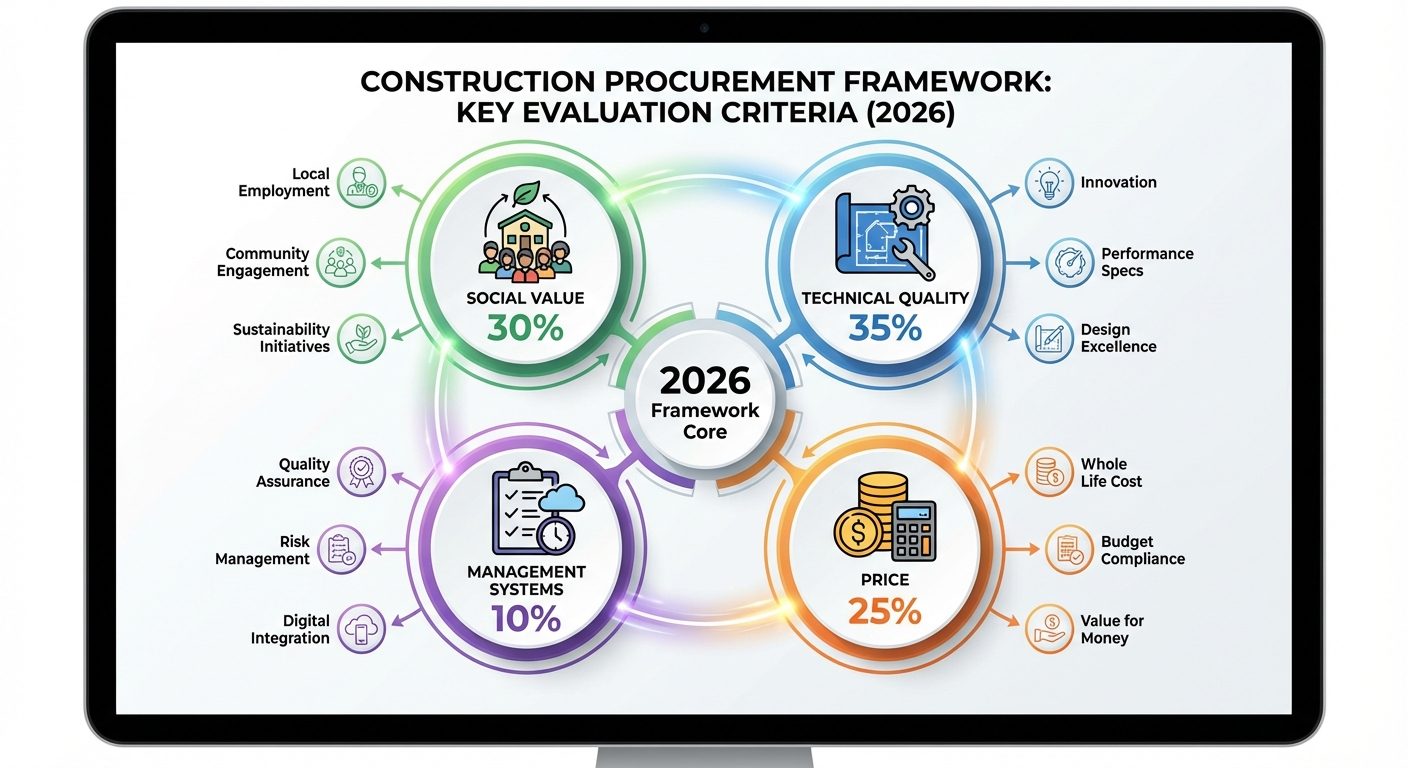
Construction procurement framework showing key evaluation criteria
Pre-Tender Preparation: Building Your Foundation
Successful tender writing begins long before the invitation to tender arrives. Construction firms that win consistently invest substantial effort in pre-tender preparation, developing the capabilities, documentation, and intelligence needed to respond effectively when opportunities arise.
Organisational Readiness and AccreditationModern construction tenders demand extensive documentary evidence of organisational capability. Firms should maintain current versions of all essential documentation including company registration certificates, VAT registration, professional indemnity insurance certificates, employer's liability insurance, public liability insurance, and relevant industry accreditations.
Industry-specific certifications carry particular weight in construction tenders. SSIP (Safety Schemes in Procurement) scheme membership demonstrates robust health and safety management, whilst ISO certifications for quality management (ISO 9001), environmental management (ISO 14001), and occupational health and safety (ISO 45001) provide standardised evidence of systematic capability.
Trade-specific registrations matter enormously. Gas Safe registration remains mandatory for gas installation work, whilst electrical contractors need NICEIC or equivalent certification. Specialist trades require demonstrable competence through relevant qualifications and trade body membership.
Financial standing represents a critical threshold in construction procurement. Contracting authorities typically specify minimum turnover requirements as a multiple of the contract value, often requiring three years of audited accounts demonstrating financial stability. Firms should prepare concise financial summaries highlighting key metrics including turnover trends, profit margins, working capital adequacy, and balance sheet strength.
Technical Capability DocumentationConstruction tenders require detailed evidence of technical capability across multiple dimensions. Firms should maintain a comprehensive project portfolio documenting similar completed works, organised by sector, contract value, and technical complexity. Each case study should include project details, contract value, client reference, delivery timelines, technical challenges overcome, and measurable outcomes achieved.
Resource capability documentation should detail available plant and equipment, with specifications, capacities, and maintenance records. Personnel capability summaries should cover key staff members including qualifications, experience, and relevant project involvement. Subcontractor and supply chain relationships warrant documentation demonstrating established partnerships with specialist trades and material suppliers.
Methodological documentation provides reusable content for technical method statements. Standard approaches to project delivery, quality management, health and safety management, environmental management, and stakeholder communication should be documented and refined based on lessons learned from previous projects.
Market Intelligence and Relationship BuildingEffective pre-tender preparation includes systematic intelligence gathering about potential clients, their priorities, past procurement patterns, and upcoming pipeline. Many public bodies publish forward procurement plans providing visibility of major projects 12-24 months ahead. Construction firms should actively monitor these pipelines and engage in early market engagement activities where permitted.
Building relationships with client organisations before tender release creates significant advantage. Attendance at industry days, participation in pre-procurement market engagement, and thought leadership through white papers or case studies establishes credibility and familiarity. Whilst procurement processes must remain fair and transparent, legitimate relationship building within appropriate boundaries helps clients understand your capabilities and builds trust.
Peer intelligence proves equally valuable. Understanding competitor positioning, their typical win themes, pricing approaches, and capability gaps enables strategic differentiation. Industry networking, attendance at sector events, and monitoring competitor communications all contribute to competitive intelligence.
Strategic Tender Assessment: The Go/No-Go Decision
Not every tender opportunity warrants pursuit. Strategic tender assessment through a rigorous go/no-go process prevents wasted effort on unwinnable bids whilst focusing resources on high-probability opportunities aligned with business objectives.
Opportunity Evaluation FrameworkEffective go/no-go assessment evaluates multiple dimensions of opportunity attractiveness. Contract fit examines alignment with core capabilities, sector experience, geographic reach, and strategic priorities. A project outside your technical sweet spot or geographic footprint may prove unwinnable regardless of effort invested.
Win probability assessment considers incumbent relationships, competition strength, differentiation opportunities, and client familiarity with your organisation. Tendering against an incumbent with strong performance history requires exceptional differentiation to overcome the incumbent advantage. Understanding the competitive landscape helps calibrate realistic win probability.
Resource availability evaluation ensures sufficient capacity exists to deliver a winning bid without compromising ongoing commitments. Construction tenders demand significant resource input including estimating effort, technical writing, management time for review, and specialist input for method statements. Firms should honestly assess whether they can mount a competitive response given current workload.
Financial viability assessment examines whether the contract delivers acceptable return given risk exposure, resource requirements, and opportunity cost. Some tenders offer insufficient margin or carry excessive risk regardless of strategic value. Others may provide acceptable return but require capital investment or bonding capacity that exceeds available resources.
Strategic value considerations extend beyond immediate financial return. Contracts that establish presence in new sectors, demonstrate capability in emerging markets, or build relationships with key clients may warrant pursuit despite modest immediate returns. Conversely, financially attractive opportunities that pull the business away from strategic direction may prove unwise despite potential profitability.
Structured Decision ProcessImplementing a structured go/no-go process ensures consistent, objective decision-making. Many successful construction firms use scoring matrices that weight evaluation criteria according to business priorities. A simple framework might allocate points across capability fit (0-25), win probability (0-25), resource availability (0-25), and strategic value (0-25), with opportunities scoring below 60 rejected and those above 75 pursued.
The decision should involve multiple perspectives. Commercial input ensures financial and contractual evaluation, operational input assesses delivery capability and resource availability, whilst business development provides competitive intelligence and strategic context. Senior management should authorise pursuit of major opportunities, ensuring bid commitments align with overall business capacity.
For borderline opportunities, risk mitigation strategies may improve attractiveness. Partnering with complementary firms through joint ventures or consortia arrangements can strengthen capability, share risk, and improve win probability. Subcontracting portions of work to specialist partners addresses capability gaps whilst limiting direct exposure.
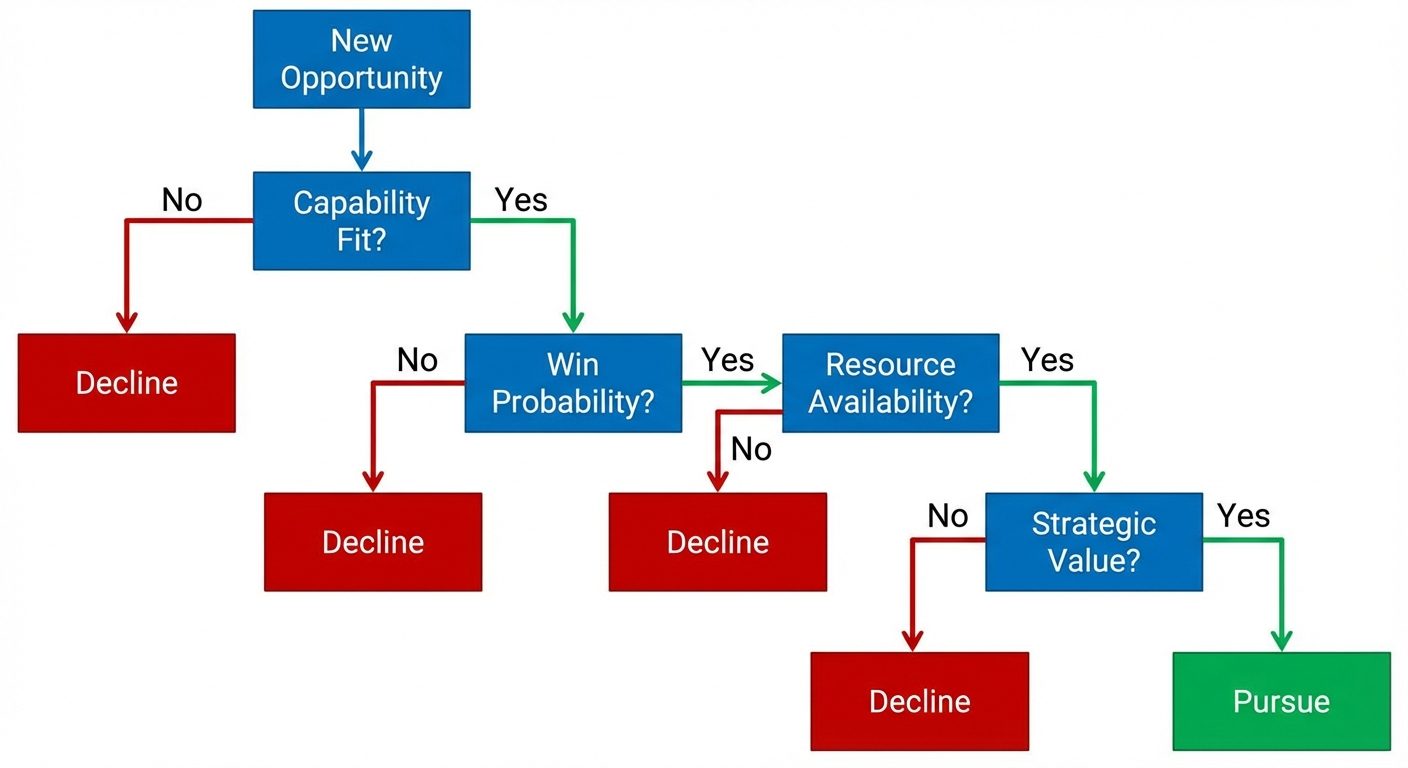
Decision tree for construction tender go/no-go assessment
Procurement Act 2023: Compliance Essentials for Construction
The Procurement Act 2023 introduced fundamental changes that construction contractors must understand to ensure compliant, competitive responses. Understanding these changes prevents disqualification whilst enabling strategic advantage through sophisticated application of new provisions.
Most Advantageous Tender FrameworkThe Act replaced "Most Economically Advantageous Tender" (MEAT) with "Most Advantageous Tender" (MAT), a subtle but significant shift emphasising outcomes and wider benefits alongside price and quality. Construction contractors must frame responses around outcome delivery rather than purely inputs or activities.
Value for money assessment under MAT encompasses quality, outcomes, and wider economic, social, and environmental benefits. Construction tenders increasingly weight these non-price factors heavily, with some contracts allocating 60-70% of evaluation points to quality and social value criteria.
Effective MAT responses require clear articulation of how your approach delivers measurable outcomes aligned with client objectives. Rather than simply describing construction methodology, winning responses demonstrate how those methods deliver faster completion, reduced whole-life costs, improved performance characteristics, or enhanced user experience.
Mandatory Exclusion and Discretionary Exclusion GroundsThe Procurement Act maintains mandatory exclusion grounds that automatically disqualify firms from procurement. These include certain criminal convictions, insolvency proceedings, tax non-compliance, and serious professional misconduct. Construction firms must ensure clean records across these areas and implement compliance systems preventing violations.
Discretionary exclusion grounds give contracting authorities flexibility to exclude suppliers based on past performance, including poor contract performance, significant contract breaches, bankruptcy, false information provision, or other professional misconduct. Given the construction sector's complexity and the potential for disputes, maintaining positive client relationships and resolving issues constructively becomes essential.
The Act introduced a central debarment list enabling authorities to exclude suppliers across the public sector. Construction firms on this list face exclusion from all public contracts unless successful appeals are made. Preventing debarment requires robust contract delivery, proactive issue management, and early escalation of risks before they become failures.
Pipeline Notices and Transparency RequirementsLarge contracting authorities must publish pipeline notices for significant contracts at least 40 days before tender publication. For construction firms, these notices provide valuable lead time for preparation, enabling early assembly of consortia, development of technical solutions, and preliminary estimating.
Enhanced transparency extends throughout the procurement lifecycle. Contract award notices must be published within 30 days, detailing winning bidder, contract value, and award criteria. Performance information becomes publicly accessible, creating reputational incentives for excellent delivery alongside contractual obligations.
Construction firms should actively monitor pipeline notices through the central digital platform, building systematic processes for opportunity identification, preliminary assessment, and preparation planning. Early engagement with potential partners, supply chain mobilisation, and solution development provides competitive advantage when formal tenders release.
Amended Procedures and Framework AgreementsThe Act introduced flexibility in procurement procedures, allowing modified approaches tailored to specific circumstances. Construction authorities can use competitive flexible procedure for complex projects requiring dialogue, whilst innovation partnerships support procurement of innovative solutions requiring developmental work.
Framework agreements remain common in construction procurement, enabling call-off contracts over extended periods. The Act reformed framework regulations, introducing greater flexibility in participation and award procedures. Construction firms on frameworks must understand specific call-off processes and maintain competitive positioning throughout the framework term.
Direct awards remain permissible in specific circumstances including extreme urgency, sole supplier capability, or research and development contracts. However, direct awards require published justification and face enhanced scrutiny, making them exceptional rather than routine.
Social Value in Construction Tenders
Social value has evolved from optional consideration to mandatory weighted criterion in most public construction tenders. Many authorities allocate 20-30% of evaluation points to social value, making it decisive in competitive situations where technical and price scores prove similar.
Understanding Social Value RequirementsThe National Procurement Policy Statement 2024 mandates social value consideration in above-threshold procurements, requiring contracting authorities to explicitly evaluate wider benefits alongside core deliverables. For construction, this encompasses local employment and skills development, supply chain diversity and SME engagement, carbon reduction and environmental sustainability, and community benefit and social impact.
Construction tenders typically structure social value requirements through the Social Value Model for Construction Contracts or equivalent frameworks. These models specify priority themes including fighting climate change, tackling economic inequality, equal opportunity, and wellbeing. Each theme contains specific measurable outcomes against which proposals are evaluated.
Effective social value responses require clear understanding of local priorities. Authorities in areas with high unemployment may prioritise local employment creation, whilst those facing skills shortages emphasise apprenticeship delivery. Understanding regional context enables targeted, relevant commitments that resonate with evaluators.
Developing Credible Social Value CommitmentsWinning social value responses balance ambition with deliverability. Excessive commitments that lack credible delivery plans raise scepticism, whilst modest commitments fail to compete against ambitious competitors. The key lies in evidence-based commitments supported by specific delivery mechanisms.
Local employment commitments should specify target percentages of workforce drawn from defined geographic areas, recruitment channels to be employed, partnerships with local employment agencies, and monitoring approaches to track achievement. Vague commitments to "maximise local employment" lack credibility compared to "source minimum 40% of workforce from host borough through partnership with XYZ employment programme."
Apprenticeship and skills development commitments require specific numbers of positions, duration, qualification levels, recruitment approach, and progression pathways. Demonstrating existing apprenticeship programmes, retention rates, and success stories proves delivery capability.
Supply chain diversity commitments should quantify SME and VCSE engagement as percentage of contract value, describe specific measures to enable smaller supplier participation, and reference existing supply chain relationships demonstrating capability. Construction firms with established supply chain diversity track records should provide concrete examples and data.
Environmental commitments increasingly focus on carbon reduction. Effective responses should quantify baseline carbon footprint for the proposed works, specify reduction targets with supporting methodology, describe specific interventions to achieve reductions, and commit to transparent reporting. Tools like the Construction Carbon Calculator enable credible carbon footprint assessment.
Community benefit commitments might include support for local charities, provision of community facilities, educational engagement with local schools, or contribution to community development initiatives. Successful approaches identify specific partners, describe concrete activities, and commit resources (whether financial or in-kind) demonstrating genuine commitment.
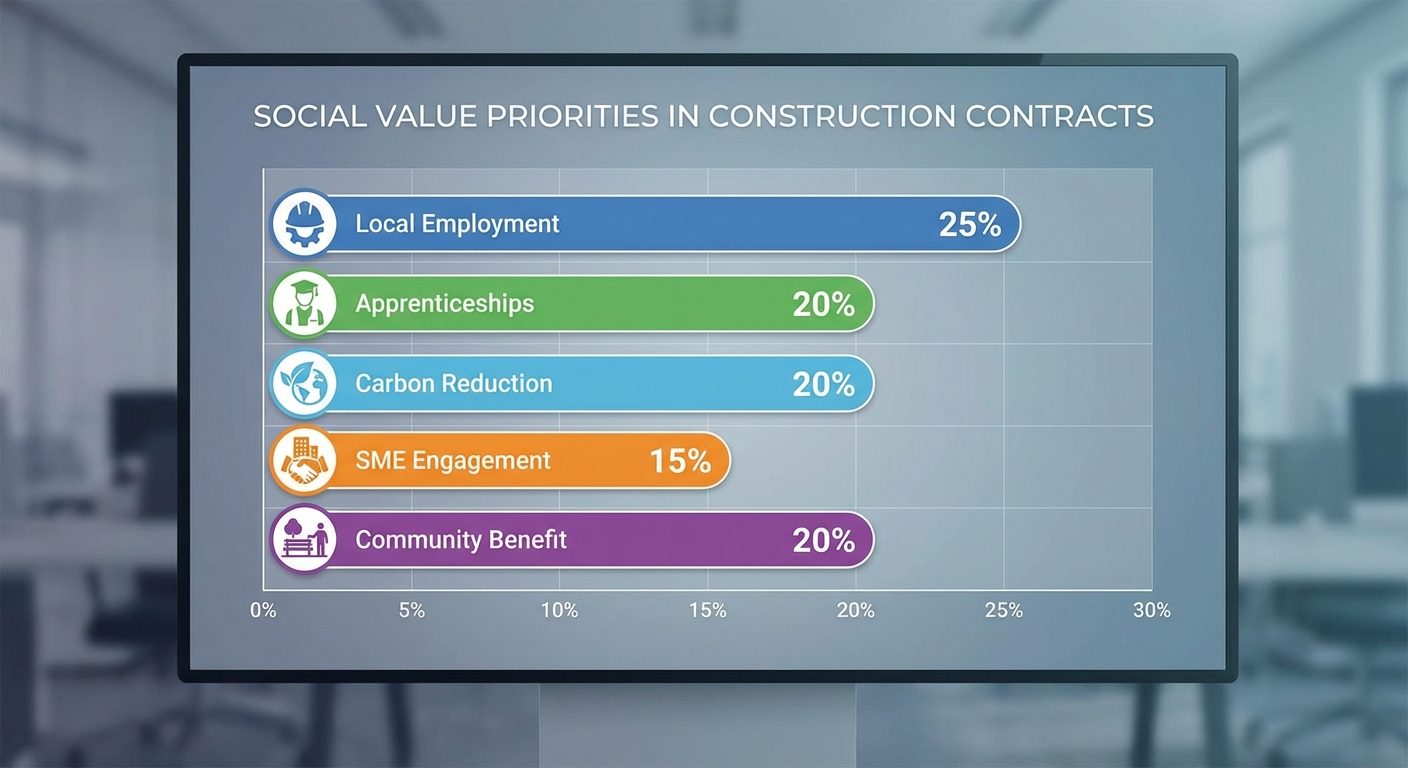
Social value priorities in construction contracts showing weighted categories
Social value commitments require monitoring and reporting throughout contract delivery. Tender responses should describe how achievement will be measured, reporting frequency and format, engagement with client monitoring processes, and remedial approaches if targets prove challenging.
Many authorities use the National TOMs (Themes, Outcomes, Measures) framework providing standardised metrics for social value reporting. Construction firms should familiarise themselves with TOMs methodology and describe how their monitoring aligns with these standard measures.
Technical Method Statements: Demonstrating Delivery Capability
Method statements form the technical core of construction tender responses, demonstrating how you will deliver the works to required standards whilst managing risks and maximising value. Strong method statements combine clear narrative, visual communication, and evidence of capability whilst addressing all evaluation criteria.
Structure and PresentationEffective method statements follow logical structure aligned with project lifecycle and evaluation criteria. A typical construction method statement includes project understanding summary, delivery strategy overview, detailed methodology for each work package, programme and sequencing, resource deployment, quality management approach, health and safety management, environmental management, risk management, and stakeholder engagement strategy.
Visual communication enhances method statement effectiveness. Diagrams illustrating construction sequences, site layouts showing logistics arrangements, programme charts depicting critical paths, and photographs of similar completed projects provide immediate clarity that dense text cannot achieve.
Many construction tenders impose page limits or word counts for method statements. Effective responses maximise content density through clear headings, bullet points, tables, and graphics whilst avoiding unnecessary narrative. Every paragraph should convey information relevant to evaluation criteria.
Project Understanding and ConstraintsDemonstrating deep understanding of project-specific challenges builds evaluator confidence. Strong method statements explicitly reference unique aspects of the project, site constraints, operational considerations, interface management requirements, and stakeholder sensitivities.
Construction firms should conduct thorough site analysis before tender submission, identifying access constraints, ground conditions, utility locations, adjacent operations, and environmental sensitivities. Documenting this analysis within method statements demonstrates diligence whilst enabling tailored solutions.
Interface management receives particular attention in construction projects involving multiple contractors or works within operational environments. Method statements should describe coordination approaches, communication protocols, programme integration, and quality boundary management demonstrating sophisticated understanding of interface risks.
Delivery MethodologyDetailed methodology sections describe how specific work packages will be executed. For each significant element, effective responses cover sequence of operations, plant and equipment to be deployed, materials and specifications, quality control measures, health and safety controls, environmental management, and verification of completion.
Generic methodology that could apply to any project lacks impact. Winning responses tailor methodology to specific project characteristics, demonstrating how standard approaches will be adapted to address unique challenges. For example, a piling methodology should reference specific ground conditions revealed in site investigation reports and explain how piling technique selection addresses these conditions.
Innovation adds competitive differentiation where appropriate. Modern construction methods, technology applications, or process improvements that accelerate delivery, reduce cost, improve quality, or minimise disruption should be highlighted with evidence of successful previous application.
Programming and SequencingConstruction programmes demonstrate deliverability and identify critical path activities. Tender responses should include high-level programmes showing major phases, intermediate milestones, and completion dates alongside more detailed programmes for critical or complex work packages.
Programme logic should be transparent, showing dependencies between activities, realistic durations based on productivity assumptions, adequate float for weather contingency and risk mitigation, and coordination with third parties or client operations. Unrealistically optimistic programmes lacking adequate contingency raise concerns about bidder competence.
Time-chainage charts, line of balance diagrams, or 4D simulation enhance programme communication for linear or repetitive works. These visualisations immediately convey sequencing logic in ways Gantt charts cannot achieve.
Resource DeploymentDescribing resource deployment demonstrates capability and deliverability. Method statements should detail key personnel including roles, experience, and time commitment; plant and equipment with specifications and availability; materials procurement approach and quality assurance; and subcontractor deployment with scope, interface management, and quality control.
Construction firms should name key personnel where possible, providing CVs demonstrating relevant experience. Generic references to "project manager with suitable experience" lack credibility compared to "Jane Smith, Chartered Civil Engineer with 15 years experience delivering similar infrastructure projects including ABC and DEF contracts."
Quality, Health & Safety, and Environmental ManagementConstruction tenders demand comprehensive management system descriptions addressing quality, health and safety, and environmental management. Responses should reference relevant ISO certifications whilst describing how standard systems will be applied to the specific project.
Quality management sections should cover inspection and test plans, hold points requiring client approval, material testing regimes, non-conformance management, and documentation approaches. Reference to project-specific inspection and test plans demonstrates preparation depth.
Health and safety management represents paramount importance in construction. Responses must describe hazard identification processes, risk assessment approach, method-specific controls, monitoring and supervision arrangements, emergency procedures, and worker competence verification. Evidence of positive safety culture through incident statistics, worker engagement initiatives, and continuous improvement demonstrates commitment beyond compliance.
Environmental management covers pollution prevention, waste minimisation, resource efficiency, biodiversity protection, and nuisance minimisation. Construction firms should quantify baseline environmental impacts and describe specific mitigation measures with measurable outcomes.
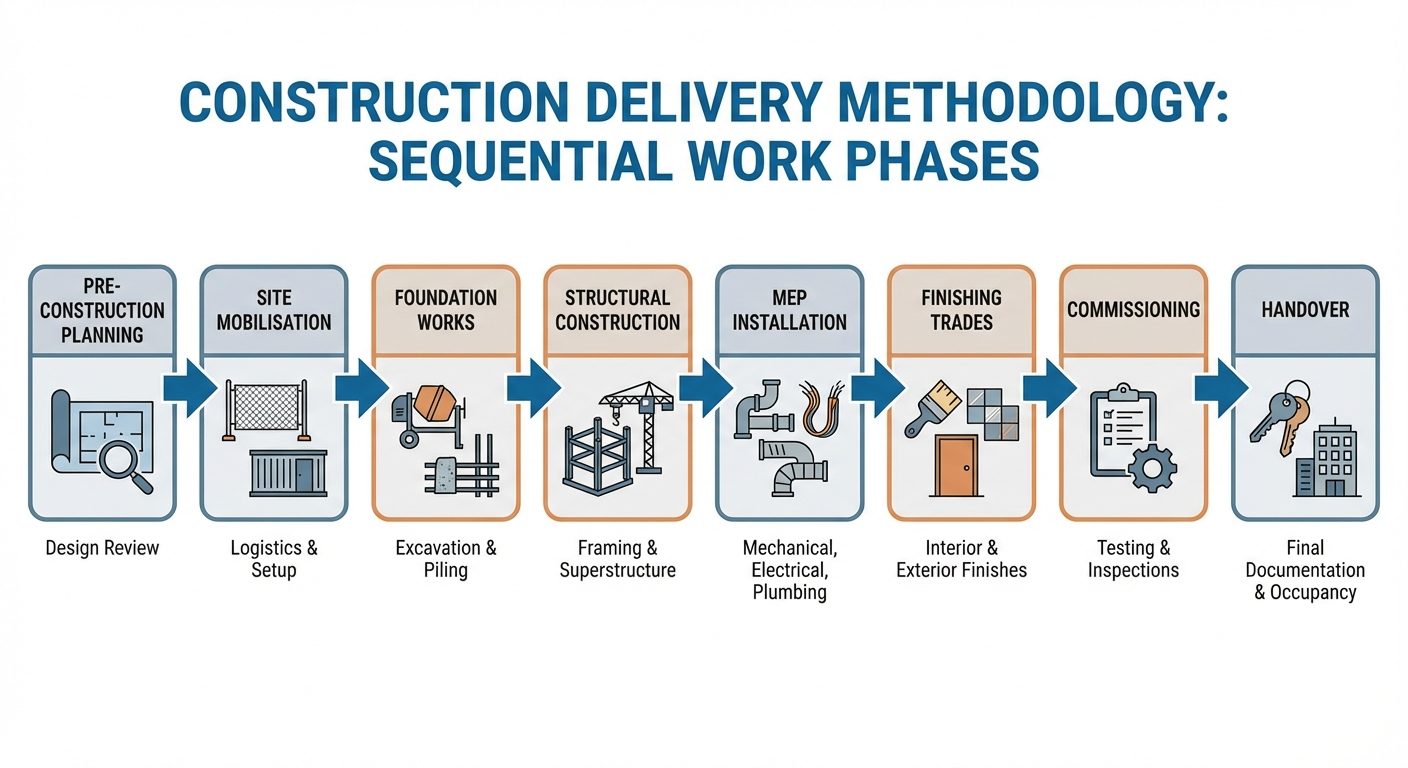
Construction delivery methodology diagram showing work phases
Pricing Strategy: Achieving Competitive Advantage
Construction tender pricing requires balancing competitiveness against commercial viability. Winning tenders with unviable pricing creates more problems than losing bids. Effective pricing strategy combines accurate cost estimation, strategic margin deployment, and risk-adjusted contingency whilst creating competitive differentiation through value engineering.
Cost Estimation FoundationAccurate cost estimation begins with thorough quantity takeoff from tender drawings and specifications. Construction firms should invest adequate time in measurement, using digital measurement tools where available to improve accuracy and efficiency. Measurement accuracy directly impacts estimate reliability.
Labour cost estimation requires realistic productivity assumptions based on site-specific conditions. Standard output rates must be adjusted for site access constraints, working hour restrictions, weather exposure, and coordination complexity. Experienced estimators develop adjustment factors based on previous project performance data.
Material pricing should reflect current market conditions with appropriate provisions for price escalation over contract duration. Construction firms should obtain competitive quotations from multiple suppliers, negotiating preliminary prices conditional on contract award. Materials represent significant cost components where procurement effectiveness directly impacts competitiveness.
Plant and equipment costs depend on ownership versus hire decisions. Owned plant requires allocation of standing costs and maintenance alongside operating costs, whilst hired plant involves hire rates with transport and establishment costs. Plant utilisation across multiple concurrent projects affects optimal ownership decisions.
Subcontractor and specialist pricing requires competitive quotations obtained early in tender preparation. Subcontractor costs often represent 50-70% of total construction costs, making subcontractor engagement critical to competitive pricing. Construction firms should maintain active subcontractor relationships enabling rapid mobilisation during tender periods.
Preliminary costs covering site establishment, temporary works, supervision, and facilities require project-specific assessment. Preliminaries typically represent 10-15% of total construction costs but vary significantly based on project duration, site constraints, and client requirements.
Margin and OverheadsConstruction margins reflect competitive intensity, risk exposure, project attractiveness, and market conditions. Typical main contractor margins range from 3-8% for public sector work, with subcontractors often working at higher margins of 10-15% given reduced risk exposure.
Overhead allocation ensures fixed business costs are recovered across the contract portfolio. Overheads include head office salaries, professional services, marketing, facilities, IT infrastructure, and other costs not directly attributable to specific projects. Typical overhead allocations range from 5-12% of turnover depending on business scale and structure.
Strategic margin deployment recognises that different project elements carry different risk profiles and competitive dynamics. Firms might apply lower margins to large-volume repetitive works where competition proves intense whilst accepting higher margins on complex or risky elements where fewer competitors possess capability.
Risk and ContingencyConstruction projects carry inherent uncertainty warranting contingency provisions. Effective contingency management identifies specific risks, quantifies potential impact, and applies appropriate provisions rather than blanket percentage additions.
Ground risk contingency addresses unforeseen ground conditions, archaeological discoveries, or contamination. The allocation depends on site investigation quality and ground condition certainty. Well-investigated sites warrant lower contingency than sites with limited investigation.
Programme risk contingency provides for weather delays, interface delays, or productivity variations. This reflects contract duration, seasonal factors, and complexity. Winter works or extended durations warrant higher weather contingency than short summer projects.
Design development risk applies where tender stage designs lack full detail. Provisional sums should be included for undefined elements, with clear assumptions documented to manage expectation and enable variation negotiation if assumptions prove inaccurate.
Client-side risk factors include late access, incomplete design information, approvals delays, or payment issues. Whilst public sector clients generally present lower payment risk than private clients, each project requires specific assessment.
Value Engineering and Alternative ProposalsValue engineering identifies opportunities to reduce cost or improve performance through design optimisation, specification changes, or methodology improvements. Construction firms should proactively develop value engineering proposals during tender preparation, demonstrating innovation and commercial awareness.
Effective value engineering maintains or enhances functional performance whilst reducing cost or accelerating programme. Proposals that compromise quality or performance to reduce cost lack appeal and may face rejection. The focus should be genuine efficiency improvement rather than corner-cutting.
Alternative technical solutions offer different approaches to achieving project objectives. Where tender documents permit alternatives, construction firms can propose innovative solutions leveraging their specialist capabilities. Alternative proposals require clear demonstration of compliance with performance requirements alongside cost and programme benefits.
Value engineering and alternative proposals should be presented clearly, quantifying cost impacts, programme effects, quality implications, and risk consequences. Client decision-makers need transparent information to evaluate alternatives against baseline solutions.
Responding to Quality Questions: Building Evaluator Confidence
Construction tenders increasingly rely on quality question evaluation alongside price comparison. Quality questions assess technical capability, relevant experience, resource adequacy, management system effectiveness, and social value delivery. Scoring typically allocates points based on response quality against defined evaluation criteria.
Understanding Evaluation MethodologyQuality questions typically employ scoring matrices with defined grade descriptors. A common approach uses five-point scales where responses score 0 (unacceptable), 1 (poor), 2 (acceptable), 3 (good), or 4 (excellent) against each criterion. Understanding these descriptors enables targeted responses calibrated to achieve excellent ratings.
Excellence typically requires comprehensive, evidenced responses demonstrating clear understanding, relevant experience, innovative approaches, and measurable outcomes. Good responses cover required ground competently with supporting evidence but lack the depth, innovation, or outcome focus of excellent responses.
Construction firms should carefully analyse evaluation criteria, identifying the specific requirements each question addresses. Responses must explicitly address every aspect of evaluation criteria whilst maintaining coherent narrative. Evaluators use criteria as checklists; any missed element results in point deductions regardless of overall response quality.
Structuring Winning ResponsesEffective quality responses follow clear structure that guides evaluators through your answer logically. A recommended approach includes brief restatement of question demonstrating understanding, concise statement of your approach or position, detailed explanation of methodology or delivery, evidence from previous experience demonstrating capability, and conclusion summarising key points.
This structure ensures comprehensive coverage whilst maintaining clarity. Evaluators reviewing dozens of responses appreciate clear signposting and logical flow enabling rapid comprehension of your proposal.
Word limits require ruthless prioritisation. Every sentence should advance your argument or provide evidence. Padding with generic statements wastes limited space and frustrates evaluators. Construction firms should draft responses without word limits initially, then edit aggressively to distill core messages within constraints.
Evidence and Case StudiesQuality responses require concrete evidence supporting capability claims. The most compelling evidence comes from similar previous projects demonstrating successful delivery of comparable requirements. Case studies should be concise but comprehensive, covering project description and context, client and contract value, delivery challenges relevant to current tender, specific approaches employed, measurable outcomes achieved, and client reference.
Quantified outcomes prove particularly powerful. Rather than claiming "successful delivery," specify "delivered 2 weeks ahead of programme, 3% under budget, with zero lost time incidents and client satisfaction score of 9.2/10." Specific metrics demonstrate genuine achievement and enable comparative evaluation.
Evidence should be relevant to evaluation criteria. A case study demonstrating exceptional community engagement provides limited value for questions about technical delivery methodology. Construction firms should maintain diverse case study libraries enabling selection of most relevant examples for each question.
Addressing Weaknesses and GapsConstruction firms sometimes face tender requirements beyond their direct experience. Honest acknowledgement combined with mitigation strategies proves more effective than attempting to disguise limitations. Approaches might include partnership with experienced firms through joint ventures, engagement of specialist consultants or subcontractors, recruitment of experienced personnel, or investment in training and capability development.
Where limited direct experience exists, related experience provides supporting evidence. A firm lacking experience in a specific building type might reference experience with similar structural systems, comparable procurement routes, or parallel technical challenges demonstrating transferable capability.
Common Quality Question TypesConstruction tenders typically include several standard question categories. Technical delivery questions assess methodology, programming, quality management, and risk management. These require detailed method statements demonstrating delivery capability.
Experience questions seek evidence of similar project delivery. Responses should provide multiple case studies demonstrating breadth and depth of relevant experience. Selection criteria should prioritise similarity in technical scope, contract value, procurement route, and delivery challenges.
Resource questions assess personnel capability, supply chain capacity, and plant availability. Responses should name key personnel with supporting CVs, detail supply chain partnerships, and specify plant holdings or hire arrangements.
Management system questions examine quality management, health and safety management, environmental management, and business continuity. Responses should reference ISO certifications whilst describing how certified systems apply to the specific project.
Social value questions assess local employment commitment, apprenticeship delivery, SME engagement, carbon reduction, and community benefit. These require specific measurable commitments with credible delivery plans.
Financial questions assess financial standing, insurance adequacy, and commercial approach. Responses require three years of accounts, insurance certificates, and explanation of commercial structure.
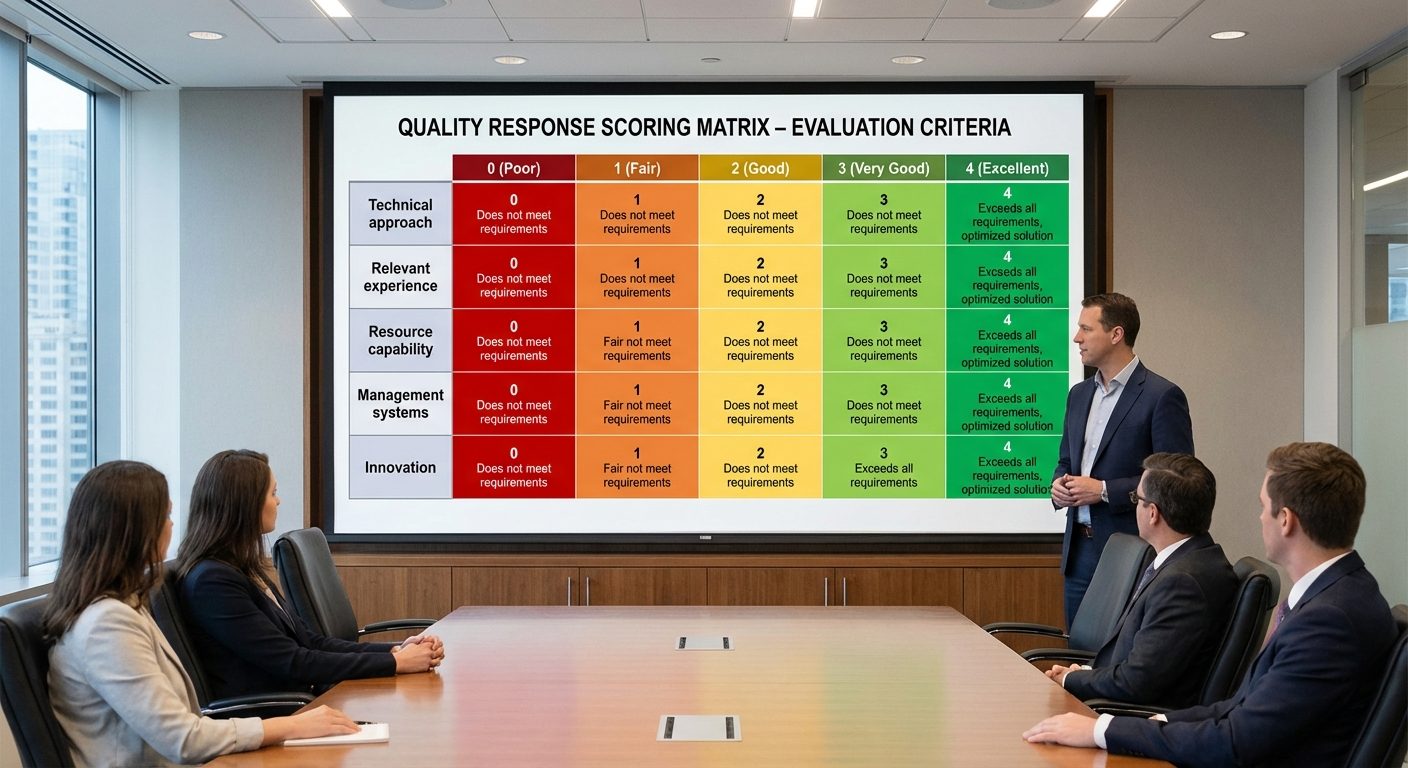
Quality response scoring matrix showing evaluation criteria
Compliance and Documentation Management
Construction tender responses require extensive supporting documentation demonstrating organisational capability, technical competence, and regulatory compliance. Missing or incomplete documentation frequently results in disqualification regardless of technical or commercial strength. Systematic documentation management prevents these costly errors.
Mandatory Documentation ChecklistMost construction tenders require similar core documentation. Firms should maintain current versions of all standard documents enabling rapid response to tender deadlines. Essential documentation includes company registration certificates and VAT registration, three years of audited accounts, insurance certificates covering professional indemnity, employer's liability, and public liability, health and safety policy and accreditation, quality management system certification, environmental management system certification, modern slavery statement, equal opportunities and diversity policy, data protection and GDPR compliance documentation, and anti-bribery and corruption policy.
Industry-specific certifications warrant particular attention. SSIP scheme membership, trade registrations like Gas Safe or NICEIC, Construction Line registration, ISO certifications, and CHAS or SafeContractor accreditation appear frequently in construction tender requirements.
Personnel documentation includes CVs for key personnel, professional qualifications and memberships, training records and competence verification, DBS checks where relevant, and right-to-work documentation. Many tenders require specific personnel to be named with commitment to deploy them on the project.
Technical capability documentation covers equipment lists with specifications, testing and calibration certificates, plant maintenance records, and evidence of technological capability where relevant to project requirements.
Document Currency and Version ControlConstruction firms should implement systematic processes ensuring documentation remains current. Insurance certificates typically require annual renewal, whilst certifications may have multi-year validity. Expired documents result in non-compliance findings and potential disqualification.
Version control ensures tender responses reference current documentation versions. A central documentation repository with clear version identification, expiry date tracking, and automated renewal alerts prevents outdated document submission.
Some documentation requires tender-specific customisation. Template policies may need project-specific details inserted, whilst generic method statements require adaptation to specific project requirements. Clear distinction between template content and project-specific content prevents inadvertent submission of inappropriate boilerplate.
Supplier Questionnaires and PrequalificationMany public authorities employ prequalification systems requiring completion of standard questionnaires before tender invitation. The Standard Selection Questionnaire (SSQ) in England, Single Procurement Document (SPD) in Scotland, and equivalent forms request information about financial standing, technical capability, health and safety management, quality assurance, and past performance.
Construction firms should maintain completed questionnaire templates requiring only minor updates for each submission. Core information about company structure, capabilities, certifications, and policies remains consistent across applications, enabling efficient reuse.
Prequalification submissions warrant similar care to tender responses. Incomplete or inadequate questionnaires result in exclusion from tender processes regardless of capability. Many firms lose opportunities at prequalification stage through poor questionnaire completion rather than insufficient capability.
Responding to Technical Specifications and StandardsConstruction tender specifications reference numerous British Standards, European Standards, and industry-specific technical standards. Responses must confirm compliance with all specified standards whilst flagging any areas where alternative standards or specifications are proposed.
Some tenders permit alternative specifications where equivalent performance can be demonstrated. Construction firms proposing alternatives must provide clear technical justification, evidence of comparable or superior performance, and cost implications. Alternatives should enhance value rather than simply reducing cost through lower specifications.
Where specifications appear unclear or potentially contradictory, firms should submit clarification requests through tender portals. Assumptions should be avoided; explicit clarification prevents misunderstandings and reduces variation risk during contract delivery.
Final Review and Submission Process
Construction tender submission represents the culmination of weeks of effort. Rushing the final review and submission process risks costly errors that undermine otherwise excellent responses. Systematic final checks prevent common pitfalls and ensure compliant, competitive submissions.
Multi-Stage Review ProcessEffective quality assurance employs multiple review stages addressing different aspects. Technical review verifies that method statements address all requirements, calculations are accurate, and technical content is correct. Commercial review checks pricing accuracy, completes commercial schedules correctly, and ensures financial and insurance documentation is current. Compliance review verifies all mandatory questions are answered, word limits and page limits are met, all requested documents are attached, and submission format requirements are followed.
Red team review involves experienced personnel not involved in bid development providing independent assessment. Red teams identify gaps, inconsistencies, or weaknesses that authors may overlook due to familiarity with content. This external perspective often identifies critical improvements in the final days before submission.
Construction firms should build adequate review time into tender programmes. Rushed reviews in the hours before deadline miss errors and prevent substantive improvements. A rule of thumb allocates 20-25% of total tender development time to review and refinement.
Common Submission ErrorsCertain errors appear repeatedly in construction tender submissions. Incomplete responses that fail to address all question elements score poorly regardless of content quality. Evaluators cannot assume answers or award credit for unstated information.
Exceeding word limits or page limits results in either score penalties or truncated responses where portals automatically cut off excess content. Ruthless editing to meet limits while preserving key messages proves essential.
Missing appendices or supporting documents create incomplete submissions. Tender portals should allow verification of uploaded documents before final submission. A checklist ensures every referenced document is actually attached.
Format errors where documents upload incorrectly, lose formatting, or become unreadable waste otherwise excellent content. PDF submission prevents format corruption whilst maintaining precise presentation control.
Incorrect pricing schedules, arithmetic errors, or incomplete cost breakdowns raise evaluator concerns about estimating competence and create potential for disputes. Independent calculation verification catches these errors before submission.
Submission Process ManagementPortal submission requires active management to prevent last-minute technical issues. Construction firms should familiarise themselves with portal functionality well before deadline, conduct test uploads to verify document compatibility, and maintain alternative submission routes (email, courier) as contingency.
Early submission provides contingency for technical issues whilst eliminating deadline pressure. Portals frequently experience heavy traffic near deadlines, creating upload delays or system failures. Firms targeting submission 2-4 hours before deadline build adequate buffer for problem resolution.
Some authorities require hard copy submission or specific formatting. Understanding submission requirements and preparing accordingly prevents disqualification due to technical non-compliance.
Post-Submission ActionsFollowing submission, construction firms should conduct post-tender reviews documenting lessons learned, estimating assumptions, and pricing decisions. This internal review supports subsequent contract negotiations and informs future tender approaches.
Many authorities conduct clarification meetings or presentations with shortlisted bidders before final selection. Construction firms should prepare presentation materials, coordinate key personnel availability, and develop responses to anticipated questions.
If unsuccessful, requesting feedback provides valuable intelligence for improving future responses. Contracting authorities typically provide scoring summaries identifying strengths and weaknesses. Systematic analysis of feedback over multiple tenders reveals recurring issues warranting attention.
Leveraging Technology: AI and Digital Tools in Construction Tendering
Technology transformation is revolutionising construction tender preparation, enabling firms to respond more efficiently, consistently, and competitively. Understanding and adopting appropriate technologies provides significant competitive advantage in 2026's digital-first procurement environment.
AI-Powered Tender Writing PlatformsModern tender writing platforms like mytender.io employ artificial intelligence to accelerate response development whilst improving quality and consistency. These platforms analyse tender requirements, suggest relevant content from previous responses, and maintain consistent messaging across multi-contributor teams.
AI systems can draft initial responses based on requirements analysis and available content libraries, providing starting points that human experts refine rather than creating content from scratch. This dramatically reduces time investment whilst maintaining quality through human oversight and customisation.
Quality checking capabilities identify missing requirements, flag inconsistent terminology, check compliance with word limits, and verify that evaluation criteria are fully addressed. Automated checking catches errors that manual reviews miss, particularly in lengthy, complex submissions.
Content reuse represents a key efficiency gain. Construction firms develop substantial content libraries over time covering standard capabilities, methodology, case studies, and policies. AI platforms intelligently retrieve and adapt relevant content for new tenders, accelerating development whilst ensuring consistency.
Digital Collaboration and Workflow ManagementConstruction tender development requires coordination across multiple contributors including estimators, technical specialists, commercial managers, and senior reviewers. Cloud-based collaboration platforms enable simultaneous contribution, version control, and structured workflow management.
These platforms provide visibility of contribution status, identify bottlenecks, enable real-time feedback, and maintain complete audit trails. Project managers can track progress across multiple concurrent tenders, identify resource constraints, and allocate personnel effectively.
Integration with document management systems ensures access to current certifications, policies, case studies, and templates. Centralised repositories eliminate duplicated effort searching for documents whilst ensuring version currency.
Data Analytics and IntelligenceTender analytics platforms aggregate data from multiple sources including public procurement portals, contract award notices, and private tender databases. Construction firms can analyse procurement patterns, identify upcoming opportunities, monitor competitor activity, and track win rates by client or sector.
Predictive analytics identify tender opportunities matching firm capabilities, estimate win probability based on historical patterns, and recommend optimal resource allocation across opportunity pipeline. Data-driven decision making improves go/no-go accuracy and resource deployment.
Performance tracking across completed tenders reveals strengths and weaknesses in tender approach. Analysing feedback themes, scoring patterns by question type, and win rate correlations with specific factors enables continuous improvement.
Document and Knowledge ManagementConstruction firms accumulate vast quantities of tender content, project documentation, and organisational knowledge over years of operation. Effective knowledge management systems make this intellectual capital accessible and reusable.
Searchable content libraries tagged by topic, project type, client, and question type enable rapid content retrieval. Rather than recreating case studies or method statements, authors locate similar previous content and adapt it for current requirements.
AI-powered search understands natural language queries and semantic relationships, returning relevant content even when exact keyword matches don't exist. This overcomes limitations of traditional search requiring knowledge of specific terminology or filing conventions.
Knowledge capture from completed projects feeds continuous improvement. Lessons learned, innovative approaches, and successful delivery examples become resources for future tender development rather than remaining locked in individual memories.
The construction tender writing landscape of 2026 demands far more than technical competence and competitive pricing. Success requires strategic thinking, regulatory compliance, compelling storytelling, and systematic process combined with emotional intelligence about client priorities and social value outcomes.
Firms that invest in tender capability development, adopt enabling technologies, maintain disciplined processes, and continuously learn from feedback will progressively improve win rates whilst building sustainable competitive advantage. Construction tender writing represents a sophisticated professional discipline warranting dedicated resources and ongoing skill development.
The Procurement Act 2023 has created both challenges and opportunities. Firms that embrace transparency, social value, and outcome-focused delivery will thrive in this new environment, winning not just contracts but building reputations as partners delivering genuine public value. Those that treat tendering as purely administrative burden or engage reactively will struggle against competitors who approach it strategically.
Technology platforms like mytender.io enable even small and medium-sized construction firms to compete effectively, democratising access to sophisticated tender writing capabilities previously available only to major contractors with dedicated bid teams. The playing field is levelling, creating opportunities for capability-driven success rather than scale-driven dominance.
The path to tender success begins with honest capability assessment, strategic opportunity selection, rigorous preparation, evidence-based content, and disciplined quality assurance. Master these fundamentals, leverage enabling technologies, and continuously refine your approach based on feedback and results. The construction opportunities exist; success depends on your capability to communicate value compellingly in competitive tender processes.
Tags
Ready to Transform Your Tender Writing?
See how MyTender's AI can help you write winning tenders in a fraction of the time.