

The Building Safety Act Competence Section: How to Write It Without Losing Marks
A practical guide to writing the Building Safety Act 2022 competence section in UK construction tenders. Covers the new dutyholder roles, the BSR competence framework, the golden thread, resident engagement, and the five mistakes that cost bid teams marks.
mytender.io Research Team
Tender Writing & Bid Management Specialists
The Building Safety Act Competence Section: How to Write It Without Losing Marks
It is 8pm the night before submission. The pricing schedule is locked. The case studies have been peer reviewed. Then the bid manager opens the file one last time and lands on the question they have been quietly dreading: "Demonstrate your organisation's competence under the Building Safety Act 2022."
Most bid teams panic here. The BSA competence section is newer than CDM, the language is unfamiliar, and the dutyholder roles are not the ones you have been writing about for the last decade. So bidders default to vague phrases about "qualified teams" and "compliance with relevant legislation", and they lose marks they did not need to lose.

Construction consultant reviewing compliance documents
This guide is written for bid managers who already know what the BSA 2022 is in outline, but who want to understand what evaluators are actually scoring and how to write a competence response that performs at Level 3 or 4.
Why the BSA Competence Question Is Different
CDM is familiar territory. The BSA is not. That difference is exactly what evaluators are testing for.
The Building Safety Act 2022 introduced a new statutory competence regime, specifically for higher-risk buildings (HRBs). The regime sits alongside CDM, not on top of it. An HRB is a residential building of at least 18 metres or 7 storeys, with at least two residential units. Care homes and hospitals meeting the height test are also captured during design and construction.
This is not CDM with a fresh coat of paint. The BSA introduced new dutyholders, a new regulator (the Building Safety Regulator, sitting inside HSE), a new statutory document trail (the "golden thread"), and a new gateway approval process for HRBs.
Most bid teams conflate CDM dutyholders with BSA dutyholders. That is a fatal error. When a tender asks about BSA competence, evaluators want to see that you understand the new regime as a regime, not as a footnote to CDM.
The Three Dutyholders Evaluators Test On
The BSA creates several dutyholder roles. Three of them carry the heaviest tender scoring weight, and bid teams routinely confuse all three.
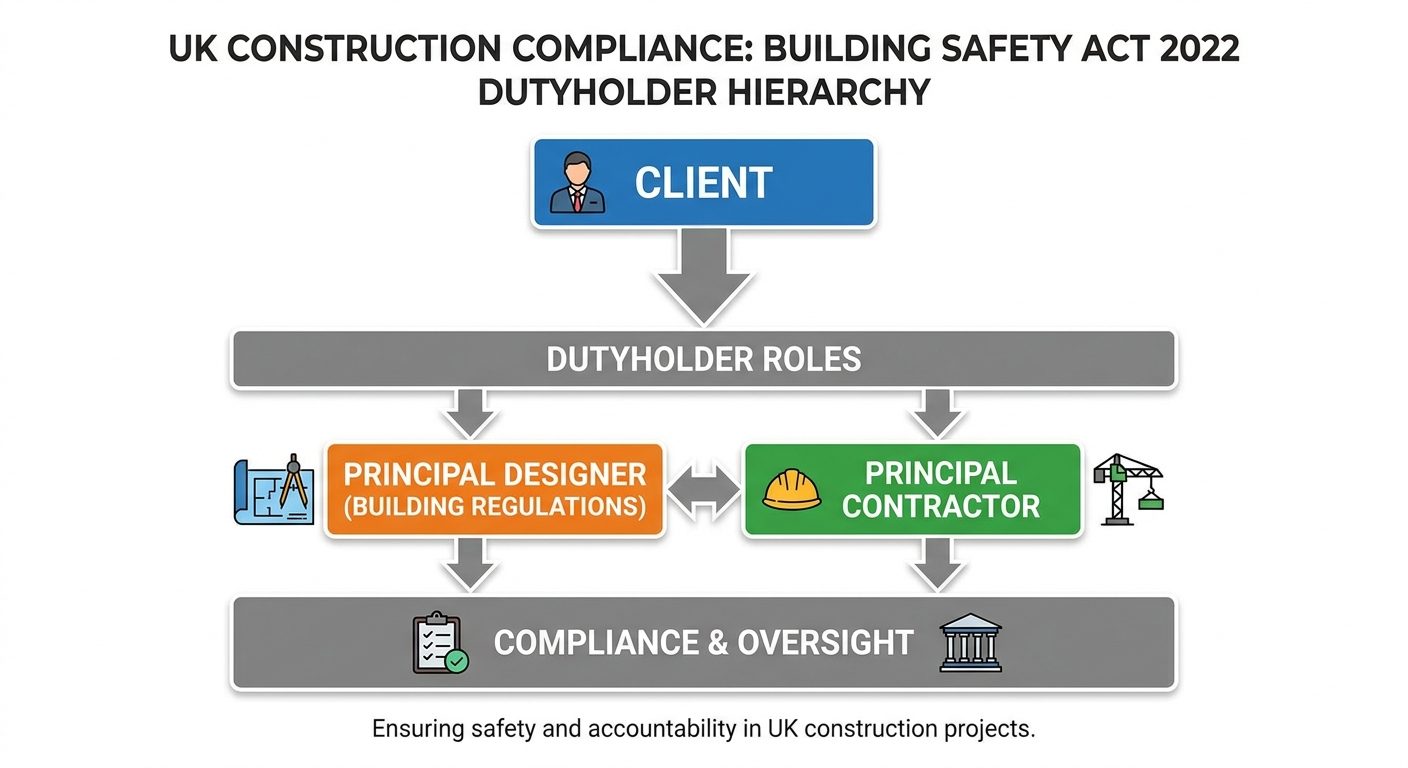
Building Safety Act dutyholder hierarchy
Principal Accountable Person (PAP)
The PAP is the entity with legal responsibility for the HRB in occupation. It is typically a freeholder, RMC, or registered provider. The PAP must register the building with the BSR, apply for a Building Assessment Certificate, and discharge a wide range of statutory duties around fire and structural safety.
For tenders, evaluators want to see that you understand which entity is the PAP on the proposed contract, and how your role supports the PAP in discharging its duties. If you are bidding to be the PAP, that is a different (and much more onerous) commitment than supporting one.
Accountable Person (AP)
An AP is any organisation or individual with a repair or maintenance obligation under a lease or relevant agreement, in relation to an HRB. There can be multiple APs in one building. Each AP has duties around assessing and managing building safety risks in the parts of the building they control.
In a tender, evaluators look for clarity on whether your scope makes you an AP at all, and if so, which obligations you are taking on. Service charge contracts, lifecycle works contracts, and PPM contracts can all create AP duties. Pretending they do not is the fastest way to score badly.
Building Safety Manager (BSM)
The BSM is the AP's day-to-day operative for managing building safety risks on an HRB. The BSA originally mandated the BSM role in primary legislation, and although the formal statutory requirement was softened during implementation, the function is still very much expected in practice, and tender questions still ask about it.
The BSM's competence must be assessed against the BSR's framework. For tenders, evaluators want a named individual (or named role with a clear competence pathway), evidence of the assessment process, and a description of how the BSM interfaces with the AP, the residents, and the BSR.
The headline rule: in your response, name the role you are being asked to fill, name the statutory obligations of that role, and do not muddle one dutyholder with another.
The Competence Framework: What Evaluators Actually Score
The BSR has published competence frameworks for BSMs and other duty roles. These frameworks underpin how serious evaluators score the BSA section.
Competence under the BSA is assessed across three dimensions: knowledge (do you understand the legislation and standards), skills (can you apply them in practice), and experience (have you done it before, with evidence). All three must be present for a competent claim.
A Level 1 answer looks like this: "We have a competent team and adhere to all relevant legislation, including the Building Safety Act 2022 and associated regulations." This scores nothing useful. There is no named person, no evidence, no link to the building in question.
A Level 3 or 4 answer looks very different. It names the individual proposed for the role. It cites their CIOB, RICS, CABE, IFE or Chartered qualification. It references their specific HRB project experience, with floor counts, building types, and AP names where permissible. It describes the competence assessment process the individual has been through, and how that assessment maps to the BSR framework.
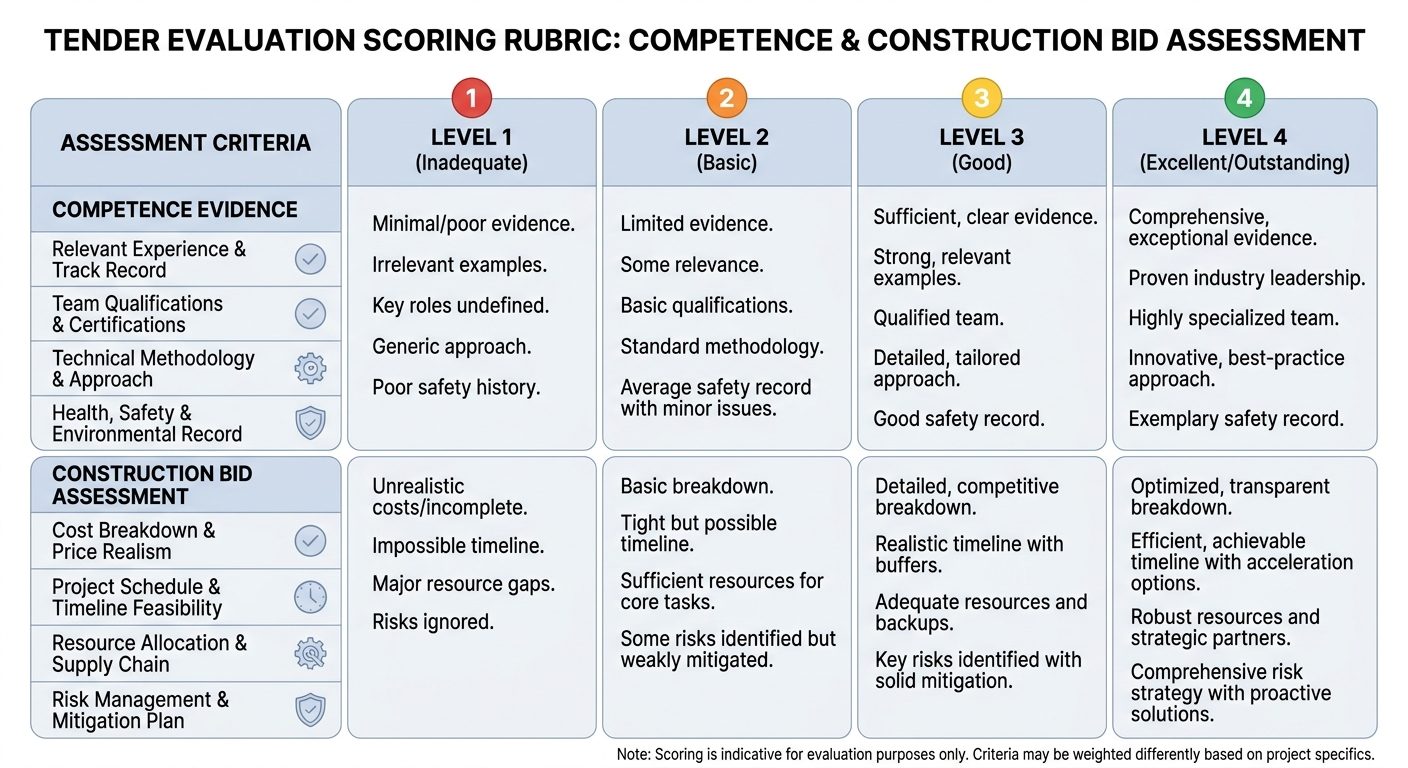
BSA competence scoring rubric
The same logic applies even when you are not proposing a BSM. Evaluators looking at BSA competence for any HRB-adjacent contract are scoring named, evidenced, framework-aligned competence. Generic "team" language caps you at Level 2.
The Golden Thread: Don't Ignore It
The BSA 2022 requires Accountable Persons to maintain the golden thread: a live, structured, digital record of the information needed to keep the building safe across its lifecycle. The golden thread is not a folder of PDFs. It is intended to be a controlled, accessible, current set of information that any future dutyholder can rely on.
Tender evaluators for HRB-adjacent contracts increasingly ask: "How will you maintain and contribute to the golden thread?" Many bid teams have no idea this question exists until it appears in the ITT.
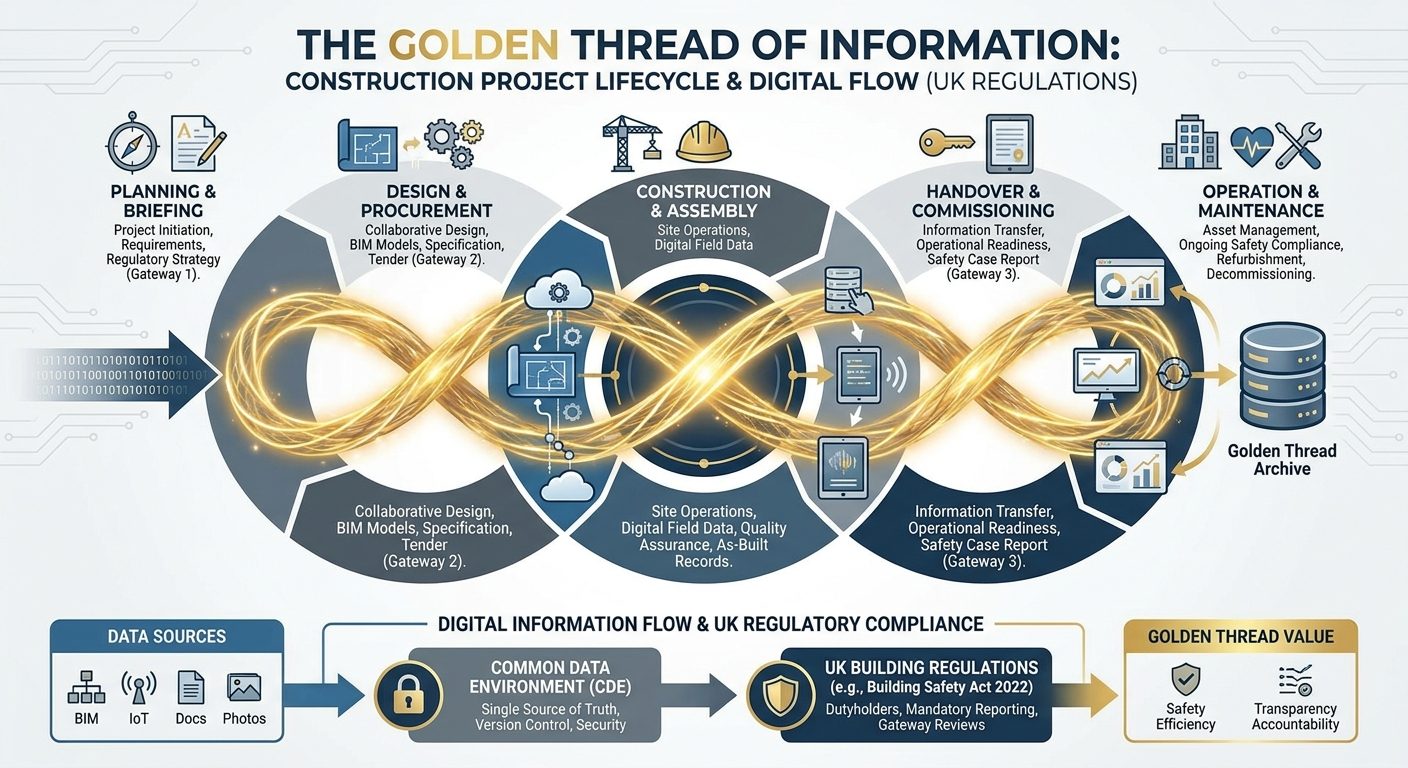
Golden thread of building safety information
A Level 1 answer: "We will maintain records in accordance with statutory requirements."
A Level 3 or 4 answer:
- Names the specific software or BIM environment used (for example, the CDE platform, the asset management system, or the document control tool).
- Describes the information classification used (BS 8644-1 alignment is a strong signal of seriousness).
- Names the role responsible for golden thread updates on the contract.
- Specifies the handover protocol at contract end, including format, completeness check, and how the receiving AP confirms acceptance.
- References how design changes, replacements, and incidents are reflected in the golden thread in near-real time, not at annual review.
A small but useful aside: keeping a structured, reusable bid library makes golden-thread-ready answers far easier to produce. If your previous HRB project descriptions, named individuals, and process write-ups already live in a clean library, you can pull them into a fresh response in minutes rather than rebuilding from scratch. We built mytender.io partly around this idea.
Resident Engagement: The Often-Missing Section
The BSA 2022 created statutory rights for residents of HRBs to engage with the Accountable Person on building safety. The AP must publish a resident engagement strategy, must respond to complaints within statutory timescales, and must enable residents to escalate to the BSR if the AP fails to act.
Some tender questions ask directly: "Describe your resident engagement framework for building safety." This is not a social value question. It has a statutory basis, and evaluators score it against the BSA resident engagement framework, not against generic community benefit thinking.
A strong response covers:
- Named contact routes for residents (phone, email, portal, in-person).
- Response timescales aligned with the statutory framework (the 28-day complaint response period being the most commonly cited).
- Escalation pathway, including to the BSR if the AP fails to act.
- How residents are informed about safety information, both proactively (annual updates, building manager visits) and reactively (post-incident communication).
- How feedback is fed into the golden thread and risk assessment review cycles.
If a tender asks about resident engagement and you treat it as social value, you have already lost the section.
Five Mistakes That Cost Marks
Across BSA competence sections, the same patterns of marks loss come up again and again. The most damaging are below.
Using CDM dutyholder language when answering BSA questions. Talking about Principal Designers and Principal Contractors in a question about BSA dutyholders shows you are recycling CDM content without thinking. The BSA introduced different roles; use the right ones. Naming a "team" rather than a named individual. "Our experienced team holds the relevant qualifications" is a Level 1 phrase. Name the person, cite their qualifications, cite their assessment. Ignoring the golden thread requirement entirely. Bid teams that never mention the golden thread signal that they have not engaged with the BSA in depth. Evaluators notice. Treating resident engagement as a social value add-on. Resident engagement under the BSA has a statutory basis. Treating it as "community benefit" misses the point and the marks. Copying CDM construction phase plan language wholesale. A CPP is not a BSA safety case. Pasting CPP content into a BSA answer reveals that the bid library has not been updated since 2022, and evaluators infer a wider lack of currency in your systems.Practical Drafting Checklist
Before submitting any BSA competence response, run it through this short list:
- Have you confirmed whether the proposed contract relates to a higher-risk building under the BSA definition?
- Have you identified which BSA dutyholder roles you are taking on (PAP, AP, BSM, supporting role)?
- Have you named the individuals for each role and evidenced their competence against the BSR framework?
- Have you described how the golden thread will be created, maintained, and handed over, with named systems and named roles?
- Have you addressed resident engagement, with statutory timescales and escalation routes?
- Have you stripped any CDM dutyholder language from BSA-specific paragraphs?
- Have you referenced specific HRB project experience, with floor counts and building types where permissible?
- Have you avoided the phrase "competent team" in favour of named, evidenced individuals?
If you can answer yes to most of these, you are competing at Level 3 or 4. If you cannot, the response is sitting in Level 1 or 2 territory regardless of how long the section is.
A Closing Thought
The BSA competence section is still relatively new. That means most competitors are getting it wrong. The bidders who treat it as a serious test of competence, with named individuals, evidenced experience, golden thread detail, and proper resident engagement, are pulling ahead.
That is the opportunity. The section that feels uncomfortable to write is the section where the most marks are sitting on the table.
If you want live HRB-adjacent opportunities to practise on, the Tender Finder lists open construction and FM contracts where BSA competence questions are increasingly common. Worth a look before the next one lands in your inbox.
Tags
Ready to Transform Your Tender Writing?
See how MyTender's AI can help you write winning tenders in a fraction of the time.