
Supplier Debarment List & Transparency Requirements: Complete Procurement Act 2023 Guide for 2026
Everything suppliers need to know about the UK central debarment list, mandatory and discretionary exclusion grounds, payment notices, contract performance notices, and self-cleaning procedures under the Procurement Act 2023 — now fully in effect.
Evie
Procurement Specialist
The Procurement Act 2023 reshaped public procurement in the United Kingdom. Among the most consequential changes for suppliers is the introduction of a central debarment list and a set of transparency requirements that go far beyond anything the previous regime demanded. If you supply goods, services, or works to UK public bodies, these provisions affect you directly.
This article is part of our Procurement Act series. For an overview of what changed and links to every guide in the series, see our Procurement Act 2023 supplier's guide.
This guide explains what the debarment list is, how it works in practice, what the new transparency requirements mean for your business, and what you need to do to stay compliant. Whether you are a large contractor or an SME tendering for your first public contract, the information here is essential reading in 2026 and beyond.

Overview of the UK supplier debarment list process flow under the Procurement Act 2023
What Is the Central Debarment List?
The central debarment list is a register of suppliers who have been formally excluded from participating in public procurement in the United Kingdom. It was introduced by the Procurement Act 2023 and became operational when the Act came into full force in February 2025.
Before the Act, exclusion decisions were made individually by each contracting authority. If a supplier had been excluded from one contract for serious misconduct, there was no systematic way for other public bodies to know about it. A supplier could be banned by one council and successfully bid for a contract with another the following week. The system was fragmented, inconsistent, and widely criticised.
The debarment list solves this. It is a single, centrally maintained register managed by the Cabinet Office. When a supplier is placed on the debarment list, every contracting authority in the country can see it. The list is public, searchable, and linked to the Central Digital Platform that underpins the new procurement regime.
Why It Matters
For suppliers, the debarment list changes the stakes. A serious compliance failure is no longer a localised problem. It becomes a national one. Being placed on the list effectively locks you out of the public procurement market across the entire UK, potentially for years.
For contracting authorities, the list provides clarity. Instead of conducting independent due diligence on exclusion grounds from scratch for every procurement, they can check a single authoritative source. This streamlines the assessment process and reduces the risk of a problematic supplier slipping through the net.
For the public, the list delivers accountability. Taxpayer-funded contracts are now subject to a visible enforcement mechanism. Companies that engage in fraud, corruption, or persistent poor performance face real, public consequences.
How the Debarment List Works
The debarment list operates through a structured process involving investigation, decision, and review. Understanding this process is important for any supplier, because it defines both the risks you face and the rights you have if your organisation is ever the subject of a debarment investigation.
The Investigation Phase
Debarment investigations can be triggered by several routes:
- Referral by a contracting authority. If a public body encounters evidence of serious misconduct by a supplier during a procurement or contract, it can refer the matter to the debarment team at the Cabinet Office.
- Intelligence from other government bodies. Information from regulators, enforcement agencies, or auditors can prompt an investigation. For example, a conviction for fraud reported by the Serious Fraud Office could trigger a referral.
- Proactive monitoring. The Cabinet Office has the power to initiate investigations based on information that comes to light through contract performance data published on the Central Digital Platform, media reports, or whistleblower disclosures.
- Supplier self-disclosure. In some circumstances, suppliers may self-report issues that could constitute exclusion grounds, particularly as part of a self-cleaning exercise (more on this below).
The Decision
Once an investigation is complete, the Minister responsible (or a senior official acting under delegated authority) makes a determination. The key question is whether the supplier meets the criteria for either mandatory or discretionary exclusion. If the answer is yes, the supplier is placed on the debarment list for a specified period.
Suppliers have the right to make representations before a final decision is taken. This is a critical safeguard. If you receive notice that your organisation is under consideration for debarment, you should treat it as a matter of the highest urgency and seek specialist legal advice immediately.
Duration and Review
Debarment is not permanent by default. The length of a debarment period depends on the severity of the grounds and is set at the time of the decision. Suppliers can apply for removal from the list before the end of the debarment period if they can demonstrate that they have successfully addressed the underlying issues — a process known as self-cleaning.
The list is reviewed periodically, and suppliers whose debarment periods have expired are removed automatically.
Mandatory Exclusion Grounds
The Procurement Act 2023 distinguishes between mandatory and discretionary exclusion grounds. Mandatory grounds are the most serious. If a supplier (or a person connected to the supplier, such as a director or shareholder with significant control) meets any of the mandatory grounds, the contracting authority must exclude them from the procurement. There is no discretion.

Mandatory exclusion grounds checklist for UK public procurement under the Procurement Act 2023
The mandatory exclusion grounds include:
Criminal Offences
- Fraud and financial offences. Convictions for fraud, theft, bribery, money laundering, or tax evasion by the supplier or a connected person.
- Terrorism offences. Convictions for offences under UK terrorism legislation.
- Modern slavery. Convictions under the Modern Slavery Act 2015.
- Organised crime. Convictions for participation in a criminal organisation.
- Corruption. Convictions for offences involving corruption of public officials.
Other Mandatory Grounds
- Non-payment of tax or social security contributions. Where there has been a binding judicial or administrative decision confirming the breach, and no satisfactory arrangements for payment have been made.
- Professional misconduct proven by a court or professional body. Where the misconduct is sufficiently serious and has been formally established.
What "Connected Person" Means
A critical detail: the exclusion grounds apply not only to the supplier entity itself but also to connected persons. This includes directors, officers, and persons who exercise significant influence or control over the organisation. If a director of your company has a relevant conviction, the entire company can be caught by the mandatory exclusion grounds.
This makes director and officer vetting a compliance priority. You need robust processes to check the backgrounds of anyone in a position of influence within your organisation, and you need to update those checks regularly.
Discretionary Exclusion Grounds
Discretionary exclusion grounds give contracting authorities the option, but not the obligation, to exclude a supplier. The decision depends on the nature and severity of the issue, how recent it is, and whether the supplier has taken remedial action.
The discretionary grounds are broader than the mandatory ones and cover a wider range of conduct:
Performance-Related Grounds
- Significant or persistent deficiencies in performance of a prior public contract. If a supplier has a documented history of failing to deliver on contractual obligations, this can be used as a basis for exclusion.
- Early termination of a prior public contract due to supplier fault. If a contracting authority has previously terminated a contract with the supplier for underperformance or breach, this may be cited.
Conduct-Related Grounds
- Grave professional misconduct that calls into question the supplier's integrity. This does not require a criminal conviction — it can be established through any appropriate means.
- Distortion of competition. Evidence that the supplier has engaged in anti-competitive behaviour, such as bid-rigging or cartel activity, even where a criminal prosecution has not been brought.
- Conflict of interest that cannot be effectively remedied by other means. Where a supplier's involvement in a procurement creates a conflict that undermines the fairness of the process.
- Misrepresentation. Providing false or misleading information in connection with a procurement, or failing to disclose required information.
Organisational Grounds
- Insolvency, winding up, or administration. Where the supplier is subject to insolvency proceedings or is in a comparable financial state. This does not automatically mean exclusion — contracting authorities assess whether the supplier can still perform the contract.
- Environmental, social, or labour law breaches. Violations of applicable obligations in these areas, where established by a court or administrative decision or otherwise provable.
The Proportionality Test
For discretionary grounds, contracting authorities must apply a proportionality test. They need to consider the seriousness of the issue, how long ago it occurred, whether the supplier has taken steps to put things right, and the potential impact on the procurement. A minor or historical issue that has been fully addressed may not justify exclusion.
This is where self-cleaning becomes essential. Even if your organisation has a discretionary exclusion ground in its past, demonstrating credible remediation can prevent exclusion.
How Suppliers Get Added to the Debarment List
The route onto the debarment list is through a formal process managed by the Cabinet Office. It is not something that happens overnight or without due process.
The typical sequence is:
- Trigger event. A contracting authority, government body, or the Cabinet Office itself identifies a potential exclusion ground.
- Preliminary assessment. The debarment team reviews the evidence to determine whether a full investigation is warranted.
- Investigation. The team gathers evidence, which may include reviewing court records, contract performance data, regulatory findings, and information from the supplier itself.
- Notice to the supplier. The supplier is informed that debarment is being considered and is given the opportunity to make representations. This is where your right to be heard applies.
- Decision. Based on the evidence and the supplier's representations, a decision is made. If the grounds are established and proportionate, the supplier is placed on the list.
- Publication. The debarment entry is published on the Central Digital Platform, making it visible to all contracting authorities and the public.
What Information Is Published
The debarment list entry includes:
- The supplier's name and registered details.
- The exclusion ground(s) that apply.
- The date the debarment was imposed.
- The duration of the debarment.
- A summary of the circumstances.
- Whether the debarment is mandatory or discretionary.
This transparency is deliberate. The system is designed to ensure that the consequences of serious misconduct are visible and that all contracting authorities have the information they need.
Payment Notice Requirements
One of the most significant transparency provisions in the Procurement Act 2023 is the requirement for contracting authorities to publish payment notices for payments above a threshold.
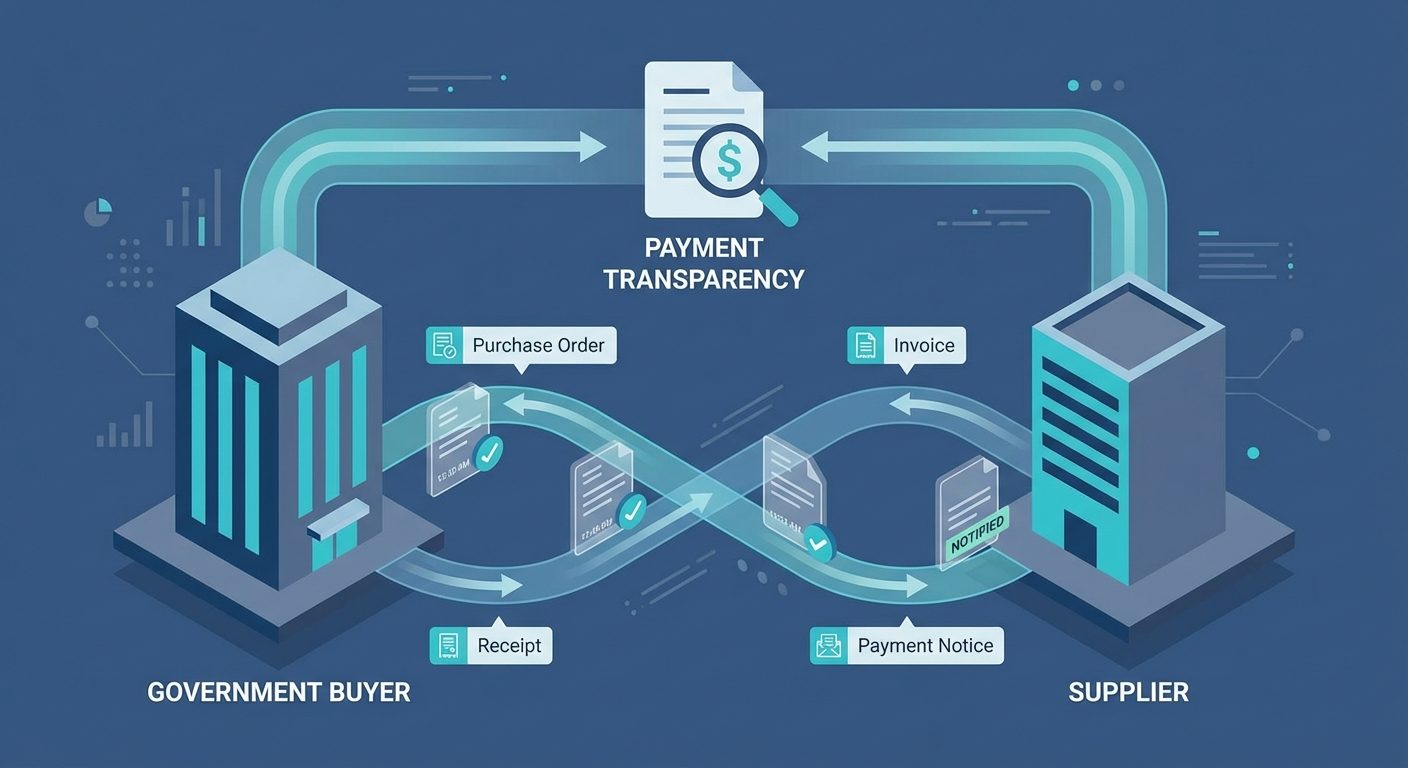
Payment notice transparency requirements in UK public procurement
The Rules
Under the Act, contracting authorities must publish a notice on the Central Digital Platform every time they make a payment of more than 30,000 pounds under a public contract. The notice must include:
- The name of the supplier receiving the payment.
- The amount of the payment.
- The date of the payment.
- A description of what the payment relates to.
- The contract reference.
Why This Matters for Suppliers
Payment notice transparency has several implications:
Cash flow visibility. Your payment receipts from public contracts are now on the public record. Competitors, journalists, and the public can see what you are being paid and when. This is a significant shift from the previous regime, where payment information was typically not proactively disclosed. Late payment accountability. The payment notice regime also shines a light on payment timing. If a contracting authority is consistently paying late, that pattern becomes visible. This gives suppliers evidence to support complaints and creates pressure on buyers to pay on time. For suppliers struggling with late payments from public bodies, this is a welcome development. Supply chain transparency. Payment notices, combined with other transparency requirements, make it possible to build a clearer picture of how public money flows through the supply chain. This supports scrutiny by Parliament, auditors, and the public. Competitive intelligence. In practical terms, published payment data gives you and your competitors visibility into each other's public sector revenue. This is something to be aware of when developing pricing strategies.Compliance for Suppliers
As a supplier, you do not publish payment notices yourself — that is the contracting authority's obligation. However, you should be aware that:
- Your payment data will be published, so ensure your invoicing is accurate and reflects the work delivered.
- Discrepancies between payments and contract terms could attract scrutiny.
- You can use published payment data to monitor whether you are being paid in accordance with contract terms.
Contract Performance Notices
Alongside payment notices, the Procurement Act 2023 requires contracting authorities to publish contract performance notices. These are periodic reports on how a contract is performing against the agreed terms, including any KPIs.
What Contract Performance Notices Include
A contract performance notice typically covers:
- Whether the contract is on track, at risk, or in breach.
- Performance against agreed KPIs.
- Any modifications that have been made to the contract.
- Issues that have arisen during delivery.
- Actions taken to address underperformance.
The Impact on Suppliers
Contract performance notices create a public track record for every supplier holding a significant public contract. This has far-reaching implications:
Your performance is on display. Good or bad, your delivery record is visible. Future contracting authorities assessing your bids will look at this record. A strong history of on-time, on-budget delivery becomes a genuine competitive advantage. A pattern of underperformance becomes a liability. It connects to debarment. Persistent poor performance documented through contract performance notices can constitute discretionary exclusion grounds. If your performance record shows repeated failures, it could form the basis of a debarment investigation. The system is designed to create this linkage. It creates accountability. Both parties are accountable. If the contracting authority has contributed to performance issues (for example, by failing to provide access to a site or delaying approvals), that should be reflected in the notice. Suppliers have an interest in ensuring performance notices accurately reflect the facts. It supports bid strategy. Strong performance notices are evidence you can reference in future bids. When a tender asks you to demonstrate relevant experience and track record, being able to point to independently published performance data is powerful.Checking the Debarment List Before Bidding
Before submitting a bid for any public procurement, you should check the debarment list. This is not just good practice — it is essential due diligence.
How to Check
The debarment list is accessible through the Central Digital Platform. You can search by supplier name, company registration number, or other identifying details. The platform provides current debarment status, the grounds for any active debarment, and the period of exclusion.
Why You Should Check Your Own Status
It may seem obvious, but you should periodically check your own organisation's status on the debarment list. Reasons include:
- Connected person changes. If a new director or officer has been appointed, their background could introduce exclusion grounds you were not previously aware of.
- Historical issues. An old conviction or regulatory finding involving a connected person might have been disclosed to the Cabinet Office without your knowledge.
- Data accuracy. Errors can occur. If incorrect information appears on the list relating to your organisation, you need to identify and challenge it promptly.
Checking Subcontractors and Partners
If you plan to subcontract part of a public contract, or to bid as part of a consortium, you should also check the debarment status of your proposed subcontractors and partners. A debarred subcontractor can create problems for your bid and, if discovered after contract award, can lead to serious contractual consequences.
Contracting authorities are required to verify that neither the main contractor nor key subcontractors are on the debarment list. You should do your own verification as part of your pre-bid due diligence rather than relying on the buyer's checks.
Self-Cleaning: How to Get Off (or Stay Off) the Debarment List
Self-cleaning is one of the most important concepts in the new debarment regime. It refers to the steps a supplier takes to address the underlying issues that gave rise to an exclusion ground, with the aim of demonstrating that they are now fit to participate in public procurement.
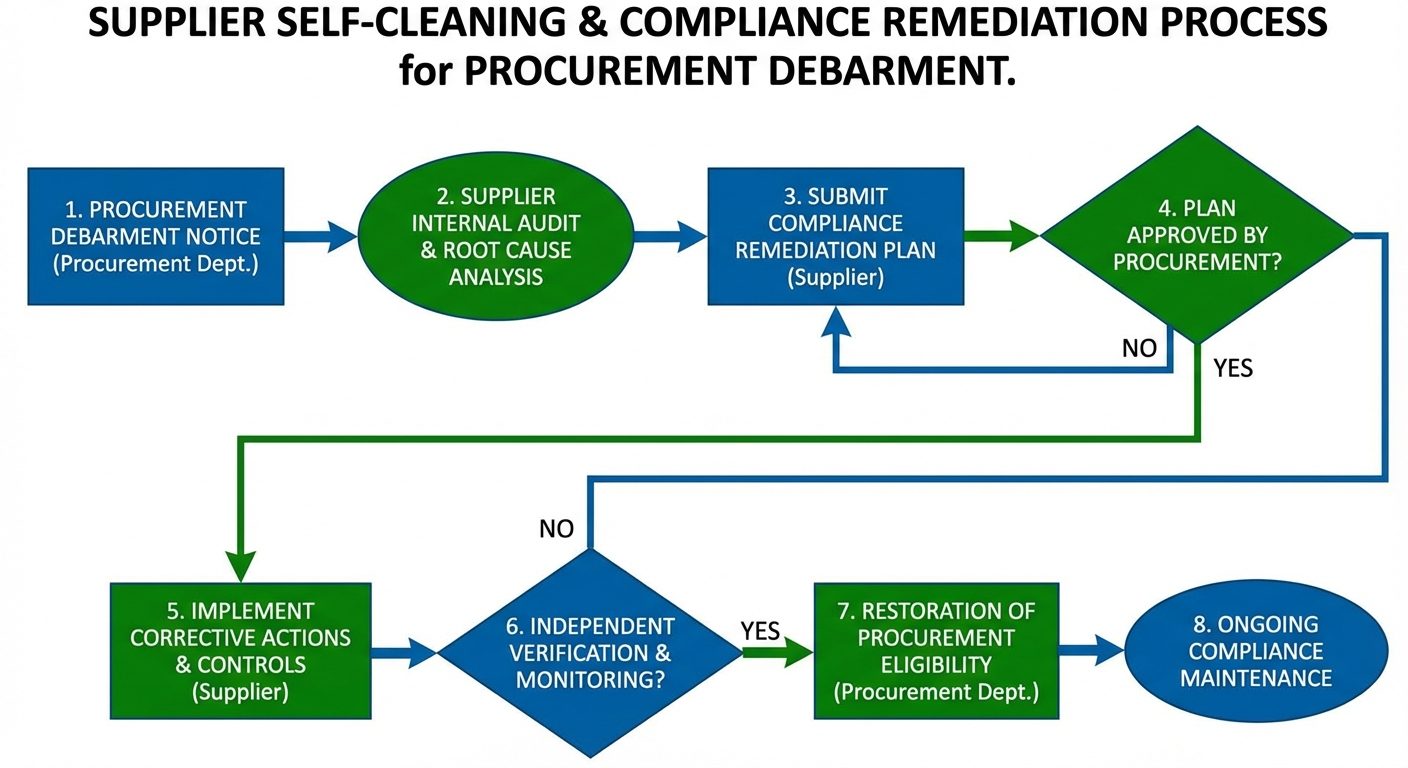
Supplier self-cleaning and compliance remediation process for procurement debarment
When Self-Cleaning Applies
Self-cleaning is relevant in two scenarios:
- Before debarment. If your organisation has an exclusion ground but has not yet been placed on the debarment list, demonstrating effective self-cleaning can persuade a contracting authority (or the Cabinet Office) not to proceed with debarment.
- After debarment. If your organisation is already on the debarment list, successful self-cleaning can support an application for early removal.
What Effective Self-Cleaning Looks Like
The Procurement Act 2023 does not prescribe a one-size-fits-all self-cleaning process, but the following elements are generally expected:
Acknowledgement and accountability. The supplier must acknowledge the issue openly and honestly. Minimising, denying, or deflecting is counterproductive. Contracting authorities and the Cabinet Office want to see genuine accountability. Investigation and root cause analysis. The supplier should conduct a thorough internal investigation to understand how the issue arose, who was involved, and what systemic failures contributed to it. Remedial action. Concrete steps must be taken to address the problem. This could include:- Terminating the employment of individuals responsible for the misconduct.
- Implementing or strengthening compliance programmes, including training, policies, and internal audit functions.
- Engaging independent compliance monitors or auditors.
- Making restitution to affected parties where applicable.
- Cooperating fully with any ongoing investigations by regulators or law enforcement.
The Assessment
When a supplier presents self-cleaning evidence, the contracting authority (or the Cabinet Office in the case of debarment decisions) assesses whether the measures taken are sufficient to establish the supplier's reliability. The key question is: has the supplier done enough to address the underlying problem and prevent recurrence?
Factors considered include the severity of the original issue, the time that has passed, the quality and scope of the remedial measures, and whether the supplier cooperated with authorities during the investigation.
Impact on Tender Writing and Bid Strategy
The debarment list and transparency requirements have practical implications for how you write tenders and develop your bid strategy. Smart suppliers are already adapting their approach.
Addressing Exclusion Grounds in Your Bid
Most public procurement processes include a selection stage where suppliers are asked to declare whether any exclusion grounds apply to them. Under the new regime, this declaration carries more weight because it is cross-referenced against the debarment list and other public data.
Be truthful and complete. The temptation to omit or downplay a past issue is understandable but dangerous. Misrepresentation is itself a discretionary exclusion ground. If an issue comes to light after contract award, the consequences are severe: contract termination, potential debarment, and reputational damage. If self-cleaning applies, explain it proactively. If your organisation has an exclusion ground but has completed self-cleaning, address it head-on in your bid. Explain what happened, what you did about it, and why you are now a reliable supplier. A well-documented self-cleaning narrative is far more convincing than a gap in the record.Leveraging Your Performance Record
The transparency requirements create a new source of evidence for your bids. Published contract performance notices and payment data provide independent verification of your track record.
Reference your performance notices. When responding to questions about relevant experience and past performance, point evaluators to your published performance notices on the Central Digital Platform. This is third-party evidence, which carries more weight than self-reported case studies. Highlight consistency. A track record of consistent, on-time delivery across multiple public contracts is a powerful differentiator. The transparency regime makes this verifiable for the first time. Address any blemishes. If a performance notice contains negative findings, address them in your bid. Explain the context, what you learned, and what you changed. Evaluators will find the negative notice anyway — it is better to control the narrative.Pre-Bid Due Diligence
The transparency regime means that buyers have more information about suppliers than ever before. You should assume that evaluators will check the debarment list, review your performance notices, and look at your payment history.
This means your pre-bid preparation should include:
- Checking your own debarment status and that of proposed subcontractors.
- Reviewing all published performance notices relating to your organisation.
- Identifying any issues that a buyer might raise and preparing your response.
- Ensuring your Central Digital Platform registration is accurate and current.
What Suppliers Must Do to Ensure Compliance
Compliance with the debarment and transparency regime is not optional. Here is a practical framework for what suppliers need to have in place.
Governance and Policies
- Board-level oversight. Ensure that compliance with procurement regulations is a standing item at board level. A named individual should be responsible for oversight.
- Code of conduct. Maintain a clear, enforced code of conduct that covers the behaviours associated with exclusion grounds: fraud, bribery, modern slavery, environmental compliance, and so on.
- Whistleblowing procedures. Provide safe, confidential routes for employees and subcontractors to report concerns. Investigate all reports promptly.
People and Vetting
- Director and officer vetting. Conduct background checks on all directors, officers, and persons with significant control. Repeat these checks at regular intervals and whenever there is a change of personnel.
- Training. Ensure that staff involved in public procurement understand the exclusion grounds, the consequences of non-compliance, and their responsibilities.
Monitoring and Reporting
- Contract performance management. Invest in robust systems for tracking contract performance against KPIs. You need to know how you are performing before the buyer publishes a notice about it.
- Compliance monitoring. Regularly audit your organisation against the mandatory and discretionary exclusion grounds. Identify and address issues before they escalate.
- Central Digital Platform management. Keep your CDP registration up to date. Monitor published notices relating to your organisation for accuracy.
Supply Chain Management
- Subcontractor due diligence. Check the debarment status of subcontractors and key supply chain partners. Include compliance requirements in your subcontracts.
- Flow-down provisions. Ensure that subcontractors are bound by equivalent compliance obligations. If a subcontractor triggers an exclusion ground, it can affect your standing.
Incident Response
- Rapid response process. Have a documented process for responding to compliance incidents. The faster you act, the stronger your self-cleaning position.
- Legal advice. Maintain access to legal advisers who specialise in procurement law. If a debarment investigation is initiated, you need expert representation from day one.
The Broader Transparency Framework
The debarment list and payment/performance notices are part of a wider transparency framework introduced by the Procurement Act 2023. Understanding the full picture helps you appreciate how these elements fit together.
Pipeline Notices
Contracting authorities must publish pipeline notices setting out their planned procurements for the coming year. This gives suppliers advance visibility of upcoming opportunities, allowing earlier and better-informed bid decisions.
Tender Notices
All above-threshold tenders must be published on the Central Digital Platform. The notices must include sufficient detail for suppliers to assess whether to bid, including evaluation criteria and weightings.
Award Notices
When a contract is awarded, the contracting authority must publish an award notice explaining who won, why, and what the contract is worth. This is more detailed than previous requirements, giving unsuccessful bidders clearer feedback and the public greater visibility.
Modification Notices
Any significant modification to a contract must be published. This prevents quiet contract variations that change the scope or value without public scrutiny.
Termination Notices
If a contract is terminated early, a notice must be published explaining the circumstances. Combined with performance notices, this creates a complete lifecycle record for every significant public contract.
How It All Connects
The transparency framework creates a continuous, public record of the entire procurement lifecycle: from the authority's plans, through the tender process, to contract award, delivery, payment, performance, and completion or termination. The debarment list sits at the enforcement end of this spectrum — it is the mechanism for holding suppliers accountable when things go seriously wrong.
For suppliers, this means that your public sector activities are more visible than ever. Every stage is documented, published, and linked. Your reputation in public procurement is now built on verifiable, public data.
How mytender.io Helps with Compliance
Managing compliance with the Procurement Act 2023's debarment and transparency requirements is a significant operational challenge, especially for suppliers managing multiple public contracts.
mytender.io provides tools that help suppliers stay on top of their compliance obligations:
Tender compliance monitoring dashboard showing debarment status tracking and data visualisation
If you want to see how mytender.io can help your organisation navigate the new compliance landscape, request a demo and speak to one of our team.
Practical Compliance Checklist for Suppliers
Use this checklist to assess your readiness for the Procurement Act 2023's debarment and transparency requirements:
Debarment and Exclusion
- [ ] Conducted background checks on all directors, officers, and persons with significant control.
- [ ] Reviewed your organisation against all mandatory exclusion grounds.
- [ ] Reviewed your organisation against all discretionary exclusion grounds.
- [ ] Checked your status on the central debarment list.
- [ ] Established a regular schedule for repeating these checks (at least annually, and on any personnel change).
- [ ] Documented any historical issues and the self-cleaning steps taken.
- [ ] Put in place a code of conduct covering all relevant areas (fraud, bribery, modern slavery, environmental compliance, labour standards).
- [ ] Established whistleblowing procedures.
Transparency and Notices
- [ ] Registered on the Central Digital Platform and verified all details are current.
- [ ] Reviewed all published payment notices relating to your organisation.
- [ ] Reviewed all published contract performance notices relating to your organisation.
- [ ] Identified any inaccuracies in published notices and raised corrections with the relevant contracting authority.
- [ ] Set up monitoring for new notices relating to your organisation.
Contract Performance
- [ ] Implemented KPI tracking systems for all public contracts above threshold.
- [ ] Assigned responsibility for contract performance management to named individuals.
- [ ] Established a process for identifying and escalating performance issues early.
- [ ] Documented your approach to contract performance in a way that supports future bid responses.
Supply Chain
- [ ] Checked the debarment status of all key subcontractors and supply chain partners.
- [ ] Included compliance requirements in subcontract terms.
- [ ] Established a process for ongoing monitoring of subcontractor compliance.
- [ ] Documented your supply chain due diligence for inclusion in bid responses.
Bid Preparation
- [ ] Updated your standard bid templates to address the new exclusion ground declarations.
- [ ] Prepared proactive self-cleaning narratives for any relevant historical issues.
- [ ] Built a library of performance evidence from published notices to reference in future bids.
- [ ] Updated your pre-bid checklist to include debarment list and performance notice checks.
- [ ] Ensured your tender writing team understands the new requirements.
Frequently Asked Questions
Is the debarment list public?Yes. The debarment list is published on the Central Digital Platform and is accessible to the public. Anyone can search it.
How long does a debarment last?The duration is set at the time of the decision and depends on the severity of the grounds. It can range from a few years to longer periods for the most serious offences. Suppliers can apply for early removal through self-cleaning.
Can I bid for contracts while on the debarment list?If you are on the list under mandatory exclusion grounds, contracting authorities must exclude you. If you are on the list under discretionary grounds, contracting authorities may still exclude you, but they have some flexibility. In practice, being on the list makes it extremely difficult to win public contracts.
What if a director is convicted of a relevant offence after we have already won a contract?You should notify the contracting authority immediately. Depending on the circumstances, this could affect your existing contract and your eligibility for future procurements. Prompt disclosure and decisive action (such as removing the individual from their position) are essential for any self-cleaning argument.
Do the transparency requirements apply to below-threshold contracts?The statutory requirements focus on above-threshold contracts, but many contracting authorities apply similar transparency standards to lower-value procurements voluntarily. Always check the specific requirements of the procurement you are bidding for.
How do payment notices affect my business commercially?Your public sector payment data becomes publicly visible, which means competitors and other stakeholders can see what you are earning from public contracts. Factor this into your commercial strategy, but remember that the transparency applies to all suppliers equally.
What is the difference between the debarment list and the exclusion decision in a specific procurement?The debarment list is a central, national register maintained by the Cabinet Office. An exclusion decision in a specific procurement is made by the individual contracting authority. Being on the debarment list means you are excluded across all public procurements. An exclusion in a specific procurement only applies to that one process, although the grounds may be relevant to future procurements.
Looking Ahead: Debarment and Transparency in 2026 and Beyond
The debarment list and transparency requirements are still maturing. The Cabinet Office continues to refine its processes, and the body of case law and precedent around debarment decisions is growing. Key trends to watch include:
Increased enforcement. As the debarment team builds capacity and processes become established, expect more suppliers to be investigated and more entries on the list. The government has signalled that it intends to use the debarment power actively, not just as a theoretical deterrent. Data-driven scrutiny. With contract performance notices, payment data, and other transparency information flowing into the Central Digital Platform, it is increasingly possible for the government, Parliament, and the media to conduct data-driven analysis of supplier performance. Patterns of underperformance will become easier to identify. Supply chain deepening. As the regime matures, expect greater scrutiny of supply chains. Contracting authorities are likely to look more closely at the compliance status of subcontractors and to hold main contractors responsible for supply chain issues. International alignment. The UK's debarment regime has similarities with systems used in the EU, the US, and other major procurement jurisdictions. Suppliers operating internationally should be aware of how their status in one jurisdiction may affect their eligibility in others. Technology adoption. Compliance management tools, including platforms like mytender.io, will become increasingly important as the volume of transparency data grows and the compliance burden increases. Manual processes will not scale.Conclusion
The supplier debarment list and the transparency requirements introduced by the Procurement Act 2023 represent a fundamental shift in how UK public procurement works. Suppliers face greater scrutiny, more public accountability, and higher stakes than ever before.
But these changes are not just risks to manage. For well-run, compliant suppliers, they are opportunities. A clean debarment record, strong performance notices, and a visible track record of reliable delivery are competitive advantages that your less diligent competitors cannot match.
The practical steps are clear: understand the exclusion grounds, vet your people and your supply chain, track your performance, maintain your compliance, and be prepared to demonstrate all of this transparently. The suppliers who do this well will be the ones who thrive in the new procurement landscape.
If you are looking for support in managing your procurement compliance and strengthening your bid quality, mytender.io can help. Request a demo to see how our platform supports suppliers navigating the Procurement Act 2023.
Tags
Ready to Transform Your Tender Writing?
See how MyTender's AI can help you write winning tenders in a fraction of the time.