
Central Digital Platform Supplier Profile Optimisation: How to Turn Tell Us Once Data into Better Tender Scores
A practical 2026 guide for UK suppliers on optimising Central Digital Platform profiles, standard supplier data, compliance evidence and performance records so public sector bids are easier to qualify, write and defend.
mytender.io Research Team
Tender Writing & Procurement Specialists
Central Digital Platform Supplier Profile Optimisation: How to Turn Tell Us Once Data into Better Tender Scores
Most suppliers treat the Central Digital Platform as admin. That is understandable, but it is the wrong lens.
Under the Procurement Act 2023, the Central Digital Platform is becoming the place where public buyers expect core supplier information to be accurate, reusable and easy to verify. It supports the shift towards a Tell Us Once model: give the public sector standard supplier data once, keep it current, and stop retyping the same company facts into every portal.
That sounds like a compliance chore. In practice, it is also a bid strategy opportunity.
When your supplier profile is tidy, your team can qualify opportunities faster, complete selection questions with less friction, reduce avoidable clarification risk, and spend more time on the scored narrative that actually wins the work. When it is messy, every tender starts with a scramble. Someone searches for the latest insurance certificate. Someone checks whether the organisation chart is still current. Someone pastes old turnover numbers into a new form. Nobody is quite sure whether the case study dates match the finance pack.
That scramble is not harmless. It drains bid capacity, creates inconsistency, and makes the submission feel less controlled than it should.

Central Digital Platform supplier profile optimisation workspace
This guide is about using the Central Digital Platform properly: not just registering, but building a supplier profile and evidence base that makes public sector tendering easier, faster and more credible.
It is written for bid managers, sales leaders, commercial directors and operations teams who already know that public procurement has changed. The next advantage is not simply knowing the rules. It is operationalising them.
Why Supplier Profile Quality Now Matters More
The Procurement Act has changed the shape of UK public procurement in three important ways.
First, transparency is no longer a final-stage formality. Notices, performance information, payment data and supplier identifiers are part of a more visible procurement lifecycle. Buyers are expected to document decisions, suppliers are easier to identify across contracts, and poor data is harder to hide.
Second, public buyers have more flexibility in how they design competitions. The move from a rigid procedure mindset towards more flexible, outcome-led procurement means suppliers need to present themselves clearly from the first interaction. A buyer running market engagement, a competitive flexible procedure, a framework mini-competition or a below-threshold exercise still needs confidence that a supplier is eligible, capable and low-risk.
Third, performance history is becoming more connected to future opportunity. Public sector buyers have always cared about track record, but the new regime makes contract performance and supplier identity more structured. A good supplier profile should therefore do more than prove you exist. It should support the same capability story that runs through your tenders.
There is a simple way to think about it:
Your Central Digital Platform profile is the factual spine of your public sector bidding operation.
It does not replace tender writing. It does not win points on its own. But if the spine is weak, everything attached to it becomes harder to hold up.
Registration Is Not the Finish Line
Many suppliers approach the Central Digital Platform with one question: what do we need to enter so we can be awarded a contract?
That is the minimum viable answer. It is not the commercial answer.
A supplier can be technically registered but still bid badly. The profile can be live but outdated. The unique supplier identifier can exist, but the supporting evidence can still be scattered across finance folders, old bid drives, SharePoint libraries and individual inboxes. The standard company information might be correct enough to pass an administrative check, while still being too weak to help a bid team write with confidence.
The better question is: what information do we want buyers and evaluators to be able to trust immediately?
That changes the exercise. It turns registration into a controlled data project.
A strong supplier profile should help answer five questions quickly:
- Are we eligible to bid?
- Are we financially and operationally credible?
- Can we evidence relevant past performance?
- Are our compliance claims current and defensible?
- Can our bid team reuse this information without rewriting it from scratch?
If the answer to any of those is unclear, the profile needs work.
The New Tender Admin Burden Is Actually a Data Problem
Bid teams often describe public sector tendering as paperwork. That is true, but incomplete. Most of the paperwork is really repeated data handling.
The same details appear again and again: company registration, VAT status, ownership, insurance, accreditations, policies, financial accounts, health and safety statistics, carbon commitments, equality policies, modern slavery statements, cyber credentials, complaints history, contract examples and mobilisation capability.
A weak bid process treats those as documents. A strong bid process treats them as governed data.
That distinction matters because documents age quietly. A policy PDF can sit in a folder for two years. An accreditation certificate can expire without anyone telling the bid team. A case study can still be technically true but no longer be the strongest example. A quality assurance statement can mention an old structure, old software or a former director. These small inconsistencies rarely destroy a bid alone, but they erode confidence.
The Central Digital Platform pushes suppliers towards a more disciplined approach. If public procurement is moving towards more standardised supplier information, then bid teams need an internal source of truth that is at least as clean as the external profile.
That source of truth should not live only in one person's head.
What to Optimise Before the Next Tender Lands
The easiest mistake is to wait until a live tender forces the issue. That guarantees time pressure, and time pressure is where supplier information becomes messy.
Instead, optimise your supplier profile before the next opportunity opens. Start with the data areas most likely to affect eligibility, scoring or evaluator confidence.
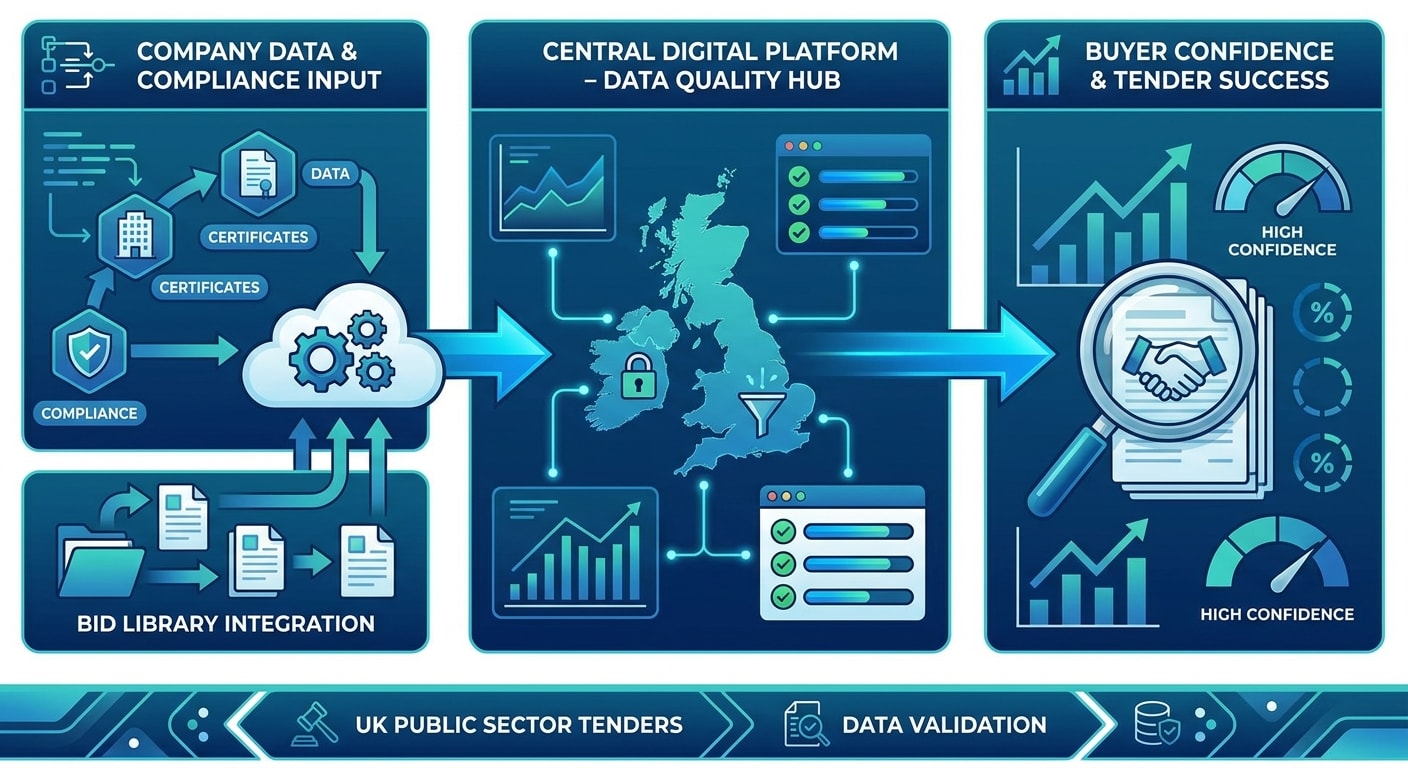
Supplier data quality workflow for Central Digital Platform readiness
Company Identity and Ownership
Your legal identity must be boringly precise. Registered name, trading names, company number, VAT number, registered office, parent company details and persons with significant control should match across the Central Digital Platform, Companies House, accounts, insurance documents, quality certificates and tender responses.
This is not cosmetic. Public buyers use this information to assess eligibility, conflicts, exclusions, financial standing and contract award records. If your bid uses a trading name but your accounts use a legal entity name and your insurance uses a group name, the evaluator has to work harder than they should.
Make the relationship clear. If you operate through subsidiaries, explain which entity is bidding, which entity will contract, and what support is provided by the group. If you rely on parent company resources, prepare the wording and evidence before you need it.
Financial Standing
Financial information is one of the easiest areas to leave to the last minute. It is also one of the quickest ways to create bid risk.
For public sector tenders, your team should know where to find the latest accounts, turnover figures, insurance levels, credit explanations and any contextual notes needed to explain unusual results. If there was a one-off dip in revenue, a restructuring, a merger, or a change in reporting period, do not wait for a clarification question. Prepare a calm explanation in plain English.
The goal is not to make weak finances look strong. The goal is to avoid making reasonable finances look confusing.
Compliance Declarations
Exclusion grounds, tax compliance, conflicts of interest, modern slavery, anti-bribery, equality, cyber security and health and safety declarations should be handled with care. Many are pass-fail or near pass-fail issues. A sloppy answer can create unnecessary escalation.
Keep a controlled record of who owns each declaration, when it was last reviewed, and what evidence supports it. If a declaration requires board-level or legal sign-off, build that into your timetable. Do not let the bid team discover a missing sign-off two hours before submission.
Accreditations and Certifications
ISO certificates, Cyber Essentials, CHAS, SafeContractor, Constructionline, waste carrier licences, professional memberships, environmental permits and sector-specific credentials are often used as short-hand evidence of capability.
They need expiry dates, renewal owners and approved descriptions. The tender response should not say you hold an accreditation if it expires before contract award and renewal is uncertain. Equally, do not undersell a certification by burying it in an appendix with no explanation of how it improves delivery.
The best bid libraries treat certificates as evidence assets, not attachments.
Insurance and Risk Cover
Insurance requirements often look standard until they are not. Public liability, employer's liability, professional indemnity, product liability, cyber liability, fleet and sector-specific covers may all appear depending on the contract.
Your supplier profile should hold current certificates, renewal dates, broker contact details and an escalation route for uplift requests. If a tender asks for higher cover than you currently hold, the bid team needs to know whether that uplift is available and what it would cost.
A generic line saying cover can be increased if required is weaker than a confirmed broker note or internal approval route.
Turning Standard Data into Better Tender Content
The Central Digital Platform does not remove the need to write strong tender responses. It changes the starting point.
When standard supplier information is already controlled, bid writers can focus on interpretation: why the evidence matters, how it reduces buyer risk, and what it proves about delivery.
For example, a health and safety accreditation is not just a certificate. In a strong response, it supports a story about competent supervision, near-miss reporting, site audits, training compliance and reduced disruption for the client. A carbon reduction plan is not just a PDF. It supports a story about measured emissions, practical decarbonisation actions, supplier engagement and contract-specific reporting.
That is where scores are won.
Most evaluators do not reward suppliers for having documents. They reward suppliers for showing how the documents translate into reliable contract performance.
This is also where AI-assisted bid writing can help if it is used properly. A tool like mytender.io can draw from approved evidence, previous successful answers and current supplier information to create a first draft. But the quality of the output depends on the quality of the source material. If your supplier profile is outdated, your AI-assisted draft will inherit that weakness.
The better your evidence base, the better your first draft. That is the unglamorous truth of bid automation.
Build a Supplier Profile Evidence Map
A supplier profile evidence map connects each common tender question to the best available proof.

Supplier profile evidence map connecting standard data to scored tender answers
This does not need to be complicated. Start with a simple matrix:
- Data category
- Current approved answer
- Evidence owner
- Source document
- Expiry or review date
- Relevant tender question types
- Approved proof points
- Example contract evidence
- Last used in a bid
- Notes or limitations
The value is not the spreadsheet itself. The value is the decision-making it forces.
If the evidence owner cannot be named, the evidence is fragile. If the review date is blank, the answer will go stale. If the source document is hard to find, the team will copy from old bids. If there are no proof points, the content will become generic.
This exercise also reveals duplication. Many businesses have three versions of the same company overview, four versions of their quality management description, and a dozen slightly different sustainability statements. Each was probably correct when written. Together, they create confusion.
A profile evidence map lets you pick one approved version and improve it over time.
What Great Supplier Profiles Have in Common
The strongest supplier profiles are not necessarily the longest. They are the most controlled.
They have clear ownership. Finance owns finance data. HR owns workforce figures. Operations owns delivery methodology evidence. Compliance owns policies. Bid management owns how this material is translated into tender responses. Everyone knows the bid team can reuse approved content, but nobody assumes the bid team is responsible for inventing facts.
They have version control. When a certificate changes, the old version is archived. When a case study is updated, the previous wording is not left floating in a folder with a similar file name. When a policy is superseded, bid writers are told.
They have evidence hierarchy. Not every fact deserves equal weight. A recent, audited, contract-specific metric is stronger than a five-year-old anecdote. A named public sector reference is stronger than a generic statement. A measured KPI is stronger than an aspiration. Strong profiles make the best evidence easiest to find.
They are written for humans. Supplier information often becomes dense because people are afraid to simplify it. But buyers are busy. A clear, accurate summary supported by documents is more useful than a long, vague corporate description.
They are connected to lessons learned. If a clarification question keeps appearing, the profile probably has a gap. If evaluators repeatedly mark a section down, the evidence may not be strong enough. If a buyer asks for the same missing document twice, fix the source of truth rather than treating it as a one-off.
The Bid-No-Bid Advantage
Supplier profile optimisation is not only about better submissions. It also improves bid selection.
A good bid-no-bid decision needs fast answers. Do we meet the eligibility criteria? Do we have the accreditations? Can we evidence three comparable contracts? Do we meet the insurance requirements? Is the financial threshold realistic? Are there conflicts? Can we deliver the social value commitments? Do we have capacity to mobilise?
If every answer requires an internal hunt, the team loses precious days. Worse, the business may chase opportunities it should decline.
A clean supplier profile turns qualification into a sharper conversation. The bid team can identify blockers early, escalate real decisions to leadership, and avoid wasting time on tenders where the organisation cannot credibly win.
That is especially important under the Procurement Act, where early engagement, pipeline notices and flexible procedures can create more decision points before a formal tender lands. Suppliers that know their own capability profile can respond faster and more strategically.
How Public Buyers May Use Supplier Profile Data
Public buyers still need to evaluate the tender in front of them. They cannot simply award work because a profile looks polished. But profile data can influence the procurement journey in practical ways.
At market engagement stage, buyers may use supplier information to understand who is active in a category, what delivery models exist, and which organisations appear credible. At selection stage, they may use standard data to verify eligibility and reduce administrative burden. At award stage, they may need supplier identifiers and compliance information to publish notices and complete internal checks. During contract management, performance and payment data may feed future confidence.
This means suppliers should assume their data may be seen in more contexts than a single tender answer.
A rushed profile creates friction. A strong profile creates confidence.
It also helps smaller suppliers. One of the goals of procurement reform is to reduce barriers for SMEs and VCSEs. A well-maintained profile can help a smaller business appear organised, compliant and ready for public sector work even without a large bid department. The point is not to pretend to be bigger. It is to make your real capability easy to understand.
Common Mistakes to Avoid
The most common mistake is treating the Central Digital Platform as a one-off registration task. Someone completes it, gets the identifier, and the business moves on. Six months later, the profile is already out of date.
The second mistake is leaving ownership unclear. If everyone assumes someone else updates supplier data, nobody does it reliably.
The third mistake is uploading evidence without interpreting it. A buyer should not have to infer why a document matters. If a certificate, policy or case study supports a claim, your tender response should explain the link.
The fourth mistake is using profile content that sounds like marketing copy rather than procurement evidence. Public sector evaluators want clear delivery confidence. Phrases like market-leading, innovative and customer-focused are weak unless attached to proof.
The fifth mistake is failing to align the profile with live bid content. If your Central Digital Platform data says one thing, your SQ answer says another, and your method statement says a third, the evaluator may question which version is true.
The sixth mistake is not preparing for performance visibility. If future buyers can see more performance information, suppliers need to manage contract delivery and bid promises as one connected system. Do not make commitments in bids that operations cannot measure and deliver.
A Practical 30-Day Supplier Profile Optimisation Plan
A supplier profile does not need a six-month transformation programme. A focused 30-day clean-up can make a meaningful difference.
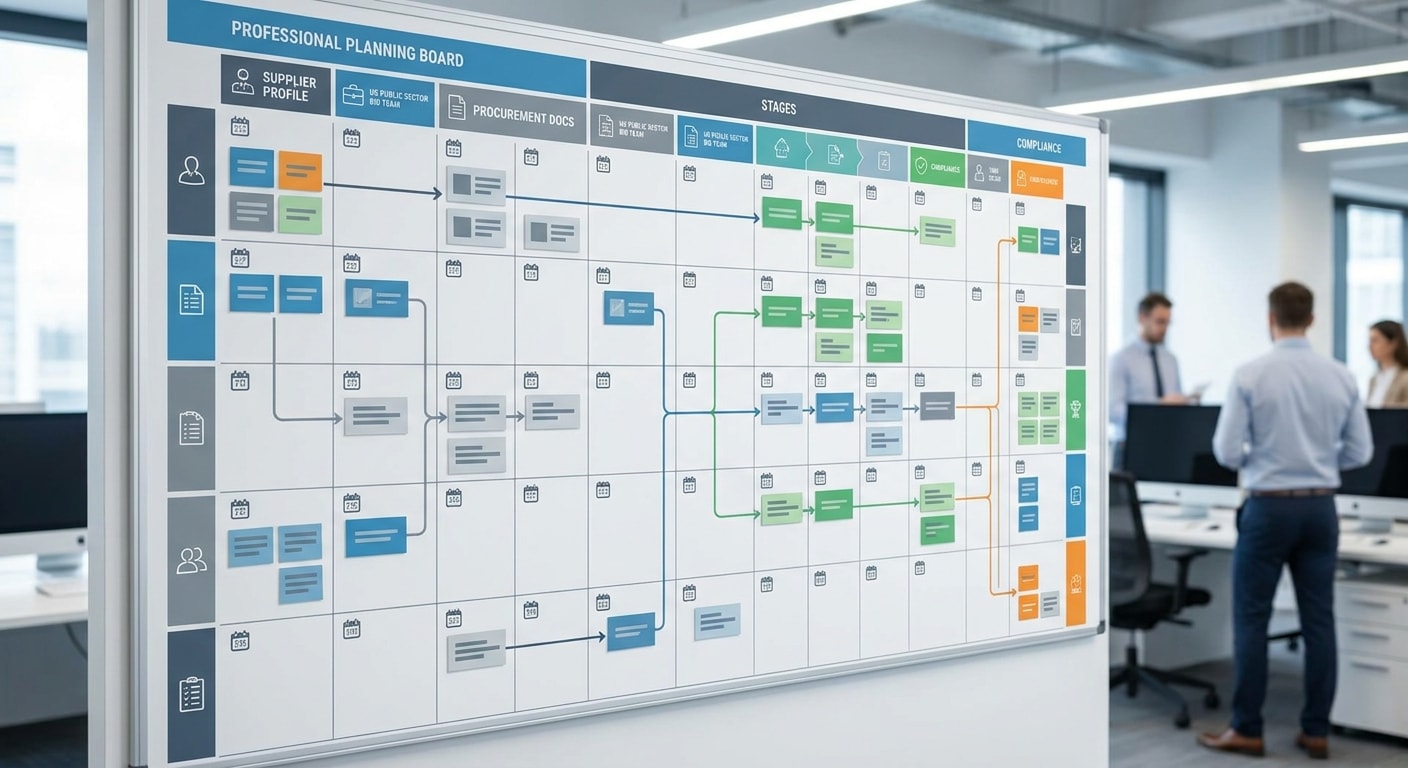
Thirty day Central Digital Platform supplier profile optimisation plan
Days 1 to 5: Baseline the Current Position
Export or document your current supplier profile information. List every recurring document used in tenders. Identify where each item lives, who owns it and when it was last checked.
Look for obvious issues: expired certificates, old company descriptions, outdated turnover figures, missing insurance documents, duplicated policies and broken folder links.
This stage is not about perfection. It is about visibility.
Days 6 to 10: Fix Eligibility and Compliance First
Prioritise the items that could block an award or trigger clarification: legal entity information, tax status, ownership, insurances, exclusion declarations, core policies and mandatory certifications.
Agree approved wording for common declarations. If legal, finance or compliance sign-off is needed, obtain it now. Store the signed-off version somewhere the bid team can actually find.
Days 11 to 15: Strengthen Evidence for Scored Questions
Move beyond pass-fail documents. Identify the evidence that supports quality scores: case studies, KPIs, mobilisation examples, customer outcomes, innovation examples, social value commitments, carbon data, safety performance and service improvement records.
For each item, write a short evidence note explaining what it proves, which tender themes it supports and any limitations. This saves bid writers from guessing under pressure.
Days 16 to 20: Align the Bid Library
Compare the refreshed supplier profile with your existing bid library. Replace outdated standard answers. Remove duplicates. Flag content that needs rewriting.
If you use mytender.io, this is the point where a clean knowledge base matters. Upload or connect the approved materials, tag them clearly, and make sure old versions are not competing with new ones.
Days 21 to 25: Test Against Recent Tenders
Take two or three recent tenders and test whether the refreshed profile would have helped. Could you answer the selection questions faster? Would the evidence have supported higher-quality responses? Were any recurring gaps still unresolved?
This is a practical stress test. It turns the profile from a theoretical compliance asset into a working bid tool.
Days 26 to 30: Assign Governance
Set review dates, owners and escalation routes. Decide what happens when a certificate is renewed, a policy changes, a contract ends or a new case study becomes available.
The aim is simple: the profile should stay current without requiring heroics before every submission.
How mytender.io Helps
mytender.io is built around a straightforward idea: bid teams should spend less time hunting for information and more time shaping winning responses.
Supplier profile optimisation fits that perfectly. The platform helps teams turn scattered documents into a usable bid knowledge base, retrieve approved evidence quickly, and generate tender-specific first drafts based on real organisational content rather than generic AI guesswork.
That matters in a Central Digital Platform world because standard supplier information and scored tender content are becoming more connected. Your legal identity, compliance evidence, past performance, policies and delivery proof points all need to tell the same story.
With mytender.io, teams can:
- Store approved supplier information in one place
- Reuse strong answers from previous successful bids
- Generate first drafts in minutes using relevant source material
- Check responses against tender requirements
- Keep bid teams aligned around the latest evidence
- Reduce time wasted searching through old files and inboxes
AI is not a substitute for supplier governance. It is a multiplier for good governance. If your data is clean, structured and current, AI-assisted tender writing becomes far more useful. If your data is messy, AI simply helps you reproduce the mess faster.
The advantage comes from combining both: controlled supplier evidence and a purpose-built tender writing workflow.
The SEO Point Is Also the Commercial Point
Search interest around the Central Digital Platform, supplier registration, unique supplier identifiers and Procurement Act compliance is not going away. Suppliers are trying to understand what the new regime means in practice. Many already know they need to register. Fewer understand how to turn that registration into a better bidding operation.
That is the gap.
The suppliers that benefit most will not be the ones that merely complete a profile. They will be the ones that connect profile data to qualification, evidence management, bid writing, contract delivery and performance review.
In other words, they will treat supplier information as a strategic asset.
What to Review Quarterly
A supplier profile review works best when it is regular and deliberately boring. Once a quarter, check the profile against live business reality. Has the legal entity changed? Has a director joined or left? Have insurance levels moved? Has a major contract been won, extended or lost? Have new KPIs become available from operations? Has a policy changed because of legislation, audit feedback or a client requirement?
This quarterly rhythm prevents the common failure mode where supplier data is technically updated only when a bid deadline exposes a problem. It also gives the bid team a natural moment to refresh proof points. If a mobilisation finished successfully, capture the lesson while it is fresh. If a contract review produced strong performance data, turn it into reusable evidence. If a buyer challenged a standard answer, improve the source content immediately rather than leaving the same weakness for the next tender.
The review should be short, owned and documented. A one-hour check with finance, compliance, operations and bid management is usually enough to catch most issues. The important part is that the profile becomes part of normal commercial governance, not emergency bid admin.
Final Checklist
Before your next public sector tender, ask these questions:
- Is our Central Digital Platform profile current?
- Does our legal entity information match across all bid documents?
- Are our insurance, accreditation and policy documents in date?
- Do we have approved wording for common compliance declarations?
- Can we find financial standing evidence quickly?
- Do our case studies include measurable outcomes?
- Is there a named owner for each recurring evidence area?
- Have outdated standard answers been removed from the bid library?
- Can our AI-assisted drafts access the right evidence?
- Are our bid commitments realistic for operations to deliver?
If the answer is no, fix it before the tender arrives.
The Central Digital Platform may have started as a procurement reform requirement, but for suppliers it should become something more useful: a forcing function for cleaner data, better evidence and stronger bids.
Public sector tendering will always involve judgement, relationships, strategy and writing craft. But those things work best when the basics are already under control.
Your supplier profile is one of those basics. Get it right, and everything downstream becomes easier.
If your team is still rebuilding supplier answers from scratch, chasing documents at the last minute or worrying whether the evidence is current, that is exactly the problem mytender.io was built to solve. Bring the knowledge together, keep it clean, and let your bid team focus on the parts of the tender that actually decide the score.
Tags
Ready to Transform Your Tender Writing?
See how MyTender's AI can help you write winning tenders in a fraction of the time.