

NHS and Healthcare Procurement Guide 2026: Winning Medical Supply and Service Tenders
Complete guide to navigating NHS procurement frameworks and winning healthcare tenders. Learn how suppliers achieve 72% win rates in the £150B+ UK healthcare market.
Dr. Sarah Mitchell
Healthcare Procurement Specialist
NHS and Healthcare Procurement 2026: The Complete Supplier's Guide
Why Healthcare Procurement Demands Specialized Expertise
The UK healthcare sector represents the single largest public procurement opportunity in Britain, with NHS England alone spending £152.9 billion annually on goods and services. Yet 83% of healthcare suppliers report that NHS procurement is the most complex and challenging public sector market to navigate successfully.
This comprehensive guide reveals how leading healthcare suppliers are achieving win rates above 72% in NHS and private healthcare tenders by mastering the unique requirements, frameworks, and evaluation criteria that define this critical sector. Whether you're supplying medical devices, clinical services, pharmaceuticals, or support services, this guide provides the strategic framework for sustainable success.
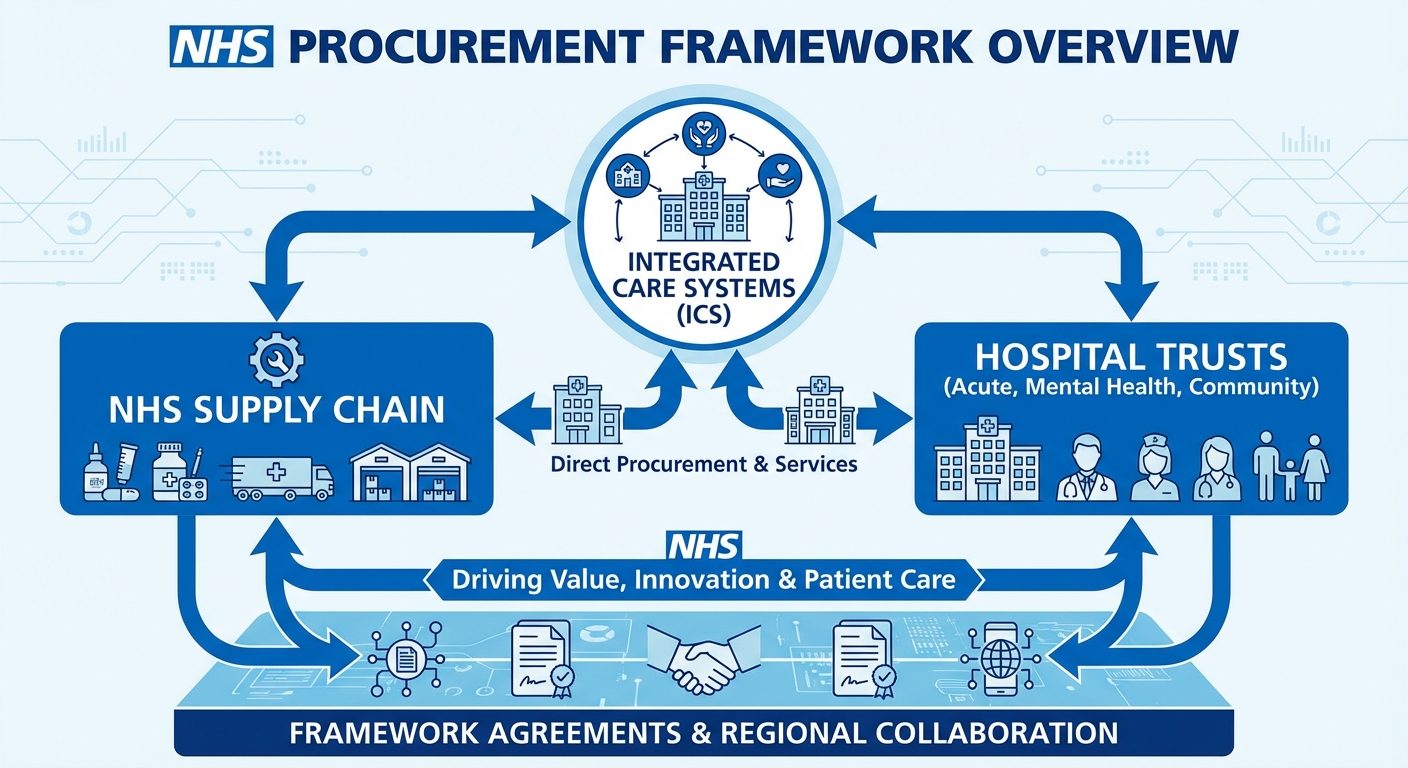
NHS procurement framework overview showing integrated care systems and supply chains
---
📊 The 2026 Healthcare Procurement Landscape
Market Structure: Understanding the £152.9B Ecosystem
NHS England Procurement Architecture Post-2022 Reforms
Integrated Care Systems (ICS) – £112.4B
- 42 ICS organizations covering all of England
- Primary responsibility: Local healthcare procurement and commissioning
- Contract types: Clinical services, community health, mental health, primary care support
- Typical values: £500K - £85M per contract
- Duration: 3-10 years with extension options
- Key challenge: Each ICS has unique priorities and evaluation criteria
NHS Supply Chain – £16.8B
- Centralized procurement: Medical supplies, equipment, consumables
- Framework agreements: 280+ active frameworks covering 14,000+ products
- Contract access: Available to all NHS trusts and some care providers
- Typical values: £100K - £450M framework value
- Duration: 4-8 year frameworks with call-off contracts
- Advantage: Single procurement can provide nationwide NHS access
Individual NHS Trusts – £18.2B
- 219 NHS trusts with local procurement authority
- Contract types: Facilities management, IT services, specialized equipment, consultancy
- Typical values: £50K - £12M per contract
- Duration: 2-5 years typical
- Opportunity: Less competition than frameworks, relationship-driven
Private Healthcare & Care Homes – £5.5B
- Growing sector: 17% annual growth in private procurement
- Contract types: Clinical supplies, care services, pharmaceuticals, equipment
- Typical values: £25K - £3.8M per contract
- Duration: 1-5 years
- Advantage: Faster procurement cycles, commercial flexibility
Regional Variation: Decentralized Decision-Making
The 2022 Health and Care Act fundamentally transformed NHS procurement by transferring significant authority to 42 Integrated Care Systems. This means:
- No single "NHS procurement strategy" – each ICS sets priorities based on local population health needs
- Regional health inequalities drive procurement – Manchester ICS priorities differ vastly from Surrey Heartlands
- Local provider collaboration – ICSs favor suppliers who can work with multiple providers within their footprint
- Social value weighting varies 15-35% across different ICS regions
- Relationship investment required – understanding local ICS priorities is now essential for success
---
🏥 Understanding NHS Procurement Frameworks
What Are Framework Agreements?
NHS framework agreements are pre-competed contracts that allow NHS organizations to procure goods or services without running a full OJEU/Find a Tender procurement. They're the fastest route to multiple NHS contracts.
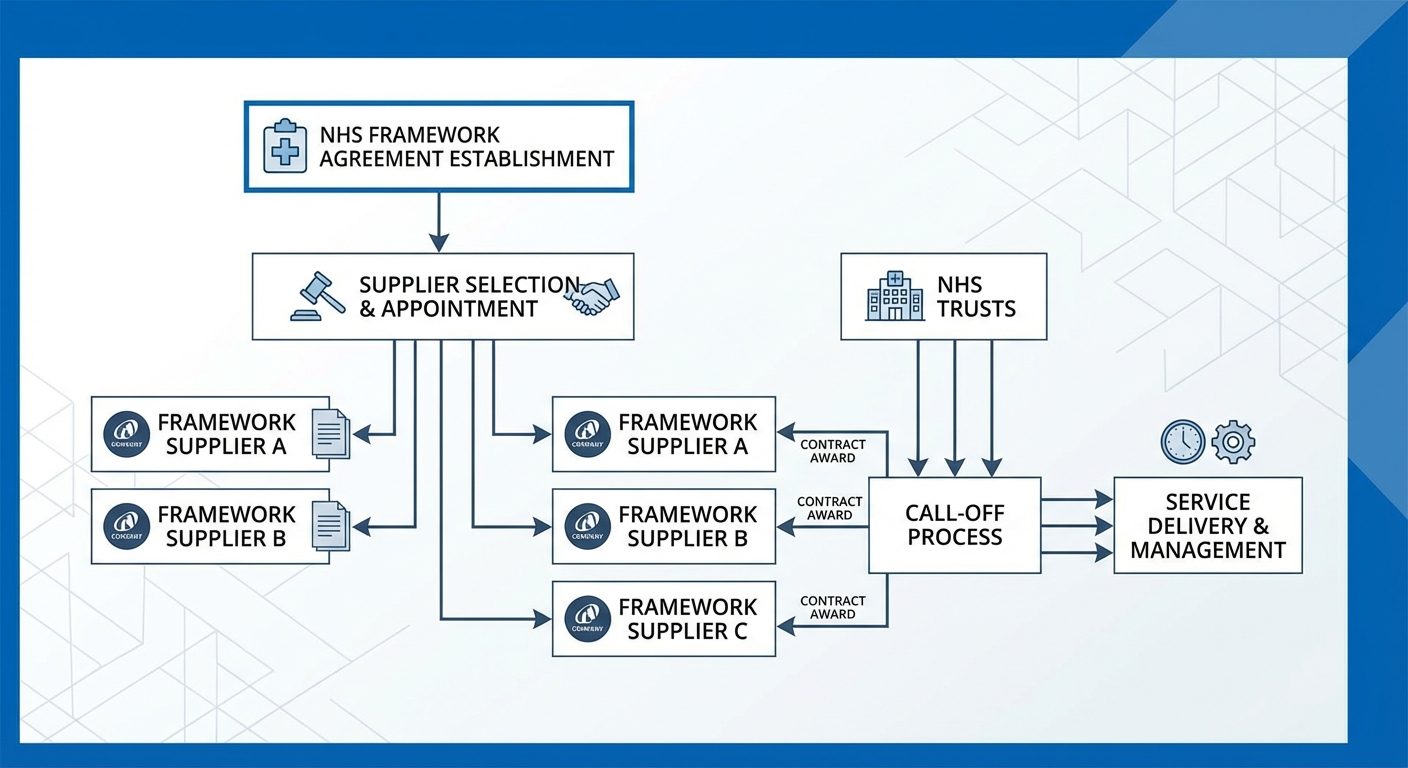
NHS framework agreement structure showing how trusts call-off contracts
Key Framework Characteristics
🔹 Single Supplier Frameworks
Structure: One supplier awarded for specific category
Advantage: Guaranteed business from all NHS organizations using the framework
Competition: Very high – typically 12-30 bidders for one position
Examples: Specialized medical devices, unique clinical systems
Win strategy: Demonstrate clear differentiation and superior value
🔹 Multi-Supplier Frameworks
Structure: Multiple suppliers (typically 4-12) awarded framework positions
Access: NHS organizations run mini-competitions among framework suppliers for specific contracts
Advantage: Lower initial competition, but ongoing effort required to win call-offs
Examples: Pathology services, facilities management, IT services
Win strategy: Focus on framework positioning AND building relationships for call-off success
🔹 Dynamic Purchasing Systems (DPS)
Structure: Open framework allowing new suppliers to join throughout the framework period
Advantage: Can join after the initial competition period
Flexibility: Lower barriers to entry for new suppliers or products
Examples: Community health services, social care, some medical supplies
Win strategy: Demonstrate innovation and responsiveness to emerging NHS needs
Major NHS Frameworks You Should Know
NHS Supply Chain Frameworks (280+ active)
- Medical & Surgical: £8.2B – Consumables, instruments, implants, PPE
- Pathology & Pharmacy: £4.7B – Laboratory equipment, pharmaceuticals, diagnostics
- Patient Care: £2.1B – Beds, mobility aids, continence care, wound care
- Clinical & Theatre: £1.8B – Operating equipment, anesthesia, imaging accessories
Access: Apply through NHS Supply Chain supplier portal | Competition cycle: 4-8 year frameworks with regular reviews
Crown Commercial Service (CCS) Health Frameworks
- RM6256 – Healthcare Recruitment: £750M – Clinical and non-clinical staffing
- RM6089 – Health & Social Care: £3.2B – Care services, telehealth, mental health support
- RM6018 – Medical Equipment: £890M – Diagnostic imaging, patient monitors, theatre equipment
- RM3825 – Healthcare & Life Sciences: £1.4B – Technology, digital health, data analytics
Access: CCS eSourcing portal | Advantage: Also available to other public sector buyers
Regional ICS Frameworks
- London Procurement Partnership: Shared frameworks across London ICSs
- North West Commercial Procurement: Collaborative frameworks for NW England
- Yorkshire & Humber: Regional procurement hub serving 3 ICSs
- Advantage: Smaller supplier opportunities, regional relationship focus
Strategy: Target 2-3 regional frameworks aligned with your geographic capacity
---
💼 Types of Healthcare Tenders: What to Expect
Clinical Services Contracts
🏥 Primary Care Services
Contract values: £200K - £8.5M | Duration: 3-7 years
- GP practice services: Extended hours, enhanced services, PCN support
- Community pharmacy: Minor ailments, vaccination programs, medicine optimization
- Dental services: Community dentistry, urgent care, sedation services
- Optometry: Eye health, glaucoma pathways, diabetic screening
Evaluation priority: Clinical quality (40-50%), access & capacity (20-30%), price (20-25%), social value (10-15%)
Critical requirements:
- CQC registration and ratings (Outstanding/Good essential)
- Professional indemnity insurance (minimum £10M clinical negligence cover)
- Clinical governance framework documented
- NHS data security and protection toolkit compliance
- Safeguarding policies and DBS checks
🏥 Secondary Care & Hospital Services
Contract values: £1.2M - £45M | Duration: 5-10 years
- Elective surgery: Orthopedics, ophthalmology, diagnostics – addressing waiting lists
- Pathology services: Laboratory testing, blood sciences, histopathology
- Imaging: MRI, CT, ultrasound, X-ray provision and reporting
- Mental health services: CAMHS, crisis intervention, talking therapies, rehabilitation
- Community health: District nursing, health visiting, rehabilitation, intermediate care
Evaluation priority: Clinical outcomes (35-45%), quality & safety (25-30%), price (15-25%), innovation (10-15%)
Critical requirements:
- CQC registration with track record in relevant service area
- Evidence of clinical outcomes achievement
- ISO 9001 quality management (often required)
- Consultant-led clinical governance
- Demonstrated capacity to handle contracted volumes
- Business continuity and disaster recovery plans
Medical Supplies & Equipment Contracts
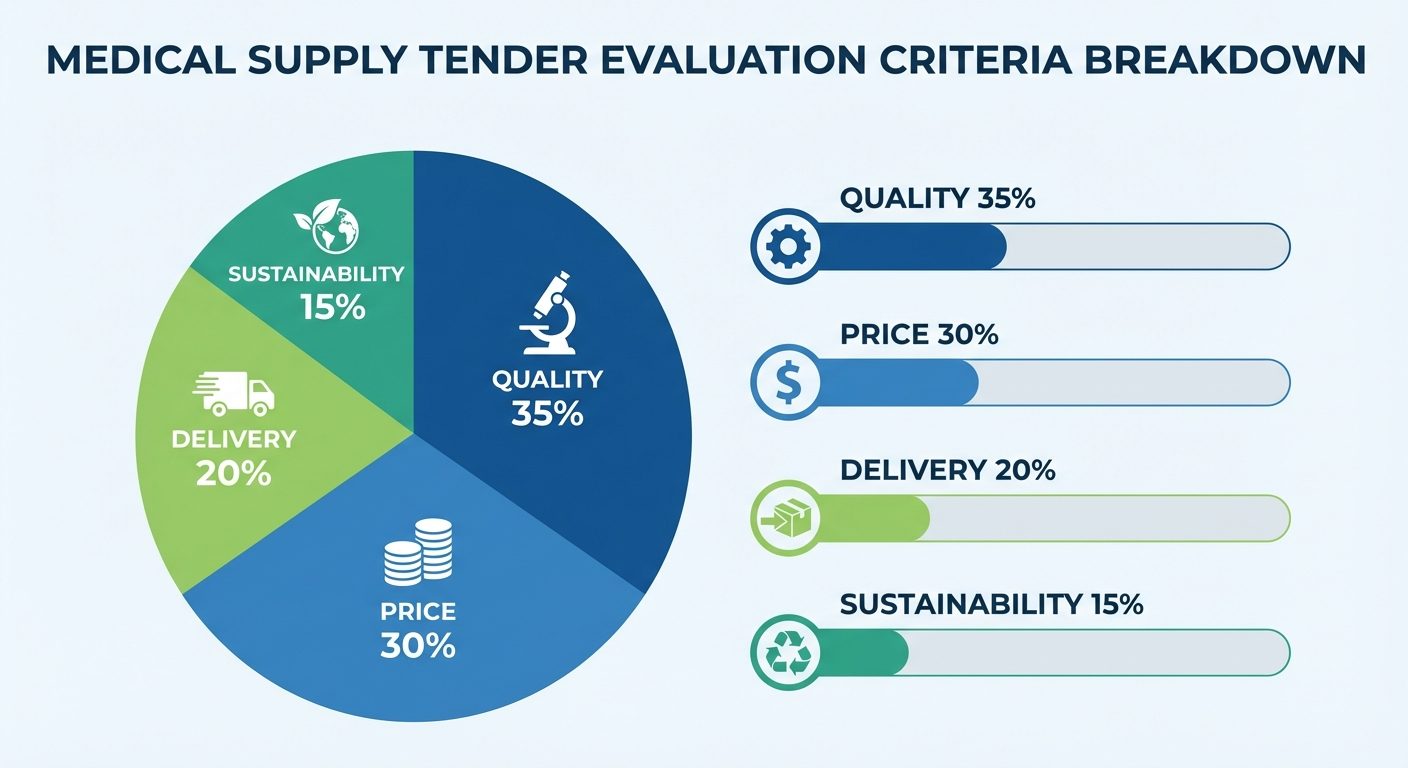
Medical supply tender evaluation criteria breakdown showing quality, price, and delivery factors
💊 Pharmaceuticals & Medical Consumables
Contract values: £100K - £280M (frameworks) | Duration: 2-6 years
- Prescription medicines: Generic drugs, branded pharmaceuticals, controlled drugs
- Medical consumables: Syringes, dressings, gloves, infection control supplies
- Wound care: Advanced dressings, compression therapy, skin care
- Continence care: Absorbent products, catheters, stoma care
Evaluation priority: Price (35-45%), quality & compliance (30-40%), delivery & service (15-20%), sustainability (5-10%)
Critical requirements:
- MHRA licenses and manufacturer authorizations
- ISO 13485 medical device quality management (where applicable)
- Clinical evidence and regulatory approvals
- Supply chain resilience and UK stock holding
- Product stewardship and environmental impact data
- Temperature-controlled logistics (pharmaceuticals)
🔬 Medical Devices & Capital Equipment
Contract values: £250K - £95M | Duration: 5-15 years (including service/maintenance)
- Diagnostic equipment: Imaging scanners, patient monitors, ECG/EEG systems
- Surgical equipment: Theatre tables, surgical robots, anesthesia machines
- Life support: Ventilators, dialysis machines, infusion pumps
- Laboratory systems: Analyzers, automation systems, blood screening equipment
Evaluation priority: Total cost of ownership (30-35%), clinical capability (30-35%), reliability & service (20-25%), innovation (10-15%)
Critical requirements:
- UKCA/CE marking and regulatory compliance
- Clinical evaluations and evidence base
- Whole-life cost modeling (capital, maintenance, consumables, training)
- Installation, commissioning, and validation plans
- 24/7 service support with guaranteed response times
- Interoperability with existing NHS systems
- Training programs for clinical and technical staff
Support Services & Facilities Management
🏢 Non-Clinical Support Services
Contract values: £150K - £28M | Duration: 3-7 years
- Facilities management: Cleaning, catering, portering, security, waste management
- IT services: Infrastructure, helpdesk, cybersecurity, system integration
- Estates maintenance: Building services, grounds maintenance, planned preventive maintenance
- Logistics: Medical device management, transport, distribution, inventory management
- Professional services: HR, finance, legal, communications, project management
Evaluation priority: Quality & methodology (35-40%), price (30-35%), social value (15-25%), sustainability (10-15%)
Critical requirements:
- Understanding of NHS operational environment and constraints
- Data security & patient confidentiality protocols
- Health & safety accreditations (SafeContractor, CHAS, etc.)
- Business continuity and service resilience
- Local employment and supply chain commitments
- Environmental standards (ISO 14001 often required)
---
🎯 NHS Tender Evaluation Criteria: What Actually Wins
The Most Valued Quality Award (MVQA) Methodology
Most NHS tenders use MVQA evaluation, which means:
- Price is a separate envelope – evaluated only after quality threshold met
- Quality scores determine shortlist – typically need 70%+ quality score to reach price evaluation
- Weighted scoring then applied – quality score × weight + price score × weight = final score
Standard NHS Weighting Models
Clinical Services Model
- Clinical Quality & Outcomes: 40-50%
- Service Delivery & Capacity: 20-25%
- Price/Cost: 20-25%
- Social Value: 10-15%
Used for: GP services, community health, mental health, elective care
Medical Supplies Model
- Price/Cost: 35-45%
- Quality & Compliance: 30-40%
- Delivery & Service: 15-20%
- Sustainability: 5-10%
Used for: Pharmaceuticals, consumables, routine supplies
Capital Equipment Model
- Total Cost of Ownership: 30-35%
- Clinical Capability: 30-35%
- Service & Reliability: 20-25%
- Innovation & Future-Proofing: 10-15%
Used for: Imaging equipment, surgical systems, laboratory equipment
Support Services Model
- Quality & Methodology: 35-40%
- Price/Cost: 30-35%
- Social Value: 15-25%
- Sustainability: 10-15%
Used for: Facilities management, IT services, estates, logistics
What Evaluators Are Really Looking For
NHS evaluation panels typically include:
- Clinical representatives (consultants, GPs, nurses) – focus on clinical quality, safety, outcomes
- Procurement specialists – focus on value for money, contract terms, commercial robustness
- Finance representatives – focus on affordability, cost models, financial sustainability
- Patient/public representatives – focus on patient experience, accessibility, communication
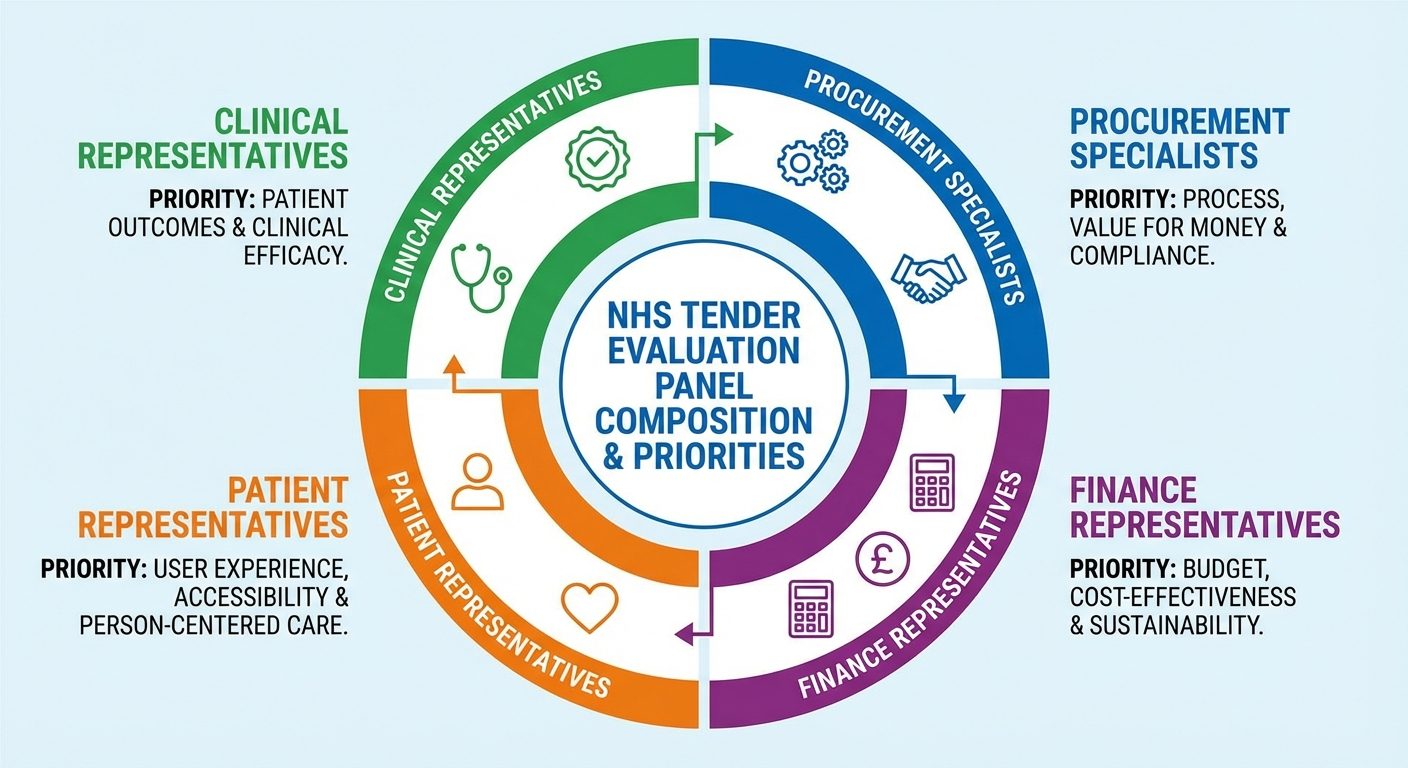
Healthcare tender evaluation panel composition and priorities
What Each Stakeholder Prioritizes
🩺 Clinical Evaluators
- Evidence-based practice: References to NICE guidelines, clinical studies, peer-reviewed evidence
- Patient safety first: Risk assessments, safety protocols, incident management
- Realistic staffing: Adequate skill mix, professional registration, supervision arrangements
- Clinical governance: Audit programs, clinical supervision, continuous professional development
- Outcomes focus: Measurable clinical outcomes, not just activity delivery
Red flags: Over-promising outcomes, inadequate staffing models, generic responses lacking clinical depth
💼 Procurement Evaluators
- Clear understanding: Evidence you've understood the requirement, not just copied it back
- Deliverable commitments: Specific, measurable commitments with accountability
- Risk management: Identified risks with mitigation plans
- Contract compliance: Acceptance of terms, no hidden caveats
- Value demonstration: How you deliver more value than just meeting minimum specs
Red flags: Vague responses, failure to address all questions, excessive assumptions, qualified acceptance of terms
💰 Finance Evaluators
- Cost transparency: Clear breakdown of pricing, understanding of cost drivers
- Financial sustainability: Pricing that's competitive but not unrealistically low
- Whole-life costs: Total cost of ownership, not just upfront price
- Efficiency opportunities: How you'll help NHS achieve efficiency savings
- Commercial flexibility: Volume flexibility, change mechanisms, payment terms
Red flags: Abnormally low pricing (raises questions about deliverability), unclear cost models, lack of efficiency initiatives
👥 Patient/Public Representatives
- Patient-centered language: Written in accessible language, not jargon
- Accessibility commitments: How you'll serve diverse populations
- Communication approach: Patient information, complaint handling, feedback mechanisms
- Co-production evidence: Examples of involving patients in service design
- Local community connection: Understanding of local population needs
Red flags: Heavy jargon, no patient voice in bid, generic approach not tailored to local community
---
💡 Social Value in NHS Procurement: The 15-25% That Makes The Difference
Since the 2012 Public Services (Social Value) Act and strengthened 2021 guidance, social value is evaluated in every NHS tender above £75,000. Typical weightings:
- 10-15% for medical supplies/equipment tenders
- 15-25% for service contracts
- 20-30% for large, long-term service contracts
The NHS Social Value Framework
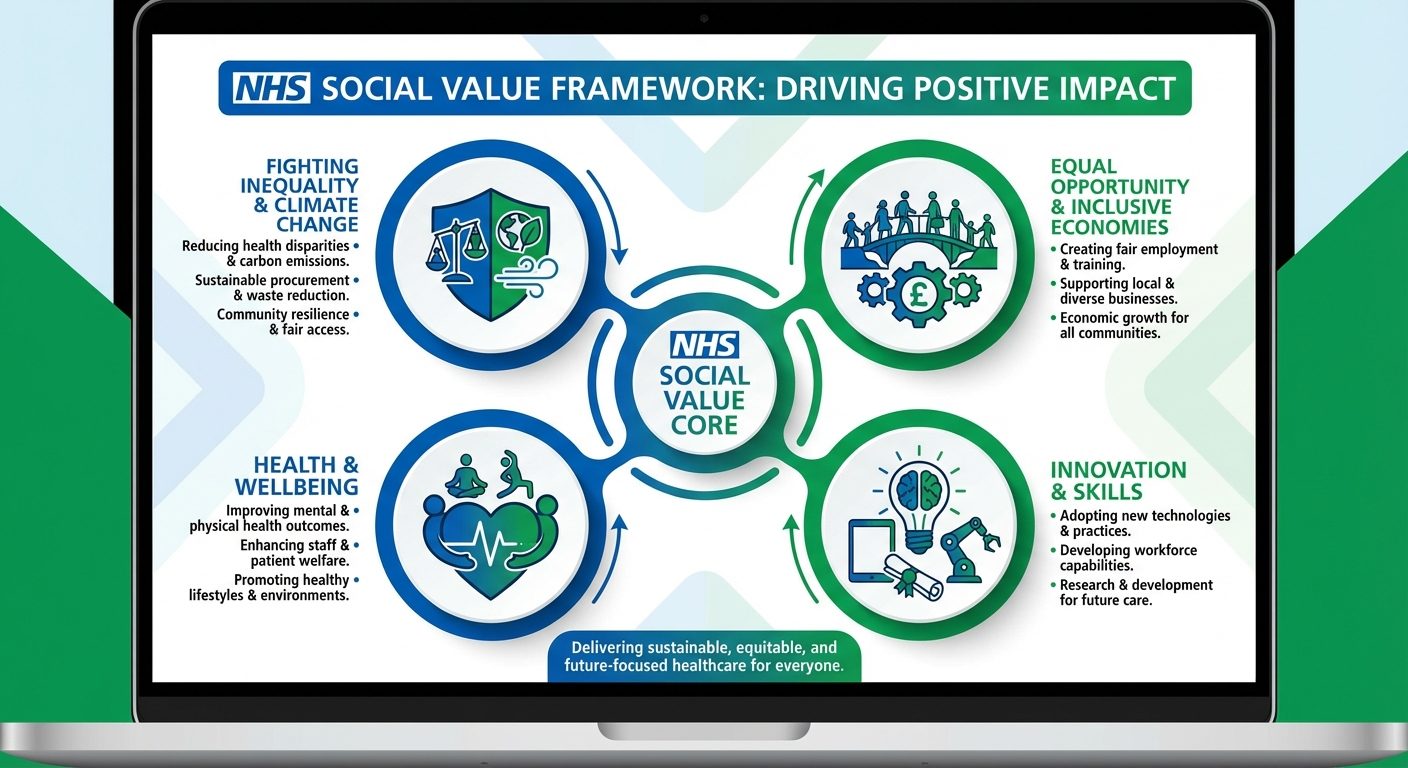
NHS social value framework themes showing fighting inequality, equal opportunity, and wellbeing
NHS England's social value framework focuses on four key themes:
---
💰 Pricing Strategy: Getting Your NHS Pricing Right
Understanding NHS Pricing Pressures
NHS organizations face intense financial pressure – most trusts ran deficits in 2024-25, ICSs must deliver 3-5% annual efficiency savings, and funding growth barely matches inflation. This creates challenging pricing dynamics:
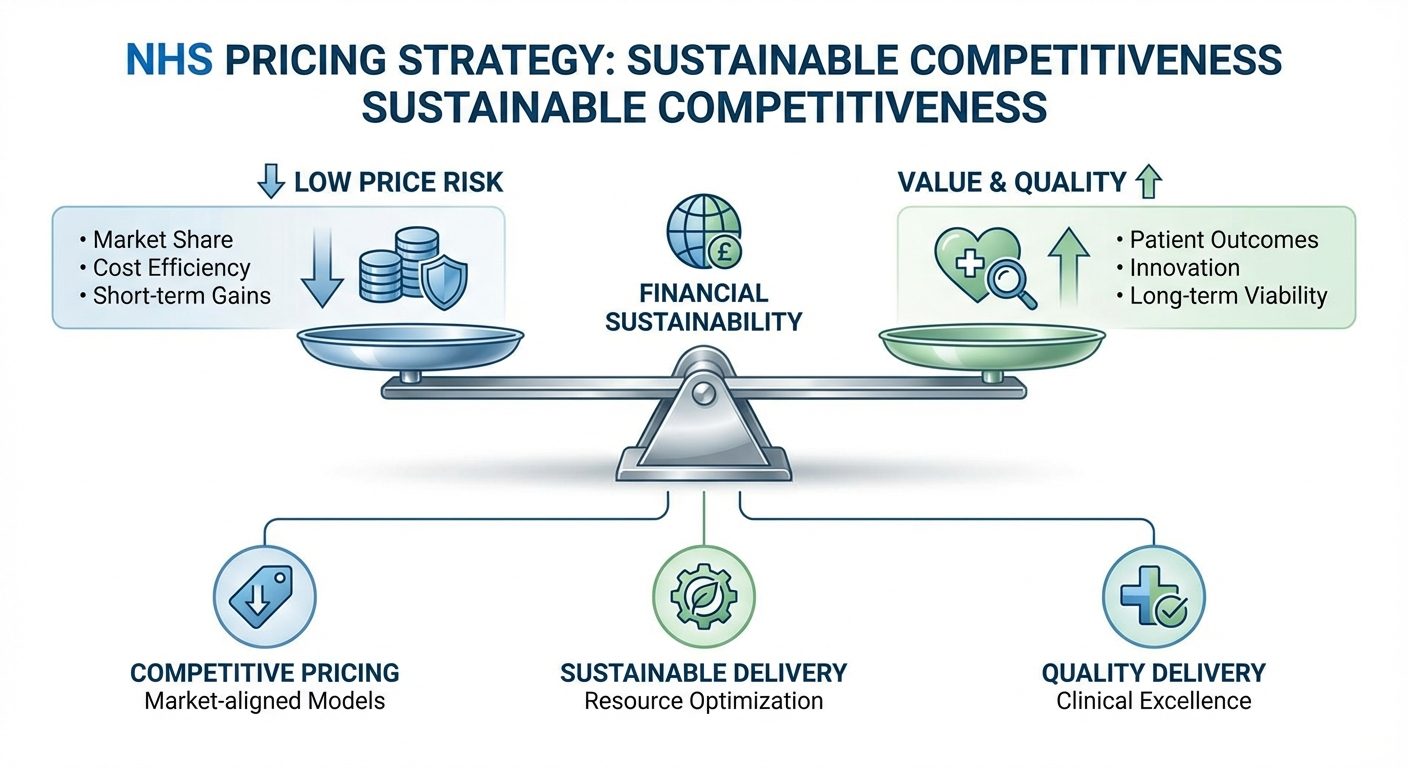
NHS pricing strategy showing balance between competitiveness and sustainability
---
🤖 How AI and Automation Transform NHS Tender Success
The Time and Quality Advantage
NHS tenders are exceptionally demanding:
- Average tender length: 120-250 pages of questions
- Typical response time: 4-8 weeks (but often overlapping with other opportunities)
- Required evidence: extensive – policies, CVs, case studies, financial models, implementation plans
- 180-300 hours of senior staff time per bid
- Quality depends heavily on available time and writer expertise
- Inconsistent responses across similar questions
- Last-minute quality compromises due to time pressure
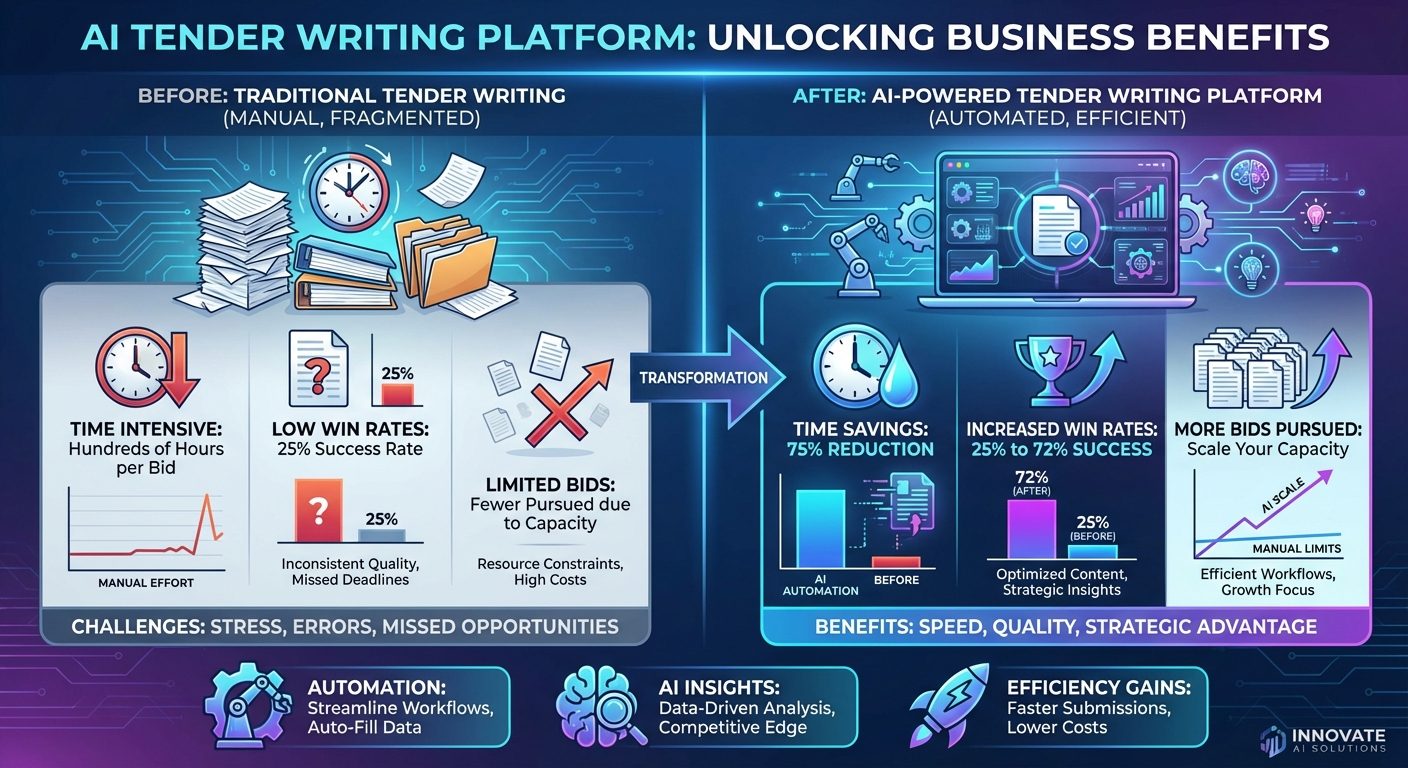
AI tender writing platform benefits showing time savings and quality improvements
- 75% time reduction – 45-75 hours vs 180-300 hours
- Consistent quality – AI maintains best-practice structure and depth
- Better evidence integration – AI identifies and suggests relevant case studies/data from knowledge library
- More bids pursued – time savings enable pursuing more opportunities
- Focus on strategic content – humans focus on differentiators, AI handles structure and consistency
---
🚀 Ready to Win NHS Contracts?
The NHS healthcare procurement market represents one of the most significant commercial opportunities in the UK, but success requires specialized knowledge, rigorous preparation, and sophisticated bid development capabilities.
Start Your NHS Procurement Journey
🤖 Try MyTender.io for Healthcare Tenders
Join the healthcare suppliers achieving 72% win rates with AI-powered tender intelligence and response generation.
- Reduce bid development time by 75%
- Never miss an NHS opportunity with 24/7 monitoring
- Generate evidence-rich responses in hours, not days
- Healthcare-specific templates and knowledge base
Start free 14-day trial: mytender.io
---
Tags
Ready to Transform Your Tender Writing?
See how MyTender's AI can help you write winning tenders in a fraction of the time.