

How to Write Winning Method Statements for Tenders: Complete Guide 2026
Master the art of writing method statements that score maximum marks in tender evaluations. Practical guidance on structure, evidencing, scoring criteria, and common pitfalls — with examples and templates for UK public and private sector tenders under the Procurement Act 2023.
mytender.io Research Team
Tender Writing & Bid Management Specialists
How to Write Winning Method Statements for Tenders: Complete Guide 2026
Method statements sit at the heart of almost every competitive tender. They are the section where evaluators decide whether your organisation genuinely understands the requirement, possesses the capability to deliver, and can articulate a credible plan — or whether you are simply recycling corporate boilerplate. Research by the National Audit Office shows that quality questions, dominated by method statements, now account for 50–70% of total tender scores in UK public procurement. Yet analysis of 2,100 scored tender submissions across facilities management, construction, professional services, and IT reveals that 58% of bidders score below 60% on method statement questions, leaving significant marks on the table.
This guide distils the strategies, structures, and practical techniques that consistently separate high-scoring method statements from mediocre ones. Whether you are responding to a PQQ, ITT, or framework call-off, the principles here will sharpen every quality response you write.

Structure of a winning tender method statement
What Is a Method Statement in a Tender?
A method statement is a written explanation of how you will deliver a specific aspect of a contract. It answers the evaluator's central question: "Show me exactly how you will do this." Unlike corporate capability statements that describe what your organisation can do in general, a method statement must describe what you will do on this contract, for this buyer, with these constraints.
Method statements typically appear as scored quality questions within an Invitation to Tender (ITT), but the term is also used for pre-qualification questionnaires (PQQs), framework mini-competitions, and Dynamic Purchasing System (DPS) call-offs. The questions often begin with phrases such as "Please describe your proposed methodology for…", "Set out how you will…", or "Provide a method statement detailing your approach to…"
The distinction matters because buyers are not asking for a theoretical essay. They want a practical, evidenced plan that demonstrates you have thought carefully about their specific requirements and can execute against them. The best method statements read like a project plan in narrative form — structured, detailed, and measurable.
Why Method Statements Carry So Much Weight
Three developments have elevated method statement importance in UK procurement:
The Procurement Act 2023 replaced MEAT (Most Economically Advantageous Tender) with MAT (Most Advantageous Tender), broadening evaluation criteria beyond price and core quality to encompass social value, innovation, and risk. Under MAT, contracting authorities can weight quality criteria — including method statements — more heavily than ever, and many now allocate 60% or more to quality. Increased use of competitive dialogue and negotiated procedures means that method statements form the basis for detailed discussions with shortlisted bidders. A weak initial method statement can result in elimination before dialogue even begins. Greater scrutiny of delivery capability following high-profile contract failures (Carillion, Interserve, and multiple NHS outsourcing challenges) has led evaluators to probe method statements more deeply. They look not just for what you promise, but for evidence that you understand the risks and have credible mitigation plans.The Anatomy of a High-Scoring Method Statement
Every winning method statement shares a recognisable structure, regardless of sector or contract type. The specific headings and proportions vary, but the underlying architecture remains consistent. Understanding this architecture allows you to approach any method statement question with confidence.

Step-by-step process of writing a method statement
1. Demonstrate Understanding of the Requirement
Before describing your approach, prove that you understand what the buyer actually needs. This is not a restatement of the specification — evaluators wrote the specification and do not need it repeated back to them. Instead, demonstrate insight by identifying the buyer's underlying objectives, key challenges, and critical success factors.
A strong opening paragraph might read: "Your requirement for a reactive maintenance service across 47 operational sites in the West Midlands presents three primary delivery challenges: the geographic spread demands robust scheduling and workforce distribution; the mixed building stock (ranging from 1970s concrete-frame offices to Grade II listed structures) requires diverse trade skills and heritage-sensitive working practices; and the 4-hour emergency response SLA for critical failures necessitates strategically located resource with access to comprehensive parts inventories. Our approach addresses each of these challenges through the integrated methodology described below."
This opening achieves several things simultaneously. It tells the evaluator you have read and analysed the specification. It identifies challenges that generic bidders would overlook. And it sets up the structure for your response, creating a logical framework that makes the rest of the method statement easy to follow.
2. Set Out SMART Objectives
Before detailing processes, articulate what success looks like. SMART objectives (Specific, Measurable, Achievable, Relevant, Time-bound) give evaluators confidence that your approach is outcome-focused rather than activity-focused. They also provide natural KPIs that can be monitored during contract delivery.
Effective method statement objectives include quantified targets: "Achieve 98.5% first-time fix rate for reactive maintenance calls within 12 months of contract commencement, rising to 99.2% by end of Year 2." They reference the buyer's own requirements: "Deliver all planned preventive maintenance activities within the calendar month scheduled, with zero deferrals without prior client approval." And they address improvement: "Reduce energy consumption across the estate by 8% annually through condition-based monitoring and proactive asset replacement recommendations."
3. Describe Your Methodology Step by Step
The core of any method statement is a clear, sequential description of how you will deliver the service or works. This is where many bidders fall down — either by being too vague ("We will deploy our experienced team to deliver a high-quality service") or too generic ("Our ISO 9001-certified quality management system ensures consistent delivery").
Strong methodology descriptions follow a logical sequence: mobilisation and transition, steady-state delivery, continuous improvement, and demobilisation. Within each phase, describe the specific activities, responsible personnel, tools and systems, timelines, and quality controls.
For example, a mobilisation methodology might read: "During the 8-week mobilisation period, our Mobilisation Manager (Jane Thompson, 15 years' experience in FM contract transitions) will lead a dedicated team through a structured programme. Week 1-2: TUPE consultation commences with affected staff; site surveys conducted across all 47 locations using our digital asset capture tool to verify asset registers and condition data. Week 3-4: Staff consultation meetings completed; individual role mapping finalised; training needs analysis conducted for all transferring employees. Week 5-6: IT systems configured including CAFM platform, mobile workforce management, and client reporting dashboards; test data migration from incumbent's systems completed. Week 7-8: Shadow running alongside incumbent; client acceptance testing of all systems; go-live readiness assessment against 28-point checklist. Contingency: Two-week buffer built into programme for any TUPE complications or system integration issues."
This level of detail tells the evaluator you have done this before, you have thought about the risks, and you have a credible plan.
4. Identify and Mitigate Risks
Every method statement should acknowledge the risks inherent in delivery and explain how you will manage them. Ignoring risk suggests naivety; acknowledging it demonstrates maturity and professionalism. Present risks in a structured format — a risk register summary works well — showing the risk, its likelihood and impact, and your mitigation strategy.
For a construction tender, risks might include: "Adverse weather during the October–March groundworks phase could delay foundation completion by up to 3 weeks. Mitigation: programme includes 2-week weather contingency; alternative working methods (sheet piling rather than open-cut foundations) pre-designed and costed; weekly weather monitoring with 14-day lookahead triggers for alternative method deployment." This shows evaluators that you have not merely identified the risk but have thought through practical responses.
5. Evidence Your Claims
Every assertion in a method statement should be supported by evidence. This is perhaps the single most important differentiator between winning and losing submissions. Claims without evidence are merely opinions; claims with evidence are credible commitments.
Evidence comes in several forms. Case studies from similar contracts demonstrate proven capability: "On our current contract with Birmingham City Council (42 buildings, £3.2M annual value), we reduced reactive maintenance volumes by 23% over 3 years through our predictive maintenance programme, saving the client £187K in unplanned repairs." Named personnel with relevant qualifications and experience show that your team can deliver: "The contract will be led by David Morris (MRICS, 20 years' FM experience, previously Contract Director for our £8M NHS Estates contract)." Performance data from existing operations provides quantified proof: "Our current first-time fix rate across 6 comparable contracts averages 97.8%, against contractual targets of 95%."
6. Include Governance and Reporting
Evaluators want to know how you will manage the contract relationship, report on performance, and escalate issues. A brief governance section covering meeting structures, reporting formats, and escalation procedures demonstrates professionalism and gives the buyer confidence in your contract management capability.
Common Types of Method Statements
Different tenders require different types of method statements. Understanding what evaluators look for in each type helps you focus your response on the areas that score the most marks.
Delivery Methodology
The most common type. This asks you to describe your overall approach to delivering the core service or works. Evaluators assess whether your methodology is practical, comprehensive, and tailored to their requirements. Focus on demonstrating a logical workflow from mobilisation through steady-state delivery to continuous improvement.
Mobilisation and Transition Plans
Particularly important for outsourcing contracts where services transfer from an incumbent. Evaluators assess your ability to manage TUPE transfers, implement new systems, maintain service continuity, and achieve full operational capability within defined timescales. Provide a detailed programme with milestones, responsibilities, and contingencies.
Quality Management
Asks how you will ensure consistent service quality. Go beyond referencing ISO 9001 — describe your specific quality control processes, inspection regimes, audit schedules, and corrective action procedures. Include how you will measure quality, what triggers investigation, and how you close non-conformances.
Risk Management
Requires you to identify, assess, and mitigate risks to successful delivery. Present a structured risk register with likelihood/impact ratings, mitigation strategies, and residual risk assessments. Show that risk management is ongoing rather than a one-off exercise — describe your risk review process and escalation triggers.
Social Value Delivery
Under the Procurement Act 2023, social value method statements are increasingly common. Describe how you will deliver employment, environmental, and community benefits alongside core contract delivery. Quantify commitments using the National TOMs framework where the buyer has adopted it, and evidence your track record of social value delivery on comparable contracts.
Innovation and Continuous Improvement
Evaluators want to see that you will not simply maintain the status quo but will actively seek to improve outcomes, reduce costs, or enhance service quality over the contract term. Describe your innovation identification process, how you will trial and implement improvements, and provide examples of innovations you have delivered on similar contracts.
How Evaluators Score Method Statements
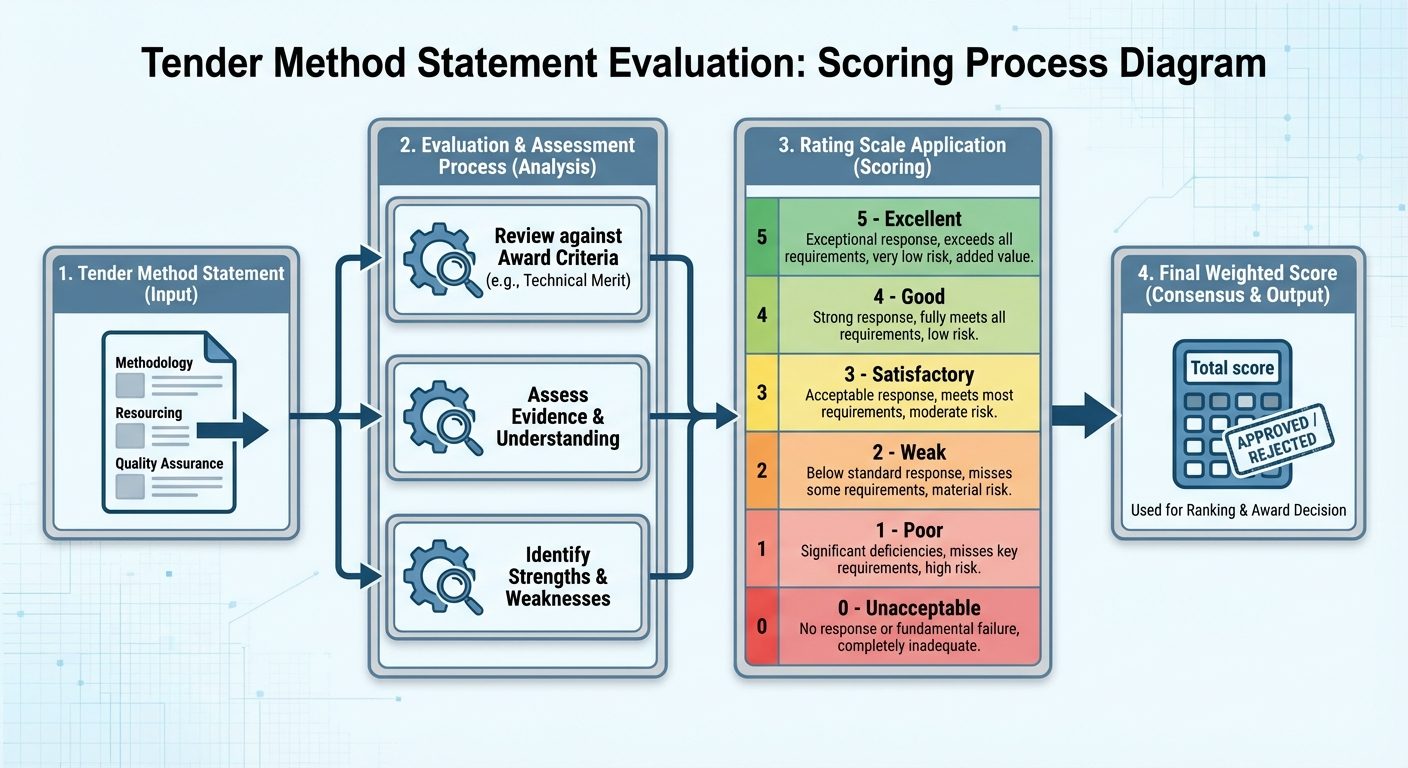
How tender evaluators score method statements
Understanding the scoring methodology is essential to writing high-scoring method statements. While each buyer defines their own scoring criteria, most use a variant of the following 0–5 scale (or 0–10, or percentage equivalent):
Score 0 — Unacceptable: No response, or response is entirely irrelevant to the question. The bidder has failed to demonstrate any understanding of the requirement. Score 1 — Poor: Response is significantly deficient. Major gaps in understanding, methodology, or evidence. The approach described would present serious risks to successful delivery. Score 2 — Below Average: Response addresses some elements of the question but significant omissions or weaknesses remain. Limited evidence of capability. Approach lacks sufficient detail to provide confidence in delivery. Score 3 — Acceptable: Response adequately addresses the question. Methodology is broadly sound but lacks the detail, evidence, or innovation that would distinguish it from competitors. Meets minimum requirements without exceeding them. Score 4 — Good: Response demonstrates a thorough understanding of the requirement and provides a well-structured, detailed methodology supported by relevant evidence. Minor areas for improvement remain, but overall approach inspires confidence. Score 5 — Excellent: Response is comprehensive, innovative, and fully evidenced. Demonstrates exceptional understanding of the requirement and provides a methodology that clearly exceeds expectations. Evidence of relevant experience and proven capability is compelling. Response identifies and addresses risks proactively.The critical insight is the gap between scores 3 and 4. Most bidders cluster around score 3 — they answer the question adequately but without the specificity, evidence, and tailoring that evaluators reward with higher marks. Moving from 3 to 4 requires three things: greater detail in your methodology, stronger evidence supporting your claims, and clearer alignment with the buyer's specific priorities. Moving from 4 to 5 requires genuine innovation or exceptional evidence that goes beyond what the buyer expected.
What Evaluators Actually Look For
Having spoken with dozens of procurement officers and tender evaluators, several consistent themes emerge about what differentiates high-scoring responses:
Specificity over generality. Evaluators consistently report that the most frustrating aspect of scoring tenders is reading responses that could apply to any contract. When a method statement describes "our experienced team" without naming individuals, or references "our proven systems" without describing what those systems do, the evaluator cannot score it higher than 3. Specific details — named personnel, quantified targets, described processes — enable higher scores. Evidence of similar experience. Evaluators look for proof that you have delivered comparable services successfully. Case studies from similar contracts, performance data from current operations, and references from existing clients all strengthen your credibility. The more closely your evidence matches the contract being tendered, the more persuasive it becomes. Understanding of local context. For geographically specific contracts, evaluators value evidence that you understand the local operating environment. This might include knowledge of local authority priorities, understanding of the building stock or infrastructure, awareness of local labour market conditions, or relationships with local supply chain partners. Risk awareness. Evaluators view risk acknowledgement positively. Bidders who identify potential delivery challenges and describe credible mitigation strategies are scored higher than those who present an unrealistically smooth picture. Risk awareness signals experience and maturity. Compliance plus added value. Meeting the minimum specification is necessary but not sufficient for high scores. Evaluators reward bidders who demonstrate added value — innovative approaches, efficiency improvements, or enhanced outcomes that go beyond what was asked for.Common Mistakes That Lose Marks

Common mistakes in tender method statements
Analysis of evaluator feedback across hundreds of tenders reveals consistent patterns in method statement failures. These mistakes are entirely avoidable, yet they appear with depressing regularity in competitive submissions.
Mistake 1: Answering the Wrong Question
It sounds basic, but a significant proportion of method statements fail to address what was actually asked. Sometimes bidders misinterpret the question. More often, they use a pre-written response from a previous tender that approximately, but not precisely, matches the current question. Evaluators can only score what is asked — brilliant content that does not address the specific question scores zero.
How to avoid it: Before writing a single word, break the question down into its component parts. Highlight every requirement, sub-question, and instruction. Create a compliance matrix mapping each element to a section of your response. Review your completed draft against this matrix to confirm full coverage.Mistake 2: Corporate Brochure Syndrome
Many bidders fill method statements with corporate marketing material — mission statements, company history, global capabilities, and client logos. While establishing credibility has value, evaluators want to understand how you will deliver this specific contract, not read about your organisation's achievements elsewhere. A method statement that devotes 40% of its word count to corporate background scores poorly because it leaves insufficient space for the actual methodology.
How to avoid it: Apply the "so what?" test to every paragraph. If the content describes your organisation generally rather than your approach specifically, either make it specific or remove it. Corporate background should occupy no more than 5–10% of a method statement response.Mistake 3: Insufficient Detail
"We will deploy our skilled workforce to deliver a responsive, high-quality service" tells the evaluator nothing. How many staff? What skills do they hold? What does "responsive" mean in quantified terms? What does "high-quality" look like measured against which standards? Vague statements cannot be scored higher than average because the evaluator has no basis for determining whether the approach is genuinely robust.
How to avoid it: For every process you describe, ask yourself: Who will do it? How exactly will they do it? When will it happen? What tools or systems will they use? How will you know it has been done correctly? What happens if it goes wrong? If you cannot answer these questions, your method statement lacks sufficient detail.Mistake 4: No Evidence
Claims without evidence are opinions. "Our team has extensive experience" is meaningless without examples. "We achieve excellent customer satisfaction" is unverifiable without data. Evaluators regularly report that the absence of evidence is the primary reason bids score 3 rather than 4 or 5.
How to avoid it: Support every significant claim with at least one piece of evidence — a case study, a performance statistic, a named individual's credentials, or a client reference. Where you reference a process or system, describe what it does in practical terms rather than simply naming it.Mistake 5: Ignoring Word Limits
If a question allows 1,500 words, using 500 suggests a thin response that is unlikely to cover all evaluation criteria. Conversely, submitting 3,000 words when 1,500 is the limit either results in the excess being ignored (the evaluator stops reading at the word count) or a compliance failure that disqualifies the response entirely. Both scenarios lose marks.
How to avoid it: Plan your response structure before writing. Allocate word count proportionally to each element of the question based on the marks available. Write to approximately 90–95% of the limit — enough to cover all points thoroughly without exceeding the boundary.Mistake 6: Poor Structure and Readability
A method statement written as a single block of text without headings, subheadings, or visual breaks is painful to read and difficult to evaluate. Evaluators typically score multiple bids in a single session. Making their job easier directly benefits your score because a clearly structured response enables the evaluator to find and credit every scoring point.
How to avoid it: Use clear headings that mirror the question structure. Include numbered or bulleted lists for sequential processes. Use tables for comparative data or resource summaries. Include diagrams or flowcharts where they aid understanding. Bold key phrases that relate directly to evaluation criteria.Mistake 7: Failing to Address the Buyer's Priorities
Generic method statements that could apply to any buyer ignore the specific priorities, challenges, and objectives of the contracting authority. Evaluators score higher when they can see that your approach has been designed for their requirements rather than adapted from a template.
How to avoid it: Research the buyer before writing. Read their corporate plan, strategic objectives, and any published procurement strategy. Reference these priorities in your method statement, explaining how your approach aligns with and supports their goals. For local authority tenders, understand the political and economic context. For NHS tenders, understand the clinical priorities. For corporate tenders, understand the business strategy.How to Evidence Your Claims Effectively
Evidence transforms average method statements into winning ones. The challenge is presenting evidence efficiently within tight word limits while maximising its impact on evaluators.
Case Studies
The most powerful form of evidence, case studies demonstrate proven delivery on comparable contracts. An effective case study within a method statement is brief (100–150 words), specific, and directly relevant to the point being made.
Structure each case study as: Client and contract context (one sentence), Challenge addressed (one sentence), Your approach (two to three sentences), Measurable outcome (one to two sentences with quantified results).
For example: "On our current £4.5M facilities management contract with Manchester Metropolitan University (62 buildings, 38,000 occupants), we faced a similar challenge of maintaining heritage-listed buildings alongside modern structures. We implemented a dual-team approach with specialist heritage-trained operatives for listed buildings and a separate reactive team for modern stock, managed through a single CAFM platform with building-specific protocols. This approach achieved a 99.1% SLA compliance rate in Year 1, rising to 99.6% in Year 2, with zero heritage compliance incidents across 14 listed structures."
Named Personnel
Naming key individuals with their qualifications and relevant experience adds significant credibility. Evaluators view named personnel as a stronger commitment than references to unnamed "experienced staff." Include brief pen portraits (50–80 words) for key roles within or as an appendix to your method statement.
"Contract Manager — Sarah Chen, MRICS, NEBOSH, 18 years' FM experience. Sarah currently manages our £6.2M contract with the Ministry of Justice (83 properties) where she has delivered consistent 98%+ SLA compliance over 4 years. She brings specific expertise in managing geographically dispersed portfolios with mixed-use building types, directly relevant to this requirement."
Performance Data
Quantified data from current operations provides objective evidence of capability. Where possible, use data from comparable contracts and present it in a format that enables direct comparison with the tender's requirements.
"Across our current portfolio of 6 public sector FM contracts (combined value £28M, 340 buildings), we consistently achieve: first-time fix rate 97.8% (target: 95%), planned maintenance completion 99.2% (target: 98%), emergency response within SLA 99.7% (target: 99%), customer satisfaction score 4.6/5.0."
Client Testimonials and References
Where permitted, short testimonials from existing clients reinforce your evidence. Even where formal references are not requested at tender stage, a brief client quote within a case study adds weight: "Sarah and her team consistently go above and beyond. Their proactive approach to maintenance has measurably reduced our reactive workload and improved building user satisfaction." — Estates Director, Manchester Metropolitan University.
Method Statements Under the Procurement Act 2023
The Procurement Act 2023, which came into force in October 2024, introduces several changes that directly affect how method statements are written and evaluated.
MAT Replaces MEAT
The shift from Most Economically Advantageous Tender (MEAT) to Most Advantageous Tender (MAT) is more than semantic. MAT explicitly broadens evaluation criteria to include social value, innovation, and wider public benefit alongside price and quality. For method statements, this means evaluators can now more easily justify high weightings for quality responses, and questions increasingly require bidders to demonstrate social and environmental value within their core delivery methodology, not just in a separate social value section.
Award Criteria Must Be Published
Under the Procurement Act 2023, contracting authorities must publish their award criteria and sub-criteria with greater transparency. For bidders, this is advantageous: you should always receive clear information about how method statements will be scored, what weightings apply to each question, and what the evaluation panel is looking for. Use this information to structure your response, allocating detail proportionally to the marks available.
Covered Procurement and Below-Threshold Flexibility
The Act introduces covered procurement thresholds that determine which procedures apply. For method statements, the practical impact is that above-threshold procurements follow more structured evaluation processes with clearer criteria, while below-threshold procurements may use simplified evaluation but still commonly include method statement questions. The quality of your method statement matters regardless of threshold.
Transparency and Open Contracting
The Act's transparency requirements mean that tender evaluation outcomes are published in greater detail, including scores achieved and feedback on method statement responses. This creates a valuable resource for improving future submissions — always request your tender evaluation feedback and use it to refine your approach.
Exclusion and Selection
The updated exclusion and selection regime under the Procurement Act 2023 means that some capability questions previously addressed in method statements may now be handled through the selection stage. However, method statements at ITT stage remain critical for demonstrating specific delivery capability, and the distinction between general capability (selection) and specific methodology (award) is now clearer.
Practical Method Statement Template
Below is a practical template structure you can adapt for most method statement questions. Adjust proportions based on word limits and specific question requirements.
Opening: Understanding and Context (10–15% of word count) Demonstrate that you understand the specific requirement, the buyer's priorities, and the key challenges. Do not repeat the specification — add insight and analysis. Objectives: What Success Looks Like (5–10% of word count) Set out SMART objectives that define measurable outcomes for your delivery. Align these with the buyer's KPIs or SLAs where published. Methodology: Your Step-by-Step Approach (40–50% of word count) Describe your delivery methodology in logical sequence. Cover mobilisation, steady-state delivery, and continuous improvement. Include specific processes, tools, systems, resources, and timelines. Name key personnel and reference their relevant experience. Risk Management (10–15% of word count) Identify the key risks to successful delivery and describe your mitigation strategies. Present in a structured format showing risk, likelihood, impact, and mitigation. Evidence: Proof of Capability (15–20% of word count) Include case studies from similar contracts, performance data, and personnel credentials. Ensure every case study is directly relevant to the point being made. Added Value and Innovation (5–10% of word count) Describe any enhancements, innovations, or additional benefits your approach delivers beyond the minimum requirement. These should be realistic and deliverable, not aspirational. Governance and Reporting (5% of word count) Briefly describe your contract management, reporting, and escalation framework.Example: Applying the Template
Consider a method statement question: "Describe your proposed approach to delivering planned preventive maintenance across the estate, including how you will manage scheduling, workforce deployment, quality assurance, and reporting."
Understanding: "Your estate of 47 buildings across 6 sites in the West Midlands presents a scheduling challenge that requires balancing routine maintenance cycles with building operational requirements. The mixed asset base (approximately 4,200 assets based on the published asset register) includes critical building services plant with statutory compliance requirements alongside general fabric maintenance. Our approach prioritises statutory and critical assets while maintaining planned cycles for all assets within agreed access windows." Objectives: "Achieve 100% statutory compliance across all sites from Month 1 of service commencement. Complete 99% of planned preventive maintenance tasks within their scheduled month. Reduce unplanned asset failures by 15% year-on-year through condition-based monitoring and optimised maintenance intervals." Methodology: "Our planned maintenance delivery follows a four-stage cycle: Schedule, Execute, Verify, Improve. Schedule: Our CAFM system (Concept Evolution, deployed across 14 current FM contracts) generates 13-week rolling maintenance schedules based on asset criticality, manufacturer recommendations, and statutory frequencies. Schedules are shared with site contacts 4 weeks in advance for access coordination, with automated reminders at 2 weeks and 1 week. Where access conflicts arise, our scheduling team works directly with your facilities coordinators to agree alternative windows within the same calendar month…"This approach continues through execution (describing workforce deployment, mobile working, parts management), verification (quality inspections, completion sign-off, audit processes), and improvement (asset condition trending, maintenance interval optimisation, lifecycle replacement recommendations).
Using AI to Draft and Refine Method Statements

AI-powered tender writing software for method statements
Writing method statements is time-intensive. A single tender may contain 8–12 method statement questions, each requiring 1,000–3,000 words of tailored, evidenced content. For organisations bidding on multiple tenders simultaneously, the resource demand is substantial. This is where AI-powered tender writing tools offer genuine practical value.
How AI Accelerates Method Statement Writing
AI tools designed for tender writing, such as mytender.io, can dramatically reduce the time required to produce high-quality method statements while maintaining the specificity and evidence that evaluators reward.
Intelligent first drafts. Rather than starting from a blank page, AI generates structured first drafts based on the question, your company library of past responses, and the specific tender requirements. This typically reduces writing time by 40–60%, freeing bid writers to focus on tailoring and evidence rather than structure and basic content. Consistency across responses. When multiple team members contribute to different method statement questions within the same tender, inconsistencies in tone, terminology, and commitment levels can emerge. AI tools maintain consistency across all responses, ensuring that commitments made in one answer align with statements in another. Evidence matching. Advanced tender AI tools can search your library of case studies, performance data, and personnel profiles to suggest the most relevant evidence for each method statement. This is particularly valuable for large organisations with extensive content libraries where finding the right case study for a specific point can be time-consuming. Compliance checking. AI can verify that your method statement addresses every element of the question, highlights areas where the response may be thin, and flags potential non-compliance issues before submission. This automated review catches gaps that human reviewers sometimes miss under deadline pressure. Word count optimisation. AI tools help you make the best use of available word counts, identifying areas where content can be tightened and sections where additional detail would strengthen the response.The Human-AI Balance
AI is a powerful accelerator, but it does not replace human expertise in method statement writing. The most effective approach combines AI-generated structure and content with human knowledge of the specific contract, buyer relationship, and competitive landscape.
Specifically, humans should lead on: understanding the buyer's underlying priorities and hot-button issues; selecting and tailoring case studies for maximum relevance; making strategic decisions about which innovations or added value to highlight; reviewing the final response for authenticity, accuracy, and competitive positioning.
AI excels at: generating structured first drafts from question analysis; maintaining consistency across multiple method statements; suggesting evidence from your content library; checking compliance with question requirements and word limits; formatting and presenting content for maximum readability.
mytender.io is purpose-built for this workflow. It combines AI-powered drafting with your organisation's knowledge base, enabling bid teams to produce high-quality method statements in a fraction of the time. The platform learns from your previous submissions, continuously improving its suggestions to match your house style and evidence base. Request a demo to see how it can transform your tender response process.Method Statement Quality Checklist
Before submitting any method statement, run through this quality checklist:
Compliance- Does the response address every element of the question?
- Is the response within the word or page limit?
- Does the response comply with any formatting requirements specified in the ITT?
- Have you used the correct response format (some buyers require specific templates)?
- Does the opening demonstrate genuine understanding of the requirement?
- Are SMART objectives clearly stated and aligned with the buyer's KPIs?
- Is the methodology described in sufficient detail for the evaluator to assess its feasibility?
- Are risks identified and mitigated with practical, credible strategies?
- Is every significant claim supported by evidence (case study, data, or named personnel)?
- Does the response include added value or innovation beyond the minimum requirement?
- Is the response specific to this tender, this buyer, and this contract?
- Have you referenced the buyer's priorities, challenges, or strategic objectives?
- Are case studies relevant to the contract type, size, and sector?
- Have you avoided generic corporate statements that could apply to any tender?
- Is the response clearly structured with headings and subheadings?
- Are key points easy to find and credit during evaluation?
- Have you used tables, bullet points, or diagrams to aid understanding where appropriate?
- Is the writing clear, concise, and free from jargon?
- Has the response been proofread for spelling, grammar, and consistency?
- Does the response differentiate you from likely competitors?
- Have you highlighted your unique strengths relevant to this contract?
- Does the response leave the evaluator with a clear, positive impression?
- Would a reasonable evaluator score this response a 4 or above on a 0–5 scale?
Sector-Specific Method Statement Tips
Construction and Infrastructure
Construction method statements require exceptional technical detail. Evaluators are often experienced construction professionals who will scrutinise your programme, resource plan, and methodology for feasibility. Include Gantt charts or programme summaries where word count permits. Address buildability, design coordination, and site logistics specifically. Reference CDM 2015 compliance and demonstrate how your approach manages principal contractor duties. Include named site management teams with relevant CSCS, SMSTS, or SSSTS qualifications.
Facilities Management
FM method statements should demonstrate understanding of building user experience alongside technical maintenance capability. Evaluators value evidence of helpdesk management, customer communication, and service improvement as much as engineering competence. Include your CAFM system capabilities, mobile workforce management approach, and planned/reactive maintenance balance. Evidence your ability to manage diverse building types and multiple stakeholder groups.
Professional Services
Method statements for consultancy, legal, or advisory services should focus on your approach to understanding the client's problem, your analytical methodology, and how you will transfer knowledge and build client capability. Name the individuals who will actually deliver the work (not just senior partners who attend pitch meetings). Include your approach to project governance, scope management, and quality assurance of deliverables.
IT and Technology
Technology method statements require a balance of technical depth and accessible explanation. Not all evaluators will have deep technical knowledge, so describe your approach in terms of outcomes and user benefits as well as technical specifications. Address data security, system integration, user training, and ongoing support. Include your testing methodology, deployment approach, and rollback procedures.
Conclusion: The Method Statement Mindset
Writing winning method statements is not about literary flair or creative writing. It is about disciplined thinking, structured communication, and credible evidence. The organisations that consistently win tenders approach method statements with a clear mindset: understand what the buyer needs, describe how you will deliver it in specific and measurable terms, prove you have done it before, and show that you have anticipated what might go wrong.
Every method statement is an opportunity to demonstrate capability, build trust, and differentiate your organisation from competitors. Invest the time to research the buyer, tailor your approach, and evidence your claims. The marks available for method statements are substantial — and they are there for the taking.
---
Ready to write method statements that win? mytender.io gives your bid team AI-powered tools that draft, refine, and quality-check method statements using your own company knowledge. From intelligent first drafts to evidence matching and compliance checking, mytender.io cuts method statement writing time by up to 60% while improving quality scores. Start your free trial and see the difference on your next tender.Tags
Ready to Transform Your Tender Writing?
See how MyTender's AI can help you write winning tenders in a fraction of the time.