

What to Write When a Local Authority Asks If You Used AI in Your Tender
Local authorities are asking whether suppliers used AI in tender submissions. Here is how to answer clearly, confidently, and without making the evaluator nervous.
mytender.io Research Team
Tender Writing & Bid Management Specialists
What to Write When a Local Authority Asks If You Used AI in Your Tender
The "have you used AI?" question can feel like a trap.
It usually isn't. Most local authorities are not trying to catch you out. They are trying to understand whether the response is accurate, specific to their contract, and properly checked by a human before submission.
That is a very different thing.
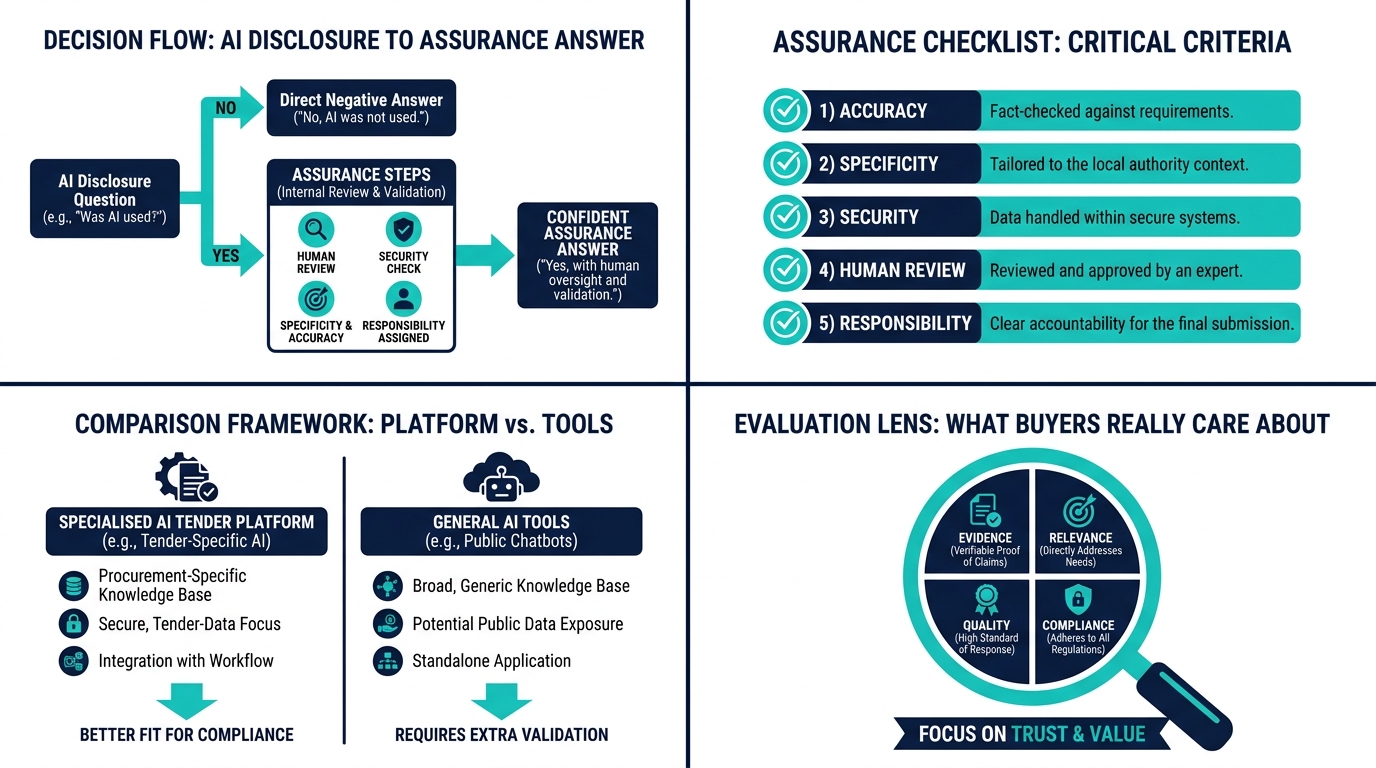
AI disclosure decision flow for local authority tender responses
If you use mytender.io, Copilot, ChatGPT, Claude, Gemini, or any other AI-assisted tool, the best answer is not defensive. It is calm, transparent and practical.
Say what you used. Explain what it helped with. Confirm that your team reviewed it. Then make clear that you remain responsible for every claim in the bid.
First, Is AI Allowed in Public Sector Bids?
Yes.
The clearest official wording is in the Cabinet Office Procurement Policy Note on improving transparency of AI use in procurement. It says suppliers' use of AI is not prohibited during the commercial process.
It also says there may be benefits to suppliers using AI to develop bids, including helping them bid for more public contracts.
That matters because the question often feels loaded. In reality, government guidance treats AI much like using a bid writer: something that may create risk if used badly, but is not banned.
The Procurement Act 2023 also sits behind a procurement regime built around fair treatment, transparency and proportionate assessment. Buyers can ask sensible questions about AI, especially around accuracy and risk. What they should not do is apply a blanket penalty simply because a supplier used an AI-assisted tool.
Why Are Local Authorities Asking?
They are asking because AI can produce two things at once:
- Better structured, more complete first drafts
- Plausible claims that may be wrong if nobody checks them
The second point is what buyers worry about.
They are not usually bothered that you used software. Everyone uses software. Nobody asks whether you wrote the bid with a keyboard instead of handwriting it. In a few years, the AI question will probably feel just as odd.
What matters is whether the submitted answer can be trusted.
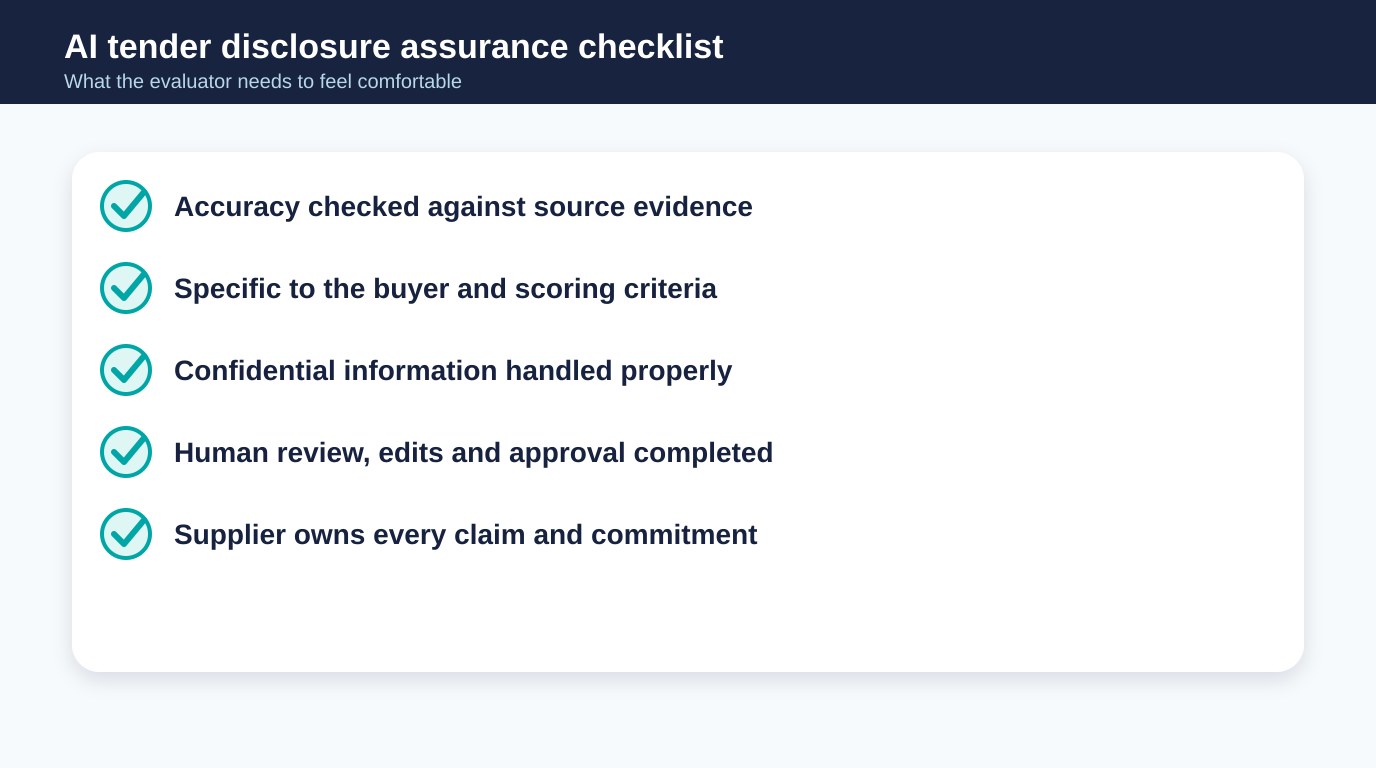
Tender AI assurance checklist covering accuracy, specificity, security, human review and responsibility
So your answer should reassure the evaluator on five points:
- The content is specific to the tender requirements
- The evidence relates to real capability, not invented claims
- The submission has been checked and approved by people in your business
- Confidential information has been handled properly
- You remain accountable for the commitments made
That is the heart of a good AI disclosure answer.
The Short Answer Most Suppliers Should Give
If the tender asks a simple yes or no question, answer honestly.
If it gives you space for detail, use that space well. A good answer should be short enough to read quickly but specific enough to create confidence.
Here is the structure:
- Name the tool or type of tool used
- Describe what it supported
- State what it did not replace
- Confirm human review and approval
- Confirm responsibility for accuracy and commitments
That is it. Do not apologise for using AI. Do not over-explain the model architecture. Do not sound evasive.
Example Wording If You Used mytender.io
You can adapt this:
> We have used mytender.io, an AI-assisted tender writing and bid management platform, to support preparation of this response. > > The platform helps analyse tender requirements, identify compliance points, organise source material, and create structured first-draft content. Data entered into mytender.io is not used to train public AI models. > > mytender.io maintains strong security controls and holds recognised credentials including Cyber Essentials Plus and ISO 27001. All AI-assisted content has been reviewed, edited and approved by our team. We remain fully responsible for the accuracy, completeness and commitments made in this submission.
That wording works because it answers the real concern.
It does not just say "yes, we used AI." It explains that the AI helped with structure, analysis and drafting, while the supplier retained control of the final submission.
Example Wording If You Used Copilot, ChatGPT or Another General AI Tool
If you used a general tool, be equally clear. Do not pretend it was a specialist bid platform if it was not.
Use something like this:
> We used AI-assisted tools to support drafting, editing and structuring parts of this response. The tools were used to help improve clarity, organise source material and produce initial working drafts. > > The tools were not used as the sole source of any factual, technical, financial or contractual claim. All content has been reviewed, amended and approved by our team before submission. > > We remain fully responsible for the accuracy, completeness and deliverability of all statements, evidence and commitments included in this tender response.
If you used a public model, add a sentence on confidential information:
> We did not use public AI tools to process confidential buyer information unless permitted by the tender documents and our internal information security controls.
Use that only if it is true. The worst AI disclosure answer is a polished sentence that your actual process cannot support.
Specialist AI Platform vs General AI Tool
There is nothing automatically wrong with general AI tools. They are useful for rewriting, summarising and turning rough notes into cleaner prose.
But a bid-specific platform gives you stronger assurance points because it is built around procurement workflows.
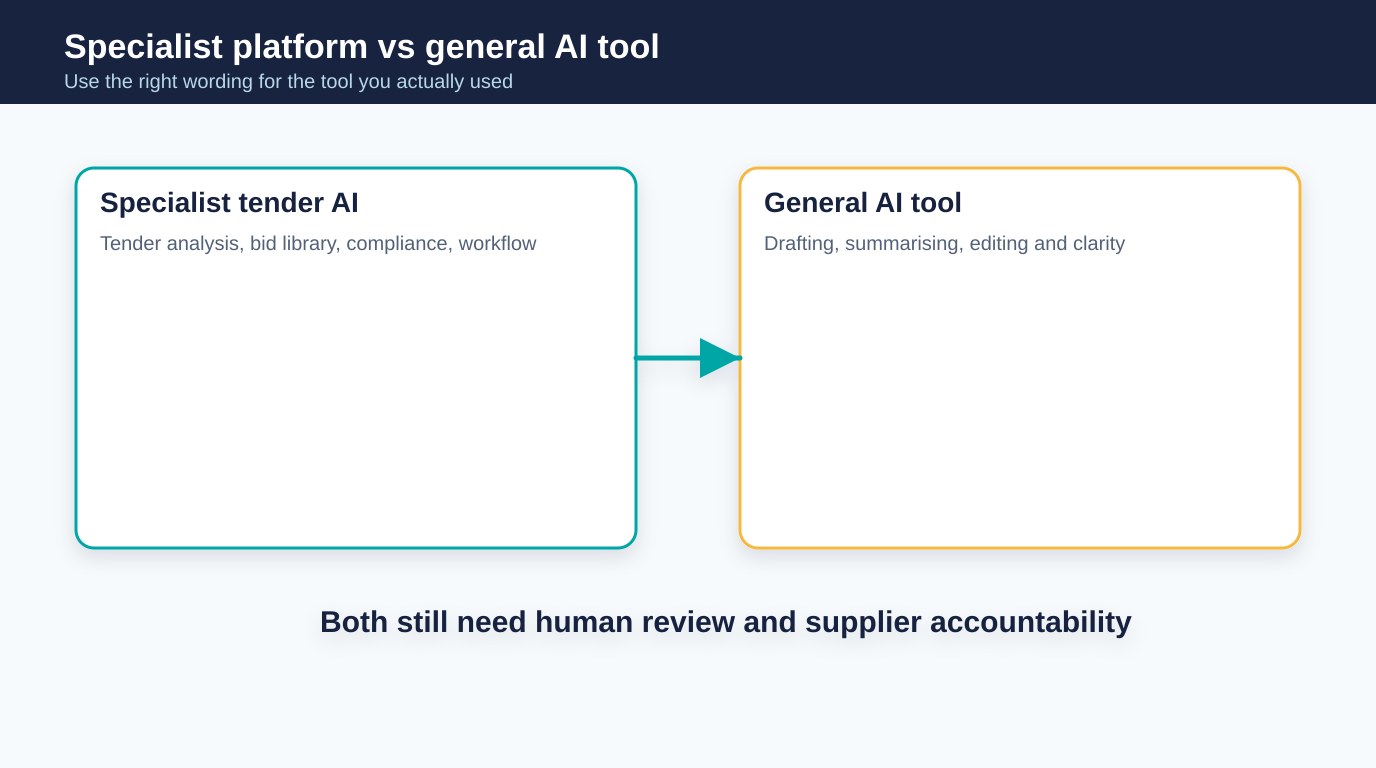
Comparison of specialist AI tender platform and general AI tools for bid disclosure answers
The difference usually shows up in four areas:
- Tender analysis: Can the tool break down the actual questions, scoring criteria and compliance requirements?
- Source control: Can it pull from your approved bid library, case studies, policies and previous evidence?
- Security: Is the platform designed for commercial bid information rather than casual prompting?
- Review workflow: Can your team edit, approve and track what makes it into the final response?
That is why the disclosure wording for a tool like mytender.io can be more specific. You are not just saying "we asked a chatbot to write something." You are saying you used a controlled platform to help manage the bid process, with human review throughout.
What Buyers Actually Care About
This is the bit suppliers often miss.
The buyer is not marking your tool choice. They are marking the tender response. If your answer is generic, unsupported or full of claims you cannot evidence, it will score badly whether AI was involved or not.
If your answer is specific, relevant, compliant and backed by credible evidence, the fact you used AI to help prepare it should not be the issue.
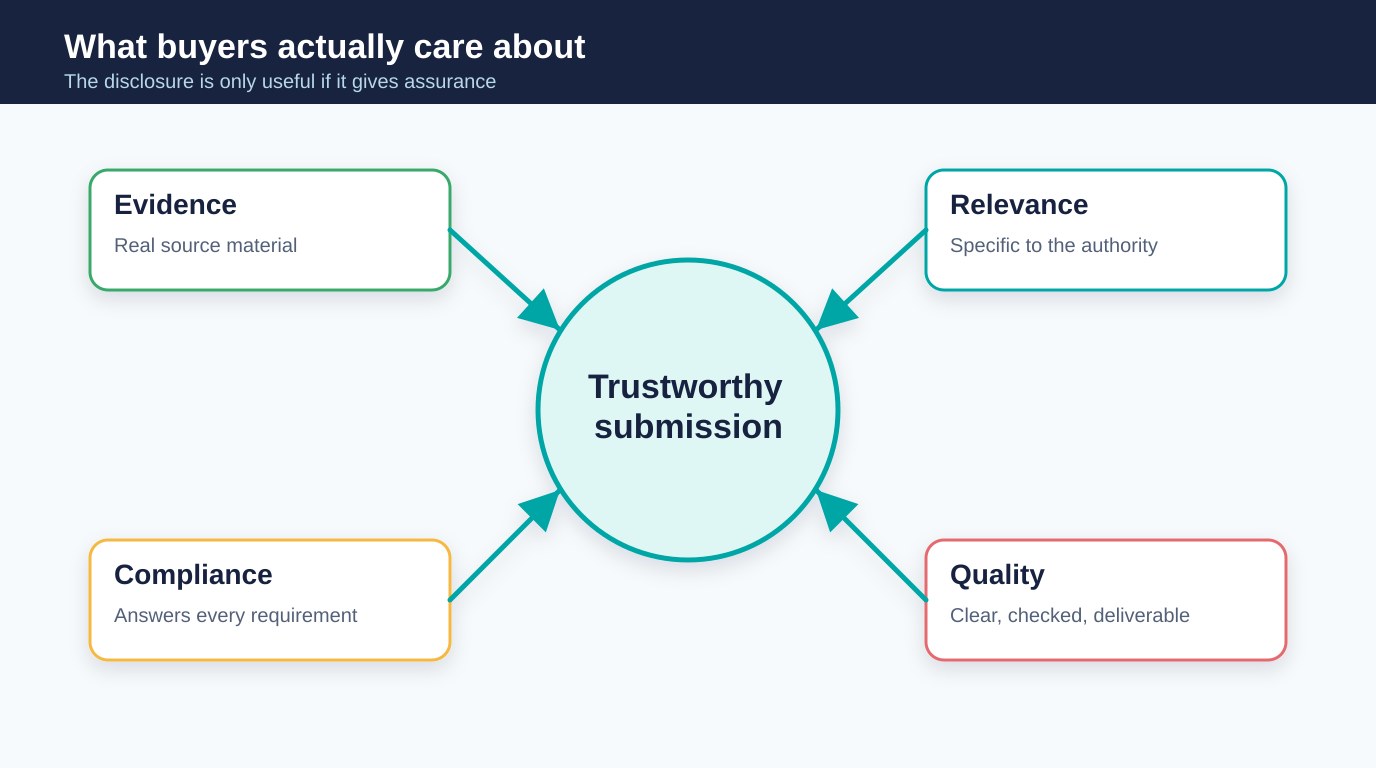
Evaluation lens for AI assisted tender responses showing evidence, relevance, quality and compliance
So focus your disclosure on assurance:
- Accuracy: Every factual claim has been checked
- Specificity: The response has been tailored to the buyer's requirement
- Evidence: Case studies, credentials and figures come from real source material
- Quality: AI-assisted drafting has been edited by people who understand the service
- Accountability: The supplier owns the final submission
That language makes evaluators more comfortable because it connects AI use to bid quality, not shortcuts.
What Not to Write
Avoid these answers:
> No, we have not used AI.
If you have used it, this is simply risky. It is also increasingly hard to define. Was grammar checking AI? Was Copilot in Word enabled? Did someone use an AI search summary while researching the buyer?
Another weak answer:
> Yes, we used AI to write the response.
That sounds like the tool did everything and nobody checked it.
And the worst version:
> We used AI, but only a little bit.
This creates more doubt than confidence. "A little bit" is vague. It does not tell the evaluator anything useful.
Use practical language instead. Explain the role of the tool and the role of your team.
A Better Internal Rule for Bid Teams
Before you submit, ask one question:
Could we defend every claim in this response if the buyer asked for evidence tomorrow?
If yes, your AI disclosure is simple. If no, the problem is not the disclosure. The problem is the bid.
Your team should be able to point to:
- The source document or policy behind each claim
- The person who reviewed each technical answer
- The case study or contract example used as evidence
- The sign-off owner for commercial and delivery commitments
AI can help you get to a stronger draft faster. It cannot take responsibility for your claims.
A Paste-Ready Answer
Here is a compact version you can use in most tender portals:
> We have used AI-assisted tools to support preparation of this response, including analysis of tender requirements, organisation of source material, drafting support and editing. > > AI-assisted content has been reviewed, amended and approved by our team before submission. We have checked the response against our source evidence and the tender requirements. > > We remain fully responsible for the accuracy, completeness and deliverability of all statements, evidence and commitments made in this submission.
If you used mytender.io, add:
> Where mytender.io was used, it supported tender analysis, compliance checking, bid library retrieval and structured drafting. Data entered into the platform is not used to train public AI models.
The Bottom Line
Do not treat the AI question like a confession box.
Treat it like an assurance question. The buyer wants to know whether your bid is accurate, specific, secure and properly reviewed.
So answer in that language.
Yes, AI was used where relevant. Yes, humans checked it. Yes, the evidence is real. Yes, the supplier remains accountable.
That is the answer local authorities actually need.
If you want to see live public sector opportunities while building your bid process, the Tender Finder is free to use. It helps you spot tenders early enough to prepare properly, including the evidence and assurance you need for AI disclosure questions.Sources
- Cabinet Office, PPN 017: Improving transparency of AI use in procurement
- GOV.UK, Procurement Act 2023 guidance: covered procurement objectives
- legislation.gov.uk, Procurement Act 2023 explanatory notes
Tags
Ready to Transform Your Tender Writing?
See how MyTender's AI can help you write winning tenders in a fraction of the time.