

Grounded AI Tender Responses: How to Avoid Generic Bid Content and Prove Every Claim in 2026
A practical guide for bid teams using AI in tenders without producing generic, unevidenced responses that cap scores. Learn how to ground every claim in buyer context, source evidence and human review.
mytender.io Research Team
Tender Writing & Bid Management Specialists
Grounded AI Tender Responses: How to Avoid Generic Bid Content and Prove Every Claim in 2026
AI has made tender writing faster. It has not made weak evidence stronger.
That is the awkward truth behind a lot of bid teams' frustration in 2026. They have adopted AI tools, built prompt libraries, copied useful workflows from sales teams and found ways to produce first drafts in a fraction of the old time. Yet the scores do not always move. Sometimes they even fall.
The problem is rarely that AI was used. The problem is that the response sounds finished before it is true.
Public sector evaluators are now reading more AI-assisted content than ever. They can spot the pattern: polished introduction, neat structure, confident claims, light detail, thin evidence and phrases that could belong to almost any supplier. It reads well for ten seconds. Then it collapses under the scoring model.
The winning bid teams are taking a different route. They are using AI to accelerate structure, analysis, retrieval, compliance mapping and red-team review. But they are grounding every answer in buyer context, operational evidence and human accountability.
This guide explains how to do that.

Bid team using AI to connect tender requirements, evidence sources and human review before submission
Why this topic matters now
The UK tender market has shifted in two directions at the same time.
First, procurement is becoming more transparent and more evidence-led. The Procurement Act 2023 regime has pushed buyers and suppliers towards clearer notices, stronger performance thinking, broader public value and more visible contract outcomes. Buyers are not only asking whether a supplier can write a convincing method statement. They are asking whether the supplier can prove it can deliver.
Second, AI has become normal in bid teams. It is used to summarise specifications, draft responses, search content libraries, create compliance matrices, turn interview notes into first drafts and check whether an answer has missed a requirement.
That combination creates a new quality bar.
Using AI is not the shortcut some people hoped for. It is a force multiplier. If your source evidence is strong, AI helps you use it faster. If your evidence is poor, AI helps you produce poor answers more fluently.
That is why the phrase grounded AI matters. A grounded response is not just well written. It is traceable. It has a clear link between the buyer's question, the scoring criteria, the supplier's evidence and the final claim on the page.
The mistake: treating AI as the author instead of the assembler
The most common mistake is asking AI to write an answer from a question alone.
A tender asks: Describe your approach to mobilisation.
The bidder pastes that into a general AI tool and receives a plausible answer about mobilisation planning, stakeholder engagement, risk management, governance, communication and continuous improvement. It looks helpful. It may even sound professional.
But it has almost no scoring value until it is connected to reality.
A high-scoring mobilisation answer needs to know the contract type, estate profile, TUPE risk, incumbent position, systems handover, local labour market, buyer concerns, transition period, critical dates, implementation governance, comparable mobilisation evidence and specific measures that prove the bidder can do the work.
AI cannot invent those facts safely. It can only organise them once the team has supplied them.
The better mental model is this:
AI should not be the author of your tender response. It should be the assembler, analyst and challenger working from verified material.
That changes the workflow. Instead of asking, write our answer, the stronger prompt becomes:
Use the specification, scoring criteria, our approved case study notes, our mobilisation plan and the subject matter expert interview transcript to draft a response that answers each sub-question, cites the evidence source for each claim and flags any unsupported promise.
That is a very different process.
The generic AI ceiling
Generic AI content often reaches a ceiling. It can sound competent, but it rarely earns top marks.
Evaluators score against the question in front of them. Top bands usually require specific methodology, credible evidence, clear roles, measurable outcomes, risk controls and buyer-specific tailoring. Generic prose tends to provide the opposite. It offers broad principles where the evaluator needs proof.
The signs are easy to spot:
- claims such as robust, seamless, comprehensive and best-in-class without evidence
- paragraphs that describe what any competent supplier would do
- no named roles beyond generic account manager or project lead
- no link to the buyer's sector, site type or service risk
- no figures, dates, baseline measures, performance results or lessons learned
- promises that sound attractive but are not owned by operations
- social value commitments that could apply to any region
- risk management language that never names the actual risks
That content may pass a first glance. It rarely survives a scoring panel.
The hard part for bid teams is that AI makes this content feel productive. A blank page becomes 900 words in seconds. The team feels progress. But unless those 900 words are grounded, the work has simply moved the problem from drafting to editing.
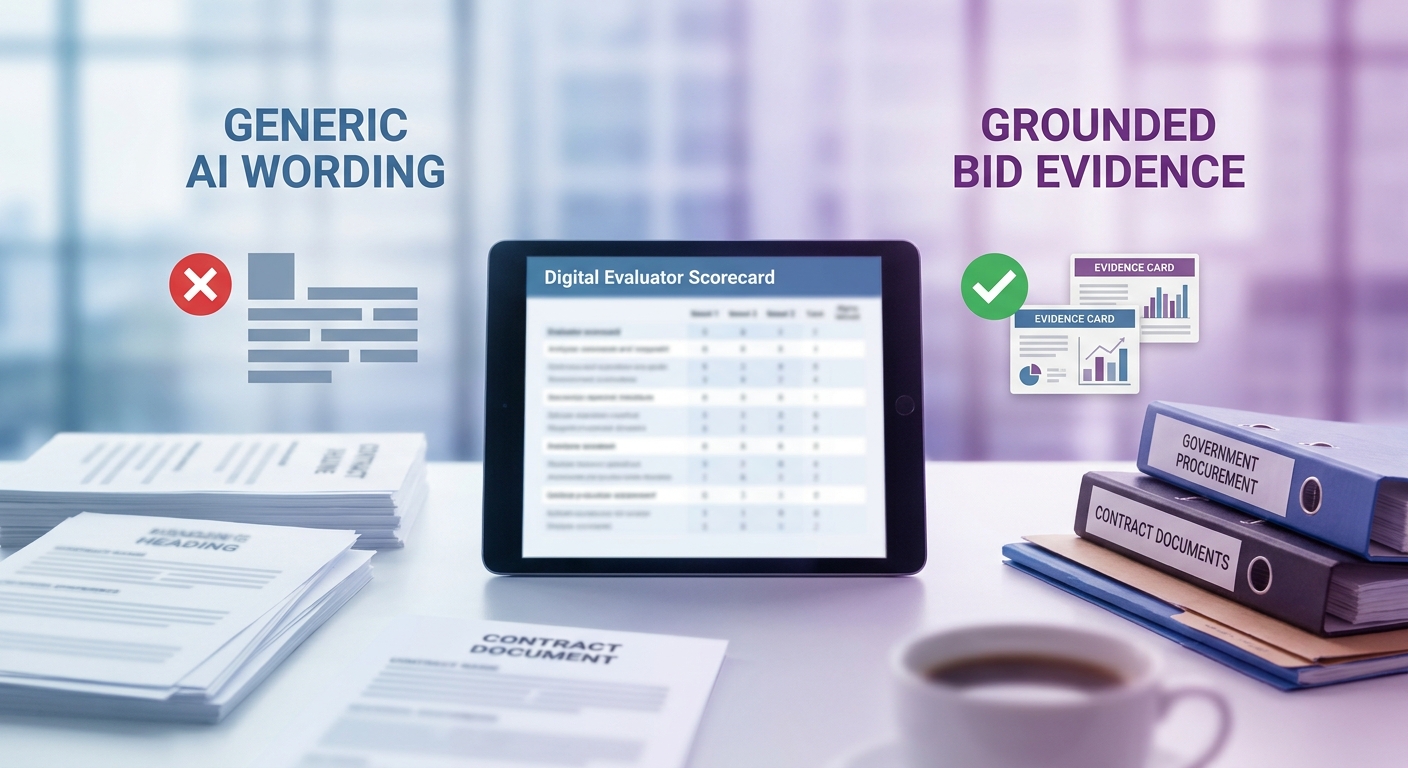
Evaluator scorecard comparing generic AI wording with grounded bid evidence and buyer-specific proof
What grounding means in a tender response
Grounding is the practice of tying every important claim back to a verified source.
In tender writing, that source might be:
- the invitation to tender or specification
- the scoring criteria
- a clarification response
- a mobilisation plan
- a contract review pack
- a KPI dashboard
- a client testimonial
- a case study approved by the account team
- a policy or accreditation
- a delivery method signed off by operations
- a subject matter expert interview
- a pricing assumption
- a contract risk register
- a lessons learned report
A grounded answer does not have to cite these sources publicly in a footnote style unless the tender asks for it. But internally, the bid team should know where each claim came from.
If a sentence says, we maintain 98% planned preventive maintenance completion, someone should be able to point to the report that supports it.
If a sentence says, our mobilisation model reduces transition risk, someone should be able to show the mobilisation tracker, the comparable contract and the lesson that informed the approach.
If a sentence says, we will create apprenticeships in the buyer's area, someone should know who owns that commitment, what budget supports it and how it will be measured.
Grounding is what turns AI from a fluent writer into a useful bid engine.
The five-part grounded AI workflow
A good AI tender process is not complicated. It is disciplined.
Use this five-part workflow for any scored response where AI is involved.
1. Read the buyer question as a scoring problem
Before drafting, break the question into scoring tests.
A question rarely asks for one thing. It may ask for approach, experience, mobilisation, risk management, quality assurance, innovation, social value and reporting inside the same paragraph.
AI is useful here. Ask it to extract each requirement, implied risk and evidence need from the tender documents. Then check the output manually.
The aim is not to create a pretty summary. The aim is to stop the team missing marks.
For each question, create a simple answer map:
- What is the buyer asking directly?
- What is the buyer worried about indirectly?
- What evidence will prove we can do this?
- Which subject matter expert owns the answer?
- Which claims must be checked before submission?
This prevents the classic AI mistake: answering the theme but missing the marks.
2. Gather evidence before drafting
Do not let the first draft run ahead of the evidence.
For each response, gather the proof first. That can feel slower, but it makes the writing faster and safer.
A practical evidence pack might include:
- three relevant case study snapshots
- two or three performance metrics from comparable contracts
- named team roles and responsibilities
- a method statement or operating procedure
- a risk register extract
- mobilisation lessons learned
- compliance certificates or accreditations
- examples of reporting packs or dashboards
- social value delivery records
- customer feedback or contract review outcomes
The evidence pack should be short. You are not building a legal bundle. You are giving AI and the writer enough verified material to produce a credible answer.
This is where mytender.io's approach is different from a generic chat tool. The strongest bid teams do not rely on memory or improvised prompts. They connect AI to approved bid libraries, previous submissions, operational content and tender-specific documents, then use human review to decide what belongs in the final response.
3. Draft from sources, not vibes
Once the evidence is assembled, AI can draft.
The instruction should be specific. Tell it the buyer context, the scoring criteria, the required tone, the word limit, the source material and the evidence standard.
A good drafting instruction includes:
- use only the supplied evidence for factual claims
- flag missing evidence rather than inventing it
- structure the answer around the scoring criteria
- make the first sentence answer the buyer's question directly
- include measurable proof where available
- avoid generic adjectives unless supported by evidence
- identify any claim that needs subject matter expert approval
This produces a very different output from a blank prompt.
The response may be less glossy at first, but it will be closer to the truth. That is exactly what you want. Polishing comes later. Evidence comes first.
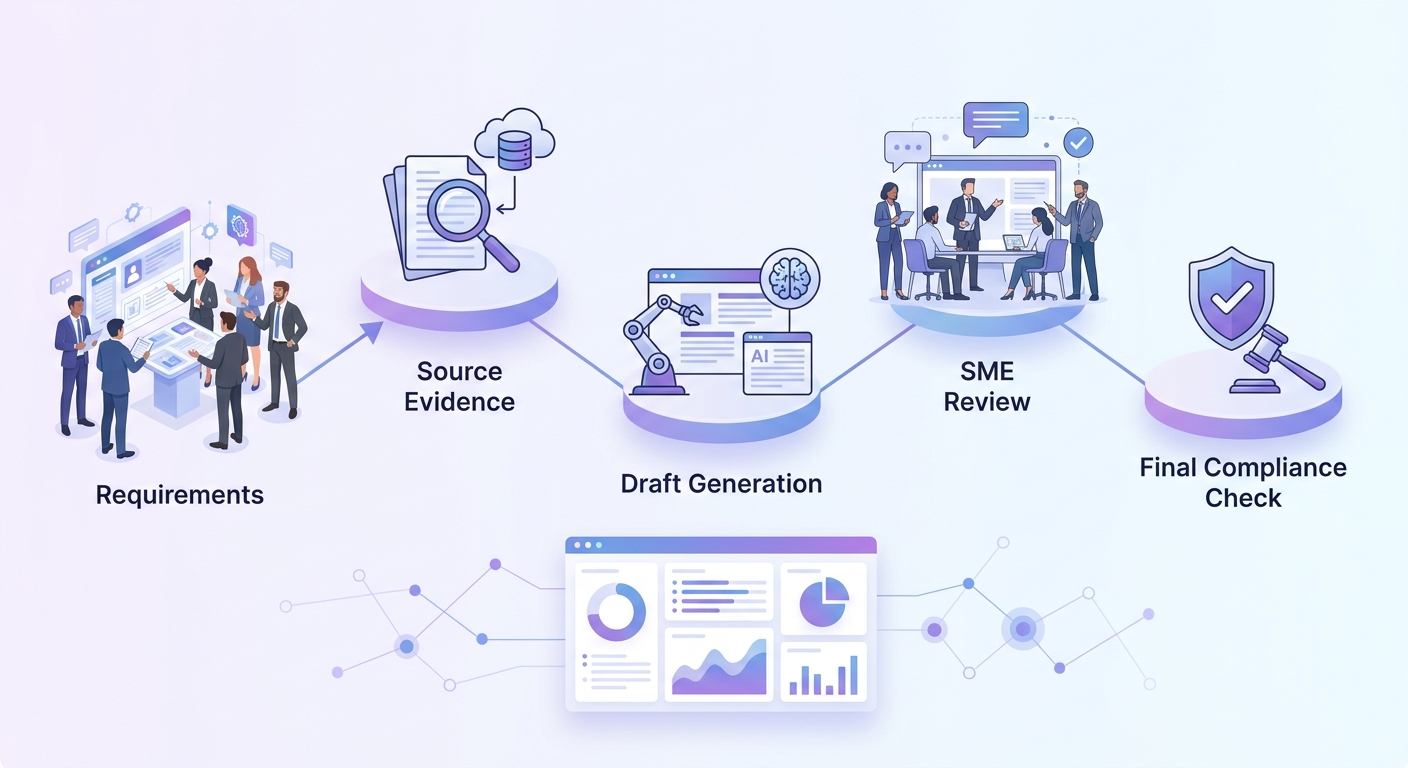
Grounded AI workflow showing requirements, source evidence, draft generation, SME review and final compliance check
4. Run a human evidence review
Human review is not just proofreading.
A real review asks whether the answer is accurate, deliverable and scoreable.
The reviewer should check:
- Are all factual claims true?
- Are figures current and approved for use?
- Does the case study actually match the buyer's context?
- Have we promised anything operations cannot deliver?
- Does the answer respond to every sub-question?
- Is the evidence specific enough for top marks?
- Are any AI-created phrases too vague or inflated?
- Are assumptions clearly owned?
- Is the answer consistent with the price and delivery model?
This is especially important where AI has been used to make an answer sound smoother. Smooth writing can hide weak commitments.
A sentence such as our dedicated mobilisation team will provide seamless transition support sounds harmless. But who is dedicated? For how long? What does transition support include? Is it priced? Is it available in the first four weeks? What happens if the incumbent delays data handover?
Human review turns that into something the buyer can score:
Our mobilisation manager, helpdesk lead and contract manager will run a four-week transition plan covering asset validation, CAFM data import, TUPE consultation support, supplier onboarding and first-month KPI reporting. On a comparable multi-site FM mobilisation in 2025, the same governance model completed 96% of planned mobilisation actions before service commencement and reduced first-month reactive backlog by 22%.
That is the difference.
5. Red-team before submission
The final AI use should not be more drafting. It should be challenge.
Ask AI to act as an evaluator, but do not treat its judgement as final. Use it to find weaknesses.
Useful red-team checks include:
- Which parts of this answer sound generic?
- Which claims lack evidence?
- Where does the answer fail to address the scoring criteria?
- What clarification question might an evaluator ask?
- Which promise creates delivery or pricing risk?
- What would stop this answer reaching the top score band?
- Which sentence should be cut because it says nothing measurable?
This is one of the safest and highest-value AI uses in bid writing. It does not invent facts. It pressures the draft.
How to write an AI disclosure answer
Many public sector tenders now ask whether AI has been used in preparing the bid. The exact wording varies, but the intent is usually transparency, not automatic penalty.
The best answer is calm and factual.
Do not over-explain. Do not apologise for using modern tools. Do not pretend AI was not used if it was.
A strong disclosure usually covers four points:
- AI was used to support drafting, structuring, summarisation or document analysis.
- The supplier remains fully accountable for the final submission.
- All AI-assisted content was reviewed and approved by qualified human reviewers.
- Confidentiality, data security and factual verification controls were applied.
For example:
We used approved AI-assisted bid tools to support document analysis, response structuring and first-draft preparation. Final content was reviewed, edited and approved by our bid team and relevant subject matter experts before submission. We remain fully responsible for the accuracy and deliverability of all responses. No confidential buyer information was entered into public consumer AI tools, and all factual claims, case studies, commitments and compliance statements were checked against approved internal sources.
That is enough for most disclosure questions.
The answer should not be treated as a marketing moment. The buyer wants reassurance, not a lecture about AI transformation.
How to remove AI fluff from a tender response
AI fluff is not only bad style. It is wasted word count.
Every tender answer has a finite space. If 20% of it is generic setup, you have given away marks before the evaluator starts scoring.
Look for these phrases:
- We understand the importance of
- We are committed to delivering excellence
- Our comprehensive approach ensures
- We leverage industry best practice
- We provide a seamless end-to-end solution
- We pride ourselves on
- We will work collaboratively with stakeholders
- We have robust systems and processes
These phrases are not always forbidden. But they are usually a warning that the sentence needs evidence.
Replace them with proof.
Instead of:
We have robust systems and processes to manage contract performance.
Write:
The contract manager reviews performance weekly using a live KPI dashboard covering response times, overdue actions, complaints, audit findings and improvement actions. Exceptions are assigned to named owners within 24 hours and reviewed at the monthly client meeting until closed.
Instead of:
We understand the importance of social value.
Write:
For this contract, our social value plan focuses on the buyer's stated priority of local employment. We will ring-fence interview opportunities for local candidates, partner with two borough-based employability providers and report monthly on interviews, starts, training hours and retention.
Instead of:
Our mobilisation process ensures a smooth transition.
Write:
Our 30-day mobilisation plan is split into five workstreams: people, assets, systems, suppliers and governance. Each workstream has a named owner, weekly checkpoint and day-one acceptance criteria, so the buyer can see whether transition risk is reducing before service commencement.
The pattern is simple: replace abstract confidence with visible control.
Build an evidence library AI can actually use
The biggest constraint on AI bid quality is not the model. It is the content library.
If your bid library is full of old submissions, duplicated paragraphs, unverified statistics and outdated policies, AI will only make that mess faster.
A useful AI-ready bid library needs structure.
At minimum, tag content by:
- sector
- service line
- buyer type
- contract size
- geography
- date
- evidence status
- owner
- approval date
- expiry date
- source document
- whether the content can be reused externally
The evidence status is critical.
Not every piece of content should be treated equally. Separate approved evidence, draft examples, expired content and content that needs SME review. AI should not be allowed to pull a five-year-old claim into a live bid as if it were current.
For each case study, keep a one-page evidence card:
- client type
- problem solved
- scope of work
- contract value band if publishable
- dates
- measurable outcomes
- relevant KPIs
- named internal owner
- reusable proof points
- restrictions on use
- lessons learned
This turns the library into something AI can retrieve safely.

AI-ready bid library with approved evidence cards, expiry dates and source verification for tender responses
What to do when evidence is missing
Sometimes the evidence is not there.
That is not an AI problem. It is a business problem, and it is better to find it before submission than after award.
When evidence is missing, there are four options.
First, get the evidence. Speak to operations, finance, HR, account teams or delivery leads. Many teams have the proof but not in a bid-ready format.
Second, narrow the claim. If you cannot prove performance across the whole business, use a specific verified example. A modest truthful claim beats a broad unsupported one.
Third, write the control instead of the result. If you cannot evidence an outcome yet, explain the governance, measurement and review process that will control it on this contract.
Fourth, remove the claim. This is painful, but necessary. Unsupported claims create scoring risk and delivery risk.
AI should help flag missing evidence, not cover it up.
A useful internal rule is: if we would be uncomfortable explaining this sentence in a clarification meeting, it should not be in the submission.
How this changes the bid writer's role
AI does not make bid writers less important. It changes where their judgement matters.
The old bottleneck was often first-draft production. The new bottleneck is evidence quality.
Bid writers now add value by:
- interpreting the buyer's scoring priorities
- extracting useful detail from subject matter experts
- deciding which evidence belongs in the answer
- removing generic language
- checking whether claims are deliverable
- shaping the story around buyer risk
- coordinating review and approval
- protecting the submission from unsupported promises
That is higher-value work than retyping boilerplate.
The strongest bid writers become evidence editors. They use AI to move faster, but they decide what is true, relevant and persuasive.
A practical grounded AI checklist
Use this checklist before any AI-assisted tender response is submitted.
Before drafting
- Have we broken the question into all scoring requirements?
- Have we identified the buyer's real risk behind the question?
- Have we gathered relevant case studies, metrics and method evidence?
- Have we confirmed which source documents AI is allowed to use?
- Have we set rules that prevent invented claims?
During drafting
- Does the first paragraph answer the question directly?
- Is the structure aligned to the scoring criteria?
- Are generic claims replaced with specific evidence?
- Are roles, timescales, controls and measures clear?
- Has AI flagged missing evidence rather than filling gaps?
During review
- Has a subject matter expert checked factual accuracy?
- Are all figures current and approved?
- Are commitments priced, resourced and deliverable?
- Does the answer reflect the buyer's sector and local context?
- Have unsupported claims been removed or narrowed?
Before submission
- Have we completed the AI disclosure question honestly?
- Have we checked confidentiality and data security requirements?
- Have we red-teamed the response against the scoring model?
- Have we cut filler to make room for evidence?
- Would we defend every claim in a clarification meeting?
If the answer is yes, AI has helped the bid. If not, AI has only made the draft look more complete than it is.
Examples of grounded AI in common tender sections
The principle is simple, but it becomes most useful when applied to the sections bid teams write every week.
For mobilisation, grounding means more than describing a transition plan. It means showing the first 30, 60 and 90 days, the workstream owners, the day-one acceptance criteria, the dependency on incumbent information, the buyer decisions needed and the evidence from comparable transitions. AI can help turn those moving parts into a clean narrative, but the substance must come from the mobilisation team.
For quality management, grounding means explaining how non-conformance is found, assigned, corrected and prevented from recurring. A generic answer says the supplier has ISO 9001 and continuous improvement processes. A grounded answer explains the audit rhythm, escalation route, root-cause method, corrective action owner and reporting pack the buyer will actually see.
For social value, grounding means replacing national promises with local commitments. The answer should connect the buyer's priorities to deliverable actions, named partners, measurable outputs and reporting cadence. If the tender is in Manchester, a generic paragraph about community engagement is not enough. The evaluator wants to know what will happen in Manchester, who will do it, when it will start and how progress will be evidenced.
For sustainability, grounding means using real baseline data and operational controls. AI can help structure a carbon reduction answer, but it must not invent emissions figures, fleet plans or waste diversion rates. If current data is partial, say how it will be measured and improved rather than pretending the baseline is complete.
For risk management, grounding means naming the risks the buyer is most likely to care about. A boilerplate risk process is weak. A grounded response says which risks apply to this contract, what early warning indicators will be tracked, who owns each mitigation and how unresolved risk will be escalated.
These examples all point to the same rule. AI should make the answer clearer, not make the evidence look bigger than it is.
Where mytender.io fits
Generic AI tools can help with isolated writing tasks. They struggle when the bid depends on many sources, strict compliance, team review and reusable evidence.
mytender.io is built for the real tender workflow. It helps teams break down ITT requirements, retrieve relevant content from their own knowledge base, create strong first drafts, collaborate with subject matter experts, check compliance and keep bid teams focused on the evidence that wins marks.
That matters because bid quality is not just phrasing. It is the connection between requirement, evidence, review and final answer.
A good AI tender tool should help teams:
- understand what the buyer is really asking
- find the right previous content quickly
- avoid starting from scratch
- reduce repetitive drafting time
- keep human reviewers in control
- improve consistency across responses
- spot missing requirements before submission
- turn scattered operational knowledge into usable bid evidence
That is the difference between faster writing and better bidding.
The bottom line
AI will not win tenders by sounding clever.
It wins time when it helps bid teams find, structure and test the evidence that was already inside the organisation. It loses value when it turns weak source material into confident generic prose.
In 2026, the best bid teams will not be the ones using AI the loudest. They will be the ones using it with the most discipline.
Start with the buyer's scoring problem. Gather the evidence. Draft from sources. Review with humans. Red-team the answer. Disclose AI use honestly when asked.
That is how you avoid the generic AI ceiling.
And it is how AI becomes what bid teams actually need: not a shortcut around tender discipline, but a faster route through it.

Final grounded AI tender response pack with compliance check, evidence trail and approved submission ready for upload
Tags
Ready to Transform Your Tender Writing?
See how MyTender's AI can help you write winning tenders in a fraction of the time.