

CDM Compliance in Tender Responses: What Evaluators Actually Look For
A practical guide to writing CDM 2015 sections that actually score marks. What evaluators look for in duty holder competence, pre-construction information, construction phase plans, and the mistakes that lose easy points.
mytender.io Research Team
Tender Writing & Bid Management Specialists
CDM Compliance in Tender Responses: What Evaluators Actually Look For
It's Tuesday afternoon. You've got a 60-page ITT open on one screen and the SHEQ Manager's Teams message pinging on the other. The health and safety section is due back to you by Friday. There are seven CDM questions. You've copied last quarter's responses into a draft, changed the project name, and a small voice in your head says: this isn't going to score well.
That voice is right.
CDM compliance is one of the most under-scored sections in UK construction tenders. Not because bidders don't know the regulations, but because they treat it like a box-ticking exercise. Evaluators don't. They're looking for something specific, and most submissions don't give it to them.
This guide is for the bid managers and SHEQ managers writing those sections. Here's what evaluators actually score, and how to score better.
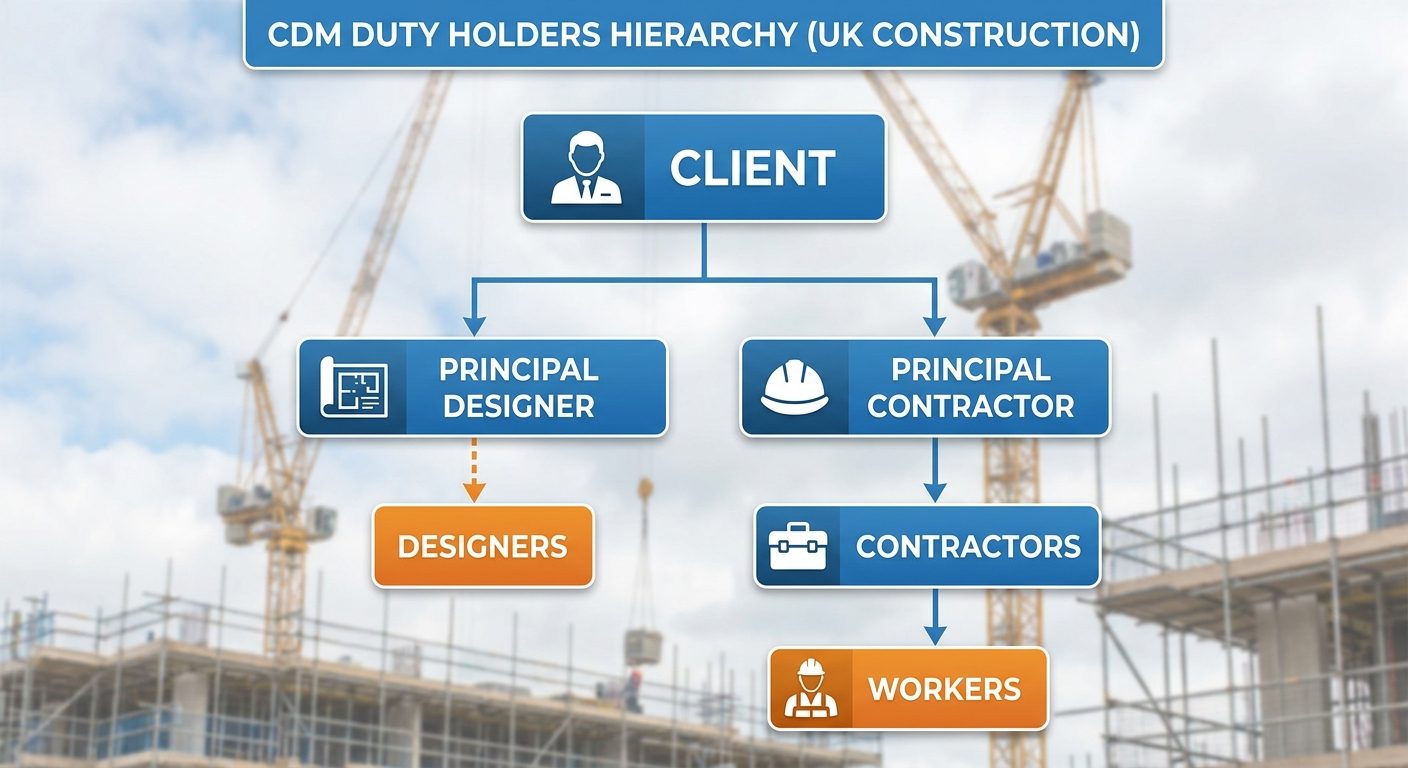
CDM duty holders hierarchy for construction tenders
What CDM 2015 Actually Requires
The Construction (Design and Management) Regulations 2015 set out duties for everyone involved in a construction project. The regulations apply to all construction work, no matter how small. The level of paperwork scales with the project, but the principles don't.
Five duty holders, each with defined responsibilities:
- Client. Makes suitable arrangements for managing the project, including welfare facilities and project information.
- Principal Designer (PD). Plans, manages and monitors the pre-construction phase. Coordinates health and safety in design.
- Principal Contractor (PC). Plans, manages and monitors the construction phase. Required on any project with more than one contractor.
- Designers. Eliminate, reduce or control foreseeable risks through design choices.
- Contractors. Plan, manage and monitor their own work, and comply with directions from the PD and PC.
Two thresholds matter for tender writing:
- More than one contractor on site. Triggers the appointment of a PD and PC.
- Notifiable projects. Construction lasting longer than 30 working days with more than 20 workers on site at any one time, or exceeding 500 person-days. These require an F10 notification to HSE before work starts.
If you write CDM responses and don't know off the top of your head whether the project is notifiable, you're already behind. Evaluators notice.
What Evaluators Actually Score (Hint: Not Just "Do You Have a Policy")
Here's where most bids leak marks. The question reads something like "describe your approach to CDM 2015 compliance" and the bidder responds with a generic statement that they comply with CDM 2015, attaches their policy, and moves on.
The evaluator scores it a 2 out of 5. Pass, but barely.
What they actually wanted was project-specific evidence. Look at the way modern public-sector tender questions are phrased:
- "Describe how you will discharge your duties as Principal Contractor on this project, including your interface with the appointed Principal Designer."
- "Explain how the pre-construction information provided will inform your construction phase plan for this specific scheme."
- "Provide examples of how your team has managed CDM duties on two comparable projects delivered in the last three years."
Notice the pattern. They're not asking what CDM is. They're asking what you'll do, on this project, for this client. A policy attached as an appendix doesn't answer any of that.
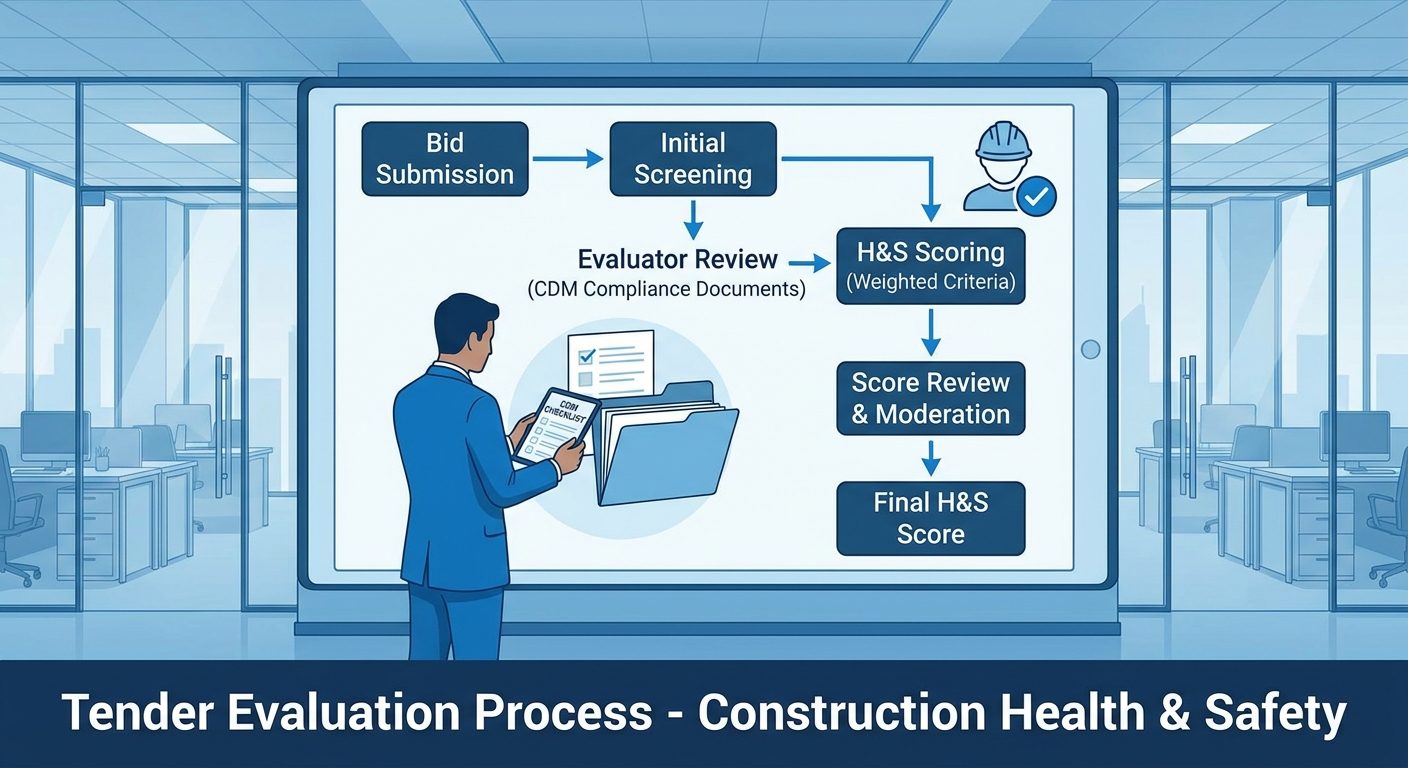
Tender evaluation scoring for health and safety
The Four Things Evaluators Are Genuinely Looking For
After reading enough scoring rubrics, the same four themes come up over and over:
- Specificity to the project. Did you read the pre-construction information? Did you reference the site's actual hazards?
- Evidence of competence. Named individuals with named qualifications, not "we are a CHAS-accredited contractor."
- Integration with the wider team. How you'll work with the PD, the client's CDM advisor, designers, and other contractors.
- A track record on similar work. Two or three relevant projects with concrete outcomes (accident-free hours, RIDDOR-free record, HSE engagement).
Score against those four and you'll move from a 2 to a 4 on most CDM questions. The marks are there. Most bidders just don't reach for them.
Pre-Construction Information: Read It, Then Use It
The Pre-Construction Information (PCI) pack is the most important document in your tender response and the most ignored. Clients put effort into producing it. Bidders skim it.
Inside a typical PCI you'll find:
- Site surveys (topographical, structural, intrusive)
- Ground investigations and contamination reports
- Existing utilities (live services, abandoned mains)
- Hazardous materials registers, including any asbestos surveys
- The health and safety file from previous works
- Programme constraints (occupied buildings, school holidays, listed status)
- Site access, welfare, and storage limitations
Your CDM response should explicitly reference these documents. Not just mention them. Use them.
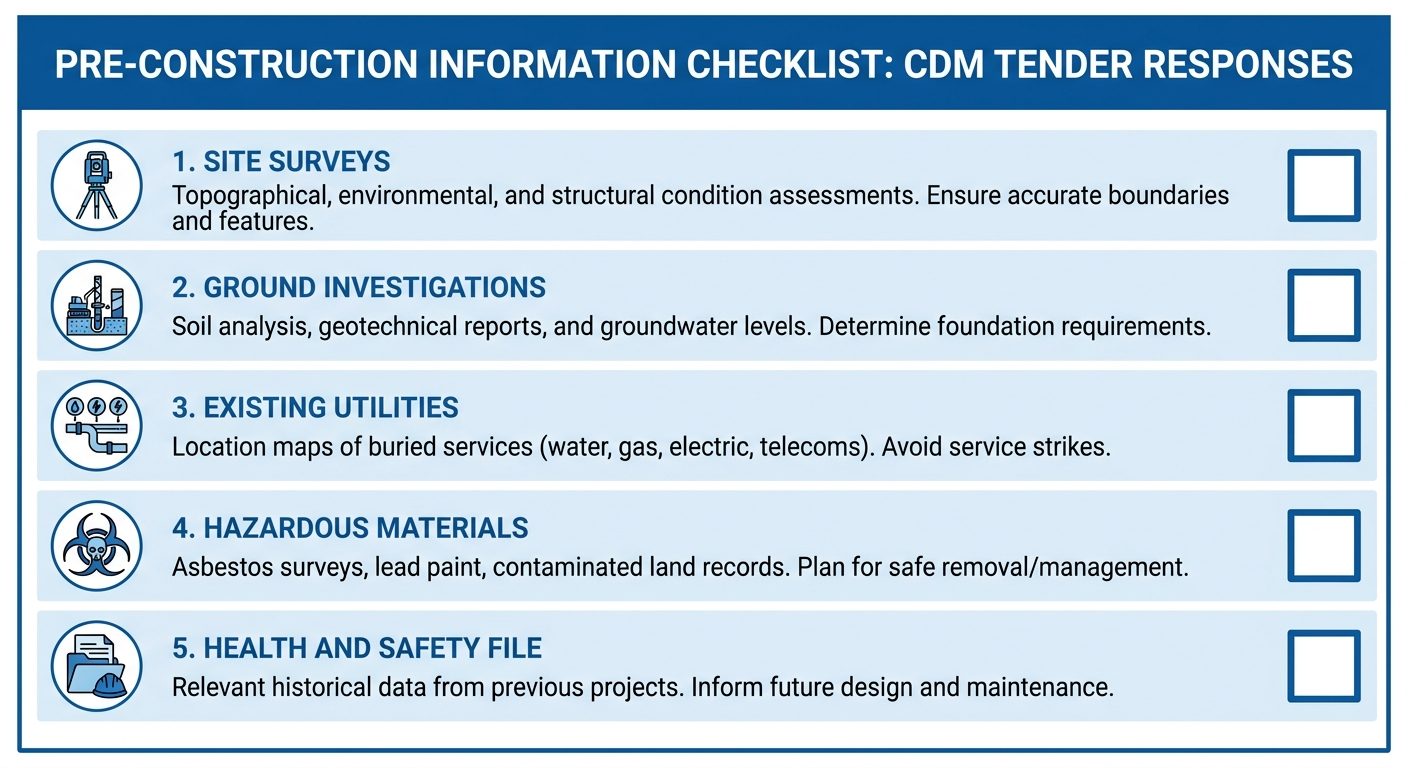
Pre-construction information checklist
For example, instead of:
> "We will conduct site-specific risk assessments before work commences."
Write something like:
> "The PCI confirms an R&D asbestos survey was completed in March 2026 (Survey Ref: ABS/2026/041) identifying ACMs in the basement plant room. Our construction phase plan will reflect this finding through an HSE-licensed removal package, sequenced ahead of mechanical strip-out, with air monitoring throughout."
That second version scores. The first doesn't. The evaluator can tell, immediately, whether you've actually read the PCI or not.
Principal Contractor vs Principal Designer: Address Both
A common trap: the tender asks you to describe how you'll fulfil your duties as Principal Contractor. You write a long answer about the PC role. You score badly.
Why? Because the evaluator wanted to see you understand the interface between PC and PD. Buyers often ask you to address both even when you're only formally appointed as one.
If you're bidding as Principal Contractor:
- Confirm acceptance of the PC appointment in writing on contract award.
- Describe the interface with the appointed PD, including how design changes will be reviewed for buildability and risk.
- Set out the mechanism for raising design-related health and safety concerns and tracking them to resolution.
- Explain how PD-issued pre-construction information feeds into your construction phase plan and ongoing risk management.
If you're bidding on a design and build basis where you'll appoint a PD:
- Name the PD organisation, even if it's an internal team.
- Set out their competence (qualifications, relevant experience, PII cover).
- Describe the design risk management process from concept through to construction.
The bids that score well on the PC/PD interface tend to use a simple diagram. Show the flow of information between the client, PD, PC, designers and contractors. Evaluators love a clear diagram. It signals you've actually thought about how the team will work, rather than copying a definition out of a textbook.
Competence and Training: What Good Looks Like
This is where most bids genuinely fail. The question asks how you'll ensure CDM competence. The bidder responds with "all our staff are SMSTS or SSSTS qualified."
That's not evidence. That's a sentence.
Evidence looks like this:
- A named PC representative with their CSCS card grade, SMSTS expiry date, IOSH/NEBOSH qualification, and years of experience as a Site Manager on comparable projects.
- A competence matrix for the wider team showing roles, required qualifications, and current holding.
- Training records with refresh cycles and a clear process for when someone's certification expires.
- Toolbox talk schedules linked to the site-specific risks identified in the PCI.
A useful pattern: write the competence section as if the evaluator is going to audit you on day one of mobilisation. If they can verify every claim from your response, you've done it right. If your response would melt under scrutiny, rewrite it.
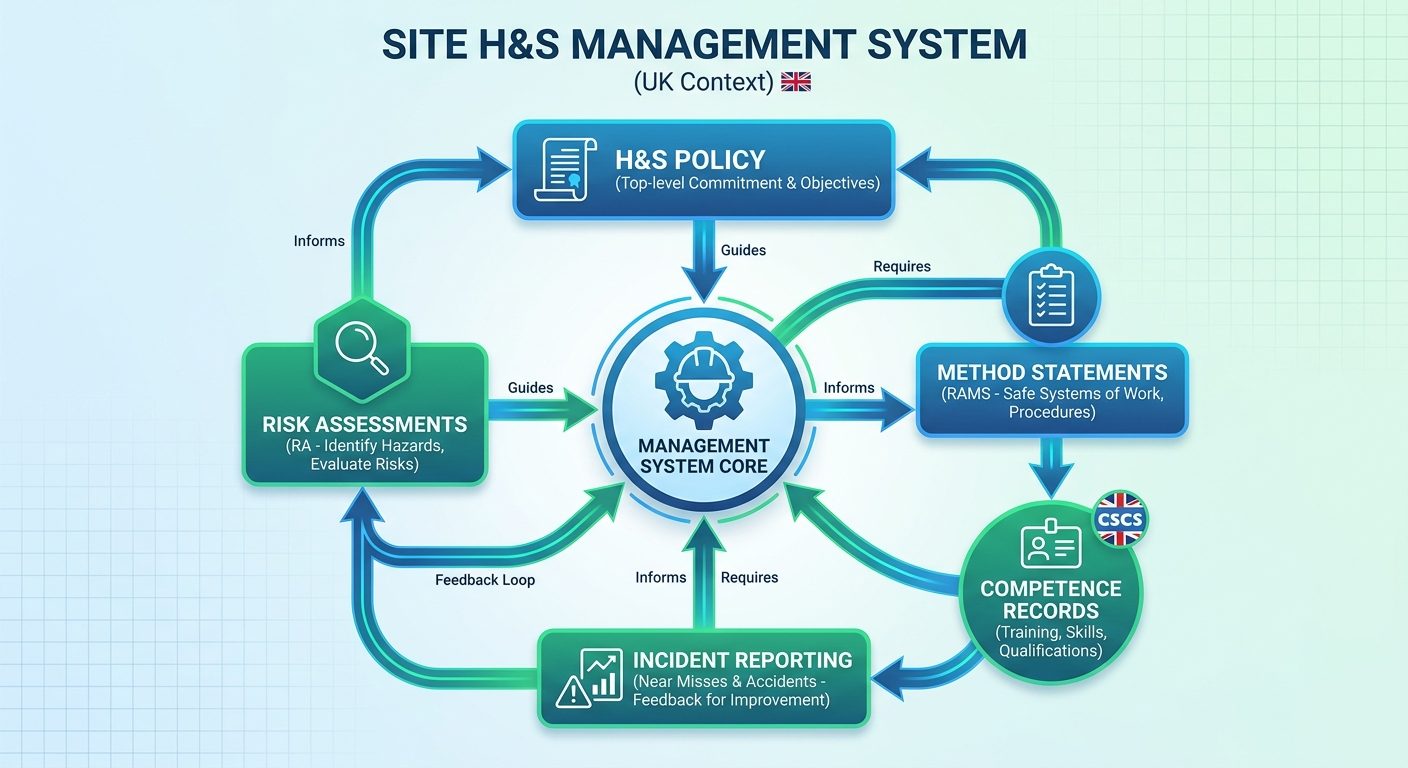
Health and safety management system diagram
A short table works well here. Three columns: role, qualification, individual (named). Evaluators can scan it in seconds and see you've thought it through.
Common Mistakes That Cost Marks
After reading a fair number of these submissions, the same errors crop up repeatedly. Here's the highlights reel of what goes wrong, and what to do instead.
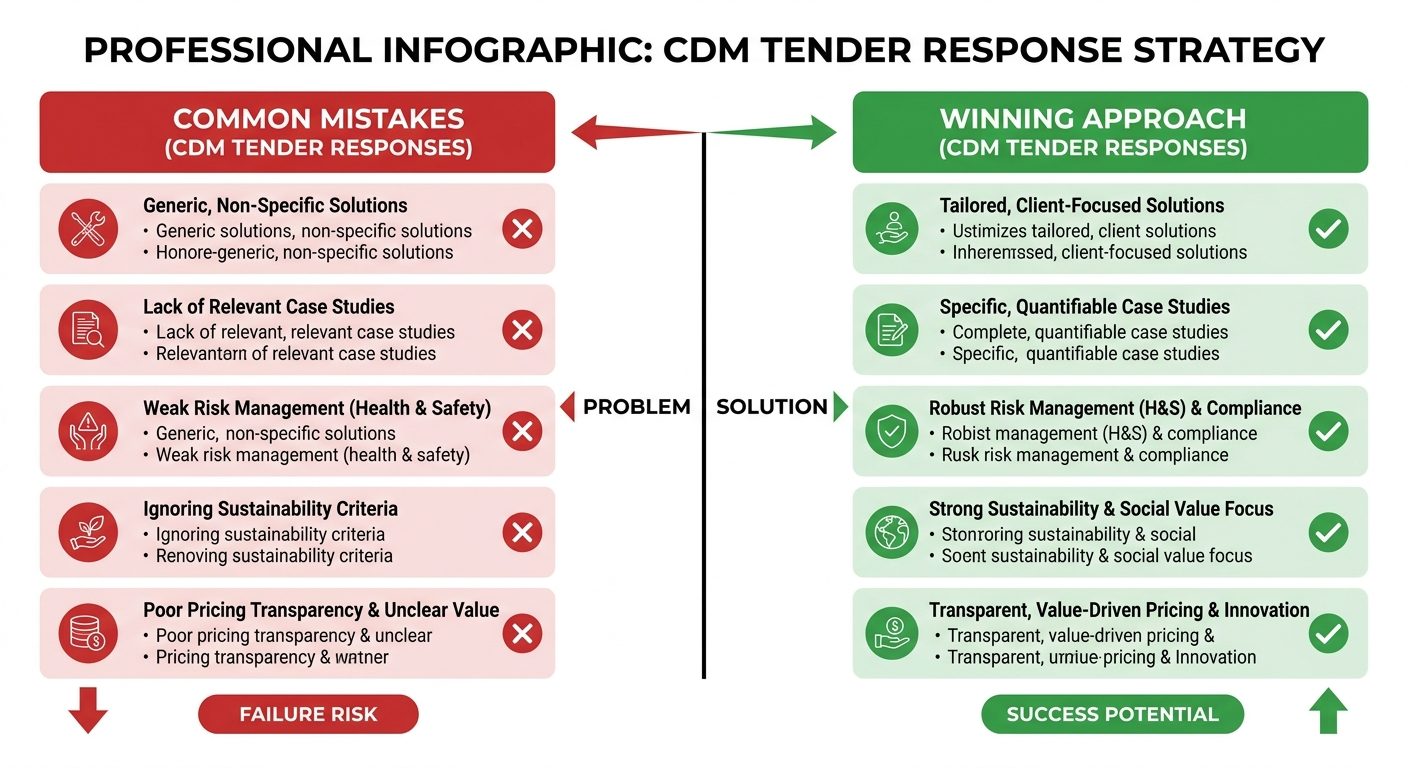
Common CDM tender response mistakes vs winning approach
How AI Bid Tools Can Help (Without Compromising Quality)
The biggest unlock with AI tools on a CDM section isn't writing the answer for you. It's giving you a structured first draft to react to.
A platform like mytender.io can:
- Pull through your library of previous CDM responses, indexed by project type, so you start from the most relevant prior example instead of a blank page.
- Cross-reference the PCI against your draft and flag where you've referenced the project specifics and where you haven't.
- Surface inconsistencies (a named PC representative in one section, a different name in another, an expired qualification on file).
- Generate the boilerplate sections (policy summary, regulatory framework) in a few seconds so you can spend the saved time on the project-specific narrative.
What it can't and shouldn't do is invent competence claims, project examples, or training records. Those still need to come from your SHEQ team. The job of the tool is to make sure your real evidence is presented in the strongest possible form, not to fabricate evidence you don't have.
Used well, a bid team can turn a 35-hour CDM section into a 12-hour CDM section and score better because more of those hours go on the parts that actually matter.
A Quick Checklist Before You Submit
Before you press submit on a construction tender, run the CDM sections through this:
- Have you confirmed whether the project is notifiable and addressed the F10?
- Have you named the Principal Contractor and (if appointed by you) Principal Designer?
- Have you referenced specific findings from the PCI?
- Have you named individuals with their qualifications, not just "our team is qualified"?
- Have you described the PC/PD interface, even if you're only one of them?
- Have you cited at least one comparable project with concrete outcomes?
- Have you addressed CDM Schedule 2 (welfare)?
- Has the SHEQ Manager reviewed the draft?
If you can answer yes to all eight, you're scoring in the top quartile.
Wrapping Up
CDM sections are scored on what evaluators can verify, not on what you claim. Specificity wins, generic wording loses. The marks are there for bidders who actually read the PCI, name their people, evidence their competence, and write to the project in front of them rather than the policy template in the bid library.
If you want to see live construction opportunities matched to your sector and capabilities, the mytender.io Tender Finder is free to use. It's a useful next step if you're trying to widen the funnel without adding to the SHEQ team's reading list.
Good luck on the next one. Don't skim the PCI.
Tags
Ready to Transform Your Tender Writing?
See how MyTender's AI can help you write winning tenders in a fraction of the time.