
How Are Tenders Evaluated? UK Scoring Criteria Explained
Understand exactly how buyers score and evaluate your tender submissions. From quality/price weightings to evaluation panels, standstill periods, and feedback — a complete guide to maximising your tender scores in 2026.
Evie Mace
Bid Strategy Specialist @ mytender.io
How Are Tenders Evaluated? A Complete Guide to UK Tender Scoring & Evaluation Criteria
You have spent days, sometimes weeks, pulling together your tender response. You have tailored the methodology, gathered the case studies, polished the executive summary, and submitted before the deadline. Then you wait. But what actually happens next? How does the buyer score your bid, and what determines whether you win or lose?
To put these scoring principles into practice, see our guides to writing a method statement and passing the PQQ or selection stage.
Understanding the tender evaluation process is one of the most underrated advantages in competitive bidding. Most suppliers pour energy into writing but invest little time understanding how evaluators think, how scores are calculated, and what the buyer is genuinely looking for behind the phrasing of a question. This guide changes that.
Whether you are a first-time bidder or an experienced bid team looking to sharpen your approach in light of the Procurement Act 2023 changes, this is your complete walkthrough of how UK public sector tenders are evaluated — from the moment submissions close to the day the contract is awarded.
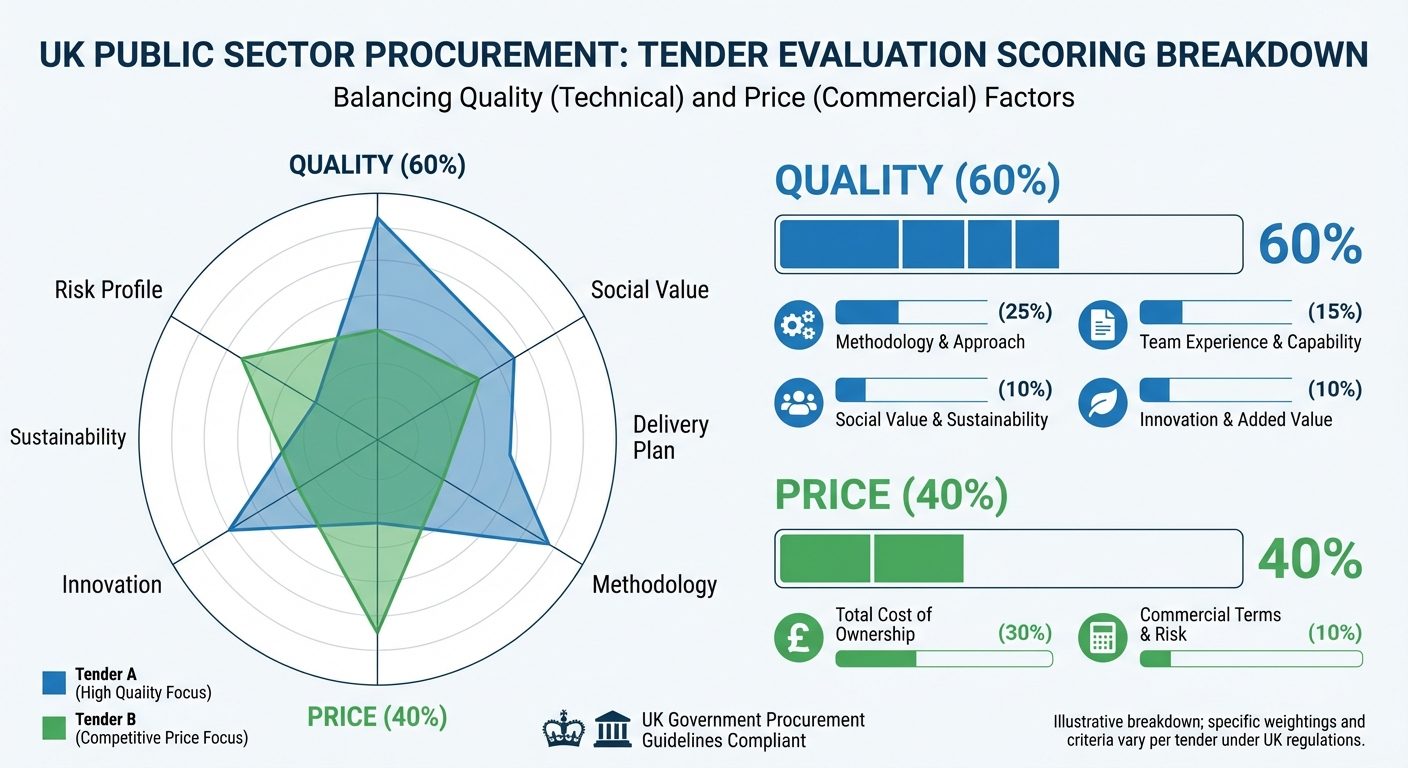
Tender evaluation scoring criteria breakdown showing quality and price weightings
The Foundations: What Is Tender Evaluation?
Tender evaluation is the formal process by which a contracting authority (the buyer) assesses and compares all compliant submissions to identify the best overall offer. It is governed by procurement regulations — in the UK, now primarily by the Procurement Act 2023 — and must be conducted consistently, transparently, and in line with the published evaluation criteria.
The key principle: buyers can only assess what you have actually written. No assumptions are made. No credit is given for experience you have not evidenced. No bonus points for being an incumbent. Every bid is assessed against the same scoring criteria, using the same methodology.
This sounds straightforward, but it has significant implications for how you write. The most common reason good suppliers lose tenders is not because their services are inferior — it is because their written response does not demonstrate their capabilities as clearly and specifically as a competitor's.
Why Evaluation Methodology Matters to Bidders
When you understand how an evaluator will read your response, you can structure it to score maximum marks. That means:
- Answering the question that was actually asked, not the question you wanted to answer
- Providing the right type and volume of evidence for each criterion
- Structuring your response so evaluators can quickly find and reward the key points
- Avoiding common scoring traps like vague claims, missing specifics, and generic statements
The Procurement Act 2023, which came into force in February 2025, brought significant changes to how public sector contracts are evaluated — most notably the shift from Most Economically Advantageous Tender (MEAT) to Most Advantageous Tender (MAT). Understanding this shift is essential for any organisation bidding for public contracts in 2026.
Most Advantageous Tender (MAT): The New Standard
Under the old MEAT framework, buyers were required to award contracts based on the most economically advantageous offer — which, in practice, often led to excessive focus on price. The new MAT standard under the Procurement Act 2023 is broader and more holistic.
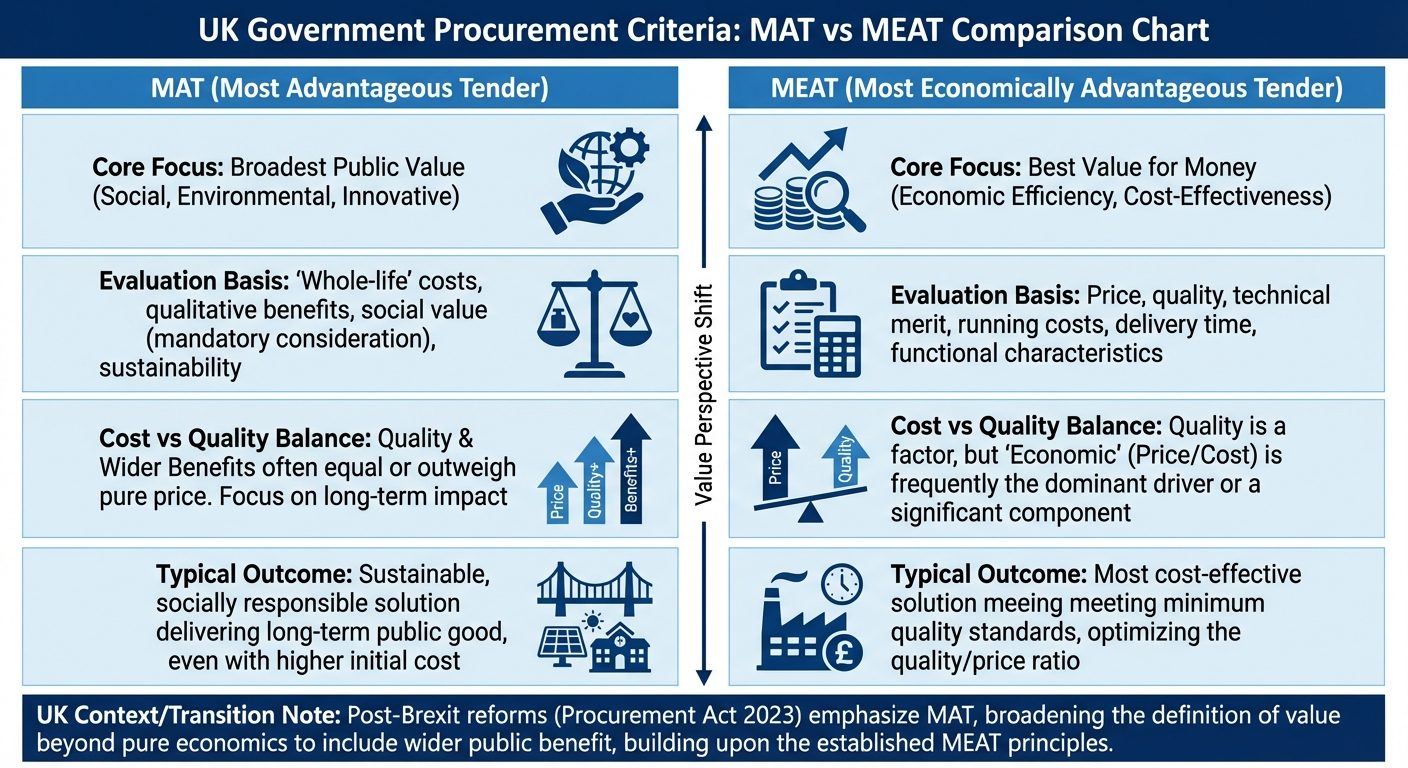
Comparison of MAT vs MEAT procurement evaluation criteria
Under MAT, contracting authorities must award contracts on the basis of the "best offer" — taking into account the full value of the bid, including social, environmental, and economic considerations. Price remains important, but it is no longer the dominant driver in the way MEAT sometimes allowed it to be.
What This Means in Practice
For bidders, the MAT shift has three key implications:
Social value now carries real weight. The updated Social Value Model (PPN 002), mandatory for central government procurements since October 2025, requires a minimum 10% weighting for social value. This is not a tick-box exercise. Evaluators are trained to score vague commitments poorly and reward specific, measurable, time-bound delivery plans. Quality criteria are broader. Buyers can now factor in a wider range of qualitative considerations, including innovation, resilience, and whole-life value, alongside the traditional quality and price split. Environmental credentials and supply chain practices carry greater weight than ever. Price is still critical — but not everything. Even with a strong quality score, a significantly uncompetitive price can cost you a contract. Equally, winning on price alone with a weak quality response is increasingly difficult as buyers prioritise long-term value.How Tender Evaluation Is Structured
Most public sector tender evaluations follow a structured multi-stage process. While the exact approach varies between contracting authorities and procurement routes, the broad framework looks like this.
Stage 1: Compliance Check
Before any scoring begins, all submissions are reviewed for compliance. This means verifying that:
- The submission was received before the deadline
- All mandatory documents and attachments have been provided
- Minimum requirements (pass/fail criteria) have been met
- Any mandatory accreditations, certifications, or insurance levels are in place
Non-compliant bids are excluded at this stage. There is typically no opportunity to remediate a missing document or late submission after the deadline has passed. This is why compliance checklists and last-minute submission reviews are non-negotiable parts of good bid management practice.
Stage 2: Evaluation Panel Formation
Once compliance is confirmed, the substantive evaluation begins. Most contracting authorities convene an evaluation panel — typically two to four individuals with relevant knowledge of the subject matter, commercial expertise, and sometimes a representative from the end-user or procurement team.

Tender evaluation panel of evaluators reviewing submissions
Panel members evaluate responses independently before coming together to moderate scores. This independent evaluation is important: it prevents any single evaluator from unduly influencing the outcome and helps surface bias or inconsistency early.
Evaluators are usually given scoring guidance, including model answers or scoring descriptors for each level (typically 0–5 or 0–10), to ensure consistency across the panel.
Stage 3: Independent Scoring
Each evaluator reviews and scores the responses against the published criteria. Most evaluation processes use a two-pass approach:
Pass 1: Read all responses to a given question from all suppliers before assigning scores. This gives context and helps calibrate scoring — rather than reading supplier A's response in isolation, the evaluator can see where it sits relative to competitors. Pass 2: Finalise scores, noting the specific reasons for each score. Evaluators are typically required to record written justifications for their scores, which inform moderation and, later, the feedback provided to unsuccessful bidders.Stage 4: Moderation
Moderation is where individual evaluators bring their independent scores together and discuss any significant discrepancies. Where evaluators have scored a response very differently, they present their reasoning and either move towards consensus or maintain different scores, depending on the process.
The moderated quality score is then combined with the price evaluation (using the published formula) to produce a final combined score for each bidder.
Stage 5: Price Evaluation
Price is evaluated using a formula specified in the procurement documents. The most common approach is the "inverse pricing" or "cost proportionality" method:
Lowest price supplier scores maximum marks. All other suppliers score proportionally fewer marks based on how much higher their price is.For example, if price carries 40% of the total marks and the formula is:
Price score = (Lowest price / Your price) × Maximum price marksA supplier quoting £500,000 where the lowest bid is £400,000 would score: (£400,000 / £500,000) × 40 = 32 out of 40 marks
Some buyers use alternative price evaluation methods — such as fixed price (where all suppliers bid against a set budget) or ranked scoring. Always check the ITT documents for the exact formula.
Stage 6: Combined Score and Award Decision
The moderated quality score and price score are combined using the published weighting. Typically this results in a total score for each bidder, and the highest combined score wins.
In some procurements, particularly at framework level, multiple suppliers may be awarded contracts within a ranked structure. In these cases, the evaluation determines both who is included and their position on the framework.
Stage 7: Standstill Period and Award
Before the contract is formally awarded, contracting authorities must observe a mandatory standstill period — typically ten calendar days. During this period, they notify all bidders of the outcome, including unsuccessful suppliers.
The notification to unsuccessful bidders must include:
- The score awarded to the successful supplier (or the winning bid characteristics)
- Their own scores and rankings
- The reasons why they were not selected
This transparency requirement has been strengthened under the Procurement Act 2023. Buyers are now expected to provide meaningful feedback, not just a score comparison. Unsuccessful suppliers have the right to challenge the decision during the standstill period if they believe there has been a procedural error or breach of the procurement rules.
Quality/Price Weighting: What to Expect
The split between quality and price marks varies significantly across procurement categories. Understanding the typical weightings in your sector helps you allocate writing effort appropriately.
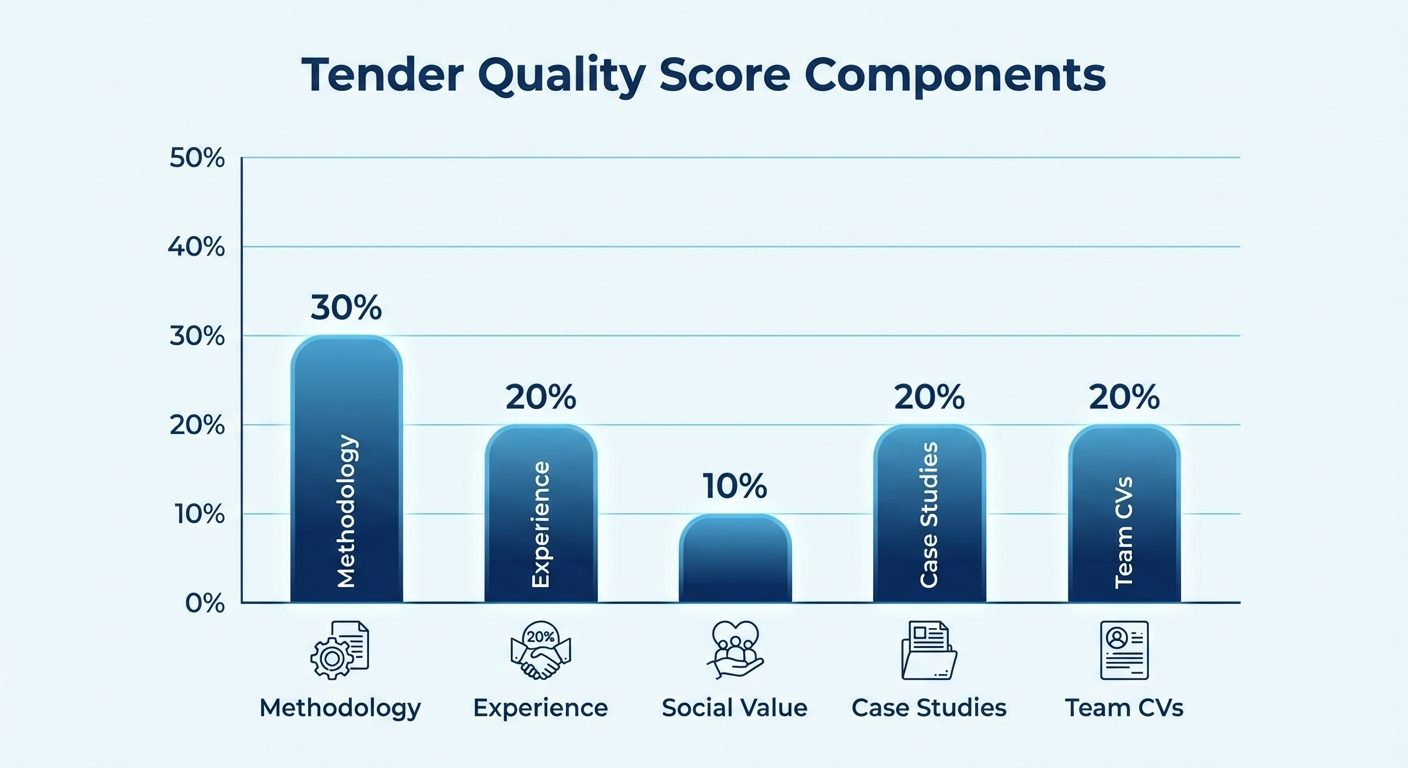
Quality score components breakdown for UK tender evaluation
Typical Weighting Ranges by Category
Professional Services (consultancy, legal, audit): Quality tends to dominate at 70–80%, with price at 20–30%. Buyers in these categories recognise that the cheapest professional services are rarely the best, and the cost of poor advice or execution far outweighs any savings on day rates. IT and Technology Services: Often balanced at 60/40 quality/price, though complex digital transformation contracts may weight quality higher due to delivery risk. Cyber security and data compliance add additional technical evaluation dimensions. Construction and Engineering: Typically 60/40 or 70/30 quality/price, with increasing weighting on social value, sustainability, and safety record. Lifecycle costing is increasingly used alongside initial capital cost. Facilities Management: Often 60/40 or 50/50, though social value requirements mean effective quality presentation is growing in importance. Service delivery methodology and mobilisation planning are heavily weighted. Healthcare and NHS: Typically quality-heavy at 70/80%, with a strong emphasis on clinical quality standards, patient outcomes, and staffing. CQC registration and compliance requirements are usually pass/fail at the outset. Waste Management and Environmental Services: Increasingly sustainability-led, with carbon reduction plans and circular economy commitments factoring significantly. Price remains important but environmental performance is weighted more heavily than in previous years. Cleaning and Security (low-complexity services): Price tends to carry more weight at 40–50%, reflecting the commoditised nature of the service. That said, social value and workforce wellbeing criteria are growing.How Each Quality Criterion Is Scored
Most evaluation frameworks use a five-point or ten-point scoring scale. Understanding the descriptors at each level is the key to writing responses that earn top marks.
The Standard Five-Point Scale
The most common scoring framework used in UK public procurement works on a 0–5 scale:
0 – Unacceptable / No response: No information provided, or the response does not address the question at all. Sometimes awarded where the response is wholly contradictory or demonstrates the supplier cannot meet the requirement. 1 – Poor: A response that attempts to address the question but is vague, lacks evidence, or fails to demonstrate competence. Generic statements with no specifics. Claims without proof. 2 – Acceptable / Adequate: A satisfactory response that covers the main elements but misses important detail, lacks strong evidence, or does not fully demonstrate added value. Meets the minimum requirement but no more. 3 – Good: A clear, well-evidenced response that addresses all the key elements of the question. Relevant experience is demonstrated with specific examples. Methodology is credible and specific to this contract. 4 – Very Good: A strong, comprehensive response that goes beyond the basics. Multiple relevant examples. Specific, measurable commitments. Clear added value. Demonstrates understanding of the buyer's specific context and challenges. 5 – Excellent / Outstanding: An exceptional response that fully demonstrates all elements of the requirement with compelling, specific evidence. Innovative thinking, sector-specific insight, risk mitigation considered, measurable outcomes clearly defined. Leaves the evaluator in no doubt.Most bidders aim to score 3s and assume that is good enough. In competitive procurements, winning suppliers typically score 4s and 5s. The difference between a 3 and a 4 is almost always evidence specificity and tailoring.
What Moves a Response from 3 to 4 or 5
The practical gap between a good score and an excellent score typically comes down to four things:
Specificity over generality. "We will assign a dedicated account manager" scores lower than "We will assign Sarah Brown, our senior account manager with twelve years of FM experience, as your single point of contact." Names, numbers, and timelines matter. Evidence over assertion. "We have extensive experience in this sector" scores lower than "We delivered a similar mobilisation for [comparable organisation] in 2024, transitioning 47 sites in 14 weeks, achieving 99.2% service continuity." Case studies, metrics, and references transform responses. Understanding the buyer's specific context. Generic methodology descriptions score poorly even when technically competent. Referencing the buyer's specific operational context, known challenges, or stated strategic priorities demonstrates genuine understanding and commands higher scores. Adding value beyond the minimum requirement. Where a question asks "how will you ensure quality?", a 5-scoring response does not just answer the question — it goes beyond it, demonstrating innovation, proactive risk management, and a commitment to continuous improvement that the buyer did not necessarily ask for but will recognise and reward.Common Quality Criteria and How to Tackle Them
Methodology and Approach
This is often the highest-weighted individual criterion. Evaluators want to see that you understand what delivering this contract actually requires — not a theoretical process, but a practical, deliverable plan.
Strong responses describe your specific methodology in sufficient detail to be credible, acknowledge the key risks and how you will mitigate them, and demonstrate that you have thought through the practicalities of transition, mobilisation, and day-to-day delivery in this specific context.
Avoid using the same methodology description across multiple bids. It shows. Evaluators can recognise generic responses, and they reward suppliers who have clearly read and understood the specification.
Experience and Case Studies
Buyers want evidence that you have delivered similar contracts successfully before. The challenge is choosing the right case studies and presenting them in a way that directly answers the evaluation question.
The best case studies follow a structured format: context (what was the contract?), challenge (what were the difficulties?), your approach (what did you do?), and outcome (what measurable results did you achieve?). Every case study should include specific metrics: contract value, duration, scale, and quantified outcomes.
Match your case studies to the buyer's context. If you are bidding for a healthcare cleaning contract, your case studies should be from healthcare settings, not office buildings. If the specification emphasises out-of-hours flexibility, your case study should evidence how you delivered that.
Team and Staff
Buyers want to know that the people who will actually deliver the contract are competent, experienced, and available. CVs should be specific, relevant, and include named individuals rather than generic role descriptions.
Where the contract involves specialist roles (clinical staff, engineers, project managers), accreditations, qualifications, and professional memberships carry weight. Succession planning and staff retention strategies are increasingly valued, particularly in labour-intensive contracts.
Social Value
Under PPN 002, social value responses must be specific, measurable, and time-bound. Generic commitments like "we will support local employment" score poorly. Strong responses name specific initiatives, set targets (e.g., a percentage of contract hours delivered by local residents), and explain how outcomes will be measured and reported.
Social value commitments should be proportionate to the contract value and realistic. Evaluators are increasingly experienced at identifying inflated or undeliverable commitments, which can actively harm your score if they appear implausible.
Price Submission
Price competitiveness is important, but winning at all costs can be counterproductive. Under-pricing a contract to win it and then struggling to deliver damages your reputation, leads to contract performance issues, and can disqualify you from future opportunities.
The right approach is to price fairly, understand where your cost structure sits relative to likely competitors, and focus your competitive advantage on quality rather than price alone. If you cannot compete on price, win on quality, evidenced with such compelling responses that the price premium is justified.
The Procurement Act 2023: Key Evaluation Changes
The Procurement Act 2023 brought several important changes that affect how tenders are evaluated and how the award process works.
Increased Transparency
The new regime significantly expands publication requirements. Contracting authorities must now publish:
- Preliminary market engagement notices
- Tender notices
- Award notices (including the score of the winning bid)
- Contract performance notices at regular intervals
- KPI notices and annual performance assessments
For suppliers, this increased transparency means you can benchmark your scores against winning bids in real time. If your scores are consistently 20% below the winners, you have a concrete baseline to improve against.
Assessment of Past Performance
The Procurement Act 2023 gives buyers significantly more discretion to consider past performance when evaluating bids. Under the previous regime, exclusions based on performance were limited to defined mandatory and discretionary grounds. The new rules give buyers broader ability to factor in documented poor performance on previous contracts.
This cuts both ways. A strong track record with public sector clients, documented through references and performance data, is increasingly valuable. Poor past performance — particularly contract terminations, service failures, or KPI breaches — can work against you in ways that were not previously permitted.
Supplier Debarment
The new Procurement Act establishes a formal debarment list. Suppliers found to have committed specified misconduct or poor performance can be entered on the list and excluded from public contracts for a defined period. This represents a significant escalation in consequences for compliance failures.
The Evaluation Process Explained Step by Step
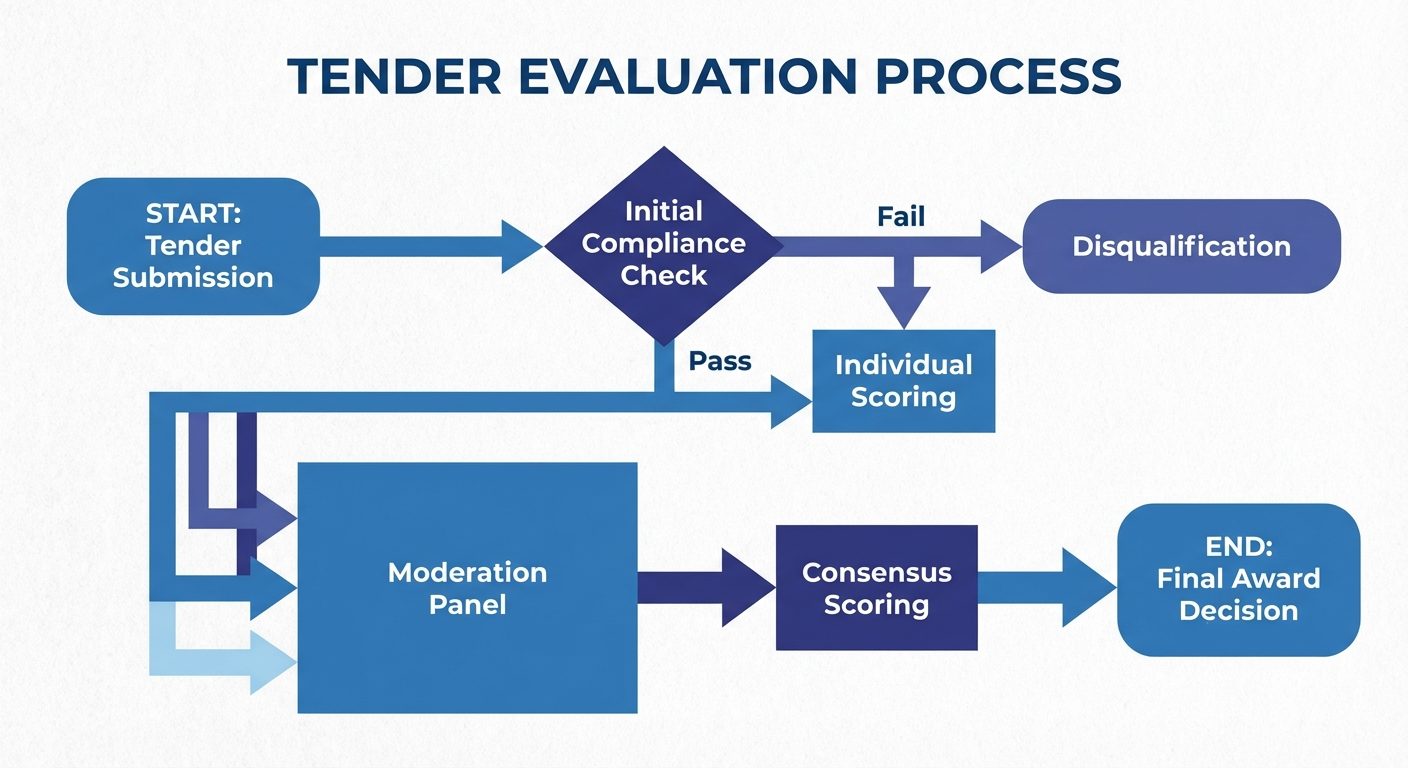
Tender evaluation process flowchart from submission to award
To pull this all together, here is a complete walkthrough of the tender evaluation journey from a buyer's perspective — and what it means for you at each stage.
Submission Deadline
The moment the portal closes, submissions are locked. No amendments, no late additions. The evaluation team typically receives an anonymised pack of responses — in many procurements, supplier identities are redacted from quality responses to prevent evaluator bias.
Compliance Verification (Day 1–2)
The procurement team verifies compliance for all submissions. Non-compliant bids are rejected. Compliant bids proceed to the evaluation panel.
Independent Evaluation (Days 3–10)
Each panel member evaluates and scores responses independently. This may take several days depending on the volume of responses and the complexity of the ITT. Panel members may not discuss scores with each other during this phase.
Moderation (Days 11–14)
The panel meets to compare scores and discuss discrepancies. Where significant differences exist, evaluators present their reasoning. The moderated quality score is finalised.
Price Evaluation (Concurrent or Post-Moderation)
Price envelopes are typically opened separately, either concurrently with quality evaluation or after quality scores are moderated. The price formula is applied and combined with quality scores to produce the final rankings.
Award Recommendation (Days 15–20)
The evaluation team prepares an award recommendation report documenting the scores, rationale, and recommended winning supplier. This is reviewed and approved by the relevant authority — which may include senior management, legal, or a procurement committee depending on contract value.
Standstill Notification (Day 21 onwards)
All suppliers are notified of the outcome simultaneously. Unsuccessful suppliers receive their scores and a brief explanation of why they were not selected. The standstill period begins — typically ten calendar days.
Contract Award (Day 31+)
Once the standstill period has elapsed without challenge, the contract is formally awarded and the notice published. The winning supplier begins mobilisation.
Getting Feedback and Using It
Requesting and acting on feedback from unsuccessful bids is one of the most valuable investments you can make in your bidding capability.
Under the Procurement Act 2023, unsuccessful suppliers have an enhanced right to receive meaningful debriefs. You should request these promptly after every unsuccessful bid and approach them as a learning opportunity rather than a grievance process.
Useful questions to ask in a debrief include:
- What was my overall score relative to the winning bidder?
- Which specific criteria did I score most poorly on?
- Were there particular gaps in evidence that limited my scores?
- How did my pricing compare to the winning bid?
- Was there anything in my methodology that raised concerns?
Track this feedback systematically. If the same weaknesses emerge across multiple bids — whether it is weak social value responses, generic case studies, or under-competitive pricing — you have a clear improvement agenda.
How mytender.io Helps You Score Higher
Understanding how tenders are evaluated is one thing. Systematically improving your scores across every bid you write is another. This is where purpose-built bid writing technology makes a tangible difference.
mytender.io has been designed specifically around the way procurement evaluation works. Rather than giving you a generic writing assistant, it provides an AI platform built on the logic of tender scoring. Content Library: Store your best-performing case studies, methodologies, and social value commitments in a structured library. Every time you answer a quality criterion, you draw on real, evidence-backed content rather than writing from scratch. Tender Analysis: Automatically parse tender documents to identify the evaluation criteria, weightings, and key requirements — so your writing effort is prioritised around what matters most to the score. AI-Assisted Drafting: Generate first-draft quality responses that are structured to score well against the published criteria, tailored to the specific tender context rather than generic templates. Gap Analysis: Identify which questions are weakest in your draft response and where additional evidence or specificity would lift your score — before you submit. Collaborative Review: Bring your bid team together in a shared workspace to review, comment, and improve responses in real time, with version control and change tracking built in.The platform does not replace the expertise of your team. It amplifies it — taking the structural and mechanical elements of bid writing off your plate so you can focus on the strategic decisions and evidence that win contracts.
Practical Tips to Maximise Your Evaluation Scores
Before we close, here are the most practical, immediately actionable things you can do to improve your tender scores.
Read the Scoring Criteria Before You Write a Single Word
This sounds obvious, but many suppliers start writing before they have fully understood how their response will be scored. Before drafting anything, read the evaluation criteria, weightings, and any scoring descriptors provided in the ITT. Build your response structure around the criteria, not around what you want to say.
Answer the Question That Was Actually Asked
One of the most common scoring mistakes is answering a related but different question. If the question asks "how will you manage performance?", your answer should be specifically about performance management — not a general overview of your quality management system. Stay on topic.
Use a 'Claim, Evidence, Impact' Structure
For each point you make in a quality response, apply the CET framework: make a Claim, provide Evidence, and explain the Impact. "We use a dedicated mobilisation team" (claim) "who successfully mobilised the [Contract Name] contract in 2024, transitioning 120 staff across 18 sites in six weeks" (evidence) "achieving full operational service within 30 days and retaining 95% of the incumbent workforce" (impact). This structure moves responses from a 3 to a 4 consistently.
Match Word Count to Marks Available
If a question carries 10% of the total marks and you have 5,000 words to play with across the whole ITT, roughly 500 words should go to that question. Over-writing low-weighted questions and under-writing high-weighted ones is a common error that leaves marks on the table.
Use Headers and Structure Within Responses
Many evaluators are scoring multiple bids against a checklist. Making it easy for them to find your key points — with clear headers, numbered steps, and bullet lists for multi-part answers — directly helps your score. A well-structured response signals professional competence even before the content is assessed.
Avoid Jargon and Self-Congratulation
Phrases like "we are market leaders", "best in class", or "our innovative approach" mean nothing without evidence and score poorly. Replace every superlative with a specific fact. Replace every abstract claim with a concrete example. Evaluators are trained to award marks for substance, not style.
Get a Fresh Set of Eyes Before Submission
Someone who has not been working on the bid should read every response before submission and ask: "Does this actually answer the question? Is there sufficient evidence? What would make this response better?" It is astonishing how many scoring gaps are obvious to a fresh reader that the bid team has become blind to.
Conclusion
Winning tenders is not random, and it is not purely about being the best supplier in the market. It is about understanding how the evaluation process works, structuring your responses to score maximum marks against each criterion, and presenting evidence that leaves evaluators in no doubt.
The Procurement Act 2023 has raised the bar. Social value is no longer optional. Quality is scrutinised more carefully. Transparency requirements mean you can benchmark your scores against winners and see exactly where you are losing points. For serious bidders, this is good news — it means consistent improvement leads to consistent results.
Take the time to understand how your target buyers evaluate tenders. Request feedback after every loss. Build your content library with evidence-rich case studies and methodologies. Structure your responses around the scoring criteria. And use the right tools to make your team faster, sharper, and more consistent.
The suppliers who win most often are not the ones who write the longest responses or have the most impressive credentials. They are the ones who understand how the game is scored — and play accordingly.
---
mytender.io helps bid teams consistently score higher on quality criteria by providing AI-assisted drafting, structured content libraries, and tender analysis tools purpose-built for UK public sector procurement. Learn more about how it works.Tags
Ready to Transform Your Tender Writing?
See how MyTender's AI can help you write winning tenders in a fraction of the time.