
Tender Response Evidence Matrix: How to Build Proof-Led Bid Answers That Score Higher in 2026
A practical guide for bid teams on building a tender response evidence matrix, mapping every buyer requirement to proof, owners, scoring criteria and final answer quality before submission.
mytender.io Research Team
Tender Writing & Bid Management Specialists
Tender Response Evidence Matrix: How to Build Proof-Led Bid Answers That Score Higher in 2026
Most tender answers do not lose marks because the writing is ugly. They lose marks because the proof is too thin.
That is the uncomfortable truth behind many near-miss bids. The response is compliant. The grammar is fine. The structure looks professional. The team has answered the question, added a few headings, included some sensible benefits and pressed submit on time. Then the feedback arrives: good response, but limited supporting evidence; methodology described, but outcomes not demonstrated; risk approach clear, but not tailored; social value commitments not sufficiently measurable.
In other words, the bid sounded right but did not prove enough.
That problem is becoming more visible in 2026. Public sector buyers are working under a more transparent procurement environment, assessment methodologies are more explicit, and suppliers are increasingly expected to show how every claim connects to delivery, risk reduction and measurable value. At the same time, AI-assisted drafting has made it easier to produce fluent content quickly. Fluent content is not the same as scored content.
A tender response evidence matrix solves that problem. It gives the bid team a practical way to map every buyer requirement to the proof, owner, source document and final answer section before the deadline panic starts.
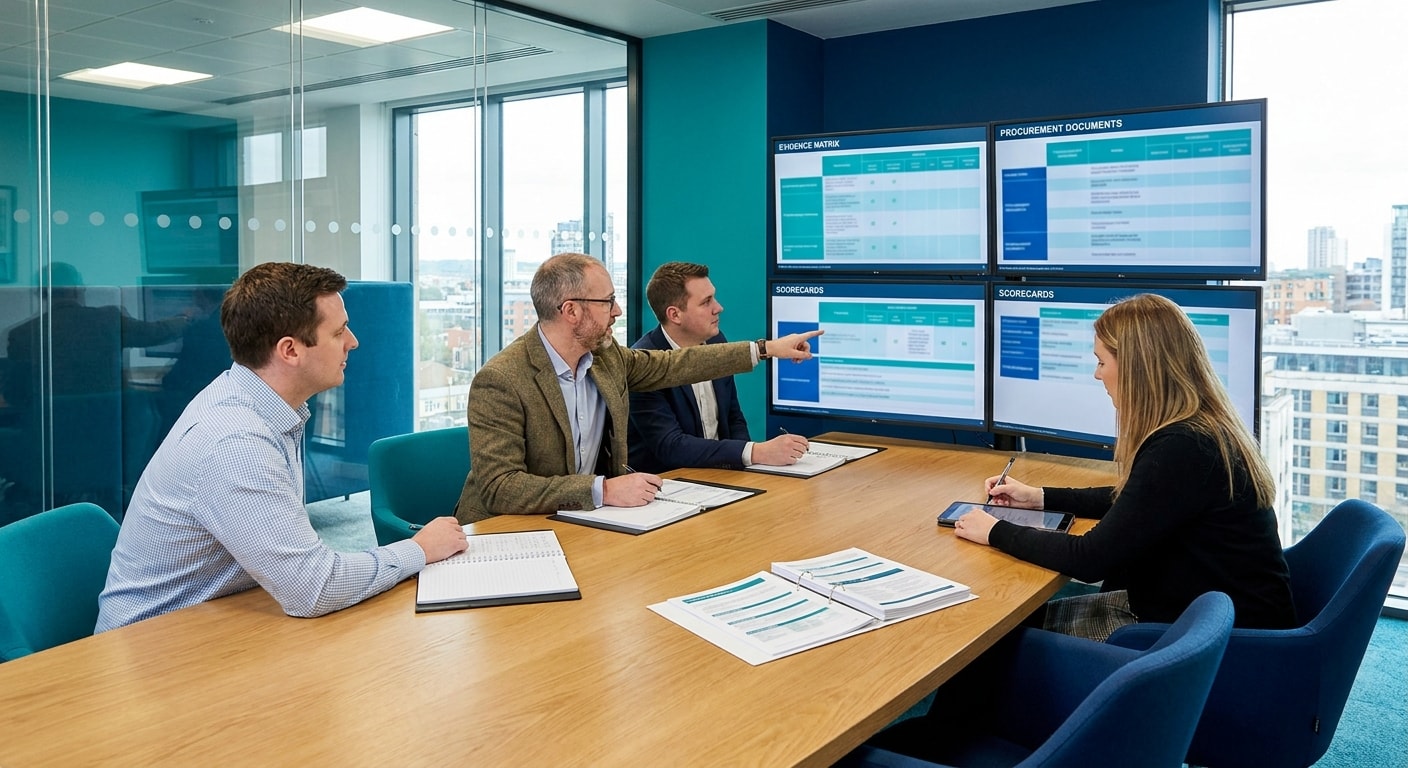
Bid team building a tender response evidence matrix across buyer requirements, proof points and scoring criteria
This guide explains how to build one, how to use it during bid writing, how it fits with red team review, and how mytender.io helps teams turn scattered evidence into stronger first drafts and cleaner final submissions.
The short version: if your bid process relies on people remembering where the proof is, you are leaving marks on the table.
What is a tender response evidence matrix?
A tender response evidence matrix is a working document that connects four things:
- what the buyer asks for
- how the answer will respond
- what evidence proves the claim
- who owns and verifies that evidence
It sits between the compliance matrix and the written response.
A compliance matrix tells you whether every requirement has been addressed. An evidence matrix tells you whether every important statement has been proven.
That distinction matters. A bid can be technically compliant and still be weak. It can answer every question and still lack the depth needed for a high score. The evidence matrix forces the bid team to move beyond, have we written something here, and ask, have we proved it well enough for an evaluator to award the top band?
A simple evidence matrix normally includes:
| Field | Purpose |
|---|---|
| Requirement or question reference | Links the evidence back to the ITT, RFP or SQ question |
| Scoring criteria and weighting | Shows how important the answer is and what the evaluator will reward |
| Buyer concern | Captures the risk, outcome or pain point behind the question |
| Proposed answer theme | States the core message the response will make |
| Evidence needed | Lists the proof required to make the answer credible |
| Evidence source | Points to the exact document, metric, case study or SME interview |
| Owner | Names the person responsible for confirming the evidence |
| Status | Shows whether the evidence is requested, received, verified or missing |
| Response location | Maps the proof to the answer section, page or portal field |
The matrix gives the team one place to see whether the bid is strong, weak or pretending. If a 15% quality question has no verified proof two days before submission, everyone can see the risk. If a social value answer relies on a generic pledge without local measurement, the matrix exposes it early enough to fix. If an AI-generated paragraph includes a claim that nobody can source, it gets challenged before it reaches the portal.
Why evidence matters more under modern public procurement
Public sector procurement has shifted towards greater transparency, clearer assessment and broader value. The Procurement Act 2023 regime, in force from February 2025, emphasises published assessment methodology, transparent notices and a move from the old language of Most Economically Advantageous Tender towards Most Advantageous Tender.
For suppliers, the practical message is simple: buyers are not only assessing whether your answer is pleasant to read. They are assessing whether it gives them confidence.
Confidence comes from proof.
A buyer evaluating a facilities management mobilisation plan wants to know that your mobilisation process has worked on comparable estates, under similar timescales, with credible TUPE planning and named governance. A buyer evaluating a construction quality answer wants to know how defects, design changes, subcontractor performance and safety risks are controlled in real life. A buyer evaluating a technology support tender wants evidence of response times, security processes, service desk maturity and escalation discipline.
The winning answer usually combines four elements:
- A clear method that answers the question directly.
- Evidence that the method has worked before.
- Tailoring that shows the bidder understands the buyer's context.
- Risk control that reduces the evaluator's fear of awarding the contract.
The evidence matrix is the bridge between those elements.
Without it, bid teams often do evidence late. They draft the answer first, then search for a statistic, case study or testimonial to support it. That leads to vague proof, rushed approvals, repeated content and unsupported claims.
With an evidence matrix, evidence comes first. The team asks: what would we need to prove for this answer to deserve a top score? Then the drafting follows.
The scoring gap: why good writing still gets average marks
Most scoring systems have a gap between acceptable and exceptional. Bid teams feel that gap every time they receive feedback saying the response was good but not distinctive.
A score of three out of five often means the response met the requirement. It may have explained the process, referenced relevant experience and avoided obvious errors. But it did not give the evaluator enough confidence to call it excellent.
A score of five usually requires something stronger:
- direct alignment to every part of the question
- clear methodology rather than broad intent
- evidence from comparable contracts
- quantified outcomes where possible
- named roles, governance and accountability
- buyer-specific risks and mitigations
- credible added value linked to the contract
- measurable social value or sustainability commitments
- no gaps, contradictions or unsupported claims
The evidence matrix helps the team see the difference before the buyer does.

Evaluator scorecard showing the difference between acceptable tender wording and proof-led high-scoring bid evidence
Consider this simple example.
A weak answer says: We have extensive experience delivering high-quality helpdesk services and will provide a responsive, user-focused service.
A stronger answer says: On three comparable public sector helpdesk contracts, our team handled more than 40,000 support requests in the last 12 months, maintained 98.7% SLA compliance and reduced average first response time by 21% after introducing automated triage. For this contract, we will replicate the same triage model, with a named Service Delivery Manager accountable for weekly KPI reporting and escalation within two hours for priority incidents.
The second answer is not better because it has more words. It is better because it gives the evaluator something to score.
The evidence matrix makes that standard repeatable. It stops proof being an afterthought and turns it into a design principle.
When to build the matrix
Build the evidence matrix immediately after the bid or no-bid decision and before full drafting begins.
That timing matters. If the matrix is built too late, it becomes a filing exercise. If it is built early, it shapes the bid strategy.
The best sequence is:
- Read the tender pack and extract requirements.
- Confirm the opportunity is worth bidding.
- Build the compliance matrix.
- Build the evidence matrix for scored responses and mandatory claims.
- Run a short evidence gap review.
- Draft from approved evidence.
- Review against the matrix before submission.
This does not need to slow the team down. In fact, it usually saves time. The pain in bid writing is rarely the planned work. It is the last-minute scramble: finding a missing policy, checking whether a case study can be used, asking operations for performance data at 8pm, rewriting a section because the promised evidence never existed.
An early matrix brings those problems forward while there is still time to solve them.
For a small tender, the matrix might be a simple spreadsheet with 20 rows. For a complex framework, it might be a shared workspace with hundreds of requirements, evidence links, owners and review statuses. The principle is the same: every important claim needs a source.
The core structure of a strong evidence matrix
A useful evidence matrix does not need 40 columns. Too much complexity kills adoption. The best version is detailed enough to support quality, but simple enough that bid managers, subject matter experts and reviewers will actually use it.
Start with these ten fields.
1. Requirement reference
Use the buyer's numbering wherever possible. If the tender question is 4.2.1, your matrix should use 4.2.1. If the portal has unhelpful field names, create your own reference but keep it stable.
This makes review easier. It also reduces the chance of missing a sub-question buried inside a paragraph.
2. Buyer question or requirement
Copy the relevant question, but do not stop there. Break long questions into sub-requirements. Many tender questions contain five or six scoring tests in one block.
For example, a mobilisation question may ask for governance, timescales, TUPE, communication, risk management, reporting and business continuity. If the matrix treats that as one requirement, the team may miss half the marks.
3. Assessment criteria and weighting
Record the weighting, page limit, word limit and scoring guidance. A 2% pass-fail attachment does not need the same level of narrative effort as a 20% method statement. The matrix should help the team allocate time where it matters.
4. Buyer concern
This is the hidden gold. Behind every question is a worry. The buyer may be worried about service failure, transition risk, poor incumbent performance, cost escalation, safety, local disruption, reputational harm or weak reporting.
Write that concern in plain English. It helps the response move from generic description to buyer-specific reassurance.
5. Answer theme
Capture the main point the response needs to make. This might be: low-risk mobilisation through proven governance; faster response through regional teams; measurable social value through local employment; safer delivery through certified supervisors and live audit data.
The answer theme keeps writers aligned. It also helps AI tools produce more relevant first drafts when the prompt includes the actual win theme.
6. Evidence needed
List the proof required. Be specific. Do not write case study. Write case study from a similar local authority contract with mobilisation under eight weeks and KPI improvement evidence.
Common evidence types include:
- contract performance dashboards
- KPI reports
- mobilisation trackers
- customer satisfaction data
- audit results
- incident logs
- case studies
- references or testimonials
- policies and accreditations
- training records
- carbon reduction plans
- social value delivery reports
- risk registers
- lessons learned reviews
- management information packs
7. Evidence source
Record where the evidence lives. A vague source such as SharePoint is not enough. Point to the exact document, folder, library item, CRM note, contract review pack or SME interview.
This is where many organisations struggle. Their evidence exists, but it is scattered across old bids, account folders, inboxes, spreadsheets and people's heads. That is exactly the problem mytender.io is built to solve: turning messy bid knowledge into retrievable, usable content.
8. Owner
Every important piece of evidence needs an owner. That person may be in operations, finance, ESG, HR, legal, compliance, security, account management or delivery.
Ownership stops the bid team becoming responsible for verifying facts it cannot validate. If the answer says a process will be delivered, the delivery owner should sign off the claim.
9. Evidence status
Keep statuses simple:
- needed
- requested
- received
- verified
- rejected
- gap
The status column is where the bid manager can manage risk quickly. A high-weighted question with several gap statuses needs action. A low-weighted answer with verified evidence can move into drafting.
10. Response location
Finally, map the evidence to where it appears in the bid: section number, heading, portal answer, appendix or attachment. This helps reviewers check that the evidence was not only collected but actually used.
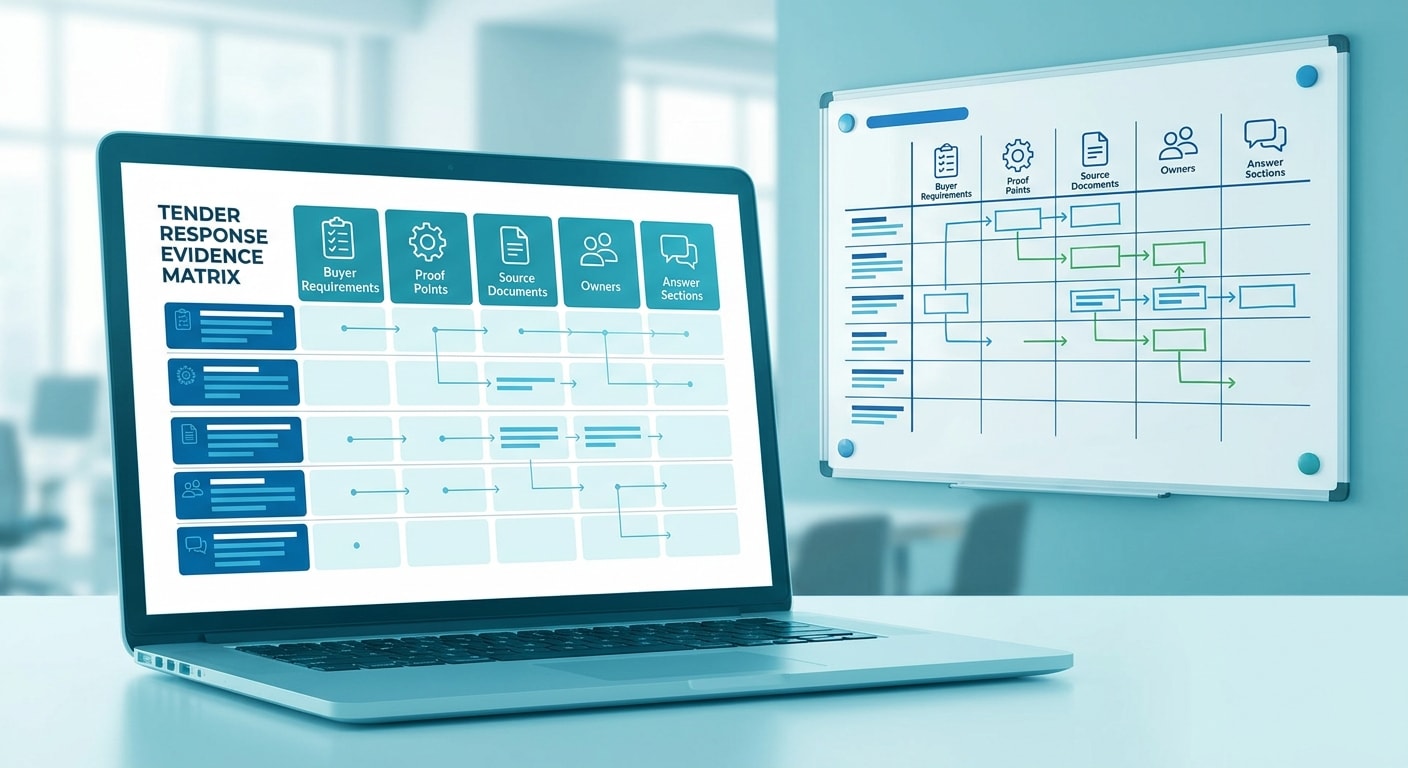
Tender response evidence matrix template mapping ITT requirements to proof, source documents, owners and answer sections
How to extract requirements without missing hidden marks
The hardest part of building a matrix is not filling in the columns. It is correctly interpreting the buyer's question.
Tender questions are often written as dense paragraphs. A single question might ask the bidder to explain methodology, provide examples, identify risks, describe governance, state timescales, include innovation and show how performance will be monitored. If the team answers only the headline, it loses marks quietly.
Use a three-pass extraction method.
Pass one: explicit requirements
Highlight every instruction the buyer states directly. Look for words such as provide, describe, explain, demonstrate, include, evidence, confirm, submit, outline and detail.
If the question says include mobilisation milestones, that becomes a row. If it says provide evidence of comparable experience, that becomes a row. If it says explain how you will monitor KPIs, that becomes a row.
Pass two: implied requirements
Now look for what the buyer is worried about but has not stated bluntly.
A question about complaints handling may imply concerns about response time, root cause analysis, escalation, customer communication and recurring failures. A question about subcontractor management may imply concerns about supply chain risk, payment, quality, health and safety, modern slavery and continuity.
These implied requirements do not replace the written question. They help the team answer it intelligently.
Pass three: scoring language
Finally, read the scoring criteria. If the top score requires comprehensive evidence, added value, innovation, measurable outcomes or clear risk mitigation, those phrases need to appear in the matrix as evidence tests.
The question tells you what to answer. The scoring criteria tells you what excellence looks like.
This is where mytender.io can save serious time. AI can break down tender documents, extract requirements, identify hidden sub-questions and create a structured response plan. The human bid team still decides the strategy, but it starts from a cleaner map.
What counts as strong tender evidence?
Not all evidence is equal. A policy document is useful for proving that a process exists. It does not prove that the process works. A case study is useful for showing delivery. It is weaker if it is old, irrelevant or missing outcomes.
Think of evidence in levels.
Level one: existence evidence
This proves you have something. Examples include policies, accreditations, insurance, organisational charts, system screenshots, certificates and standard operating procedures.
It is often necessary, especially for compliance. But on its own, it rarely wins quality marks.
Level two: delivery evidence
This proves you have done something. Examples include mobilisation plans, project examples, implementation timelines, contract review packs, service reports and named experience.
This is stronger because it connects capability to real work.
Level three: outcome evidence
This proves the work produced a measurable result. Examples include SLA performance, cost savings, reduced complaints, faster response times, improved audit scores, carbon reductions, apprenticeship starts, customer satisfaction scores or defect reduction.
Outcome evidence is usually where high scores live.
Level four: relevance evidence
This proves the outcome matters for this buyer. A case study from the same sector, geography, scale, risk profile or service model is far more persuasive than a generic example.
The strongest bid answers combine all four levels. They show the process exists, prove it has been delivered, quantify the outcome and explain why the example is relevant to the buyer's situation.
That is the standard the evidence matrix should aim for.
How to use the matrix during drafting
Once the matrix is built, do not leave it in a folder. Use it as the drafting brief.
For each answer, give the writer:
- the question and scoring criteria
- the buyer concern
- the agreed answer theme
- the evidence sources
- the proof points approved for use
- the claims that must not be made
- the word limit and structure
This immediately improves quality. The writer is no longer staring at a blank page or recycling an old answer. They are assembling a response from verified material.
It also makes AI-assisted drafting safer. Instead of asking AI to write a generic answer from the buyer question alone, the team can ask it to draft using the approved evidence, answer theme and scoring criteria. That produces a first draft that is faster and more grounded.
A good AI prompt might say:
Use the buyer question, scoring criteria, answer theme and approved proof points below to draft a 750-word response. Answer every sub-requirement explicitly. Use only the evidence provided. If evidence is missing, flag the gap rather than inventing a claim. Write in a clear public sector bid style and signpost benefits for the evaluator.
The instruction use only the evidence provided is critical. AI should help organise and tailor evidence, not create imaginary proof.
The red team review becomes sharper
A red team review often fails because reviewers are asked to judge a nearly finished document without seeing the evidence trail. They can comment on readability, structure and persuasiveness, but they may not know whether the claims are supported.
The evidence matrix changes the review.
Reviewers can ask:
- Does the answer use the strongest available evidence?
- Are high-scoring criteria supported by outcome data?
- Are any claims unsupported or exaggerated?
- Does the answer address every sub-requirement in the matrix?
- Is the evidence tailored to the buyer's sector, geography and risk?
- Would the evaluator understand the proof quickly?
- Are attachments and appendices referenced correctly?
That makes the review more objective. Instead of vague feedback such as make this stronger, the reviewer can say: this claim needs a comparable case study; the KPI evidence is missing; the social value commitment is not measurable; the risk register evidence is not reflected in the answer.

Red team bid review workflow checking tender answers against evidence sources, scoring criteria and final compliance
This is especially important for high-value public sector bids where the margin between first and second place may be tiny. A response that moves from generic to evidence-led can be the difference between a respectable loss and a win.
Common evidence matrix mistakes
The matrix is simple, but there are a few ways teams make it harder than it needs to be.
Mistake one: building it after drafting
If the answer is already written, the matrix becomes a justification exercise. Build it before drafting so it shapes the content.
Mistake two: treating all questions equally
A low-weighted requirement does not need the same effort as a major quality question. Use weighting to prioritise evidence gathering.
Mistake three: accepting weak proof too easily
A vague case study is not enough. Ask whether the evidence proves the specific claim being made. If not, mark it as a gap.
Mistake four: letting unsupported claims survive
If nobody can verify a claim, remove it or reword it. It is better to make a narrower, proven claim than a bold, unsupported one.
Mistake five: ignoring commercial alignment
The qualitative response must match the pricing model. If the answer promises extra site visits, dedicated resource, enhanced reporting or additional social value, make sure the commercial team knows.
Mistake six: forgetting evidence expiry
Certificates expire. KPIs age. Case studies become less relevant. Policies change. The matrix should use current evidence, not whatever happened to be in last year's bid.
Building a reusable bid evidence library
A single matrix helps one bid. A structured evidence library improves every future bid.
After submission, do not archive the matrix and forget it. Review what was useful. Add verified proof points to your bid library. Tag evidence by sector, service, buyer type, geography, contract size, outcome, accreditation and risk area. Capture evaluator feedback when it arrives.
Over time, your evidence library should answer questions like:
- Which case studies prove rapid mobilisation?
- Which contracts show measurable social value delivery?
- Which examples demonstrate cost control?
- Which KPI reports prove service reliability?
- Which evidence supports net zero commitments?
- Which proof points work for NHS, local authority, construction, FM or technology bids?
- Which claims have been approved by operations and legal?
This is where bid teams move from reactive writing to an evidence-led operating model.
mytender.io helps by connecting bid teams to their existing documents, previous answers and knowledge sources, then using AI to retrieve the right material when a tender arrives. The value is not just faster drafting. It is better evidence reuse. Teams stop reinventing answers and start building from what they already know is true.

AI-powered bid library organising verified tender evidence, case studies and proof points for future submissions
A practical evidence matrix workflow for bid teams
Here is a simple workflow you can use on your next tender.
Day one: break down the tender
Extract every scored question, mandatory requirement and attachment. Record weightings, word limits, deadlines and owners. Identify the highest-value answers.
Day two: build the first evidence map
For each major question, list the proof you need. Do not worry yet whether you have it. The first version is about identifying the ideal evidence.
Day three: run the evidence gap meeting
Bring together the bid manager, subject matter experts, operations, commercial and compliance. Review the matrix. Confirm what evidence exists, where it lives and who owns it. Mark gaps honestly.
Day four onwards: draft from verified proof
Writers should use the matrix as the brief. AI tools can help draft, structure and tailor, but only from approved evidence.
Mid-bid: review gaps and risks
Before the red team review, check the status column. High-weighted questions should not still have unresolved evidence gaps. If they do, escalate early.
Red team: score against evidence
Ask reviewers to score the answers using the buyer's criteria and the matrix. Challenge every unsupported claim.
Final review: check traceability
Before submission, confirm the final answers still match the evidence, attachments and pricing. Make sure no late edits introduced unsupported promises.
Post-submission: update the library
After submission and feedback, update the evidence library. Keep what worked. Improve what was weak. Remove outdated or rejected proof.
How mytender.io makes this easier
The hard part of evidence-led tender writing is not understanding the principle. Everyone agrees that bids should be specific and proven. The hard part is finding the right evidence quickly, especially when it is scattered across SharePoint, previous submissions, PDFs, policy folders, spreadsheets and people's memory.
mytender.io is built for that reality.
The platform helps bid teams:
- break down ITTs and specifications into clear requirements
- retrieve relevant previous answers and source documents
- create first drafts grounded in approved content
- organise bid libraries around reusable evidence
- collaborate across writers, reviewers and subject matter experts
- check responses against tender requirements before submission
- reduce time spent searching, copying and rebuilding old answers
That matters because the best bid teams in 2026 will not be the ones that write the most from scratch. They will be the ones that know their evidence, retrieve it quickly, tailor it intelligently and prove their claims clearly.
AI should not make bids more generic. Used properly, it should make the best evidence easier to use.
Final checklist: is your answer evidence-led?
Before submitting any major scored response, ask these questions:
- Have we answered every sub-requirement in the buyer's question?
- Have we mapped the answer to the published scoring criteria?
- Does every important claim have a verified source?
- Have we used outcome evidence, not just process descriptions?
- Is the evidence relevant to this buyer's sector, scale or risk?
- Are social value and sustainability commitments measurable?
- Has the delivery owner approved operational promises?
- Does the qualitative answer match the pricing and resourcing model?
- Would an evaluator quickly understand why this deserves a high score?
- Have we saved the approved proof for future bids?
If the answer to any of those questions is no, the bid may still be compliant. But it is probably not as strong as it could be.
The bottom line
A tender response evidence matrix is not an admin extra. It is a quality control system for winning bids.
It helps bid teams stop relying on memory, recycled prose and late-stage proof hunting. It turns buyer requirements into evidence tasks, gives reviewers a sharper way to challenge weak answers and helps writers build responses that deserve higher scores.
In a market where AI can generate fluent content in seconds, evidence is what separates serious bids from polished noise.
The teams that win more tenders in 2026 will not simply write faster. They will prove better.
And that starts with knowing exactly where every claim comes from.
Tags
Ready to Transform Your Tender Writing?
See how MyTender's AI can help you write winning tenders in a fraction of the time.