

Construction Sector Tender Writing Guide 2026: Win More Building, Infrastructure & Civil Engineering Contracts
Master construction tender writing with this comprehensive 2026 guide. Learn how to win building, infrastructure, and civil engineering contracts worth millions through strategic bid development, compliance management, and AI-powered efficiency.
mytender.io Research Team
Construction Procurement Specialists
The UK construction sector represents one of the most lucrative yet competitive procurement landscapes in 2026. With public sector construction spending exceeding £48 billion annually and private sector contracts adding another £60 billion, the opportunities are vast. But winning these high-value contracts requires more than competitive pricing—it demands strategic tender writing that demonstrates technical capability, financial stability, health and safety excellence, and increasingly, environmental responsibility.
This comprehensive guide explores how construction firms can elevate their tender success rates through proven strategies, compliance frameworks, and modern technology. Whether you're bidding for a £200,000 school refurbishment or a £50 million infrastructure project, the principles remain consistent: understand the evaluation criteria, demonstrate your unique value, and present a compelling, compliant response.
Understanding the Construction Procurement Landscape in 2026
The construction procurement environment has evolved significantly. The Public Contracts Regulations 2015 still govern most public sector work, but recent amendments and the introduction of the Procurement Act 2023 (fully implemented January 2024) have shifted emphasis toward social value, sustainability, and transparent evaluation processes.
For construction contractors, this means tenders now routinely allocate 10-20% of evaluation scores to social value commitments, with another 5-10% for environmental sustainability measures. Traditional price-quality ratios of 60:40 or 70:30 are giving way to more nuanced scoring that rewards innovation, community benefit, and carbon reduction strategies.
Major frameworks dominate the landscape. The Crown Commercial Service construction frameworks, NHS estates frameworks, local authority consortia like SCAPE and Pagabo, and regional frameworks each have distinct requirements and evaluation approaches. Understanding which frameworks align with your capabilities is the first step in strategic bid planning.
The average win rate for construction tenders sits around 15-20% for experienced contractors. Top performers achieve 30-35% through disciplined bid qualification, investment in compelling responses, and continuous improvement based on feedback. The difference often lies not in what you can deliver, but in how effectively you communicate that capability.
The Construction Tender Lifecycle: From Pipeline to Award
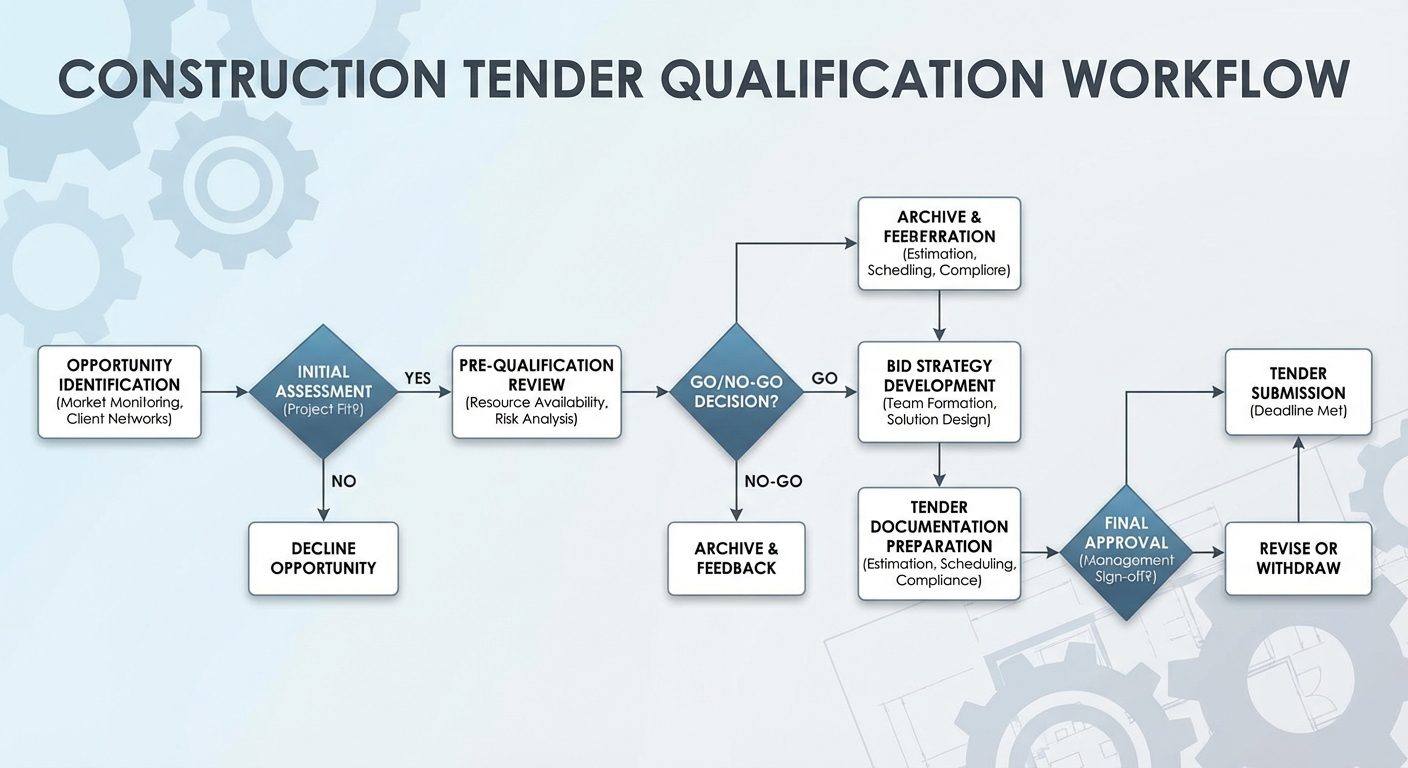
Construction tender qualification workflow
Successful construction bidding begins long before the tender arrives. The most effective contractors maintain robust opportunity pipelines, monitoring upcoming projects through:
Contracts Finder and Find a Tender Service remain the primary sources for public sector opportunities above threshold values. These platforms publish contract notices, tender documents, and award decisions, providing visibility into both current opportunities and competitor activity. Framework mini-competitions represent a significant portion of available work. Once appointed to a framework, contractors compete for specific projects through simplified procurement processes. Framework membership itself requires substantial tender investment, but it opens access to pre-qualified work with reduced competition. Early market engagement allows contractors to influence project design and procurement strategy before formal tender publication. Attending pre-procurement events, responding to prior information notices, and engaging with client teams can provide competitive intelligence and relationship development opportunities.Once a tender opportunity is identified, qualification is critical. The most common mistake is bidding for everything. Successful contractors apply rigorous qualification criteria: project value alignment, geographic location, technical capability match, resource availability, and strategic fit. A well-qualified pipeline converts at 25-30%; an unqualified one struggles to reach 10%.
The tender preparation phase typically spans 4-8 weeks for major projects. This includes document review, site visits, supply chain engagement, technical solution development, pricing, quality assurance, and submission. Compressed timelines demand efficient processes and clear internal responsibilities.
Essential Components of a Winning Construction Tender
Construction tenders are comprehensive documents that must address technical, commercial, and compliance requirements simultaneously. The typical structure includes:
Selection Questionnaire (SQ) or Pre-Qualification Questionnaire (PQQ) serves as the initial filter. These documents assess financial standing, insurance coverage, health and safety performance, environmental management systems, and past project experience. Failing at SQ stage is common—approximately 40% of applicants don't progress beyond this point.Financial assessments scrutinize your balance sheet, turnover, profit margins, and credit rating. For contracts over £5 million, expect detailed financial due diligence. Contractors with turnover below 2-3x the contract value often face immediate rejection. Parent company guarantees or performance bonds can mitigate concerns about financial capacity.
Health and safety credentials are non-negotiable. CHAS, Constructionline, and SSIP scheme membership provides baseline assurance, but major clients demand evidence of proactive safety culture. Your RIDDOR reportable incident rate, lost time injury frequency rate, and approach to managing high-risk activities will be assessed in detail.
Quality questionnaires or method statements form the technical evaluation. Here, contractors must demonstrate understanding of project requirements, articulate their delivery approach, identify risks and mitigation strategies, and explain how they'll ensure quality outcomes.The most effective method statements follow a structured narrative: understanding of requirements, proposed methodology, resource allocation, program and sequencing, quality assurance, risk management, and added value. Each section should reference the specific evaluation criteria, using the language and terminology from the tender documents.
Generic responses fail. Clients can immediately identify when a contractor has submitted a templated response with minimal customization. Every method statement should include project-specific details: the actual site conditions, named personnel who will deliver the work, specific challenges you've identified, and tailored solutions that demonstrate deep understanding.
Social value proposals have become crucial differentiators. Under the Public Services (Social Value) Act 2012, and reinforced by the Procurement Act 2023, public sector buyers must consider social value in procurement. Construction tenders routinely ask how contractors will:Generate local employment and training opportunities, including apprenticeships and work experience placements. Clients want specific numbers: how many apprentices, which trades, partnership with which training providers.
Support local supply chains by committing to minimum percentages of contract value spent with SMEs or within the local authority area. Vague commitments to "use local suppliers where possible" score poorly against specific targets like "minimum 40% spend within 20-mile radius."
Engage with schools, colleges, and community groups through site visits, career talks, and mentoring programs. The most compelling proposals include named schools, scheduled events, and clear learning outcomes.
Address environmental sustainability through waste reduction, circular economy practices, carbon reduction, and biodiversity enhancement. Specific commitments outperform general statements: "divert 95% of construction waste from landfill" beats "minimize waste."

Social value scoring framework for construction tenders
Most public sector tenders evaluate price on a relative basis: the lowest compliant bid receives maximum points, with other bids scored proportionally. A 10% price difference might cost you 5-7% of total available points. This makes the quality-price balance crucial—investing in a compelling quality response can justify a moderate price premium.
Pricing errors are common and often fatal. Arithmetic mistakes, missing items, unrealistic rates, and inconsistencies between different pricing documents all lead to rejection or post-tender clarification that weakens your position. Robust quality assurance of pricing is essential.
Technical Excellence: Demonstrating Construction Capability
Construction clients buy confidence. Your tender must convince them that you understand their project, have the technical capability to deliver it, and will manage it successfully from mobilization to handover.
Project-specific methodology should walk the evaluator through your delivery approach. Start with mobilization: how you'll establish the site, set up welfare facilities, implement security and safety measures, and coordinate with the client's operations. For live environment projects like schools or hospitals, demonstrating understanding of access constraints, noise limitations, and phasing requirements is critical.The construction sequence should be logical and realistic. Break complex projects into clear phases, explain dependencies between activities, identify critical path items, and show how you'll maintain program even when challenges arise. Gantt charts and visual program representations are valuable, but ensure they're readable and referenced in the narrative.
Quality management goes beyond "we're ISO 9001 certified." Explain your inspection and test plans, how you'll ensure workmanship standards, your approach to snagging and defects management, and how you'll achieve client sign-off at practical completion. Project-specific quality requirements should be explicitly addressed.
Health and safety management requires detailed attention. Generic safety statements won't suffice—clients want to see how you'll manage the specific risks of their project. Site-specific risk assessments, method statements for high-risk activities (working at height, confined spaces, demolition, etc.), and your approach to managing subcontractor safety should all be covered.The most effective safety responses include visual elements: example risk assessment formats, safety plan layouts, toolbox talk records. These demonstrate that your safety management is operational, not theoretical.
Resource allocation and key personnel must be credible. Name your project manager, site manager, and other key roles. Include CVs that demonstrate relevant experience on similar projects. Clients want to see that you're committing experienced people, not theoretical resources.Subcontractor and supply chain management deserves detailed treatment. Major projects require extensive supply chains, and clients need confidence you can manage them effectively. Explain your procurement approach, how you'll ensure subcontractor competence and compliance, and your approach to payment and performance management.
Environmental and Sustainability Requirements
Sustainability has moved from "nice to have" to "essential" in construction procurement. The UK's commitment to net zero by 2050, combined with stricter environmental regulations, means every construction tender now includes substantial sustainability requirements.

Construction sustainability framework
The most sophisticated contractors use tools like OneClick LCA or similar software to quantify embodied carbon and demonstrate how their design and material choices reduce environmental impact. Being able to state "our approach reduces embodied carbon by 15% compared to baseline specification" provides powerful differentiation.
Circular economy principles are increasingly expected. This includes designing for deconstruction, using recycled content materials, minimizing waste through off-site manufacturing, and creating material reuse plans. Specific commitments to waste diversion rates (e.g., "95% of construction waste diverted from landfill") are now standard.Material passports and end-of-life plans demonstrate advanced thinking. Documenting materials used, their composition, and how they can be recovered or recycled at end of building life shows commitment to circular principles.
Biodiversity net gain became mandatory for most planning applications in 2024. Construction tenders often require demonstration of how the project will deliver the mandated 10% biodiversity net gain. This includes habitat surveys, impact assessments, enhancement measures, and long-term management plans.Contractors with in-house ecological expertise or established partnerships with ecological consultants can respond more credibly than those treating biodiversity as an afterthought. Specific proposals—"creating 0.3 hectares of wildflower meadow" rather than "enhancing biodiversity"—score better.
Sustainable procurement extends beyond your direct activities to your supply chain. Clients want evidence that you'll source responsibly: timber from certified sustainable sources (FSC or PEFC), conflict-free minerals, suppliers with robust environmental management systems, and local sourcing to minimize transport emissions.The most compelling sustainability responses integrate environmental considerations throughout the methodology, not in an isolated section. When discussing demolition, mention material recovery. When describing concrete work, specify recycled aggregate content. This demonstrates that sustainability is embedded in your approach, not bolted on.
Managing Risk and Program Certainty
Construction projects are inherently risky. Ground conditions, weather, supply chain disruptions, design changes, and coordination challenges all threaten successful delivery. Clients award contracts to contractors who demonstrate understanding of these risks and credible mitigation strategies.
Risk registers should be project-specific and comprehensive. Generic risks like "adverse weather" with mitigation "allow contingency time" demonstrate lazy thinking. Effective risk registers identify specific risks relevant to the project, assess their likelihood and impact, and propose targeted mitigation measures.For example, if the project involves work near a river, identify flooding risk, assess it based on local flood history and seasonal patterns, and propose specific mitigation: raised storage for materials, mobile flood barriers, contingency plant relocation plan, and program float during high-risk periods.
The most sophisticated responses include risk allowances: quantified time or cost reserves allocated to specific risks based on probability-impact assessment. This demonstrates commercial maturity and realistic planning.
Program management must balance ambition with realism. Aggressive programs that promise impossible completion dates raise concerns about quality corners or unrealistic resource assumptions. Conversely, overly conservative programs suggest inefficiency.The credible approach is to present a realistic baseline program with clearly identified opportunities for acceleration through value engineering, off-site manufacturing, or enhanced resourcing. This shows you understand the client's urgency while maintaining program integrity.
Dependencies and interfaces should be explicitly managed. Where your work depends on client actions (design approvals, site access, existing service diversions), clearly identify these dependencies and proposed management approach. This protects your position and demonstrates commercial awareness.
Change management processes should be clearly articulated. How will you handle variations? What's your approach to early warning of potential changes? How will you ensure change costs are accurately assessed and transparently presented? Clients value contractors who manage change professionally rather than opportunistically.Leveraging Technology for Tender Success
The complexity of modern construction tenders creates both challenges and opportunities. Traditional approaches—manual document assembly, generic template responses, and linear quality assurance—struggle to deliver the quality and efficiency required for competitive success.
Technology is transforming construction tender preparation in three key areas:
Document management and collaboration tools enable teams to work efficiently on complex responses. Cloud-based platforms allow simultaneous contribution from estimating, technical, and commercial teams, with version control and audit trails. This eliminates the chaos of email exchanges and conflicting document versions.For larger contractors with multiple office locations or joint venture arrangements, these platforms enable genuine collaboration despite geographic separation. The winning Crossrail tender involved teams across five offices working in a shared digital environment.
Data and content libraries allow organizations to build and maintain repositories of relevant experience, case studies, CVs, methodology statements, and policy documents. When a new tender arrives, teams can quickly locate and adapt relevant content rather than starting from scratch.The most effective libraries are structured around evaluation criteria and project types. When a tender asks about flood risk management, the library should yield immediately relevant methodology statements from previous flood risk projects, not a generic environmental management policy.
AI-powered tender writing platforms like mytender.io have emerged as game-changers for construction contractors. These systems go beyond simple template management to provide intelligent support throughout the tender lifecycle.The technology analyzes tender requirements, extracts evaluation criteria, and guides response development to ensure every scored element is addressed. For construction contractors juggling multiple parallel bids, this systematic approach eliminates the risk of missing requirements.
Content generation capabilities allow teams to draft comprehensive responses faster. By inputting project-specific details and relevant experience, the AI can generate tailored methodology statements that follow best-practice structure while incorporating your unique approach. This dramatically reduces the time from tender receipt to submission-ready draft.
Quality assurance features help ensure compliance before submission. Automated checks verify that all questions are answered, word counts are met, required appendices are included, and responses address evaluation criteria. This catches errors that manual review often misses under deadline pressure.
Perhaps most valuably, AI platforms learn from each submission. Analysis of successful and unsuccessful bids builds understanding of what works, creating continuous improvement in response quality. Over time, this institutional learning compounds into significant competitive advantage.
Case Study: How AI Transformed a Mid-Tier Contractor's Win Rate
Midlands Construction Services, a £25 million turnover regional contractor, struggled with tender success rates below 12% despite strong project delivery capabilities. Their challenge was typical: experienced project teams but limited bid resources, forcing rushed responses to multiple simultaneous opportunities.
Their bid coordinator spent 70% of her time on document assembly and formatting, leaving minimal time for strategic response development. Pricing teams worked in isolation from technical responses, leading to inconsistencies. Quality assurance was time-pressured and often incomplete.
After implementing mytender.io, their approach transformed. The platform's requirement extraction meant they could quickly understand what each tender was asking. The content library held their project experience, methodologies, and case studies in structured, searchable format.
Response drafting time dropped by 60%. Instead of writing from scratch, the bid coordinator could generate comprehensive first drafts by inputting project specifics. This freed time for strategic thinking: how to differentiate, which case studies were most relevant, how to present innovative approaches.
Importantly, project managers could contribute more effectively. The platform's user-friendly interface meant technical experts could input their knowledge without struggling with formatting or structure. The AI then crafted this into polished methodology statements that matched evaluation criteria.
Quality improved noticeably. Automated compliance checks caught errors before submission. Responses consistently addressed all evaluation criteria with appropriate detail. The presentation was professional and consistent across all submissions.
The results were dramatic: win rate increased to 28% within eight months. The value of won work increased by £4.8 million year-on-year, despite bidding for fewer opportunities. By being more selective and submitting higher quality responses, they achieved better outcomes with less effort.
The commercial impact was profound. Additional revenue of £4.8 million at 8% margin generated £384,000 in additional profit. The platform cost £12,000 annually, delivering a 32:1 return on investment. Even accounting for the bid coordinator's salary (now spent on strategy rather than document assembly), the ROI exceeded 15:1.

Construction contractor tender success metrics before and after AI implementation
Frameworks and Pre-Qualification: Long-Term Strategic Positioning
While individual tender opportunities provide immediate revenue opportunities, framework positions offer longer-term strategic value. Major frameworks like SCAPE, Pagabo, NHS ProCure22, and Crown Commercial Service frameworks provide multi-year access to pre-qualified work with reduced competition.
Framework applications are substantial undertakings, often requiring responses to 50+ questions across financial standing, technical capability, case studies, social value commitments, and commercial terms. The evaluation is rigorous—acceptance rates for competitive frameworks typically run 20-30%.The investment is worthwhile. Framework members report that mini-competition conversion rates are 2-3x higher than open tender success rates. The reduced competition (often 3-5 framework members per opportunity rather than 15-20 open market bidders) and simplified procurement process make framework work more efficient.
Framework tender responses should demonstrate breadth of capability while highlighting specialisms. Clients use frameworks for diverse projects, so showing you can handle various project types, values, and complexities is valuable. Simultaneously, distinct capabilities (heritage restoration, complex M&E, modular construction) create differentiation.
Case study selection for framework applications should be strategic. Include projects that demonstrate:- Range of values from small works to major projects
- Diverse project types and sectors
- Complex projects showcasing technical capability
- Recent projects demonstrating current capability
- Excellent client references and repeat business
- Award-winning or innovative projects
The strongest case studies tell stories: the challenge, your approach, the outcome, and the client benefit. Quantified results—cost savings, program acceleration, operational benefits—are powerful. "Delivered £2.3 million college refurbishment two weeks ahead of program, enabling client to complete room allocations before term start" is more compelling than "completed project on time."
Maintaining framework positions requires ongoing performance. Poor delivery, client complaints, or administrative non-compliance can result in framework removal. The most successful framework members treat their framework position as a strategic asset requiring active management.This includes maintaining current accreditations, insurance, and compliance documentation; responding promptly to mini-competitions; delivering projects to high standards; maintaining client relationships; and contributing to framework development and improvement initiatives.
Quality Assurance: The Final Critical Step
The best technical solution and most competitive price are worthless if your tender is non-compliant or poorly presented. Robust quality assurance is the difference between success and failure.
Compliance checking should verify every requirement is addressed. Create a compliance matrix that lists every tender question, word limit, required appendix, and submission requirement. Check each off as you complete and review it. This simple discipline prevents the common mistake of missing questions.Format compliance matters. If the tender specifies 11-point Arial font, use it. If it requires appendices in specific order or PDF format, comply. Failure to follow instructions suggests you won't follow contract requirements either.
Content quality review should assess whether responses actually answer what's asked. It's surprisingly common for responses to discuss a related topic while not directly addressing the question. An independent reviewer (someone not involved in writing) provides the best quality assurance.Each response should be evaluated against the evaluation criteria. If the question is worth 10% of the quality score and relates to "health and safety management on live school sites," does your response thoroughly address school-specific safety considerations? Have you demonstrated understanding of safeguarding, minimizing disruption, and managing contractor-pupil interfaces?
Pricing verification should include multiple independent checks:- Arithmetic accuracy in all calculations
- Consistency between summary and detailed pricing
- Coverage of all schedule items
- Reasonableness of rates and allowances
- Comparison with cost plan or budget expectations
- Compliance with pricing instructions
Many contractors use independent price reviews by senior estimators or directors who weren't involved in the original pricing. Fresh eyes catch errors that familiarity blinds you to.
Presentation quality influences evaluation, often subconsciously. Professional formatting, clear structure, appropriate visual elements, consistent branding, and error-free text create positive impressions. Conversely, poor formatting, inconsistent fonts, typos, and unclear visuals undermine confidence.The final submission should look like a cohesive document, not an assembly of parts. Consistent headers and footers, unified formatting across sections, aligned visual style, and clear navigation all contribute to professional presentation.
Feedback, Learning, and Continuous Improvement
Every tender outcome—win or loss—provides learning opportunities. The most successful contractors systematically capture and apply these lessons.
Debrief requests should be standard practice for lost bids. Under the Public Contracts Regulations, contracting authorities must provide feedback explaining why you weren't successful. This feedback is invaluable for understanding weaknesses and improving future responses.Common themes in feedback include: technical approach lacked detail or didn't fully address requirements; social value commitments were generic rather than specific; pricing was non-competitive; case studies weren't sufficiently relevant; or key personnel lacked appropriate experience.
Patterns across multiple debriefs reveal systemic issues. If multiple clients report that your environmental proposals lack detail, you need to strengthen this area. If pricing is consistently non-competitive, your cost base or margins may need review.
Win analysis is equally important. Understanding why you won helps replicate success. What aspects of your response differentiated you? Which case studies resonated? What pricing strategy worked? This positive learning is often neglected in favor of analyzing failures. Knowledge management turns individual learning into organizational capability. Document lessons learned, update templates and content libraries, share successful approaches across the team, and revise bid procedures based on experience.The contractors with the highest win rates are learning organizations. They don't just bid more effectively—they continuously improve their bidding through systematic learning cycles.
The Future of Construction Tendering
The procurement landscape continues to evolving. Several trends will shape construction tendering in coming years:
Increased transparency through the Procurement Act 2023's requirements for pipeline publication, outcome reporting, and open book approaches. This provides earlier visibility of opportunities but also increases scrutiny of procurement decisions and contractor performance. Greater emphasis on outcomes rather than specifications. Clients increasingly describe what they want to achieve (a zero-carbon school, a resilient flood defense) and invite contractors to propose how to deliver it. This rewards innovation but demands greater technical sophistication in tender responses. Digital transformation of procurement processes. E-tendering platforms, digital evaluation tools, and online collaboration are becoming standard. This improves efficiency but requires contractors to develop digital capabilities and adapt to new submission formats. Value-based evaluation continues to grow. Pure price-based competition is declining in favor of multi-factor evaluation that includes quality, social value, sustainability, innovation, and life-cycle cost. This rewards contractors who invest in comprehensive, compelling responses. Collaboration and integration through models like alliancing, two-stage procurement, and integrated project insurance. These approaches emphasize partnership over adversarial contracting, but require different tender responses focused on cultural fit, collaborative working, and aligned incentives.The contractors who will thrive in this evolving landscape are those who embrace change, invest in capability development, and leverage technology to enhance their competitive position. The fundamentals remain—understand requirements, demonstrate capability, manage risk, price competitively—but the sophistication required continues to increase.
Taking Action: Improving Your Construction Tender Success Rate
Whether you're a regional contractor pursuing local authority work or a major player competing for infrastructure projects, improving tender success requires systematic effort:
Qualify ruthlessly. Bid only for opportunities that align with your capabilities, capacity, and strategic objectives. A 30% win rate on well-qualified opportunities beats 10% on everything you could theoretically bid. Invest in quality responses. Allocate sufficient time and resources to develop comprehensive, compelling tenders. Rushed responses rarely win. The cost of a thorough tender preparation is a fraction of the profit from winning. Build capability systematically. Develop your content library, refine your methodologies, maintain case study bank, and update key personnel CVs regularly. This foundation enables efficient response to opportunities as they arise. Leverage technology strategically. Tools like mytender.io aren't about replacing human expertise—they're about amplifying it. Let AI handle document analysis, content drafting, and compliance checking, freeing your team to focus on strategy, innovation, and differentiation. Learn continuously. Request feedback, analyze outcomes, identify patterns, and systematically improve. The gap between average and excellent contractors isn't talent—it's disciplined continuous improvement. Focus on differentiation. In competitive markets, being competent isn't enough. What makes your approach better? What unique capabilities do you offer? How will the client's project benefit from choosing you? Answer these questions compellingly in every tender.The construction sector offers extraordinary opportunities for contractors who can navigate the procurement process effectively. The tender is your first project deliverable—deliver it to the same standards you'll bring to the actual construction work, and your success rate will reflect that commitment to excellence.

Construction tender success roadmap
The firms winning major construction contracts in 2026 aren't just building well—they're bidding smart. They combine deep technical knowledge with sophisticated tender development capabilities, leveraging technology to enhance efficiency while maintaining the human insight that creates truly compelling responses. In an industry where margins are tight and competition is fierce, the ability to win work at reasonable prices might be the most valuable capability of all.
Tags
Ready to Transform Your Tender Writing?
See how MyTender's AI can help you write winning tenders in a fraction of the time.