
Assessment Summaries: How to Turn Tender Feedback Into Your Next Win
Assessment summaries under the Procurement Act give suppliers more useful feedback than old standstill letters. Here is how bid teams should read them, log them and use them to improve win rate.
mytender.io Research Team
Tender Writing & Bid Management Specialists
Assessment Summaries: How to Turn Tender Feedback Into Your Next Win
Most bid teams waste the most useful document they receive all year.
Not the ITT. Not the pricing schedule. The feedback.
A result lands, everyone either celebrates or sulks, someone forwards the scores, and then the whole thing disappears into a folder called something like "2026 tenders". Three months later, the team writes the same weak mobilisation answer again.
That is painful. It is also avoidable.
Under the Procurement Act 2023, suppliers are getting more structured information through assessment summaries. The old habit of treating feedback as a post-mortem is no longer good enough. Used properly, an assessment summary is not a consolation prize. It is a scoring map for the next bid.

Bid team reviewing a Procurement Act assessment summary after a tender result
This guide explains what assessment summaries are, what to look for, and how to turn tender feedback into better bid decisions, stronger answers and a cleaner evidence library.
Why assessment summaries matter now
The Procurement Act changed more than the language around award notices.
For competitive procurements, contracting authorities now have to give assessed suppliers clearer information before the contract is entered into. Assessment summaries are part of that shift. They are intended to explain how your tender was assessed, where it scored well, where it fell short, and how the winning tender compared.
The exact detail will depend on the procurement, but the direction of travel is obvious: public sector feedback is becoming more structured, more comparable and more useful.
That matters because feedback is one of the few places where evaluators tell you what they actually valued.
Tender documents tell you what they asked for. Assessment summaries tell you what they rewarded.
Those are not always the same thing.
What an assessment summary usually tells you
An assessment summary is not a free consulting report. Do not expect a line-by-line rewrite of your answer.
But a useful one should help you understand:
- your score against each assessed criterion
- the reasons for that score
- the winning supplier's score, where the rules require it
- the difference between your tender and the successful tender
- any particular strengths or weaknesses identified by evaluators
- the award decision context before the standstill period runs
That last point matters. The standstill period is short. In many cases it is eight working days. If there is a serious procedural issue, you need to act quickly. But for most suppliers, the bigger commercial opportunity is learning.
Not every loss should become a challenge. Every loss should become data.
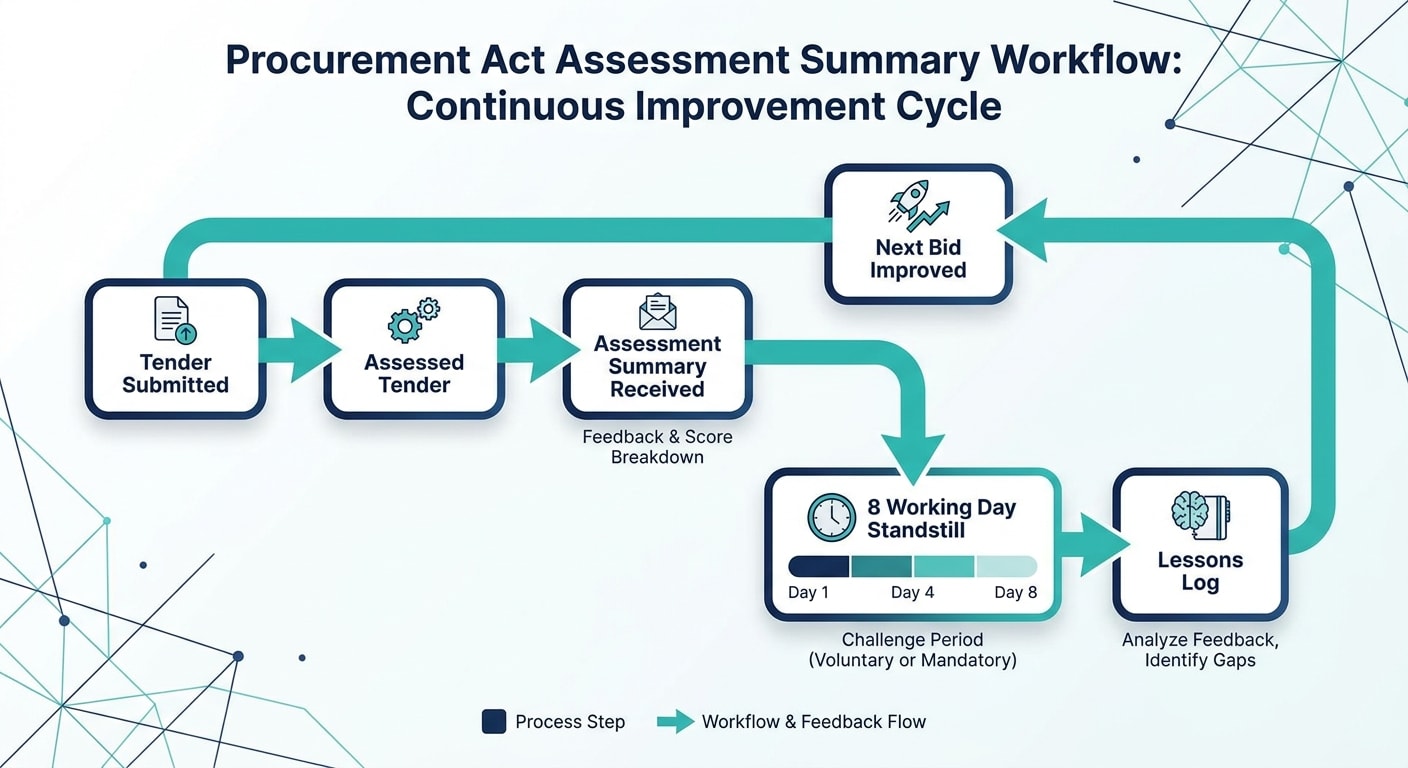
Workflow diagram showing how an assessment summary moves from result notice to standstill review, lessons log and improved next bid
The first read: separate challenge risk from learning value
When the result arrives, do not start with emotion. Start with triage.
There are two jobs to do, and they should not be muddled.
The first job is procedural. Was the process fair? Was the scoring consistent with the published criteria? Does anything look obviously wrong? Is the explanation clear enough to understand the decision?
If something looks seriously off, escalate it properly. Get legal or procurement advice fast. The window is not generous.
The second job is commercial learning. This is where most teams should spend their energy.
Ask:
- Where was the score gap biggest?
- Did we lose on quality, price, social value, risk, mobilisation or evidence?
- Were our strong sections actually strong, or just familiar to us?
- Did the winning tender beat us because of substance, presentation or relevance?
- Which weakness is likely to appear again in future tenders?
That last question is the money question.
A one-off weakness is annoying. A repeated weakness is a win-rate leak.
The mistake most suppliers make with feedback
Most teams read feedback as judgement.
That is understandable. Someone has just marked weeks of work, and the result may have cost you a contract. It feels personal, even when it is not.
But judgement is not the useful bit.
The useful bit is pattern.
If three different authorities say your mobilisation plan lacks detail, you do not have a mobilisation feedback problem. You have a mobilisation content problem.
If evaluators keep praising your technical method but marking down social value, your bid library is probably too operational and not outcome-led enough.
If you score well on written quality but lose on price every time, the issue may sit in qualification and pricing strategy, not writing.
Feedback only compounds when you treat it as a dataset.
Build a feedback matrix, not a folder
A folder stores documents. A matrix creates learning.
For every assessed tender, capture the feedback in a consistent format. It does not need to be complicated. A spreadsheet is enough at the start.
Use these fields:
- buyer
- contract name
- sector
- submission date
- result
- contract value
- criterion
- weighting
- your score
- winning score
- evaluator reason
- score gap
- root cause
- content fix needed
- evidence fix needed
- owner
- deadline
This turns a feedback document into a management tool.
The root cause field is especially important. Do not write "lost marks on quality". That is not a cause. Write something like "case study did not prove comparable scale" or "method explained process but not governance".
Specific feedback gets fixed. Vague feedback gets admired and ignored.
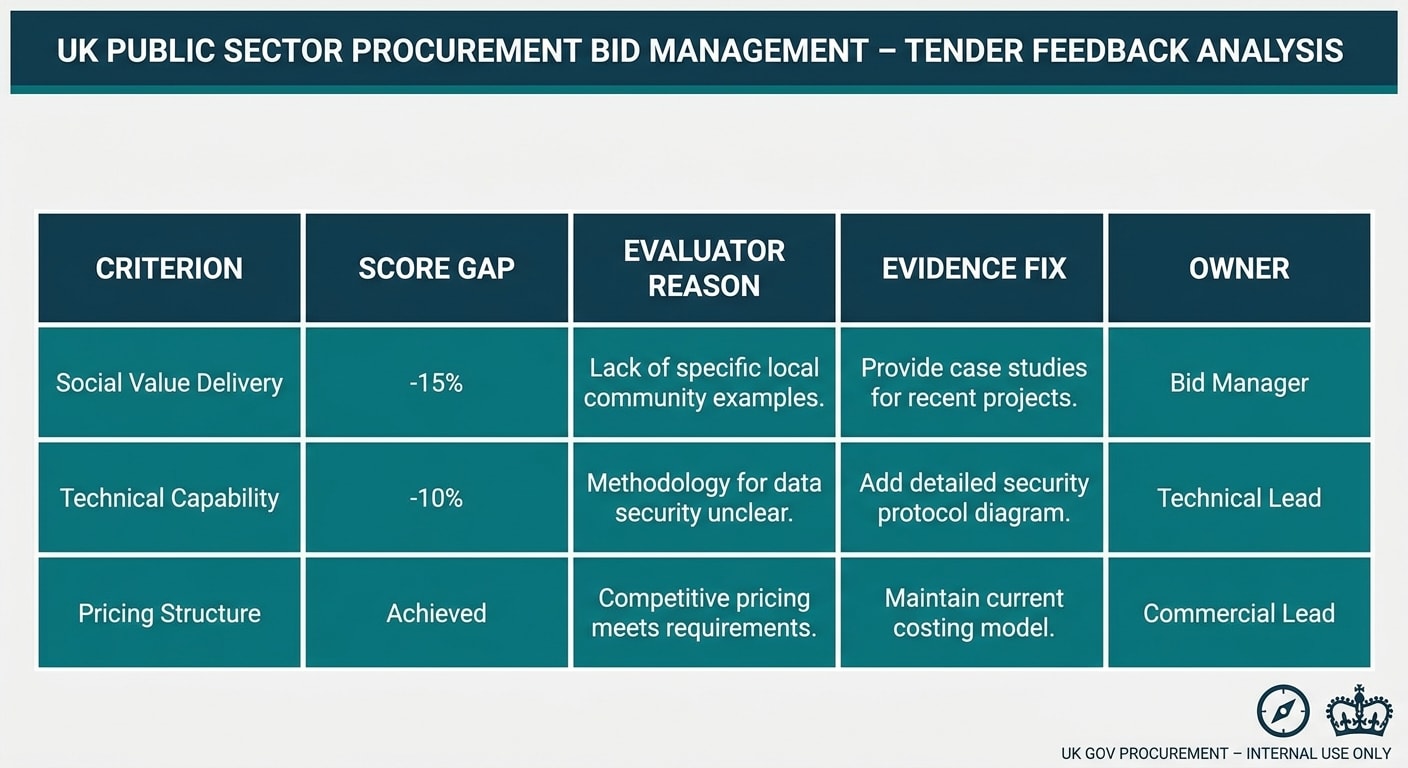
Tender feedback analysis matrix showing criterion, score gap, evaluator reason, evidence fix and owner
How to read score gaps properly
A two-mark gap can mean very different things.
If the criterion is worth 5%, it may not matter much. If it is worth 25%, it may explain the whole result.
So do not rank feedback by emotional pain. Rank it by weighted impact.
For each criterion, calculate:
Score gap x weighting = commercial importanceThen look at repeatability.
A high-impact, repeatable weakness should go straight onto the improvement plan. A low-impact, one-off weakness can wait.
For example:
- lost 2% on a bespoke technical requirement unlikely to recur: note it, but do not rebuild your library around it
- lost 8% on mobilisation detail in an FM tender: fix the mobilisation answer now
- lost 10% on social value evidence across three bids: this is a strategic content gap
- lost on price despite excellent quality scores: review qualification, commercial model and competitor positioning
This stops the team chasing every comment equally.
Not all feedback deserves the same response.
Turn evaluator language into bid-library language
Evaluator comments are often written in procurement language. Your bid library needs usable writing guidance.
So translate comments into practical fixes.
If the evaluator says:
> The response provided a clear process but limited evidence of successful delivery on comparable contracts.
The library fix is not "add more evidence".
The fix is:
- add two comparable case studies by contract size and service type
- include the mobilisation timeline achieved
- include the baseline problem and measured improvement
- name the governance forum used to control delivery
- add client-approved KPI results where available
If the evaluator says:
> The social value proposals were relevant but lacked measurable commitments.
The fix is:
- create a social value commitment bank by sector
- attach outputs, outcomes, owners and reporting method
- remove generic charity volunteering claims unless linked to the contract
- add evidence from previous delivery
You are not just storing feedback. You are converting it into better future answers.
The five feedback categories that improve win rate
Most assessment summary findings fall into five buckets. Use these buckets to tag every comment.
1. Relevance
This is where the evaluator is really saying: you answered the wrong version of the question.
The response may be well written, but too generic. It talks about your business, not their contract. It explains a method, but not the specific risks, users, geography or outcomes in the tender.
Fix this by improving response planning. Before writing, identify the buyer's real concern behind the question.
2. Evidence
This is the most common gap.
Suppliers make claims they cannot prove. They say they deliver mobilisation safely, manage risk well, improve resident satisfaction or reduce waste, but the answer has no numbers, examples or named controls.
Fix this by building evidence packs, not prose templates.
3. Specificity
This is different from evidence.
A response can include evidence and still feel vague if it does not explain exactly what will happen on this contract.
Specificity means named roles, timescales, governance meetings, escalation routes, reporting cadence, systems, outputs and decision points.
4. Differentiation
Sometimes the feedback says your answer was acceptable. That sounds fine until you realise acceptable rarely wins.
If the winning supplier gave clearer innovation, lower delivery risk, stronger social value or better sector insight, your answer may have been competent but forgettable.
Fix this by making the evaluator's comparison easier. Say what is different about your approach, then prove why it matters.
5. Commercial alignment
This includes price, whole-life cost, risk transfer, payment terms and value for money.
If your quality score is strong but you keep losing overall, commercial alignment may be the issue. Do not ask the bid writer to solve a pricing problem with better adjectives. That is how teams waste months.
Use feedback to improve bid/no-bid decisions
Feedback is not only for writing better answers. It should change what you choose to bid.
If the same buyer repeatedly scores you poorly on local presence, ask whether you should keep bidding that region without a partner.
If construction tenders keep marking you down on Building Safety Act competence, fix the evidence before chasing another similar opportunity.
If waste tenders reward route optimisation and fleet data, and you cannot evidence either, stop pretending the next tender will be different.
A good bid/no-bid process uses feedback from past results.
That means asking:
- Have we lost similar tenders for the same reason?
- Has that reason been fixed?
- Do we have new evidence since the last submission?
- Are we bidding because we can win, or because the opportunity is visible?
This is uncomfortable. Good.
Bid teams do not lose capacity because they are lazy. They lose capacity because nobody stops low-probability bids early enough.
Feed assessment summaries into your AI system carefully
If you use AI for bid writing, feedback is gold.
But only if it is structured.
Dumping ten PDFs into a generic chat and asking it to "learn from these" is not a strategy. You will get a summary, not a capability.
Instead, capture feedback against the same tags each time:
- sector
- buyer type
- question type
- score gap
- evaluator concern
- evidence needed
- reusable lesson
- source tender
Then connect that to your bid library.
When the next mobilisation question appears, your system should know that previous evaluators wanted named workstream owners, mobilisation risk logs, TUPE communication plans and week-by-week governance. It should not just produce a smoother paragraph.
This is one of the places where mytender.io can help, because bid feedback, previous submissions and reusable evidence can be organised around the way tender questions are actually scored.
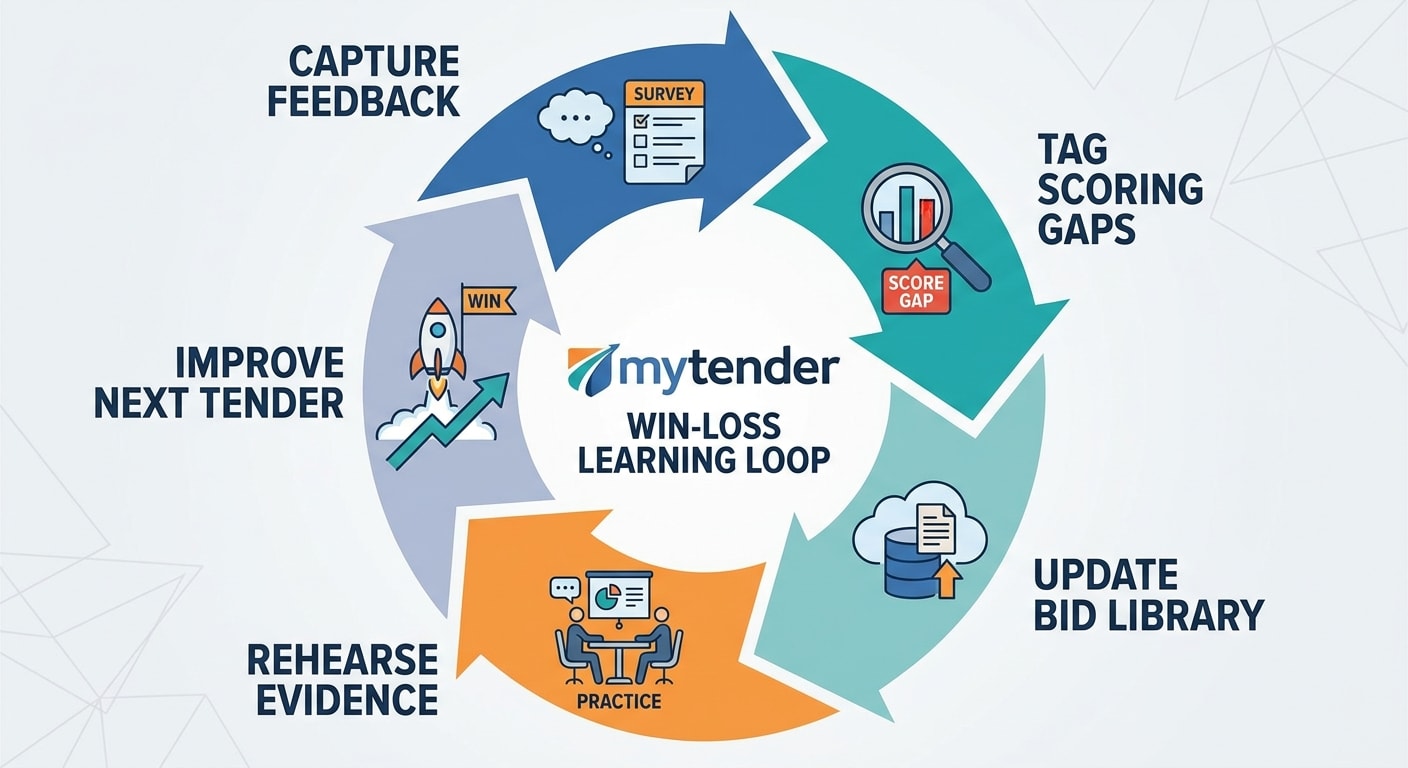
Circular learning loop showing feedback capture, scoring gap tags, bid library updates and stronger next tender responses
Do not wait until the next live bid
The worst time to fix feedback is during the next deadline.
By then, everyone is busy. The writer is trying to hit word counts. The subject matter expert is late with comments. The commercial lead is still debating assumptions. Nobody has time to rebuild the evidence base properly.
Set a rule: every tender result gets a 45-minute review within five working days.
Keep it tight.
Agenda:
- What did we score?
- Where did we lose or win marks?
- What was the weighted impact?
- What is the root cause?
- What do we change before the next tender?
- Who owns the change?
No theatre. No blame. No two-hour therapy session.
Just decisions.
How to run the 45-minute review
Bring four things:
- the assessment summary
- the submitted response
- the scoring model
- the bid/no-bid notes
Start with the highest weighted score gap. Read the evaluator comment out loud. Then read the answer you submitted.
This is where the truth usually appears.
Often the answer looks weaker than people remember. It may be too generic. It may bury the strongest evidence halfway down page three. It may answer the question in the final paragraph instead of the first sentence.
Capture the fix immediately.
Do not write "improve evidence". Write "add Sodexo mobilisation case study to FM mobilisation library with four-week timeline, KPI dashboard and governance structure".
Then move on.
The goal is not to relitigate the result. It is to make the next bid harder to mark down.
The link between feedback and case studies
Most tender case studies are written from the supplier's point of view.
They say what you did. They rarely say what an evaluator needs to know.
Assessment summaries help you rebuild case studies around scoring concerns.
If evaluators keep asking for comparable scale, every case study should show contract value, geography, service volume, mobilisation length and stakeholder complexity.
If evaluators worry about risk, every case study should show the risk, the control, the escalation route and the outcome.
If evaluators mark down social value, every case study should show the commitment, delivery mechanism, measured result and verification method.
A good case study is not a success story. It is evidence arranged for scoring.
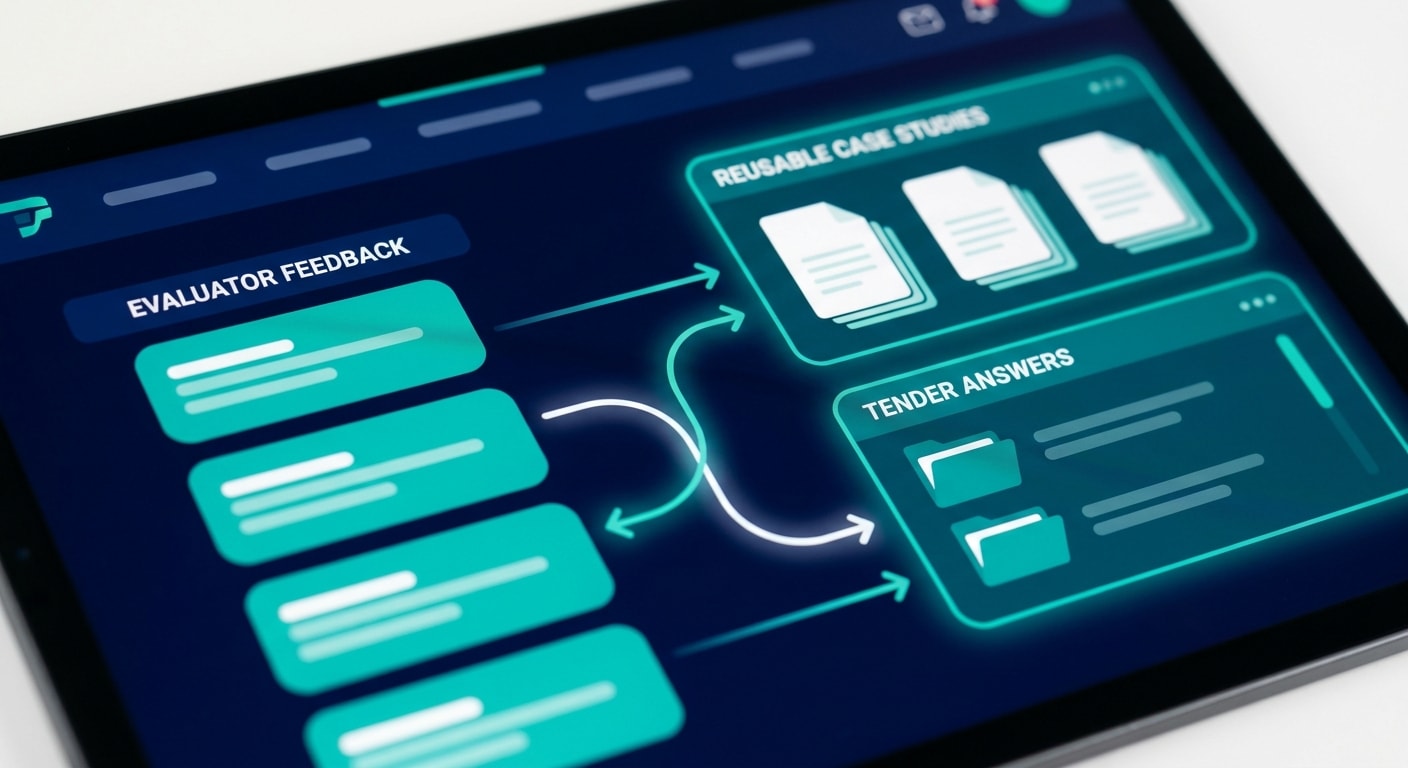
Bid library dashboard concept linking evaluator feedback to reusable tender case studies and evidence
What good feedback management looks like after six months
After six months, you should be able to answer these questions without hunting through inboxes:
- Which tender sections lose the most marks?
- Which buyers score us consistently well?
- Which sectors expose our weakest evidence?
- Which subject matter experts produce the strongest proof points?
- Which case studies are overused?
- Which social value commitments score well?
- Which losses were really qualification failures?
- Which improvements have already increased scores?
That last question matters.
If feedback management does not change scores, it is admin. The point is to make better commercial decisions and write stronger tenders.
A simple assessment summary checklist
When the next result lands, use this checklist.
- Save the assessment summary in a central place.
- Record scores by criterion and weighting.
- Calculate weighted score gaps.
- Identify whether any procedural issue needs urgent review.
- Tag comments by relevance, evidence, specificity, differentiation and commercial alignment.
- Translate comments into concrete content fixes.
- Assign owners for evidence gaps.
- Update the bid library before the next tender.
- Review bid/no-bid assumptions if the loss exposed a qualification issue.
- Revisit the same weakness after the next submission to see whether scores improved.
It is not glamorous. It works.
The real advantage: fewer repeated mistakes
You do not need every assessment summary to be perfect.
Some will be thin. Some will be frustrating. Some will tell you what you already suspected.
Use them anyway.
The best bid teams are not the ones that never lose. They are the ones that stop losing for the same reason twice.
That is the whole game.
Treat assessment summaries as bid intelligence. Build the matrix. Fix the library. Feed the lessons into qualification. Then make the next tender better than the last one.
If you want to find live opportunities where those lessons can actually be used, the Tender Finder is free to try.
Tags
Ready to Transform Your Tender Writing?
See how MyTender's AI can help you write winning tenders in a fraction of the time.