
Contract Performance Notices: How Suppliers Should Protect Future Tender Scores in 2026
Contract Performance Notices are turning delivery history into public tender evidence. Here is how suppliers should manage KPI risk and use performance data in future bids.
mytender.io Research Team
Tender Writing & Bid Management Specialists
Contract Performance Notices: How Suppliers Should Protect Future Tender Scores in 2026
A bad contract review used to stay mostly private.
The client was unhappy. The account team knew. Maybe the next bid team heard about it six months later, usually when they were trying to find a case study and someone said, quietly, "not that one".
That era is fading.
Under the Procurement Act 2023, contract performance is becoming more visible. For larger public contracts, buyers must publish performance information against KPIs. Serious poor performance can become part of the public record. And even when the formal notice regime does not apply, the direction of travel is obvious: evaluators want evidence that suppliers deliver what they promise.

Bid team reviewing contract performance notices and KPI dashboards
For suppliers, this changes the job of bid writing.
You are not only writing to win the next contract. You are writing promises that may be checked, published and reused as evidence later.
That sounds uncomfortable. It should. But it is also useful.
Good suppliers finally have a stronger way to prove they are lower risk. Weak suppliers have less space to hide behind polished prose.
This guide explains what Contract Performance Notices mean for suppliers, how they affect future tender scores, and how to build a performance evidence system that protects you before the next bid lands.
Why Contract Performance Notices matter
Contract Performance Notices are part of the Procurement Act's wider push toward transparency and contract management.
For public contracts above £5 million, contracting authorities are expected to set and publish at least three KPIs. From 2026, they also have duties to publish contract performance information against those KPIs at least annually and at the end of the contract.
The official language can feel procedural. The commercial impact is simpler.
Your delivery record is becoming bid evidence.That matters for three reasons.
First, evaluators are more likely to ask for hard performance data. If they know public contracts are being measured more openly, vague claims feel weaker.
Second, buyers can use past performance to judge risk. If your organisation has a visible pattern of poor delivery, expect harder questions.
Third, your bid commitments need to be realistic. If you promise service levels your operations team cannot hit, the problem may not end at contract award. It can follow you into the next procurement.
This is not just a compliance issue. It is a win-rate issue.
The notice is not the real problem
Most suppliers hear "Contract Performance Notice" and worry about the notice itself.
That is understandable, but slightly backwards.
The notice is the symptom. The real issue is the gap between what was promised, what was measured and what was actually delivered.
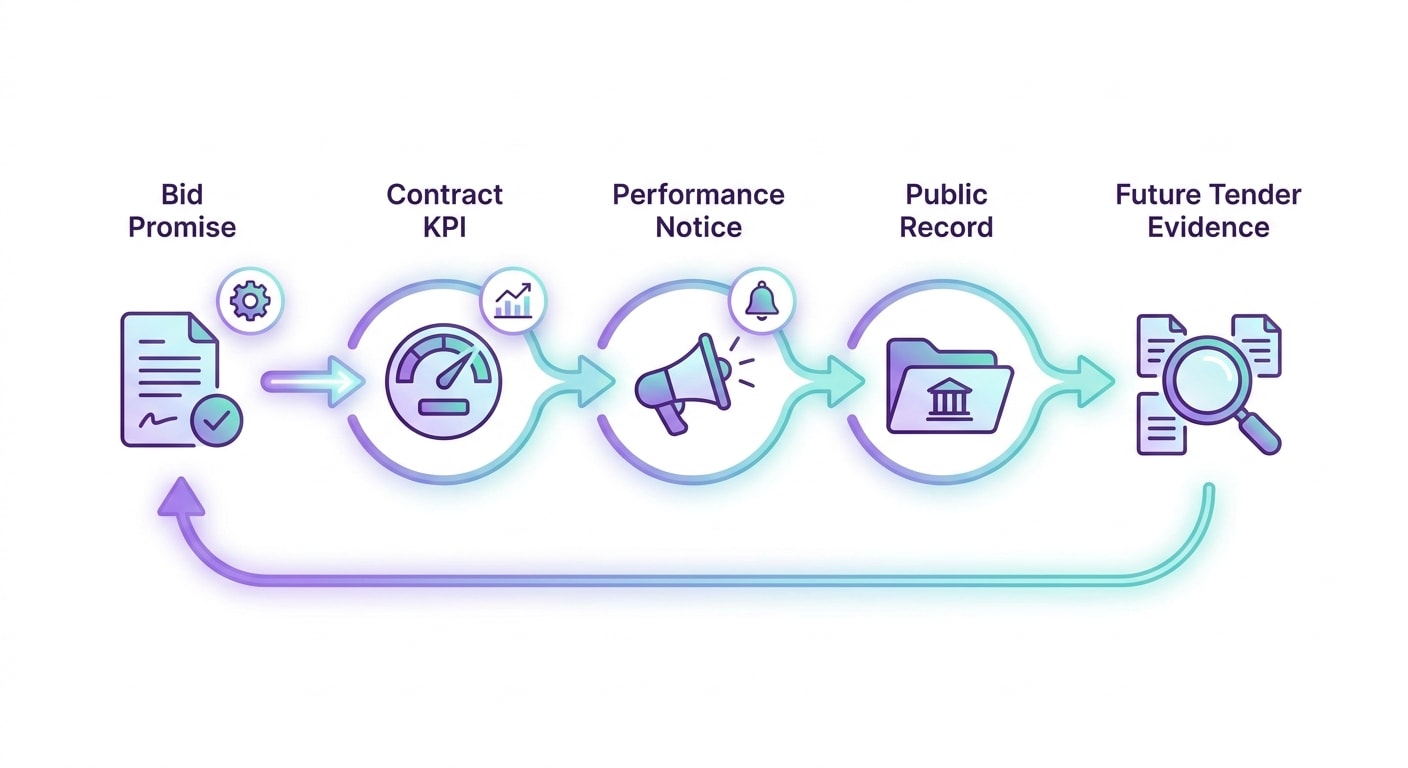
Performance loop from tender promise to KPI reporting and future bid evidence
A supplier gets into trouble when those three things drift apart.
The tender says response times will be within four hours. The contract KPI says urgent jobs must be attended within six hours. The operational report measures average completion time, not attendance. The client complains because the dashboard looks good but the lived service does not.
That is where confidence collapses.
The fix is not better wording in the next tender. The fix is better alignment:
- tender commitments that match operational reality
- KPIs that measure the thing the buyer actually cares about
- reporting that catches problems early
- corrective action that is documented properly
- case-study evidence that shows what changed
A bid team can help with all five. But only if it is connected to contract delivery.
How performance history affects future tender scores
Most tender evaluation models do not say, "we will mark you down for a previous Contract Performance Notice".
They usually phrase it more politely.
They ask for relevant experience. They ask for mobilisation evidence. They ask how you manage performance. They ask for quality assurance, risk controls, governance and continuous improvement.
That is where your performance history shows up.
If you have strong KPI evidence, those answers become easier to write and harder to dismiss.
If you have weak evidence, every section becomes more fragile.
Relevant experience
A case study with delivery data is much stronger than a case study with adjectives.
Compare these two lines:
"We successfully delivered a similar contract for a local authority."
"On a three-year local authority contract covering 42 sites, we achieved 97.8% planned service completion, reduced repeat complaints by 28% and retained the contract at extension review."
The second line feels safer because it gives the evaluator something to test.
Mobilisation
Mobilisation is one of the biggest places where bid promises become operational risk.
If you have previous mobilisation KPIs, use them. Show the number of sites, users, assets, staff, TUPE transfers, data migrations or routes involved. Then show what landed on time.
If something slipped, do not hide it. A credible corrective action story often scores better than a suspiciously perfect one.
Quality management
Quality answers are often bland because they describe systems instead of behaviour.
Performance notices push suppliers to show how the quality system works when something goes wrong.
That means evidence such as:
- issue logs with root-cause categories
- monthly KPI packs
- audit findings and closure rates
- client review actions
- examples of process changes after underperformance
The evaluator wants to know whether poor performance is spotted early, owned properly and fixed permanently.
Social value and contract outcomes
Social value is no longer just a tender promise on day one. Buyers increasingly want to know what was delivered after award.
If you promise apprenticeships, local jobs, volunteering hours, carbon reduction or community benefits, build the measurement trail from the start.
Future bids will be much stronger if you can say what happened, not just what you intended.
What suppliers should do before bidding
The worst time to build performance evidence is the week before submission.
By then, the bid team is asking operations for data under pressure. Operations sends whatever is easiest to find. The final answer ends up with a few numbers, no context and a nervous caveat.
Do the work earlier.
Create a performance evidence library
Every supplier bidding regularly for public work should have a performance evidence library.
Not a folder of random monthly reports. A proper library that turns contract delivery into reusable tender evidence.
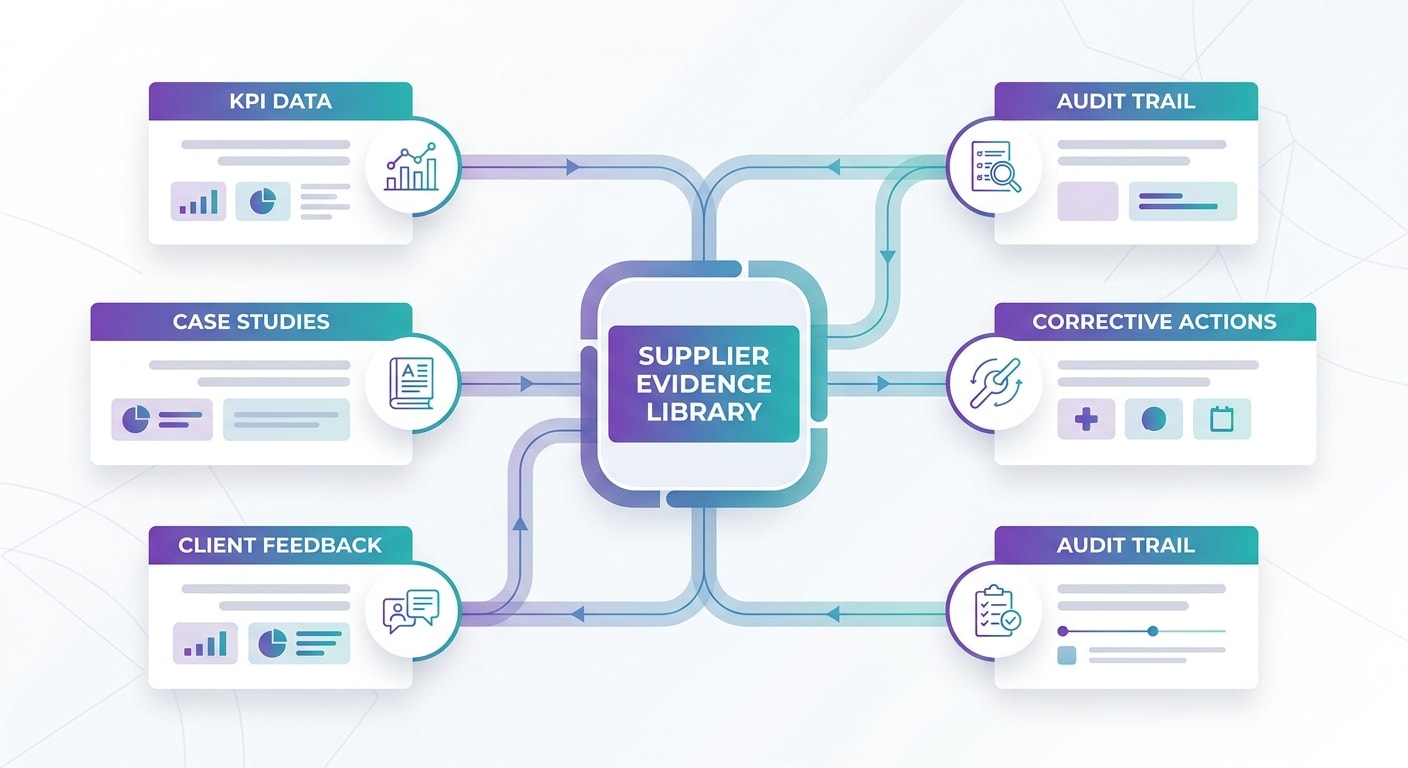
Supplier evidence library organised by KPI data, case studies and audit trail
At minimum, keep:
- contract name, sector, value band and duration
- buyer type, such as council, NHS trust, housing provider or university
- scope, including sites, users, assets, routes or service lines
- promised KPIs and actual performance
- social value commitments and actual outcomes
- client feedback, award extensions and testimonials where approved
- incidents, underperformance and corrective actions
- named internal owner for each evidence set
This is not admin for admin's sake. It is the raw material of better bids.
A bid writer using clean evidence can produce sharper answers in half the time. More importantly, they can avoid making promises the business cannot defend.
Map tender promises to delivery metrics
Before you submit a bid, ask a simple question: if we win, how will this promise be measured?
That question catches a lot of nonsense.
If the bid says you will deliver a proactive, responsive and transparent service, what does that mean in numbers? Response times? First-time fix? Missed visits? Complaint closure? Reporting accuracy? Client portal usage?
If nobody can answer, the promise is too vague.
For each major commitment, define:
- the operational metric
- the data source
- the review frequency
- the owner
- the escalation trigger
- the evidence you will keep for future bids
This makes the tender more credible now and protects the supplier later.
Agree a safe claims policy
Bid teams like strong claims. They should. Weak bids rarely win.
But a strong claim is not the same as a reckless claim.
A safe claims policy helps writers know what they can say without overpromising. For example:
- do not quote a performance percentage unless the source report is stored
- do not use a case study without approval from the contract owner
- do not promise a KPI that operations has not reviewed
- do not describe software functionality that is not live
- do not claim client satisfaction without dated evidence
This sounds restrictive. It is actually freeing.
When the rules are clear, writers can be confident. They spend less time chasing permission and more time making the evidence persuasive.
What to do if performance is poor
Sooner or later, a contract underperforms.
A route fails. A mobilisation slips. A subcontractor lets you down. A helpdesk backlog builds. A KPI moves from green to amber, then amber to red.
The question is not whether a supplier has ever had a problem. The question is what happened next.
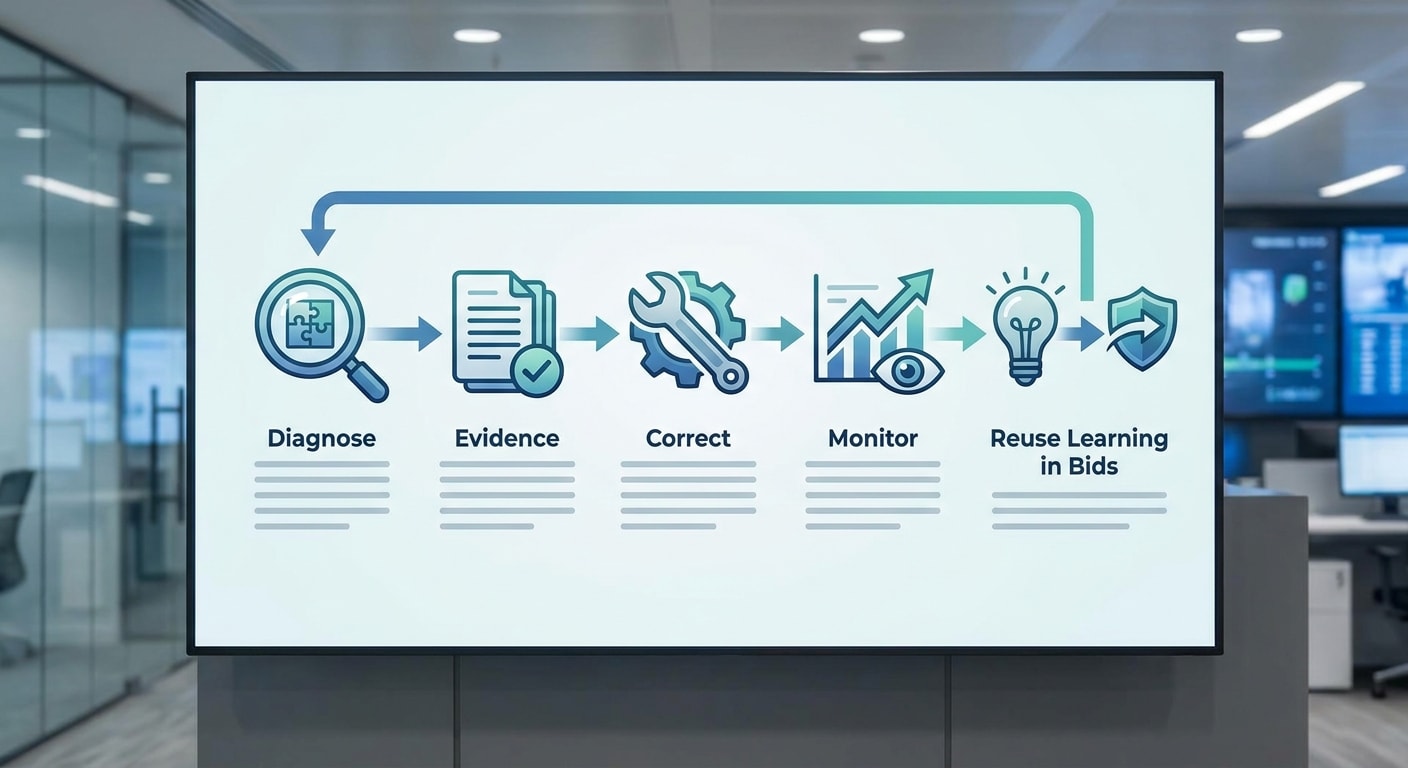
Corrective action process for poor contract performance
If a buyer is considering a poor performance notice, or if you know the contract is at risk, do five things quickly.
1. Separate fact from commentary
Do not start with defensiveness.
Start with the record.
What KPI was missed? Over what period? What was the target? What was the actual result? Was the data accurate? Were there external factors? Were there previous warnings?
This gives you a clean basis for the conversation.
2. Identify the root cause
A missed KPI is not a root cause.
"Staff shortage" is usually not enough either. Why was there a shortage? Recruitment lead time? Absence spike? TUPE data error? Poor rota design? Subcontractor failure? Wrong productivity assumption in the bid?
The uncomfortable answer is often the useful one.
If the tender promise created the delivery problem, admit it internally. Then stop repeating that promise.
3. Document corrective action properly
A corrective action plan should be specific enough that someone can check it later.
Include:
- action owner
- due date
- expected KPI movement
- interim control
- client communication route
- evidence required for closure
Do not bury this in email threads. Store it where the bid team can find it later.
A well-documented recovery can become strong future evidence. A messy recovery becomes a rumour.
4. Tell the story honestly in future bids
If a relevant contract had an issue, you do not always need to volunteer every detail. But if the tender asks about performance management, continuous improvement or lessons learned, do not pretend nothing has ever gone wrong.
A good lessons-learned answer has four parts:
- the issue
- the cause
- the action
- the result
For example:
"During the first quarter of a multi-site mobilisation, our completion reporting was slower than the client needed because site-level data was being validated centrally. We changed the process so supervisors validated daily exceptions locally, with contract-manager review weekly. Reporting lag reduced from five working days to one, and the revised process is now part of our mobilisation checklist."
That feels credible because it shows learning.
5. Feed the lesson back into bid governance
This is the step suppliers miss.
A contract problem should change future bidding. If it does not, the same issue comes back under a different title.
Update your bid library, mobilisation template, KPI assumptions, risk register and pricing notes.
Do not let the same optimistic sentence keep escaping into new tenders.
How to write about Contract Performance Notices in a tender
You probably will not get a question that says, "please explain your Contract Performance Notice strategy".
You will get questions about performance, quality, risk, governance and continuous improvement.
Here is how to answer them.
Start with the buyer's risk
Do not open with your system name.
Open with the buyer's concern.
For example:
"The main performance risk in this contract is not a lack of reporting. It is late visibility of exceptions. Our approach is designed to identify missed visits, unresolved actions and KPI drift early enough for the client to intervene before service users feel the impact."
That opening shows you understand the contract.
Link every KPI to an action
KPIs do not manage contracts. People do.
For each major KPI, explain what happens when performance moves.
Green: what routine review happens?
Amber: who investigates and by when?
Red: who escalates, what corrective plan is created, and how is the client kept informed?
This turns reporting into control.
Use one strong case study, not five weak ones
Evaluators do not need your entire credentials deck.
Pick the closest contract and go deeper.
Include context, numbers and learning:
- contract type and scale
- relevant KPI targets
- actual performance
- issue encountered
- improvement made
- result sustained over time
One strong example beats a page of name-dropping.
Avoid the four phrases that kill credibility
These phrases look harmless. They are not.
"We will monitor performance closely."
How?
"We have robust governance."
What does that mean?
"Issues will be escalated as appropriate."
To whom, and when?
"We are committed to continuous improvement."
Show the improvement.
If you cannot explain the mechanism, cut the phrase.
A simple framework for stronger answers
Use this structure when writing any performance-management section.
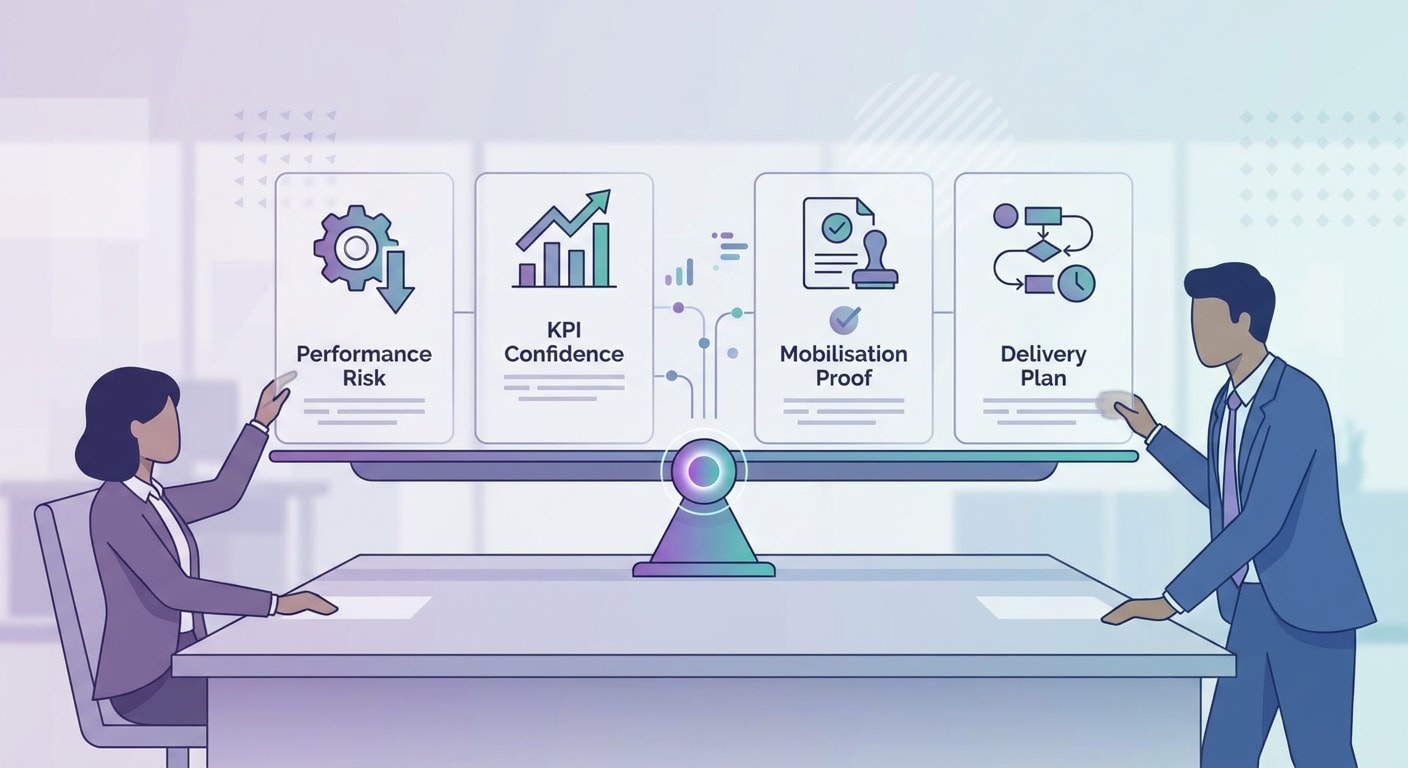
Tender scoring framework balancing performance risk, KPI confidence and delivery proof
1. Risk
Name the real delivery risk in the contract.
For FM, that might be missed statutory checks, poor helpdesk triage or weak subcontractor control.
For construction, it might be programme slippage, building safety competence or poor handover documentation.
For waste, it might be contamination, missed collections or unreliable tonnage data.
2. Control
Explain the process that prevents the risk becoming a contract failure.
Keep it practical. Who checks what? How often? What system is used? What happens when something is late, missing or wrong?
3. Evidence
Prove you have done it before.
Use KPI history, audit results, client feedback, extension decisions, complaint trends or social value delivery data.
4. Improvement
Show how the evidence changes behaviour.
This is where many suppliers score poorly. They report performance but do not show learning.
A simple improvement example can lift the answer because it proves the contract is actively managed.
How bid teams and operations should work together
Contract Performance Notices make the wall between bidding and delivery look increasingly silly.
The bid team writes the promise. Operations inherits it. The client measures it. The next bid team needs the evidence.
That is one loop, not four separate jobs.
A practical operating rhythm helps:
- bid team reviews high-risk commitments before submission
- operations signs off deliverability and assumptions
- mobilisation team converts bid promises into launch actions
- contract manager records KPI evidence monthly
- bid library owner refreshes case studies quarterly
- leadership reviews any red KPI before approving similar future claims
This does not need to be bureaucratic. A one-hour quarterly evidence review is enough for many suppliers.
The point is to stop losing knowledge between teams.
What this means for SMEs
For SMEs, this can feel like another procurement burden.
It is, partly. More transparency usually means more admin.
But there is an upside.
Large incumbents often have more polished bid teams. SMEs can compete by being more specific, more honest and closer to delivery.
If you can show clean KPI evidence from a smaller but highly relevant contract, use it. Do not apologise for scale. Explain why the example matches the buyer's risk.
An SME that can say, "our managing director reviews every red KPI within 24 hours" may feel more credible than a national supplier describing a governance board nobody can picture.
The trick is discipline.
Keep your evidence current. Keep your claims tight. Do not copy promises from larger competitors if your operating model works differently.
The mistakes to avoid in 2026
The first mistake is treating performance notices as a legal footnote.
They are part of a wider buyer behaviour shift. Public bodies want suppliers that can prove delivery, not just describe it.
The second mistake is overpromising because the bid is competitive.
A brave promise can win a tender. A reckless promise can damage the next three.
The third mistake is hiding poor performance from the bid team.
That feels safer in the short term. It creates worse bids in the long term. Writers cannot manage risk they cannot see.
The fourth mistake is collecting data without turning it into evidence.
A monthly report is not automatically a tender asset. Someone has to extract the story: the target, the result, the action, the proof.
A quick checklist before your next public tender
Before submitting a public sector bid in 2026, ask these questions:
- Have operations reviewed every major KPI promise?
- Can we evidence the performance levels we quote?
- Are our case studies current and approved?
- Do we know which previous contracts had performance issues?
- Have lessons learned changed this bid's mobilisation or delivery plan?
- Are social value claims measurable after award?
- Could this answer still look sensible if the contract performance became public?
That last question is the killer.
If the answer is no, rewrite it.
Final thought
Contract Performance Notices should make suppliers more careful. They should not make good suppliers quieter.
The best response is not to write timid bids. It is to write bids with evidence behind them.
Clear promises. Measurable KPIs. Honest lessons. Strong delivery records. Corrective action that actually gets used.
That is how you protect future tender scores.
It is also how you write better tenders now.
If you want to see live public sector opportunities where performance evidence could give you an edge, the mytender.io Tender Finder is free to use.
Tags
Ready to Transform Your Tender Writing?
See how MyTender's AI can help you write winning tenders in a fraction of the time.