

Tender Risk Registers: How to Write Risk Responses Evaluators Actually Trust
A practical guide to building tender risk registers that improve scores: risk identification, controls, ownership, evidence, Procurement Act transparency and AI-assisted bid writing checks.
mytender.io Research Team
Tender Writing & Bid Management Specialists
Tender Risk Registers: How to Write Risk Responses Evaluators Actually Trust
A tender risk register is not a defensive appendix. It is one of the clearest ways to prove that your delivery method is real.
Buyers do not ask about risk because they expect a perfect contract. They ask because they know every contract has pressure points. Mobilisation can slip. TUPE data can be incomplete. Incumbent knowledge can be patchy. Supply chains can fail. Technology adoption can be slower than promised. Social value commitments can drift after award. A polished bid that pretends none of this exists is not reassuring. It is brittle.
The strongest suppliers do something different. They name the risks, explain why they matter, show how they will be controlled, assign ownership, and prove that the controls have worked before. That is what a good tender risk register does.

Bid team reviewing a tender risk register with delivery risks, mitigation owners and evidence columns
This matters more in 2026 because public procurement is moving further towards performance, transparency and contract accountability. Under the Procurement Act 2023 environment, buyers are paying closer attention to supplier track record, key performance indicators, contract performance notices, prompt payment, social value delivery and the practical realism of tender promises. The old habit of writing a generic risk management paragraph is no longer enough.
A good risk register helps evaluators see that your answer is not just confident. It is controlled.
This guide explains how to build a tender risk register that supports scoring. It covers risk identification, scoring, mitigation, ownership, evidence, review cadence, AI-assisted checks and how platforms such as mytender.io help bid teams turn scattered delivery knowledge into stronger, safer responses.
Why tender risk registers win marks
Most bid teams know they need to mention risk. Fewer understand how risk is actually scored.
Evaluators are not usually rewarding the longest list of possible problems. They are rewarding delivery confidence. They want to know whether the supplier has understood the contract, spotted the areas most likely to affect performance, and put realistic controls in place before the problem becomes the buyer's problem.
That means a risk register should do more than list hazards. It should tell a story about control.
A weak risk answer says: we maintain a risk register and review it regularly.
A stronger answer says: we have identified the five delivery risks most relevant to this contract, scored each one before and after mitigation, assigned named owners, linked controls to mobilisation and governance activity, and included evidence from comparable contracts where those controls reduced service disruption.
The second version gives the evaluator something to mark. It shows method, ownership, evidence and relevance. It also reduces the buyer's perceived burden after award.
Risk registers are especially valuable in tenders where the buyer is assessing mobilisation, continuity of service, supply chain resilience, health and safety, cyber security, TUPE, social value, environmental performance, contract management or transformation. In those areas, a vague statement can cost marks because the evaluator knows that delivery risk is high.
The point is not to sound nervous. The point is to sound prepared.
The common mistake: writing risks after the solution
Many risk registers are written too late. The bid team drafts the solution first, then adds a risk table near the end because the question asks for it.
That creates two problems.
First, the risk register becomes generic. It lists familiar risks such as mobilisation delay, staff absence, supply chain failure and communication breakdown, but it does not connect tightly to the actual contract. The evaluator can tell it has been copied from a previous bid.
Second, the risk register fails to improve the solution. A proper risk process should change the answer. If the team identifies TUPE data uncertainty, the mobilisation plan should include validation steps. If technology adoption is a risk, the implementation plan should include user training and adoption metrics. If local supply chain capacity is uncertain, the social value answer should avoid unrealistic SME spend targets and explain the supplier engagement route.
Risk should not sit beside the method. It should shape the method.
The best time to build the first risk register is during bid strategy, before the main writing sprint. The bid manager, solution lead, operations lead, commercial lead and subject matter experts should spend time asking one uncomfortable question: what could stop us delivering exactly what we are about to promise?
That question prevents a lot of weak tender writing. It catches assumptions before they become commitments. It also gives the bid writer better material. Instead of writing around uncertainty, the writer can show how the team has understood and controlled it.
What evaluators look for in a tender risk register
A tender risk register should help the evaluator answer five questions.
The first is whether the risks are specific to the contract. Generic risks suggest generic thinking. A facilities management mobilisation in an occupied hospital, a waste collection contract across rural geographies, a construction project with live-site constraints, and a software implementation for a council all have different risk profiles. If the register looks identical across all four, it is not doing its job.
The second is whether the risks are material. A register full of minor administrative risks can look busy but weak. Evaluators want to see the risks that could affect service continuity, safety, quality, cost, compliance, user experience, social value, carbon, data security or contract outcomes.
The third is whether the controls are practical. Saying that a risk will be monitored is not a control. Monitoring tells you a problem exists. It does not prevent or reduce it. Practical controls include named governance forums, acceptance criteria, readiness checks, escalation thresholds, alternative suppliers, quality audits, training records, contingency staffing, data validation, change control and tested business continuity arrangements.
The fourth is whether there is ownership. A risk without an owner is a concern without a home. The evaluator should be able to see who is accountable, who supports them, how often the risk is reviewed and what happens if the rating increases.
The fifth is whether the register is evidenced. Good risk answers include proof that the supplier has managed similar risks before. Evidence might include mobilisation lessons learned, KPI performance, audit results, incident logs, supply chain continuity examples, implementation dashboards, customer references or internal assurance records.
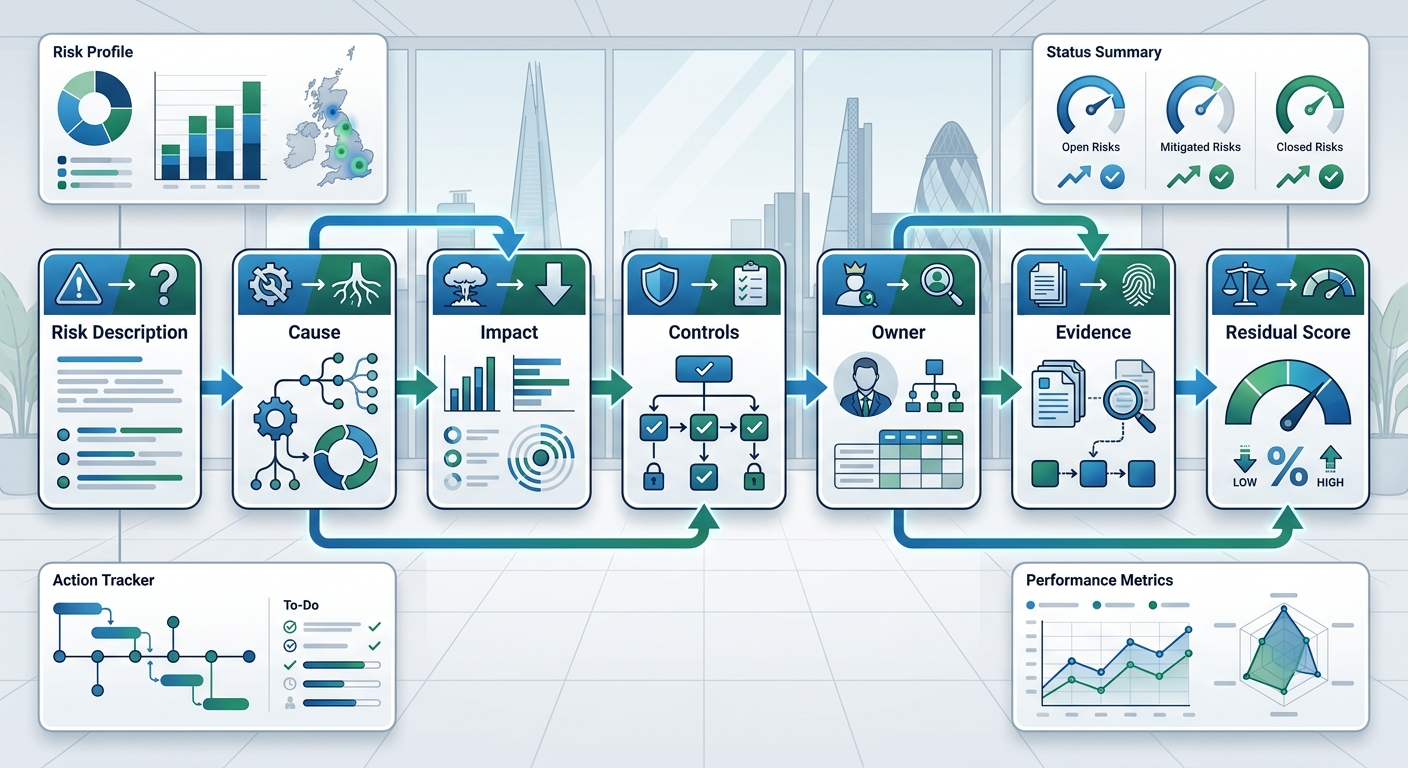
Tender risk register framework showing risk description, cause, impact, controls, owner, evidence and residual score
When those five elements are present, the risk register becomes more than a compliance table. It becomes a trust-building device.
The structure of a high-scoring tender risk register
A useful register is simple enough to read quickly and detailed enough to prove control. It should not bury the evaluator in columns, but it should include enough information to show the method behind the promise.
A strong tender risk register usually includes these fields.
The risk description should be specific. Instead of writing mobilisation delay, write delay in validating inherited asset data before service commencement. Instead of writing staff shortages, write inability to recruit specialist engineers in the contract geography before month two. Specific language shows that the team has thought about the contract rather than the category.
The cause explains why the risk could happen. This matters because different causes need different controls. A mobilisation delay caused by late buyer information is controlled differently from a mobilisation delay caused by internal resourcing. A supply chain risk caused by single-source dependency is different from one caused by regional capacity.
The impact explains what would happen if the risk materialised. This should connect to the buyer's priorities: service disruption, missed statutory inspection, user dissatisfaction, delayed mobilisation, KPI failure, increased cost, safety issue, data breach, carbon target slippage or social value under-delivery.
The inherent score shows the risk before mitigation. This can be high, medium or low, or a numeric likelihood and impact score. Keep it simple. The evaluator does not need a complicated enterprise risk methodology unless the tender asks for it.
The mitigation controls explain what will reduce likelihood or impact. This is the heart of the answer. Controls should be actions, not aspirations.
The owner names the role accountable for control. In a tender response, a role is usually safer than a named individual unless the tender requires named people. Contract Manager, Mobilisation Lead, Commercial Manager, Supply Chain Lead or Health and Safety Manager is clear enough.
The evidence source shows how the buyer will know the control is working. This could be a dashboard, audit, meeting pack, readiness checklist, issue log, training record, supplier report or KPI pack.
The residual score shows the risk after controls. It helps the evaluator see that the mitigation has an effect.
The review cadence explains when the risk will be revisited. Mobilisation risks may be reviewed weekly. Live contract risks may move to monthly operational review and quarterly strategic review. Critical risks may have escalation thresholds.
A register with these fields gives evaluators a complete view: what might happen, why it matters, what you will do, who owns it, how it will be proven and how it will stay live.
Example tender risk register entries
The best entries are written in operational language. They avoid bland labels and show a clear connection between risk and response.
Here is a simplified example for an FM mobilisation tender.
| Risk | Impact | Controls | Owner | Evidence |
|---|---|---|---|---|
| Inherited asset data is incomplete or inaccurate during mobilisation | Statutory maintenance schedule may be delayed or duplicated | Week-one asset data validation, critical asset walkdown, exception log, client sign-off before schedule freeze | Mobilisation Lead | Asset validation report, exception log, signed schedule |
| TUPE consultation information changes after award | Workforce engagement delays and rota instability | TUPE assumptions register, HR review within 48 hours of data receipt, union communication plan, contingency rota planning | HR Lead | TUPE tracker, meeting notes, rota approval |
| Specialist subcontractor availability is constrained in the contract geography | Reactive works response times could be missed | Pre-award supplier capacity check, secondary supplier framework, onboarding pack prepared before award | Supply Chain Lead | Supplier confirmations, onboarding log, SLA dashboard |
| Risk | Impact | Controls | Owner | Evidence |
|---|---|---|---|---|
| Users do not adopt the new platform after launch | Benefits are delayed and support queries increase | Role-based training, champion network, adoption dashboard, hypercare clinic for first four weeks | Implementation Manager | Training attendance, adoption metrics, support trend report |
| Source documents are inconsistent or duplicated | AI-assisted responses may use outdated information | Controlled content library, document ownership, review dates, source citation checks before publication | Bid Knowledge Lead | Content audit log, source references, approval record |
That is much more credible.
Link the risk register to the scoring criteria
A common weakness in tender risk writing is treating risk as a separate exercise. The risk register should be mapped directly to the scoring criteria.
If the buyer is scoring mobilisation, the register should include mobilisation risks that affect readiness, continuity, people, data, supply chain and communication. If the buyer is scoring social value, include risks around partner capacity, local recruitment, measurement, eligibility and evidence. If the buyer is scoring innovation, include risks around adoption, integration, user behaviour, training and fallback. If the buyer is scoring contract management, include risks around governance, KPI drift, issue escalation and reporting quality.
This does not mean forcing a risk into every section. It means using the risk register to support the answers that carry marks.
For each scored question, ask:
- What could stop this promise being delivered?
- What would the buyer worry about if they read this answer sceptically?
- What evidence do we have that this risk has been controlled before?
- Which control should be visible in the main answer, not hidden in an appendix?
That final question is important. If a risk is central to the buyer's scoring concern, do not leave the mitigation buried in the risk table. Pull it into the narrative.
For example, if a waste contract has a high-risk mobilisation across multiple depots, the main mobilisation answer should mention route validation, vehicle readiness, depot access, driver induction and service continuity controls. The register can then reinforce the detail. If the narrative ignores those issues and the risk register mentions them later, the answer will feel disjointed.
A good bid reads as one controlled delivery plan.
Avoid the fake comfort of low risk ratings
Some bid teams are tempted to rate every residual risk as low. It feels safer. It is not.
A register where every serious contract risk magically becomes low after generic mitigation can damage credibility. Evaluators know that some risks remain material even after controls. A complex mobilisation, cyber integration, TUPE transfer or supply chain dependency may remain medium risk. That is acceptable if the controls and escalation route are strong.
The purpose of a risk register is not to pretend the contract is easy. It is to show that the supplier understands the level of challenge and has the governance to manage it.
Use low residual ratings where the controls genuinely reduce the risk to a routine level. Use medium ratings where the risk needs active management. Use high residual ratings rarely, and only if the tender allows you to explain escalation and buyer dependency. If a key risk remains high after mitigation, the bid team should decide whether the solution needs to change before submission.
This is where commercial discipline matters. A risk register can reveal that the team is about to promise something operationally fragile. That is not a writing problem. It is a bid decision.
Procurement Act transparency and performance risk
The Procurement Act 2023 has made performance credibility harder to fake.
Public sector buyers are increasingly focused on the whole procurement lifecycle: tender, award, contract management, KPI reporting, payment behaviour, supplier performance and transparency notices. For larger contracts, buyers are expected to set and publish key performance indicators and report on performance. Poor performance can become more visible. That changes the tone of risk writing.
A risk answer should therefore show how the supplier will prevent tender promises from becoming contract management problems.
If the bid includes social value commitments, the register should include delivery and measurement risks. If the bid promises service improvements, the register should include adoption and change risks. If the bid relies on subcontractors, the register should include onboarding, capacity, prompt payment and performance monitoring risks. If the bid uses AI-assisted processes, the register should include source accuracy, human review, data security and approval controls.
This is not about adding fear to the bid. It is about showing maturity.
A buyer wants a supplier that will tell the truth early, manage issues visibly and keep the contract under control. A mature risk register gives them that signal before award.

Public procurement performance dashboard linked to tender risk, KPI reporting and contract review governance
How to write mitigation that sounds real
Weak mitigation often relies on abstract verbs: monitor, manage, ensure, liaise, communicate and review. Those words are not wrong, but on their own they are soft.
Strong mitigation uses concrete controls.
Instead of we will monitor mobilisation progress, write we will run a weekly readiness review covering people, assets, systems, suppliers and client dependencies, with red-rated items escalated to the mobilisation board within 24 hours.
Instead of we will manage supply chain risk, write we will pre-qualify two approved suppliers for each critical work package, confirm capacity before contract start, and track subcontractor SLA performance through the monthly contract dashboard.
Instead of we will ensure staff are trained, write role-specific training will be completed before go-live, recorded in the learning management system, and checked during the mobilisation gate review.
The pattern is simple: control, frequency, owner, evidence, escalation.
That pattern turns a risk statement into a delivery mechanism.
Use evidence from previous contracts without breaching confidentiality
Risk evidence is powerful, but bid teams sometimes avoid it because previous contracts are confidential. That is sensible, but it should not stop you proving competence.
You can usually anonymise evidence while keeping it meaningful. For example, you might write that on a comparable multi-site FM mobilisation, your team identified 312 asset data exceptions during the first fortnight, resolved critical statutory gaps before service commencement and agreed a revised preventive maintenance baseline with the client before month one reporting. That is much stronger than saying you have experience of mobilisation risk.
Useful evidence can include:
- mobilisation gate checklists from similar contracts
- before-and-after KPI performance
- audit closure rates
- incident reduction data
- supplier onboarding completion rates
- training attendance and competency checks
- lessons learned logs
- customer satisfaction trends
- social value delivery dashboards
- carbon reporting packs
- change control records
The key is relevance. Evidence should prove the control, not just decorate the answer.
If the risk is asset data quality, show data validation evidence. If the risk is workforce continuity, show retention, training, consultation or rota stabilisation evidence. If the risk is AI accuracy in bid content or service reporting, show human review, source control and approval evidence.
This is where a well-managed bid library becomes a scoring advantage. The team should not be hunting for proof at midnight. The evidence should already be tagged, approved and easy to retrieve.
AI-assisted risk registers: useful, but not automatic
AI can help build a better risk register, but only if it is grounded in the tender documents and your real delivery evidence.
Useful AI tasks include extracting risk signals from the ITT, comparing the draft solution against buyer requirements, identifying unsupported delivery promises, checking whether mitigation controls are repeated or vague, and turning SME notes into clearer risk entries.
AI is less reliable when asked to invent risks without context. It may produce a plausible list that looks professional but misses the contract-specific issues. It may also suggest controls that the organisation cannot actually deliver. That creates a dangerous kind of confidence.
A sensible AI-assisted workflow looks like this.
First, load the tender documents, scoring criteria, specification and draft solution into a controlled workspace. Second, ask AI to identify delivery assumptions, buyer dependencies and areas where the solution makes a promise. Third, ask operational leads to validate the list and remove generic noise. Fourth, connect each material risk to evidence from previous delivery. Fifth, use AI again to check whether each mitigation has an owner, evidence source and review cadence.
The human team still owns the register. AI can accelerate the analysis, but it cannot approve operational risk on behalf of the organisation.
mytender.io is built for this kind of governed bid work. It helps teams break down tender requirements, retrieve relevant evidence from previous bids and source material, draft structured responses, and keep human review in the loop. That matters because risk writing is only useful when it is connected to real knowledge, not generic language.
AI-assisted bid workspace extracting risk signals from tender documents and linking them to approved evidence
Sector examples: how risk changes by tender type
A risk register should reflect the contract. Here are common patterns by sector.
In facilities management tenders, risk often centres on mobilisation, inherited asset data, statutory compliance, subcontractor coverage, helpdesk transition, PPM backlog, reactive response times, TUPE, health and safety, and business continuity. The best answers show readiness gates and contract governance, not just experience.
In construction tenders, risk often centres on design maturity, planning conditions, site access, supply chain availability, health and safety, building safety duties, cost inflation, programme interfaces, carbon and stakeholder disruption. The strongest entries link risk controls to programme management, design assurance and change control.
In healthcare and NHS-related tenders, risk often centres on service continuity, infection prevention, data security, safeguarding, clinical adjacency, estate disruption, workforce competency, patient experience and compliance with healthcare standards. Risk language should be calm, precise and safety-led.
In waste and environmental services tenders, risk often centres on route design, depot readiness, fleet availability, contamination rates, crew recruitment, digital waste tracking, resident communication, seasonal demand and environmental compliance.
In IT and technology tenders, risk often centres on integration, data migration, cyber security, user adoption, service desk readiness, legacy systems, AI governance, training and change resistance.
The category matters because evaluators recognise their own world. A generic register feels like procurement theatre. A contract-specific register feels like delivery experience.
Turn the register into a live contract tool
A tender risk register should not die after submission.
If you win, the register should move into mobilisation. It should be reviewed at the mobilisation kick-off, updated as assumptions are confirmed, and used to structure early contract governance. Buyer dependencies should be visible. Critical risks should have escalation routes. Closed risks should be recorded with evidence. New risks should be added as the contract moves from transition to steady state.
This is important because tender promises often fail during handover. The bid team knew the assumptions, but the delivery team inherits only the final document. A live risk register helps transfer intent. It shows why certain controls were promised and what the buyer will expect to see.
The handover should include:
- the final tender risk register
- assumptions made during bidding
- buyer dependencies and information requests
- promised controls and reporting outputs
- evidence offered in the tender
- residual risks needing early management
- links to mobilisation milestones and KPI reporting
That handover is not admin. It protects the contract.
A simple process for building the register
Use a five-step process.
Step one: read the tender for risk signals. Look at the specification, scoring criteria, contract terms, TUPE information, mobilisation requirements, KPI schedule, social value requirements, cyber requirements, reporting obligations and clarification responses.
Step two: run a risk workshop before drafting. Include bid, operations, commercial, HR, supply chain, finance and technical leads where relevant. Do not leave risk to the bid writer alone.
Step three: prioritise the top material risks. A tender response does not need every possible issue. It needs the risks that affect scoring and delivery confidence.
Step four: write controls in operational terms. Every material risk should have mitigation, owner, evidence and review cadence.
Step five: cross-check against the solution. If the register exposes a weak promise, fix the solution. If the solution contains a major promise, make sure the register controls it.

Workshop scene where bid, operations and commercial leads prioritise tender delivery risks before final submission
This process is simple, but it requires discipline. The main failure mode is leaving it too late.
Checklist before submission
Before submitting a risk register, ask these questions.
- Are the risks specific to this tender, buyer and contract environment?
- Are the highest-scoring sections supported by relevant risk controls?
- Does every material risk have a practical mitigation?
- Does every mitigation have an owner?
- Is there evidence that the control has worked before or can be delivered now?
- Are residual ratings believable?
- Do the risks align with the mobilisation plan, pricing, staffing model and social value commitments?
- Have operational leads approved the controls?
- Are buyer dependencies clearly but diplomatically stated?
- Will the register be handed over if the bid is won?
If the answer to any of those is no, the register is not finished.
How mytender.io helps bid teams write stronger risk responses
The hard part of risk writing is not the table. It is the knowledge behind it.
Bid teams need to understand the tender, retrieve relevant evidence, compare the draft solution against the scoring criteria, involve operational experts and avoid generic filler. Doing that manually across multiple live bids is painful. Documents are scattered, lessons learned are hard to find, and previous risk answers are often copied without enough context.
mytender.io helps by turning tender documents and existing bid knowledge into structured, usable material. Teams can break down the ITT, identify compliance requirements, find relevant previous answers, draft first responses, and review the output against the buyer's question. That gives bid writers a better starting point and gives reviewers more time to test delivery credibility.
It does not replace human risk ownership. That would be the wrong goal. It helps the right people get to a stronger answer faster.
For a risk register, that means fewer generic rows, better evidence retrieval, clearer mitigation language and a more controlled review process before submission.
Final thought: risk is not a weakness
The best tender teams are not the ones that claim there is no risk. They are the ones that prove they can manage it.
A strong risk register shows maturity. It tells the evaluator that the supplier has read the contract properly, understood the pressure points, involved the delivery team and built controls before the problem reaches the buyer.
In a procurement environment focused on transparency, performance and public value, that is exactly the signal buyers are looking for.
If your risk register could be copied into any bid, it is not good enough. If it makes the evaluator think, they have clearly delivered this before and know where the hard bits are, it is doing its job.
That is how risk becomes a scoring advantage.
Tags
Ready to Transform Your Tender Writing?
See how MyTender's AI can help you write winning tenders in a fraction of the time.