

Bid Presentations and Supplier Workshops Under the Competitive Flexible Procedure: Guide 2026
Supplier workshops, presentations and demos can now shape public tender outcomes. Learn how to prepare live evaluation stages under the competitive flexible procedure.
mytender.io Research Team
Tender Writing & Bid Management Specialists
Bid Presentations and Supplier Workshops Under the Competitive Flexible Procedure
The hardest part of a flexible procurement is often not the written tender.
It is the room.
A buyer asks your mobilisation lead to explain how the first 90 days will work. Someone from finance asks whether your risk assumptions still hold after a scope change. The operations director challenges your social value promise. A technical evaluator wants to know who will actually own the service once the sales team leaves.
That moment can win the tender. It can also undo six weeks of careful writing.

Bid team preparing for a public procurement presentation and supplier workshop
Under the Procurement Act 2023, the competitive flexible procedure gives public buyers more room to design multi-stage competitions. That means more dialogue, more demos, more supplier workshops, more presentations and more chances for evaluators to test whether your written answer is real.
This guide is for bid managers, commercial directors and delivery teams who now need to treat live sessions as part of the bid, not a side event.
The short version: your workshop strategy needs the same discipline as your written submission.
Why This Topic Matters Now
Recent procurement guidance and supplier commentary point in the same direction. The new regime is more transparent, more flexible and more focused on the Most Advantageous Tender. Buyers can use stage gates, dialogue, negotiations, final tenders, demos and presentations, as long as the rules are published and applied fairly.
That sounds procedural. It is not.
For suppliers, it changes the job of bidding. A strong written response still matters. But in complex procurements, evaluators may now see your team think, explain, defend assumptions and handle pressure before they make the award decision.
That is especially true in:
- facilities management contracts with mobilisation and TUPE risk
- construction frameworks with design, competence and delivery-model choices
- technology procurements with live demos and integration questions
- waste and environmental tenders with route design and compliance assumptions
- healthcare or local government contracts where stakeholder confidence is central
The content gap is clear. Plenty of suppliers are searching for what the competitive flexible procedure is. Fewer know how to run the presentation, workshop and final tender stages without losing control.
That is where better bid teams can pull away.
The New Bidding Reality: Written, Spoken and Tested
Old tender habits were built around documents. You downloaded the pack, split the questions, wrote the answers, priced the solution and submitted before the deadline.
That process still exists. But it is no longer enough for every public tender.
A competitive flexible procedure can ask suppliers to progress through a sequence like this:
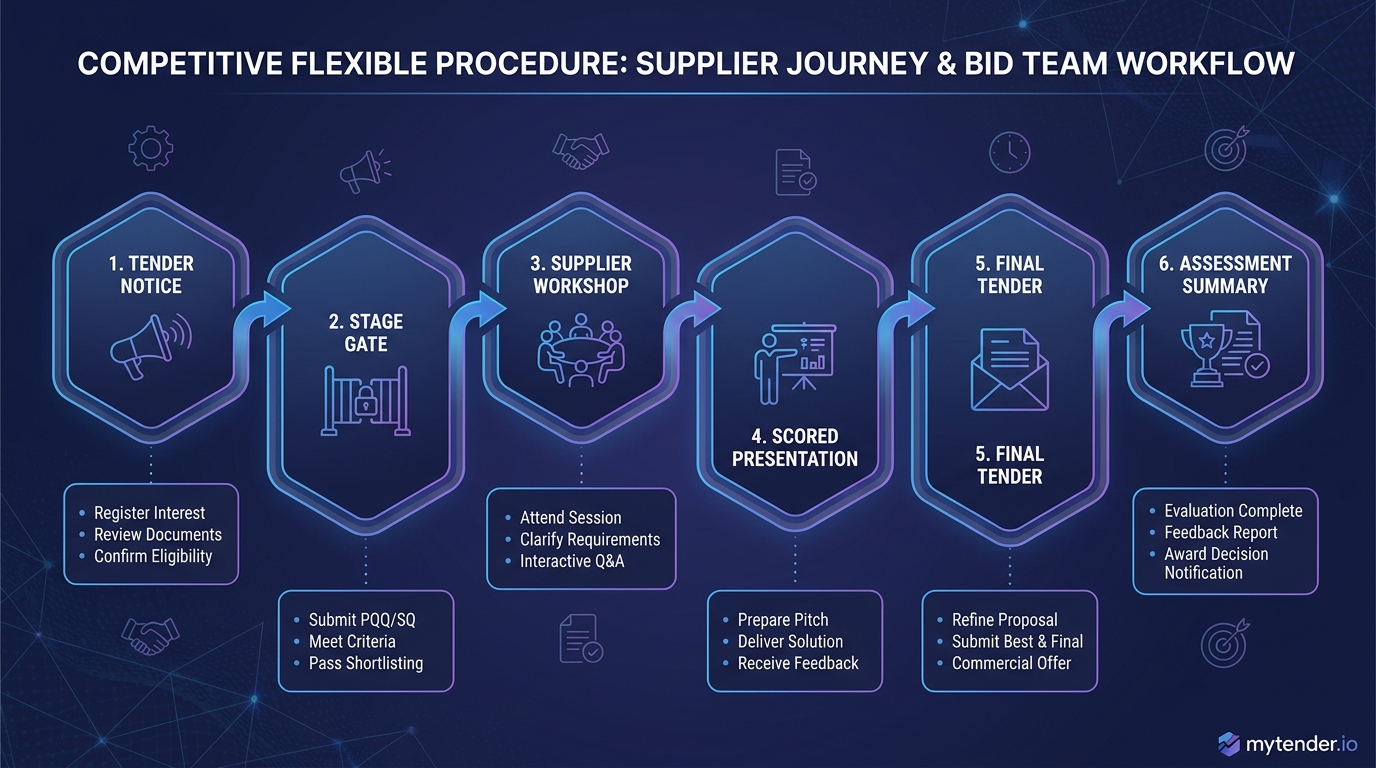
Stage map for supplier workshops, presentations and final tenders in a competitive flexible procedure
- participation stage or initial selection
- outline solution
- clarification questions
- supplier workshop or dialogue session
- revised solution
- presentation, demo or interview
- final tender
- assessment summary and standstill
Not every tender will include all of these. That is the point. The buyer has flexibility.
Your job is to build a bid process that can flex without becoming chaotic.
The written answer, slide deck, workshop script, pricing assumptions, clarification log and final tender must all tell the same story. If they do not, evaluators will notice.
First, Work Out Whether the Session Is Being Scored
This sounds obvious. It is missed more often than it should be.
When a buyer invites you to a presentation or workshop, do not assume you know what it means. It may be a scored evaluation event. It may be dialogue. It may be a clarification meeting. It may be part of down-selection. It may be used to test the credibility of the written submission without carrying a separate score.
Those distinctions matter.
Ask these questions as soon as the invitation arrives:
- Is the session scored?
- If yes, what criteria and weightings apply?
- Will scores from the session be added to written scores or used as a moderation input?
- Will the session be recorded?
- Can the buyer ask questions outside the published agenda?
- Can suppliers introduce new evidence?
- Are verbal answers binding?
- Will clarification notes be shared with all bidders?
- Can the scope change after the session?
- Can suppliers submit a revised solution afterwards?
If the documents already answer these questions, capture the answers in your bid plan. If they do not, submit a clarification early.
Do not be awkward about it. You are not challenging the buyer by asking how the process works. You are making sure your team competes fairly and prepares properly.
Build One Narrative Across Every Format
A common mistake is treating the written bid and the presentation as separate pieces of work.
The bid writer owns the response. The sales lead owns the slides. The operations team turns up for the workshop. Finance answers price questions. Everyone does their bit.
Then the buyer hears five slightly different versions of the offer.
That is how doubt creeps in.
A better approach is to create one central bid narrative before you build any materials. It should answer five questions:
- What problem does the buyer need solved?
- Why is our approach safer, better or more valuable than the obvious alternative?
- What evidence proves we can deliver it?
- What risks have we recognised, and how will we manage them?
- What commitments are we making that we can genuinely stand behind?
This narrative becomes the spine of the written response, the slides, the demo, the workshop agenda and the final tender.
It does not mean every format repeats the same words. It means every format reinforces the same case.
For example, if your written mobilisation answer says the first 30 days will focus on workforce transfer, data capture and service continuity, your presentation should not open with a generic company overview. It should show the evaluators what the first 30 days will feel like, who is accountable, what decisions happen when and how the buyer will know the transition is on track.
That is useful. A corporate slide about your history is not.
Treat the Workshop as Evidence, Not Theatre
Supplier workshops can feel informal. The chairs are less formal. People use first names. The buyer may say they want an open conversation.
Believe them, but do not relax too much.
A workshop is still part of a procurement process. The buyer is learning whether your team understands the contract, whether your assumptions are sensible and whether your people can work with theirs.
The best workshops show evidence through conversation.
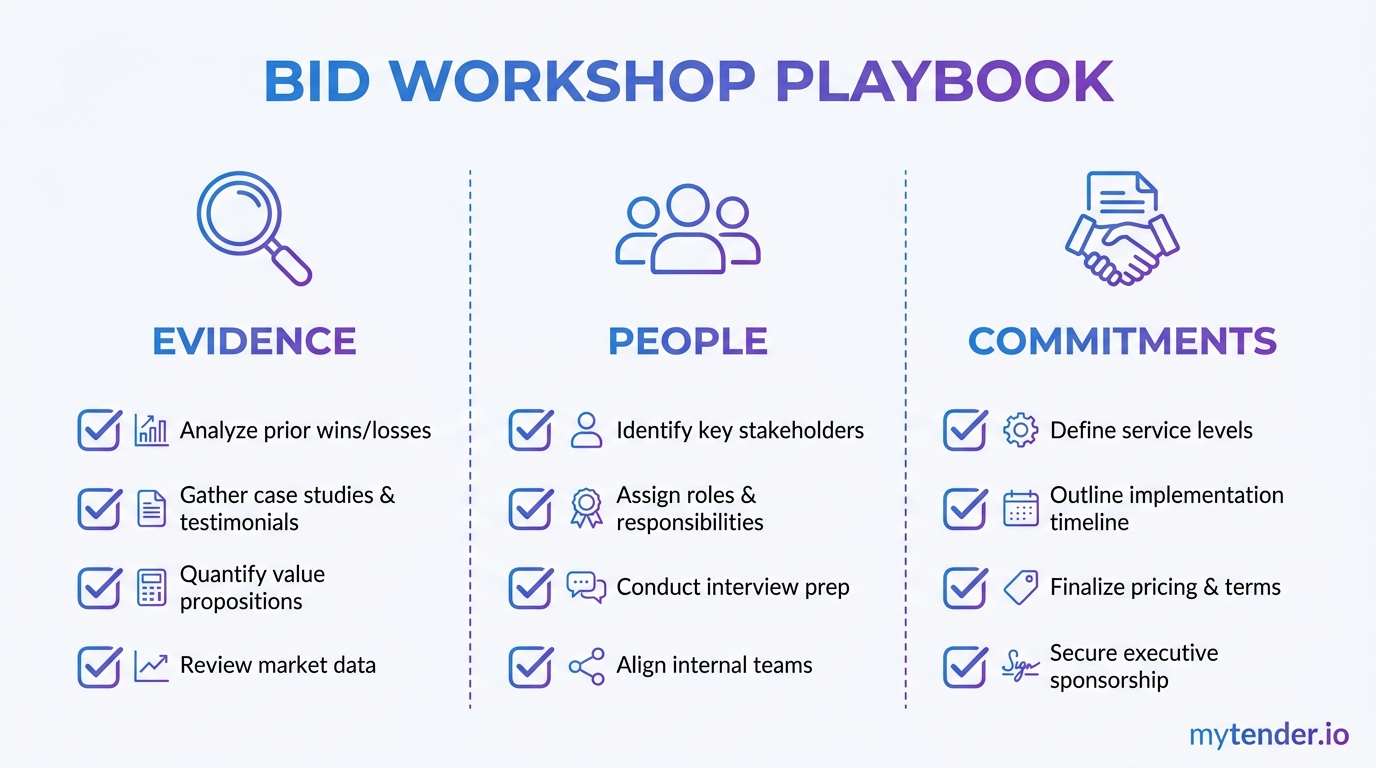
Supplier workshop playbook showing evidence, people and commitments
That means preparing three layers.
Layer 1: The Evidence Layer
Bring the proof behind your claims.
If you say you can mobilise quickly, bring a mobilisation timetable from a similar contract. If you say you can reduce defects, bring before-and-after KPI data. If you say you can manage subcontractors, bring the governance model and escalation route.
Do not drown the buyer in appendices. Have the evidence ready so your team can answer with confidence.
Good evidence sounds like this:
- We used this mobilisation sequence on a comparable multi-site contract last year.
- The first service review moved from red to amber in month two and green in month four.
- The buyer's main issue was not staffing, it was asset data quality, so we changed the first two weeks of discovery.
- Here is how we would adapt the same approach for your estate.
That is much stronger than saying you have a proven mobilisation methodology.
Layer 2: The People Layer
The buyer is not just evaluating the bid team. They are evaluating the people who will deliver.
Put the right people in the room.
That usually means fewer senior figureheads and more contract-relevant operators. The person who will own mobilisation should explain mobilisation. The person who will manage compliance should explain compliance. The commercial lead should handle price and risk, but not every question.
This matters because evaluators can tell when a presentation is polished but detached from delivery.
If your delivery team is credible, use them. If they are not ready, rehearse them properly before the buyer sees them.
Layer 3: The Commitment Layer
Every workshop needs a commitment register.
This is a simple live document that records anything your team says that could affect scope, price, service level, timeline or risk. It should capture:
- the commitment or assumption
- who said it
- where it was said
- whether it is already in the written tender
- whether it needs clarification
- whether it affects pricing
- whether it must appear in the final tender
This is not bureaucracy. It prevents expensive drift.
A delivery lead may say, perfectly innocently, that your team can provide weekly mobilisation reporting. If the written bid priced monthly reporting, someone needs to catch that before final tender.
Presentations Should Answer the Evaluator's Worry
Most bid presentations are too broad.
They try to summarise the whole tender, introduce the company, repeat the written response and squeeze in a few smiling team photos. The result is polite, forgettable and rarely useful.
A better presentation starts with the evaluator's worry.
What is the buyer nervous about?
In a facilities management tender, it might be service continuity on day one. In construction, it might be competence under the Building Safety Act. In waste, it might be route disruption and missed collections. In technology, it might be integration risk or user adoption.
The presentation should tackle those worries directly.
A simple structure works well:
- We understand the risk.
- Here is how it shows up on contracts like this.
- Here is how we will manage it.
- Here is the evidence that we have done it before.
- Here is what the buyer will see, measure and control.
That structure is much more persuasive than a tour of your organisation chart.
Rehearse the Q and A Like It Is a Scored Section
The Q and A is where weak bids get exposed.
Teams rehearse the slides, then improvise the questions. That is backwards.
The slides are the easiest part to control. The Q and A is where evaluators test assumptions, probe weak evidence and check whether your people understand the solution.
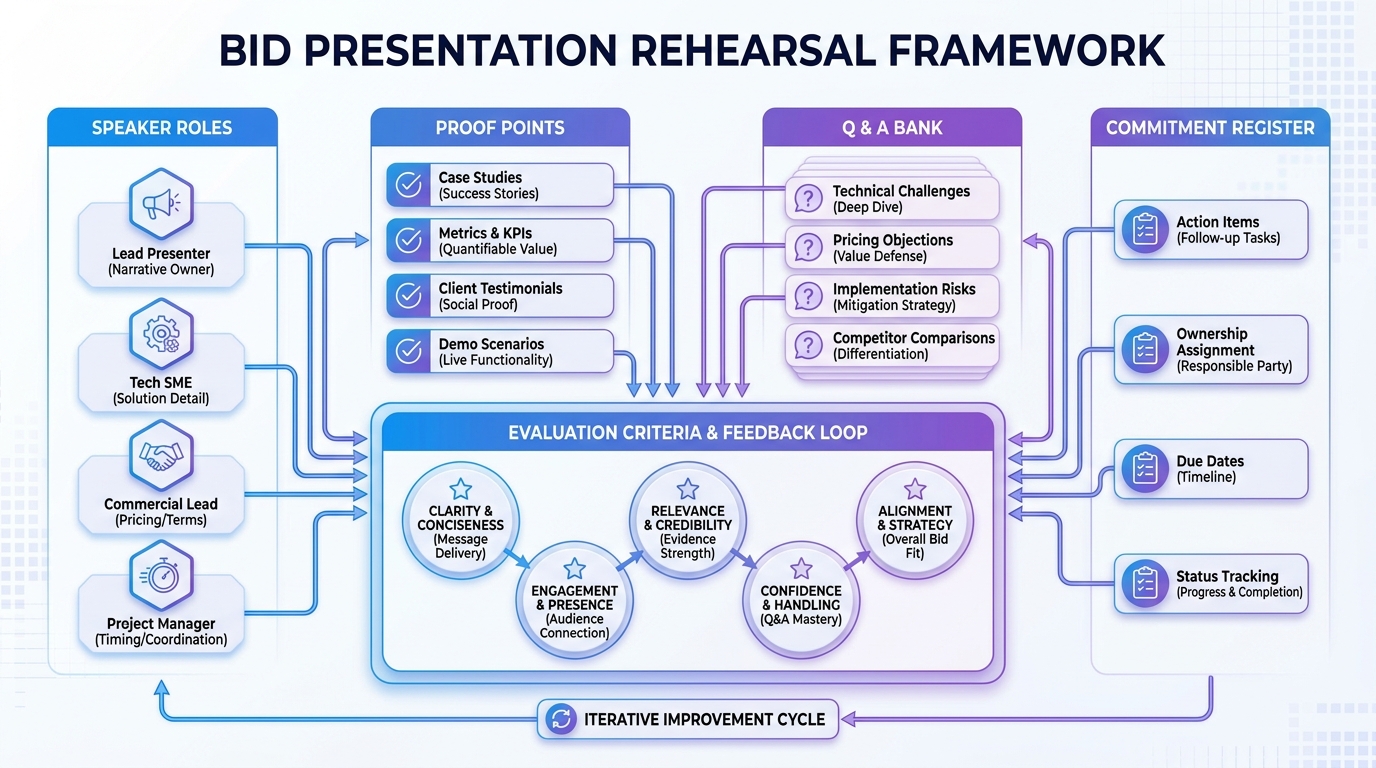
Bid presentation rehearsal framework mapped to evaluation criteria, speaker roles and proof points
Build a question bank before the rehearsal. Start with the evaluation criteria and ask what a sceptical evaluator would challenge.
Useful categories include:
- delivery risk
- mobilisation timing
- staffing and capacity
- social value deliverability
- price assumptions
- supply chain resilience
- data and reporting
- contract governance
- contingency planning
- lessons from similar contracts
For each question, prepare three things:
- the short answer
- the proof point
- the person who should answer
The short answer keeps the team concise. The proof point stops the answer becoming vague. The named owner prevents the awkward moment where three people start talking at once.
The best answer is often only 30 seconds long.
Keep the Buyer Facing Team Small Enough to Trust
There is a temptation to bring everyone.
Commercial lead. Bid manager. Operations director. Contract manager. Mobilisation lead. HR. Finance. Social value. Sustainability. Account director. Executive sponsor.
Sometimes that is needed. Usually it is not.
A large team can make the buyer feel like nobody owns the answer. It also increases the risk of contradiction.
Choose the team based on the scoring event, not internal politics.
A good core group is often:
- one commercial lead who can handle strategy and price boundaries
- one delivery lead who will own the contract
- one subject expert for the buyer's highest-risk area
- one bid lead who tracks commitments and process
Others can support behind the scenes. Not everyone needs a speaking role.
If someone attends, they need a purpose. If they speak, they need a rehearsed lane.
Manage Scope Change Without Losing Margin
Flexible procedures are useful because they let the buyer refine the requirement. That is also where suppliers get into trouble.
A workshop may reveal that the estate is more complex than expected. A demo may create an expectation for extra configuration. A dialogue session may shift the risk allocation. A site visit may expose operational constraints not reflected in the original documents.
If you do not track those changes, your final tender can become a collection of unpriced promises.
Create a scope change log from day one.
Track:
- original requirement
- new information from the buyer
- potential impact on service design
- pricing impact
- risk impact
- clarification needed
- final tender treatment
The bid manager should own this log, but finance and operations must review it before every stage gate.
This is where many teams lose money. They win the contract they wanted, but not at the margin they thought.
Use Stage Gates to Decide Whether to Continue
A competitive flexible procedure can take a lot of time.
That time is not automatically justified because the contract value is high.
You need stage gates inside your own bid process. Not just the buyer's process.
Before each major stage, ask:
- Has our win probability improved, fallen or stayed the same?
- Do we have new information about the buyer's real priorities?
- Has the scope changed?
- Has the likely margin changed?
- Are we still differentiated?
- Can we resource the next stage properly?
- Would a no-bid now be commercially smarter than continuing?
This is not pessimism. It is discipline.
The worst outcome is not losing. The worst outcome is spending senior time on a tender you should have exited two stages ago.
Align the Final Tender With Everything Said Before
The final tender is where the story has to tighten.
By this point, you may have had clarifications, workshops, presentations, revised documents and internal pricing reviews. The final submission must reflect the latest agreed position.
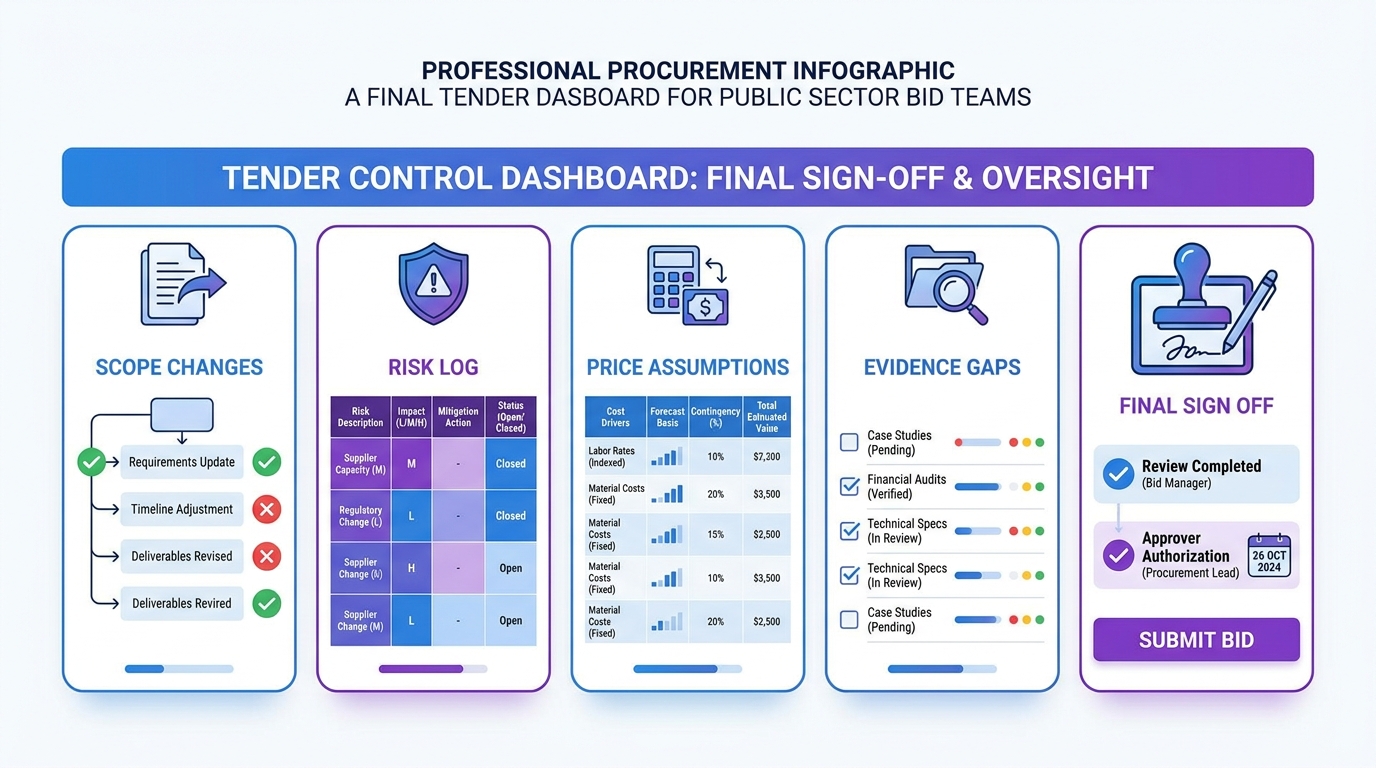
Final tender control dashboard for scope changes, risks, price assumptions and evidence gaps
Before submission, run a final alignment check.
Check 1: Written Response vs Workshop Commitments
Review the commitment register. Anything promised verbally needs a decision.
It is either:
- included in the final tender
- clarified as an assumption
- priced properly
- withdrawn or corrected through the proper route
Do not leave it floating.
Check 2: Slides vs Final Tender
If the presentation introduced a stronger proof point, make sure the final tender uses it where allowed.
If the presentation simplified a message, ask whether the written response should be tightened too.
Check 3: Pricing vs Scope
Every scope change needs a pricing decision. Even if the decision is to absorb the cost, make that decision consciously.
Check 4: Risk Register vs Contract Commitments
Check that your risk register matches what you have offered. If the final tender says you can meet a demanding KPI from month one, the risk register should not quietly say that the data will be unreliable until month three.
Evaluators may not see your internal risk register, but your delivery team will. Misalignment here becomes a delivery problem later.
Check 5: Evidence vs Evaluation Criteria
Final tenders often get bloated after dialogue. Teams add more detail because they have learned more. Detail is good only if it helps the score.
Go back to the criteria. Every paragraph should earn its place.
What Good Looks Like in Different Sectors
The principle is the same across sectors: live sessions should make the written bid more believable.
But the emphasis changes.
Facilities Management
FM workshops often test mobilisation, TUPE, statutory compliance, service continuity and operational governance.
Strong suppliers bring:
- a realistic mobilisation timeline
- named mobilisation roles
- asset and data discovery assumptions
- KPI reporting examples
- TUPE communication plans
- escalation routes for day-one issues
The buyer wants to know whether the contract will feel stable from the first week.
Construction
Construction presentations often focus on delivery model, programme risk, health and safety, competence, social value and stakeholder management.
Strong suppliers bring:
- comparable project evidence
- realistic programme assumptions
- named competence and compliance owners
- risk transfer clarity
- supply chain management evidence
- lessons from similar sites
The buyer wants confidence that the team understands the job, not just the tender language.
Waste and Environmental Services
Waste tenders often test route design, mobilisation, compliance, resident communication, recycling performance and operational resilience.
Strong suppliers bring:
- route planning assumptions
- depot and fleet readiness evidence
- missed collection recovery plans
- contamination reduction approach
- compliance reporting model
- mobilisation communications plan
The buyer wants to know that service change will not turn into complaints.
Technology and Digital Services
Technology procurements often use demos, technical walkthroughs and integration workshops.
Strong suppliers bring:
- a demo mapped to user journeys, not product features
- integration assumptions
- implementation milestones
- data security and access controls
- adoption and training plans
- support model evidence
The buyer wants to see the product solve their problem, not admire a feature list.
The Role of AI in Preparing for Live Evaluation
AI is useful here, but not as a shortcut for thinking.
A good AI-supported process can help you:
- turn the evaluation criteria into a rehearsal question bank
- extract commitments from drafts, slides and notes
- compare written responses against workshop scripts
- flag vague claims that need evidence
- create first drafts of speaker notes
- summarise clarification logs before final tender
The danger is using AI to produce polished but generic presentation content. That is exactly what evaluators are learning to distrust.
The value is in structure, retrieval and consistency. The human team still needs to bring judgement, evidence and delivery knowledge.
This is where a specialist bid platform helps. mytender.io helps bid teams turn tender documents, past answers and content libraries into better first drafts, compliance checks and evidence-led responses. But the win still comes from how your team applies that material.
The tool should make the workshop sharper. It should not replace the workshop.
A Practical Preparation Plan
Here is a simple plan you can use the next time a buyer invites you to a workshop or presentation.
The Documents You Should Create Before the Session
A workshop is easier to control when the team has a small set of shared documents. You do not need a complicated library. You need the right five documents, kept current.
1. Evaluation map. This links every criterion to the slide, proof point, speaker and written response section that supports it. If a criterion is not covered, you have found a gap before the buyer does. 2. Evidence pack. This is not necessarily sent to the buyer. It is the internal proof file your team can draw from during preparation. Include case studies, KPI screenshots, mobilisation plans, governance examples and any permitted reference material. 3. Commitment register. This tracks anything said in dialogue, presentation rehearsals or live sessions that could become a promise. It is the single best protection against scope creep. 4. Question bank. This should be mapped to the evaluator's likely concerns, not just the questions you hope they ask. Include hostile questions. Include price questions. Include questions about failed projects, weak evidence and operational edge cases. 5. Final tender change log. This records what changed between the original tender documents and the final submission. It should be reviewed by bid, commercial, legal and delivery leads before sign-off.These documents keep the team honest. They also make the final tender faster, because the hard thinking has already been captured.
How to Brief Senior Leaders
Senior leaders can help a bid presentation. They can also derail it.
The problem is not seniority. It is looseness. Executives are often used to speaking commercially, confidently and broadly. Procurement evaluation needs something tighter.
If a senior leader is attending, give them a specific role. For example:
- opening with the strategic commitment to the buyer
- explaining governance and escalation
- answering questions about investment, risk or long-term partnership
- closing with why the organisation is committed to delivery
Do not let them freestyle product claims, delivery promises or pricing assumptions.
A good executive contribution is short and reassuring. It tells the buyer this contract matters, the delivery team has authority and the supplier will not disappear after award.
A poor executive contribution is a ten-minute brand monologue. Nobody needs that.
How to Use Buyer Signals Without Overreacting
Workshops generate useful signals. The buyer may spend more time on one risk than expected. They may ask repeated questions about staffing. They may challenge your mobilisation timetable. They may sound excited about a specific innovation.
Capture those signals, but do not rewrite the whole bid around one comment.
After the session, sort signals into three groups:
- Confirmed requirements. These are things the buyer has clearly stated or clarified through the formal route.
- Strong preferences. These are repeated themes, concerns or priorities that should shape emphasis.
- Interesting comments. These may be useful, but should not drive major scope or pricing decisions alone.
This discipline matters because live sessions can create false certainty. One evaluator's question is not always the buyer's priority. One positive comment is not a scoring guarantee.
Use signals to sharpen the final tender, not to chase every passing remark.
What to Do Immediately After the Session
The hour after the session is valuable. Do not waste it on vague celebration or panic.
Run a structured debrief while everyone still remembers what happened.
Capture:
- questions asked by the buyer
- questions you answered well
- questions that exposed a weak spot
- commitments or possible commitments
- new information about scope or risk
- evidence the buyer seemed to respond to
- anything that should be clarified formally
- changes needed in the final tender
Then assign owners. A debrief note is useless if nobody acts on it.
The best teams turn live evaluation into better written submissions. The weaker teams simply survive the meeting and move on.
Ten Working Days Out
Confirm the rules. Is the session scored? Who can attend? What can be submitted? Are there slide limits? Are questions allowed? Will the session be recorded?
Build the evaluation map. Put each criterion next to the message, evidence and speaker responsible for it.
Start the commitment register.
Seven Working Days Out
Draft the presentation or workshop plan around evaluator worries, not your company story.
Build the Q and A bank. Include the uncomfortable questions.
Check that every claim has evidence.
Five Working Days Out
Run the first rehearsal. Focus on message clarity and role ownership.
Do not polish slides yet. Fix the story first.
Update the commitment register and scope log.
Three Working Days Out
Run a pressure rehearsal with someone independent acting as the evaluator.
Ask them to interrupt. Ask them to challenge assumptions. Ask them to mark the answers against the criteria.
This rehearsal is where you want the mistakes to happen.
One Working Day Out
Lock the materials. Confirm attendees. Reconfirm the rules. Print or save any evidence packs allowed under the procedure.
Brief the team on what not to say as clearly as what to say.
Same Day
Keep answers short. Use evidence. Do not invent commitments. If you do not know, say how and when you will confirm through the proper route.
After the session, debrief immediately. Capture every buyer signal, question, concern and potential commitment while it is fresh.
The Mistakes That Lose Marks
The same mistakes appear again and again.
Repeating the written bid. If the buyer wanted the written answer read aloud, they would not need a presentation. Bringing the wrong people. A senior sponsor who cannot answer delivery questions is less useful than a contract manager who can. Over-promising in the room. Verbal confidence can become contractual pain. Ignoring price impact. Scope drift without pricing control is a margin leak. Treating Q and A as improvisation. Good answers are prepared, not scripted to death, but prepared. Forgetting the final tender. The live session should improve the final submission. If nothing from the workshop feeds back into the bid, you wasted intelligence. Being too polished. Evaluators do not need theatre. They need confidence.How This Improves Win Rate
Live sessions can feel like risk. They are also an opportunity.
A written bid can hide weaknesses. It can also hide strengths. A strong delivery team, a clear mobilisation lead or a credible technical expert may be more persuasive in person than on the page.
The suppliers who benefit most are those who prepare live evaluation as carefully as written evaluation.
They know their proof points. They know their assumptions. They know who answers what. They track commitments. They align final tender with what happened in the room.
That creates evaluator confidence.
And confidence wins marks.
Final Thought
The competitive flexible procedure is not just a new procurement route. It is a test of how well your bid team can operate across documents, conversations, evidence and delivery reality.
If you treat workshops and presentations as theatre, you will either bore the evaluator or promise something you regret.
If you treat them as evidence, they become a serious advantage.
For related reading, see our guides to competitive flexible procedure tender strategy, bid intelligence and win rate, and assessment summaries.
If you want to spot live opportunities where this kind of preparation could matter, the Tender Finder is free to use.
Tags
Ready to Transform Your Tender Writing?
See how MyTender's AI can help you write winning tenders in a fraction of the time.