
How Investing in Your Bid Intelligence Layer Improves Win Rate — Guide 2026
Most bid teams collect data but never use it to win more. Learn how to build a bid intelligence layer that turns past performance into future wins.
mytender.io Research Team
Tender Writing & Bid Management Specialists
How Investing in Your Bid Intelligence Layer Improves Win Rate
Most MD-level conversations about win rate start with the same question: "Why are we losing bids we should be winning?"
The answer is rarely "our prices are too high" or "our team isn't good enough." It's usually much simpler. The organisation is flying blind. They submit, they lose (or win), and they move on. No systematic capture of what worked. No honest review of what didn't. The same mistakes repeat because nobody connected the dots.
That's what a bid intelligence layer fixes.
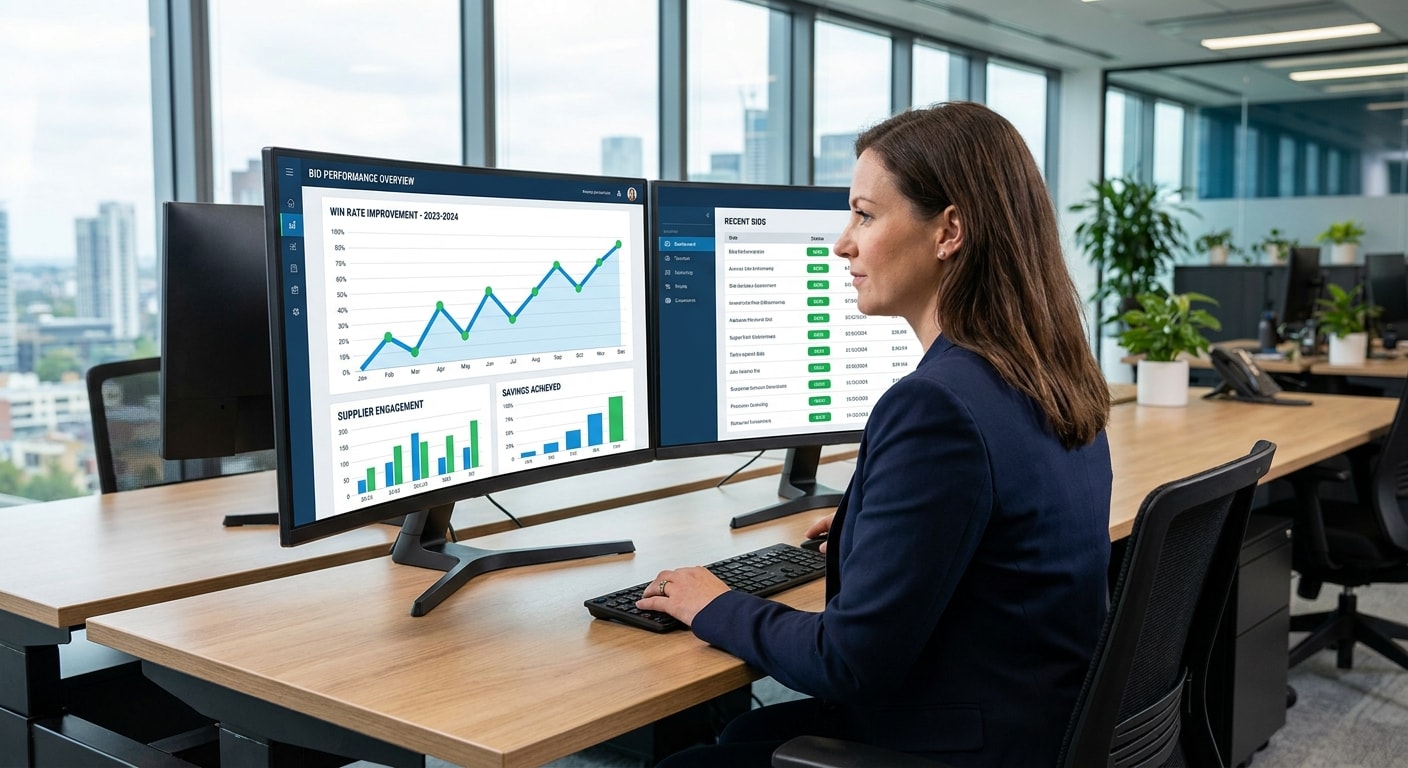
Procurement professional reviewing bid performance dashboards — win rate improvement over time
This isn't a technology product or a software category. It's a discipline. A deliberate, structured way of turning the data your bid process already generates into insights that make future bids sharper. Done well, it's one of the most direct investments a commercial team can make in win rate.
Here's how to build one that actually works.
What "Bid Intelligence" Actually Means
The term gets used loosely. Some people mean competitor research. Others mean market analysis. Neither is wrong, but both are incomplete.
A proper bid intelligence layer has four components working together:
- Win/loss analysis — structured debriefs from every submission, win or lose
- Evaluator pattern tracking — understanding how specific buyers score and what they weight
- Competitor intelligence — knowing who you're up against and how they position
- Tender history and trend data — tracking your own performance patterns over time
Most bid teams do one or two of these in a rough, ad hoc way. The difference between 25% and 45% win rates is usually in doing all four, consistently, with the outputs feeding directly back into live bids.
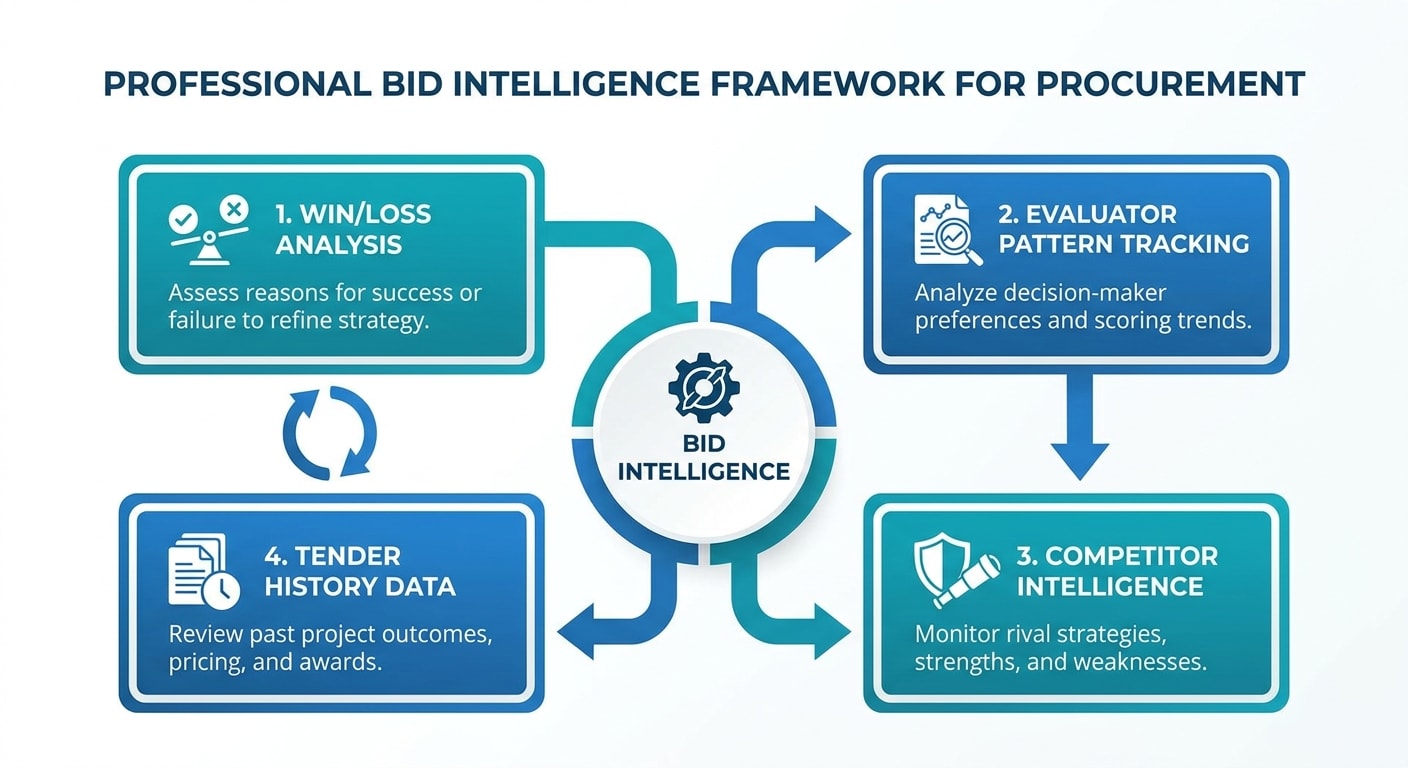
The four-component bid intelligence framework: Win/Loss Analysis, Evaluator Pattern Tracking, Competitor Intelligence, and Tender History Data
Component 1: Win/Loss Analysis
This is the foundation. If you're not systematically debriefing every submission, you're missing the most direct feedback available.
The problem is most teams only debrief losses, and only when they feel bad enough about them to ask. That's backwards. Wins are often more instructive — they tell you what's actually resonating with evaluators, which sections scored well, and why your pricing held up.
What a good debrief captures:- Evaluator scores by section (not just total)
- Feedback quotes, verbatim where possible
- Which commitments or case studies evaluators referenced positively
- Where you lost marks and what the winner apparently offered instead
- The gap between your estimate of a section score and the actual score
Under the Procurement Act 2023, contracting authorities are now required to give standstill notifications and more meaningful feedback. That's free intelligence. Request it every time.
Build a simple debrief template. Fill it within 72 hours of result notification, while it's fresh. File it in one place. That's the whole system at the start.
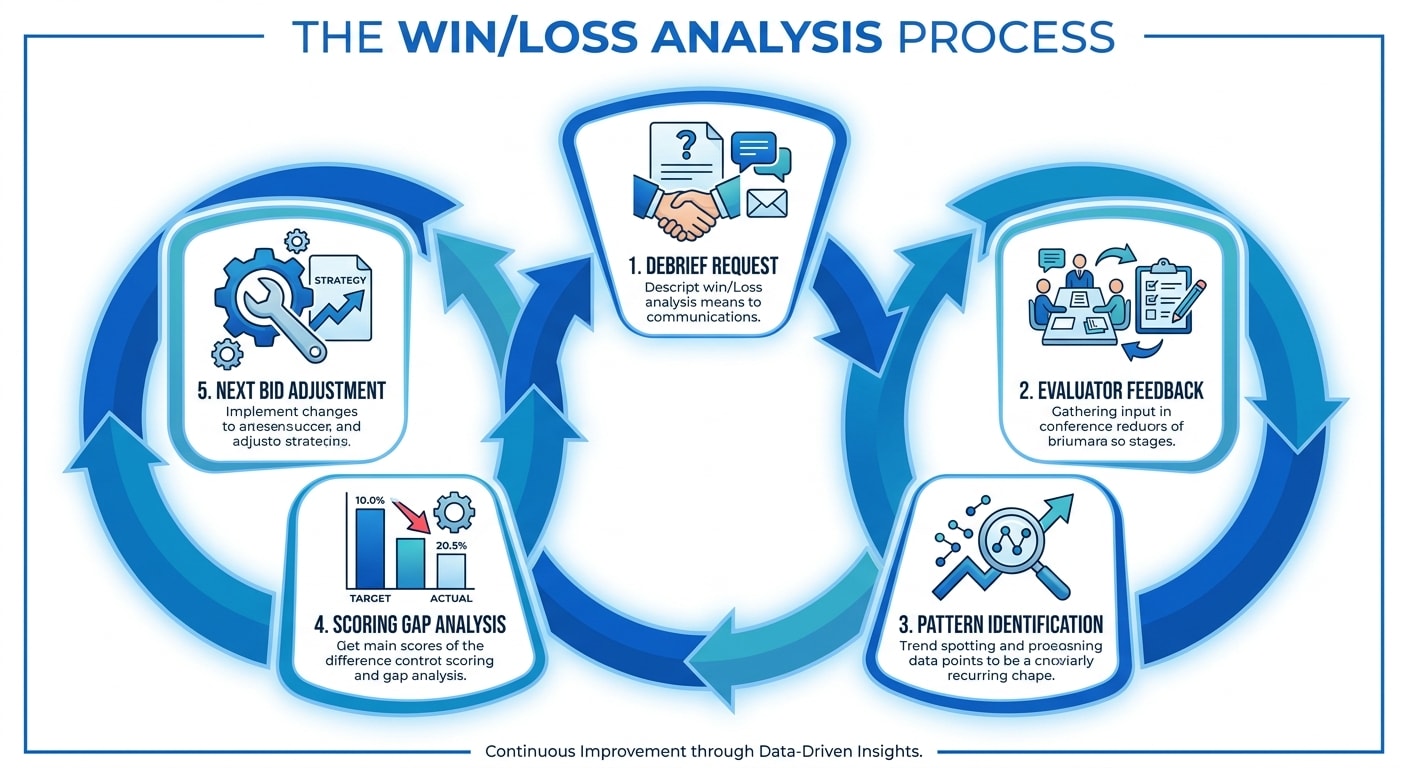
The win/loss analysis process: a five-step circular workflow from debrief request through to next bid adjustment
The Pattern You're Looking For
One debrief gives you data. Ten debriefs give you patterns.
Common patterns bid teams discover when they finally start tracking:
- "We consistently underscore on social value sections relative to our estimate"
- "Our mobilisation plans score well in construction but average in FM"
- "We lose on price in contracts below £2m but win on quality above £5m"
- "Buyer X weights innovation heavily; Buyer Y just wants evidence of similar work"
These patterns are worth money. Once you know them, you stop guessing and start engineering your responses to close specific scoring gaps.
Component 2: Evaluator Pattern Tracking
Buyers are not a monolith. A local authority procurement team in Manchester evaluates differently from a central government commercial team. A social housing provider cares about different things than an NHS trust.
The mistake is treating every ITT as a blank slate. It isn't. The buyer's past awards, their published evaluation criteria, their tender questions, and their feedback from previous rounds all carry signal.
What to track per buyer:- Weighting breakdown (quality vs price, and sub-weightings where published)
- Which sections they score hardest and which they tend to award generously
- Whether they've asked the same questions across multiple rounds
- Past award values and which incumbents have held which contracts
- Any published post-award transparency data (increasingly common under the new regime)
This builds up slowly. After a year of tracking, you'll have profiles on your top 20 target buyers that make your bid managers significantly more confident when writing for them.
Component 3: Competitor Intelligence
This one makes people uncomfortable. It shouldn't.
Competitor intelligence in public procurement is almost entirely built from public data. Contract award notices, Companies House filings, press releases, case studies on their website, and increasingly, supplier performance data that contracting authorities are required to publish under the Procurement Act.
You're not spying. You're reading what's publicly available.
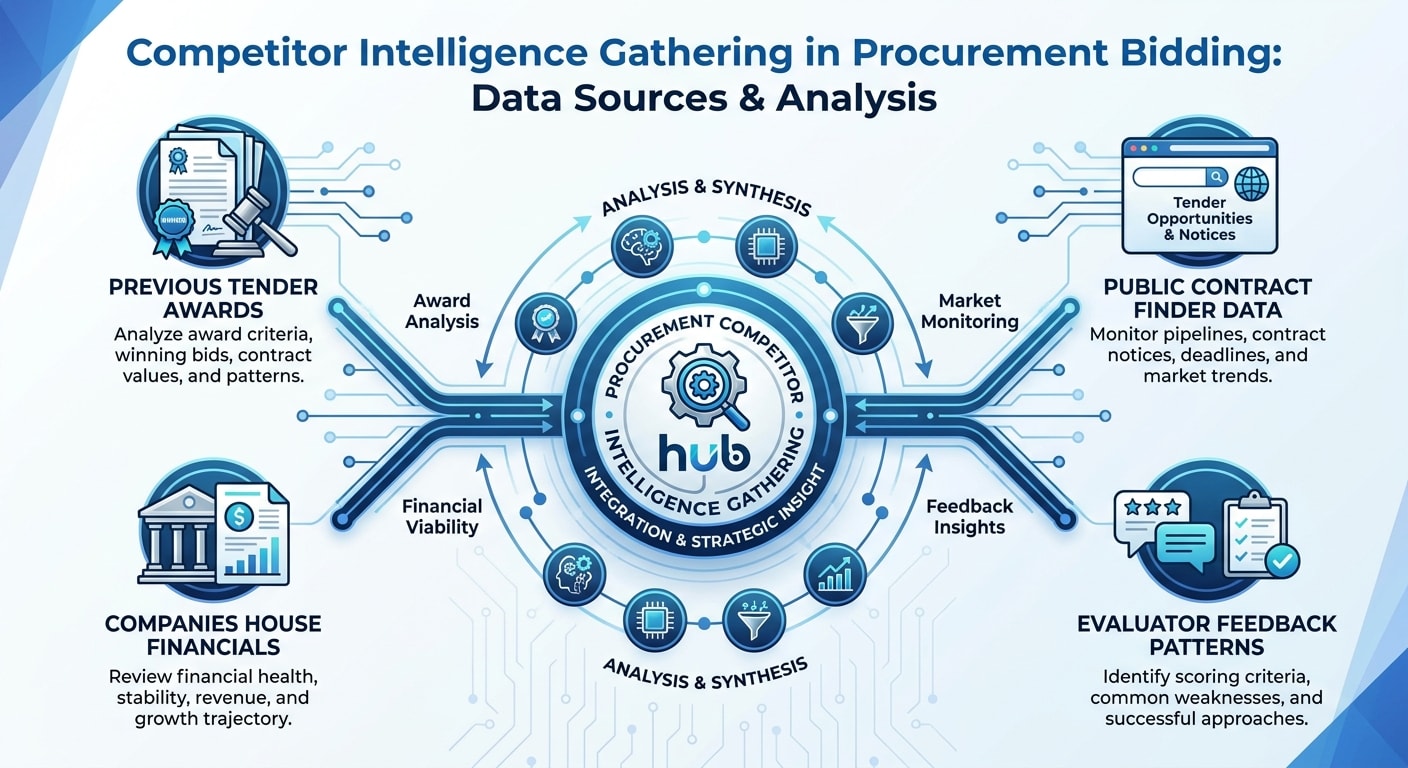
Competitor intelligence data sources diagram — tender awards, contract finder, Companies House, evaluator feedback patterns
- Which contracts they hold and when they come up for recompete
- Their typical pricing positioning (low-cost challenger vs quality premium)
- Their published case studies and reference projects (tells you what they'll use as evidence)
- Sectors where they're growing vs where they appear to be retreating
- Key personnel — bid directors, sector leads — and any recent hires or departures
When you know a specific competitor is likely to be on a shortlist, you can deliberately sharpen the sections where they're weakest and anticipate where they'll try to outscorer you.
Component 4: Tender History and Trend Data
This is the least glamorous component and the most neglected. It's also where commercial leadership often gets the starkest wake-up calls.
Tracking your own submission history with actual outcomes creates a picture most organisations have never seen clearly:
- Win rate by sector
- Win rate by contract value band
- Win rate by bid writer or team
- Win rate on re-competes vs new logos
- Correlation between bid quality score (if you assess internally) and outcome
- Time-to-submission vs win rate (do rushed bids lose more?)
Most commercial directors think they know their win rate. When they actually pull the numbers properly, they're usually off by 10-15 percentage points. And the sector or value-band breakdowns often reveal something the gut feel completely missed: "We're actually good at FM contracts over £3m. Everything below that, we're losing consistently."
That's a no/bid decision insight right there.
Why Most Companies Get This Wrong
They store it in the wrong places.
Debrief notes in someone's email. Competitor observations mentioned in a team meeting and promptly forgotten. Tender history as a list in an Excel sheet with no outcome data attached. Win rates calculated by whoever's preparing the board report, from memory.
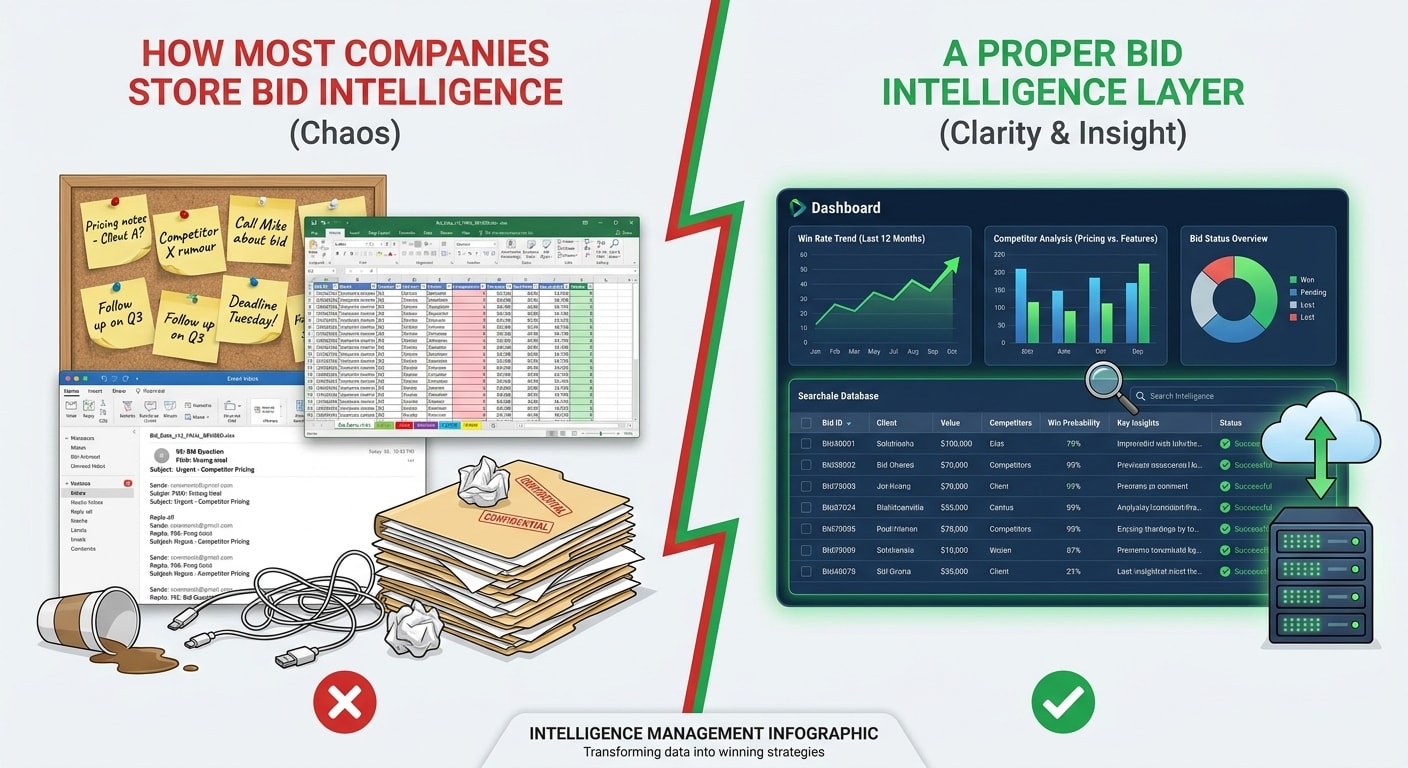
Comparison: chaotic ad hoc bid intelligence vs a structured bid intelligence layer
The result is that when a new ITT lands, there's no ready way to answer questions like:
- "Have we bid for this buyer before and how did we do?"
- "Who are the likely competitors on this one?"
- "Which sections are we historically weakest on for this type of contract?"
- "What's our win rate on retenders in this sector?"
These aren't difficult questions. They just require the data to exist and be accessible.
How to Build It Without a Massive Overhead
You don't need a data engineering team. The minimal viable bid intelligence layer is:
1. A shared debrief log — a structured form or spreadsheet with fixed fields: bid ID, buyer, contract value, submission date, outcome, scores by section where available, key debrief takeaways. One person owns it. Everyone contributes. 2. Buyer profiles — a simple document per buyer you target regularly. Updated after each interaction. Even two or three paragraphs on what they care about is better than nothing. 3. Competitor files — one file per key competitor with a running log of their wins, their positioning, and any intelligence from public sources. Doesn't need to be exhaustive. Even rough notes, kept current, build up. 4. A monthly review — 30 minutes, the bid manager and commercial lead, looking at the numbers. What did we win last month? What did we lose? Any patterns emerging? What are we adjusting?That's it. No software required to start. The discipline matters more than the tool.
Where AI Fits In
Once you have the data, AI can dramatically accelerate what you do with it.
The most immediate use is in writing. If your bid intelligence layer tells you that a particular buyer scores social value sections harshly and cares most about local employment commitments, an AI tool like mytender.io can use that context to weight your content accordingly. Instead of generic social value boilerplate, you get a response calibrated to what that buyer has rewarded in the past.
Similarly, if your win/loss data shows you consistently underscore on mobilisation planning sections, AI can flag this during drafting and suggest strengthening the relevant content before submission.
The intelligence layer feeds the AI. The AI uses it at the point of writing. The combination is considerably more powerful than either alone.
What You Should See in 12 Months
Teams that build this systematically and review it consistently typically see a 10-15 percentage point improvement in win rate over 12-18 months. Not from better writing alone, but from making smarter no/bid decisions, targeting buyers where they have genuine advantage, and closing the specific scoring gaps that keep appearing in debriefs.
The compounding effect matters. Each win gives you a better debrief. Each debrief sharpens the next submission. Each competitor loss teaches you something about the shortlist you're likely on. Over time, the intelligence layer pays for itself many times over.
The firms that aren't building this are making the same mistakes on repeat. You don't have to.
Start With One Thing
If you take nothing else from this, start with the debrief log. After your next submission, fill in five fields: buyer, contract value, outcome, section scores (if available), and one paragraph on what you'd do differently.
Do that for six months. Then look at what you've got.
You'll have the foundation of something that starts improving your win rate before you've spent a pound on technology.
---
If you want to see live tender opportunities matched to your sector and contract value, the Tender Finder is free to use. It surfaces opportunities your bid intelligence layer will want to track.Tags
Ready to Transform Your Tender Writing?
See how MyTender's AI can help you write winning tenders in a fraction of the time.