

Competitive Flexible Procedure Tenders: How Suppliers Should Bid in 2026
The competitive flexible procedure gives buyers more freedom to design tenders. Here is how suppliers should read the rules, manage risk and write stronger responses.
mytender.io Research Team
Tender Writing & Bid Management Specialists
Competitive Flexible Procedure Tenders: How Suppliers Should Bid in 2026
The most dangerous tender is not always the hardest one.
Sometimes it is the one that looks familiar, until you realise the buyer has changed the rules halfway through the process.
That is why the competitive flexible procedure matters. Under the Procurement Act 2023, public buyers have more freedom to design their own competition. They can build stages, use dialogue, shortlist suppliers, refine requirements and create evaluation processes that do not fit the old neat boxes.
For good suppliers, this is an opportunity. You can shape the buyer's thinking earlier, test assumptions, and win on more than price.
For unprepared bid teams, it is a mess waiting to happen.

Bid team mapping a competitive flexible procedure tender strategy
This guide is for bid managers, commercial directors and accidental bid writers who need to handle competitive flexible procedure tenders without losing control of time, price, evidence or risk.
The short version: stop treating the procedure as admin. Treat it as part of the bid strategy.
What Is the Competitive Flexible Procedure?
The competitive flexible procedure is the Procurement Act 2023's main competitive route for above-threshold public contracts.
Instead of forcing buyers into a small set of familiar procedures, it lets them design a process that fits the contract. That might include negotiation, dialogue, presentations, demonstrations, down-selection stages, revised tenders, site visits, moderation points, or final best and final offers.
The buyer still has to be transparent. They still need to explain how the competition works. They still need to evaluate fairly against the published criteria.
But the shape of the process can vary a lot.
That is the point.
A software procurement might include demos and technical clarification. A facilities management tender might include solution workshops and mobilisation interviews. A construction framework might use staged technical submissions before final commercial offers. A waste contract might ask suppliers to refine collection round assumptions after market engagement.
Same legal route. Very different bid experience.
Why This Changes the Supplier's Job
Under older procurement habits, many bid teams built their process around a simple rhythm:
- receive the ITT
- shred the requirements
- assign questions
- write responses
- price the solution
- submit before the deadline
That rhythm still works for some tenders.
It is not enough for a flexible procedure.
The reason is simple. In a flexible process, the tender is not just a document. It is a sequence of decisions.
You need to understand what each stage is designed to test, what can still change, what is locked, and where the buyer might be looking for confidence rather than polished prose.
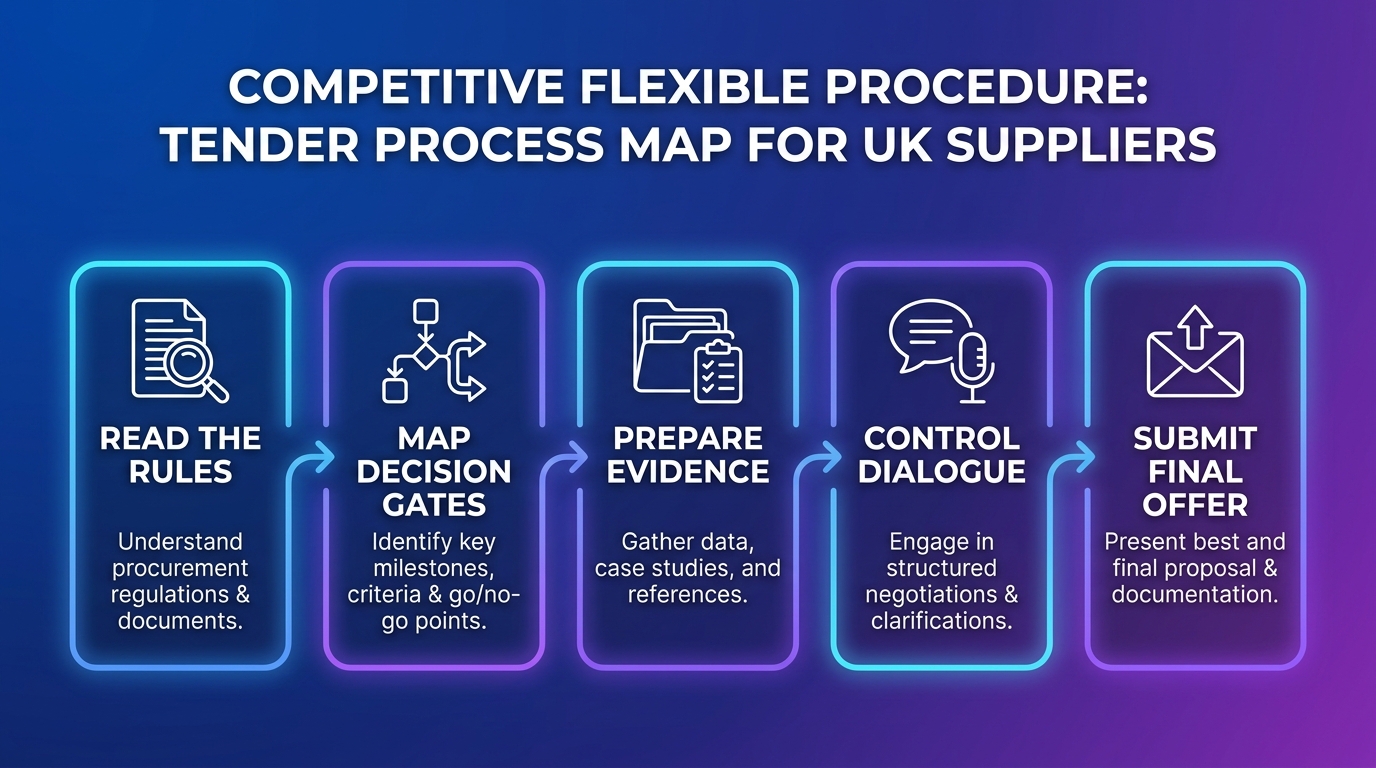
Competitive flexible procedure process map for suppliers
A strong supplier asks different questions from day one:
- What is the buyer trying to learn at each stage?
- Which requirements are fixed, and which may be refined?
- Where can our solution influence the final specification?
- What evidence will survive from early stage to final evaluation?
- Where could pricing drift if the scope changes?
- What is the real bid/no-bid decision point?
That last one matters.
A flexible procedure can consume weeks of senior time before the final submission. If the opportunity is not strategically right, you need to know early.
The SEO Reality: People Are Searching for Rules, But They Need Strategy
Recent procurement searches show a clear pattern. Suppliers are trying to understand the new Procurement Act regime, including the Central Digital Platform, new notices, MAT, standstill changes, transparency, KPI reporting and the competitive flexible procedure.
That tells us something useful.
Most suppliers are still in rule-learning mode. They are asking, "What does the Act require?"
But the better question is, "How should we change the way we bid?"
The legal change is only the start. The practical impact sits in bid management:
- more varied tender structures
- more early-stage engagement
- more public visibility of performance
- more emphasis on wider value
- more chances for buyers to test supplier credibility
- more risk of bid teams misreading the process
If your competitors are only reading the rules, you can beat them by building a better operating model.
Start With the Procedure Rules, Not the Questions
Most bid teams open the tender pack and jump straight to the quality questions.
That is understandable. It is also risky.
In a competitive flexible procedure, the first document to read is the process document. Not the specification. Not the pricing schedule. Not the response template.
Read the rules of the competition first.
You are looking for seven things.
1. The Stage Gates
How many stages are there? What has to be submitted at each stage? Can suppliers be eliminated before final tender?
If there is a down-selection point, your early response has to do more than keep you compliant. It has to earn the right to continue.
That changes your writing style. You may need sharper proof, clearer differentiators and less background explanation.
2. The Evaluation Weightings
Check whether the weighting changes by stage.
Some buyers may use a pass/fail compliance stage, then a quality and price stage, then a presentation or demonstration. Others may carry scores forward.
If early scores carry forward, do not save your best evidence for later. There may not be a later.
3. The Dialogue Rules
Can you ask questions? Can you propose alternatives? Will the buyer hold workshops? Are all clarifications shared with all bidders?
This defines how bold you can be.
If the process allows discussion, prepare your commercial and technical team properly. Do not let a workshop become a casual chat where someone accidentally commits to something expensive.
4. The Scope Change Rules
Can the buyer refine the specification? Can they issue revised documents? Can you amend your solution after dialogue?
This is where price risk appears.
A small change in service scope, mobilisation timing, staffing assumptions, reporting obligations or KPI regime can wreck a margin if your bid team does not track it.
5. The Submission Format
Flexible procedures often include presentations, demos, interviews or scenario exercises.
These are not add-ons. They are scoring events.
Treat them as part of the tender response, with rehearsals, evidence packs and clear ownership.
6. The Clarification Cut-Off
Find the deadline for questions and work backwards.
A late clarification can expose a major assumption, but if the window has closed, you are stuck with either risk pricing or silence.
Neither is ideal.
7. The Standstill and Challenge Window
Under the Procurement Act, suppliers need to move quickly if something looks wrong after award. The standstill period is tighter than many teams are used to.
You do not need to plan a legal challenge on day one. You do need to keep clean records of clarifications, scoring assumptions and process changes.
Good records protect you.
Build a Bid/No-Bid Decision for the Procedure Itself
A normal bid/no-bid model looks at fit, value, competition, relationship, capacity and win probability.
For a competitive flexible procedure, add a procedure risk layer.
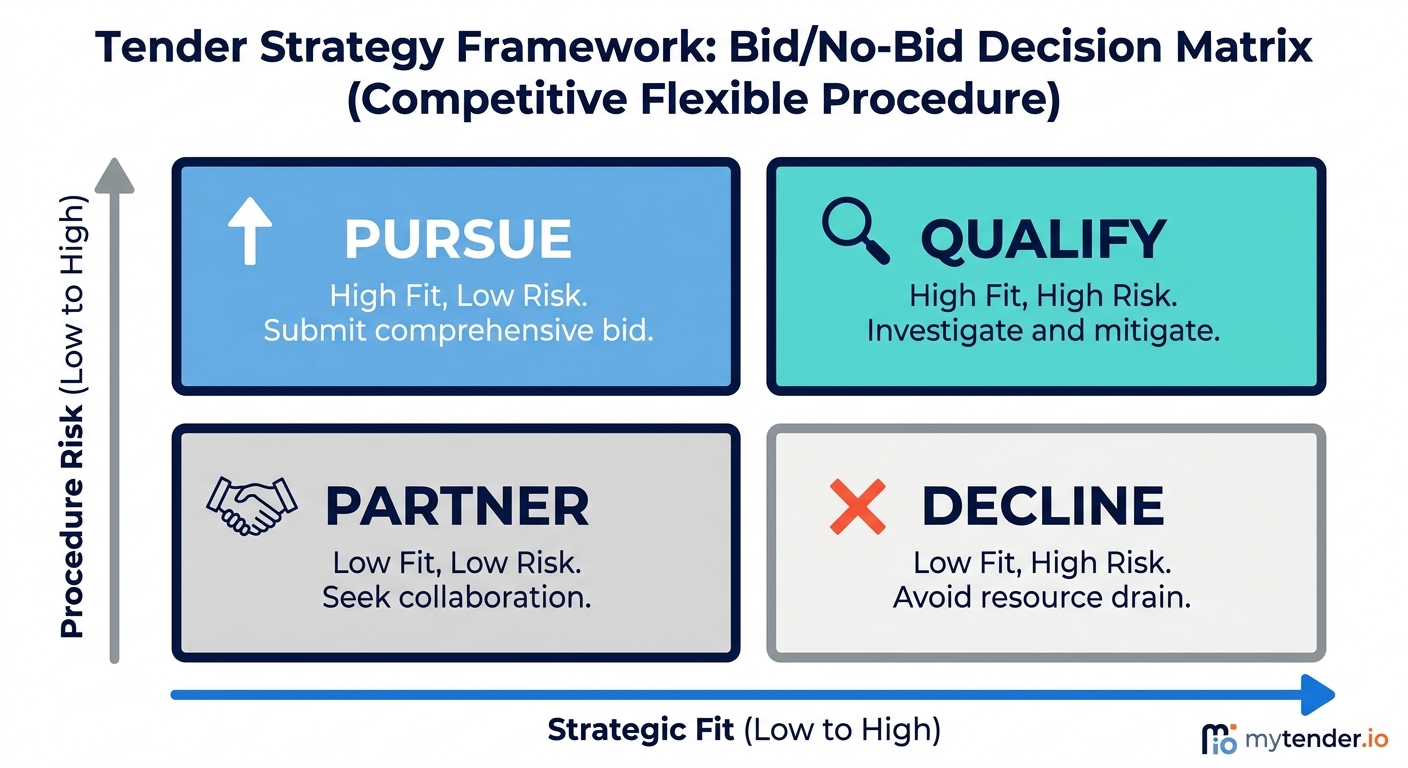
Bid no bid matrix for competitive flexible procedure tenders
Ask these questions before committing fully:
- Do we understand how the buyer will evaluate each stage?
- Do we have senior people available for dialogue, demos or interviews?
- Can we price safely if the scope changes?
- Do we have enough evidence to survive shortlisting?
- Is the buyer using flexibility to improve the process, or because they are unsure what they want?
- Can we influence requirements constructively without giving away unpaid consultancy?
- Would winning this contract strengthen our position for future work?
That final question is underrated.
Some flexible procedures are worth the effort because they let you shape a long-term contract, framework or category strategy. Others are expensive distractions with unclear requirements and a low chance of success.
Be honest. A brave no-bid is better than a heroic submission nobody should have started.
Treat Dialogue as a Scored Moment
Dialogue sounds collaborative. It can be.
But suppliers should not confuse collaboration with informality.
Every interaction with the buyer shapes confidence. Even if a workshop is not formally scored, it can influence how evaluators read your final submission.
A good dialogue strategy has three parts.
Know What You Want to Learn
Do not walk into a supplier session with vague curiosity.
Prepare a short set of questions that test the assumptions that matter most:
- operational constraints
- incumbent performance issues
- mobilisation risks
- user pain points
- reporting expectations
- budget pressure
- appetite for innovation
- must-have compliance requirements
The goal is not to ask the most questions. The goal is to remove the most dangerous uncertainty.
Know What You Want the Buyer to Believe
Dialogue is also a chance to create confidence.
Before the session, decide the three things the buyer should remember about you.
For example:
- you understand the operational risk better than other bidders
- your mobilisation model is proven on comparable contracts
- your pricing approach protects service quality rather than hiding cuts
Then make sure your technical people reinforce those points through examples, not slogans.
Capture Every Commitment
After every dialogue session, update your assumption log.
Record what the buyer said, what you said, what changed, and what still needs clarification.
This protects the final bid. It also stops pricing, solution design and quality writing drifting apart.
Control the Evidence Architecture
Flexible procedures punish messy evidence.
If your case study, pricing narrative, social value offer and delivery model all tell slightly different stories, the buyer will notice.
You need an evidence architecture: a single source of truth for the bid.
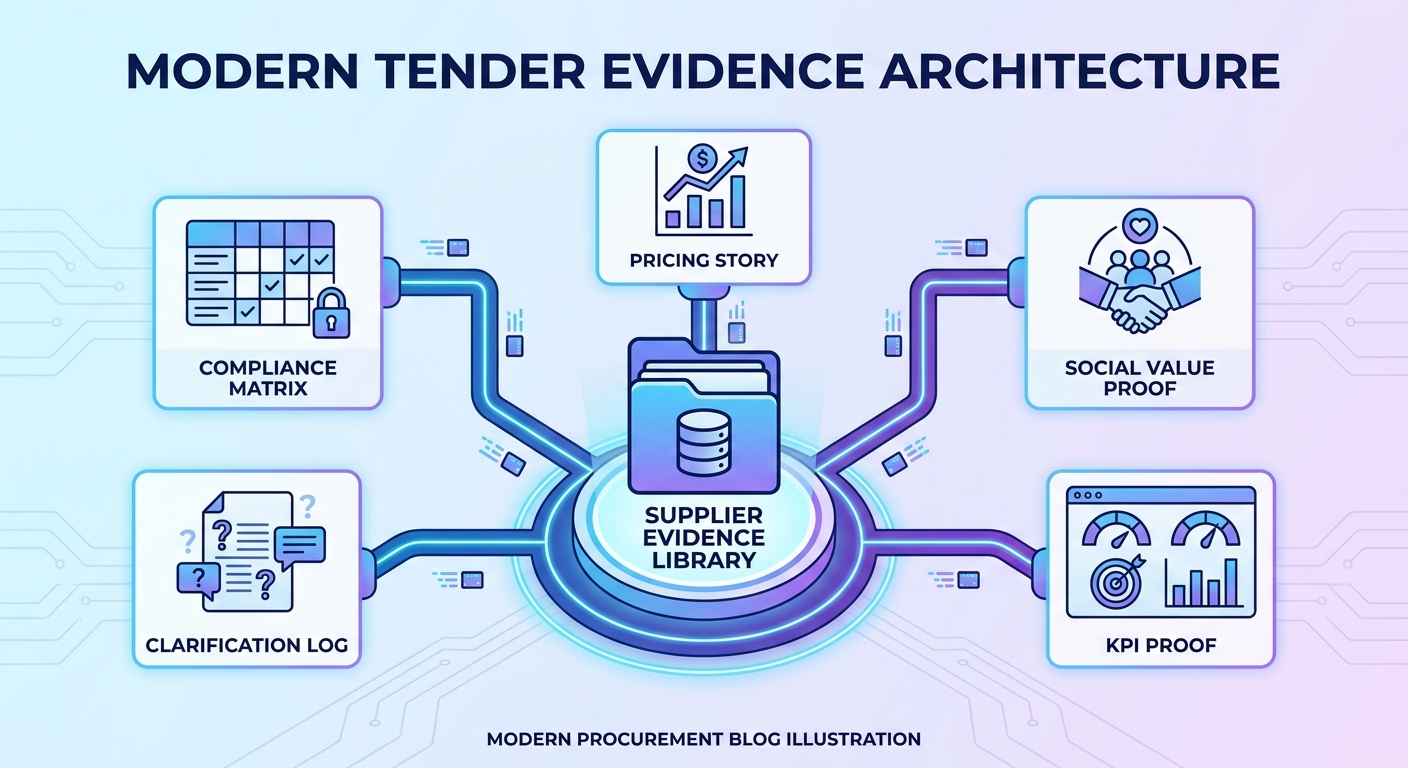
Evidence architecture for competitive flexible procedure tender responses
At minimum, build five connected documents.
1. Compliance Matrix
This is the base layer. It tracks every instruction, mandatory requirement, attachment, certificate, policy, declaration and response limit.
In flexible procedures, update it every time the buyer issues a clarification or revised document.
2. Assumption Log
This tracks the commercial and operational assumptions behind the bid.
Examples include staffing levels, TUPE assumptions, site access, baseline volumes, asset condition, handover timing, data quality and buyer responsibilities.
The assumption log is where margin is protected.
3. Evidence Library
Collect proof before writing starts.
You want case studies, KPI results, mobilisation plans, audit scores, testimonials, accreditations, carbon evidence, social value delivery records and lessons learned.
Do not let writers invent claims because the evidence is hard to find.
4. Win Themes
A flexible process can pull teams into detail. Win themes keep the story coherent.
Strong win themes are specific to the buyer. They are not generic claims like "quality", "innovation" or "partnership".
A better version might be: "low-risk mobilisation across occupied civic buildings" or "transparent KPI control for a contract under public scrutiny".
5. Change Log
Every revised document, clarification answer, pricing change and scope adjustment should be tracked.
This sounds dull. It is not.
When the buyer changes something three days before submission, the change log is the difference between a controlled response and a bid room argument.
Write for the Most Advantageous Tender, Not the Cheapest Acceptable Offer
The shift from MEAT to MAT is not just a wording change.
Most Advantageous Tender gives buyers permission to think more broadly about value. That can include quality, resilience, social value, environmental impact, innovation, lifecycle cost, deliverability and performance risk.
Do not overstate it. Price still matters. A lot.
But the best response does not simply say, "we are good and cost-effective".
It explains why your offer is the safest route to the buyer's desired outcome.
That means writing in terms of consequences:
- fewer mobilisation failures
- faster access to accurate reporting
- lower contract management burden
- stronger continuity of service
- clearer KPI ownership
- fewer complaints
- reduced whole-life cost
- more credible social value delivery
Evaluators are not just marking words. They are judging risk.
Help them choose you without feeling exposed.
Watch the Five Common Failure Points
Competitive flexible procedures create extra room for good suppliers to stand out. They also create extra room for bid teams to trip over themselves.
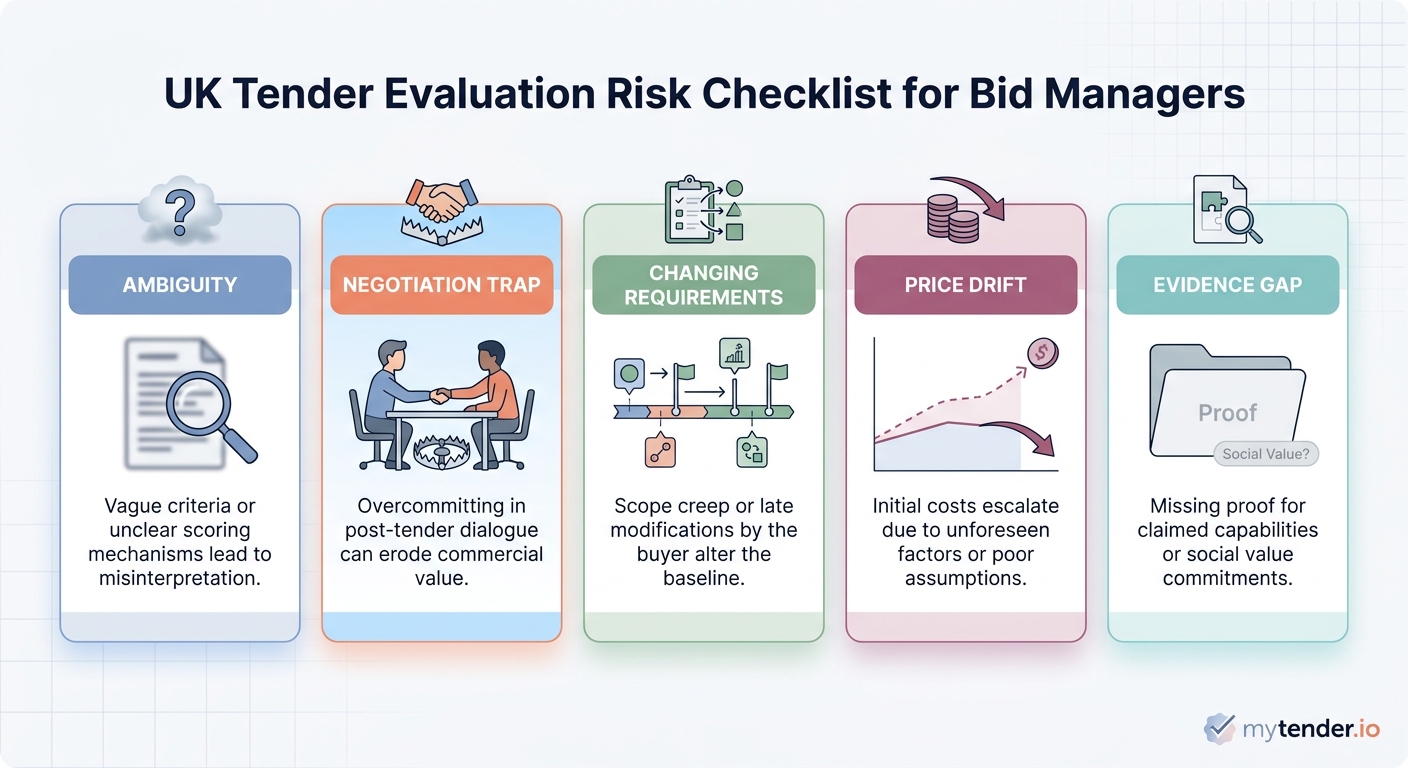
Risk checklist for competitive flexible procedure tenders
These are the five failure points to watch.
1. Ambiguity That Never Gets Resolved
Some teams keep writing around unclear requirements because they do not want to bother the buyer.
That is backwards.
A good clarification question is not a nuisance. It is risk management.
If the answer affects price, compliance, staffing, liability, mobilisation or scoring, ask it early.
2. Dialogue That Becomes Free Consultancy
There is a fine line between helpful market input and giving away your solution.
Be generous with principles. Be careful with proprietary methods, detailed designs and commercial advantages.
If the buyer wants a fully developed solution, that belongs in the competition, not in an unpaid pre-final discussion.
3. Pricing That Drifts Away From the Solution
This happens all the time.
The technical team refines the model. The pricing team works from an older assumption. The social value team adds commitments. The mobilisation lead changes the phasing.
Then the final bid looks joined-up, but the cost base is not.
Run alignment checks after every major change.
4. Presentations Treated as Theatre
A presentation is not a TED talk. It is evidence delivered verbally.
The best teams rehearse answers, assign roles, prepare examples and practise handling challenge questions.
The worst teams make slides the night before and hope charisma covers the gaps.
It rarely does.
5. Losing the Audit Trail
Flexible procedures can move quickly. Documents change. Clarifications land. Meetings happen. Requirements are refined.
If you cannot show how the final submission reflects the latest rules, you are exposed.
Keep the audit trail clean.
How AI Helps, and Where It Does Not
AI is useful in competitive flexible procedures because the information load is high.
A good AI-supported bid process can help you:
- shred procurement documents into a compliance matrix
- compare revised versions of tender documents
- extract mandatory requirements
- summarise clarification responses
- map evidence against questions
- flag missing proof
- keep win themes consistent across sections
- draft first-pass answers from approved evidence
That is valuable, especially when the process changes quickly.
But AI should not decide your commercial position. It should not promise commitments your delivery team cannot meet. It should not invent evidence. It should not replace judgement in dialogue.
The best use of AI is to give the bid team more time for the human work: strategy, evidence, pricing, buyer understanding and final judgement.
That is where mytender.io fits naturally. It helps teams turn tender documents, company knowledge and previous responses into a controlled draft and evidence workflow, so people spend less time hunting through files and more time improving the answer.
A Practical 10-Step Workflow
If you are bidding a competitive flexible procedure next month, use this workflow.
Step 1: Read the Process Document First
Before assigning writers, map the competition stages, deadlines, evaluation method and clarification rules.
Step 2: Build a Stage-by-Stage Calendar
Include internal deadlines, buyer events, clarification cut-offs, review meetings, pricing gates and approval points.
Step 3: Run a Procedure Risk Bid/No-Bid
Do not just assess the contract. Assess the process.
If the procedure demands three workshops, two demos and a final offer, check whether the opportunity deserves that level of effort.
Step 4: Create the Compliance Matrix
Track every requirement and owner. Keep it live.
Step 5: Create the Assumption Log
Use it from day one. Make pricing, solution and quality teams work from the same assumptions.
Step 6: Prepare Dialogue Properly
Write questions. Rehearse messages. Decide what not to disclose.
Step 7: Collect Evidence Before Drafting
Do not let the bid become a creative writing exercise. Evidence first, prose second.
Step 8: Align Price and Solution After Every Change
Every scope change needs a commercial check.
Step 9: Rehearse Presentations Like Scored Responses
Use real challenge questions. Make subject matter experts practise concise answers.
Step 10: Final Check Against the Latest Documents
Before submission, confirm the response matches the latest tender pack, clarifications and pricing assumptions.
It sounds basic. Under pressure, basic is what fails first.
What Good Looks Like
A strong competitive flexible procedure bid feels controlled.
The buyer sees a supplier that understands the process, responds quickly, asks intelligent questions and gives evidence without overcomplicating the answer.
Internally, the team knows what has changed, what is still uncertain, what has been priced, and which claims are backed by proof.
That control is a competitive advantage.
Many suppliers will treat flexible procedures as a legal update. Better suppliers will treat them as a new bid discipline.
That is where marks will be won.
Final Thought
The competitive flexible procedure is not something to fear. It is something to manage.
If the buyer uses it well, it can produce a better competition and a better contract. If you use it well, it can give you more room to show why your solution is genuinely stronger.
But it rewards preparation. It rewards clean evidence. It rewards teams that can think commercially while the process is still moving.
If you want to see live public sector opportunities and start qualifying which ones deserve your bid team's time, the mytender.io Tender Finder is free to use.
Use it early. The best flexible procedure strategy starts before the tender lands.
Tags
Ready to Transform Your Tender Writing?
See how MyTender's AI can help you write winning tenders in a fraction of the time.