
Pre-Market Engagement Under the Procurement Act 2023: How to Use It to Win More Tenders
Pre-market engagement is one of the most underused win-rate levers in UK public procurement. Here is what the Procurement Act 2023 allows and how suppliers should use it.
mytender.io Research Team
Tender Writing & Bid Management Specialists
Pre-Market Engagement Under the Procurement Act 2023: How to Use It to Win More Tenders
Most suppliers start trying to win a tender after the notice goes live.
This article is part of our Procurement Act series. For an overview of what changed and links to every guide in the series, see our Procurement Act 2023 supplier's guide.
That is often too late. By then, the buyer has already shaped the requirement, chosen the route, drafted the award criteria, tested the budget, and formed a view of what good looks like.
Pre-market engagement is where some of that thinking happens. Under the Procurement Act 2023, it is clearer, more visible and more useful than many suppliers realise.
For commercial leaders, this is not a compliance footnote. It is a win-rate lever.
The firms that treat preliminary market consultation as a strategic activity get three advantages: they understand buyer intent earlier, they spot bad-fit tenders sooner, and they prepare stronger evidence before the clock starts.
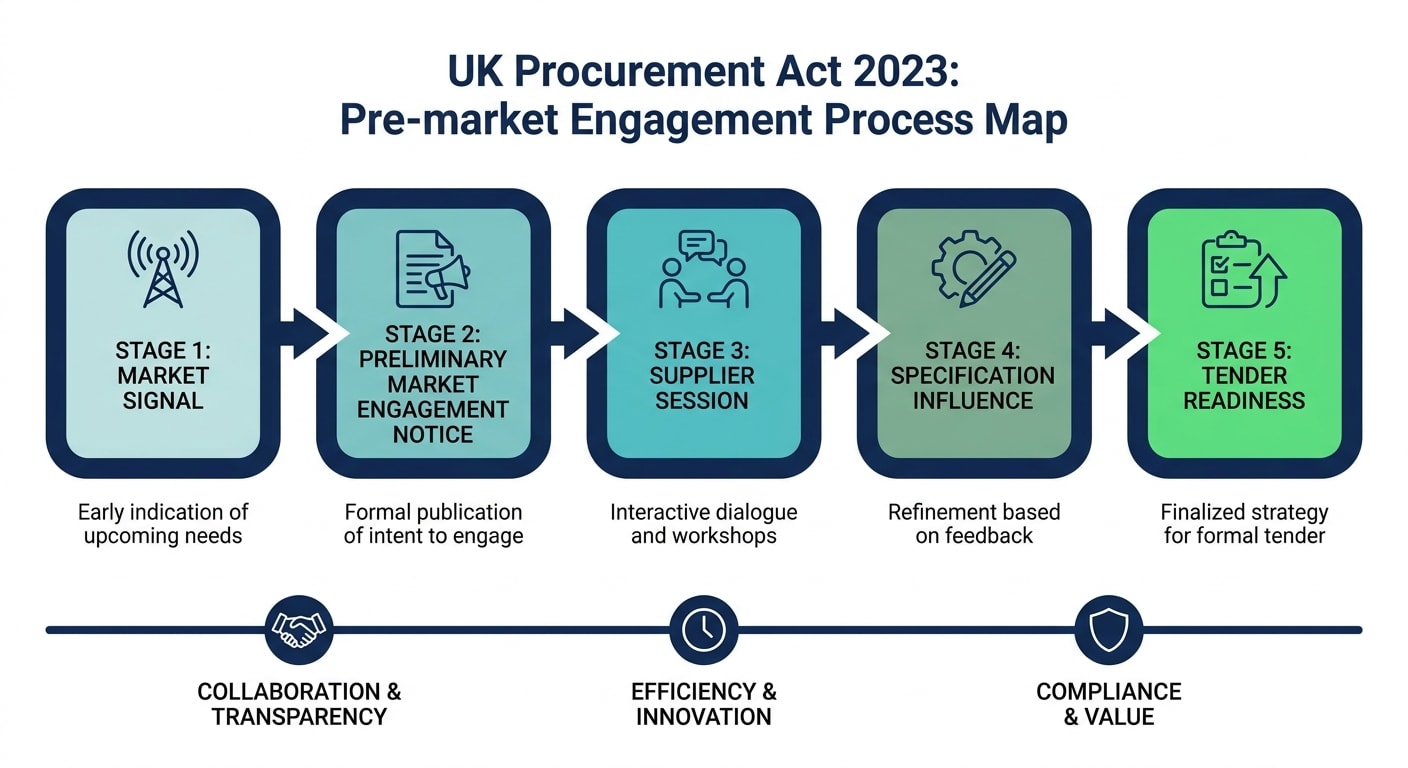
Pre-market engagement process map under the Procurement Act 2023
What Pre-Market Engagement Means Under the Procurement Act 2023
Pre-market engagement, also called preliminary market engagement or preliminary market consultation, happens before a tender notice or transparency notice is published.
The Cabinet Office guidance on preliminary market engagement says it helps contracting authorities and suppliers prepare for procurement. The point is simple: the buyer can test the market before locking down the procurement.
Section 16 of the Procurement Act 2023 gives authorities room to engage with the market for several purposes. These include developing requirements, designing the procedure, setting conditions of participation, shaping award criteria, preparing tender documents, identifying suppliers, understanding contract terms, and building supplier capacity.
That matters. It means early market engagement tendering is not a grey-area sales tactic. It is part of the new regime when handled properly.
Section 17 adds a transparency point. If an authority carries out preliminary market engagement, it must either publish a preliminary market engagement notice before the tender notice or explain in the tender notice why it did not.
For suppliers, that creates a signal. When you see a preliminary market engagement notice, the buyer is still thinking. That is the moment to show up.
Why Most Suppliers Miss the Opportunity
Most bid teams are built around deadlines, not market signals.
They monitor portals for live tenders. They run a bid/no-bid meeting. They scramble for case studies.
Then they try to reverse-engineer the buyer's thinking from the final specification.
That is a reactive model. It works when you are the incumbent or when the requirement is plain. It struggles when the buyer is still trying to define the problem.
Commercial teams miss PME for five common reasons:
- They do not track preliminary market engagement notices as pipeline signals
- They see supplier engagement as a procurement-only event, not a sales and bid strategy moment
- They send junior people who cannot speak credibly about delivery risk, pricing or innovation
- They treat the session as a pitch instead of a listening exercise
- They fail to turn what they learn into a better bid plan
That last point is the expensive one. Pre-tender market engagement UK buyers run today can tell you what the tender will reward tomorrow.
If you do nothing with that insight, you have simply attended a meeting.
The Win-Rate Case for Early Engagement
Win rate improves when three things happen: you bid the right opportunities, you understand the buyer's real priorities, and your evidence fits the scoring model.
Pre-market engagement helps with all three.
First, it improves qualification. If the buyer's desired model does not fit your operating model, you can walk away before the bid team burns three weeks on a low-probability response.
Second, it exposes the gap between the written requirement and the real concern. A tender might say "mobilisation plan". In the PME session, the buyer might reveal that the real worry is TUPE data quality, service continuity during school holidays, or public complaints in the first 90 days.
Third, it gives you time to build evidence. If you learn that the buyer is likely to weight social value heavily, you can gather local commitments and proof before the tender lands. If you learn that risk transfer is a concern, you can prepare a sharper commercial position.
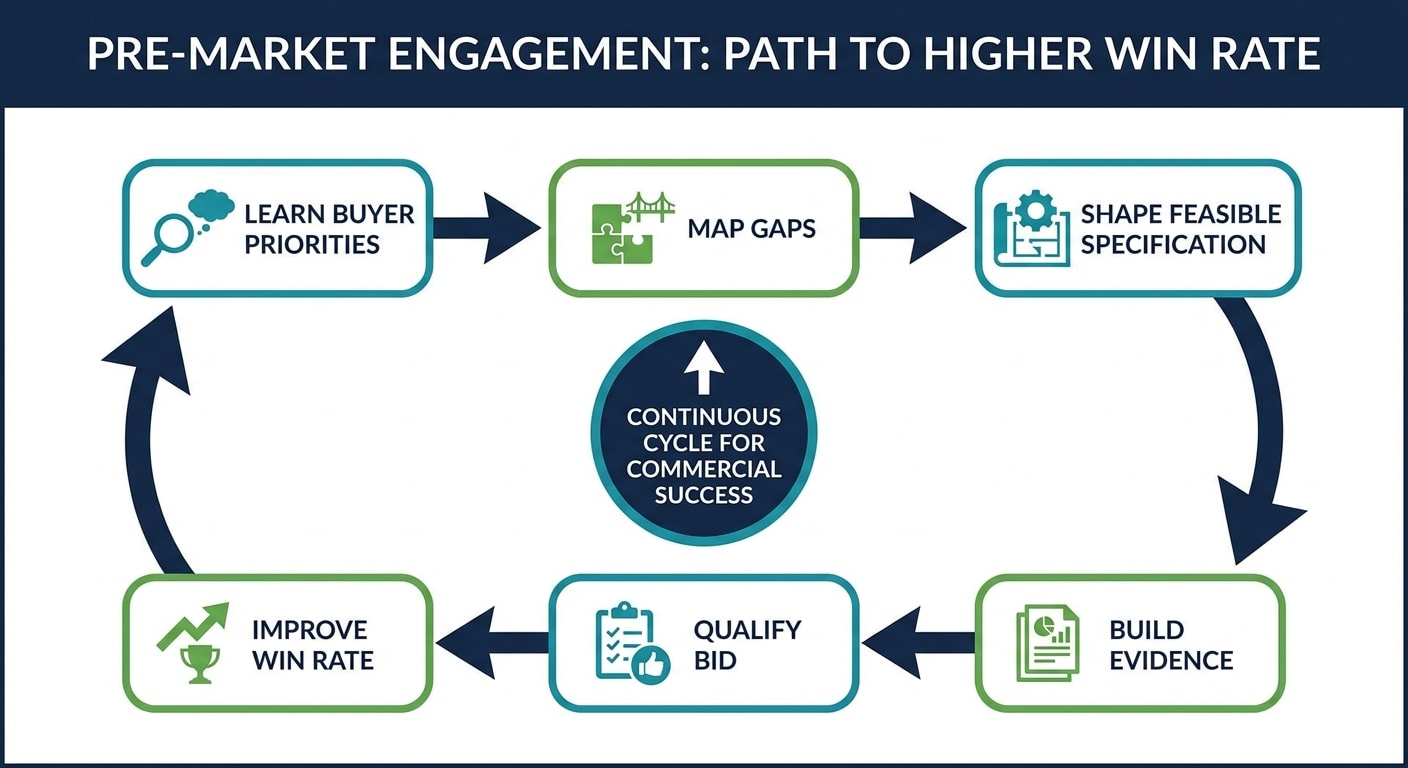
Pre-market engagement to higher win rate strategy loop
This is why PME belongs inside your win rate procurement strategy, not in a folder called "events".
The value is not access. The value is better judgement.
What Suppliers Can Influence, Ethically
You cannot write the tender for the buyer. You cannot ask for privileged information. You cannot expect private advantage because you joined a session.
You can influence the buyer's understanding of the market.
That distinction is the whole game.
The Act allows authorities to use engagement to develop requirements, procedures, award criteria and contract terms. Suppliers can contribute evidence that helps buyers make those decisions well.
For example, you can explain:
- Which parts of a draft requirement will drive unnecessary cost
- Where a proposed mobilisation timetable is not credible
- Which service levels are easy to measure and which will create disputes
- How different lot structures affect SME participation
- Where a pass/fail condition might exclude good suppliers for no real gain
- What data the buyer should provide so bidders can price the risk fairly
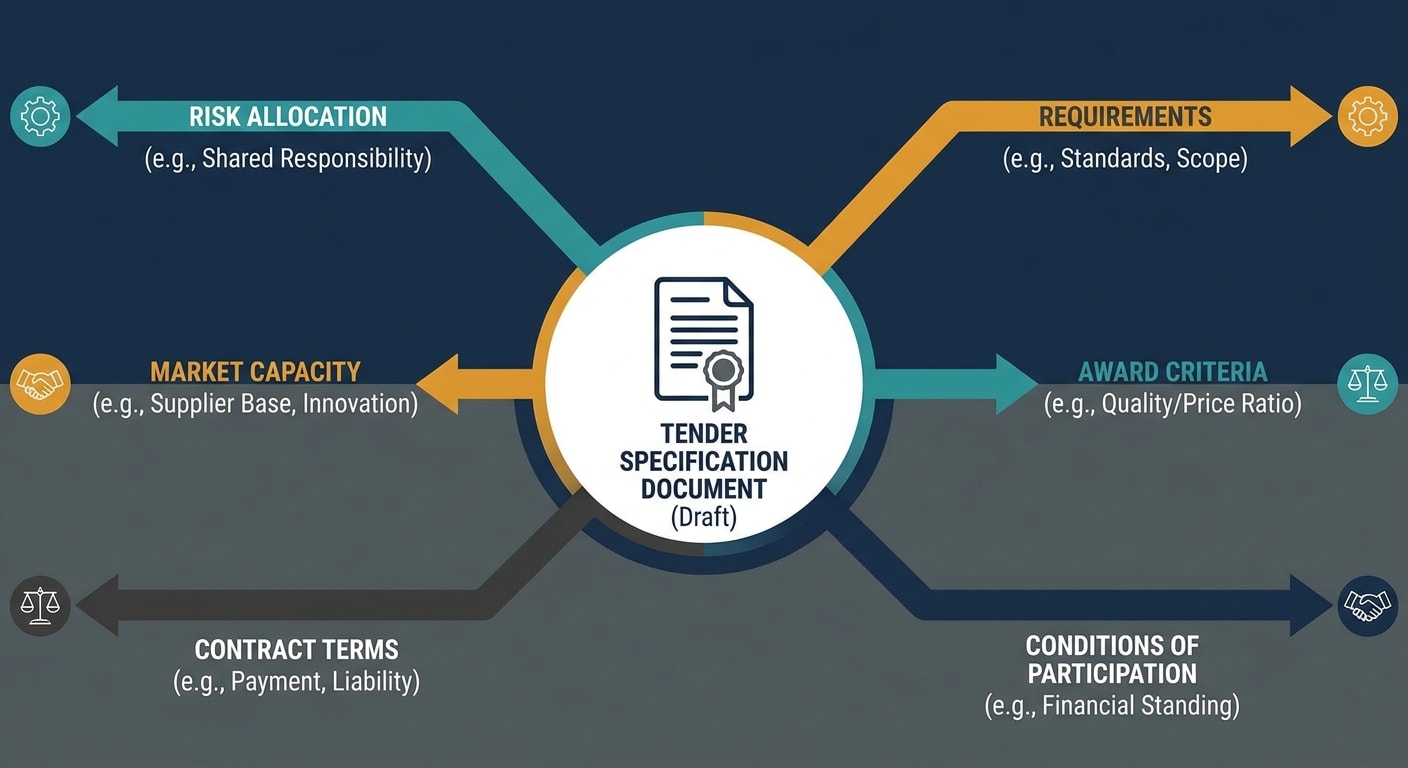
Specification influence areas for supplier market engagement strategy
That is how to influence tender specifications without crossing the line. You bring market evidence. You do not ask for a favour.
The strongest suppliers are useful before they are persuasive.
The Ethical Guardrails
The Procurement Act guidance is clear that engagement must not give a supplier an unfair advantage or distort competition.
That is good news for serious suppliers. It keeps the game cleaner and makes buyer engagement less awkward.
Use these guardrails.
Assume anything material may be shared. If your point genuinely helps the buyer, it should still be useful if every bidder hears it later. Talk in evidence, not preference. "We would like the threshold changed" sounds self-serving. "This threshold would remove three common SME delivery models and reduce competition" is a market insight. Do not ask for inside information. Do not press for budget clues, named competitors, hidden scoring preferences or draft documents that are not being shared with everyone. Declare conflicts early. If you helped with research, pilots, consultancy or prior delivery, make the position clear. Let the authority manage the risk. Keep your own record. Note who attended, what was discussed, what documents were shared, and what actions you took afterwards. If a question ever comes up, you want a clean audit trail.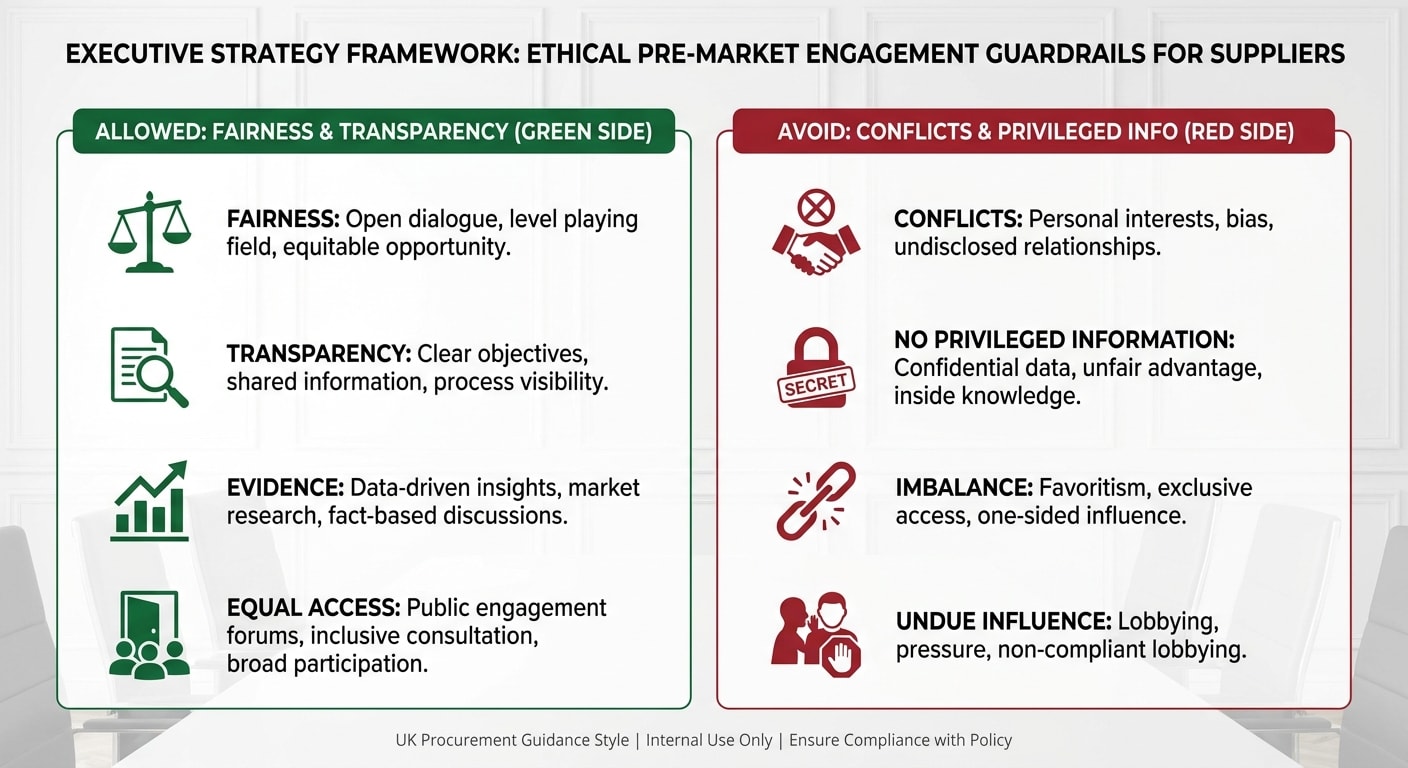
Ethical guardrails for procurement act supplier engagement
The rule of thumb is simple. If you would be embarrassed for a competitor to read your notes, do not say it.
A Supplier Market Engagement Strategy That Actually Works
Good PME performance is prepared. It is not a charm offensive.
Before any session, decide what you need to learn and what market insight you can offer. The goal is not to dominate the room. The goal is to leave the buyer better informed and your team better prepared.
Use this structure.
1. Read the Buyer Before You Speak
Look at the buyer's current contracts, prior awards, committee papers, strategy documents, complaints, KPI reports and published pipeline notices.
You are looking for pressure points. Is the current contract failing on quality? Is the buyer under cost pressure?
Are they trying to widen SME access? Have they made public commitments on carbon, local employment or digital service quality?
This turns a generic supplier engagement session into a focused commercial conversation.
2. Bring Evidence From Delivery
The buyer does not need a sales deck. They need market reality.
Bring specific evidence from comparable contracts: mobilisation timelines, adoption rates, service failure patterns, pricing drivers, risk controls, resource models and lessons learned.
Make it practical. "For this contract size, a six-week mobilisation is realistic if asset data is complete. If it is not, 10 to 12 weeks is safer" is far more useful than a claim about being experienced.
3. Ask Questions That Reveal Scoring Intent
You will not get the final evaluation criteria. You can still learn what the buyer cares about.
Ask questions such as:
- What problem are you most trying to fix compared with the current arrangement?
- Which outcomes have been hardest to measure in the existing contract?
- Where do you think suppliers usually underestimate delivery risk?
- What would make implementation feel low-risk for your stakeholders?
- Are you more concerned about innovation, continuity, cost control or market participation?
These questions help your future bid. They also help the buyer write a better tender.
4. Turn Notes Into Bid Assets
The follow-up is where most teams fall down.
After the session, update your bid library, case study shortlist, risk register, pricing assumptions and go/no-go score. If the opportunity is likely to fit, assign owners before the tender notice appears.
This is where a tool like mytender.io helps. Your PME notes, buyer themes, past evidence and draft answer plans should sit in one place, not in a sales person's notebook and three inboxes.
The 30-Day Preparation Plan
If a preliminary market engagement notice appears today, do not wait for the event invitation to become a calendar item.
Use the next 30 days deliberately.
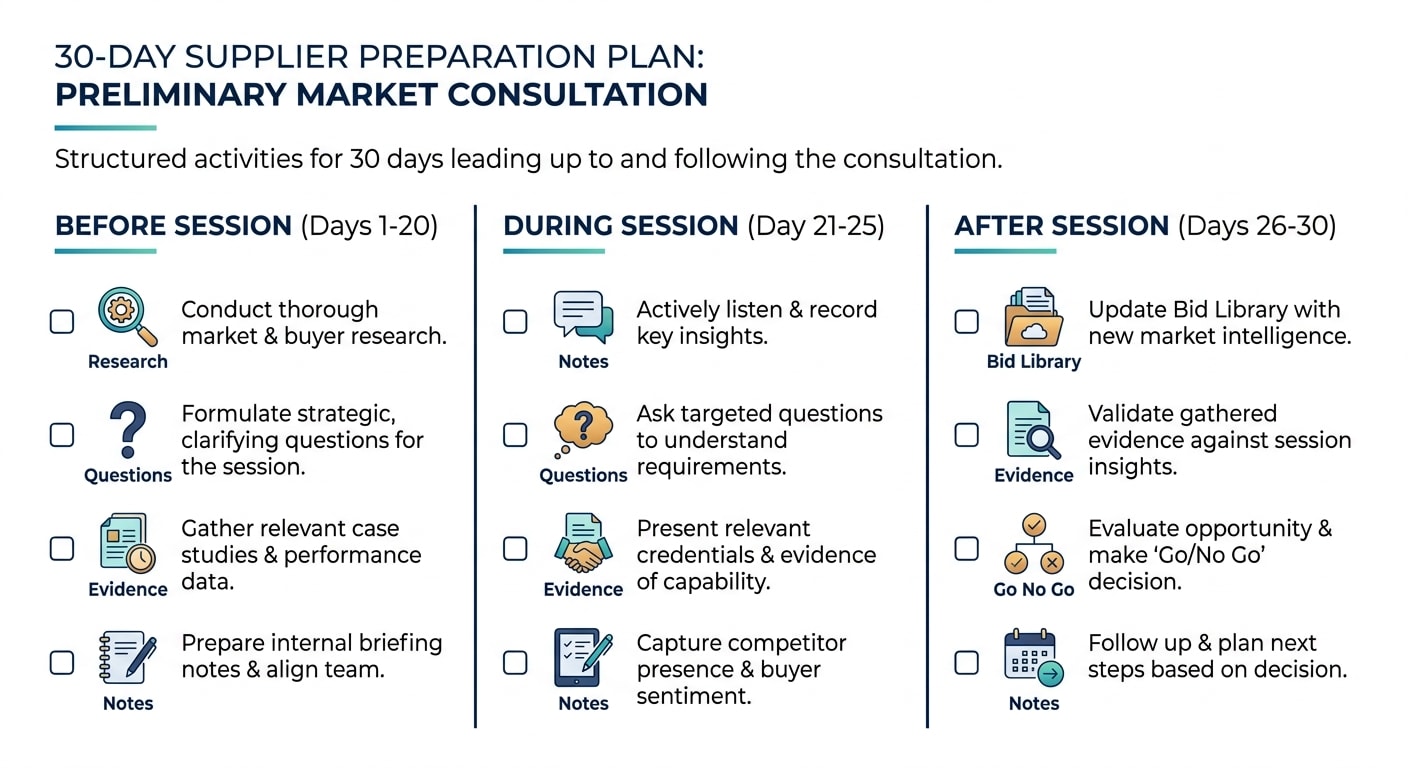
30 day preparation plan for preliminary market consultation procurement
This is not admin. It is pre-qualification engagement with commercial intent.
What To Do After the Tender Lands
When the tender notice arrives, compare it with what you learned during PME.
Look for three things.
Alignment. Did the final specification reflect the market feedback? If yes, your bid should mirror the buyer's stated priorities and show how your evidence fits them. Gaps. Did the buyer ignore a risk that came up during engagement? If so, address it carefully in your response. Do not sound critical.Show that you have understood the risk and have a credible control.
Signals. Did the award criteria reveal which themes matter most? Map every answer back to those themes. Do not bury the insight in the introduction and then write a standard response.This is where Procurement Act 2023 bid strategy becomes practical. You are not just responding to the document. You are responding to the journey the buyer took before the document existed.
The Board-Level Question
For MDs and commercial directors, the question is not "should we attend PME sessions?"
The question is: "Which future contracts are important enough that we should be engaging before procurement starts?"
That changes the operating model.
You need someone watching early notices, pipeline notices and buyer signals. You need account owners who can build credible relationships before tenders are live. You need bid teams that turn engagement learning into reusable evidence.
You need a qualification process that rewards early insight, not just deadline heroics.
Most importantly, you need to stop treating tenders as isolated events.
A tender is often the visible end of a much longer decision. Pre-market engagement is your chance to understand that decision while it is still forming.
Use PME To Compete Better, Not To Game the Process
Pre-market engagement under the Procurement Act 2023 gives suppliers a fairer way to contribute before a tender is fixed.
Used badly, it becomes a forgettable webinar. Used carelessly, it creates procurement risk. Used well, it helps buyers write better specifications and helps suppliers make better commercial calls.
That is why the best suppliers will not wait for the tender notice. They will track preliminary market consultation activity, show up with useful evidence, ask sharper questions, and build their bid plan before the deadline pressure starts.
If you want to see live public sector opportunities and start spotting early market signals in your sector, the Tender Finder is free to use.
Tags
Ready to Transform Your Tender Writing?
See how MyTender's AI can help you write winning tenders in a fraction of the time.