
Council Tenders 2026: How to Win Local Government Contracts
Master local government procurement with this comprehensive guide. Learn council tender requirements, evaluation criteria, compliance frameworks, and proven strategies to win more local authority contracts in 2026.
mytender.io Research Team
Local Government Procurement Specialists

UK council building with diverse community members representing transparent local government procurement
Local government procurement represents one of the most significant opportunities in the UK public sector contracting landscape. With over 400 local authorities collectively spending more than £60 billion annually on goods and services, understanding how to navigate council tenders effectively can transform your business growth trajectory.
For the fundamentals that apply in every sector, see our bid writing guide, how to respond to an invitation to tender and how to write a method statement.
Yet local government procurement operates under distinct rules, evaluation frameworks, and community expectations that differ substantially from central government contracting. This comprehensive guide examines everything you need to know to win local authority contracts in 2026, from understanding the regulatory environment to crafting compelling responses that demonstrate genuine community value.
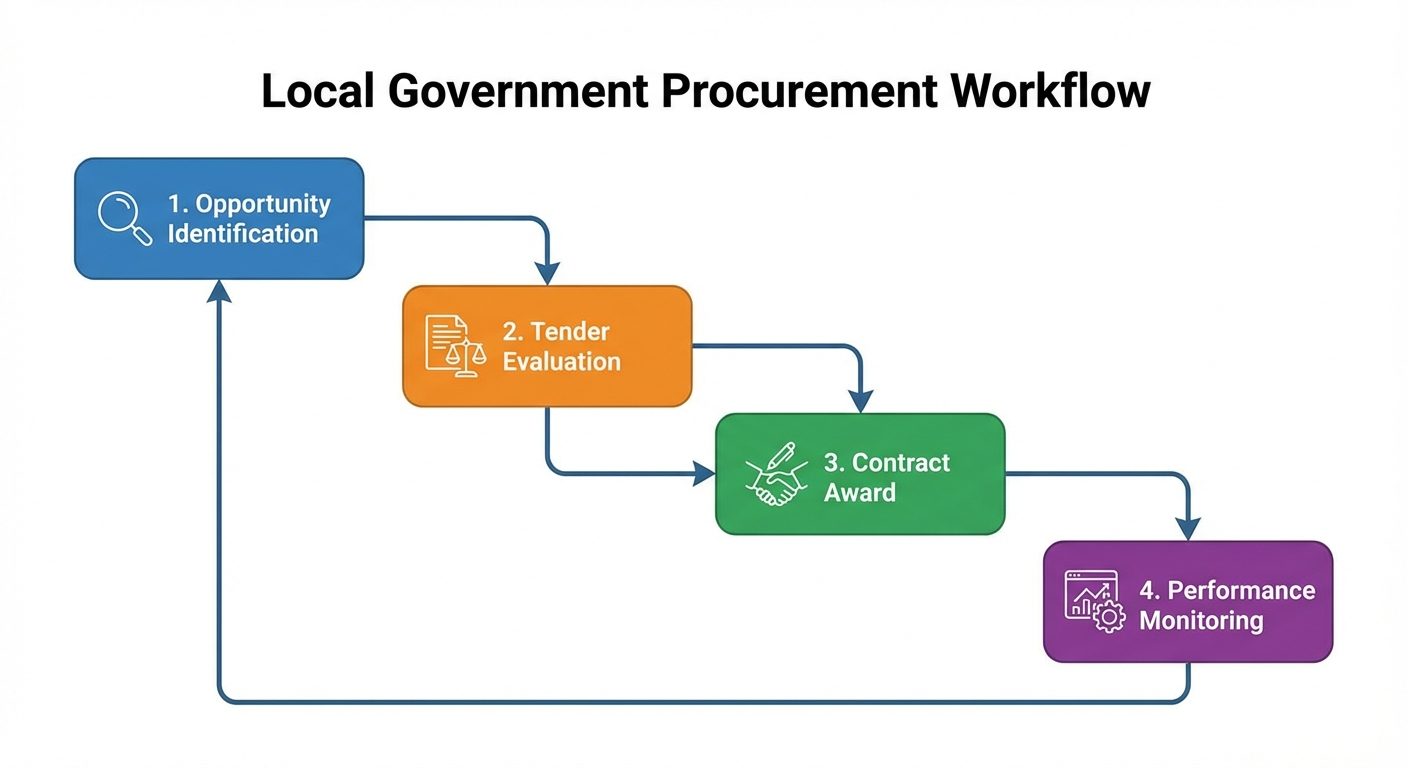
Local government procurement workflow diagram showing the tender process from opportunity identification to contract award
Understanding Local Government Procurement in 2026
The Procurement Act 2023, which came into force in February 2024, has fundamentally reshaped how local authorities conduct their purchasing activities. While the core principles of transparency, equal treatment, and value for money remain unchanged, the new framework introduces greater flexibility and emphasis on social value that forward-thinking suppliers must understand.
Local authorities operate under the National Procurement Policy Statement, which requires consideration of economic, social, and environmental benefits when awarding contracts above certain thresholds. This means your tender responses must demonstrate not just competitive pricing and technical capability, but genuine commitment to community outcomes, local economic development, and environmental sustainability.
Key differences between local and central government procurement:Local authorities typically have stronger emphasis on local economic impact, community engagement, and social value delivery. They often face intense scrutiny from elected councillors and local residents, making transparent communication and demonstrated community benefit essential. Decision-making cycles can be longer due to committee approval requirements, but relationships once established tend to be more stable and collaborative.
Council procurement teams are frequently smaller and more resource-constrained than central government departments, meaning they value suppliers who can demonstrate straightforward compliance, clear communication, and minimal administrative burden. Understanding these operational realities shapes how you should present your capabilities and structure your proposed delivery model.
The Local Authority Procurement Landscape
Local government purchasing spans an enormous range of requirements, from daily operational needs to major capital projects. The largest spending categories include social care services, highways and transport, waste management, construction and building maintenance, IT systems and support, and facilities management. Each category carries distinct evaluation priorities and regulatory requirements.
Current market dynamics in 2026:The sector continues adapting to sustained budget pressures following years of austerity, with councils under instruction to deliver "more for less" while maintaining service standards. This creates opportunity for innovative suppliers who can demonstrate genuine efficiency gains, not just cost-cutting that compromises quality. Digital transformation remains a priority, with significant investment in systems that improve service delivery and reduce administrative overhead.
The push toward carbon neutrality has intensified, with many councils setting ambitious net-zero targets for 2030 or earlier. Suppliers who can credibly demonstrate environmental benefits, sustainable supply chains, and support for local climate action plans gain substantial competitive advantage. Meanwhile, the social value requirement has evolved from compliance checkbox to central evaluation criterion, with councils increasingly sophisticated in assessing genuine community impact versus superficial claims.
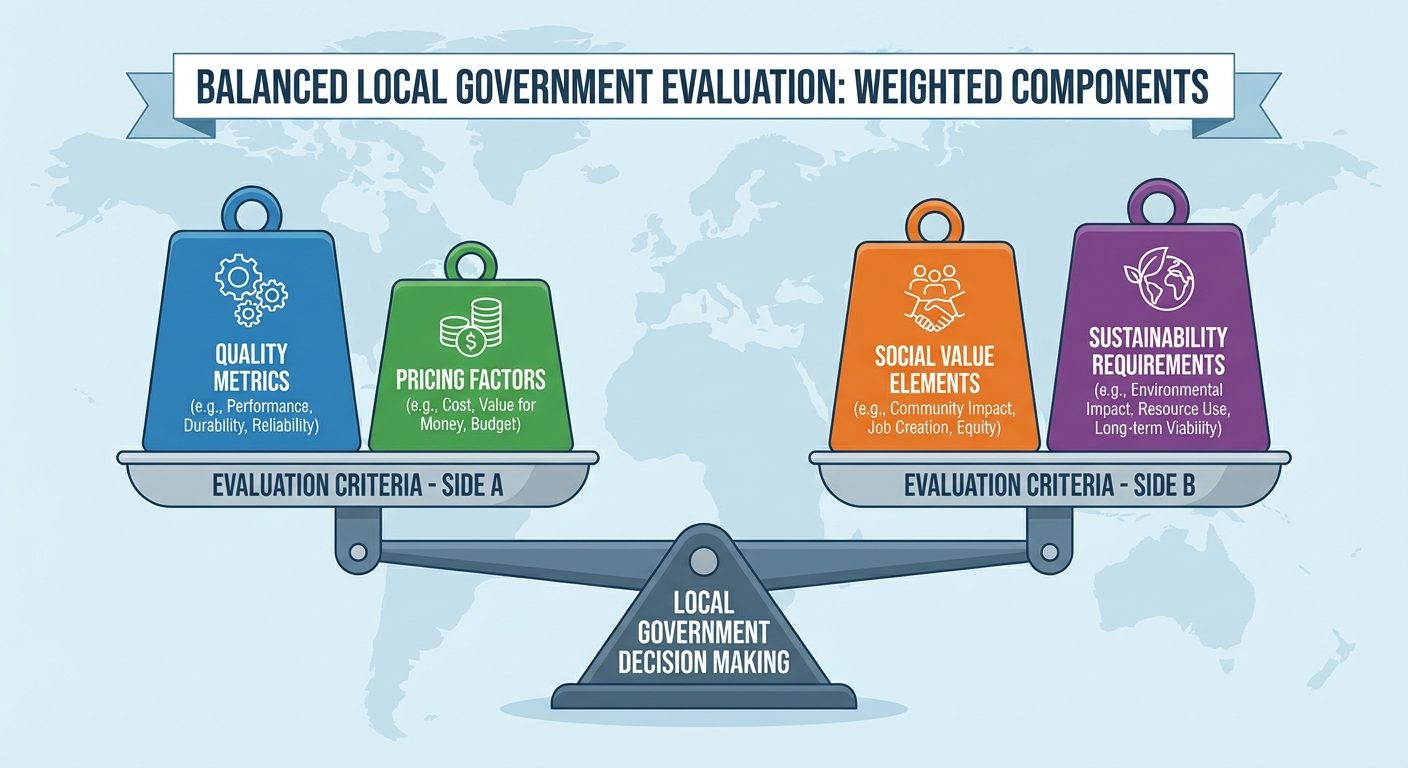
Key evaluation criteria diagram showing the balance between price, quality, social value, and sustainability in local government procurement
Regulatory Framework and Compliance Requirements
The Procurement Act 2023 establishes clear thresholds that determine procedural requirements. For goods and services, the threshold is £214,904; for works, it's £5,372,609. Light touch regime services, which include many health, social, and education services, have a threshold of £663,540. Below these thresholds, councils retain substantial discretion in their procurement approach, though they must still comply with general principles of transparency and value for money.
Mandatory exclusions and discretionary grounds:The Act specifies mandatory exclusions for serious offenses including fraud, money laundering, terrorist financing, and modern slavery violations. Councils also have discretion to exclude suppliers for issues like persistent contract breaches, significant tax irregularities, or evidence of grave professional misconduct. Your tender submission must include declarations addressing these areas, with any issues transparently disclosed and remedial actions clearly explained.
The Most Economically Advantageous Tender (MEAT) principle continues to govern evaluation, though the Act provides greater flexibility in how councils define and assess economic advantage. This includes explicit permission to consider wider benefits to the community and environmental impacts as part of the value assessment. Understanding how specific councils interpret and weight these factors is crucial for targeting your response effectively.
Contract Registers and Pipeline Visibility:Every local authority must maintain a contracts register providing details of contracts awarded, and many now publish forward procurement plans showing anticipated tenders for the coming 12-18 months. This transparency creates opportunity for early engagement, market warming activities, and strategic positioning before formal tenders are released. Regularly monitoring these resources should be a core element of your business development process.
Finding Local Government Tender Opportunities
Multiple platforms host local authority tenders, with varying levels of comprehensiveness. Contracts Finder remains the primary platform for public sector opportunities in England, with requirements for notices above certain thresholds. However, many councils also use regional procurement portals, framework agreement systems, or their own websites for lower-value opportunities.
The Find a Tender service (FTS), which replaced OJEU for post-Brexit procurement, is mandatory for opportunities above regulatory thresholds. But significant value exists below these thresholds, where councils have more procedural flexibility and sometimes face less intense competition. Monitoring individual council procurement pages, subscribing to supplier bulletins, and engaging with regional business support networks can reveal opportunities that never appear on major portals.
Framework agreements represent a critical route to market for local government business. Councils frequently use frameworks established by Crown Commercial Service, regional purchasing consortia like Yorkshire Purchasing Organisation or Eastern Shires Purchasing Organisation, or sector-specific bodies like London Councils or NHS Shared Business Services. Understanding which frameworks serve your target councils and securing places on relevant frameworks can dramatically simplify access to regular business flow. Early market engagement:Progressive councils conduct supplier engagement events, "meet the buyer" sessions, and prior information notices (PINs) to test market capacity and refine requirements before formal procurement. Participating in these activities builds visibility, allows you to shape specifications toward your strengths, and demonstrates proactive commitment to partnership. The relationships developed through early engagement often prove as valuable as the specific opportunity that prompted the interaction.
Decoding Local Government Tender Documentation
Council tender packs typically include the Invitation to Tender (ITT) document, specifications and requirements, pricing schedules, terms and conditions, and evaluation methodology. Unlike some central government tenders that run to hundreds of pages, local authority documentation is often more concise, though this doesn't mean requirements are simpler or evaluation less rigorous.
Common document structures:The specification outlines what the council needs delivered, including service standards, performance requirements, and quality expectations. Pricing schedules break down how you should present costs, often requiring detailed breakdowns rather than lump sum figures. This transparency allows councils to understand cost drivers and assess value for money more accurately. Terms and conditions cover contractual obligations, payment terms, insurance requirements, and dispute resolution procedures.
The evaluation methodology explains how responses will be scored, typically breaking down between quality and price elements with specified weightings. Social value often appears as a distinct scored element, though some councils integrate it within quality criteria. Understanding the weighting tells you where to focus effort—a tender with 70% quality weighting demands substantially different response strategy than one weighted 60% on price.
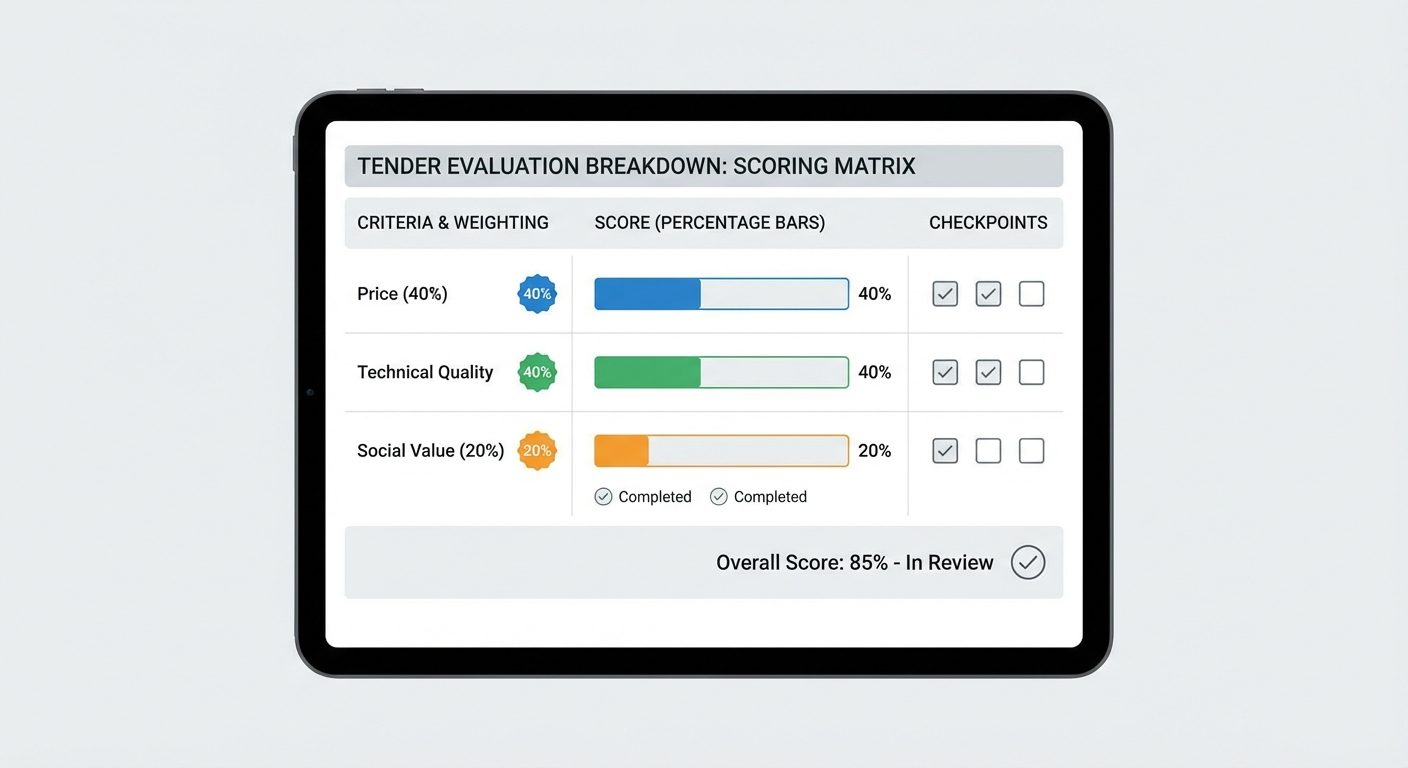
Tender evaluation scoring matrix showing typical weightings between price (40%), technical quality (40%), and social value (20%)
Council tenders typically request method statements addressing how you'll deliver specific requirements. These differ from central government "capability questions" by focusing more on practical delivery approach than organizational credentials. Evaluators want to understand your concrete plans, not just assert you have relevant experience. Strong method statements follow a clear structure: demonstrating understanding of the requirement, outlining your proposed approach, explaining resource deployment, identifying risks and mitigation strategies, and showing how you'll measure and report performance.
Word counts and formatting requirements:Many council tenders impose strict word limits, typically 300-500 words per question. This constraint forces prioritization and clarity. Evaluators appreciate concise responses that directly answer questions without filler content. Use formatting strategically—subheadings, bullet points, and bold text improve readability and help evaluators locate key information quickly. However, excessive formatting or graphics can appear like you're compensating for weak content, so balance visual interest with substantive information.
Quality and Technical Evaluation Criteria
Local authorities assess quality across several dimensions. Relevant experience requires demonstrating successful delivery of comparable contracts, ideally with references from similar-sized authorities or organizations. Rather than listing all experience, focus on the most relevant two or three examples that closely match the tender requirements in scope, complexity, and operating environment.
Resource and capacity questions assess whether you can realistically deliver what you promise. Councils need confidence you have adequate staff, appropriate qualifications, necessary equipment, and sufficient financial stability to complete the contract without service disruption. If you're a smaller organization bidding against larger competitors, emphasize your focus, specialization, and ability to provide senior attention rather than trying to match the headcount and infrastructure of bigger players. Delivery methodology evaluation examines how you'll actually perform the work. Strong responses describe clear processes, identify critical dependencies, explain how you'll manage interfaces with council staff and other contractors, and outline quality assurance mechanisms. If the service requires flexibility to respond to changing demands, explain how your approach accommodates this rather than just asserting you're flexible. Concrete examples of adapting to unexpected changes in previous contracts provide compelling evidence. Innovation and added value:Councils increasingly reward suppliers who propose improvements beyond basic specification compliance. This might include deploying new technology to improve service outcomes, providing additional community benefits at no extra cost, or implementing processes that reduce council administrative burden. However, innovation must be relevant and realistic—proposing bleeding-edge solutions requiring massive council investment typically backfires. The most effective innovation demonstrates incremental improvement that council staff can easily adopt and maintain.
Contract mobilization and transition:If you're taking over from an existing provider, councils need confidence you can transition smoothly without service disruption. Describe your mobilization plan with realistic timelines, explain how you'll maintain business continuity during handover, outline stakeholder communication approaches, and detail how you'll capture knowledge from the outgoing provider. Understanding TUPE regulations and demonstrating fair treatment of transferring staff is particularly important in service-based contracts.
Pricing Strategy for Local Government Tenders
While pricing weight varies, councils remain extremely price-sensitive due to ongoing budget pressures. However, "lowest price wins" is increasingly rare. Most tenders use some form of price-quality evaluation where the lowest bidder doesn't automatically win. Understanding the specific evaluation formula is crucial for calibrating your pricing strategy.
Common pricing evaluation methods:Many councils use a formula where the lowest price receives maximum points and higher prices receive proportionally fewer points. For example, if your price is 20% higher than the lowest bidder on a tender where price counts for 40% of total marks, you might lose 8 percentage points overall. You can only win if your quality scores exceed competitors by more than this margin. This mathematical reality should inform how aggressive your pricing needs to be given your quality strengths.
Some councils use price bands or ranges, where all bids within a defined range receive equal price scores and only quality differentiates them. This approach reduces pressure for unsustainably low pricing and can favor established providers with stronger quality propositions. Understanding whether the tender uses banded pricing versus pure ratio formulas should shape your approach significantly.
Whole life costing considerations:Progressive councils consider total cost of ownership rather than just initial purchase price. This includes ongoing maintenance, energy consumption, disposal costs, and environmental impacts. If your solution has higher upfront costs but substantially lower running costs, clearly articulate this in your pricing narrative. Provide calculations showing total expenditure over the contract term, demonstrating genuine savings despite higher initial pricing.
Schedule of rates versus fixed prices:Many service contracts use schedules of rates rather than fixed prices, particularly where demand volumes fluctuate or the council wants flexibility to vary scope. Pricing these effectively requires understanding likely usage patterns and balancing competitive headline rates with sustainable margins. Councils often model different usage scenarios when evaluating rate-based submissions, so providing clear explanations of what's included in each rate and how additional services are charged helps evaluators understand your true value proposition.
Social Value and Community Benefit Requirements
Since 2021, the Public Services (Social Value) Act requires councils to consider how procurement can improve economic, social, and environmental well-being. What started as a modest requirement has evolved into a major evaluation criterion, often weighted at 10-20% of total scores. Understanding what councils actually value versus generic social value claims is essential for competitive responses.
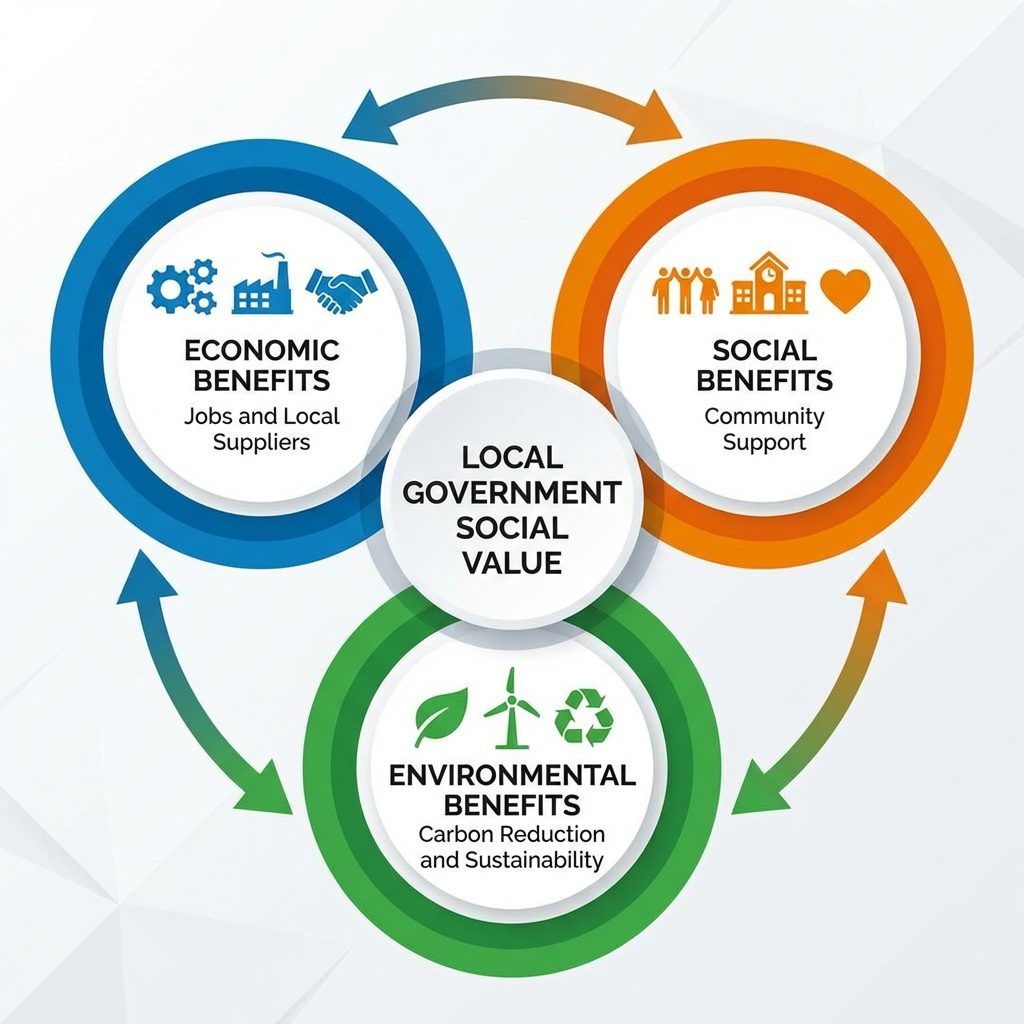
Social value framework showing economic, social, and environmental priorities for local government procurement
Local authorities prioritize local economic impact—creating jobs in the area, using local suppliers in your supply chain, providing apprenticeships and training opportunities, and supporting local businesses to grow and develop. Effective commitments are specific and measurable: "We will create 5 new full-time roles in [location], prioritizing recruitment from residents facing barriers to employment, and provide guaranteed interviews for local applicants." Generic claims like "we'll support the local economy" score poorly.
Social benefits:Councils value activities that address local priorities identified in their strategic plans. This might include providing education and skills development, supporting vulnerable groups, contributing to community safety, or enhancing public health outcomes. Research the specific council's priorities before crafting social value commitments—what matters intensely to one authority may be irrelevant to another. Many councils publish social value frameworks or priorities on their procurement pages.
Environmental commitments:Most councils have declared climate emergencies and set net-zero targets, making environmental social value increasingly important. Strong commitments include reducing carbon emissions in service delivery, minimizing waste, using sustainable materials, supporting biodiversity, and helping the council achieve its environmental objectives. Again, specificity matters—"We'll reduce fleet emissions by 30% through transitioning to electric vehicles on this contract" is far more credible than "we're committed to sustainability."
Measuring and reporting:Councils need confidence you'll actually deliver promised social value rather than winning on attractive commitments then failing to implement. Describe how you'll measure each commitment, how often you'll report progress, and what happens if you fall short of targets. Some councils now include social value performance in contract management processes, with consequences for underdelivery. Demonstrating established tracking systems and examples of social value delivery from other contracts provides strong evidence.
Demonstrating Local Capability and Community Connection
While councils can't formally discriminate in favor of local suppliers, they consistently value strong local presence and understanding of community context. If you're based in or near the council area, emphasize this. If you're bidding from outside the area, demonstrate how you'll establish genuine local presence and engagement.
Local knowledge and stakeholder understanding:Show you understand the specific challenges and priorities facing that community. Reference local demographics, economic conditions, or recent developments that inform your approach. For example, if the council area has high deprivation in certain wards, explain how your delivery model ensures equitable service access. If there's significant rural population, address how you'll maintain service standards across dispersed geography.
Community engagement approach:Many services require interaction with residents or local organizations. Describe how you'll engage with community stakeholders, gather feedback, and adapt services based on local input. Councils value suppliers who view residents as partners rather than passive service recipients. If you have existing relationships with local community groups, schools, charities, or businesses, mention these as they demonstrate established commitment rather than opportunistic claims.
Case studies from similar communities:Reference examples from comparable councils where you've delivered successfully. Councils facing similar demographic, geographic, or socioeconomic conditions to their own find these case studies particularly relevant. Explain challenges you encountered that parallel likely issues in the target council, and how you addressed them effectively. This helps evaluators visualize your capability in their specific context.
Risk Management and Contract Delivery Assurance
Councils are inherently risk-averse. They face intense public and media scrutiny when services fail, with potential political consequences for council leadership. Your tender must provide confidence that you understand potential risks and have robust plans to prevent and mitigate them.
Risk identification and mitigation:Identify specific risks relevant to the contract and explain your mitigation strategies. Don't just list generic risks that could apply to any contract—focus on those most pertinent to the particular service, delivery environment, and stakeholder context. For each risk, explain likelihood and potential impact, preventive measures to reduce occurrence probability, and contingency plans if the risk materializes despite prevention.
Business continuity and disaster recovery:For critical services, councils need assurance about continuity if problems occur. Describe backup systems, alternative delivery arrangements, and recovery time objectives. If service interruption would significantly impact residents or council operations, explain redundancy built into your delivery model. Having detailed business continuity plans that you can reference (even if not included in full in the tender response) demonstrates mature risk management.
Financial stability and insurance:Councils assess financial health to ensure you can sustain delivery throughout the contract term. Financial statements, credit ratings, or parent company guarantees may be required. Professional indemnity insurance, public liability insurance, and sometimes specific coverage like cyber insurance are typically mandatory. Confirm you meet or exceed minimum requirements and explain any additional protections in place.
Subcontractor management:If you're using subcontractors, explain how you'll manage them to ensure consistent quality and compliance. Councils worry about prime contractors who subcontract extensively then provide inadequate oversight. Describe selection criteria for subcontractors, how you'll monitor their performance, and what happens if subcontractors underperform. Many councils now require transparency about intended subcontracting arrangements in tender submissions.
Contract Management and Performance Monitoring
Council tender documentation usually outlines performance monitoring requirements. Understanding these requirements and demonstrating strong contract management capability is crucial, particularly for larger or longer-term contracts.
Performance indicators and reporting:Most contracts include Key Performance Indicators (KPIs) measuring critical service aspects. Your response should acknowledge these KPIs, confirm you can track and report against them, and explain how you'll use performance data to drive continuous improvement. If you think proposed KPIs miss important aspects or could be strengthened, suggesting enhancements (while confirming you'll comply with requirements as written) can demonstrate sophisticated understanding.
Regular review and communication:Describe your proposed engagement model with council contract managers. This typically includes regular operational meetings, periodic strategic reviews, and clear escalation routes for issues. Councils value suppliers who proactively communicate about delivery, identify emerging issues early, and propose solutions rather than waiting for the council to spot problems. Outline your relationship management approach and who will be the council's main points of contact.
Continuous improvement culture:Leading councils want suppliers committed to innovation and improvement throughout the contract term, not just at tender stage. Explain how you'll systematically identify improvement opportunities, test new approaches, and share learning. Examples of improvements implemented during existing contracts provide credible evidence of genuine commitment rather than tender-time promises.
Common Mistakes That Lose Local Government Tenders
Certain errors repeatedly undermine otherwise strong submissions. Generic responses that could apply to any council signal you haven't engaged seriously with the specific opportunity. Evaluators immediately recognize copy-paste content that doesn't address their unique situation, priorities, or requirements. Tailor every response to the specific council and opportunity.
Ignoring word limits damages scores even if your content is strong. Evaluators typically stop reading at the word limit, meaning your most compelling points may never be seen if they appear late in an over-length response. Discipline yourself to prioritize information and edit ruthlessly. If you consistently struggle with word limits, you're probably including unnecessary detail or failing to structure arguments efficiently. Weak or irrelevant case studies waste valuable space. Every example should clearly demonstrate capability relevant to the tender. Include specifics: What was the context? What did you deliver? What results were achieved? How do these relate to the current opportunity? Vague descriptions like "we successfully delivered a similar service" with no detail or measurable outcomes provide no value to evaluators. Overlooking the evaluation methodology is surprisingly common. If social value counts for 20% of marks but receives minimal attention in your response, you've unnecessarily handicapped yourself. If the methodology heavily weights delivery methodology over experience, don't spend most of your response on credentials while glossing over your delivery approach. Let the evaluation weightings guide your effort allocation. Poor presentation and basic errors create negative impressions. While substance matters most, sloppy formatting, inconsistent styling, spelling mistakes, or incorrect references undermine confidence in your attention to detail. If you can't compile an error-free tender, evaluators wonder whether you'll deliver error-free services. Always proofread carefully and ideally have someone unfamiliar with the content review for clarity and errors.Using Technology to Improve Local Government Tender Success
Modern AI-powered tender writing platforms like MyTender have transformed how organizations approach local government procurement. Rather than starting from blank pages for each tender, these systems maintain libraries of pre-approved content, automatically adapt responses to specific requirements, and ensure consistency across multiple bids.
Content library management:Effective platforms allow you to store and categorize examples, case studies, policy statements, and methodology descriptions that can be rapidly retrieved and customized for each tender. This eliminates duplication of effort when similar questions appear across multiple tenders, ensures your strongest content is consistently deployed, and maintains quality standards even when different team members contribute to various bids.
Requirement analysis and gap identification:Advanced systems can parse tender documentation, identify questions and requirements, flag potential risks or unusual demands, and highlight gaps in your current capability or planned response. This systematic analysis ensures nothing is missed and allows strategic decisions about where to focus development effort or whether to pursue opportunities that don't align well with your strengths.
Collaborative workflow and review:Multiple contributors need to work efficiently on complex tenders without version control chaos or duplicated effort. Good platforms provide structured workflows where specific sections are assigned to subject matter experts, progress is tracked transparently, and review cycles are managed smoothly. Stakeholder review and approval processes are documented for quality assurance and organizational learning.
Data-driven improvement:Analyzing historical bid data reveals patterns in what works. Which case studies score consistently well? Which methodologies resonate with specific types of councils? Where do you regularly lose marks? Systematic analysis of feedback from wins and losses should drive continuous refinement of your approach, content library, and strategic positioning.
Strategic Positioning for Long-Term Local Government Success
Winning a single tender is an achievement, but building sustainable local government business requires strategic thinking beyond individual opportunities. Successful suppliers develop reputations, build relationships, and position themselves as trusted partners rather than transactional vendors.
Framework positioning:Securing positions on relevant frameworks creates multiple advantages. The initial framework competition may be intense, but once appointed, you gain simplified access to all participating councils throughout the framework term. Many framework call-offs use shortened procedures focusing primarily on service design and pricing for the specific council's needs, with technical capability already established through the framework evaluation. Research which frameworks serve your target sectors and geographies, and invest in winning places on the most strategic ones.
Building council relationships:While formal procurement processes require equal treatment during competitive tenders, councils welcome supplier engagement outside procurement processes. Attend sector events, participate in consultation exercises, respond to soft market testing, and offer knowledge sharing. These interactions build familiarity and trust that don't influence formal evaluation scores but do affect whether councils think of you when shaping requirements or conducting early market engagement.
Thought leadership and sector contribution:Contributing expertise to sector knowledge development positions you as a credible authority rather than just another supplier. This might include publishing insights on sector challenges, participating in working groups, speaking at conferences, or collaborating on pilot initiatives. Councils increasingly value suppliers who contribute to sector improvement, not just extract profit from contracts.
Geographic and sector focus:Trying to win everything everywhere typically results in winning nothing anywhere. Successful suppliers often concentrate on specific geographies where they can build genuine local presence and understanding, or specific service sectors where they can develop deep expertise. This focus allows more sophisticated tailoring of offerings, builds credibility through visible specialization, and creates efficiency through shared learning across similar contracts.
Preparing Your Organization for Local Government Contracting
Success in local government procurement requires organizational capability beyond just strong tender writing. Your business must be genuinely ready to deliver what you propose, work within public sector frameworks, and maintain relationships over extended contract terms.
Compliance and governance infrastructure:Public sector contracts come with substantial reporting, audit, and governance requirements. You need systems to track performance against KPIs, document compliance with contractual obligations, manage freedom of information requests, and respond to audit requirements. If you're moving from private sector business into local government work, these requirements can be surprising. Invest in appropriate systems early rather than retrofitting after winning contracts.
Cultural alignment:Public sector organizations operate differently from private businesses. Decision-making can be slower due to committee approval requirements and political oversight. Transparency expectations are higher. Communication styles may be more formal. Suppliers who understand and respect these differences build stronger relationships than those who try to force private sector approaches onto public sector partners.
Long-term relationship perspective:Local government contracts often run for multiple years with potential extensions. Success requires genuine partnership mentality rather than transactional relationships focused solely on contract deliverables. Councils remember suppliers who provide excellent service during contract delivery, respond flexibly to changing needs, and contribute beyond minimum contractual obligations. These reputations influence future procurement decisions, reference calls, and informal recommendations to other councils.
Conclusion: Building Your Local Government Procurement Strategy
Local government procurement offers substantial opportunities for organizations that understand its distinctive requirements, priorities, and evaluation frameworks. Success requires more than strong technical capability and competitive pricing—you must demonstrate community commitment, social value contribution, and genuine partnership mentality.
The Procurement Act 2023 and evolving social value expectations have intensified focus on broader outcomes beyond immediate service delivery. Councils increasingly select suppliers who contribute to strategic objectives around local economic development, environmental sustainability, and social equity. Understanding these priorities and translating them into credible, measurable commitments has become essential for competitive success.
Technology platforms like MyTender enable organizations to respond more effectively to local government opportunities by maintaining consistent quality across multiple bids, ensuring compliance with complex requirements, and learning systematically from each tender experience. As procurement volumes continue increasing and competition intensifies, these tools increasingly separate winners from losers.
Start by building deep understanding of your target councils' strategic priorities, budget pressures, and procurement approaches. Research their published forward plans, analyze recent contract awards to understand evaluation preferences, and engage in early market interactions where opportunities exist. This intelligence allows sophisticated targeting of opportunities where your capabilities align strongly with council needs, rather than spreading effort across poorly-matched tenders.
Develop robust content libraries covering your capabilities, methodology, experience, and social value commitments. Structure these libraries to enable rapid customization while maintaining quality and consistency. Invest in skills and technology that support efficient, high-quality tender development at pace—the councils with most opportunities often have short turnaround times that favor well-prepared suppliers.
Most importantly, recognize that local government procurement success is about long-term relationships and reputation as much as individual tender responses. Deliver excellent service on every contract, contribute to sector improvement, and position yourself as a trusted partner committed to public service outcomes. This strategic approach builds sustainable business that extends far beyond any single tender opportunity.
Tags
Ready to Transform Your Tender Writing?
See how MyTender's AI can help you write winning tenders in a fraction of the time.