
How to Write a Mobilisation Plan That Convinces Evaluators (2026)
A winning mobilisation plan does three things evaluators actually mark. Most bidders write generic plans the evaluator has read 30 times before — here is what scores, section by section, with the structures that move you from a 60/100 answer to an 85/100.
mytender.io Research Team
Tender Writing & Bid Management Specialists
How to Write a Mobilisation Plan That Convinces Evaluators (2026)
A winning mobilisation plan does three things evaluators actually mark: it proves you have understood the specific contract — not just mobilisation in general; it shows a credible, dated timeline with a named lead and clear contingencies; and it evidences risk awareness with mitigations the evaluator recognises from their own contracts going wrong.
Most bidders lose marks on this section not because they leave things out, but because they write plans the evaluator has read 30 times before. The same headings, the same generic timelines, the same boilerplate risk register copied from the last bid.
This guide is for the bid manager writing the mobilisation section tomorrow morning. It breaks down what evaluators score, section by section, with the structures that move a 60/100 answer to an 85/100.
Mobilisation plan: what evaluators actually score
Why Mobilisation Matters More Than Most Bidders Realise
In facilities management, cleaning, security and grounds-maintenance tenders, the mobilisation question is regularly weighted at 10–20% of the overall quality score. On a £5m three-year contract, that is the difference between winning and losing.
It also carries a different kind of weight. Evaluators read the mobilisation answer to decide whether you are credible enough to actually deliver. A weak mobilisation plan undermines the rest of the bid. The reader thinks: the methodology section sounds good, but if they cannot describe how they would start the contract, can I trust them to run it for three years?
Conversely, a strong mobilisation plan does the opposite. It signals that the bidder has done this before, has thought about the buyer's specific situation, and has the maturity to handle the messy first 90 days. That perception bleeds into how the rest of the bid is read.
If you only fix one thing in your tender writing this year, fix the mobilisation section. The marks-per-hour ratio is higher than almost anywhere else.
What Evaluators Are Actually Scoring (the Six Things)
Across hundreds of evaluation moderation reports, six things come up consistently. Get all six right and you are in the 80+ band. Miss two of them and you are stuck in the high 50s.
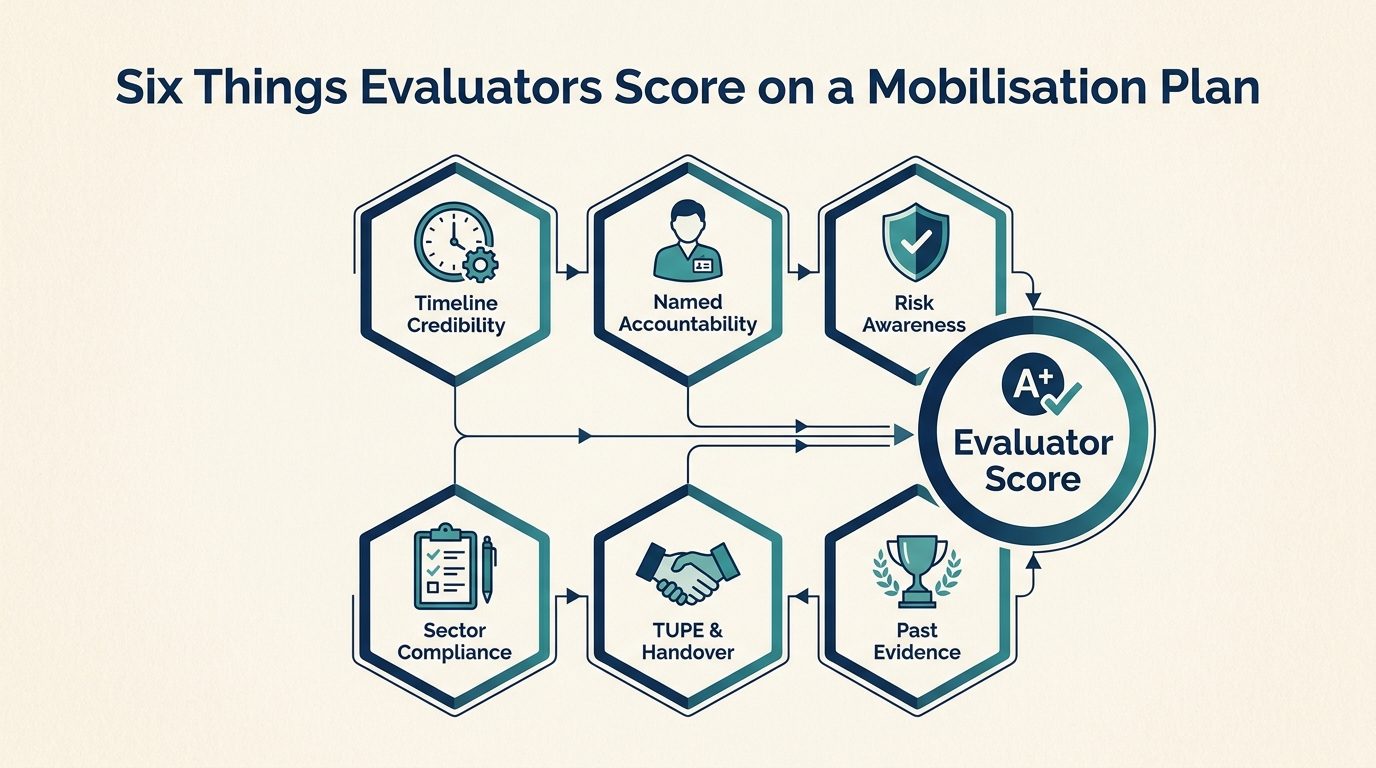
The six things evaluators score on a mobilisation plan
1. Timeline Credibility
Low-mark version: "We will mobilise in eight weeks following a phased approach." High-mark version: A dated Gantt chart with named workstreams, dependency arrows between tasks, and contingency built in. Day-by-day for the first fortnight, weekly for weeks 3–6, and named milestones (TUPE consultation complete, uniform issue, IT systems live, first joint operational review) with dates relative to the contract award date.The evaluator is not testing whether your plan is fast. They are testing whether it is plausible. Eight weeks is fine. Eight weeks with a credible breakdown is excellent.
2. Named Accountability
Low-mark version: "Our mobilisation team will be supported by senior management." High-mark version: A named Mobilisation Lead with a photo or initials, years of experience, and a specific note about contracts they have mobilised previously (anonymised if commercially sensitive). A secondary lead named for cover. A clear RACI for the first 30 days showing who is responsible for what.Evaluators are sceptical of "the team" and "senior management." They are reassured by named, accountable individuals — even if those names are obviously generic placeholders for the contract you have not won yet.
3. Risk Awareness
Low-mark version: A three-row risk register with "delays in onboarding," "supply chain issues" and "weather" — graded amber and mitigated by "robust planning." High-mark version: A risk register populated with risks the evaluator recognises. For an FM contract: TUPE information arriving late or incomplete. For a cleaning contract: incumbent staff failing right-to-work checks at transfer. For security: SIA licence lapse during the consultation period. Each with a specific mitigation that names a process, not a platitude.The evaluator's mental test: would I add anything to this risk register? If the answer is no, you are scoring 8/10 or higher on that subcriterion.
4. Sector-Specific Compliance
Low-mark version: "We will comply with all relevant regulations during mobilisation." High-mark version: The compliance items the buyer's contract manager actually loses sleep over. For FM: IOSH/CSCS verification, asbestos register handover, fire-risk assessment review. For cleaning: COSHH datasheets, equipment PAT testing, Safer Recruitment vetting where the contract is in education or care. For security: SIA licence verification with expiry tracking, vetting to BS 7858, ACS audit readiness.Naming the specific frameworks signals you have done this before. Generic compliance language signals you might be reaching for it for the first time.
5. TUPE and Incumbent Handover
This is its own section below, but for scoring purposes: if there is an incumbent and you barely mention TUPE, you cannot score above 60. If you handle TUPE convincingly, you cannot score below 70.
6. Past Evidence
Low-mark version: "We have successfully mobilised many contracts." High-mark version: Two or three concrete past mobilisations, each with: contract size or scope, the mobilisation timeline you achieved, the specific challenge encountered, and the outcome. Anonymise if you must, but quantify. "A 47-site cleaning contract mobilised in six weeks despite a two-week delay in the incumbent's TUPE information" beats "We mobilised a large national contract on time" every time.The Mobilisation Timeline That Wins Marks
The structure below is the one that consistently scores well across FM, cleaning, security and grounds-maintenance tenders. Adapt the contents; keep the phasing.
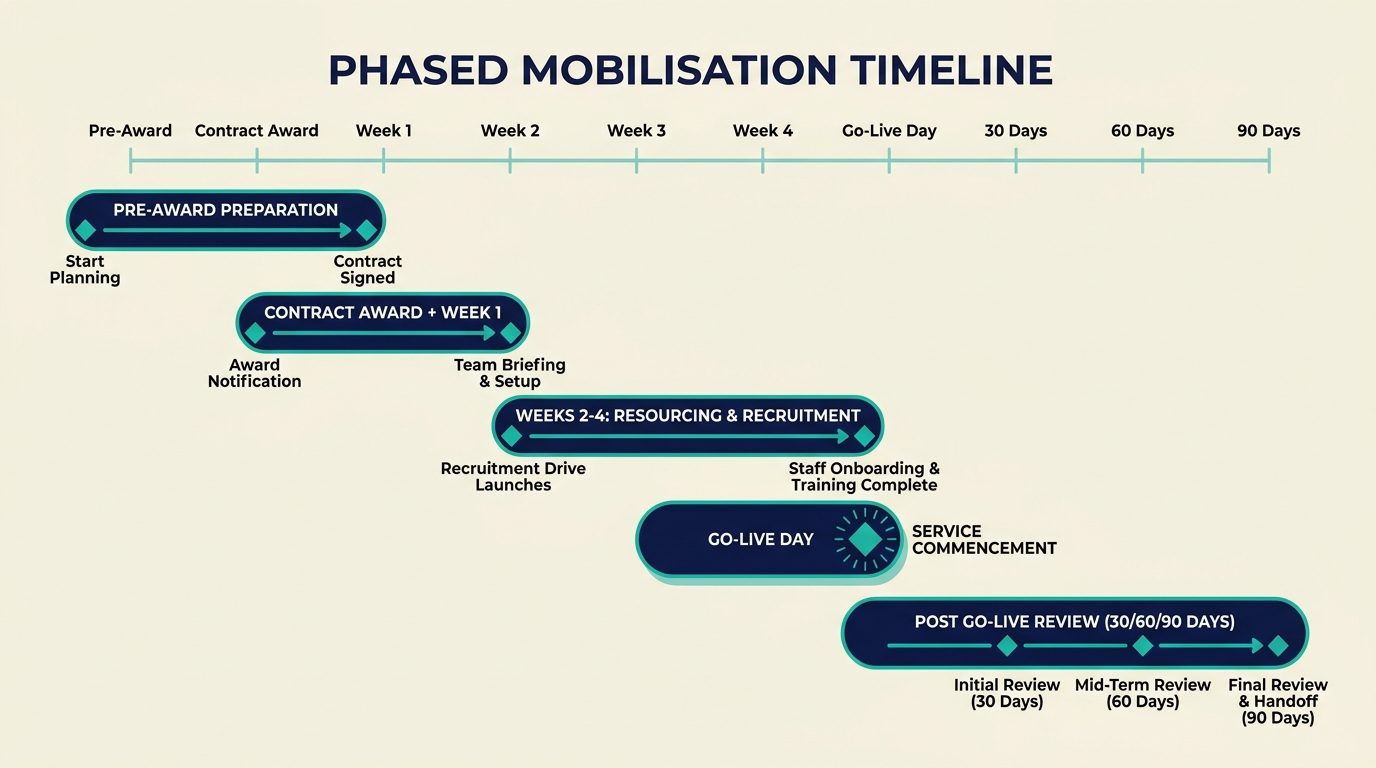
Phased mobilisation timeline from pre-award to post-go-live review
Phase 0 — Pre-Award Preparation (before contract award)
Often forgotten, almost always rewarded. Evaluators love bidders who say what they will do before the formal contract starts. Examples: tentative resource planning, draft TUPE information request templates ready, supply chain partners alerted, mobilisation lead's calendar protected.
This phase signals professionalism. Most bidders skip it because the contract is not yet awarded. Including it shows you take mobilisation seriously enough to invest before you are paid.
Phase 1 — Contract Award + Week 1 (Days 0–7)
The most heavily scrutinised section. Should include: kick-off meeting with the buyer (proposed agenda), formal TUPE information request issued, governance structure stood up, first weekly progress report scheduled, mobilisation lead's site visits booked.
If your Day-1 actions are vague, the evaluator stops trusting the rest of the plan.
Phase 2 — Weeks 2–4: Resourcing and Recruitment
The operational backbone. TUPE consultation, recruitment for any gaps, training rollout, IT and systems setup, supplier onboarding, uniform and PPE distribution. Each item with a target date and a named owner.
Evaluators often mark this phase against the buyer's own timeline. If the buyer says "go-live in six weeks" and your Phase 2 runs to week eight, your plan does not match the requirement and you lose marks regardless of how well it is written.
Phase 3 — Go-Live Day
Treat this as a discrete, named event. Should include: the operational checklist completed before go-live, the contingency plan if any element is not ready, the on-site presence of the mobilisation lead and senior management, the communication plan to the buyer for the first 24 hours, the pre-agreed escalation route.
A common trap: bidders treat go-live as a date rather than an event. Evaluators want to know what happens on Day 1.
Phase 4 — Post Go-Live Review (30/60/90 days)
The phase most bidders forget. A formal 30-day review with the buyer, a 60-day operational stabilisation review, a 90-day contract embedment review with KPIs reported against. This signals to the evaluator that you understand mobilisation does not end at go-live — it ends when the contract is genuinely operational.
Including this phase reliably adds 5–10 marks on its own.
Risk and Contingency: The Section Bidders Treat as Boilerplate (and Lose Marks On)
Most mobilisation risk registers are useless. They list generic risks ("delays," "weather," "staff turnover") with generic mitigations ("close monitoring," "robust planning"). Evaluators have read this version a thousand times. It scores in the low 60s.
The version that scores well looks specific to this contract. It uses the buyer's own risk language where possible (review their procurement strategy or service specification — the risks they are most worried about will be named there). It assigns each risk a likelihood and impact rating you have actually thought about. And every mitigation references a specific action with a specific owner, not a feeling.
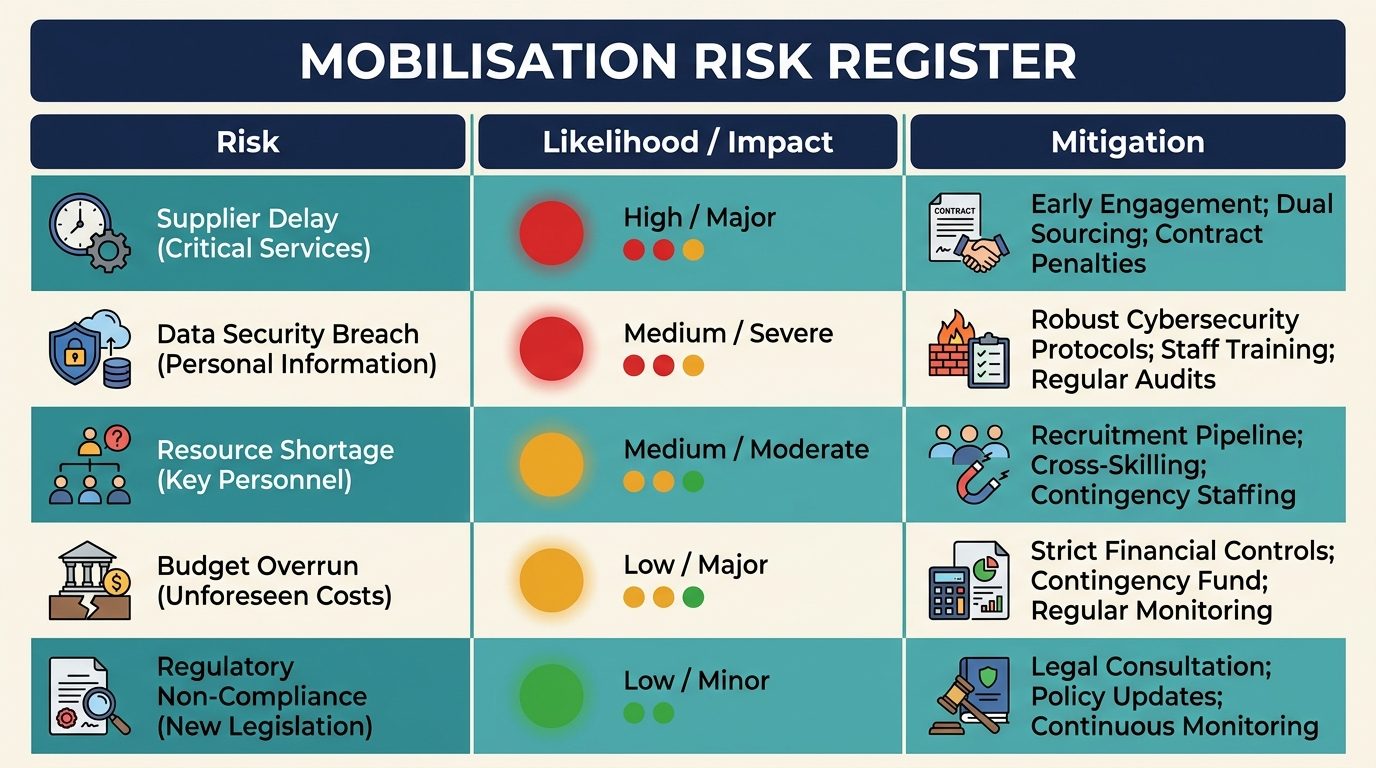
Mobilisation risk register: risk, likelihood/impact, mitigation
A useful test: read your risk register and ask whether every mitigation describes something a reasonable observer could verify happening. "Robust planning" cannot be verified. "Mobilisation lead conducts daily standup with workstream leads from Day 1 to Day 14, escalation to operations director if any RAG goes red for 48 hours" can.
Risks Evaluators Expect to See for FM, Cleaning and Security
These are the ones that earn credibility because they show the bidder has actually run mobilisations before:
- Incumbent TUPE information arriving late or incomplete. Mitigation: information request issued day 1 with a 14-day response deadline; if not received, formal escalation to the buyer's commercial team and a parallel resource plan based on tender-pack assumptions.
- TUPE-transferring staff failing right-to-work or vetting checks at transfer. Mitigation: pre-go-live verification window, contingency agency cover pre-booked.
- Specialist licences lapsing during the consultation period (SIA for security, CSCS for FM trades, food hygiene for catering). Mitigation: licence audit on Day 1; renewal funding pre-approved.
- Fleet, uniform or equipment lead times exceeding the mobilisation window. Mitigation: pre-award stock holding with named suppliers; interim hire arrangement signed off.
- Buyer-side delays (data, access, IT credentials, building passes). Mitigation: weekly RAG reporting to the buyer with explicit action owners; written escalation route into the procurement team.
If your risk register includes specific versions of three or four of these, you are already ahead of most of the field.
TUPE and Incumbent Handover — The Make-or-Break Element
For any service contract with an incumbent — which is almost every FM, cleaning, security or grounds contract you will bid for — TUPE handling is the single most-scrutinised part of the mobilisation plan. Get it right and you reassure the evaluator. Get it wrong and the rest of the bid is fighting uphill.
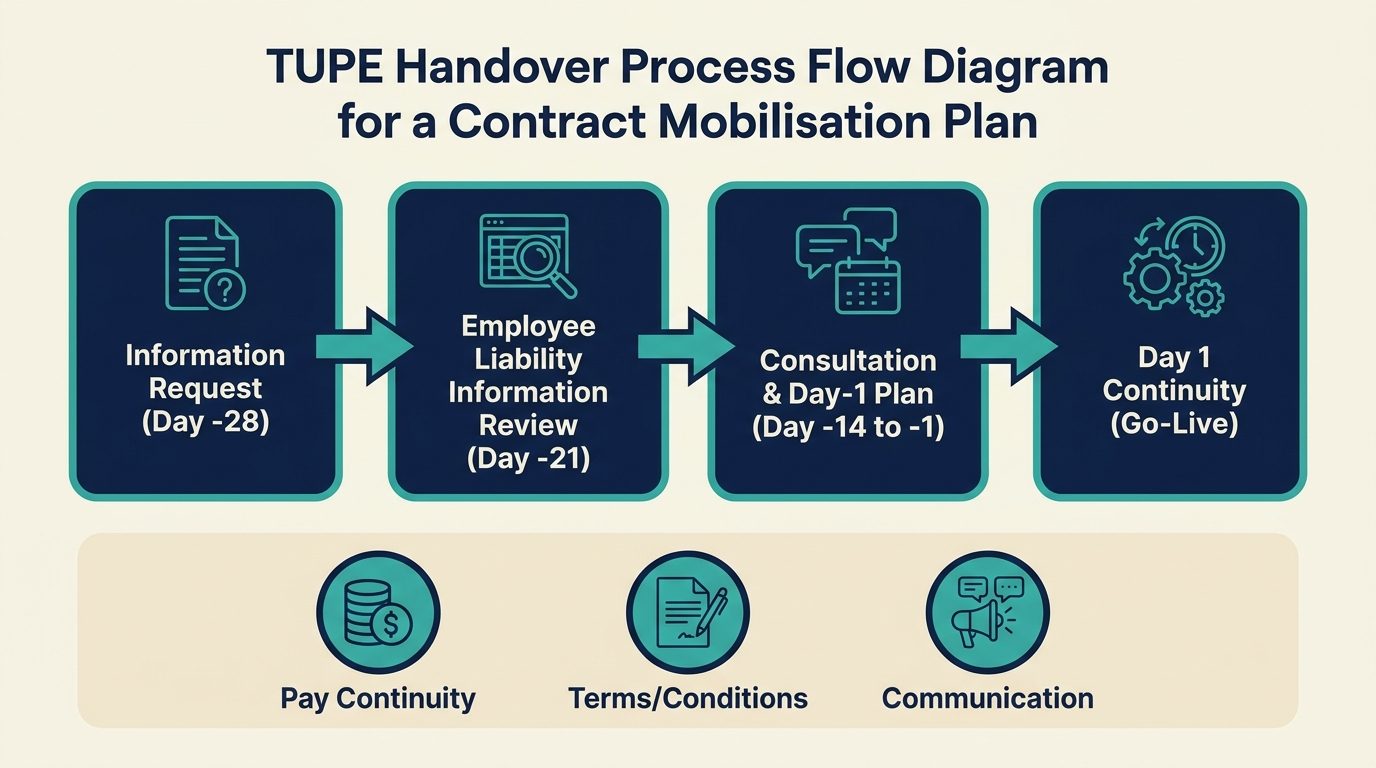
TUPE handover process from information request to Day 1 continuity
What Evaluators Look For
A clear sequence with realistic dates:
- Information request issued within 24 hours of contract award, asking the buyer to obtain Employee Liability Information (ELI) from the incumbent under TUPE Regulation 11.
- ELI review window — typically 21 days before transfer — with named legal/HR oversight, a process for clarification questions, and a timetable for any "measures" letter.
- Consultation with affected employees (and their representatives) commencing at least 30 days before transfer where reasonably practicable, with the consultation purpose, location and process specified.
- Day-1 continuity plan — pay processed without interruption, terms and conditions transferred, line management introduced, uniform and ID provided. The "Day 1 employee experience" test: the transferring colleague should know who they report to, where to be, and that their pay is unaffected.
The evaluator's mental model is simple: would I, as a transferring employee, feel reassured reading this plan? Write to that audience and you will score.
Common Pitfalls
- Treating TUPE as a one-line bullet ("we will manage TUPE in line with regulations").
- Being silent on what happens if the incumbent is uncooperative.
- Forgetting to name the role responsible for consultation (it is rarely the bid manager — it is usually HR with operational support).
- No reference to "measures" — the changes the new employer plans to make, which must be communicated as part of consultation.
A natural place where good systems help: managing TUPE evidence and consultation templates across multiple bids in a structured library, rather than rebuilding them every time from a copy of last year's submission. Bid teams that have a single source of truth for this kind of recurring section spend their time tailoring rather than rewriting — and the tailored version is the one that scores. mytender.io's library function exists precisely so the substance is reusable but the answer is always specific to the live bid.
Sector Variants — Where Buyers Score Differently
Most "how to write a mobilisation plan" articles are sector-agnostic. The reality is that the same generic plan answer scores differently depending on what the buyer is actually worried about.
Facilities Management (Hard and Soft FM)
Buyers care most about: continuity of statutory compliance (asbestos, fire, water hygiene, lifts), CAFM system handover, helpdesk continuity, planned maintenance regime takeover without missed jobs.
The marks-winning detail in FM mobilisation plans is the statutory compliance handover sequence — how you take over the asbestos register, how you verify fire-risk assessments are current, how you deal with the inevitable gaps in incumbent records.
Cleaning Contracts
Buyers care most about: TUPE (cleaning workforces are large and predominantly TUPE-transferring), Day-1 service standards, the cleaning specification reality-check (most specifications were last updated 5+ years ago, the actual building has changed, you need to flag that without being adversarial), COSHH and equipment readiness.
The marks-winning detail is showing you have walked the buildings (or planned to within the first 14 days) and your plan reflects what is actually there, not what the spec says.
Security Services
Buyers care most about: SIA licence verification at transfer, vetting to BS 7858 (or higher for sensitive sites), assignment instructions handover, control room continuity, immediate post-incident response capability.
The marks-winning detail is the licence and vetting audit on Day 1, with a named contingency for any officer who cannot be transferred (agency cover, redeployment, accelerated recruitment).
Construction-Adjacent (Repairs, Maintenance, Minor Works)
Buyers care most about: out-of-hours response capability from Day 1, materials and supply chain readiness, sub-contractor onboarding and vetting, CDM compliance for any in-scope work.
The marks-winning detail is the first-call response demonstration — a worked example of how a real call would be handled in week one.
A Worked Example: 60/100 vs 85/100
Below is a fully fictitious mobilisation answer to a simple question — "Describe how you will mobilise this contract within the eight-week period required, including how you will manage TUPE." The 60/100 version is what most bidders write under time pressure. The 85/100 version is the same answer, rewritten with the principles above.
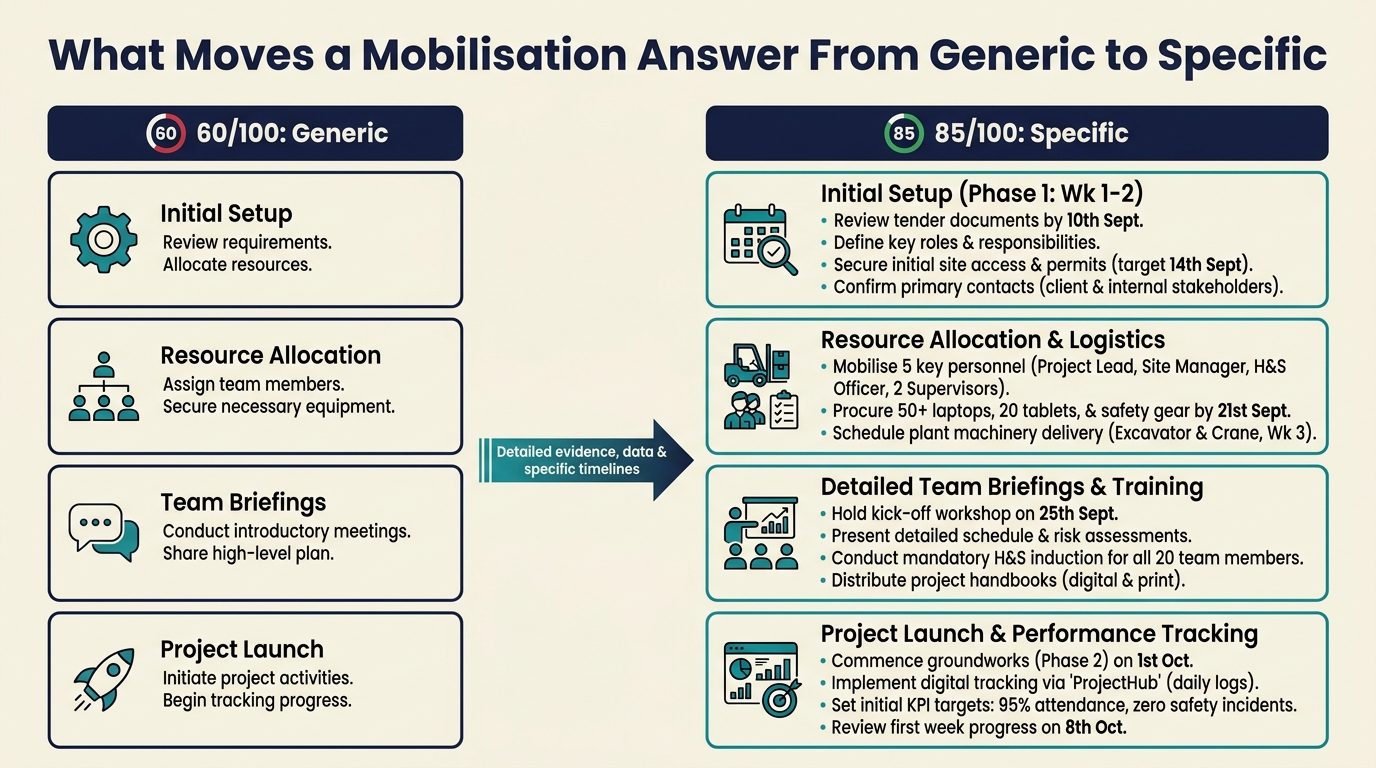
Comparison of generic 60/100 vs specific 85/100 mobilisation answers
The 60/100 Version
> Following contract award, our experienced mobilisation team will work closely with the Authority to ensure a smooth and seamless transition. We have a proven track record of mobilising contracts of this size and complexity, and we will follow our standard mobilisation methodology to deliver an on-time go-live. TUPE will be managed in accordance with all relevant regulations and we will consult with affected employees in line with statutory requirements. Risks will be identified and managed through our risk management framework, with mitigations put in place to ensure successful delivery. We will provide regular progress updates to the Authority throughout the mobilisation period.
What is wrong with it: no dates, no names, no specifics, no recognisable risks, no TUPE process, no past evidence, no Day-1 detail. Every clause could be copy-pasted from any bid. An evaluator reads this in 15 seconds and forgets it in 16.
The 85/100 Version
> Our eight-week mobilisation will be led by [Mobilisation Lead — 14 years in FM mobilisation, three contracts of comparable scope mobilised in the last 24 months], with [Operations Director] as senior accountable owner. The plan is structured in four phases: pre-award (Days -14 to 0), Award + Week 1, Weeks 2–6, and Go-Live + 30-day stabilisation review. > > Pre-award: draft TUPE information request prepared (Reg 11), supply chain alerted, mobilisation lead's calendar protected. Award + Week 1: formal TUPE information request issued within 24 hours; kick-off meeting with the Authority by Day 5; weekly RAG reporting commences; CAFM data migration plan agreed. > > TUPE. We anticipate [X] colleagues will transfer. ELI received and reviewed in days 8–21 supported by [HR Business Partner]. Consultation commences day 22, minimum 30 days, in [proposed venue] with affected employees and any recognised representatives. A "measures" letter issued day 25 covering [single example: alignment of pay date]. Day-1 readiness verified through right-to-work, vetting, uniform and pay-data audits in week six; agency contingency pre-booked at 5% of headcount in case of vetting failure. > > Top three risks. (1) ELI received late or incomplete — mitigation: parallel resource plan based on the tender pack; formal escalation to the Authority's commercial team if not received by day 14. (2) Specialist licence lapse during consultation — mitigation: Day 1 licence audit, renewal funding pre-approved, agency cover for any gap. (3) Buyer-side data or access delay — mitigation: weekly RAG report to the Authority with named action owners and a written escalation route to the procurement lead. > > Post go-live. 30/60/90-day reviews, KPI reporting from day 30, formal contract embedment review at day 90 with the Authority's contract manager.
What changed: nothing about the underlying capability of the bidder. Everything about how it is evidenced. The structure is the same; the specificity is what moves it.
This is the single most useful exercise to run with an existing mobilisation answer: print the current version and the evaluator's scoring criteria side by side. For each criterion, ask whether the answer gives the evaluator something specific to mark. Where it does not, rewrite that sentence with a date, a name, a number, or a named process. Twenty minutes of this work will reliably move an answer up two marks-bands.
Pulling It Together: A Mobilisation Plan Checklist
Before you submit, run your mobilisation answer past this list. If you can tick each one, you are in 80+ territory.
- [ ] Named Mobilisation Lead with experience referenced
- [ ] Phased timeline with dates relative to contract award (Pre-award / Week 1 / Weeks 2–4 / Go-Live / 30-60-90 review)
- [ ] At least one diagram (Gantt, RACI, or process flow)
- [ ] Specific Day-1 actions, not generic "kick-off" language
- [ ] TUPE process with information request → consultation → Day-1 plan
- [ ] Risk register with risks the evaluator will recognise from their own contracts
- [ ] Mitigations that describe verifiable actions, not feelings
- [ ] Sector-specific compliance items named explicitly
- [ ] Two or three past mobilisations referenced with quantifiable outcomes
- [ ] A 30/60/90-day review structure post go-live
- [ ] No sentence that could appear unchanged in any other bid
The last one is the hardest test, and the most useful. If your answer would read identically in a cleaning bid, an FM bid and a security bid, it is not yet specific enough.
Conclusion: The Section Where Marks Are Cheapest to Win
Mobilisation answers are scored against a small number of consistent criteria. Most of those criteria reward specificity over flair. Most bidders write generic, defensible answers that score in the high 50s or low 60s. The bidders that score 80+ are doing the same things over and over: named accountability, dated timelines, recognisable risks, real TUPE process, post go-live continuity.
That is good news. It means you do not need a stylistic genius to win marks here. You need a structured approach, time to be specific, and the discipline to refuse generic language. The marks-per-hour ratio for time invested in a mobilisation answer is among the highest in any bid section.
If you want to apply this to live FM, cleaning, security or grounds-maintenance tenders, the mytender.io Tender Browser is free to use — it shows you what is open right now, matched to your sector. From there, you can pressure-test your mobilisation approach against real opportunities rather than theoretical ones.
Tags
Ready to Transform Your Tender Writing?
See how MyTender's AI can help you write winning tenders in a fraction of the time.