
The Current Bottleneck in Improving General AI Models for Bidding
General AI tools like Claude and Copilot are getting better fast. But for bid writing, they hit a ceiling that specialised bid intelligence is built to break through.
Jamie Horsnell
Co-Founder, mytender.io
Why We Are Reaching the Ceiling of General AI Solutions
Right now, Claude and Copilot are rising in popularity for more and more business tasks, given recent advancements of both in terms of models and functionality. For systems using Copilot, you get the benefit of joint context across all your tools from Excel, email to meetings. Claude can do more than just find what you have used before; it can start to learn how you write your responses to bids.
But there is always a ceiling they can reach when it is not "specialised", and even if they do advance beyond the points outlined below, there will be another area where generalising does not deliver the final 10-20% of what is possible. In situations where this matters, so does having specialist knowledge or tools. That ceiling right now comes down to not being able to develop bid specific intelligence, which I will get into what that actually means.
A quick note: this is mainly about response quality. Workflow and bid management scalability are also problems having an AI bidding platform solves, but that is not something I am going into here.Traditional Advantages of Specialised AI Bid Software
Starting with the advantages that specialised AI in bid software has had for a couple of years now.
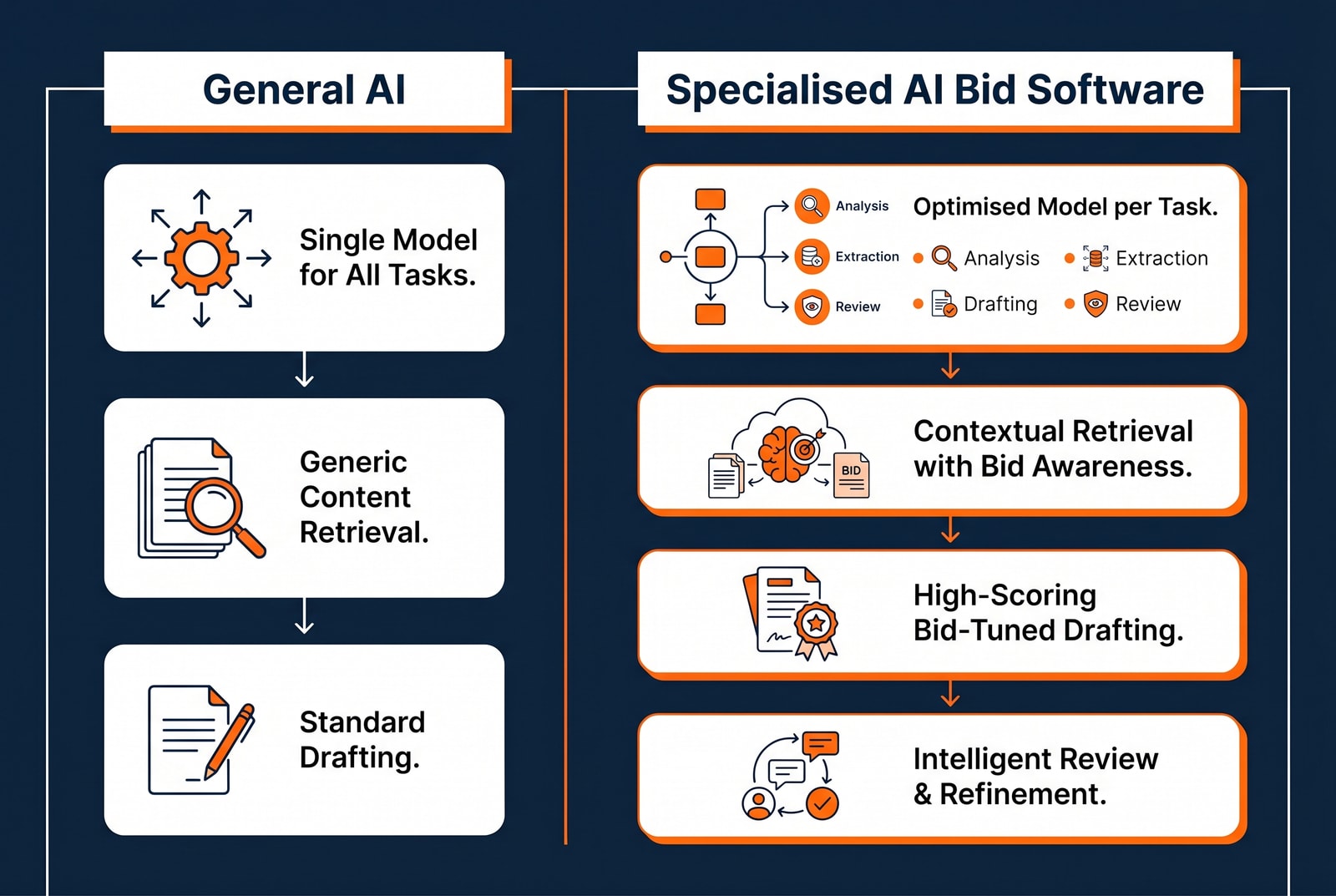
Diagram comparing general AI vs specialised AI bid writing capabilities
Now, these are not the new advantages. And with improving foundational models like Claude 4.8 and GPT-5.5, the delta of these three is not what it used to be, because they can now do a much better job across the board.
Bid-Specific Intelligence: How the AI Learns
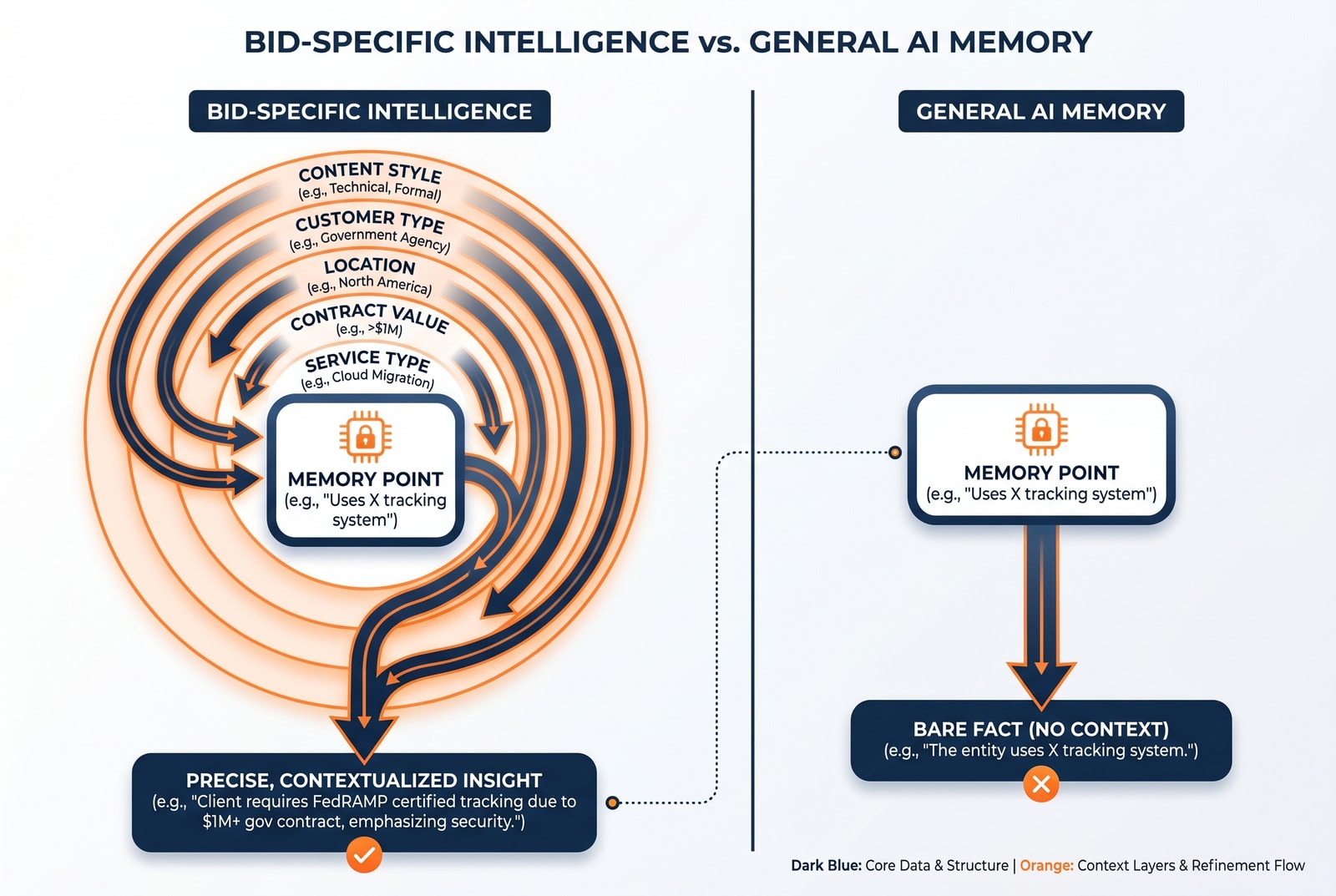
Flowchart showing how bid-specific intelligence layers context around each memory point
So now onto the more important and current bottleneck of using AI for content generation that generic models are failing on: the ability to get it to continuously learn and improve from your submissions.
AI currently learns from memory. It stores facts and information from your chats it deems to be worth remembering, which is general. This may work for remembering general facts about you on ChatGPT that do not change often, but collapses in a fast moving bidding environment.
When you are writing a bid, you have different services, different customers, different contract sizes, different pricing. All of that feeds into what you say you can and cannot do in a bid, alongside all of your general organisational knowledge.
Where general solutions are limited is the structure of all this information. They are confined to specific chat windows, where they can remember a specific knowledge point you wrote in one bid. For example, you put in that you use X tracking system on your project. That gets saved to memory, and in future, when it sees you writing a question about tracking systems, it applies it, just as you would expect.
But it is missing all the wider factors it should have been saved with. It misses that you only use that system for one of your services, on high-value contracts, in a specific location. Without those, the memory is blunt at best or wrong.Now couple this with a bid team of multiple stakeholders with different content preferences, different styles, across different regions, and it just does not work. And if the AI cannot learn these things, you are stuck with a static system that does not improve by itself.
When you scale that up, it is the difference between a 60% draft and a 90% draft. AI that can self review and improve, and AI that cannot. Big quality differences, big results in bid performance, and millions in contract value on the line.
To Summarise
New advances in AI let it start learning about how you bid. But to actually learn it, and to be effective at it, you need bid-specific intelligence: engineered for the job, not borrowed from a general model. Going forward as we work more and more with agents as part of the bid process, you need one that is going to move with you at your pace.
If you want to see how a specialised bid writing platform applies this in practice, request a demo with mytender.io or explore the Tender Finder to find live opportunities matched to your sector.Tags
Ready to Transform Your Tender Writing?
See how MyTender's AI can help you write winning tenders in a fraction of the time.