
Two-Tier Code in Outsourcing Tenders: What Bid Teams Need to Prove in 2026
The expected return of the Two-Tier Code will change how suppliers write and price outsourcing tenders. Here is what FM, waste, cleaning and public services bid teams should prepare now.
mytender.io Research Team
Tender Writing & Bid Management Specialists
Two-Tier Code in Outsourcing Tenders: What Bid Teams Need to Prove in 2026
The hardest part of an outsourcing tender is rarely the service method statement.
It is proving that the contract will not be delivered on the back of a workforce problem the buyer has to deal with later.
That problem is moving up the agenda. The Procurement Act has already made transparency, performance and supplier conduct more visible. The expected return of the Two-Tier Code in 2026 adds another pressure point for outsourced public contracts: how suppliers protect pay, terms and conditions when staff transfer or new starters join the contract.
For bid teams in facilities management, cleaning, waste, catering, security, social care support and other labour-heavy public services, this matters. Not as a legal footnote. As a scoring issue.
A buyer reading your bid wants to know three things:
- Will transferred staff be protected properly?
- Will new recruits be treated fairly enough to avoid a two-tier workforce?
- Has your price actually allowed for those commitments?
If the answer is vague, your bid looks risky.

A bid manager reviewing outsourcing tender documents with workforce protection notes
Why This Topic Is Coming Back Now
The Two-Tier Code is about workforce protection in outsourced public services.
In simple terms, it is designed to stop a public service contract being won by protecting transferred staff on paper, then delivering the service with new staff on worse terms. That creates a divided workforce. It can also create churn, poor morale, recruitment problems and service instability.
Those are not abstract HR risks. They show up quickly in outsourced contracts:
- cleaners leave after mobilisation because the job is worse than expected
- waste collection rounds miss targets because experienced loaders do not transfer smoothly
- FM supervisors spend the first quarter firefighting absence and rota gaps
- the authority gets complaints from unions, residents, service users or internal stakeholders
- the supplier asks for contract relief because the labour model was underpriced
Buyers have seen this film. They know how it ends.
So when employment protections become more prominent in public procurement, evaluators will not just check whether you have mentioned TUPE. They will look for a joined-up operating model.
The bid has to connect workforce protection, mobilisation, delivery risk and price.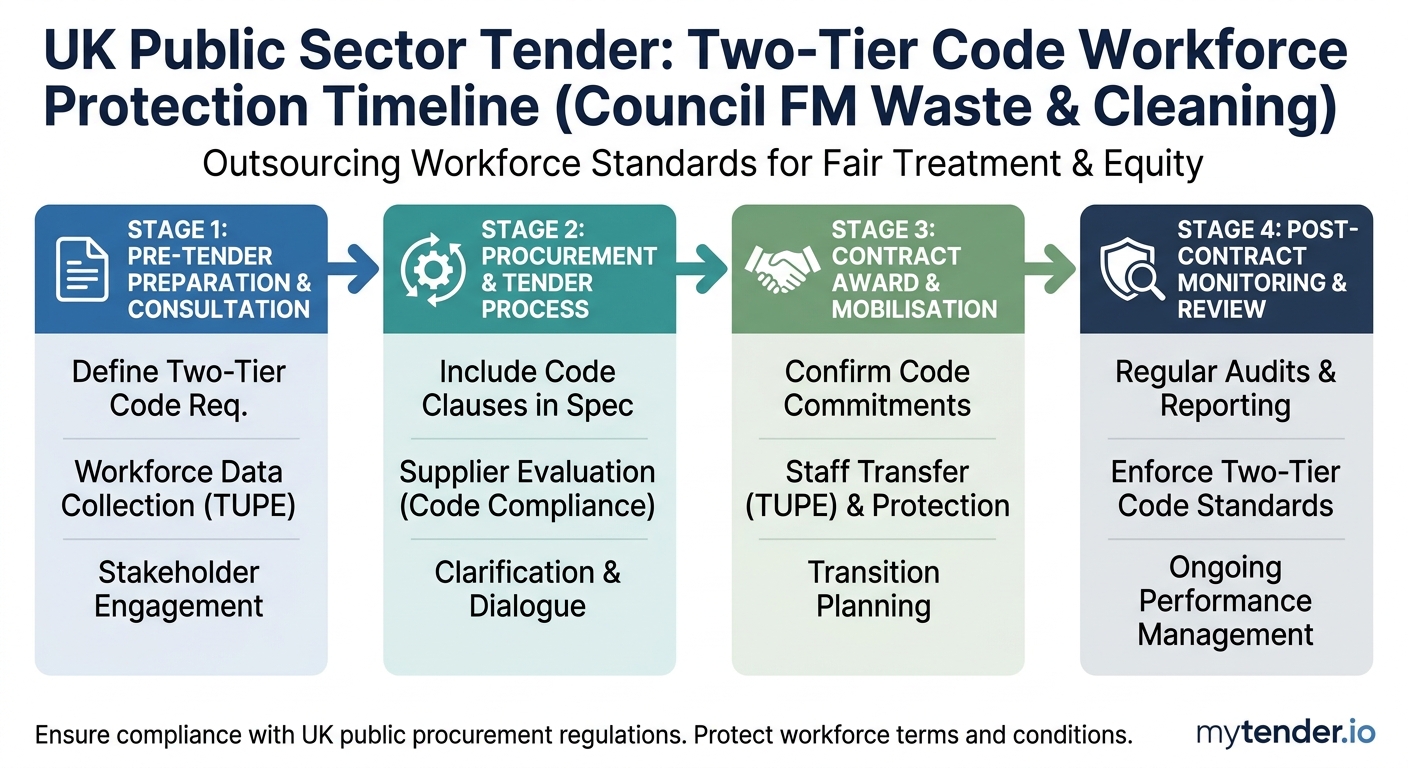
Timeline showing workforce protection checkpoints from tender release to steady-state delivery
The SEO Opportunity, and Why This Is the Right Topic
Recent procurement discussion is still dominated by the Procurement Act 2023, especially MAT, transparency notices, Central Digital Platform adoption, performance KPIs and payment reporting. Those topics are now well covered.
The gap is more practical: how those reforms affect real supplier responses in labour-heavy outsourced contracts.
The Two-Tier Code sits right in that gap. Search demand is likely to grow as buyers start reflecting worker protections in ITTs, clarification questions and mobilisation requirements. It also connects naturally to three mytender.io content pillars:
- sector-specific bid mastery for FM, waste and cleaning
- bid capacity, because these sections are time-consuming and evidence-heavy
- win rate, because workforce risk is often the hidden reason a technically capable supplier loses marks
The target reader is the bid manager or commercial lead who has to turn HR, operations and pricing input into one credible answer before the deadline.
That is a painful, valuable problem. Perfect blog territory.
What the Two-Tier Code Means in Plain English
The Two-Tier Code is not just another phrase to drop into the compliance section.
For bid teams, the practical principle is this: do not build a contract model where transferred staff keep decent terms while new staff doing the same or similar work are brought in on materially worse terms.
The exact rules and implementation details matter, and suppliers should take legal advice where needed. But most tender responses do not fail because the bidder misses a niche legal interpretation.
They fail because the answer is too thin.
A weak response says:
> We will comply with TUPE and all applicable employment legislation.
A stronger response says:
> We have mapped the transferring workforce, identified likely comparable roles for new starters, priced parity assumptions into the labour model, built consultation into mobilisation, assigned HR ownership, and included ongoing monitoring so the contract does not drift into a two-tier workforce.
The second answer gives the evaluator something to score.
Where It Will Show Up in Tenders
Do not expect every ITT to have a section titled “Two-Tier Code”. Some will. Many will not.
The requirement may appear under different headings:
- TUPE and workforce transfer
- mobilisation plan
- social value
- fair work and ethical employment
- contract management
- resourcing model
- risk management
- quality assurance
- supply chain management
- pricing assumptions
That is what makes this tricky.
If you treat workforce protection as one answer in one section, the bid can contradict itself elsewhere. The HR section promises fairness. The pricing schedule assumes low-cost replacement labour. The mobilisation plan ignores consultation. The risk register says “TUPE risk: low” with no explanation.
Evaluators notice those gaps.
The Five-Part Answer Evaluators Need
A credible Two-Tier Code response has five parts. Miss one and the whole thing starts to wobble.
1. Workforce Mapping
Start with who is affected.
For an outsourcing contract, that usually means:
- staff expected to transfer under TUPE
- staff who may be partly assigned to the service
- supervisors, schedulers, admin and depot support roles
- agency or temporary labour currently used on the contract
- subcontractor staff if parts of the service are delivered through the supply chain
- new starters you expect to recruit during mobilisation or year one
Your bid should explain how you will validate the workforce data.
Do not pretend the data is perfect if it is not. TUPE information is often incomplete during tendering. Say what you have reviewed, what assumptions you have made, what information remains outstanding, and how you will close those gaps after award.
That honesty helps. It tells the evaluator you have done this before.
2. Terms and Conditions Analysis
Once you know who is in scope, you need to understand what they are transferring with.
That includes more than salary.
Look at:
- base pay
- overtime arrangements
- shift premiums
- pension arrangements
- holiday entitlement
- sick pay
- allowances
- working patterns
- length of service
- collective agreements
- recognition arrangements
- training and certification requirements
A lot of bid teams write TUPE as if it is just a list of employees. It is not. It is a cost model, a mobilisation risk and a service continuity plan.
If you miss allowances, overtime patterns or pension assumptions, the contract can look profitable on paper and painful in month three.
3. New Starter Parity
This is the part most bidders underwrite.
It is relatively easy to say transferred staff will keep their terms. The harder question is what happens when you recruit new staff into comparable roles.
Your response should explain:
- how you define comparable roles
- how new starter terms will be benchmarked against transferring staff
- how you will avoid unfair gaps in pay and conditions
- who approves any exceptions
- how parity is monitored over time
- how subcontractors will be held to the same standard where relevant
This is where the Two-Tier Code becomes operational.
It is not enough to make a promise on day one. Buyers need to know how you stop the contract drifting over years two, three and four.
4. Mobilisation Governance
Workforce protection needs a named owner.
Not “HR”. Not “the mobilisation team”. A named role with authority.
For example:
- Mobilisation Director owns the full transfer plan
- HR Lead owns consultation, employee communications and terms validation
- Operations Lead owns rota, route and site-level workforce deployment
- Commercial Lead owns labour cost assumptions and change control
- Contract Manager owns steady-state monitoring after go-live
The governance should include decision points. When is the workforce data frozen for pricing? When are consultation packs issued? When are new starter terms approved? When does the first post-transfer workforce review happen?
If those dates are missing, your plan reads like intent rather than delivery.
5. Pricing Alignment
This is the brutal bit.
A beautiful workforce protection policy means very little if the price does not support it.
Evaluators will not always see your full labour model, but they can smell a contradiction. If your quality answer promises strong employment protections and your price is suspiciously low, they will wonder what gives.
Your commercial narrative should make the labour assumptions clear enough to be trusted.
You do not need to reveal every margin detail. You do need to show that workforce commitments have been priced, not bolted on.
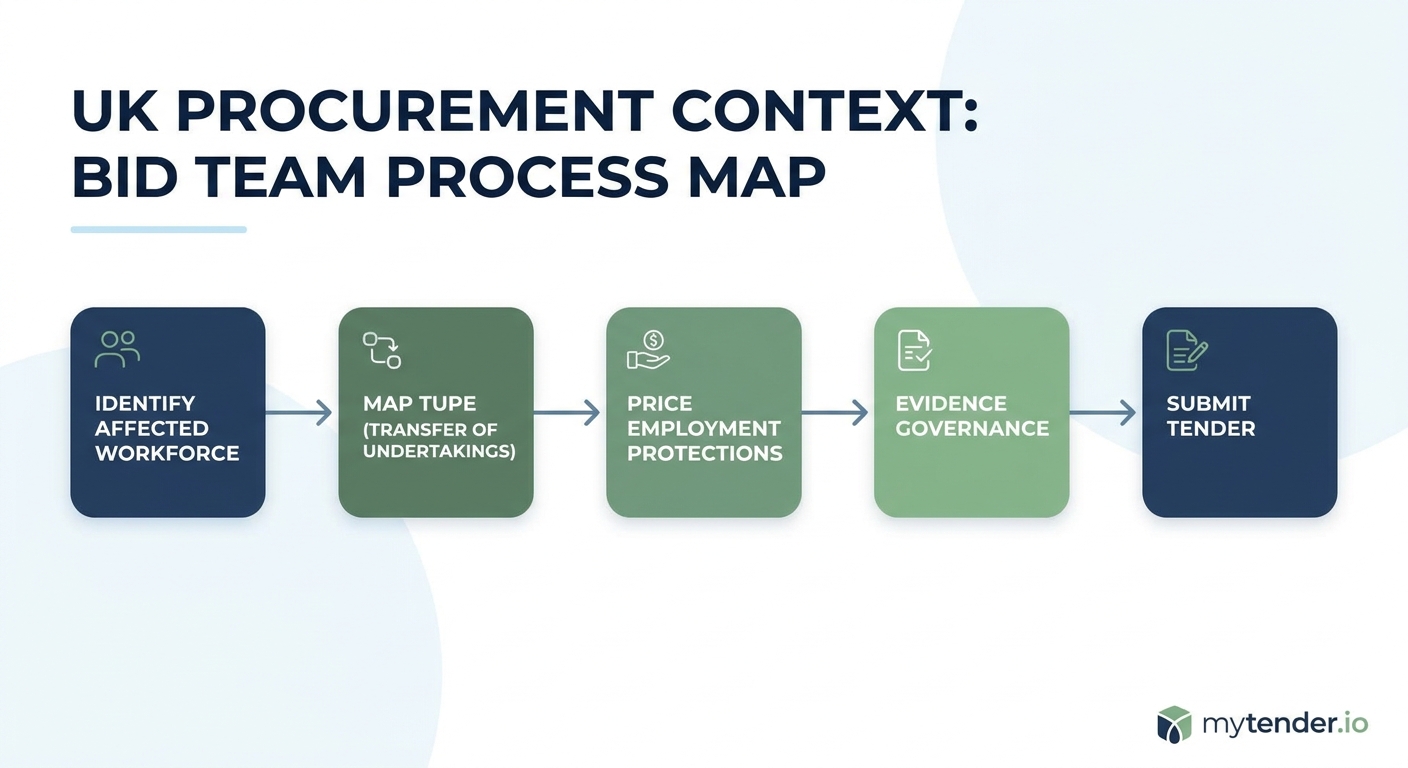
Process map showing how bid teams connect TUPE, workforce protections, pricing and submission evidence
How This Changes the Mobilisation Plan
Mobilisation plans for outsourced contracts already carry a lot: TUPE, vehicles, equipment, IT, uniforms, comms, site surveys, training, reporting and go-live support.
The Two-Tier Code makes the workforce thread even more important.
A strong mobilisation plan should include a workforce protection workstream with:
- TUPE data validation
- employee liability information review
- union or employee representative engagement
- consultation milestones
- terms and conditions mapping
- new starter policy approval
- subcontractor workforce checks
- induction and onboarding
- first payroll validation
- post-transfer staff feedback
- early-life retention monitoring
This needs to sit on the same timeline as operational mobilisation.
Why? Because the workforce plan affects the service plan.
If consultation runs late, rota confirmation runs late. If rota confirmation runs late, training runs late. If training runs late, go-live gets messy.
A good evaluator will connect those dots.
The Common Mistake: Treating TUPE as a Legal Appendix
TUPE is often handled like a compliance attachment: necessary, slightly dull, and written by someone far away from the operational solution.
That is a mistake.
In labour-heavy contracts, TUPE affects everything:
- the cost of delivery
- the experience level of the workforce
- the mobilisation timeline
- the risk of industrial relations issues
- the ability to deliver social value
- the credibility of the method statement
- the realism of KPIs
So bring TUPE into the main bid narrative.
If your cleaning tender promises a rapid productivity improvement, explain how that works with the transferring workforce. If your waste bid proposes route changes, explain how drivers and loaders will be consulted and trained. If your FM bid relies on multi-skilling, explain whether that is compatible with existing terms, job descriptions and agreements.
Do not leave the evaluator to guess.
What Good Evidence Looks Like
You cannot evidence the future perfectly. You can evidence readiness.
Useful evidence includes:
- anonymised examples of previous TUPE transfers
- mobilisation plans from comparable contracts
- consultation templates
- workforce risk registers
- HR governance charts
- sample employee communication plans
- payroll validation checks
- subcontractor onboarding controls
- retention data from previous mobilisations
- case studies showing stable service after transfer
The best evidence is specific to the contract.
A generic “we have mobilised 200 contracts” claim is fine, but it is not enough. Better is: “On a comparable borough-wide waste contract, 94 transferring employees moved on day one with no missed scheduled rounds in week one.”
Only use numbers you can substantiate. Made-up precision is worse than no number.
The Scoring Matrix Bid Teams Should Work To
Most tender questions do not tell you exactly how workforce protection will be scored. You have to infer it.
Here is a useful internal scoring lens.
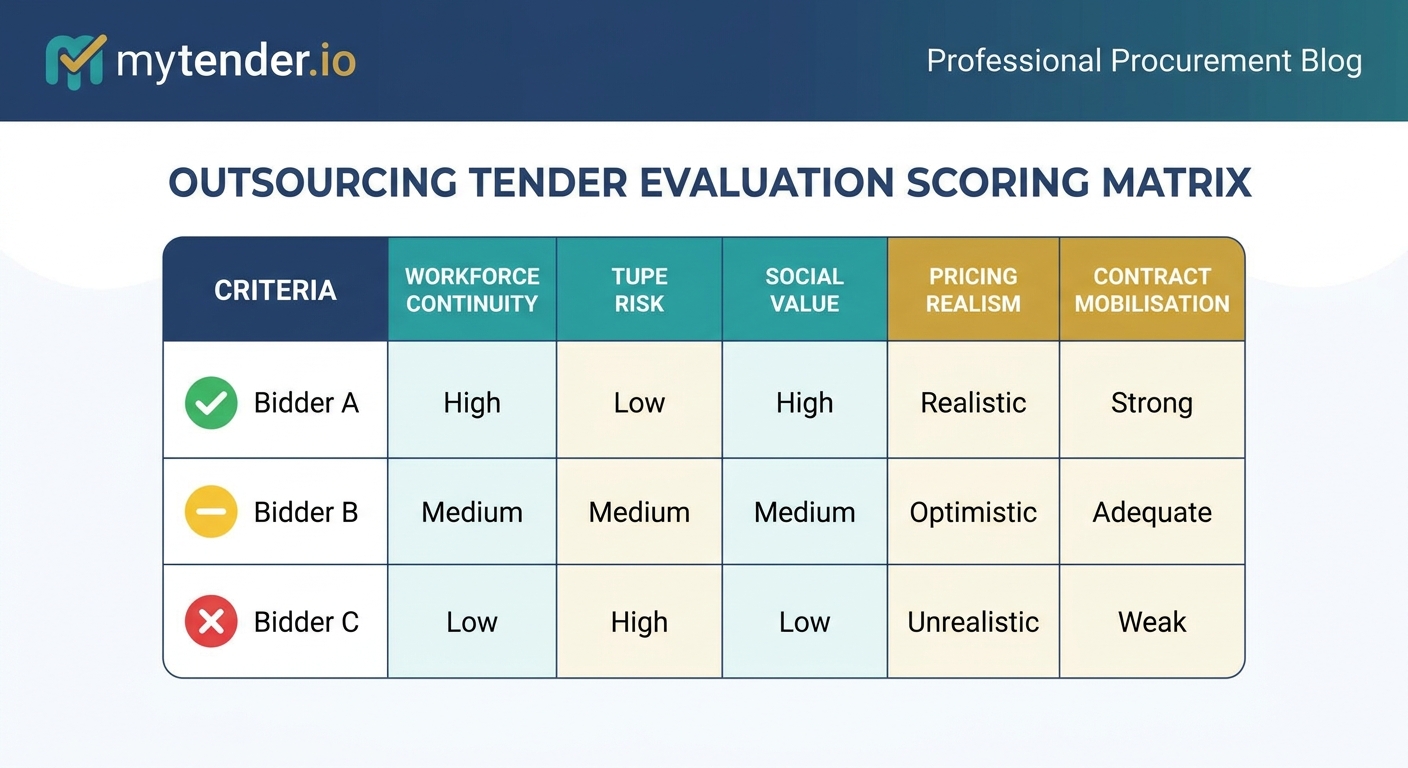
Scoring matrix for outsourcing tenders covering workforce continuity, TUPE risk, social value, pricing realism and mobilisation
Low-Scoring Answer
The bidder confirms legal compliance, mentions TUPE, and says staff will be treated fairly.
There is little detail on roles, dates, owners, data quality, pricing assumptions or post-transfer monitoring.
This answer may be compliant, but it is not reassuring.
Mid-Scoring Answer
The bidder provides a TUPE process, consultation timeline and named HR lead.
The answer is credible, but slightly isolated. It does not fully connect workforce protection to mobilisation, pricing, subcontractors or steady-state contract management.
This answer can score decently, but it leaves value on the table.
High-Scoring Answer
The bidder maps the workforce, explains assumptions, shows governance, links the plan to mobilisation milestones, addresses new starter parity, covers subcontractors, shows pricing alignment and provides relevant evidence from similar contracts.
This answer feels like a contract that can be delivered.
That is what buyers want.
How to Handle Pricing Without Over-Explaining Margin
Commercial teams sometimes resist adding detail about workforce assumptions. Fair enough. Nobody wants to hand over the whole labour model in prose.
But silence creates risk.
You can explain enough without exposing everything:
- state that labour rates include transferred terms and relevant allowances
- confirm new starter assumptions are aligned to workforce protection commitments
- identify where pensions, overtime or shift premiums have been allowed for
- explain how subcontractor labour compliance is priced and governed
- show that risk allowances are realistic, not hidden in a vague contingency
- describe the change control route if buyer data materially changes after award
That final point matters.
If the tender data is incomplete, say how you will manage it. A clear assumption log is more credible than pretending uncertainty does not exist.
Subcontractors Are Part of the Answer
Many outsourced public contracts rely on subcontractors.
That can include specialist cleaning, grounds maintenance, clinical waste, pest control, security, mechanical and electrical support, transport, agency labour or local delivery partners.
If your workforce protection commitments stop at your own payroll, the buyer has a problem.
Your bid should cover:
- flow-down employment requirements in subcontract terms
- due diligence before appointment
- checks on pay, conditions and right to work
- subcontractor mobilisation meetings
- reporting requirements
- audit rights
- escalation if a subcontractor falls short
This is especially important where social value is being scored. A supplier cannot credibly promise good local employment while ignoring the employment practices of the firms delivering part of the work.
Social Value and Workforce Protection Are Now Joined Up
A lot of social value answers still read like a menu of apprenticeships, volunteering hours and charity days.
Those may help. But in outsourced services, the core workforce is often the biggest social value lever.
Fair work, secure hours, progression, training and local recruitment are not separate from delivery. They are delivery.
If the tender asks about social value, connect your answer to workforce protection:
- local jobs with fair terms
- progression pathways for transferring and new staff
- recognised training and qualifications
- apprenticeships that do not undercut existing roles
- wellbeing support during mobilisation
- engagement with unions or employee representatives
- transparent reporting on workforce commitments
This is stronger than bolt-on social value. It is rooted in the contract.
A Practical Framework for Your Bid Library
You do not want to write this from scratch every time.
Create a reusable bid library module with five components.
1. Policy Position
A short, plain-English statement on workforce protection, TUPE and avoiding two-tier employment models.
Keep it human. Avoid legal fog.
2. Standard Process
A step-by-step process from tender review to steady-state monitoring.
This should be detailed enough to adapt quickly, but not so specific that it becomes wrong for half your bids.
3. Evidence Bank
Store anonymised examples, mobilisation stats, templates and case studies.
Tag them by sector: FM, waste, cleaning, catering, security, social care support, transport.
4. Assumption Log Template
Make it easy for bid teams to capture what they know, what they do not know, and what the price assumes.
This saves pain during governance reviews.
5. Risk Register Template
Build a standard workforce risk register for outsourcing tenders.
Then tailor it.
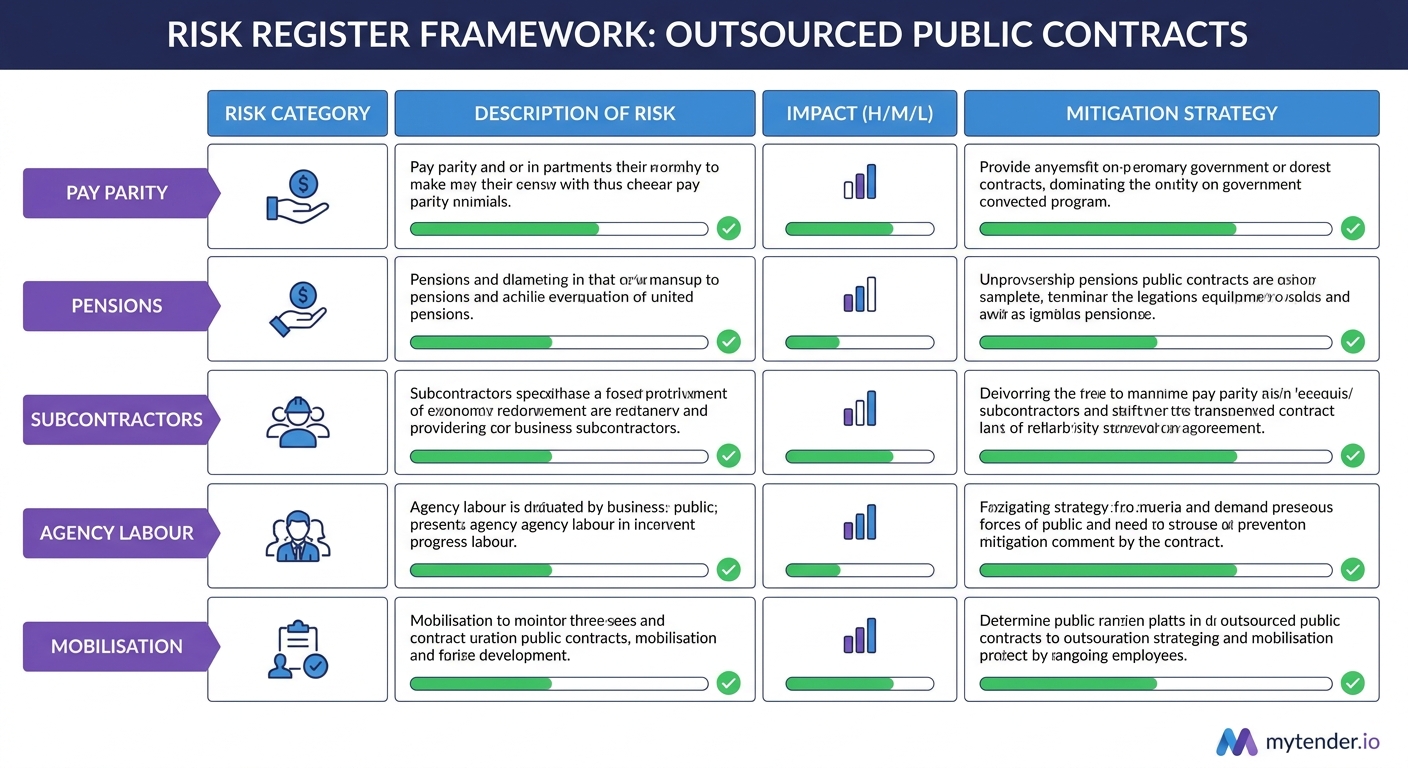
Risk register framework for outsourced public contracts covering pay parity, pensions, subcontractors, agency labour and mobilisation
The Risk Register Evaluators Actually Believe
A weak risk register says “TUPE risk” and rates it amber.
A useful one breaks the risk down.
For example:
- incomplete employee liability information
- unexpected allowance or overtime exposure
- unclear scope of transferring supervisors
- union challenge to proposed rota changes
- payroll error in first month
- new starter terms drifting away from transferred staff terms
- subcontractor non-compliance
- higher than expected attrition after transfer
- agency labour dependency during mobilisation
Each risk needs a mitigation, owner and trigger.
The trigger is important. It tells the buyer when you act.
For example: “If final ELI varies labour cost assumptions by more than 3%, Commercial Lead and HR Lead review within five working days and agree change control position.”
That is a lot more credible than “we will monitor TUPE risk closely”.
Sector Notes: FM, Waste and Cleaning
The Two-Tier Code will matter across outsourced services, but the tender evidence changes by sector.
Facilities Management
FM contracts often mix hard services, soft services, helpdesk support and specialist subcontractors.
Your bid should show how workforce protections apply across that mixed model. Pay attention to subcontractors, mobile engineers, site-based staff and helpdesk teams. If you promise a single integrated service culture, the employment model needs to support it.
Waste and Environmental Services
Waste contracts are operationally visible from day one.
Drivers, loaders, supervisors, depot staff and route planners all matter. Route changes can affect working patterns. Fleet changes can affect training. Depot moves can affect travel time. Your workforce protection plan should sit alongside the mobilisation and route optimisation plan, not behind it.
Cleaning and Soft FM
Cleaning contracts are especially exposed to workforce quality, retention and supervision.
If the bid promises improved standards, explain how hours, supervision ratios, training and fair terms make that possible. Do not price the contract as if labour is disposable and then write a quality answer as if people are the differentiator. Evaluators can spot the contradiction.
How mytender.io Helps Bid Teams Keep This Consistent
This is exactly the kind of section that falls apart when bid teams are under pressure.
The HR lead has one version. Operations has another. Commercial has a spreadsheet. The bid writer is trying to stitch it together at 10pm and make it sound coherent.
mytender.io helps by turning your best previous answers, evidence, policies and sector examples into a usable bid library. That means the next outsourcing tender does not start from a blank page or a panicked Slack thread.The value is consistency. If you promise workforce protection in one section, your mobilisation plan, risk register and pricing narrative should support it elsewhere.
A Simple Drafting Checklist
Before you submit an outsourcing tender in 2026, run this check.
Can the evaluator see:
- who is transferring and what data you have reviewed?
- how you will validate missing or incomplete TUPE information?
- how transferred staff terms are protected?
- how new starter terms are managed to avoid a two-tier workforce?
- who owns workforce protection during mobilisation?
- how the plan connects to rota, training, payroll and go-live?
- how subcontractors are controlled?
- how commitments are priced?
- what evidence proves you have done this before?
- how the contract will be monitored after go-live?
If any answer is “sort of”, fix it.
Final Takeaway
The Two-Tier Code should not scare good suppliers.
If you already run decent employment practices, price contracts properly and take mobilisation seriously, it gives you a way to prove it. If your competitors are relying on vague TUPE wording and optimistic labour assumptions, even better.
But you do need to write the answer properly.
Do not bury workforce protection in a legal appendix. Put it where evaluators can see it: in the mobilisation plan, risk register, social value response, subcontractor controls and commercial assumptions.
That is how you turn a compliance requirement into a scoring advantage.
If you want to see live outsourcing and public sector opportunities matched to your sector, the Tender Finder is free to use.
Tags
Ready to Transform Your Tender Writing?
See how MyTender's AI can help you write winning tenders in a fraction of the time.