

TUPE in Public Sector Tenders: A Complete Guide for Suppliers 2026
Master TUPE regulations in public sector tenders. Learn how to handle workforce transfers, conduct due diligence, price TUPE costs accurately, and write winning bids for TUPE-affected contracts in facilities management, cleaning, security, and more.
mytender.io Research Team
Procurement & HR Compliance Specialists
TUPE in Public Sector Tenders: A Complete Guide for Suppliers 2026
If you bid for public sector contracts in facilities management, cleaning, security, catering, transport, or social care — TUPE is one of the most consequential aspects of any tender you'll encounter. Yet it's consistently mishandled. Bids are lost because suppliers underestimate TUPE liabilities. Contracts turn unprofitable because hidden workforce costs weren't priced in. And bids are disqualified because HR transition plans fail to satisfy evaluation panels.
This guide covers everything you need to know about TUPE in public sector tendering: what it means, when it applies, how to conduct robust due diligence, how to price it accurately, and — crucially — how to write compelling TUPE responses that win marks.
TUPE Public Sector Tenders Guide 2026
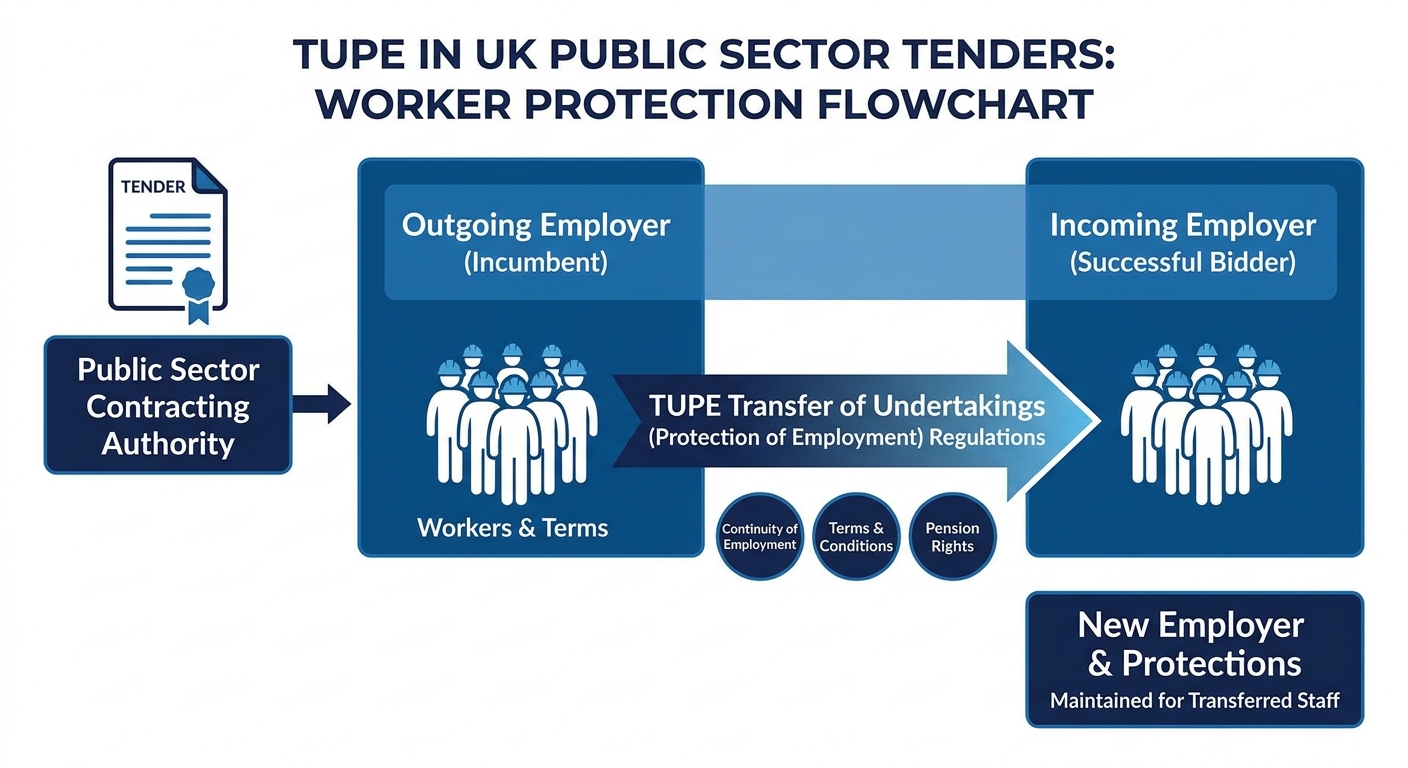
The Transfer of Undertakings (Protection of Employment) Regulations 2006, amended in 2014, protect employees' rights when a business or service changes hands. In public sector contracting, TUPE applies in two distinct scenarios: traditional business transfers (where a business or part of one is sold or transferred) and service provision changes (the most relevant scenario for most suppliers — when a contract is awarded, re-tendered, or brought back in-house). Understanding which scenario applies and what it demands of you is the foundation of every TUPE-affected bid.
What TUPE Actually Means for Tender Bidders
When TUPE applies, employees assigned to the relevant service transfer automatically to the incoming contractor. They carry their existing terms and conditions with them — the same salary, working hours, holiday entitlement, contractual benefits, and continuity of employment. The incoming contractor (that's you) becomes their new employer from day one of the contract, with all associated responsibilities and liabilities.
This has profound implications for your bid:You inherit the workforce, not the workforce you'd ideally recruit. That may mean higher salaries than your standard pay scales, different working patterns than your preferred model, legacy contractual entitlements you wouldn't normally offer, and potentially complex pension arrangements.
You inherit the employment history. If the incumbent contractor has managed performance issues poorly, failed to address attendance problems, or allowed informal working practices to become entrenched, those situations become yours to manage — without having created them.
You inherit the liabilities — with important limits. Pre-transfer employment liability generally remains with the outgoing employer, but there are exceptions, and the boundary isn't always clear. Constructive dismissal claims arising from a TUPE transfer, for instance, can land on the incoming employer.
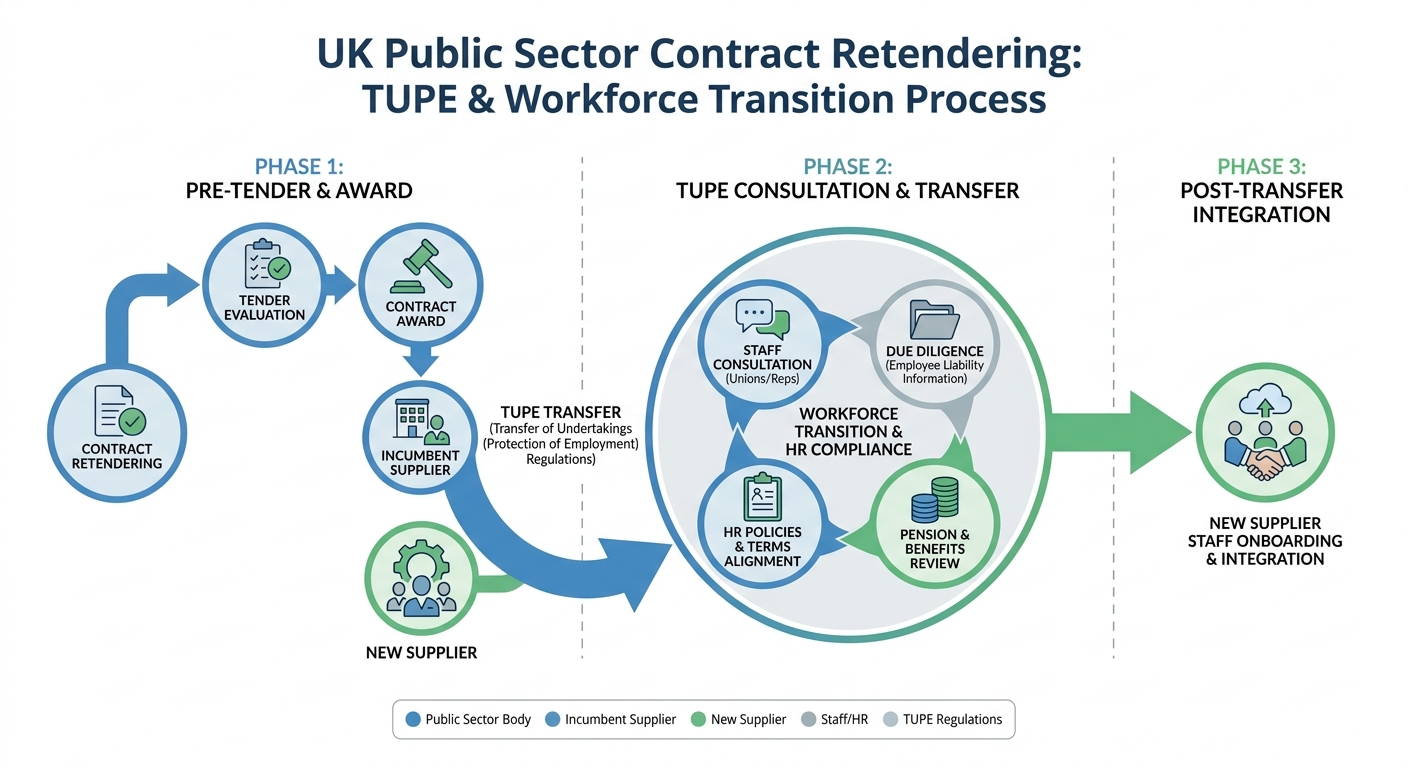
The service provision change trigger is broader than many suppliers realise. If you win a cleaning contract that was previously held by a different company, TUPE almost certainly applies. If your client brings a service back in-house and then re-tenders it, TUPE applies again. If the activities transfer but the work is genuinely split between two or more suppliers with no single organised grouping of employees, TUPE may not apply — but this is a narrow exception, and legal advice is always warranted before concluding TUPE doesn't apply.The 2014 amendments narrowed the service provision change rules slightly, excluding situations where a service is provided in connection with a single specific event or short-term task. But for ongoing services of any duration — the contracts most suppliers actively pursue — TUPE almost always applies.
When TUPE Applies: Mapping Your Risk
Not all TUPE situations carry equal risk. Before you even begin writing your bid, you need to assess the TUPE risk profile of the contract.
TUPE Contract Retendering Process
Your risk assessment should answer these questions before you commit to bidding:
- How many employees will transfer, and what are their roles?
- What are their salary levels compared to your standard pay scales for similar roles?
- What employment terms do they carry — holiday entitlement, sick pay, contractual benefits?
- Are there defined benefit (final salary) pension liabilities? If so, what are the funding levels?
- What is the employment history — any known disputes, grievances, or performance management backlog?
- How long have employees been employed — what redundancy liability would exist if the contract is lost or reduced?
- Are there any TUPE-related employment tribunal claims currently in progress?
The answers to these questions fundamentally shape your pricing, your HR transition plan, and your commercial decision about whether to bid at all.
Conducting TUPE Due Diligence in Tender Processes
The quality of TUPE information available during a tender process varies enormously. Best-practice buyers provide comprehensive employee liability information (ELI) early in the process. Many don't. Understanding how to extract reliable information and what gaps to flag is a core bidding competence.
Employee Liability Information
Under TUPE regulations, the outgoing employer (the incumbent contractor) is required to provide employee liability information to the incoming employer. This must be provided at least 28 days before the transfer — but in practice, during competitive tenders, this information should be requested earlier, and buyers should facilitate its sharing.
ELI must include: Employee identities, age and length of service, details of the written statement of particulars (or equivalent), disciplinary proceedings in the past two years, grievance proceedings in the past two years, legal actions in the past three years, and any collective agreements that will transfer. What's often missing from ELI: Pension details (ELI doesn't legally require pension information), informal working arrangements, overtime patterns and earnings, protected characteristics that might be relevant to any proposed harmonisation, and the actual cost of employment (ELI provides terms, not costs). How to fill the gaps: Use the clarification questions process. Submit detailed, specific questions to the contracting authority about workforce composition, pension arrangements, and total employment costs. Frame questions carefully — buyers sometimes refuse to answer on grounds of commercial sensitivity, but well-framed questions about aggregated cost data are usually answered. If they aren't, your bid must account for worst-case scenarios, which affects your price.
TUPE Due Diligence Tender Bid
Pension Due Diligence — The Critical Gap
Pensions represent the single biggest financial risk in public sector TUPE transfers, and they receive far too little attention in most bids. The Local Government Pension Scheme (LGPS) deserves special attention.
When public sector workers covered by the LGPS transfer to a private contractor under TUPE, the incoming contractor is typically required to provide access to the LGPS or to a pension scheme of broadly comparable value. This is separate from standard TUPE requirements and is governed by specific guidance from the Cabinet Office (the Fair Deal policy, updated in 2013).
Fair Deal applies when staff transfer out of central government bodies. For local government, equivalent arrangements typically require LGPS participation or a broadly comparable alternative. The implications are significant:
LGPS is a defined benefit scheme. As an employer member, you'll pay employer contribution rates that can be substantially higher than the workplace pension contributions you'd normally budget. Rates vary by LGPS fund, but employer contributions commonly run at 18-25% of pensionable pay, compared with the 3-5% you might pay into a workplace pension.
If the LGPS fund has a funding deficit, new employers may face an additional deficit repair contribution — effectively paying to repair a shortfall you didn't create. Some LGPS funds have significant deficits; others are in surplus. You won't know without specifically asking and reviewing the fund's actuarial report.
Practical due diligence steps on pensions:- Confirm whether transferred employees are members of a defined benefit scheme
- Identify the relevant pension fund (for LGPS, which of the 86 local funds)
- Request the fund's actuarial valuation — this is public information for LGPS funds
- Ask the contracting authority to confirm employer contribution rates you'll be required to pay
- If LGPS applies, factor in an admission body process — this takes time and has associated costs
- For private sector incumbent pensions, request scheme documentation and current funding status
Failing to adequately investigate pension liabilities before pricing a bid has derailed otherwise strong bids and made contracts loss-making from day one.
Employment History Due Diligence
Ask specifically about any ongoing or recently concluded employment tribunal proceedings, active disciplinary or grievance cases, and any employees on long-term sick leave. These situations carry disproportionate risk because they're live issues you'll inherit, often with significant uncertainty about their outcome and cost.
Employment tribunal claims that arise from a TUPE transfer can be expensive, time-consuming, and reputationally damaging. While pre-transfer liability typically remains with the outgoing employer, the boundaries aren't always clean, and post-transfer management decisions can be attributed to you as the new employer.
Pricing TUPE Costs Accurately
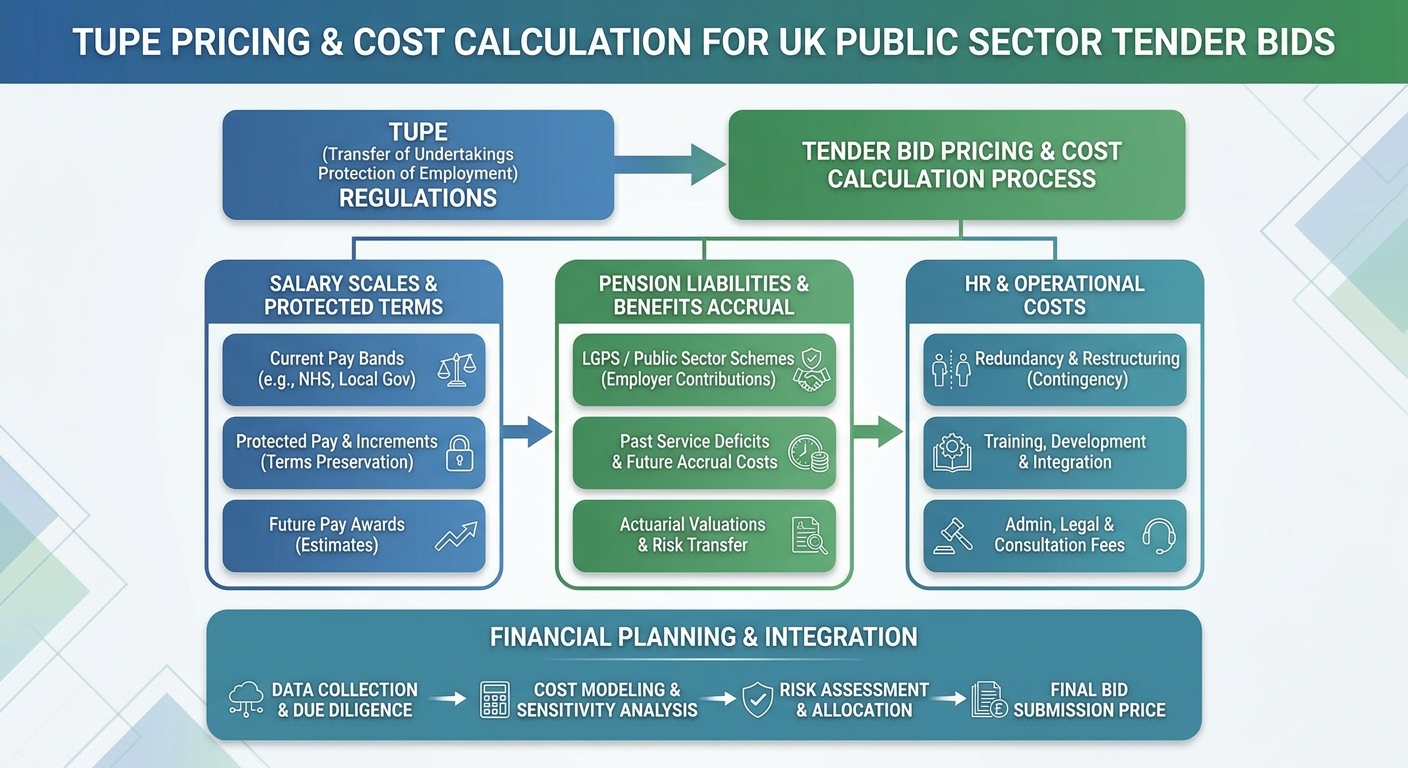
Mispricing TUPE costs is one of the most common reasons contracts become loss-making. The temptation to understate TUPE costs to win on price is understandable but commercially suicidal. Here's how to price accurately.
TUPE Pricing Cost Calculation Tender
Direct Salary Costs
Map each transferring role to its actual current salary, not your standard pay scales. Calculate the full annualised cost including any contractual enhancements (shift premiums, overtime allowances, London weighting, etc.). If the employees are paid above your standard rates for comparable roles, this is a direct cost you must absorb or address through a harmonisation programme — and harmonisation has its own costs and risks.
A common mistake is assuming you can quickly harmonise terms down to your standard rates. TUPE prohibits changing terms where the reason for the change is the transfer itself. Harmonisation is possible over time and in specific circumstances (genuine business reasons unconnected to the transfer), but it's complex, requires careful legal navigation, and typically requires meaningful negotiation and often some form of compensation.
Budget for the salary gap on a per-employee basis and include it in your cost model for the full contract term, unless you have a credible harmonisation plan with realistic timelines and associated costs.
On-Costs
Beyond salary, calculate employer's National Insurance contributions at current rates, pension contributions at the rate applicable to the relevant scheme (not your standard workplace pension rate), any contractual benefits (death in service, healthcare, etc.), and statutory holiday pay at actual earning levels including regular contractual overtime.
Holiday accrual is frequently underestimated. If transferred employees have more holiday entitlement than your standard offering, this is a direct cost. At 28 days plus bank holidays versus your standard 25 days, for a full-time employee earning £30,000, the difference is approximately £1,150 per year. Multiply across a large workforce and this becomes significant.
TUPE Process Costs
Factor in the administrative and legal costs of the transfer itself:
Legal advice: A complex TUPE transfer will require several days of employment lawyer time. Budget £5,000-£15,000 depending on complexity and workforce size. This isn't optional — the risk of getting TUPE wrong is too great. Consultation costs: TUPE requires you to inform and consult with employee representatives. For large transfers, this process takes time, may require release of employee representatives during working hours, and can involve negotiations. Budget 2-4 weeks of management time for substantive consultation. Integration costs: Onboarding a transferred workforce involves employment contracts, payroll setup, induction, and often considerable HR administration. For 50 transferring employees, budget 20-40 hours of HR/admin time, plus any IT system changes required. Redundancy reserve: If there's any possibility the contract requires fewer staff than are currently employed on it, budget for potential redundancy costs at the rates the transferred employees would be entitled to. Enhanced contractual redundancy provisions are a common TUPE legacy issue.Contingency for the Unknown
Despite your best due diligence efforts, you'll make a bid with incomplete information. Build in a contingency — typically 5-10% of total TUPE-related costs — to cover risks you couldn't fully quantify. Document this contingency in your internal cost build with specific risk items. If you win and the risks don't materialise, you've protected your margin. If they do, you're covered.
Writing a Winning TUPE Response
Most tenders include specific questions about TUPE management, workforce transition, and employee engagement. These questions are scored, and the scores can be significant — often 10-15% of total quality marks for labour-intensive contracts.
The Common Mistakes
Generic responses that describe TUPE in abstract terms without demonstrating your specific approach, experience, or understanding of the contract's workforce dynamics. Buyers want evidence you understand the specific risks and opportunities in their contract, not a textbook definition of TUPE. Underplaying commitments — vague assurances that you "take TUPE seriously" and will "consult appropriately" without specificity about what you'll do, when, and how. Evaluators mark specificity. Vagueness signals inexperience or lack of commitment. Focusing only on legal compliance — meeting minimum TUPE requirements is the floor, not the ceiling. Winning bids demonstrate proactive workforce transition management, employee engagement strategies, and a genuine commitment to workforce wellbeing that goes beyond statutory requirements. Burying the workforce story — TUPE transitions are fundamentally about people. The most effective bid responses acknowledge the human dimension: that transfer can be unsettling, that employees will have legitimate questions and concerns, and that your approach addresses those concerns actively.A Winning TUPE Response Framework
Section 1: Understanding the Transfer LandscapeOpen by demonstrating your understanding of the specific TUPE context for this contract. Reference the number of transferring employees, the nature of their roles, and any specific challenges you've identified through your due diligence. Show you've done your homework.
Example approach: "Our analysis of the employee liability information indicates 47 employees will transfer, predominantly working in [roles], with service ranging from 2 to 23 years. We recognise that a significant proportion of the workforce has long service with the incumbent contractor, creating specific obligations and requiring careful transition management."
Section 2: Pre-Transfer Communication and ConsultationDescribe your approach to informing and consulting with employee representatives before the transfer. Specify your timeline — ideally beginning consultation as soon as appointment is confirmed, well before the statutory minimum. Describe the format of consultation (meetings, written communications, Q&A sessions) and who will lead it from your side.
Section 3: Employee Information and EngagementExplain how you'll communicate directly with transferring employees. What information will you provide, in what format, and through what channels? A written welcome pack, individual briefings for managers, team meetings, and a dedicated point of contact for TUPE questions are all elements evaluators look for.
Section 4: Day One Operational PlanningBuyers are evaluating whether the service will run smoothly from day one despite the workforce transition. Describe your mobilisation plan specifically for TUPE-related activities: payroll setup, IT access, uniform/equipment provision, rota continuity, and management support structure. If you're retaining incumbent supervisors in their roles, say so — continuity of line management reduces transition risk.
Section 5: Longer-Term IntegrationShow how you'll integrate the transferred workforce into your organisation over time. This includes your induction programme, access to your training and development offering, how you'll address any initial terms harmonisation (carefully), and how you'll manage employee wellbeing through the transition period.
Section 6: Experience and Track RecordProvide specific examples of previous TUPE transfers you've managed. Include the number of employees involved, the complexity of the transfer, and the outcomes — service continuity metrics, employee retention rates, reduction in grievances post-transfer, or any awards for handling workforce transitions well. Evaluators weight evidence-based track records heavily.

TUPE Facilities Management Workforce
Sector-Specific TUPE Considerations
TUPE applies across all service sectors, but the specific challenges differ. Here's what to watch for in the sectors where TUPE most frequently arises.
Facilities Management
Integrated FM contracts typically involve multiple service streams — cleaning, security, maintenance, catering, reception — each potentially with different workforce compositions, terms, and incumbent contractors. You may be dealing with multiple TUPE transfers simultaneously, each with its own workforce and legal considerations.
Key FM-specific risks: Multi-tier subcontracting where some employees may be employed by sub-contractors to the incumbent (you need to understand the full employment chain); mixed TUPE/non-TUPE situations where some services are being added to the contract that weren't previously provided; and high staff turnover in some service streams that makes workforce composition at transfer date genuinely uncertain.
FM TUPE transfers frequently involve LGPS membership among longer-serving employees, particularly where the client is a local authority. This requires careful pension due diligence as described above.
Cleaning and Security Services
High-turnover sectors where workforce composition at transfer date can differ significantly from workforce at contract award. Due diligence should request workforce information as close to contract start as possible, with a mechanism for updating numbers and identities before transfer.
Cleaning contracts often involve part-time workers with complex hours and patterns that are difficult to model without detailed roster information. Request rosters, not just headcounts. Security contracts may involve 24/7 shift patterns with complex overtime arrangements.
Both sectors have seen significant minimum wage uprating in recent years, meaning some transferred employees may be close to National Living Wage levels — important for understanding the limited headroom for cost reduction through harmonisation.
Catering and Hospitality
School catering, hospital catering, and other public sector food service contracts carry complex TUPE considerations around seasonal fluctuations, term-time versus year-round employment, and historical use of zero-hours contracts (which transfer with all their associated complexity).
NHS catering contracts may involve NHS pension scheme membership, which carries its own requirements under the NHS Pension Scheme regulations and Fair Deal provisions distinct from LGPS. NHS pension employer contributions can be substantial.
Social Care
Home care, supported living, and other social care contracts present TUPE's most complex situations. Client-facing care workers often have strong relationships with service users, meaning TUPE transitions in social care carry reputational and safeguarding as well as employment law dimensions. Continuity of care is both a TUPE consideration and a fundamental quality requirement.
Social care TUPE is further complicated by high vacancy rates across the sector, meaning you may be inheriting a partially-staffed service with ongoing recruitment requirements from day one.
Transport Services
Bus services, patient transport, school transport, and other passenger transport contracts involve licensed drivers with specialised qualifications. TUPE here intersects with licensing requirements — ensure you understand the licensing position of all transferring drivers before transfer.
Some transport contracts involve depot facilities and vehicles that don't transfer under TUPE (assets transfer separately or stay with the client). The TUPE transfer covers the people, not the infrastructure — your mobilisation plan must account for this.
Handling TUPE When You're the Outgoing Contractor
If you're re-bidding a contract you currently hold, TUPE obligations run the other way. You're required to provide employee liability information to bidders and to the incoming contractor. Your obligations include:
Providing accurate ELI on time. The 28-day minimum is a legal requirement, not a target. Failure to provide ELI or providing inaccurate information can result in employment tribunal claims. Cooperating with consultation. If the incoming contractor needs to consult with your employees, facilitate that process appropriately. Obstruction isn't in anyone's interest and creates unnecessary risk. Managing the announcement period. The period between contract loss and transfer is difficult for employees and managers. Your communication approach and operational management during this period directly affects service continuity and handover quality. Not undermining the incoming contractor. Actions that make TUPE transfers more difficult for the incoming contractor — such as agreeing enhanced contractual terms with employees immediately before transfer — can result in legal liability.A clean, cooperative TUPE outgoing process protects your reputation in the market and with the client, maintains relationships for future bidding opportunities, and reduces the risk of legal claims against you.
Using AI to Strengthen Your TUPE Bid Responses
The volume of TUPE-related content that needs to be produced in a bid — workforce transition plans, HR policies, consultation frameworks, mobilisation schedules — creates significant drafting demands. This is one area where AI-assisted bid writing delivers genuine time savings, provided the AI is working from your actual TUPE strategy and track record, not generating generic content.
mytender.io's platform enables bid teams to input their TUPE policies, past transfer case studies, and HR frameworks as reference material, then draft and refine TUPE responses that reflect their genuine approach. The platform learns from your previous winning responses in TUPE-related sections, helping you produce first drafts that reflect your organisation's specific strengths rather than generic best-practice descriptions.
The key discipline remains the same as for all AI-assisted bid writing: the AI produces drafts, your people review for accuracy and authentic organisational voice, and the final response reflects your genuine commitment and capability — not what you think the evaluator wants to hear. Evaluators are experienced; they can identify AI-generated generic responses, and they penalise them.
Common TUPE Bid Mistakes and How to Avoid Them
Mistake 1: Assuming TUPE doesn't apply without taking legal advice. If in doubt, assume it does. Getting this wrong exposes you to significant liability. Mistake 2: Bidding on insufficient TUPE information. If the buyer hasn't provided adequate employee liability information, use clarification questions to request it. If they still won't provide it, price your bid to reflect the uncertainty or seriously consider whether to bid at all. Mistake 3: Ignoring pension liabilities. Pensions are often the largest financial risk in TUPE transfers. Never price a bid without understanding the pension position. Mistake 4: Writing the TUPE response as an HR compliance exercise. TUPE questions are scored on quality of transition management, not legal knowledge. Show leadership, communication, and genuine commitment to employee wellbeing. Mistake 5: Underestimating the timeline. TUPE mobilisation — consultation, ELI processing, payroll setup, induction, LGPS admission body process — takes time. If your mobilisation plan doesn't show specific TUPE-related milestones, it will lose marks. Mistake 6: Not naming responsible individuals. Generic descriptions of processes lose marks compared to named individuals with relevant experience taking ownership of specific TUPE responsibilities. Mistake 7: Overlooking employee-side consultation. TUPE requires consultation with employee representatives (not individual employees). If there's no existing representative structure (union or elected employee representatives), you may need to facilitate the election of representatives. This takes time and should be planned for explicitly.Checklist: TUPE in Public Sector Tenders
Use this checklist to ensure you've covered all essential TUPE elements before submitting a bid:
Due Diligence:- [ ] Confirmed TUPE applies (or obtained legal advice confirming it doesn't)
- [ ] Received and reviewed employee liability information
- [ ] Identified pension scheme(s) and obtained employer contribution rates
- [ ] Reviewed disciplinary, grievance, and tribunal history
- [ ] Identified any employees on long-term sick leave or with complex employment situations
- [ ] Assessed staffing levels against contract requirements
- [ ] Costed all transferring employees at their actual salary and contractual rates
- [ ] Included correct employer NI and pension contributions
- [ ] Included all contractual benefits and enhancements
- [ ] Factored in TUPE process costs (legal, consultation, integration)
- [ ] Included redundancy reserve if headcount reduction is possible
- [ ] Built in contingency for unknown liabilities
- [ ] TUPE response demonstrates specific knowledge of this contract's workforce
- [ ] Consultation timeline and approach described specifically
- [ ] Pre-transfer employee communication plan included
- [ ] Day one operational continuity plan addresses TUPE-specific risks
- [ ] Evidence of previous successful TUPE transfers included
- [ ] Named individual with TUPE management responsibility
- [ ] Pension obligations specifically addressed
- [ ] LGPS admission body process timed (if applicable)
- [ ] Payroll setup timeline confirmed
- [ ] IT access and onboarding planned for transfer date
- [ ] Employee representative consultation programmed into mobilisation schedule
- [ ] Service continuity plan covers transfer period
Conclusion
TUPE is a feature of public sector tendering, not a problem to be minimised. The suppliers who handle TUPE most effectively are those who treat it as a workforce management opportunity — a chance to demonstrate operational maturity, HR capability, and genuine commitment to the people who deliver the service.
Buyers notice the difference between suppliers who approach TUPE as a box-ticking exercise and those who demonstrate they understand the human reality of workforce transitions and have the systems, experience, and culture to manage them well. That difference shows up in evaluation scores, in contract outcomes, and ultimately in which suppliers build the strongest long-term relationships with public sector clients.
Get your due diligence right. Price accurately. Write responses that demonstrate genuine capability rather than generic compliance. Handle the transition with care for the people involved.
Do that consistently, and TUPE becomes a competitive advantage — because many of your competitors won't.
---
mytender.io helps bid teams produce high-quality TUPE responses faster by learning from your organisation's past winning submissions and enabling rapid drafting grounded in your real policies, case studies, and track record. If your team is spending too long on repetitive TUPE drafting across multiple bids, explore how mytender.io can help.Tags
Ready to Transform Your Tender Writing?
See how MyTender's AI can help you write winning tenders in a fraction of the time.