

TUPE in FM Tenders: How to Handle the Section Bid Teams Hate Most
The TUPE section is the part of an FM bid that everyone leaves until last and gets wrong most often. This is a practical guide for the bid manager writing it tomorrow morning: what to ask the buyer for, how to read the employee liability information properly, how to allocate risk in your price, and what evaluators actually score.
mytender.io Research Team
Tender Writing & Bid Management Specialists
TUPE in FM Tenders: How to Handle the Section Bid Teams Hate Most
It is 11pm on submission day. The methodology section is tight, the social value answer is in, the mobilisation plan is signed off. There is one question left open in the document, and everyone on the bid team has been quietly avoiding it for three weeks.
The TUPE section.
The buyer's employee liability information arrived late, the data is patchy, the commercial team have not finalised their pricing assumptions, and HR are not picking up the phone. You stare at the question, write three sentences, delete them, write them again, and eventually paste in some boilerplate from the last bid that nobody is sure was correct in the first place.
If this sounds familiar, you are not alone. Across UK facilities management tenders, TUPE is consistently the section bid teams rate hardest to write and the one that scores most inconsistently across submissions. It sits at the awkward intersection of legal obligation, commercial risk and HR planning, and most bid teams are not properly equipped to handle any of those three on their own.
This guide is for the bid manager writing the TUPE section tomorrow morning. It walks through what TUPE actually is, what to ask the buyer for and when, how to read employee liability information without missing the things that will hurt you, how to allocate risk in your price, and what evaluators are actually looking for when they mark this section.

Bid manager working late on the TUPE section of an FM tender
Why TUPE Trips Up Bid Teams (And What It Actually Is)
TUPE stands for the Transfer of Undertakings (Protection of Employment) Regulations 2006. In plain English, it is the law that says when one company takes over a service from another (a contract change, an outsourcing, an in-sourcing), the existing workforce transfers across with their existing terms and conditions. Their pay, their hours, their continuous service, their union recognition, even their grievances. The new employer steps into the shoes of the old one.
In FM, this happens every time a contract changes hands. The cleaning team at a hospital, the engineers at a corporate HQ, the security officers at a council site. When the contract is retendered, those people transfer to whoever wins it. Whether you want them or not. Whether their terms are competitive or not. Whether they want to come or not.
This creates four headaches for a bidder, and bid teams routinely underestimate all of them:
- You do not get to set the cost base. The transferring workforce arrives on their existing pay, allowances, pension contributions, holiday entitlement and shift patterns. You have to price the contract around what is, not what you would design.
- You do not get good data up front. Buyers are legally required to provide employee liability information (ELI) under Regulation 11, but the quality of what gets shared is wildly variable. Some buyers send a clean spreadsheet. Others send a smudged PDF photocopy with names redacted but everything else legible.
- You inherit liabilities you cannot see. Outstanding grievances, equal pay claims, pending tribunal cases, backdated pension contribution disputes. The seller does not always disclose these properly. The buyer does not always know about them. You find out 30 days after the contract goes live.
- The evaluator wants to see all of this thought through, in writing, in the bid response. Not waved away with three lines about being "a TUPE-experienced employer."
The reason TUPE feels hard is not that it is intellectually difficult. It is that doing it well requires you to coordinate with HR, legal, commercial and operations on a tight bid deadline, and most bid teams do not have those relationships pre-wired.
The Information Request: What to Ask for, and When
The single biggest mistake bidders make on TUPE is treating the information request as a passive activity. The ITT lands, you scan the appendix marked "TUPE / Workforce Information," you note what is missing, and you wait.
Do not wait. Chase.
Under Regulation 11 of TUPE, the outgoing employer must provide ELI not less than 28 days before the transfer date. In a tender context, the buyer typically passes this through to bidders during the ITT or via the clarification process. But the minimum legally required ELI is much narrower than what you actually need to price and write the bid properly.
Here is the difference. The legal minimum (broadly):
- Identity and age of each employee
- Particulars of employment (Section 1 statement equivalents)
- Disciplinary or grievance action in the last two years
- Legal actions brought by the employee in the last two years (or expected to be)
- Collective agreements
What you actually need to bid sensibly:
- Full pay and allowance breakdown (basic, shift, standby, overtime, anniversary uplifts, London weighting, attendance bonuses)
- Pension scheme details, including any defined benefit liabilities or admitted body status
- Sickness absence rates by role and site, ideally last 24 months
- Holiday entitlement, including service-linked accrual rates
- Working patterns, including zero-hours, variable-hours and annualised-hours staff
- Trade union recognition agreements and any active disputes
- Outstanding consultations or restructuring activity in flight
- Any TUPE-protected terms inherited from a previous transfer (yes, this layers up over time)
Submit a clarification at the earliest opportunity asking for everything in the second list. Frame it as "to enable accurate pricing and a credible mobilisation plan," not "because we do not trust your data." Buyers are far more receptive to the first framing.
If the buyer refuses or stalls, document the gaps in your bid response. Evaluators understand that ELI quality is patchy, and a bid that says "we have priced based on the ELI provided on \[date\], with the following assumptions where data was incomplete" reads as more credible than a bid that pretends the data was perfect.
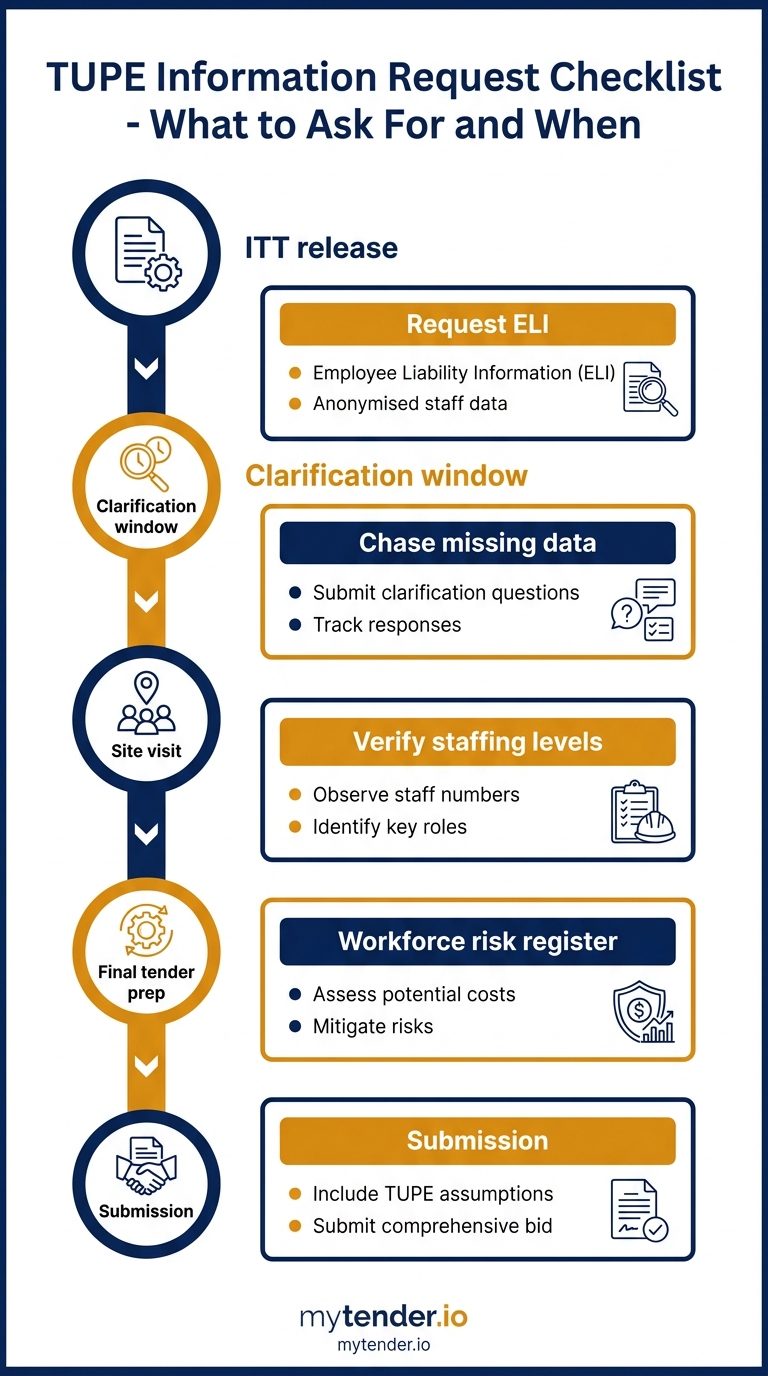
TUPE information request checklist for FM tenders
Site visits and clarification calls
Where the procurement allows site visits or supplier days, treat them as TUPE-fact-finding missions, not just operational walk-rounds. Look at the staff actually on site. Are there visibly more people than the headcount you were given? Are the supervisors agency or permanent? Is there a noticeboard with shift patterns or rotas you can photograph (with permission)?
In one recent FM retender we worked on, the ELI showed 22 cleaning operatives. The site visit showed 31 people in branded uniforms doing cleaning work. Eight of them were agency cover for sickness; one was a deep-clean specialist on a service charge that had not been disclosed. That is the kind of gap a 30-minute walk-round catches that a spreadsheet never will.
Due Diligence: Reading the ELI Properly
Once you have the ELI, the temptation is to hand it to the commercial team to plug into the pricing model and move on. Resist that temptation. The bid manager (or someone they trust) needs to read the ELI properly, because the commercial team will only price what is on the page; they will not flag the things that are missing or anomalous.
Here are the seven things to look for that most often catch bidders out:
- Sickness absence above 5%. Anything above the FM industry average of around 4 to 5% is a red flag. It signals either a workforce issue (morale, management, working conditions) or a culture of presenteeism in the data (people calling in sick when actually on leave). Either way, it costs you money in cover and adds risk to your service delivery commitment.
- Pay rates above benchmark. Compare the transferring rates to your own rates for equivalent roles, and to public benchmarks (Real Living Wage, sector pay surveys). If transferring staff are 10 to 15% above your standard rate, you have a margin problem you need to price for, not assume away.
- Long-service liabilities. Look at length of service. A workforce where 30% of staff have over 10 years' service carries significant statutory redundancy exposure if you ever need to restructure. That is a future cost the bid team should at least flag to the commercial sponsor.
- Hidden allowances. Shift allowances, standby payments, callout fees, anniversary bonuses, attendance bonuses, London weighting. These rarely appear in headline pay rates but can add 15 to 25% to the true cost of a role. Read the contract terms, not just the pay column.
- Pension scheme commitments. Defined benefit schemes (especially admitted body status in the LGPS for ex-public-sector contracts) can carry significant deficit contribution obligations that survive transfer. Get specialist input if this looks present.
- Active grievances or tribunal cases. These transfer with the employee. An open equal pay claim or constructive dismissal case becomes your problem on Day 1.
- Variable hours or zero-hours mix. A workforce with 30% zero-hours staff is more flexible but harder to manage and harder to retain. It also signals possible underlying issues with the contract's stable workload assumptions.
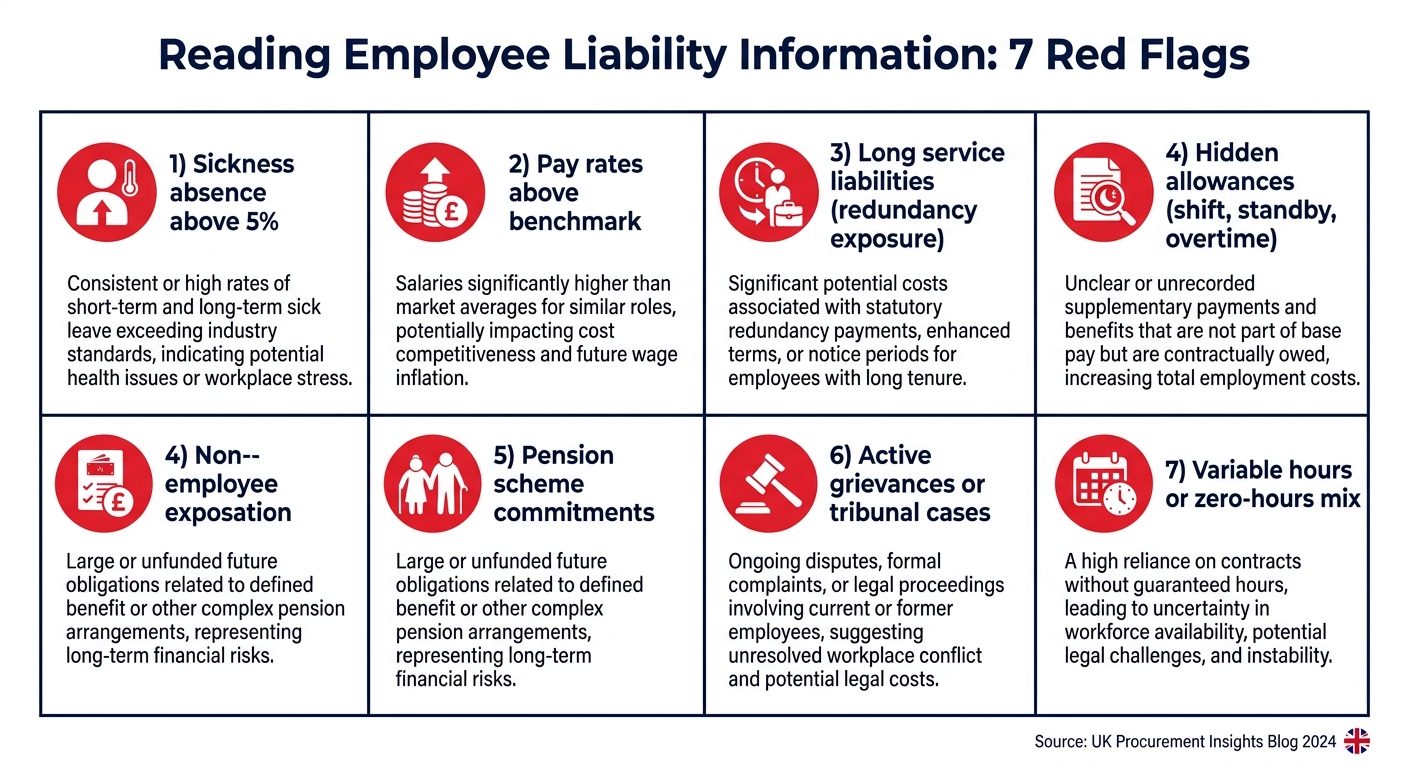
Seven red flags to look for in TUPE Employee Liability Information
Build a one-page TUPE risk summary for internal sign-off before pricing locks. The commercial team needs to see what you have spotted; the bid director needs to know what you are flagging in the response; the operations lead needs to know what they are inheriting.
Risk Allocation: Fixed Price vs Variable, and How Evaluators Read It
Once you understand the workforce you are inheriting, the next decision is how much of the TUPE risk you absorb in your price and how much you push back to the buyer through contract drafting.
This is a commercial decision, but how you describe it in the bid response is a bid-writing decision, and the two are linked.
Fixed price (full risk transfer)
You absorb everything. Pension volatility, equal pay risk, redundancy exposure, sickness costs above the ELI baseline, hidden allowances that come to light post-transfer.
- Your price is higher (you have to price the risk in)
- The buyer loves the certainty
- You need genuine reserves to cover when (not if) something surfaces
- Evaluators read this as bidder maturity, if you describe it transparently
Variable / pass-through (risk-shared)
You absorb the predictable elements (known headcount, disclosed pay, normal sickness) and pass back specific risks via the contract. Common pass-throughs:
- Equal pay claims arising from pre-transfer conduct
- Pension deficit contributions for protected schemes
- Costs of redundancies required by buyer-led service changes
- Variations in disclosed headcount above a threshold
This is harder to draft and harder to win on, because evaluators have to be confident the pass-throughs are clearly defined and not hidden price-creep mechanisms. But on a contract with material TUPE uncertainty, it is often the only commercially sensible approach.
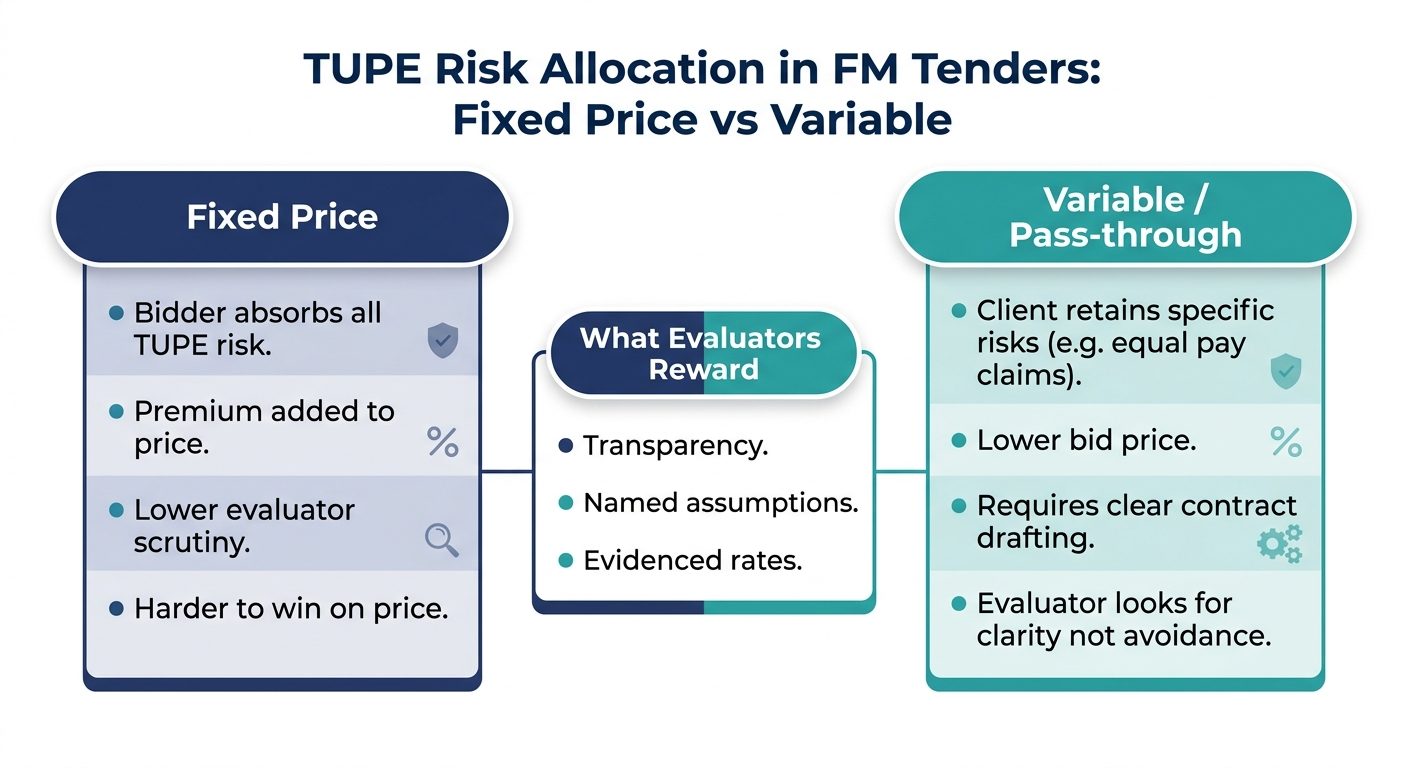
TUPE risk allocation: fixed price vs variable in FM tenders
How evaluators read this
A few hard-won lessons on what works in the bid response itself:
- Be transparent about your assumptions. A pricing schedule that names the headcount, average rate, sickness uplift, holiday cover percentage and pension contribution rate it is built on reads as professional. A schedule with a single bottom-line number reads as opaque.
- Show the workings on a single page. A "TUPE assumptions register" appendix, signed by the bid director, demonstrates rigour. Evaluators routinely score it higher than the same numbers buried in a methodology narrative.
- Avoid the language of avoidance. "We accept full TUPE risk" sounds confident but evaluators read it sceptically; they assume you have either over-priced or under-thought it. "We have priced X based on the ELI provided, with assumptions A, B, C and a defined pass-through where Y" reads as both confident and credible.
- Match the risk allocation to the contract context. A three-year hard FM contract with a stable workforce can sensibly take fixed price. A 10-year integrated FM contract with significant scope change in flight cannot.
Writing the TUPE Section: What Evaluators Actually Want to See
The TUPE response question varies wildly between buyers, but the underlying scoring criteria are remarkably consistent. Across hundreds of FM evaluation moderation reports, six things separate a 60/100 answer from an 85/100 answer.
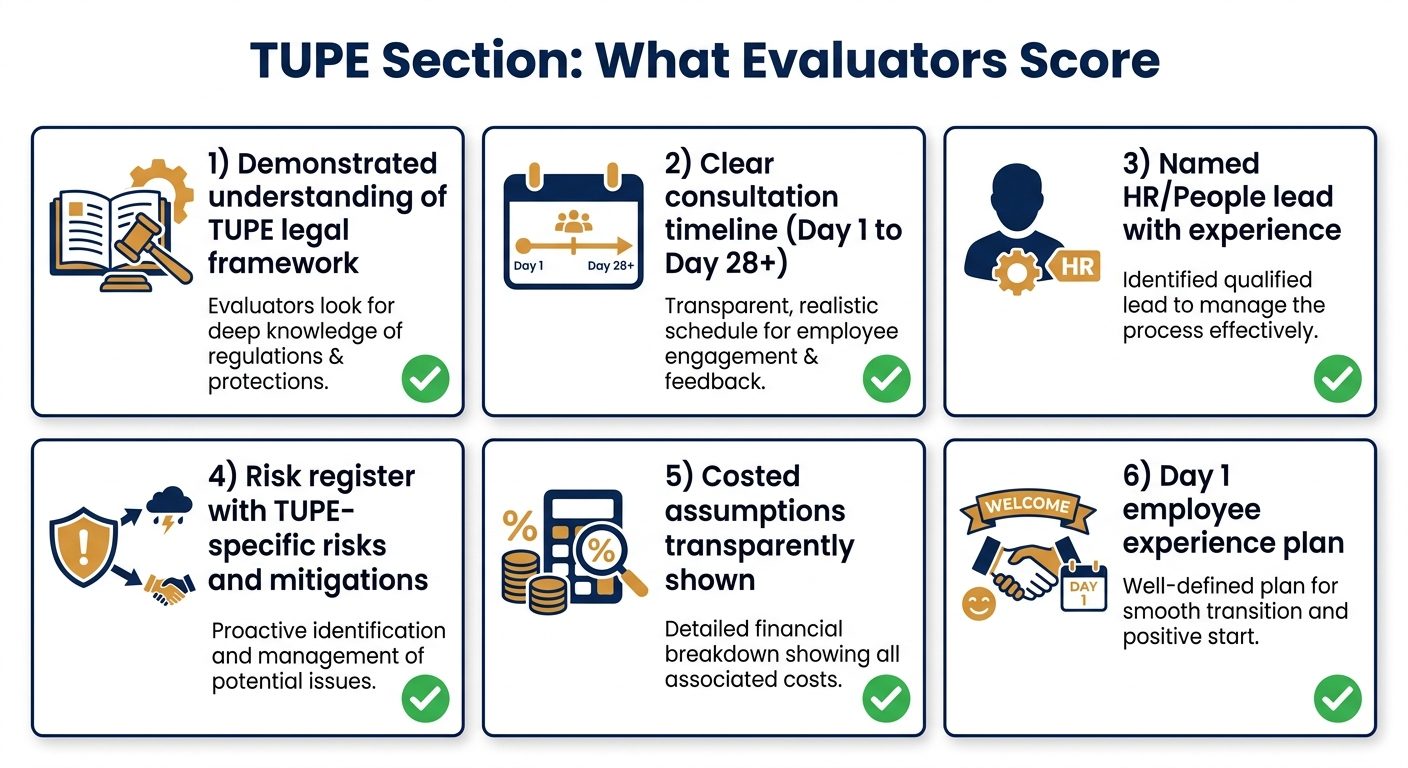
What evaluators score on the TUPE section of an FM tender
1. Demonstrated understanding of the legal framework
You do not need to recite the regulations, but you need to show you know what they are. Reference TUPE 2006 by name. Reference Regulation 11 (ELI) and Regulation 13 (consultation). Note the relevant case law if it is genuinely material (e.g. service provision changes for fragmented services). Two paragraphs, no more, but they must read as accurate.
2. A clear consultation timeline
This is the single most reliable place to win marks. Map out a consultation timeline in days relative to the contract award date:
- Day -28 (or earlier): Receive Regulation 11 ELI from outgoing provider
- Day -28 to -14: Joint employer briefings with outgoing provider
- Day -14: Letter to affected employees confirming transfer, with FAQs
- Day -14 to -7: Individual consultation meetings, employee-by-employee
- Day -7: Final ELI reconciliation, pay/benefits confirmation
- Day 0 (transfer): Welcome pack, day-one paperwork, local manager introduction
- Day +14: First post-transfer 1:1 with each employee
- Day +28: Closing of statutory consultation period
Evaluators read this and conclude: this bidder has done it before. That single conclusion is worth more than two pages of TUPE theory.
3. A named HR or People lead with experience
Generic "our HR team" language is invisible to evaluators. A named lead, with their TUPE experience summarised in one paragraph (number of transfers managed, sectors, headcounts), shifts the answer from generic to credible. Even better: a named secondary for cover, and a clear escalation route to a senior HR director.
4. A TUPE-specific risk register
Not the generic project risk register. A separate one with TUPE-specific risks: ELI gaps, pay reconciliation errors, pension administrative misalignment, union recognition continuity, T&Cs harmonisation post-protection-period, post-transfer attrition. Each with likelihood, impact and a named mitigation. Three to five rows is enough; ten is excessive.
5. Costed assumptions, transparently shown
Tie the TUPE response to the pricing schedule. "We have priced this contract based on the headcount, pay rates and benefit structures shown in the ELI dated \[X\]. Where data was incomplete, we have made the assumptions detailed in Appendix Y." That single sentence does enormous evaluator work.
6. A Day 1 employee experience plan
What does a transferring employee actually experience on the morning of transfer? Who greets them, who issues their new ID, who explains the new uniform, who runs the first toolbox talk, who answers their questions about pay? A bid that walks the evaluator through that morning, in concrete detail, scores higher than one that talks about "ensuring a smooth transition."
Common Mistakes That Cost Marks (and How to Avoid Them)
A short list of the things that cost bidders marks on the TUPE section, repeatedly, year after year:
- Boilerplate copy-paste. Last bid's TUPE section, lightly edited. Evaluators recognise it because they read it in the last bid too. Write the section fresh against the actual ELI for this contract.
- Confusing TUPE with the broader mobilisation plan. TUPE is one workstream within mobilisation; it is not the whole thing. The mobilisation plan should reference the TUPE workstream, not duplicate it. (For more on the mobilisation section itself, see our guide to writing a mobilisation plan that convinces evaluators.)
- Ignoring the union dimension. Where the workforce is unionised, evaluators expect to see union engagement in the consultation timeline. Skipping it reads as either naive or hostile. Both lose marks.
- Pretending the ELI was complete when it was not. Evaluators know the ELI was patchy; they have read the same data. A response that names the gaps and explains how they were handled reads as honest. A response that pretends there were no gaps reads as either careless or evasive.
- Over-promising harmonisation. The temptation to say "we will harmonise terms within 12 months" is high. The legal reality is that you cannot lawfully harmonise transferred terms purely because of the transfer. Promise what you can deliver, not what sounds clean.
- Forgetting the buyer also has TUPE obligations. On insourcings or contracts where the buyer is the recipient, the buyer has duties too. A mature bidder will note where buyer cooperation is needed for a clean transfer and propose how that will work.
Where Tools Like mytender.io Can Help With TUPE Consistency
The bid manager problem with TUPE is not really a TUPE problem; it is a consistency problem. You write a TUPE section for a hospital cleaning contract in March, a different one for a corporate hard FM contract in April, and a third for a council security contract in May. Each is bespoke, each draws on the same internal expertise, and each is written under deadline pressure with no time to look back at what you wrote last time and ask whether it can be reused.
This is the gap that AI-assisted bid platforms genuinely fill. Not by writing the TUPE section for you (the section needs to be tied to this contract's ELI, this workforce, this buyer's specific question) but by giving you a maintained, searchable internal library of:
- Past TUPE responses, indexed by sector and contract type
- Standard TUPE risk register entries with your tested mitigation language
- Named HR lead biographies, kept current
- Consultation timeline templates, by transfer size
- Standard assumption schedules linked to your pricing model
When the new ITT lands, the bid manager pulls the closest precedent, adapts it to the specific ELI and contract, and writes against a foundation that already includes the legal accuracy and the structural rigour evaluators are looking for. The intellectual work shifts from re-creating the framework every time to applying judgement to the things that are actually different about this contract.
That is what mytender.io is built to do. Not replace the bid manager's judgement on the hard parts, but eliminate the rework on the parts that should be consistent across submissions.
Closing: Stop Treating TUPE as the Section You Leave Until Last
The pattern across most FM bid teams is that TUPE gets written last, by whoever is left at the end of the process, against incomplete data, with little time for sign-off. That is exactly the wrong order. TUPE underpins the cost base, shapes the mobilisation plan, and signals operational maturity to the evaluator. It deserves to be written early, not late.
A few things to take away:
- Treat the information request as active work. Chase the ELI, ask clarifications, do site visits.
- Read the ELI yourself, looking for the seven red flags. Do not delegate that read entirely to the commercial team.
- Decide your risk allocation early, and write the response to match the choice.
- Write the TUPE section against the six evaluator criteria, not against last bid's structure.
- Build a maintained internal library so each new TUPE section starts from a strong foundation, not a blank page.
If you want to see live FM opportunities matched to your sector and the kind of TUPE-relevant clauses to expect from each buyer, the Tender Finder is free to use. And if you are working on an FM mobilisation plan alongside the TUPE section, our guide to writing a mobilisation plan walks through the same evaluator-led approach.
The bid teams who handle TUPE well are not the ones with the most legal expertise. They are the ones who treat it as a serious section, plan for it early, and write against what evaluators are actually scoring. The rest of the bid is easier when this section is solid.
Tags
Ready to Transform Your Tender Writing?
See how MyTender's AI can help you write winning tenders in a fraction of the time.