

How to Price a Tender: Complete Guide to Winning Bid Pricing Strategy 2026
Master tender pricing strategy in 2026. Learn how to build accurate cost models, price competitively against MEAT criteria, avoid common pricing mistakes, and use AI tools to win more public sector contracts.
Evie
Procurement Specialist
Pricing a tender is one of the most consequential decisions in the entire bidding process. Underprice and you risk winning a contract you cannot deliver profitably. Overprice and your submission never reaches evaluation. Price correctly—with the right supporting narrative—and you win contracts that grow your business sustainably.
Yet pricing strategy is consistently the least-discussed element of tender writing. Most guides focus on quality responses, compliance, and evidence. Fewer address the mechanics of how to actually price a bid, how to structure your pricing narrative, and how to position your price within the evaluation framework to maximise your score.
This guide covers everything: cost model construction, MEAT scoring mechanics, price-quality balance strategy, common pricing errors, and how modern AI tools are transforming bid pricing accuracy.
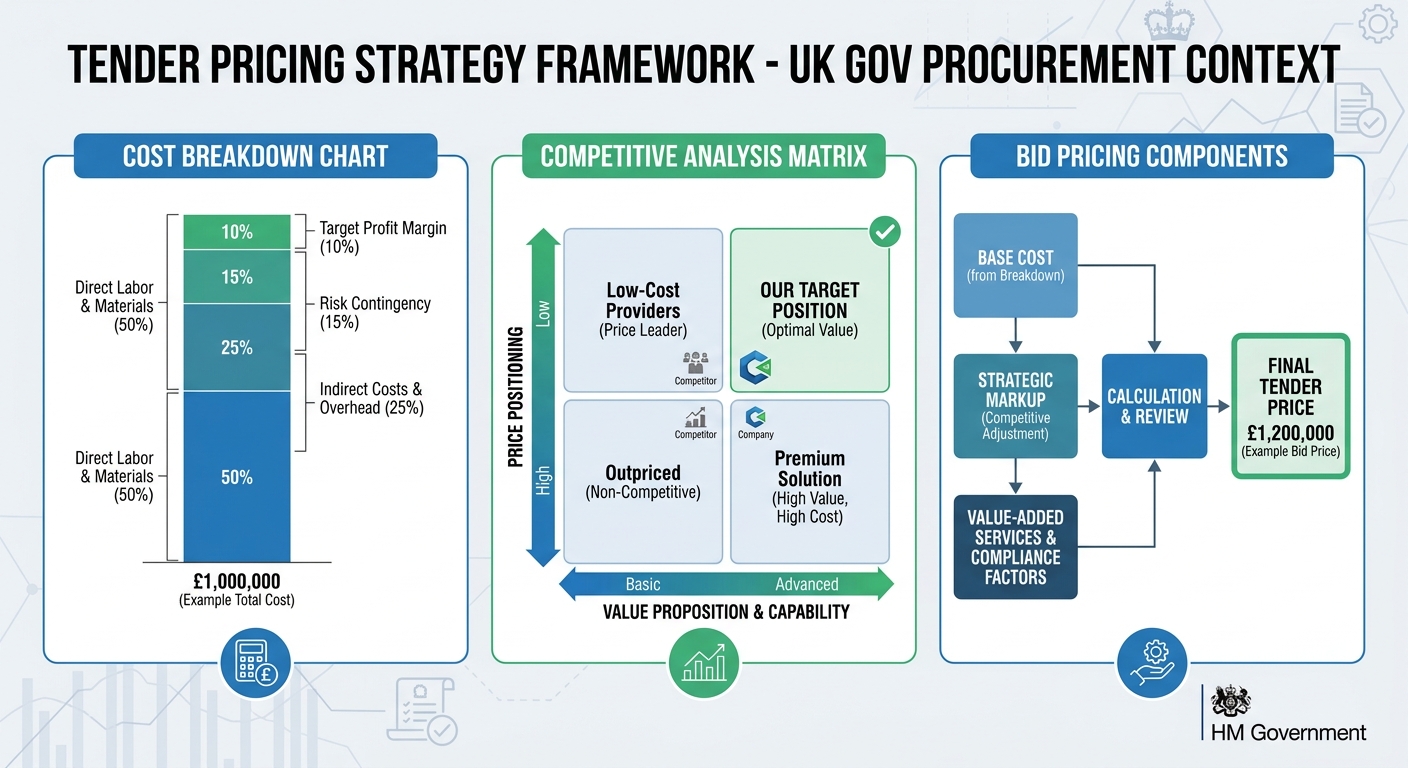
Tender pricing strategy framework showing cost breakdown, competitive analysis and bid pricing components
Why Tender Pricing Is Different From Commercial Pricing
Before diving into methodology, it's worth understanding why public sector tender pricing requires a different approach from commercial negotiations.
In a commercial sale, price is one variable in a negotiated conversation. You can adjust, discount, bundle, and respond dynamically. In a tender, your price is fixed at submission. There are no second chances, no post-submission negotiation (in most cases), and no opportunity to explain away a pricing mistake once evaluators have scored you.
Public sector buyers also evaluate price within structured frameworks. Your price doesn't just need to be competitive—it needs to score well against specific evaluation criteria, often weighted against quality scores. A price that's 5% higher than the cheapest bid might still win if it scores better on the price-quality balance. Conversely, the lowest price rarely wins outright in modern procurement; Most Economically Advantageous Tender (MEAT) criteria mean quality weighs heavily alongside cost.
Understanding this distinction—price as a scored submission element, not a negotiated position—changes how you should approach pricing entirely.
The Anatomy of a Public Sector Tender Price
A winning tender price is not simply "cost plus margin." It's a carefully constructed figure that reflects:
- Your accurate cost to deliver — direct and indirect costs, overhead allocation, risk contingency
- Your desired profit margin — sustainable for the contract duration, justified by risk and investment
- The competitive landscape — where buyers will likely cluster, what range represents genuine market value
- The evaluation framework — how your price will score relative to the lowest compliant bid
- The contract risk profile — pricing that protects you against foreseeable cost escalation
Each of these factors must inform your pricing decision. Missing any one of them creates structural pricing risk.
Step 1: Build an Accurate Cost Model
The foundation of any sound tender price is an accurate, detailed cost model. This is not a back-of-envelope calculation—it's a structured breakdown of every cost component associated with contract delivery.
Direct Costs
Direct costs are those directly attributable to contract performance. They vary with volume and are the most straightforward to calculate, but also the most frequently underestimated.
Labour costs typically represent the largest component. For each role in your delivery model, calculate:- Base salary or day rate
- Employer National Insurance contributions (13.8% on earnings above £9,100 per year in 2026)
- Pension contributions (employer minimum 3%, often higher in public sector contracts)
- Holiday pay (statutory 5.6 weeks per year, often higher for experienced staff)
- Sick leave provision (typically 2-3% of payroll as a prudent contingency)
- Training and professional development costs
A common error is calculating labour costs on base salary alone. A staff member costing £35,000 in salary actually costs closer to £42,000-£45,000 when you factor in employer NI, pension, and holiday pay. Across a 10-person contract team, this gap can amount to £70,000-£100,000 per year—a material underestimate that can eliminate margin entirely.
Materials and consumables must be priced using realistic procurement costs, not list prices. Factor in:- Current supplier pricing (ideally locked in via quotes valid through the contract period)
- Delivery and logistics costs
- Wastage rates (sector-dependent, but typically 3-8%)
- Price escalation provisions (especially for multi-year contracts)

Professional analysing bid pricing documents with cost models and financial spreadsheets
Indirect Costs and Overhead Allocation
Indirect costs—also called overheads—are costs that support your business but don't directly attribute to a single contract. They must be allocated fairly across your contract portfolio.
Common overhead categories include:
- Management and administration salaries (the time your leadership team spends managing the contract)
- Office space and utilities
- IT infrastructure and software licences
- Insurance premiums (employers' liability, public liability, professional indemnity)
- Finance and accounting
- HR functions
- Business development and bid costs (the cost of winning work)
- Central marketing and communications
The standard approach is to calculate an overhead absorption rate: total annual overheads divided by total direct labour costs (or total revenue). This rate, expressed as a percentage, is then applied to each contract.
For example, if your annual overheads are £500,000 and your direct labour costs across all contracts total £2,000,000, your overhead absorption rate is 25%. A contract with £200,000 of direct labour costs should therefore carry £50,000 of overhead.
This approach isn't perfect—some contracts are more overhead-intensive than others—but it provides a defensible, consistent methodology that procurement teams can understand.
Risk Contingency
Every contract carries risk. Pricing that risk correctly is one of the most important—and most neglected—elements of tender pricing.
Risk contingency is not a blanket percentage added to cover vague uncertainty. It should be a calculated figure based on specific identified risks, each with an estimated probability and financial impact.
Build a risk register for the contract. For each risk, calculate the expected value: probability multiplied by financial impact. Sum these expected values to arrive at your risk contingency figure.
For example:
- Risk: Key staff member leaves during contract. Probability: 25%. Recruitment and transition cost: £8,000. Expected value: £2,000.
- Risk: Material cost increase above CPI. Probability: 40%. Additional cost: £15,000. Expected value: £6,000.
- Risk: Scope creep requiring additional capacity. Probability: 30%. Additional cost: £20,000. Expected value: £6,000.
- Total risk contingency: £14,000.
This quantified approach to risk pricing produces a defensible contingency figure rather than an arbitrary percentage. It also forces you to think clearly about contract risks before you're committed to delivery.
Profit Margin
Profit margin is the return you require for the capital investment, management attention, and organisational capacity you're committing to the contract.
Appropriate margin levels vary by sector, contract type, and risk profile. As a general guide:
- Straightforward, low-risk service contracts: 5-8%
- Complex, medium-risk contracts with significant management overhead: 8-12%
- High-risk contracts, novel delivery models, or significant capital investment required: 12-20%+
Public sector buyers are not entitled to expect zero-margin pricing. A supplier operating at zero or negative margin cannot sustain quality delivery, invest in staff, or maintain operational resilience. Buyers increasingly recognise this, and the 2023 Procurement Act's emphasis on economic resilience and long-term value explicitly acknowledges that sustainable supplier economics are in the public interest.
That said, excessive margins in competitive markets signal weak cost control or low confidence in your pricing model. If your price is significantly above competitors, be prepared to justify it through quality differentiation rather than assuming the buyer will accept unexplained premium pricing.
Step 2: Understand MEAT Criteria and Price Scoring
Under the Public Contracts Regulations 2015 and reinforced by the Procurement Act 2023, public sector buyers must evaluate tenders using MEAT criteria—Most Economically Advantageous Tender. Pure lowest-price procurement is now restricted and must be specifically justified.
In practice, this means your price is scored as one component in a weighted evaluation framework. Understanding how price scoring works is essential to pricing strategy.
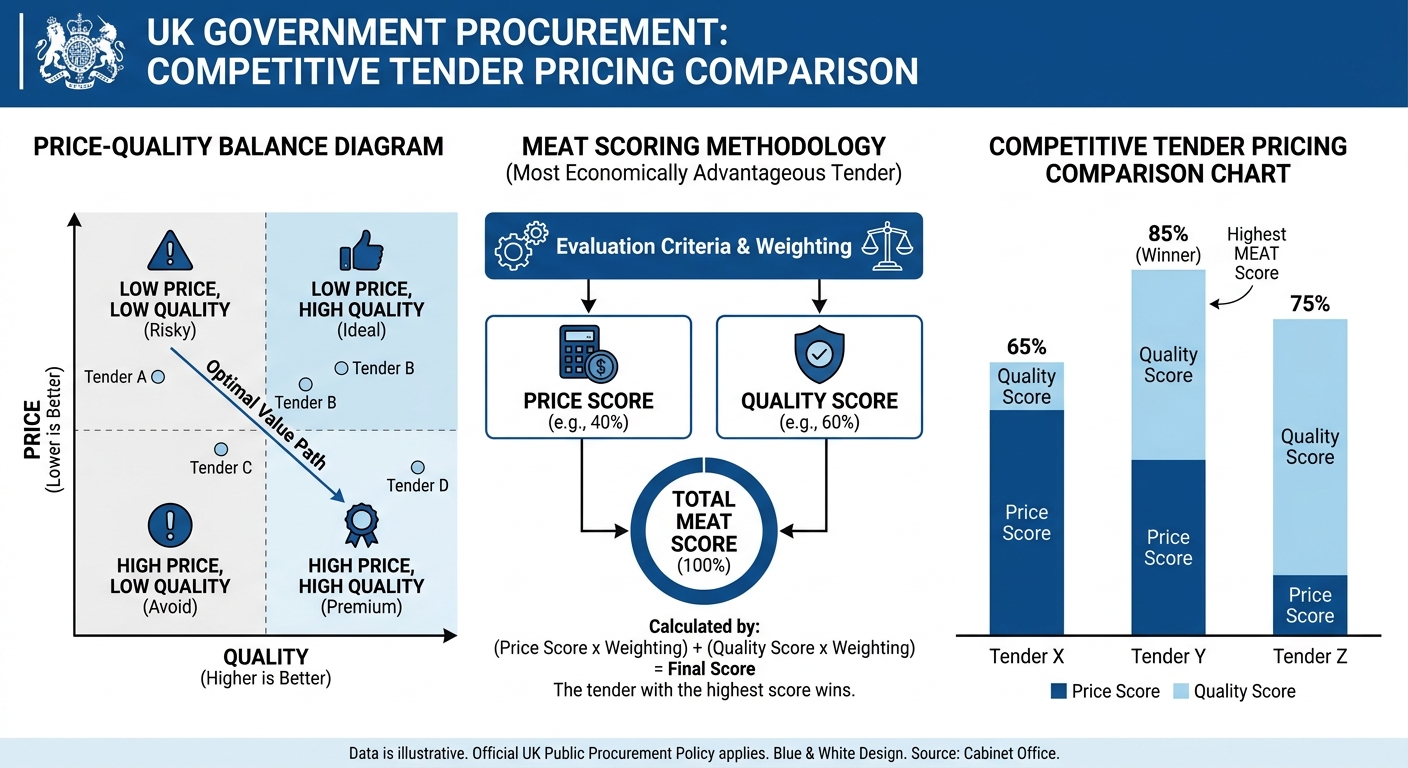
MEAT scoring methodology and price-quality balance diagram for public sector tenders
How Price Scoring Works
The most common price scoring methodology is the lowest-price formula. In this approach, the lowest compliant price receives the maximum price score (e.g., 100 points). Every other bidder's price score is calculated relative to the lowest bid:
Price score = (Lowest price / Your price) × Maximum price pointsSo if the lowest compliant bid is £100,000, the maximum price score is 100 points, and your bid is £115,000:
Price score = (£100,000 / £115,000) × 100 = 86.96 points
You score approximately 87 out of 100 for price—a meaningful but not catastrophic reduction, depending on the overall weighting.
Some buyers use alternative formulas, including:
- Range formula: Scores price relative to both the lowest and highest bids, rewarding relative competitiveness
- Fixed price model: All bidders pay the same price (set by the buyer); quality alone determines the winner
- Reverse auction: Dynamic pricing in real-time competitive bidding
Always read the tender documents carefully to understand which formula applies. The scoring methodology should be stated explicitly, but sometimes needs to be inferred from the evaluation section.
Price Weighting vs Quality Weighting
Price typically represents 20-40% of the total evaluation score in modern public sector tenders. Quality, social value, technical approach, and other criteria make up the remainder.
Common weightings include:
- 30% price / 70% quality (complex services, where delivery methodology matters most)
- 40% price / 60% quality (standard services with established delivery models)
- 20% price / 80% quality (highly specialist services where capability is paramount)
This weighting has profound implications for pricing strategy. If price accounts for just 30% of the total score, winning 30 additional price points (by pricing 15% lower) is less valuable than winning 30 additional quality points through a stronger technical submission.
This doesn't mean price is irrelevant—it means the decision to discount price must be weighed against the cost to your margin versus the scoring uplift achieved.
Step 3: Research the Competitive Landscape
Pricing in isolation—without understanding what your competitors will likely bid—is flying blind. Market intelligence is a legitimate and important component of tender pricing strategy.
Sources of Competitive Intelligence
Previous contract award data. The public sector is required to publish contract award notices on Find a Tender Service (FTS) and Contracts Finder. These notices often include the awarded contract value, which gives you a data point on what a winning price looked like for a comparable contract. Framework agreement pricing. If you're bidding on a framework call-off, the framework itself provides pricing benchmarks. Look at the range of day rates or unit costs from framework suppliers to understand market positioning. Published rate cards. Many public sector frameworks publish approved supplier rate cards. These provide explicit market benchmarks and help you understand where you're positioned relative to approved market rates. Industry knowledge. Speak to your business development team, delivery managers, and industry contacts. Experienced bid professionals build intuitive market pricing knowledge through years of submissions. This tacit knowledge, while hard to quantify, is genuinely valuable. Cost benchmarking. For labour costs, the Office for National Statistics publishes annual pay surveys by sector and occupation. These provide external validation that your staffing costs are reasonable and current.Positioning Against the Market
Once you have a sense of the market price range, you need to decide where to position your bid within it.
Below market (aggressive pricing): Appropriate when you have genuine cost advantages, want to win a strategic contract, or are entering a new market where establishing a reference site justifies margin sacrifice. Risky if your cost model is optimistic—underpricing can create delivery problems that damage reputation. At market (competitive pricing): The default position for most bids. Prices in the competitive range, relies on quality differentiation to score ahead of similarly-priced competitors. Requires a strong technical submission. Above market (premium pricing): Appropriate when you have demonstrably superior capability, unique technology, or a track record that genuinely justifies premium. Must be supported by a quality submission that scores well enough to compensate for lower price points.Step 4: Construct Your Pricing Narrative
In many tenders, you must submit not just a price but a pricing narrative—a written explanation of how your price is structured and what it includes. This is one of the most underestimated sections of a tender.
A strong pricing narrative does four things:
Demonstrates rigour. Show evaluators that your price is based on detailed, realistic cost modelling—not a rough estimate. Reference your cost components, methodology, and assumptions explicitly. Justifies your positioning. If your price is above the anticipated lowest bid, explain why. What additional capability, capacity, or quality does your higher price deliver? What risks does it mitigate that cheaper alternatives might not address? Provides transparency on assumptions. Public sector buyers appreciate clarity on what's in—and out—of your price. If your price excludes certain items, say so explicitly. Ambiguity around scope creates post-contract disputes. Demonstrates value, not just cost. Frame your price in terms of total value delivered over the contract term, not just the unit cost. A slightly higher price that includes proactive contract management, performance guarantees, and innovation investment may represent better whole-life value than a bare-minimum price.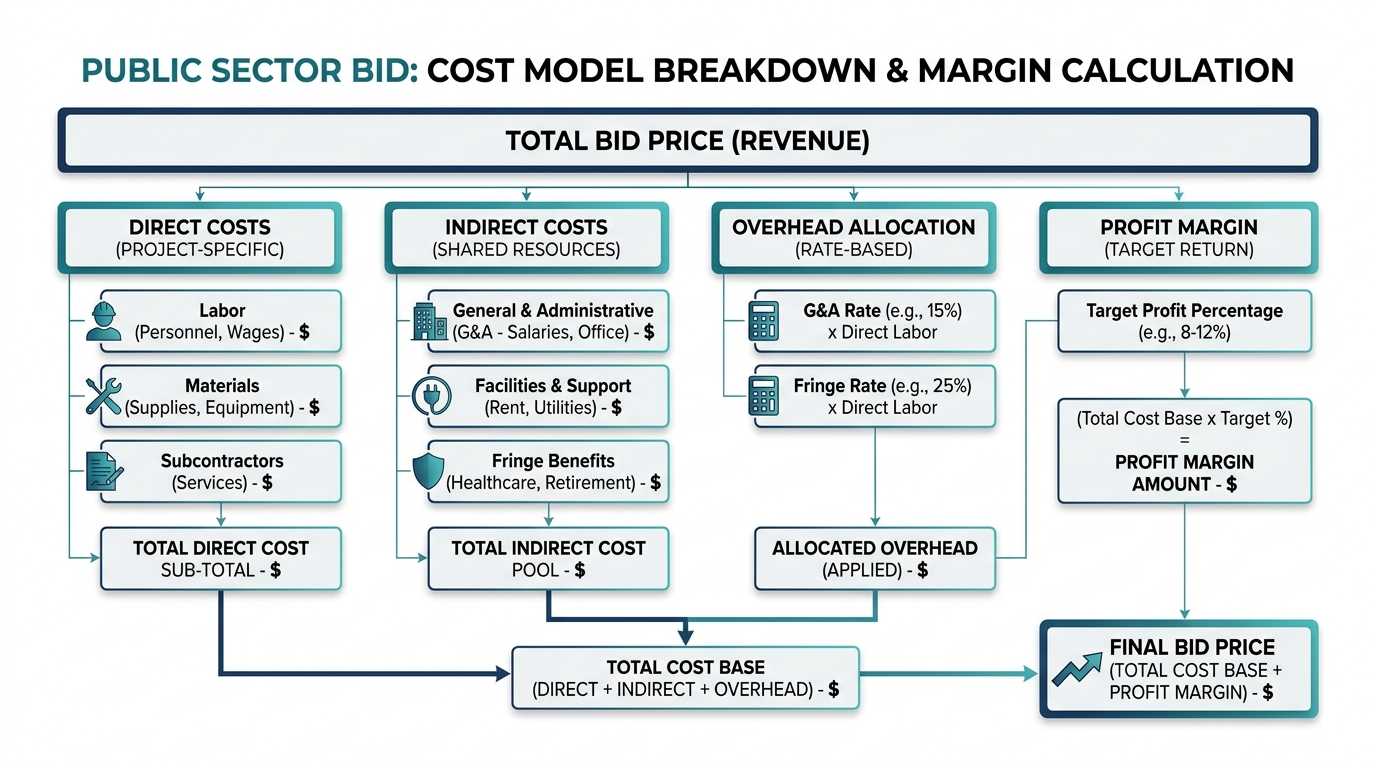
Detailed cost model breakdown showing direct costs, overhead allocation and profit margin calculation
Responding to Price Clarification Questions
Buyers sometimes issue clarification questions during evaluation, particularly if your price appears anomalously high or low. Prepare for this by:
- Keeping detailed records of your cost model and assumptions
- Being able to explain every line item in your pricing
- Having supplier quotes and market data available to support your labour and materials costs
- Documenting your overhead allocation methodology
A buyer asking you to explain your pricing is not necessarily a red flag. It's an opportunity to demonstrate the robustness of your cost model and reinforce confidence in your ability to deliver at the stated price.
Step 5: Price-Quality Trade-Off Analysis
One of the most powerful tools in tender pricing is running a deliberate price-quality trade-off analysis before finalising your bid price.
This analysis works as follows:
- Estimate your quality score based on an honest assessment of your technical submission (e.g., 75 out of 100 quality points)
- Estimate the competitive price range (e.g., likely winner will bid £90,000–£110,000)
- Calculate your price score at different bid levels using the scoring formula
- Calculate your total score (quality score × quality weighting) + (price score × price weighting) at each price point
- Identify the price that maximises your total score while maintaining acceptable margin
This analysis often reveals that modest price reductions don't significantly improve your total score—especially where price is weighted at 30% or less. A £10,000 reduction in price might improve your price score by 4 points, which, at 30% weighting, adds just 1.2 points to your total score. If that price reduction costs you £10,000 in margin, it's rarely worth it.
Conversely, if your quality score is strong and your price is at the high end of the market, the analysis might reveal that a more competitive price position would push you ahead of technically similar but higher-priced competitors.
This is the kind of analysis that transforms pricing from intuition to strategy.
Common Tender Pricing Mistakes (and How to Avoid Them)
Undercosting Labour
The single most common pricing error. Bids that win on labour costs which assume best-case staffing, minimal management overhead, or failure to include employer on-costs regularly run into margin problems during delivery. Always build your labour costs from actual employer cost, not gross salary.
Ignoring Inflation on Multi-Year Contracts
A contract priced at today's costs will face higher costs in year two, year three, and beyond. For any contract longer than 12 months, include a price escalation mechanism in your pricing narrative. Index your labour costs to the National Living Wage or CPI. Index materials to relevant commodity indices. If the buyer doesn't permit escalation clauses, factor anticipated inflation into your base price.
Failing to Read the Pricing Schedule Carefully
Pricing schedules in public sector tenders are often complex, with multiple lots, optional components, and break-even analysis requirements. Misreading a pricing schedule—pricing per unit when the buyer expected a fixed annual fee, for example—can result in disqualification or an anomalous bid that can't be evaluated fairly.
Always read the pricing schedule three times. Have a colleague review it independently. Clarify ambiguities before submission.
Copying Prices From a Previous Bid
Market rates change. Your cost base changes. A price that was appropriate 18 months ago may not reflect current labour market costs, energy prices, or competitive dynamics. Always build each bid price from a fresh cost model.
Pricing to Win at Any Cost
Winning a contract you cannot deliver profitably is worse than not winning at all. A loss-making contract damages staff, client relationships, and organisational reputation—and may preclude you from bidding for future contracts with the same buyer. Price to win on your terms, not just to win.
Not Modelling the Price Score
Submitting a price without calculating how it will score is leaving the evaluation to chance. Always run the scoring formula before submission. If your price scores significantly below what you need to win, either improve your quality submission or consider whether you can competitively reduce your price—not as a strategic afterthought but as a pre-submission decision.
Multi-Lot and Framework Pricing Considerations
Many large public sector procurements involve multiple lots or call-off arrangements under framework agreements. Pricing these correctly requires additional strategy.
Multi-Lot Bidding
When bidding for multiple lots within a single procurement, consider:
Cross-lot efficiencies. If you win multiple lots, you may achieve economies of scale in management, infrastructure, and overhead. Your pricing should reflect these synergies where genuine—but be cautious about pricing multi-lot efficiency gains that you'd only realise if awarded all lots. Lot interdependencies. Some buyers assess whether your pricing across lots is internally consistent. A price for Lot A that implies a management structure inconsistent with your Lot B price may raise red flags in evaluation. Strategic lot prioritisation. If you can't competitively price all lots, focus resources on the lots with highest value or strategic importance. A strong, competitive submission on two lots is better than a weak submission across four.Framework Call-Off Pricing
Framework agreements typically set ceiling rates for categories of service or day rates. Call-off competition within the framework allows suppliers to compete on price beneath those ceiling rates.
Key strategies:
Know your ceiling. Understand what the framework ceiling rate represents in your market. In many frameworks, ceiling rates reflect 2020 or 2021 benchmarks that are now below current market costs. Pricing at ceiling may not be competitive; pricing below ceiling may squeeze margin. Use direct award strategically. Some framework agreements permit direct award for smaller value call-offs. Where direct award is an option, your relationship with the buyer and your track record may matter more than price competition. Maintain rate card discipline. If your framework rates are set, resist buyer pressure to offer further discounts during the call-off process without a corresponding scope reduction. Framework discounting erodes margin and sets a precedent for future call-offs.How AI Is Transforming Tender Pricing
The traditional tender pricing process—spreadsheets, manual calculation, subjective market estimates—is being rapidly supplemented by AI-powered tools that improve accuracy, speed, and strategic insight.
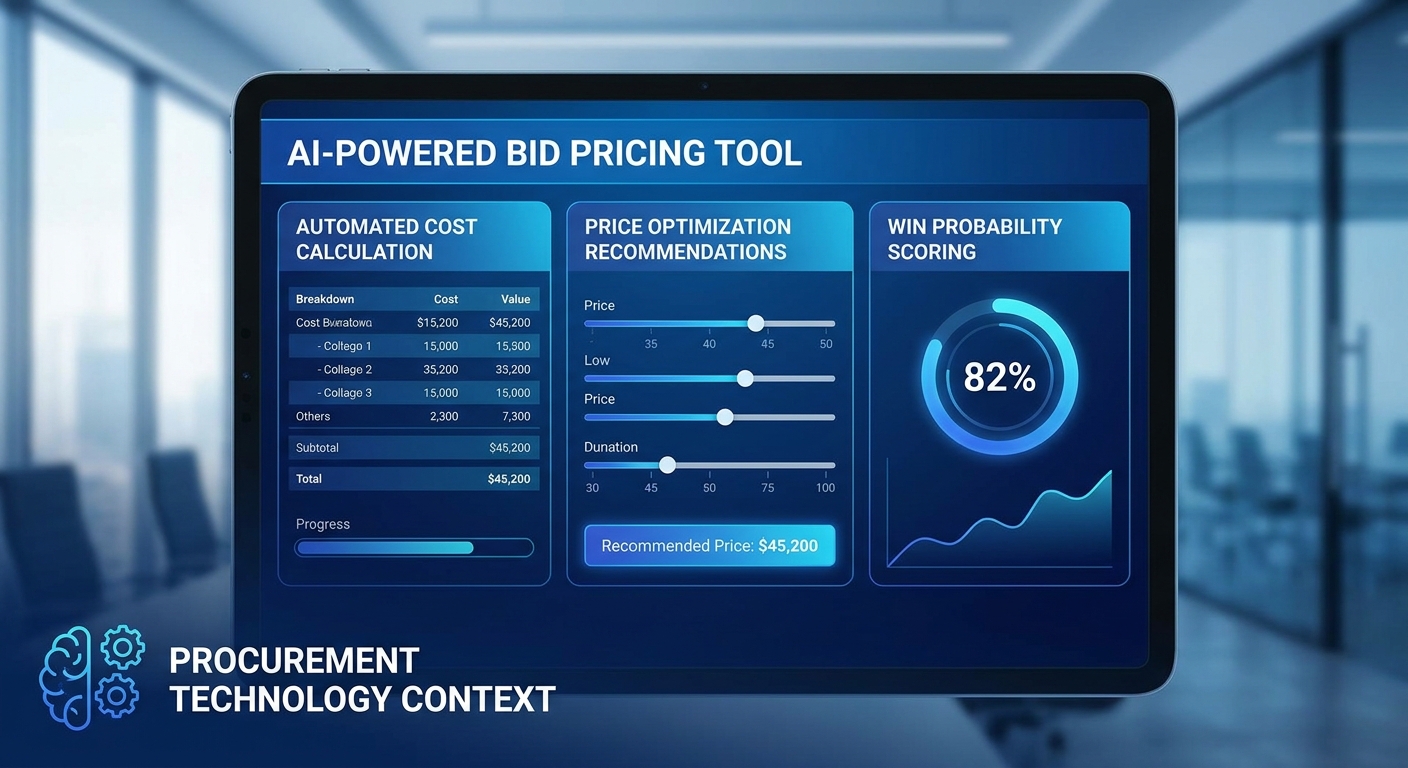
AI-powered bid pricing tool showing automated cost calculation and win probability scoring dashboard
Automated Cost Modelling
AI platforms like MyTender can process historic contract data, labour market benchmarks, and materials indices to generate baseline cost models faster than manual approaches. By ingesting previous contract data and current market rates, these tools reduce the risk of systematic undercosting.
Practical benefit: A business development manager pricing a complex facilities management contract might previously spend two days building a cost model from scratch. An AI-assisted model—seeded with company data and calibrated to current market rates—compresses this to a few hours, freeing time for strategic pricing decisions.Competitive Price Intelligence
AI tools can process published contract award data at scale, identifying pricing patterns across similar contracts, sectors, and geographies. This market intelligence—previously available only to organisations with dedicated bid analytics functions—is now accessible to SMEs bidding for the first time.
Practical benefit: Before pricing a cleaning services tender, you can review 50 comparable contracts awarded over the past 24 months. What was the average price per square metre? What was the winning margin above lowest bid? This intelligence directly informs your pricing strategy.Price Score Simulation
Modern bid platforms allow you to simulate price scores before submission. Enter your proposed price, the likely lowest competitor price, and the buyer's scoring formula—and see exactly how your price will score. Adjust the price dynamically to model different scenarios.
Practical benefit: Instead of submitting a price and hoping, you can model five different pricing scenarios in 10 minutes and make an evidence-based decision about where to position your bid.Consistency Checking
AI tools can cross-reference pricing across tender sections to identify internal inconsistencies—a staffing schedule in the methodology that implies more hours than the price schedule suggests, for example. These inconsistencies, if spotted by evaluators, undermine confidence in your submission.
Practical benefit: A consistency check that previously required a senior reviewer to read every section simultaneously can be automated, reducing error risk on complex multi-section tenders.Narrative Drafting Support
Once your pricing is finalised, AI platforms like MyTender can help draft the pricing narrative—structured, clear explanations of your cost model that demonstrate rigour and transparency without giving away proprietary commercial information.
Sector-Specific Pricing Considerations
Pricing norms vary significantly by sector. What constitutes a competitive price in construction looks very different from professional services or IT.
Construction and Infrastructure
Construction tenders typically require fully priced bills of quantities or schedule of rates. Labour and materials must be priced to industry standards (BCIS rates provide benchmarks), with preliminaries and overheads clearly separated. Profit margins in construction typically run 3-8%, compressed by competitive bidding and thin margins industry-wide.
Key considerations: fluctuation provisions for material costs, allowance for inclement weather delays, bond and insurance costs, and programme-dependent variations in prelims.
Facilities Management
FM contracts are typically priced on a cost-per-square-metre or cost-per-unit basis for static services, with variable components for reactive maintenance. Mobilisation costs—often significant for large sites—need careful treatment: built into the price, separately recoverable, or amortised over the contract term?
Key considerations: TUPE transfer costs for inheriting existing staff, mobilisation investment, KPI failure deductions, and lifecycle cost provisions.
Professional Services
Professional services tenders are typically priced by day rate per grade or role. Day rates need to reflect the full employer cost per day (including non-chargeable overhead time), not just a simple salary divided by working days.
Key considerations: Knowledge that buyers will compare your day rates against published frameworks and consultant rate benchmarks. Any significant premium needs justification through demonstrable expertise or track record.
IT and Technology Services
IT tenders may involve a combination of implementation costs, licensing, support, and managed service components. SaaS and subscription pricing must be carefully structured to align with how the buyer will approve costs (capital vs revenue).
Key considerations: Technology cost escalation (licensing fees increase), cyber security and compliance investment, and service level agreement penalty exposure.
Building a Pricing Culture in Your Organisation
Winning organisations treat pricing as a strategic competency, not a last-minute task. Building a pricing culture means:
Tracking your pricing performance. After every submission, record what you priced, what the winning price was (available from contract award notices), and what your score was. Over time, this database tells you whether you're systematically over- or under-priced in specific sectors or contract types. Debriefing on price. When you lose on price, request feedback. Buyers are required to provide debrief information under the Procurement Act 2023. Use this to calibrate your market position. Standardising cost models. Develop sector-specific cost model templates that capture all cost components consistently. Don't start from scratch on every bid—build on accumulated organisational knowledge. Separating pricing from writing. In organisations where the same person writes the quality response and builds the price, pricing often becomes an afterthought. Consider separating these responsibilities, or at minimum, scheduling dedicated pricing time alongside quality writing. Reviewing prices at board level. For high-value contracts, pricing decisions should involve senior leadership. The financial risk of mispriced public sector contracts—which can run for three to five years—justifies governance attention.The MyTender Advantage in Pricing
MyTender's AI-powered bid platform addresses the pricing challenges that most tender teams struggle with.
Cost model accuracy. MyTender integrates labour market data, materials benchmarks, and your historical contract data to generate baseline cost models grounded in reality rather than optimistic assumptions. MEAT score modelling. Enter your price and competitor price assumptions, and MyTender calculates your predicted price score under any standard public sector scoring formula. See your total score before you submit. Pricing narrative generation. Once your cost model is complete, MyTender drafts the pricing narrative section—clear, structured, and evidenced—saving hours of writing time and ensuring evaluators see a professional, rigorous cost explanation. Compliance checking. MyTender cross-references your price schedule against the tender specification, flagging any items required by the buyer that your price doesn't explicitly address. Portfolio pricing analytics. Track your pricing performance across all bids submitted through MyTender—win rates by price band, score performance at different price levels, and competitive position trends over time.Practical Checklist: Before You Submit Your Tender Price
Use this checklist before finalising any tender price:
- [ ] Full cost model built — labour, materials, subcontractors, overheads, risk contingency, profit
- [ ] Employer on-costs included — NI, pension, holiday pay, sick leave provision
- [ ] Inflation provision — CPI or wage index provisions for multi-year contracts
- [ ] Pricing schedule read three times — correct units, correct lots, correct optional items
- [ ] Price score modelled — calculated using buyer's stated formula and realistic lowest bid estimate
- [ ] Total score modelled — price score plus estimated quality score, tested at two or three price points
- [ ] Pricing narrative drafted — clear, rigorous, transparent, positions your value effectively
- [ ] Peer review completed — a colleague has independently checked the pricing schedule
- [ ] Margin approved — senior sign-off on margin level relative to contract risk profile
- [ ] Award notice research done — comparable contract prices reviewed from FTS/Contracts Finder
Conclusion: Price With Confidence, Not Optimism
Tender pricing is both a science and a strategic discipline. The science—accurate cost modelling, MEAT score calculation, inflation provision—gives you a defensible price built on rigorous analysis. The strategy—market positioning, price-quality trade-off analysis, narrative framing—turns a technically sound price into a winning bid.
The most expensive pricing mistake is not bidding too high. It's winning on a price that can't sustain quality delivery. Build your cost model from first principles, understand how your price will score, research the competitive landscape, and price at a level that reflects the genuine cost of excellent service.
Public sector buyers in 2026 want sustainable suppliers, not the lowest price at any cost. The Procurement Act 2023's emphasis on whole-life value and supplier resilience gives you the framework to argue for—and win with—a price that sustains your business long-term.
Ready to build more accurate, competitive tender prices? Discover how MyTender's AI-powered platform helps you build rigorous cost models, simulate MEAT scores, and draft pricing narratives that win. Start your free trial today.Tags
Ready to Transform Your Tender Writing?
See how MyTender's AI can help you write winning tenders in a fraction of the time.