

How Soft FM and Hard FM Score Differently, And Why Most Bidders Lose Marks They Didn't Need To
Soft FM and hard FM are evaluated against fundamentally different criteria, but most bid teams write a single methodology section and apply it to both. This guide breaks down how evaluators actually score each, where the easy marks live, and the avoidable mistakes that cost contracts.
mytender.io Research Team
Tender Writing & Bid Management Specialists
How Soft FM and Hard FM Score Differently, And Why Most Bidders Lose Marks They Didn't Need To
It is Tuesday morning. The bid manager has two FM tenders open in adjacent browser tabs. One is a five-year cleaning contract for an NHS trust. The other is a hard services M&E contract for a corporate estate. Both are due in 11 working days. Both have a 70 percent quality weighting. Both want a "service delivery methodology."
So they do what almost every bid team does under pressure. They open the previous methodology section, change the client name, swap a couple of paragraphs around, and apply broadly the same answer to both bids. After all, FM is FM, right? Same workforce challenges, same compliance regime, same evaluation logic.
It is not, and the scoresheets prove it every time.
When the feedback letters come back, the cleaning bid scores 78 out of 100 and the M&E bid scores 61. The bid manager assumes the M&E evaluators were tougher, or the incumbent was the preferred supplier, or the price was off. None of those are usually the real reason. The real reason is that hard FM and soft FM are evaluated against fundamentally different criteria, by panels with different professional backgrounds, looking for different evidence in different places. A methodology that scores well in soft FM will routinely lose marks in hard FM, and vice versa.
This guide is for the bid manager who has spotted that pattern in their own scores and wants to do something about it. It walks through what soft FM and hard FM actually are, how the scoring breaks down for each, what evaluators are really looking for, and the avoidable mistakes that cost contracts you should have won.
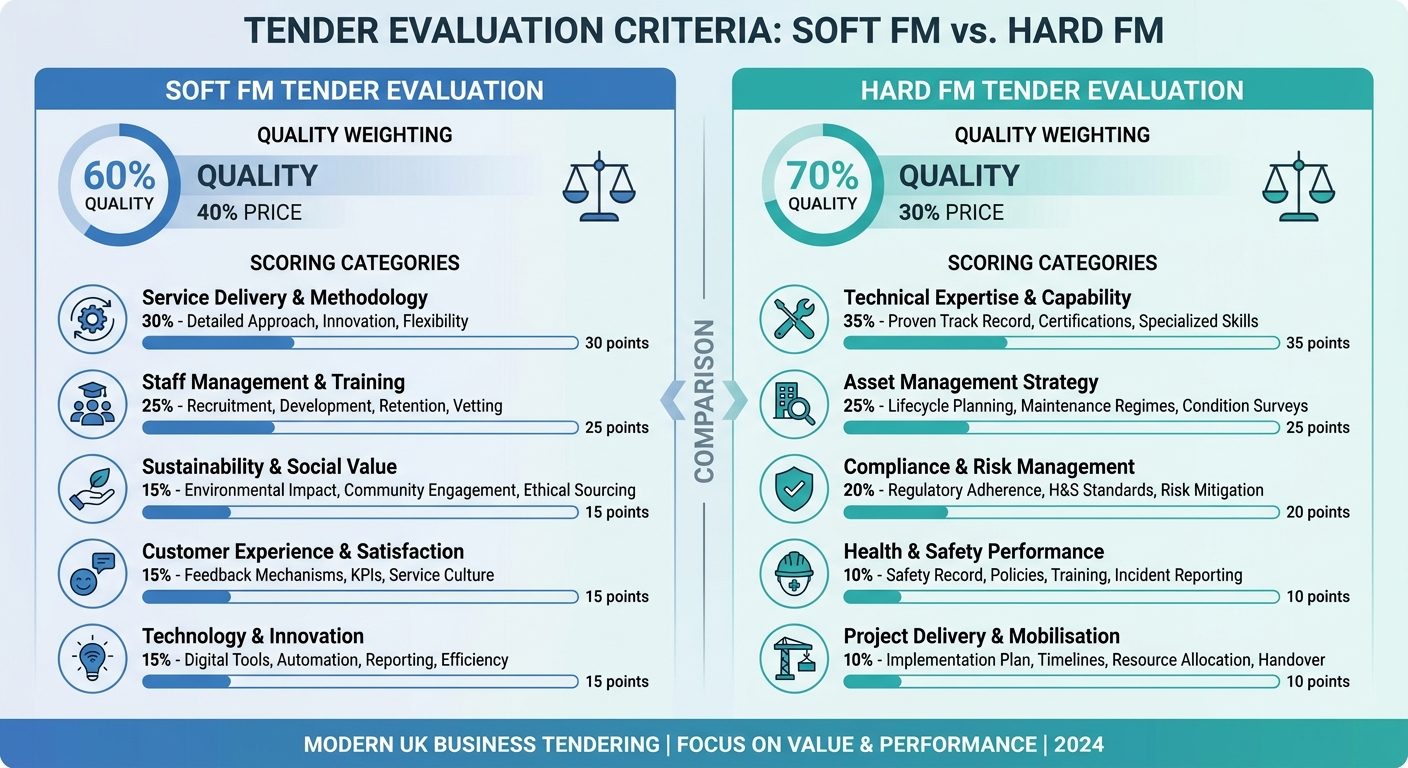
Soft FM versus hard FM tender scoring framework comparison
What Soft FM and Hard FM Actually Are (And Why It Matters for Scoring)
Before we get into the scoring, it is worth being precise about the categories, because bid teams routinely use the labels loosely and then write loose answers.
Hard FM covers the building fabric and engineered services. The mechanical and electrical (M&E) systems, building management systems, lifts, fire safety systems, HVAC, water hygiene, planned and reactive maintenance of the structure itself. It is, broadly, what keeps the building functioning as a piece of engineering. Hard FM work is technical, often safety-critical, governed by statutory compliance regimes (gas safe, electrical, lifting equipment, water systems), and almost always evaluated by people with engineering or estates backgrounds. Soft FM covers the people-facing services delivered inside the building. Cleaning, security, reception, catering, grounds maintenance, waste management, post and porter services, helpdesk. It is what makes the building feel useable for the occupants. Soft FM is labour-intensive, customer-experience driven, often regulated under TUPE on contract change, and evaluated by panels that mix operational, HR and end-user voices.Then there is integrated FM (sometimes called total FM or IFM) which bundles both, and bundled contracts which package multiple soft services or multiple hard services together. The scoring logic on bundled and integrated contracts borrows from both worlds, and that is where bid teams really get caught out, because they tend to default to whichever methodology they wrote most recently.
Why does this distinction drive scoring so hard? Because the evaluation panel is asking a fundamentally different question in each case.
In hard FM, the panel is asking: can this contractor keep our building safe, compliant and operational, and prove they have the engineering rigour to do it?
In soft FM, the panel is asking: can this contractor deliver a service our people will actually feel good about, with a workforce that is well trained, well managed, and not going to embarrass us?
The same methodology rarely answers both questions well. So the marks diverge.
The Quality Weighting Conversation
The first thing bid teams should look at on any FM tender is the quality / price / social value weighting, because the shape of the weighting is itself a signal of what the buyer cares about, and therefore where the marks are.
Across the FM contracts mytender.io has seen across UK public sector procurement, the typical pattern looks something like this:
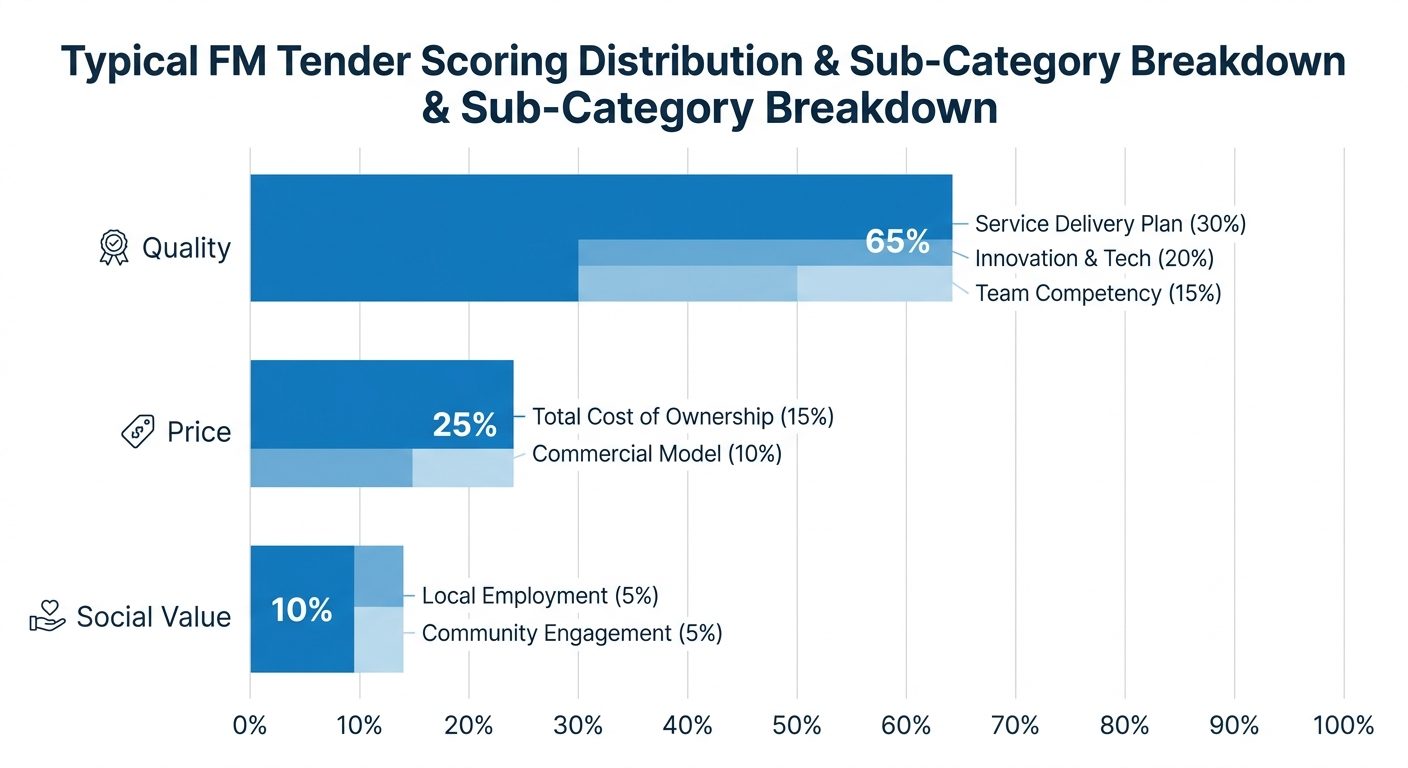
Typical FM tender scoring distribution by quality, price and social value
- Quality: typically 60 to 70 percent of the total score
- Price: typically 20 to 30 percent
- Social value: typically 10 to 15 percent (mandatory minimum 10 percent under PPN 06/20 for central government, frequently higher in local government and NHS)
But within the quality weighting itself, the sub-criteria diverge sharply between hard and soft FM. In a hard FM bid, you might see something like:
- Technical methodology and statutory compliance approach (25 percent)
- Mobilisation and transition (15 percent)
- Asset management and CAFM (15 percent)
- Health, safety and risk management (10 percent)
- Innovation and continuous improvement (5 percent)
In a soft FM bid, the same 70 percent quality envelope might split as:
- Service delivery methodology (20 percent)
- Workforce, training and TUPE (15 percent)
- Customer experience and complaint handling (15 percent)
- Sustainability and environmental management (10 percent)
- Innovation and continuous improvement (10 percent)
Same headline weighting. Completely different distribution underneath. A bid manager who treats the two bids the same is over-investing time on the wrong sections in each.
The first job on any FM bid, before a single word gets written, is to map the sub-weightings exactly and decide where the time goes. If customer experience is 15 percent of a soft FM bid and your draft answer for it is 400 words, that is the section to expand. If statutory compliance is 25 percent of a hard FM bid and your draft is a paragraph about being "ISO 45001 certified," you are leaving marks on the table.
How Hard FM Tenders Actually Score: The Sections That Matter
Let us walk through what an evaluator on a hard FM bid is genuinely looking for in each of the major sections, because the language of the evaluation criteria does not always tell you what scores well in practice.
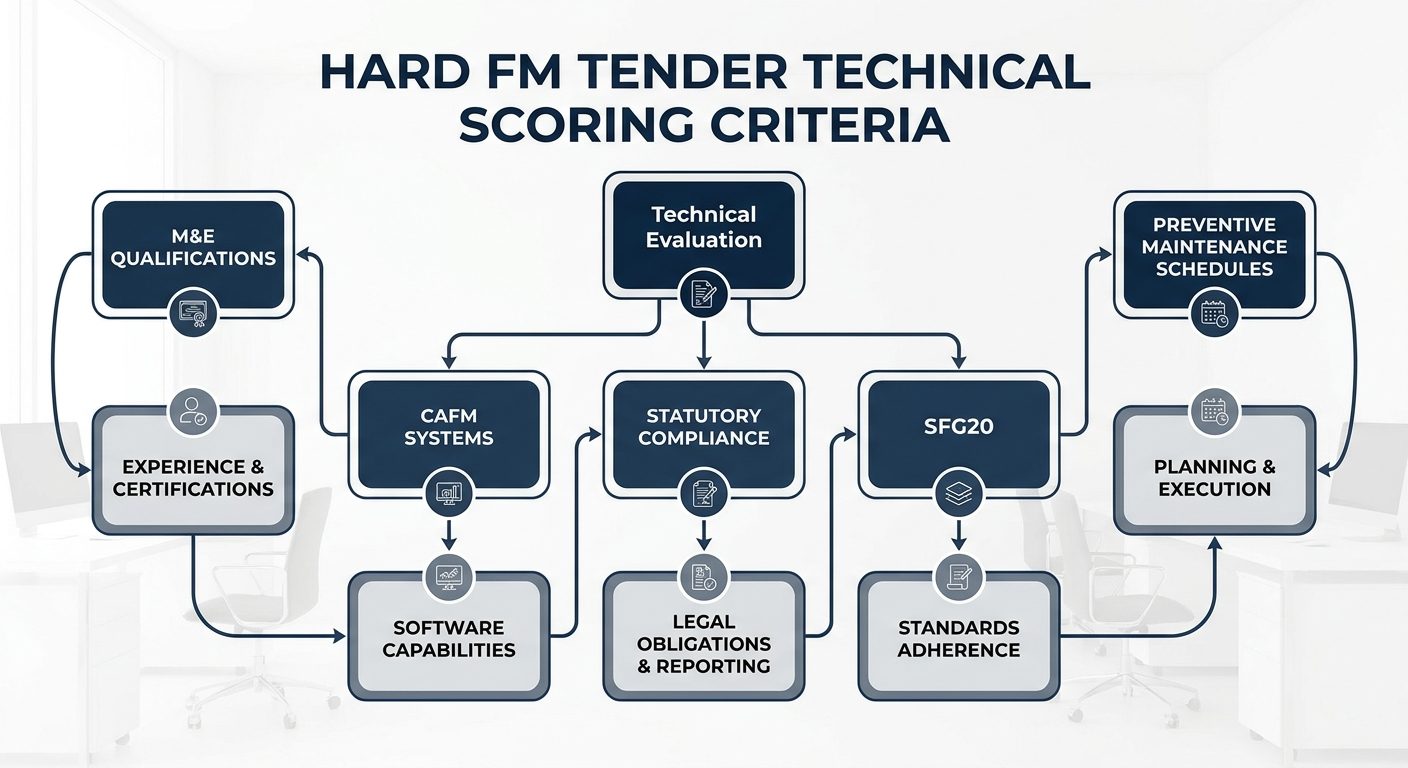
Hard FM technical scoring checklist with M&E qualifications, CAFM, statutory compliance and SFG20
Technical Methodology and Statutory Compliance
This is the biggest single section in a hard FM bid, and it is also the section bid teams most often write generically. Evaluators are looking for three things: that you understand the specific statutory regime applying to this estate, that you have a defensible methodology for keeping it compliant, and that you can evidence you have done it before on similar assets.
What scores well: naming the specific regulations that apply to the asset class (HTM 03-01 and HTM 06-01 for NHS sites, BSRIA BG 49 for water hygiene, LOLER for lifting equipment, ISO 41001 for the FM management system itself), describing your specific approach to each, and showing the audit trail. What scores badly: a generic statement that you "comply with all relevant legislation," which evaluators read as "we have not actually read your specification."
SFG20 is the maintenance standard that hard FM evaluators expect to see referenced. If you are not using SFG20 task schedules to drive your planned maintenance regime, you need to explain what you are using instead and why it is equivalent or better. Defaulting to a vague "best practice schedule" is a missed mark every time.
CAFM Systems and Asset Management
This is the section that wins or loses more hard FM bids than people realise. Buyers want to know how you will know what is in their building, when each asset was last serviced, when the next service is due, what compliance certificates exist, and whether all of that data will be available to them in real time or held hostage on your in-house system.
The CAFM platform you are proposing matters. Naming Concept Evolution, Maximo, Planon, Archibus, Pirana or whichever system you are using, and explaining the asset register import process, the mobile engineer interface, the customer reporting portal and the data export approach, all score marks. Saying you "use a leading CAFM system" with no specifics scores nothing.
Worth flagging: increasingly, public sector buyers want a contractual right to extract their full asset and compliance data at the end of the contract in a standard format. If your bid does not address data ownership and exit, you are conceding marks to the bidders that do.
Mobilisation and Transition
Hard FM mobilisation is judged against a different bar to soft FM mobilisation. The panel is not just asking "will the workforce turn up on day one." They are asking "will the building be compliant on day one, and how will you demonstrate that to us?"
That means your mobilisation plan needs to address: the asset verification survey (how you confirm what is actually there matches the spec), the compliance baseline audit (which certificates are in date, which are missing, which are about to expire), the CAFM data migration, the planned maintenance schedule build-out, the engineering competency mapping (have we got Gas Safe registered engineers in the right numbers, have we got authorised persons for HV, water, asbestos), and the statutory testing programme.
A mobilisation plan that just says "we will TUPE the existing engineers and continue the existing PPM regime" is a category error. The buyer is retendering precisely because they want the new contractor to do better than that.
Health, Safety and Risk Management
Section name varies, scoring logic does not. Evaluators are looking for: a permit-to-work system, a competent persons regime (especially for HV, asbestos, confined spaces and working at height), a near-miss reporting culture they can verify, statutory inspections being closed out on time, and evidence from comparable contracts.
What scores: real numbers from your existing book. RIDDOR rate, lost time injury frequency rate, near-miss to incident ratio, percentage of statutory inspections completed within the SLA window. Specific case studies of incidents you handled well are worth more than a long list of accreditations.
Innovation and Continuous Improvement
This section is shorter and lower-weighted in hard FM than in soft FM, but it is also the section where bid teams over-write. The panel does not want a treatise on Industry 4.0. They want to see specific innovations you are deploying on this contract: predictive maintenance using IoT sensors on critical plant, energy optimisation through BMS analytics, drone-based roof inspections, digital twin integration, that sort of thing.
Two or three concrete innovations, costed and scheduled, beat ten paragraphs of buzzwords every time.
How Soft FM Tenders Actually Score: A Different Game
Soft FM evaluation panels are usually a mix of FM, HR, end-user and operational representatives. They are reading the bid through a service-experience lens, not an engineering lens. The marks live in different places.
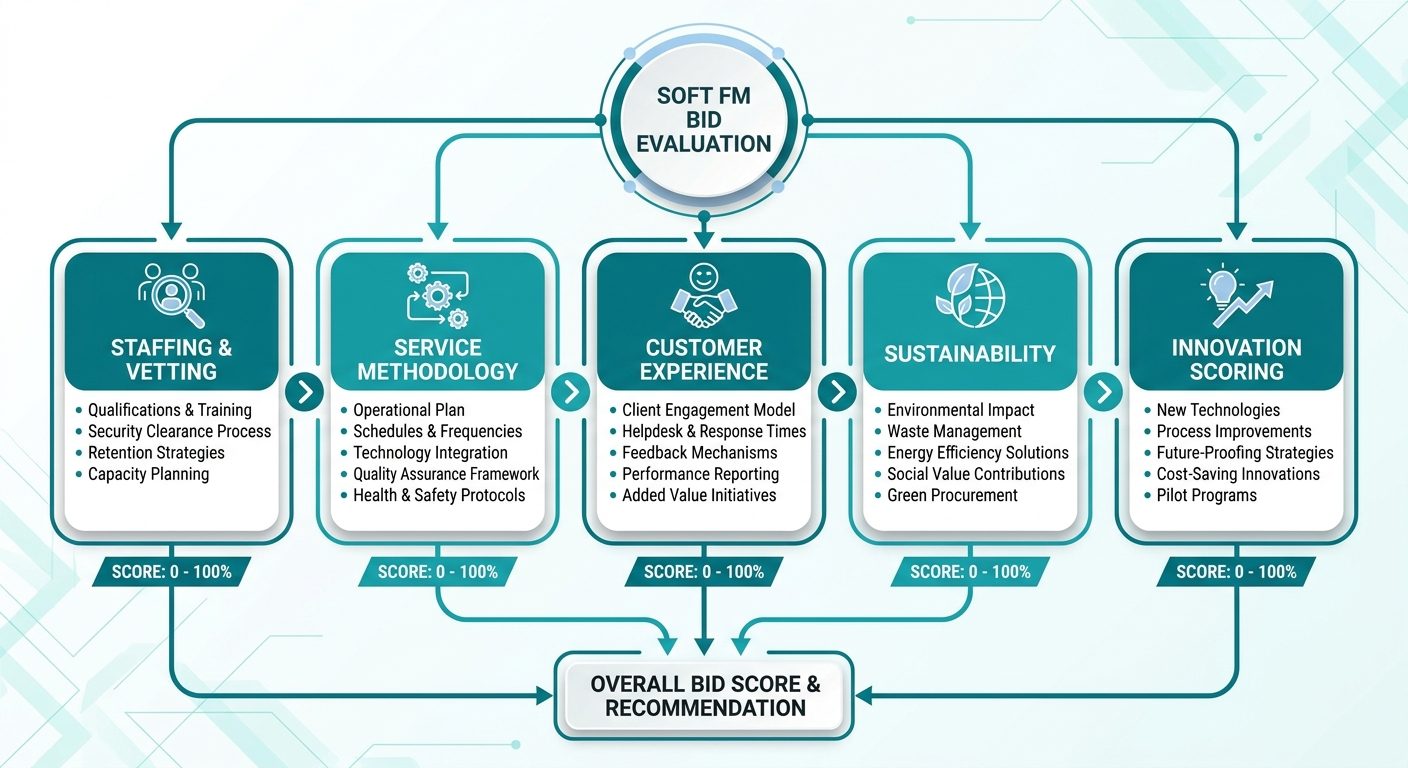
Soft FM tender scoring sections including staffing, methodology, customer experience and sustainability
Service Delivery Methodology
This is the equivalent of the hard FM technical methodology section, but the criteria are completely different. Evaluators want to see: a clear understanding of the site profile (occupancy patterns, building use, foot traffic, dwell times), a service specification mapped to that profile, and a demonstrable link between the activities and the outcomes the buyer cares about.
For cleaning, that means moving past "we follow BICSc standards" (you should, but everyone says it) to "we have profiled this site as 78 percent office, 12 percent customer-facing reception, and 10 percent welfare and washroom, and our cleaning frequency schedule reflects that profile as follows." Specificity scores. Generic methodology does not.
For security, it means describing the patrolling pattern, the vacant-out-of-hours response, the access control regime, the visitor management process, the integration with CCTV and alarm monitoring, all linked to the specific site risk profile.
Workforce, Training and TUPE
This is the single most distinctive scoring section between hard and soft FM. In hard FM, workforce sections are about engineering competency. In soft FM, they are about people management at scale. Evaluators want to see: how you will treat the TUPE-transferring workforce, how you will train them, how you will retain them, and how you will check the workforce is doing what it is supposed to.
What scores: specific training hours per FTE per year, the actual training curriculum, the supervision ratio, the vetting process (BS 7858 for security, DBS levels for healthcare and education, right-to-work check methodology), the sickness absence management approach, and demonstrable retention statistics from comparable contracts.
What loses marks: vague references to a "people-first culture" with no measurables underneath.
For deeper reading on the TUPE-specific section, see our TUPE in FM Tenders guide, which covers the workforce transfer angle in more detail.
Customer Experience and Complaint Handling
This is a 15 percent slice of the score in many soft FM bids and bid teams routinely allocate 10 percent of their writing time to it. That is the wrong ratio.
Evaluators want to know: how end-users report issues (helpdesk, app, QR code, email), how quickly issues get triaged and resolved, how complaints get escalated, how customer satisfaction gets measured (NPS, CSAT, mystery shopping), and what you will do with the data.
The differentiator here is closing the loop. Most bidders describe the front-end of complaint handling well. Few describe what happens to a recurring complaint pattern, who reviews it, how the service spec gets adjusted, and how the customer sees the change. That closing-the-loop narrative is where the high marks live.
Sustainability and Environmental Management
Sustainability sub-criteria are growing across both hard and soft FM, but they are more prominent in soft FM scoring because the activities are more visible to end-users. For cleaning, that is chemical-free systems, microfibre regimes, water-saving equipment. For grounds, it is integrated pest management and chemical-free maintenance. For catering, it is food miles, allergens and waste.
Carbon reduction commitments are increasingly scored against a credible plan, not a headline number. A bid that commits to net zero by 2030 with no SBTi-aligned targets, no scope 1/2/3 baseline and no annual milestones is now scoring less well than a bid that commits to 30 percent scope 1/2 reduction by 2028 with a costed roadmap.
Innovation and Continuous Improvement
In soft FM, this section is often weighted higher than in hard FM (10 to 15 percent versus 5 percent), and the innovations evaluators want to see are different. Robotic floor cleaners, IoT-driven washroom replenishment, footfall-led cleaning frequencies, AI-enabled video analytics for security, dynamic resourcing models, all score well when costed and scheduled into the contract.
The trap: promising every innovation under the sun in the bid, and leaving it on the contract programme without a concrete deployment plan. Evaluators have seen that movie before.
The Procurement Act 2023 and the Shift to MAT
The Procurement Act 2023, which went live in February 2025, replaced the old "Most Economically Advantageous Tender" (MEAT) framework with "Most Advantageous Tender" (MAT). The semantic shift is small. The behavioural shift is larger.
Under MAT, contracting authorities are explicitly encouraged to weight social value, public benefit and broader policy outcomes more aggressively, and the Act tightens the obligation on buyers to publish their evaluation methodology in advance and to give meaningful debrief feedback after the award.
For FM bid teams, three practical implications matter:
- Social value weightings are creeping up. It used to be common to see 10 percent. We are now seeing 15 to 20 percent on local government and NHS bids, and the social value response is being scored against the Social Value Model TOMs (Themes, Outcomes, Measures), not against a free-text essay. If your social value answer is still a narrative about how much you care about the community, you are not playing the actual game.
- Evaluation methodology is more transparent. Buyers are publishing their scoring rubric (typically a 0 to 5 scale with descriptors per band) up front. Bid teams that map their answer structure to the rubric descriptors are scoring higher than those that ignore it. Read the rubric. Mirror it.
- Debrief feedback is more substantive. When you lose, you are now entitled to a more detailed standstill notice including your scores against each criterion and the winner's scores. Use that data on the next bid. If you scored 3/5 on customer experience methodology last time, that is the section to rebuild before you submit the next one.
The shift from MEAT to MAT does not change the soft FM versus hard FM distinction, but it does raise the bar on evidence and transparency in both. Generic answers were already losing marks. They lose more marks now.
The Common Mistakes That Cost Marks (And Are Easy to Fix)
Across the FM bids we see come through, the same five mistakes show up in the post-bid feedback again and again. None of them require a brilliant bid writer to fix. They just require the bid team to know they are mistakes.
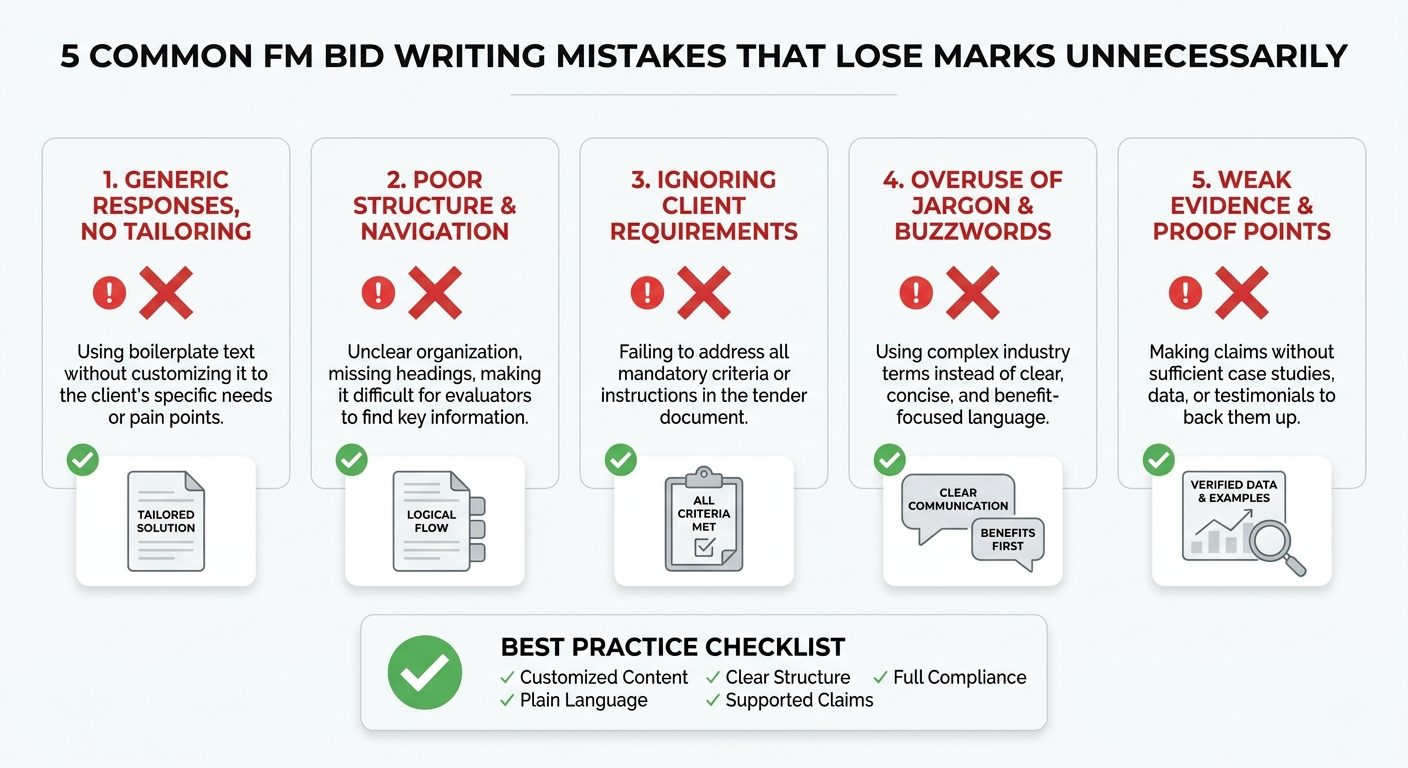
Five common FM bid mistakes that lose marks unnecessarily
Mistake 1: Using a Hard FM Methodology Template for a Soft FM Bid (or Vice Versa)
The single most common one. The bid team last wrote a hard FM bid, the structure feels familiar, they reuse the technical methodology section as the spine, and they end up with a soft FM bid that reads like an engineering manual. Or the reverse: a hard FM bid that reads like a customer experience white paper, with no SFG20, no compliance schedule and no asset register approach.
Fix: maintain two distinct bid library structures, one for each side, and police which one gets used.
Mistake 2: Treating the Workforce Section as a Bolt-on
In soft FM particularly, the workforce section is 15 percent or more of the score, and it is not where bid teams spend their best time. The result is a thin section that loses marks unnecessarily on a contract where the buyer cares deeply about who is mopping their floors at 4am.
Fix: brief the HR lead in week one, not week five. Get the training matrix, the retention numbers, the vetting process and the supervision model in writing before the methodology lead starts drafting.
Mistake 3: Skipping the Site-Specific Layer
Generic methodologies score generically. The minute the panel sees a section that could have been written for any site in the UK, they default to a mid-band score. Specificity, references to the actual estate, the actual occupancy profile, the actual buyer policies, all push the score up.
Fix: take 30 minutes after the ITT lands to walk the site, or video-walk it, and capture three or four observations that you will weave into the answers.
Mistake 4: Under-Pricing the CAFM Investment in Hard FM Bids
CAFM systems are a quality-scoring section in hard FM bids and bid teams sometimes try to win the price element by under-resourcing the technology. The result is a methodology that promises real-time asset visibility and a price that does not include the licence fees or the data migration work. Evaluators read the bid in stereo and spot the gap.
Fix: get the CAFM cost into the price model honestly, and let the methodology section write the cheque the price model can cash.
Mistake 5: Treating Innovation as Box-Ticking
In both hard and soft FM, the innovation section is where bid teams reach for the buzzword bag. The panel has read every other bid. They know what the buzzwords look like. The bids that score on innovation are the ones that pick two or three concrete innovations, cost them, schedule them into the contract programme, name the supplier or partner, and describe the outcome in measurable terms.
Fix: less ambition, more specificity. Three innovations done properly beat ten gestured at.
Putting It Together: A Practical Pre-Bid Checklist
Before the next FM bid lands on your desk, the following pre-bid moves will pay back many times over.
- Map the scoring envelope before writing. Quality, price and social value at the top level. Then the sub-criteria within quality. Then the time allocation across sections weighted accordingly.
- Decide soft, hard or integrated, and pick the right template. Do not let a methodology template chosen by familiarity drive a misaligned answer.
- Brief the right SMEs early. For hard FM: estates engineering, CAFM lead, compliance manager. For soft FM: HR, training lead, customer experience lead. The methodology lead writes well only if the SMEs feed them well.
- Read the rubric before the questions. The 0 to 5 scoring descriptors tell you what good looks like. Mirror their language.
- Use last bid's debrief. Whichever section you scored 3/5 on last time is the section you rebuild first.
- Police the language. Generic methodology kills scores. Site-specific, evidenced, costed methodology lifts them.
The gap between a 60-something score and a 75-plus score on FM bids is rarely about the writing being prettier. It is usually about whether the bid team understood that hard and soft FM are different evaluations, with different evidence requirements, scored by panels with different professional reflexes. Once you internalise that, the marks come back.
If you want to see live FM opportunities matched to your sector, the Tender Finder is free to use at mytender.io. It surfaces relevant soft FM, hard FM and integrated FM contracts from across UK public sector procurement, so the next bid you write is the one most likely to win, not the one that happened to land in your inbox first.
Tags
Ready to Transform Your Tender Writing?
See how MyTender's AI can help you write winning tenders in a fraction of the time.