
Social Value KPIs in 2026 Tenders: How to Write Commitments Evaluators Believe
A practical guide to writing social value KPIs under the Procurement Act 2023, with examples for construction, FM and waste tenders, plus a framework for evidence, ownership and reporting.
mytender.io Research Team
Tender Writing & Bid Management Specialists
Social Value KPIs in 2026 Tenders: How to Write Commitments Evaluators Believe
Social value has moved from nice words to contract evidence.
This article is part of our Procurement Act series. For an overview of what changed and links to every guide in the series, see our Procurement Act 2023 supplier's guide.
That is the real change bid teams are feeling in 2026. Under the Procurement Act 2023, buyers are thinking less about whether a supplier sounds socially responsible and more about whether the promised benefit will actually be delivered, measured and reported.
That matters because most social value answers still fail in the same way. They promise jobs, apprenticeships, volunteering hours, local spend and carbon savings, but they do not explain the operating model behind them.
Evaluators can spot that gap a mile off.

Bid team mapping social value KPIs for a public sector tender
This guide is for bid managers, commercial directors and subject matter experts who need to turn social value from a polished paragraph into a credible delivery plan.
The aim is simple: write commitments that evaluators believe, contract managers can track, and delivery teams can actually fulfil.
Why Social Value Feels Different in 2026
Social value has been part of UK public procurement for years. What has changed is the weight sitting behind it.
The Procurement Act 2023 moved public buying toward the Most Advantageous Tender. That sounds like a small wording change, but it has a practical effect. Buyers are being encouraged to look at wider public benefit, not just price and technical quality.
At the same time, transparency has increased. More contract information is being published through the Central Digital Platform. Contract performance notices, payment information and KPI reporting all create a stronger post-award evidence trail.
So social value is no longer just a scoring section. It is part of the supplier's performance record.
A weak commitment can hurt twice. First, it loses marks at tender stage. Then, if it gets accepted into the contract and is not delivered, it can create a public performance problem later.
The best bidders now treat social value as a delivery risk, not a marketing exercise.The Mistake That Costs Marks
The biggest mistake is writing social value as a list of good intentions.
You have seen the pattern:
- we will create local jobs
- we will support apprenticeships
- we will work with local charities
- we will reduce carbon emissions
- we will use local suppliers where possible
- we will provide volunteering days
None of those are bad. The problem is that they are unfinished.
A strong tender answer does not just say what you will do. It explains how much, by when, who owns it, how it will be measured, and what happens if delivery falls behind.
That is the difference between a promise and a KPI.
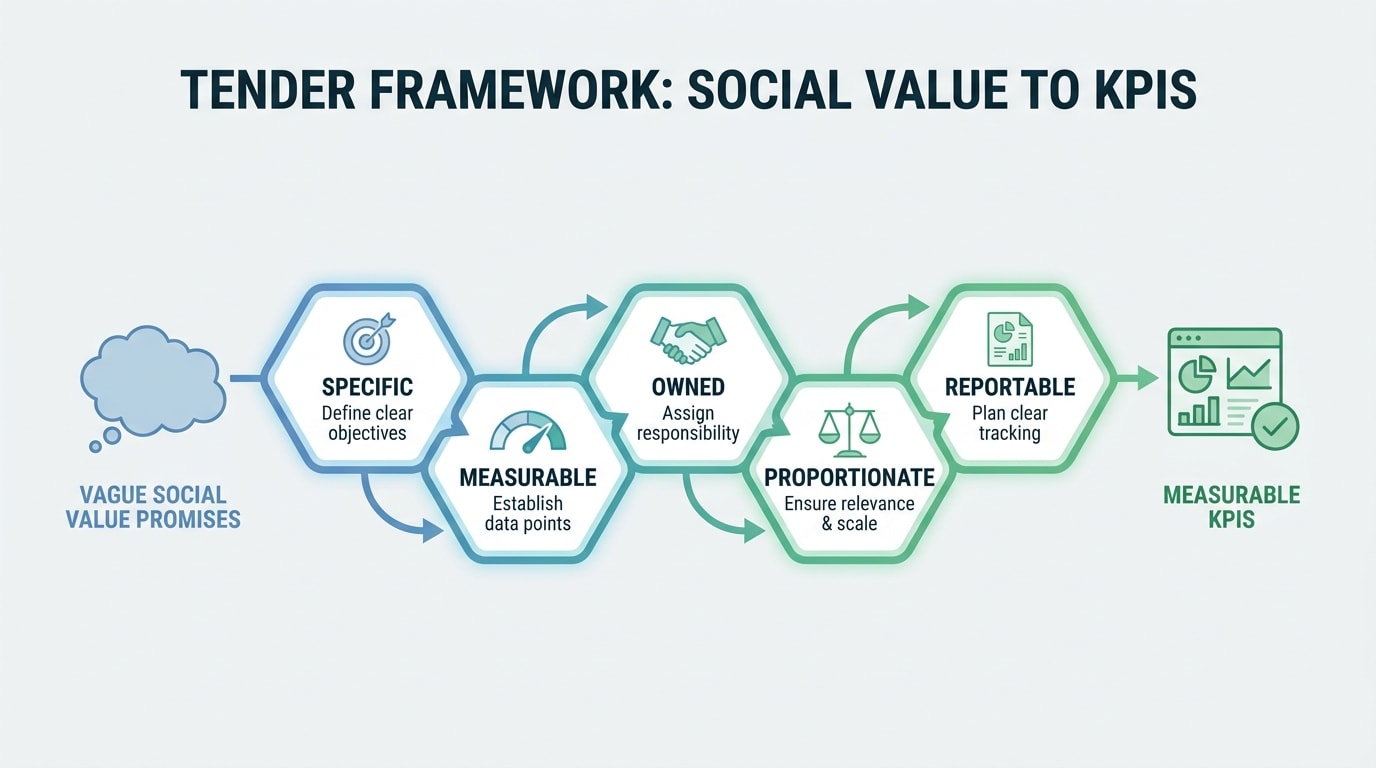
Framework showing how to turn social value promises into measurable tender KPIs
What Evaluators Actually Want to See
Evaluators are not looking for the longest social value menu. They are looking for confidence.
A credible social value answer usually gives them five things.
First, it links the commitment to the contract. If you are bidding a cleaning contract, your social value should connect to workforce development, local employment, sustainable products, waste reduction and community presence. If you are bidding a construction project, it should connect to apprenticeships, local supply chain, site impact, skills, carbon and community disruption.
Second, it gives a baseline. You cannot prove improvement if the starting point is vague.
Third, it gives numbers. Not heroic numbers. Believable ones.
Fourth, it names ownership. Someone has to be accountable after award.
Fifth, it explains reporting. The buyer needs to know how progress will be tracked without creating admin chaos.
That last point matters more than suppliers think. A buyer may like the ambition, but still mark it down if it looks difficult to manage.
The Five-Part KPI Test
Use this test before you submit any social value commitment.
1. Is It Specific?
"Support local employment" is not specific.
"Create six ring-fenced interview places for residents within the authority boundary during mobilisation" is specific.
Specific commitments make evaluators relax. They show you have thought beyond the headline.
2. Is It Measurable?
If you cannot measure it, the buyer cannot score it confidently.
Good measures include:
- number of apprenticeships started
- percentage of contract spend with local suppliers
- tonnes of waste diverted from landfill
- volunteering hours delivered
- number of school or college engagement sessions
- percentage of fleet miles using low-emission vehicles
- number of work placements completed
Avoid measures that depend on vibes. "Improve community wellbeing" may be a genuine aim, but it needs a proxy measure if it is going into a tender.
3. Is It Owned?
Every KPI needs an owner.
That might be the contract manager, social value lead, mobilisation manager, HR lead, procurement manager or sustainability lead. The title matters less than the accountability.
A simple line helps: "The Contract Manager will own monthly KPI reporting, with quarterly review by our Social Value Lead."
It tells the evaluator the commitment will not disappear after the bid team hands over.
4. Is It Proportionate?
This is where many bids overreach.
A £250,000 single-site cleaning contract cannot credibly promise the same social value programme as a £25m integrated FM contract. A small waste collection lot cannot carry the social value burden of a borough-wide environmental services partnership.
Evaluators know this. They do not reward fantasy.
Proportionate commitments feel grounded in contract value, contract length, margin, geography and staffing model.
5. Is It Reportable?
Reporting is where vague promises go to die.
For each KPI, ask what evidence you will provide:
- payroll or HR records
- apprenticeship enrolment records
- supplier invoices
- postcode analysis of local spend
- waste transfer notes
- carbon reporting outputs
- training attendance logs
- volunteering records
- monthly contract reports
If the evidence does not exist naturally in your operating model, be careful. You may be creating a commitment that will become painful to prove.
A Better Social Value KPI Structure
Here is the format I would use in most tenders.
Commitment: What you will deliver. Target: The number, percentage or milestone. Timeline: When it will happen. Owner: Who is accountable. Evidence: What record proves delivery. Reporting: How often the buyer sees progress.That structure is simple, but it changes the tone of the whole answer. It stops the section sounding like a manifesto and starts making it feel like a contract plan.
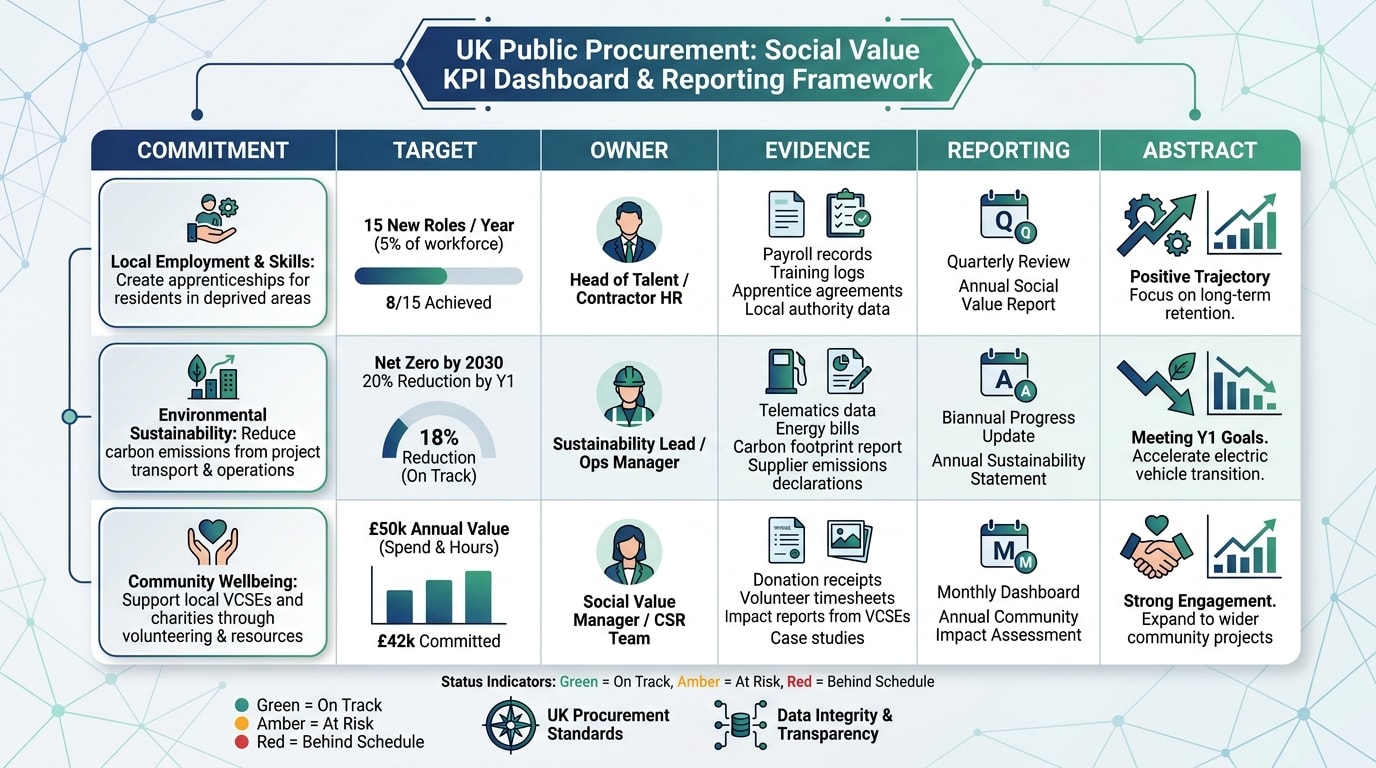
Example table layout for social value tender KPIs with target, owner, evidence and reporting
Examples of Weak and Strong Commitments
A weak commitment says:
"We will provide apprenticeship opportunities for local people throughout the contract."
A stronger version says:
"We will create two Level 2 apprenticeship starts within the first contract year, prioritising applicants from postcodes within the authority boundary. The Contract Manager and HR Business Partner will review progress monthly. Evidence will include enrolment records, payroll records and quarterly contract report updates."
That is better because it gives the evaluator something to score.
Another weak commitment says:
"We will reduce the carbon impact of our service."
A stronger version says:
"We will reduce service-related fleet emissions by 12% by the end of year two against the mobilisation baseline, using route optimisation, driver behaviour monitoring and a phased transition to electric vans where charging infrastructure allows. Progress will be reported quarterly using mileage, fuel and vehicle data."
Again, the difference is not fancy language. It is evidence.
Construction Tenders: Where the Marks Usually Sit
Construction social value is often judged on local economic impact, skills, community engagement and environmental performance.
The best construction responses connect social value to the project plan. They do not bolt it on at the end.
Useful KPI areas include:
- local labour hours as a percentage of total site labour
- apprenticeship starts linked to specific trades
- work placements with local colleges
- spend with local subcontractors and suppliers
- construction waste diverted from landfill
- embodied carbon reduction initiatives
- community liaison response times
- school engagement sessions linked to built environment careers
The common mistake is promising too many community activities while ignoring site reality.
If the project is short, intense and technically complex, your strongest commitments may be targeted skills engagement and local supply chain spend. If it is a long programme with visible community disruption, resident communication and local employment may carry more weight.
Match the social value offer to the construction method, not the bid template.For more detail on construction scoring, read our guide to social value scoring in construction tenders.
Facilities Management Tenders: Make It Operational
FM social value works best when it is built into the service model.
That might mean recruiting locally for cleaning and security roles, partnering with employability charities, creating supervisor development pathways, reducing chemical use, improving waste segregation, or using local SMEs for specialist services.
Strong FM KPI areas include:
- percentage of frontline vacancies advertised locally
- number of staff completing accredited training
- supervisor promotions from within the contract team
- local supplier spend by service line
- reduction in single-use cleaning products
- percentage of consumables from sustainable sources
- volunteering hours tied to client sites or community facilities
- social enterprise spend for appropriate subcontracted services
The key is credibility.
If your FM contract is labour-heavy, workforce KPIs will usually feel more believable than grand innovation claims. If it includes helpdesk, CAFM and estate-wide data, reporting and efficiency KPIs may be stronger.
A good FM social value answer feels like it came from the operations team, not the marketing team.
Waste and Environmental Tenders: Prove the Environmental Story
Waste tenders often invite big environmental promises. That makes evidence even more important.
Strong KPI areas include:
- recycling rate improvement against baseline
- contamination reduction in target waste streams
- tonnes diverted from landfill
- route mileage reduction
- fuel use or fleet emissions reduction
- number of resident education sessions
- missed collection reduction
- reuse partnerships with local charities or social enterprises
- circular economy pilots for bulky waste or textiles
The trap is claiming outcomes you do not fully control.
For example, a supplier can influence recycling rates through collection design, contamination feedback, communications and service reliability. But household behaviour, local housing mix and council communications also matter.
So write the KPI carefully. Promise what your service can control, then explain how you will support the wider outcome.
That nuance makes the answer more credible, not less.
How to Avoid Overpromising
Overpromising feels tempting because social value sections are competitive. Everyone wants the highest number.
But inflated commitments can backfire.
They may be scored sceptically at tender stage. Worse, they may be written into the contract and monitored later. If the commitment is public, missed delivery can damage future bids.
Before you submit, ask these questions:
- Does the margin support this commitment?
- Does the mobilisation plan include the activity?
- Has the named owner agreed to deliver it?
- Do we already collect the evidence?
- Can we report this without creating manual work every month?
- Would we be comfortable explaining this target in a quarterly review?
If the answer is no, rewrite it.
Social value should stretch the organisation. It should not rely on wishful thinking.
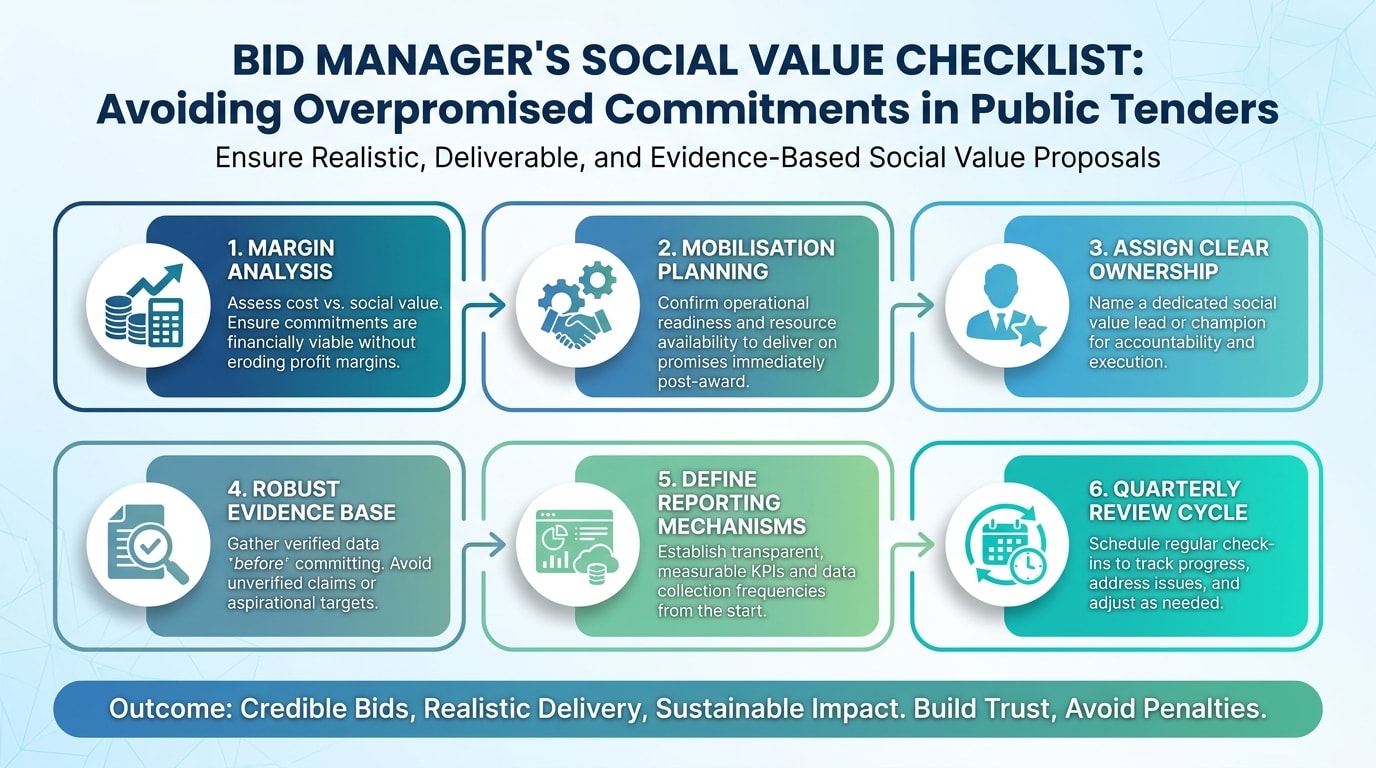
Checklist for avoiding overpromised social value commitments in tenders
The Handover Problem
A lot of social value failure starts after submission.
The bid team writes the commitment. The commercial team prices the contract. The operations team mobilises the service. Somewhere between those steps, the detail gets lost.
Then three months into delivery, someone asks for a social value update and nobody knows where the promised figures came from.
Fix this with a proper bid-to-delivery handover.
At minimum, hand over:
- the final social value commitments
- the KPI definitions
- the evidence required
- the reporting frequency
- the named owner
- any assumptions used in pricing
- any dependencies on the client, partners or subcontractors
This is where a bid library helps. Not because it stores nice wording, but because it stores the evidence trail. Previous commitments, actual delivery, proof points, lessons learned and approved numbers should all feed the next tender.
If your team is still hunting through old folders for that information, you are making every bid harder than it needs to be. Tools like mytender.io can help teams turn past bids, delivery evidence and reusable proof points into a cleaner content library, but the principle matters with or without software: keep the promise connected to the proof.
What to Do Before the Next Social Value Section Lands
You do not need to rebuild your whole bid function to improve social value scoring.
Start with four practical moves.
First, audit your last five social value answers. Highlight every commitment that lacks a number, owner, evidence source or reporting method.
Second, ask delivery teams what was actually achieved on recent contracts. Not what was promised. What was delivered.
Third, build a small bank of approved KPI patterns by sector. Keep separate examples for construction, FM and waste, because the evidence and operating models differ.
Fourth, agree your red lines. Decide what you will not promise without operational sign-off.
That last one saves pain. A bid team under deadline pressure will always be tempted to push the commitment a little further. Clear red lines stop ambition turning into nonsense.
A Simple Social Value KPI Template
Use this as a starting point:
Employment: Local interview ringfence. Target 10 guaranteed interviews in year one. Owned by the Contract Manager. Evidence comes from interview logs and applicant postcodes. Report quarterly. Skills: Apprenticeships. Target 2 starts by month 12. Owned by the HR Lead. Evidence comes from enrolment records. Report quarterly. Supply chain: Local SME spend. Target 20% of addressable spend within 30 miles. Owned by the Procurement Manager. Evidence comes from supplier invoices and postcode reporting. Report monthly. Environment: Waste reduction. Target 8% reduction against mobilisation baseline. Owned by the Sustainability Lead. Evidence comes from waste transfer notes. Report quarterly. Community: Volunteering. Target 80 staff hours per contract year. Owned by the Contract Manager. Evidence comes from timesheets and charity confirmation. Report quarterly.Do not copy those numbers blindly. They are examples, not universal benchmarks.
The right target depends on contract size, sector, geography, staff numbers, margin and client priorities.
The Bottom Line
Social value scoring is getting more serious because public procurement is getting more transparent.
That is good news for disciplined bidders. If your organisation already delivers local jobs, skills, community benefit, sustainability improvements or supply chain resilience, you now have a stronger reason to evidence it properly.
The winners will not be the suppliers with the biggest claims. They will be the suppliers with the clearest link between commitment, delivery and proof.
If you want to see live public sector opportunities where these social value requirements are appearing, the Tender Finder is free to use. It is a useful way to spot patterns before the next bid lands on your desk.
Tags
Ready to Transform Your Tender Writing?
See how MyTender's AI can help you write winning tenders in a fraction of the time.