
Social Value Scoring in Construction Tenders: Where Real Marks Are Won and Lost
Bid managers consistently underestimate social value sections in construction tenders, then lose contracts by 2-3 marks. Here is what evaluators actually score, how the Procurement Act 2023 has changed the maths, and how to evidence commitments that hold up under scrutiny.
mytender.io Research Team
Tender Writing & Bid Management Specialists
Social Value Scoring in Construction Tenders: Where Real Marks Are Won and Lost
It is Tuesday afternoon, eight working days out from submission. Your technical sections are nearly there, the programme is signed off, and the cost team has the BoQ under control. Then you open the social value questions for the first time properly and you realise the response template still says "we will engage local apprentices and support community initiatives where appropriate."
That is the sentence that loses you the contract.
Bid managers underestimate social value in construction tenders more consistently than any other section. The reasons are familiar. It sits at the back of the ITT. It feels softer than method, programme or price. It often gets handed to whoever has spare capacity in the last week. The result is responses that read like marketing copy, not bid responses, which is exactly why they pick up 1s and 2s on a five-point scale while the technical sections score 4s.
The financial impact is brutal. On a £40m schools framework with a 25% social value weighting, a 1.5-mark gap is worth roughly the same as being £1m more expensive on price. You cannot make that back in the technical write-up.
This post covers what evaluators actually want, how the National TOMs framework drives scoring, what the Procurement Act 2023 changed, where marks are consistently won and lost, and how to evidence commitments without overpromising.

Construction workers and apprentice on a UK building site discussing social value commitments
Why Social Value Now Decides Construction Contracts
For roughly two decades, the typical UK public construction tender weighted price at 40-60% and technical quality at 40-60%, with social value either absent, weighted at 5%, or hidden inside a "wider benefits" section that no one took seriously.
That arrangement is gone.
PPN 06/20 (the Social Value Model) made a 10% minimum social value weighting mandatory for central government procurement from January 2021. The Construction Playbook reinforced it. Local authorities, housing associations, NHS trusts, combined authorities and the devolved nations went further. Most contracting authorities now sit between 15% and 25%, and a meaningful minority push 30%.
Then the Procurement Act 2023 went live and shifted the architecture again. The move from "Most Economically Advantageous Tender" (MEAT) to "Most Advantageous Tender" (MAT) is not a rebrand. It legitimises wider considerations including social value, environmental performance, and broader public benefit as core evaluation criteria, not bolt-ons. Contracting authorities who were already pushing social value up the weighting now have explicit statutory cover to do so. Authorities who were nervous about it have run out of reasons to hold back.
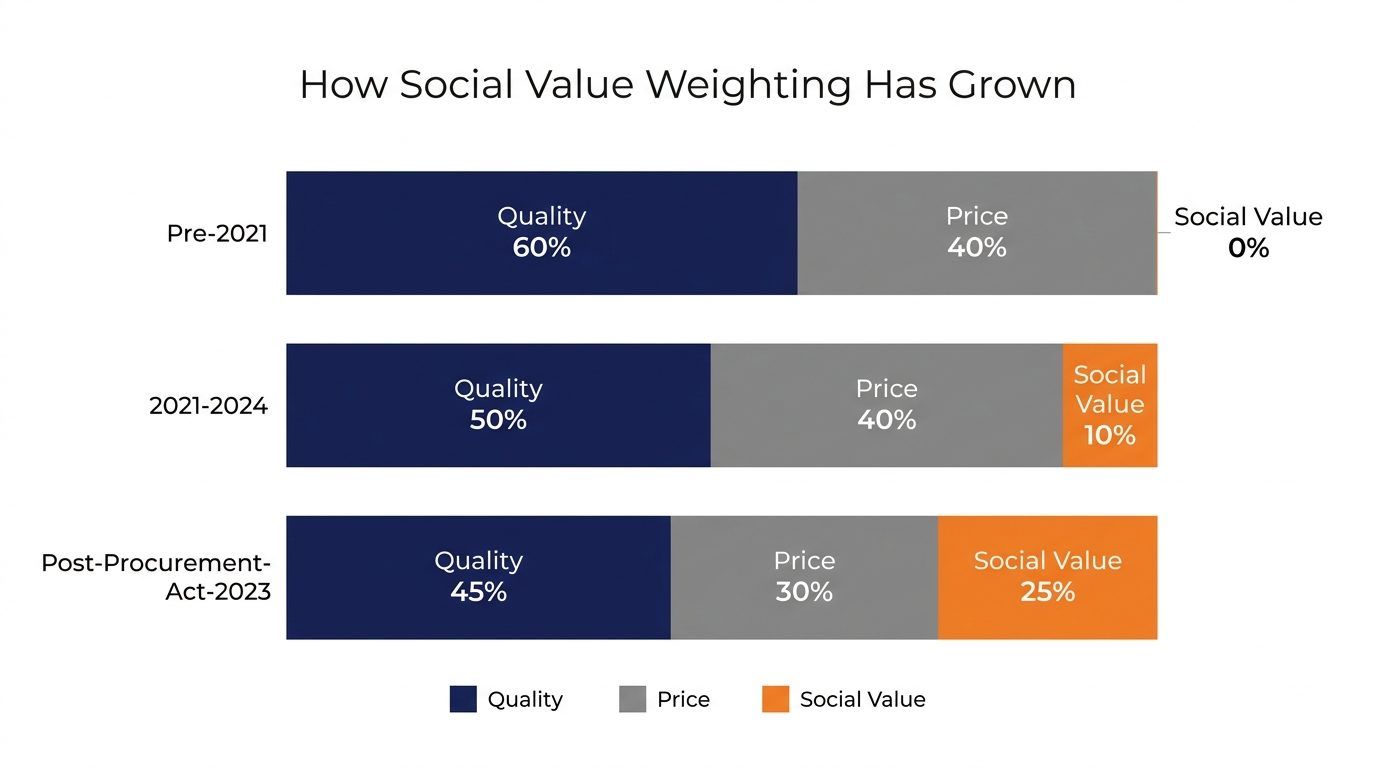
Stacked bar chart showing how social value weighting has grown across three eras of UK construction procurement
The practical effect for construction bid teams is straightforward. A section you could once write in a day now decides whether you sit at the top or the middle of a five-bidder shortlist. And because the technical and pricing maturity in the construction sector is high, the social value section is increasingly the only meaningful differentiator between qualified bidders.
What Evaluators Actually Want (and Do Not Want)
Before getting into frameworks and scoring rubrics, it is worth being blunt about what evaluators are looking for when they read a social value response. They have read hundreds of these. They know the patterns.
They want commitments that are specific, measurable, contract-relevant, and credible.A sentence like "we will deliver 12 weeks of work experience to Year 11 students from secondary schools within a five-mile radius of the Phase 1 site, coordinated through our existing partnership with St Mary's Catholic High School and Greenfield Academy" scores. A sentence like "we are committed to supporting young people from local communities through engagement with educational stakeholders" does not.
They do not want.- Generic ESG statements that could apply to any contract on any site
- Numbers without methodology (how did you arrive at 30 apprenticeship weeks? Show your working)
- Commitments that obviously belong in the H&S, environmental or quality sections being recycled into social value
- Charity donations dressed up as community investment
- "We will work with local SMEs where commercially viable" (this is the most common dead phrase in the sector)
- Promises that depend on circumstances no bidder controls (e.g. "subject to client approval" attached to every commitment)
- Commitments without named delivery owners, baselines or reporting cadence
The pattern is consistent across every public construction evaluator we have spoken to. They are tired of receiving social value responses that are 80% marketing copy and 20% commitment. They reward bidders who treat the section like a programme of work, not a brochure.
The TOMs Framework: How Social Value Is Actually Measured
The dominant measurement framework in UK public procurement is the National TOMs (Themes, Outcomes and Measures) framework, developed by Social Value Portal and adopted in some form by the majority of contracting authorities running construction tenders.
You need to understand it because most evaluation rubrics map back to it directly, and bidders who understand the framework consistently outscore bidders who do not.
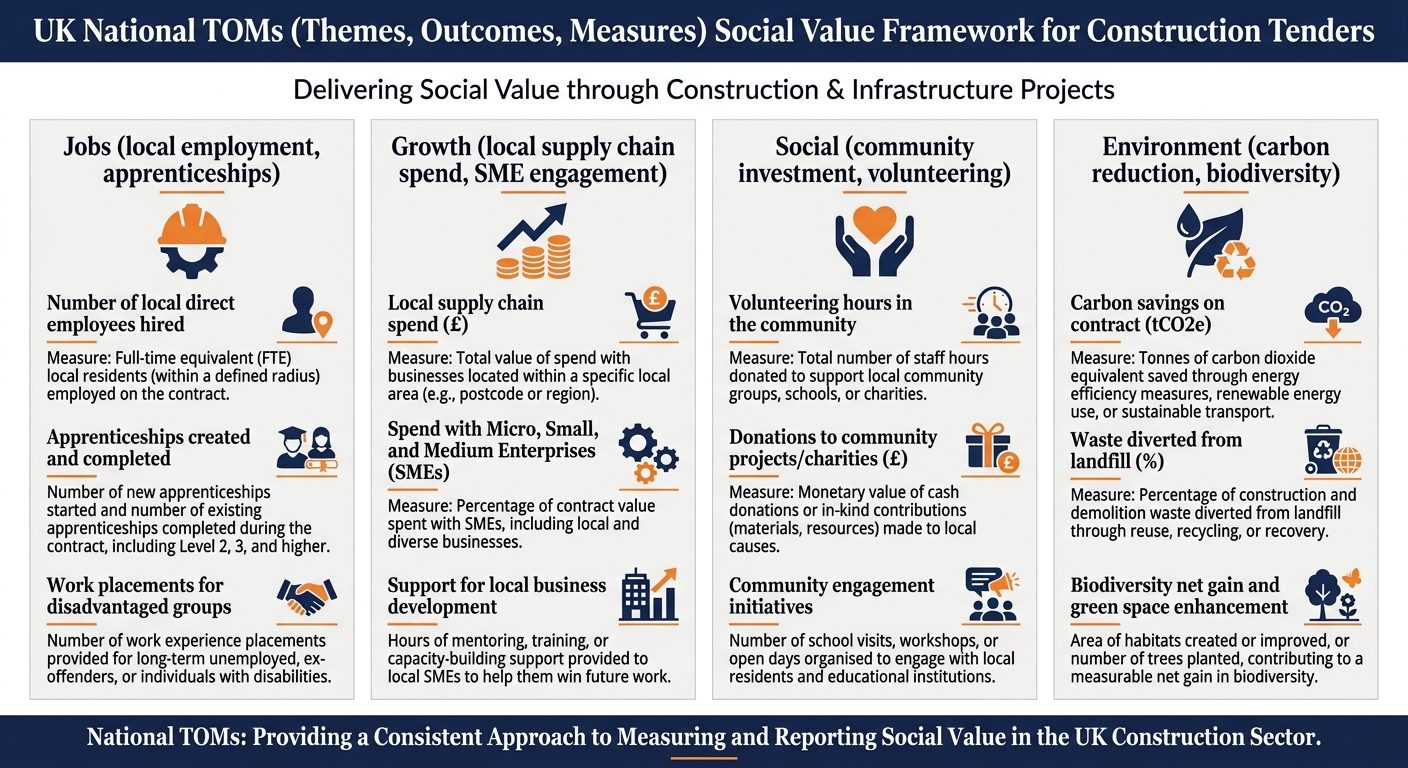
Infographic showing the four themes of the National TOMs social value framework: Jobs, Growth, Social, Environment
TOMs is built around four themes:
1. Jobs: Promoting Local Skills and Employment
This is where most construction bidders concentrate effort, correctly. Measures here typically include:
- Full-time equivalent (FTE) jobs created on the contract for people in priority groups (long-term unemployed, NEET young people, people with disabilities, ex-offenders, ex-armed-forces)
- Apprenticeship weeks delivered, broken down by Level 2, Level 3 and higher
- T-Level placements
- Work experience placements for school-age students
- Pre-employment training and CSCS card support
- Career insight days and site visits
The marks live in the specificity. "30 apprenticeship weeks at Level 2 in Carpentry, delivered through our existing relationship with Stockport College" is a scoring answer. "Apprenticeships will be supported throughout the contract" is filler.
2. Growth: Supporting Local Supply Chains and SMEs
Construction contracts move significant money through supply chains. Evaluators want to see that money moving toward local SMEs and VCSEs (Voluntary, Community and Social Enterprises) rather than entirely to national subcontractors.
Measures include:
- Percentage of contract spend committed to local SMEs (commonly defined by postcode area or LEP region)
- Percentage of contract spend committed to VCSEs
- Number of new local supply chain partners onboarded
- Mentoring hours offered to local SMEs to help them bid for work in your supply chain
- Late payment performance (Prompt Payment Code commitments)
Be careful here. Saying "we will spend 30% with local SMEs" without showing the methodology, the package strategy, or the named subcontractors you have already engaged is the fastest way to lose marks. Evaluators have learned that round numbers without working underneath them tend to evaporate during contract delivery.
3. Social: Healthier, Safer, More Resilient Communities
This is the theme most bidders fumble because they confuse it with corporate charity work. Social outcomes in construction tenders should be tied to the contract, the workforce, and the community affected by the works.
Strong measures include:
- Volunteer hours delivered by the project workforce in the local community (with named projects, not "various activities")
- STEM engagement hours in local schools tied to the project (site visits, careers talks, design challenges)
- Investment in community facilities affected by the works (hoarding decoration with local school art, temporary green space, community spaces)
- Mental health and wellbeing programmes for the project workforce, including the supply chain
- Domestic abuse, modern slavery and ethical sourcing commitments backed by audit
A donation to a national charity unrelated to the contract scores nothing. A documented programme that puts your site team into three named local primary schools to deliver a four-session "build your own bridge" engineering challenge scores well.
4. Environment: Decarbonising and Safeguarding the Environment
Carbon, biodiversity, waste and resource efficiency. Construction-specific measures include:
- Whole-life carbon assessment with measurement methodology and reduction targets
- Embodied carbon reduction commitments tied to specific design or material choices
- Diversion of construction waste from landfill (with current performance baseline, not just a target)
- Biodiversity Net Gain delivery (now mandatory in England since 2024 for most developments, but evaluators look for genuine ambition above the 10% statutory floor)
- Air quality management on site
- Water efficiency and SuDS performance
- Sustainable transport plans for the workforce and materials
Be careful not to double-count environment commitments that already sit inside your sustainability section or your method statements. Evaluators read across the whole bid and they will mark you down for repackaging the same commitment three times.
The Procurement Act 2023 Effect on Construction Social Value
The Procurement Act 2023 commenced on 24 February 2025. The headline shift, MEAT to MAT, has been written about everywhere. The implications for social value scoring in construction tenders specifically have been less well-understood.
Three things matter.
First, contracting authorities now have explicit cover to weight social value higher. Under the old MEAT regime, authorities were nervous about pushing social value above 10-15% because the relationship to "economic" advantage was contested. Under MAT, that link is no longer required. Expect more authorities to land at 25-30% social value weighting on contracts where the policy alignment is strong (housing, education, healthcare, regeneration). Second, the Act introduces broader transparency and KPI reporting requirements. Contracts above £5m are subject to KPI publication (typically three KPIs per contract, published quarterly). Social value commitments made in the bid are increasingly being mirrored in these published KPIs. The downstream effect is that evaluators are far less tolerant of overstated commitments because they know they will be held publicly accountable for delivery. Evaluators discount commitments that look unrealistic, because they would rather award the contract to a bidder whose commitments will actually land. Third, the National Procurement Policy Statement (NPPS) sets out priority outcomes. The current NPPS gives contracting authorities clearer mandate to reward bidders whose social value contributions align with national priorities (net zero, levelling up, SME participation, jobs and skills). Bidders who understand the local authority's adopted social value priorities, and who can show how their commitments map to those priorities, will score above bidders writing generic responses.Practical implication: before you start drafting the social value section, find the contracting authority's published social value policy and any local economic strategy or skills plan they reference. Cite them in the response. Map your commitments back to their stated priorities, not to the National TOMs in the abstract. This is one of the highest-leverage changes a bid manager can make to social value scoring under the new regime.
How a Five-Point Score Is Awarded
Most construction tenders use a 0-5 or 0-4 evaluation scale on social value, with descriptors that look something like this:
- 5 / Exceptional: Comprehensive, contract-specific commitments with named delivery partners, measurable outcomes, baseline data, evidence from comparable contracts, and clear governance for delivery and reporting. Significantly exceeds requirements.
- 4 / Good: Strong, contract-relevant commitments with most measures quantified and a credible delivery approach. Some areas could be more specific.
- 3 / Acceptable: Meets the requirement. Commitments are present and quantified but generic in places.
- 2 / Minor concerns: Partial response. Some commitments are vague, unquantified, or not tied to the contract.
- 1 / Major concerns: Generic response. Commitments are aspirational rather than committed. Missing measurement.
- 0 / Unacceptable: No meaningful response.
The gap between a 3 and a 4 is normally the single biggest scoring opportunity in the section, and it is almost always won on three things:
- Specificity: named partners, named schools, named colleges, postcode-defined local areas, defined priority groups
- Evidence from comparable contracts: "on the X contract delivered 2024-25, we committed to and delivered Y, here is how"
- Governance: who owns delivery, what the reporting cadence is, what happens if commitments slip
The gap between a 4 and a 5 is harder. It usually comes from genuine innovation (a programme genuinely tailored to the contract that competitors are not offering), a measurable contribution above sector norms (e.g. carbon reduction targets that genuinely exceed the contracting authority's published policy), or scale of commitment that is both ambitious and credibly evidenced.
Where Bidders Consistently Lose Marks
Across the construction tenders we see, the same scoring leakage shows up over and over.
Recycled commitments from other bids. Evaluators read the local market. If you submit the same five apprenticeship commitments you submitted on three other tenders in the same region in the last twelve months, evaluators notice. Some authorities now triangulate across bids. Numbers without baselines. "We will reduce site waste by 20%" means nothing without the baseline you are starting from. The same commitment from two bidders, one starting at 65% diversion from landfill and one starting at 95%, is wildly different in ambition. Commitments that ignore the supply chain. On a typical construction contract 60-80% of value flows through subcontractors. A social value response that only commits the principal contractor's behaviour ignores the majority of where the actual social value can be delivered. Strong responses cascade commitments into the supply chain with named flow-down clauses. Apprenticeship maths that does not add up. Apprenticeship weeks are often miscalculated. A 30-month construction contract with 200 average operatives on site and a stated commitment of "10% apprenticeship roles" implies roughly 2,400 apprenticeship weeks. Bidders routinely commit to 50 weeks and call it 10%. Evaluators with calculators do not give that the benefit of the doubt. No delivery governance. Who is the named individual responsible for social value delivery on this contract? What is the quarterly reporting cycle? What happens if commitments slip behind schedule? Bids that answer these questions clearly score consistently above bids that do not. Treating social value as standalone from operations. The strongest responses thread social value through the rest of the bid: the mobilisation plan references the local recruitment partner, the supply chain plan names the local SMEs, the environmental management plan references the carbon reduction commitments. Bids where the social value section sits in isolation from the rest of the response score lower because evaluators can see the commitments will not survive operational delivery.How to Evidence Social Value So It Holds Up Under Scrutiny
A commitment without evidence is an aspiration. Evaluators are increasingly trained to discount aspirations.
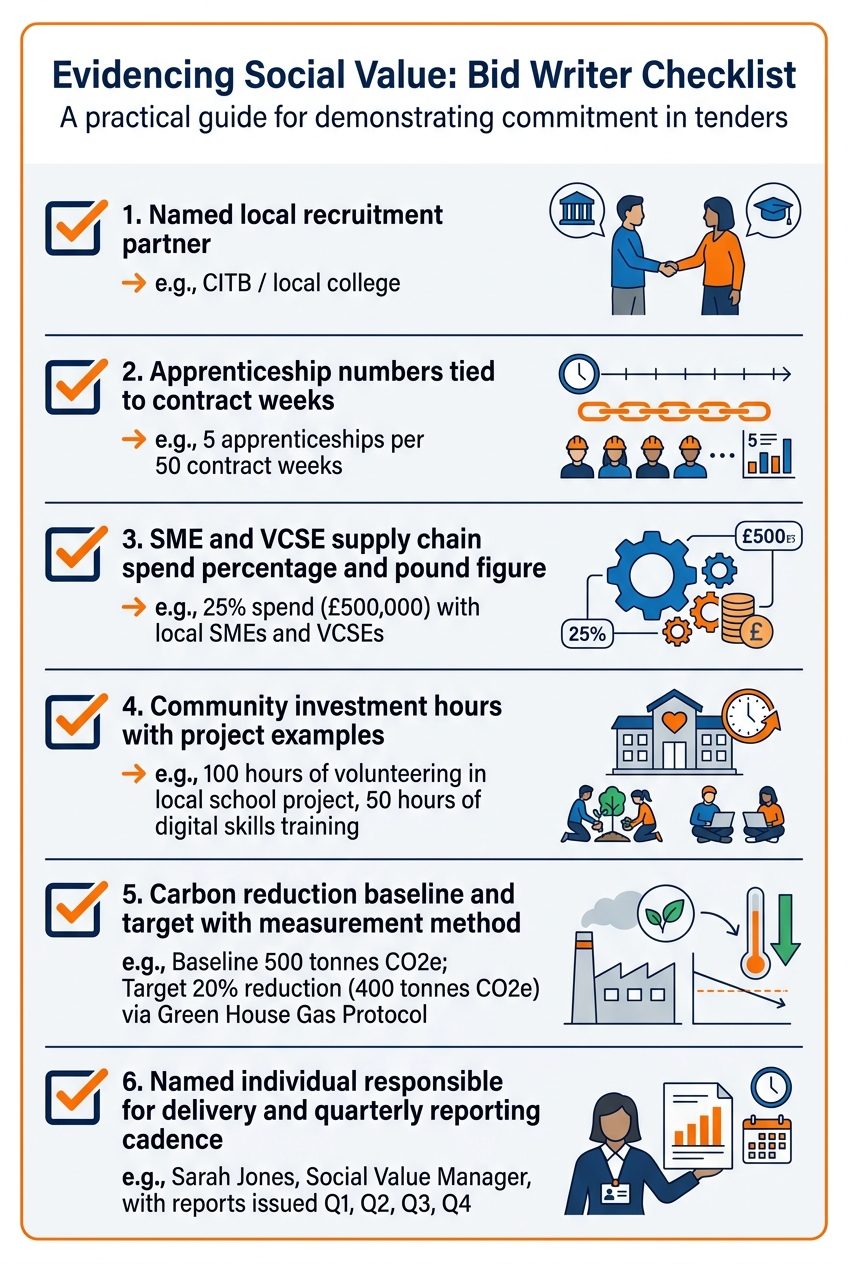
Bid writer checklist for evidencing social value commitments in construction tenders
For each commitment in the response, you should be able to point to:
A baseline. What is your current performance on this measure? If you are committing to 95% diversion from landfill, what did you deliver on the last three comparable contracts? Show the data. If you do not have it, say so honestly and commit to establishing it in the first quarter of the contract. A delivery method. How will you actually deliver this? Naming partners, processes and tools is more credible than describing intentions. "Through our existing partnership with Construction Youth Trust, supported by our internal Apprenticeship Lead Sarah Whitehouse, using our [named system] tracker" beats "we will deliver apprenticeships." A measurement methodology. How will you measure delivery? Who calculates it? When is it reported? If you are using TOMs proxy values, name the version of the framework. If you are using HACT social value calculator outputs, say so. Evaluators want to see methodological rigour. Comparable evidence. Best of all is evidence that you have done it before. A short case study referenced from a comparable contract (sector, scale, contracting authority type) that demonstrates you set a comparable commitment and met or exceeded it. Two or three of these embedded in the response transform credibility. Governance. A named individual responsible for delivery, a reporting cadence (typically monthly internal, quarterly to client), and an escalation route if commitments are at risk. This belongs in every response over 1,000 words.A simple drafting test: read each commitment and ask "if a reasonably sceptical evaluator wanted to challenge this, what would they ask?" If you cannot answer those questions inside the response, the commitment is not yet ready.
Common Mistakes That Are Easy to Fix
Most of the scoring damage in social value sections is self-inflicted and fixable in a final review pass.
Generic openers. "Mytender Construction is committed to delivering positive social value on this important contract." Delete every sentence like this. It costs words and adds nothing. Padding with policy quotation. Quoting PPN 06/20 or the Procurement Act 2023 at length wastes word count. The evaluator wrote the policy framing, they do not need it read back to them. Cite once if the citation supports a specific commitment. Repeating commitments across themes. A carbon reduction commitment in the environment theme and the same commitment again in the social theme dressed up as community wellbeing is double-counting. Evaluators see it. Headcount-only social value. "We will employ 30 local people" is not a social value commitment, it is a recruitment commitment. The social value uplift is in who those 30 people are (priority groups), how they are supported (apprenticeships, mental health, training), and what happens after the contract ends (transition into permanent employment, qualifications gained). Missing word count discipline. Most social value sections in construction tenders cap at 1,500-3,000 words. Bidders waste 30% of available word count on framing, generalities and commitments that should be in other sections. Cut hard. Spend the words on specifics. No supply chain cascade. The principal contractor cannot deliver all of the social value alone on most construction contracts. Strong responses include a named flow-down clause and a process for cascading commitments to subcontractors with measurement back up the chain.A Suggested Drafting Sequence
For bid managers responsible for the social value section, this is the sequence that consistently produces higher-scoring responses.
Two weeks out: read the contracting authority's social value policy and local economic strategy. Map each ITT social value question to the TOMs themes it implicitly references. Calculate credible benchmarks for apprenticeship weeks, FTE jobs, local SME spend, volunteer hours and carbon reduction based on contract value and duration. Identify named local partners (colleges, recruitment partners, VCSEs, schools) who can be cited. Ten days out: draft commitments with baseline, delivery method, methodology, comparable evidence and governance for each. Cross-check with the operations team that they are deliverable, and with the supply chain team that the cascade is realistic. Five days out: internal review focused on specificity (replace any abstract noun with a concrete example). Cross-reference with the mobilisation plan, supply chain plan and environmental management plan to remove duplication. Add named owner, reporting cadence and escalation route. Two days out: word count discipline pass. Cut every sentence that does not contain a specific commitment, number, named partner or piece of evidence. Final read-through against the evaluation rubric, paragraph by paragraph.Bid teams that still slot social value in during the last 48 hours will continue to score 2s and 3s while their competitors score 4s.
Where mytender.io Helps
A practical word on tooling, since this is a frequent question. The hardest part of writing strong social value responses on construction tenders is not the writing itself, it is having the right evidence to hand: baselines from previous contracts, named partners by region, comparable case studies, accurate apprenticeship maths, supply chain SME commitments. Most construction bid teams have this evidence scattered across SharePoint folders, individual mailboxes and people's heads.
mytender.io centralises that bid intelligence so that when a tender lands, your team is not starting from a blank page. Past commitments and their delivery outcomes are searchable, structured, and reusable, so the response you write reflects what you have actually delivered rather than what you can credibly promise. That is the difference between a 3 and a 4 on the evaluation rubric, repeated across every social value section your team writes this year.
Final Word
Social value scoring in UK public sector construction tenders has moved from the back of the brochure to the front of the bid. The Procurement Act 2023 has accelerated a trend that was already underway and removed most of the structural reasons contracting authorities were holding back from weighting it higher.
For bid managers, the operational answer is straightforward. Stop treating social value as a soft section. Build it into the bid with the same rigour you apply to method, programme and price. Specify, quantify, evidence and govern. Cite the contracting authority's local priorities, not the national framework in the abstract. Cascade commitments through the supply chain. And get the section into the bid plan two weeks before submission, not two days.
If you want a useful next step, the Tender Finder is free to use and lists live UK construction opportunities filtered by sector, value and contracting authority, including the social value weighting where it is published in the contract notice. It is a low-friction way to see what is in the market and how authorities in your region are pricing social value into the evaluation.
Tags
Ready to Transform Your Tender Writing?
See how MyTender's AI can help you write winning tenders in a fraction of the time.