

Risk Management in Tender Writing: Complete Guide to Identifying, Mitigating, and Presenting Risk in 2026
Master risk management in tender responses with proven strategies for risk identification, mitigation planning, and compelling risk presentation. Expert guidance on turning risk management into competitive advantage.
mytender.io Research Team
Tender Risk Management Specialists
Risk management separates winning tender responses from mediocre submissions. Procurement professionals scrutinize how bidders identify, assess, and mitigate project risks because risk directly impacts delivery success, budget stability, and contract outcomes. Organizations that demonstrate sophisticated risk management thinking gain competitive advantage while those who treat risk superficially or defensively raise red flags about their delivery capability.
This comprehensive guide reveals how to transform risk management from a compliance checkbox into a strategic differentiator that strengthens your tender responses and win rates.
Understanding Risk in Public Sector Procurement
Public sector buyers approach risk fundamentally differently than private sector purchasers. Government contracts involve taxpayer money, democratic accountability, regulatory compliance, and public scrutiny that create unique risk dimensions beyond commercial considerations.
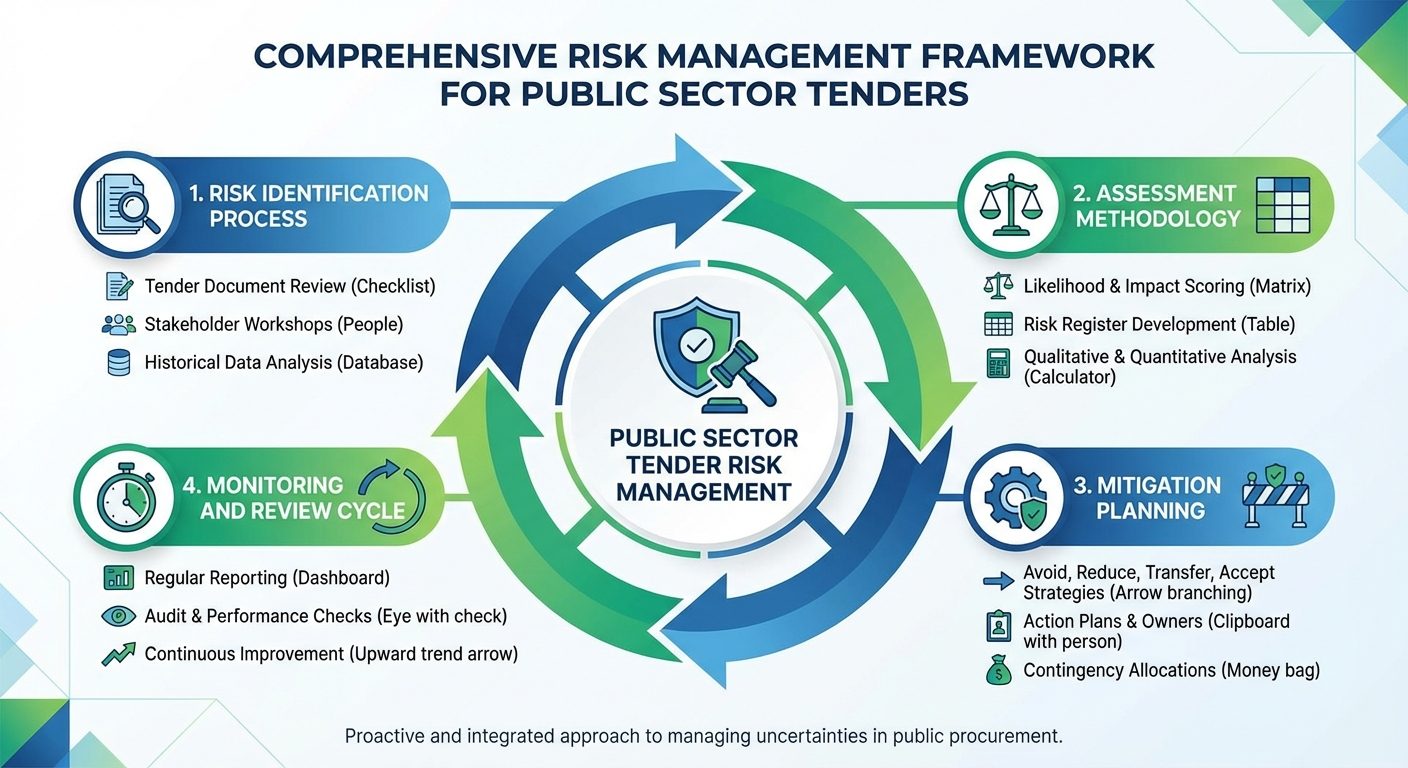
Risk management framework for public sector tenders
These priorities shape how evaluators assess risk content in tender responses. They seek evidence that you understand not just your own commercial risks but the broader implications for their organization, stakeholders, and service users. A construction contractor's risk register that focuses solely on material costs and weather delays while ignoring community impact, traffic management, or environmental compliance signals incomplete risk thinking.
Risk perception versus risk reality creates evaluation challenges. Some bidders minimize risks in tender responses, believing comprehensive risk identification suggests weakness or capability gaps. This approach backfires catastrophically. Evaluators recognize that complex projects involve significant risks—pretending otherwise demonstrates either naivety or dishonesty, both disqualifying characteristics.Conversely, organizations that present extensive risk registers without corresponding mitigation strategies create anxiety about their ability to deliver successfully. The goal is balanced realism: thorough risk identification paired with robust, credible mitigation that demonstrates you can navigate challenges effectively.
Regulatory context for risk management has intensified through the Procurement Act 2023, which emphasizes transparent risk allocation and appropriate transfer between parties. Buyers must justify risk decisions, creating opportunities for suppliers who help them demonstrate sound risk management through well-structured tender responses.Risk Identification Framework
Comprehensive risk identification requires systematic approaches that uncover risks across all project dimensions, not just obvious technical or commercial concerns.
Risk category mapping provides structure for thorough identification. Commercial risks include pricing accuracy, cost inflation exposure, payment term impacts, contract value changes, and financial viability dependencies. Operational risks encompass resource availability, capacity constraints, supply chain disruptions, technology failures, and process dependencies. Regulatory risks involve legislative changes, compliance requirements, licensing or accreditation maintenance, data protection obligations, and industry standards evolution.Stakeholder risks include client relationship management, end-user acceptance, subcontractor performance, community opposition, and political or media attention. External risks span economic conditions, market changes, environmental factors, geopolitical events, and force majeure scenarios.
Systematically working through these categories during bid development ensures comprehensive coverage rather than ad hoc identification that misses significant risks.
Project lifecycle risk analysis examines risks at each delivery stage. Mobilization risks differ fundamentally from steady-state operational risks and demobilization risks. A facilities management tender should address risks in TUPE transfers, system migrations, and service transition during mobilization; demand fluctuations, staff turnover, and equipment failures during operations; knowledge transfer, asset handback, and contract closeout during demobilization.This temporal dimension prevents the common mistake of focusing heavily on startup risks while neglecting ongoing operational or exit challenges.
Stakeholder risk workshops leverage diverse perspectives for more complete identification. Involving delivery teams, subject matter experts, financial analysts, legal advisors, and operational managers in risk identification sessions uncovers blind spots that individual analysis might miss. The procurement manager sees commercial risks, the operations director identifies delivery challenges, the compliance officer flags regulatory issues, and the finance team highlights cash flow implications.Document these collaborative sessions in your tender response to demonstrate thorough, multi-disciplinary risk thinking.
Risk Assessment and Prioritization
Identifying risks represents only the starting point. Effective risk management requires assessing likelihood, impact, and prioritization to allocate mitigation resources appropriately.
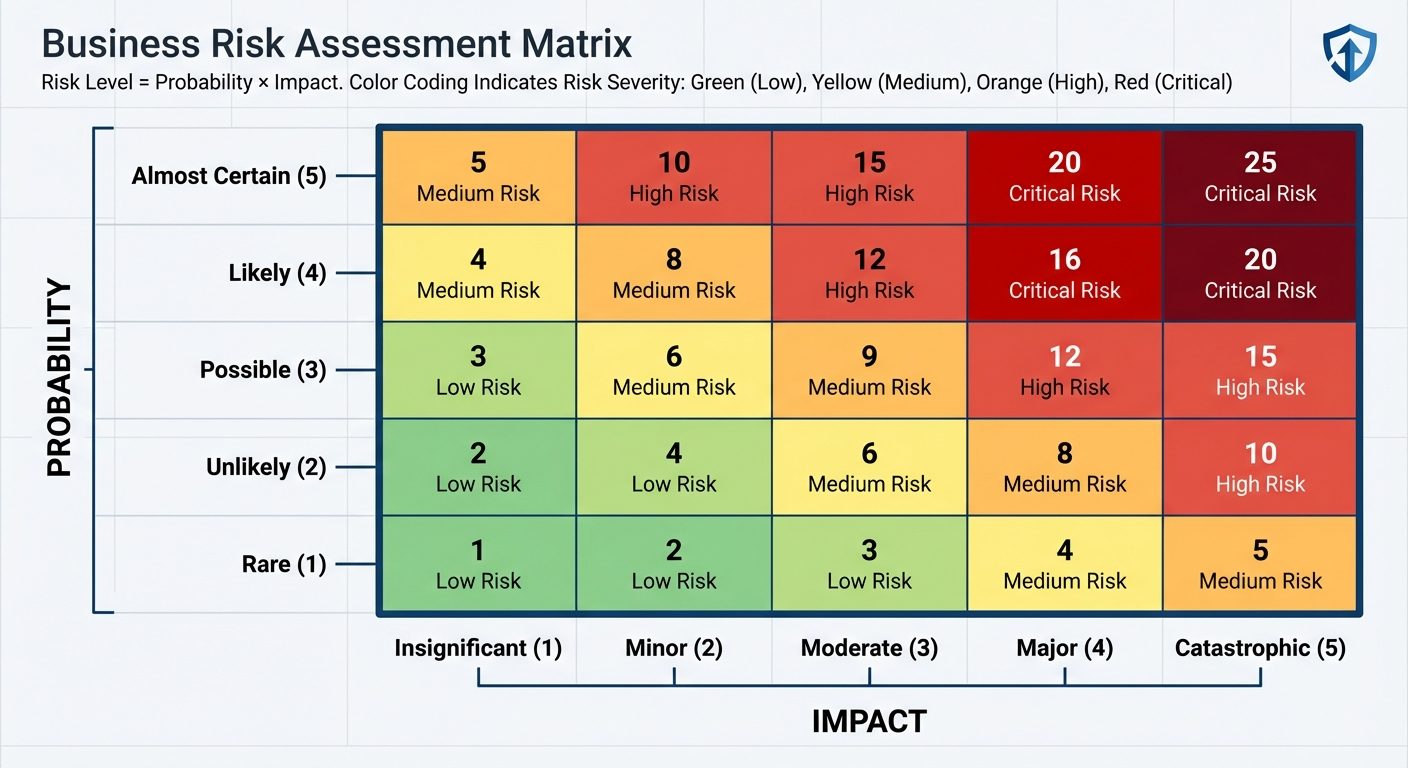
Risk assessment matrix and prioritization framework
Define scale criteria explicitly. "Moderate financial impact" might mean £10,000-£50,000 for a small contract but £500,000-£2 million for a major framework. Vague definitions produce inconsistent assessments that undermine risk management credibility.
Pre-mitigation versus post-mitigation assessment demonstrates risk management effectiveness. Present initial risk scores before any mitigation, then show reduced scores after your proposed controls and actions. This before-and-after comparison illustrates how your approach transforms the risk landscape.A cybersecurity risk might score 4 (likely) × 5 (catastrophic) = 20 pre-mitigation, but only 2 (unlikely) × 3 (moderate) = 6 post-mitigation after implementing multi-factor authentication, encryption, regular audits, and incident response procedures. This transformation proves your risk management adds genuine value.
Risk tolerance and appetite statements align your approach with buyer expectations. Public sector organizations typically have low risk appetite for safety, compliance, and reputational issues but higher tolerance for innovation or efficiency improvement risks. Understanding and reflecting this appetite in your response demonstrates commercial awareness and cultural fit.Explicitly state your risk management philosophy: "We adopt zero-tolerance approaches to health and safety, data protection, and statutory compliance while embracing calculated innovation risks that deliver service improvements within controlled parameters."
Risk interdependencies and cascading effects require sophisticated analysis. Individual risks rarely exist in isolation—one risk materializing often triggers others. Staff shortage risks cascade into service quality risks, customer satisfaction risks, contract performance risks, and revenue risks. Mapping these connections demonstrates strategic thinking that evaluators value highly.Risk Mitigation Strategies
Mitigation planning transforms risk identification from theoretical exercise into practical delivery assurance. Evaluators assess mitigation quality as carefully as risk identification completeness.
Mitigation hierarchy structures responses appropriately. Risk elimination removes the risk entirely through design changes or alternative approaches. Risk reduction decreases likelihood or impact through controls, procedures, or safeguards. Risk transfer shifts consequences to third parties through insurance, subcontracts, or partnerships. Risk acceptance acknowledges calculated risks with contingency planning where elimination, reduction, or transfer proves impractical or uneconomical.Apply this hierarchy systematically rather than defaulting to risk acceptance. Over-reliance on acceptance signals passive risk management while thoughtful progression through elimination, reduction, and transfer demonstrates active, sophisticated approaches.
Specific, actionable mitigation measures prove credibility. Generic statements like "we will monitor this risk closely" or "our experienced team will manage this effectively" provide zero reassurance. Evaluators demand concrete actions with clear implementation details.Compare "We will mitigate supply chain disruption risks through careful supplier management" with "We will implement dual-sourcing for all critical materials, maintain 30-day buffer stocks, conduct quarterly supplier financial health assessments using Dun & Bradstreet reports, and establish contractual alternative supplier arrangements with pre-negotiated emergency pricing."
The second approach provides specific, verifiable mitigation that evaluators can assess objectively.
Mitigation ownership and timescales demonstrate accountability. Every mitigation action should identify a responsible individual or role, implementation timeframe, and success criteria. "The Operations Director will implement supplier dual-sourcing for critical materials within 60 days of contract award, with completion confirmed through documented supply agreements and initial stock delivery."This clarity prevents mitigation remaining theoretical intentions rather than actual delivery commitments.
Contingency planning addresses scenarios where mitigation fails or risks materialize despite controls. Describe your response protocols for high-impact risks: "If primary supplier failure occurs despite dual-sourcing mitigation, we will activate emergency procurement through our framework agreements with [Supplier X] and [Supplier Y], ensuring service continuity within 24 hours while permanent alternative arrangements are established within 14 days."This layered approach—mitigation plus contingency—demonstrates depth of thinking that weak competitors lack.
Risk Registers and Presentation
How you present risk analysis significantly influences evaluation scores. Sophisticated risk thinking presented poorly scores lower than moderate analysis presented professionally.
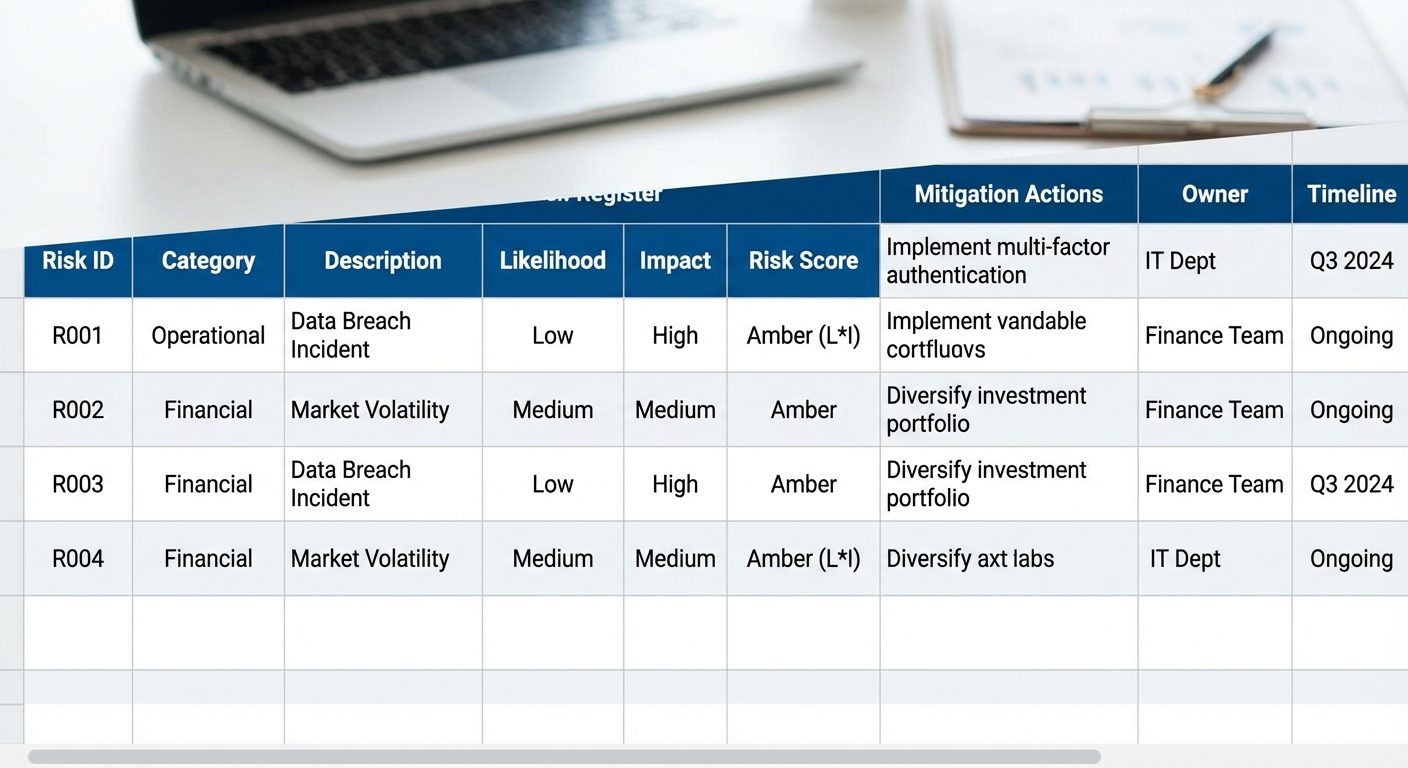
Effective risk register template and presentation
Additional useful columns include risk status (open, active, closed), review frequency, early warning indicators, and dependencies on other risks or external factors.
Risk narrative integration provides context beyond tabular registers. Use prose sections to explain your risk management philosophy, methodology for identification and assessment, governance and oversight approach, monitoring and review cycles, and escalation procedures for emerging risks.This narrative demonstrates strategic thinking that pure registers cannot convey. Explain how your risk management integrates with project governance, quality assurance, and stakeholder communication rather than existing as isolated activity.
Visual risk communication enhances understanding and engagement. Heat maps plotting risks on probability-impact matrices provide immediate visual prioritization. Traffic light indicators show risk status at a glance. Trend charts demonstrate risk score evolution over time. Process flows illustrate risk escalation pathways and decision triggers.These visual elements make risk content more accessible to diverse evaluators including those less comfortable with detailed technical analysis.
Proportionate risk management tailors register complexity to contract scale and complexity. A £50,000 maintenance contract requires focused risk analysis covering key delivery issues, not comprehensive registers spanning dozens of theoretical scenarios. Conversely, multi-year, multi-million pound transformation programmes demand extensive risk analysis demonstrating capability for complex delivery.Misjudging proportionality signals either insufficient capability (oversimplifying complex procurement) or inefficiency (over-engineering simple requirements). Study evaluation criteria weightings and quality thresholds to calibrate appropriate detail levels.
Sector-Specific Risk Considerations
Different procurement sectors involve unique risk dimensions that generic risk management approaches inadequately address.
Construction and infrastructure projects involve ground conditions and contamination, planning permission and regulatory approvals, utility diversions and third-party interfaces, weather and seasonal constraints, supply chain and material availability, workforce skills and capacity, health and safety and public protection, and community impact and stakeholder opposition.Demonstrate deep understanding of construction risk through specific mitigation like ground investigation programs, planning contingency strategies, early utility mapping, weather-appropriate scheduling, and comprehensive health and safety management systems aligned with CDM regulations.
IT and technology services present different risk profiles including technical complexity and integration challenges, cybersecurity and data protection, legacy system compatibility, user adoption and change management, vendor dependency and lock-in, intellectual property and licensing, scalability and performance, and ongoing support and maintenance.Address these through robust testing strategies, security certifications (Cyber Essentials Plus, ISO 27001), detailed migration planning, comprehensive training programs, exit management and data portability provisions, and service level agreements with clear performance metrics.
Healthcare and social services involve vulnerable populations requiring specialized risk focus on safeguarding and duty of care, clinical governance and patient safety, CQC registration and compliance, data protection and confidentiality (particularly NHS Data Security Protection Toolkit), service continuity and emergency response, workforce qualifications and DBS clearance, infection control and hygiene standards, and partnership working and information sharing.Demonstrate sector expertise through specific references to healthcare regulations, quality frameworks, professional standards, and sector-specific best practices.
Facilities management encompasses multi-disciplinary service integration, TUPE transfers and employment law, subcontractor coordination and quality, reactive maintenance and emergency response, health and safety across diverse activities, environmental compliance and waste management, client relationship and service user satisfaction, and contract variation and scope changes.Show sophisticated FM risk understanding through integrated service delivery models, TUPE due diligence processes, supplier management frameworks, 24/7 response protocols, and dynamic quality monitoring systems.
Financial Risk Management
Financial risks receive intense scrutiny because supplier financial failure creates catastrophic consequences for buyers including service disruption, additional procurement costs, project delays, and reputational damage.
Pricing risk and cost inflation require careful modeling and mitigation. Fixed-price contracts transfer inflation risk to suppliers, creating potential margin erosion if costs increase unexpectedly. Multi-year contracts intensify this exposure.Demonstrate financial risk management through detailed cost buildup showing pricing assumptions, inflationary allowances based on credible economic forecasts (OBR, Bank of England), price adjustment mechanisms where contract terms permit, efficiency improvements offsetting cost growth, and contingency reserves for unexpected cost pressure.
Show evaluators your pricing is commercially sustainable, not artificially low to win work with inevitable future financial stress.
Cash flow and working capital risks affect delivery capability. Public sector payment terms often extend to 30 days, while subcontractors and suppliers may require faster payment. Large mobilization costs before revenue generation creates cash flow challenges.Address these risks through cash flow forecasting showing adequate working capital, banking facilities providing financial headroom, early payment discount negotiations with suppliers, milestone payment requests where contract terms permit, and parent company guarantees or performance bonds for major contracts.
Subcontractor and supply chain financial stability creates indirect risk. Your financial health matters little if critical subcontractors fail mid-contract.Mitigate through financial due diligence on major subcontractors (credit reports, accounts analysis), payment term management preventing subcontractor stress, alternative supplier arrangements providing backup options, and parent company guarantees from subcontractor group structures where available.
Currency and economic risks affect international procurement or contracts with imported goods. Exchange rate fluctuations can destroy margins on fixed-price contracts paid in sterling but with dollar or euro costs.Manage through currency hedging strategies for significant exposures, contractual currency adjustment clauses where terms permit, dual-source strategies using domestic and international suppliers, and cost pass-through mechanisms for commodity price volatility.
Compliance and Legal Risk
Regulatory compliance failures create legal exposure, contract termination risk, reputational damage, and criminal liability in extreme cases. Buyers scrutinize compliance risk management intensely.
Data protection and GDPR compliance extends beyond basic policies to operational practice. Demonstrate risk mitigation through data protection impact assessments for processing activities, data minimization and retention policies, security measures including encryption and access controls, staff training and awareness programs, data processor agreements with subcontractors, breach notification and incident response procedures, and ICO registration and DPO appointment where required.Reference specific GDPR articles and principles demonstrating genuine understanding rather than superficial awareness.
Health and safety risk management varies dramatically by sector but universal requirements include competent safety management, risk assessments and method statements, training and supervision, equipment maintenance and inspection, accident reporting and investigation, and regulatory compliance (HSE, sector-specific regulations).Demonstrate safety culture through lagging indicators (accident frequency rates, lost time incidents) and leading indicators (near-miss reporting, safety observations, training completion) showing proactive rather than reactive safety management.
Modern slavery and ethical sourcing risks intensify under Modern Slavery Act requirements and public sector procurement priorities. Address through supply chain mapping and risk assessment, supplier due diligence and audits, ethical sourcing policies and codes of conduct, whistle-blowing and reporting mechanisms, training for procurement and contract management staff, and transparency statements and annual reporting.Show this extends beyond compliance tick-boxes to genuine ethical commitment embedded in business operations.
Environmental compliance spans waste management regulations, emissions controls, packaging obligations, environmental permitting, contaminated land responsibilities, and biodiversity protection. Sector-specific regulations add further requirements—construction has CDM, healthcare has clinical waste, food services have food hygiene.Demonstrate comprehensive environmental risk management through ISO 14001 certification, environmental management systems, regulatory compliance monitoring, environmental incident response procedures, and sustainability reporting demonstrating continuous improvement.
Operational Delivery Risk
Operational risks affect day-to-day contract delivery and service quality. Buyers need confidence you can maintain consistent performance across contract duration.
Resource availability and key person dependency creates vulnerability when expertise concentrates in individuals rather than teams. Mitigate through succession planning and deputy arrangements, knowledge management and documentation systems, training and development programs, retention strategies for critical staff, and recruitment pipelines for anticipated demand.Avoid biographical CVs suggesting individual dependency. Show organizational capability with depth and resilience.
Quality assurance and service consistency require systematic approaches beyond individual commitment. Demonstrate through quality management systems (ISO 9001), service level agreements and KPIs with monitoring procedures, customer feedback mechanisms and complaint resolution, continuous improvement frameworks, and audit and inspection programs.Present quality as system-driven rather than personality-dependent, proving consistency survives staff changes and organizational growth.
Technology failure and cybersecurity increasingly dominates operational risk. Services depend on IT systems, creating vulnerability to outages, cyberattacks, data loss, and technology obsolescence.Address through business continuity and disaster recovery planning, backup systems and data redundancy, cybersecurity controls and testing, incident response and recovery procedures, technology refresh and upgrade planning, and vendor management for third-party systems.
Demonstrate these aren't theoretical documents but tested, practiced procedures with evidence of successful operation.
Third-party dependencies extend your risk exposure beyond direct control. Critical subcontractors, utility services, client-provided resources, regulatory approvals, and external stakeholders all create dependency risks.Manage through contractual commitments and performance guarantees, alternative supplier arrangements, early engagement and relationship management, escalation procedures for third-party issues, and contingency plans reducing dependency where possible.
Risk Communication and Stakeholder Management
Risk management effectiveness depends on communication quality. Sophisticated analysis presented poorly or to wrong audiences achieves little.
Stakeholder risk mapping identifies who needs what risk information and when. Client senior management requires strategic risk summaries focused on delivery assurance and financial stability. Operational managers need detailed risk registers informing day-to-day decisions. Compliance officers want regulatory risk evidence. Finance teams seek financial risk analysis.Tailor risk communication to audience priorities rather than one-size-fits-all presentations.
Risk reporting frameworks establish communication rhythm and format. Monthly risk reports might include risk register updates, new risks identified, closed risks, risk score changes, mitigation progress, escalated risks requiring attention, and trend analysis showing overall risk profile evolution.Quarterly strategic risk reviews provide deeper analysis of major risks, scenario planning, horizon scanning for emerging risks, and risk management effectiveness assessment.
Escalation protocols define when and how risks move up organizational hierarchies. Clear triggers prevent both over-escalation (senior management overwhelmed with minor issues) and under-escalation (major risks hidden until crisis point).Example escalation criteria might include risk scores exceeding thresholds (e.g., any risk rated 15+ immediately escalates to senior management), mitigation failure or ineffectiveness, risks trending upward across multiple review cycles, risks affecting contract KPIs or SLAs, and client concerns or complaints about risk areas.
Positive risk communication treats risk management as strength rather than weakness. Many bidders present risks defensively or minimize them, missing opportunities to demonstrate capability and experience.Reframe risk discussions: "Our extensive experience delivering similar projects has taught us the critical risks in this area. We've developed proven mitigation approaches that protect both our organization and our clients, as demonstrated in [case study examples]."
This positions risk expertise as competitive advantage, not vulnerability admission.
Transforming Risk into Competitive Advantage
Leading organizations transform risk management from defensive compliance into strategic differentiation that wins tenders.
Risk innovation and creative mitigation demonstrates thinking beyond standard approaches. Where competitors present conventional risk management, innovative solutions create clear differentiation.Example: A cleaning services tender might standardly mitigate staff shortage risks through recruitment agencies and overtime. An innovative approach might use demand forecasting algorithms optimizing roster allocation, partnership with local skills academies creating talent pipelines, and flexible working arrangements attracting broader labor pools. This sophistication signals superior delivery capability.
Risk case studies and evidence prove your mitigation works in practice. Generic risk statements lack credibility compared to specific examples demonstrating successful risk navigation."We mitigated supply chain disruption during the 2021 freight crisis by activating dual-sourcing protocols, leveraging alternative logistics routes, and maintaining strategic buffer stocks. This enabled us to maintain 100% service continuity for [Client X] while competitors experienced widespread disruption."
This evidence-based approach transforms theoretical risk management into proven delivery assurance.
Risk-based differentiation identifies risks competitors struggle with but you handle effectively. Deep sector expertise, specialized capabilities, proprietary systems, or unique partnerships might enable superior mitigation of specific risks.Position these strengths explicitly: "Unlike generalist competitors, our specialist healthcare background enables superior mitigation of clinical governance risks through established CQC relationships, proven infection control protocols, and healthcare-qualified management teams."
Value-added risk services extend basic contract requirements. Offering to help clients improve their own risk management, sharing risk intelligence across frameworks, contributing to buyer risk policy development, or providing risk management training demonstrates partnership thinking that evaluators value.Conclusion: Risk Management as Delivery Confidence
Risk management in tender writing serves one ultimate purpose: giving buyers confidence you will deliver successfully despite inevitable challenges. Sophisticated risk identification demonstrates realism and experience. Robust mitigation proves capability and preparedness. Clear presentation shows communication skills and stakeholder awareness.
Organizations that treat risk as afterthought compliance exercise—hastily completing risk registers to tick procurement boxes—miss enormous competitive opportunities. Those who embed rigorous risk thinking throughout bid development, delivery planning, and organizational culture create compelling differentiators that translate directly to higher win rates and successful contract delivery.
The most successful tender responses present risk management as core delivery assurance, not peripheral compliance activity. They demonstrate that far from being weaknesses requiring defensive minimization, well-managed risks represent learning opportunities, innovation drivers, and relationship strengtheners with sophisticated clients who value partners capable of navigating complexity.
MyTender's AI-powered platform transforms risk management in tender writing by analyzing similar contracts to identify relevant risks automatically, suggesting sector-specific mitigation strategies based on proven approaches, generating professional risk registers and documentation, ensuring compliance with risk management best practices, and maintaining consistency across multiple bids and contract delivery.
Whether you're responding to your first public sector tender or managing complex multi-year frameworks, applying these risk management principles will strengthen your submissions, increase win rates, and support successful delivery. Master risk management, and you transform uncertainty from tender weakness into competitive strength.
Tags
Ready to Transform Your Tender Writing?
See how MyTender's AI can help you write winning tenders in a fraction of the time.