

The Procurement Act 2023: Your Complete Guide to Winning Tenders Under the New UK Framework
Master the Procurement Act 2023 with our comprehensive guide. Learn the key changes, new compliance requirements, and proven strategies to win more public sector contracts under the MAT framework.
Sam Reuter
CEO
The Procurement Act 2023 represents the most significant overhaul of UK public sector procurement in over a decade. Coming into full effect in February 2025, the Act replaces the Public Contracts Regulations 2015 and introduces fundamental changes to how businesses bid for and secure government contracts.
For suppliers, these changes present both challenges and opportunities. Understanding the new framework isn't just about compliance—it's about gaining a competitive advantage in a marketplace worth over £300 billion annually.
This comprehensive guide will walk you through everything you need to know about the Procurement Act 2023, from the cultural shift to "Most Advantageous Tender" to practical strategies for winning under the new rules.
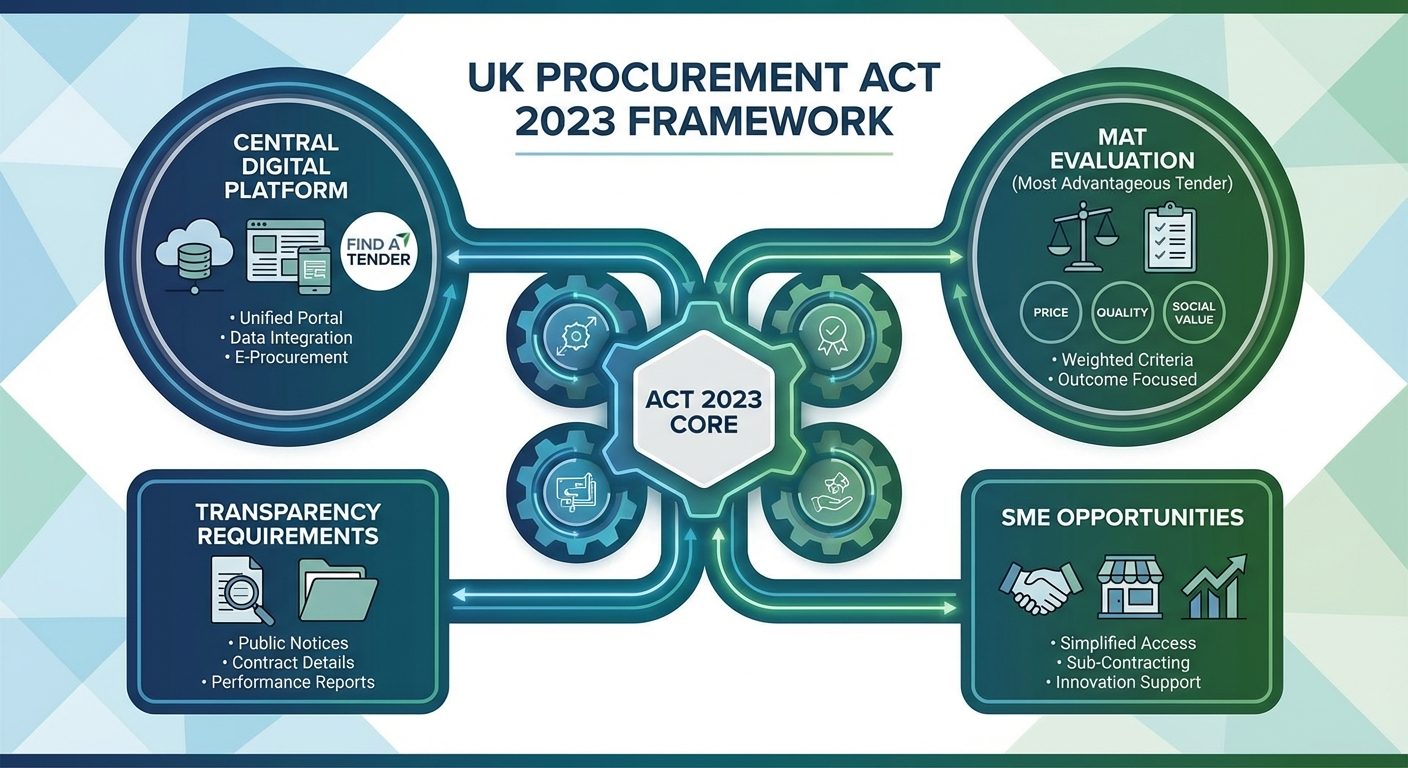
Overview of the UK Procurement Act 2023 framework showing key elements
Understanding the Procurement Act 2023: What Changed and Why
The Procurement Act 2023 emerged from years of consultation and a recognition that the UK's procurement framework needed modernisation. The previous regulations, heavily influenced by EU directives, were often criticised for being overly complex, burdensome, and favouring larger contractors over innovative SMEs.
The new Act aims to create a more transparent, flexible, and value-driven procurement system that better serves both contracting authorities and suppliers.
The Core Philosophy: From MEAT to MAT
Perhaps the most significant cultural shift in the Procurement Act 2023 is the transition from "Most Economically Advantageous Tender" (MEAT) to "Most Advantageous Tender" (MAT). This seemingly subtle change in terminology represents a profound shift in how bids are evaluated.
Under the old MEAT framework, evaluation criteria were heavily weighted towards economic factors—primarily price, but also cost-effectiveness and lifecycle costs. While quality and social value were considered, they often took a backseat to financial considerations.
The MAT framework broadens this perspective. Contracting authorities can now place greater emphasis on:
- Social value and community benefits — How your bid contributes to local employment, skills development, or community wellbeing
- Environmental sustainability — Carbon reduction, circular economy principles, and ecological impact
- Innovation and added value — Creative solutions that go beyond basic requirements
- Quality and long-term outcomes — Lasting benefits rather than short-term cost savings
- Supplier diversity and inclusion — Supporting SMEs, social enterprises, and underrepresented groups
This doesn't mean price is irrelevant. Budget constraints remain real, and value for money is still paramount. However, the MAT framework acknowledges that "most advantageous" extends far beyond the lowest price tag.
For suppliers, this shift opens new avenues for differentiation. If you've struggled to compete on price alone, the MAT framework allows you to showcase expertise, innovation, and values-driven approaches that create genuine value for public sector clients.
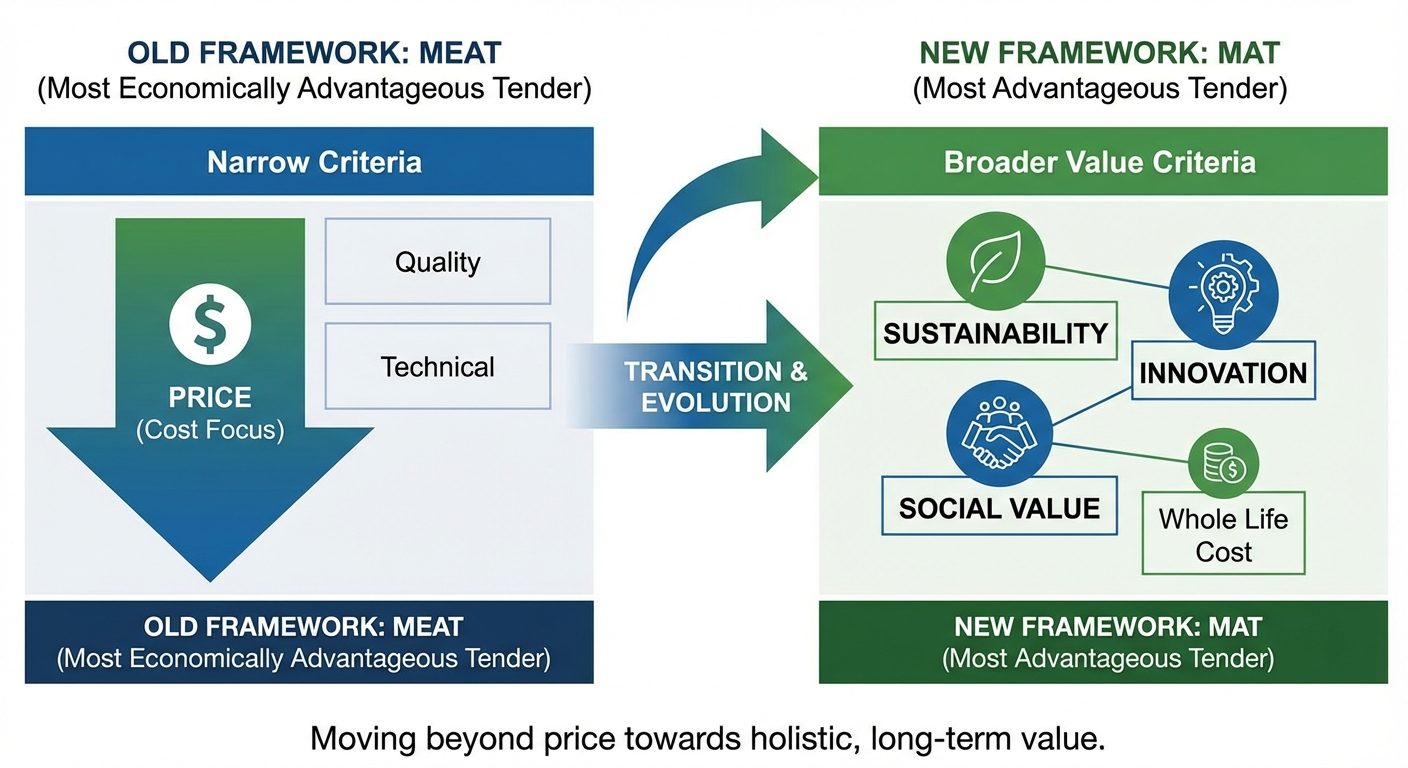
Comparison showing the transition from MEAT to MAT evaluation framework
Key Legislative Changes at a Glance
Beyond the MEAT to MAT transition, the Procurement Act 2023 introduces several structural changes:
New Procurement Thresholds: As of January 2026, revised thresholds determine which contracts fall under the Act's full provisions. Most thresholds have decreased, meaning more contracts are now subject to formal procurement processes. For central government goods and services contracts, the threshold is now £135,018, while sub-central government contracts have a threshold of £207,720. This expansion means greater transparency and opportunity for suppliers, but also increased compliance requirements for smaller contracts. Central Digital Platform: The Act replaces Contracts Finder and other fragmented platforms with a centralised Central Digital Platform. All contracting authorities must publish tender notices, award notices, and contract modifications on this platform. For suppliers, this means a single source of truth for opportunities across the entire UK public sector. Enhanced Transparency Requirements: Contracting authorities must now publish details of all payments exceeding £30,000 within 30 days of each quarter end. This unprecedented level of transparency allows suppliers to better understand spending patterns, identify opportunities, and benchmark their pricing. Pipeline Notices: Public sector organisations with expected annual procurement spend exceeding £100 million must publish pipeline notices outlining planned procurements over £2 million. These forward-looking notices give suppliers valuable lead time to prepare bids and form partnerships. Supplier Debarment List: A new mandatory debarment list excludes suppliers who fail to meet legal, ethical, or performance standards. While this creates risks for non-compliant suppliers, it also levels the playing field by removing bad actors who might previously have undercut compliant competitors. Key Performance Indicators (KPIs): For contracts above relevant thresholds, suppliers must regularly report KPIs via the Central Digital Platform. This data-driven approach ensures ongoing contract management and accountability, but requires robust performance tracking systems.The MAT Framework: How Tenders Are Evaluated Under the New Rules
Understanding how the MAT framework operates in practice is crucial for crafting winning bids. While every tender will have unique evaluation criteria, the underlying principles remain consistent.
Award Criteria and Weighting
Under the Procurement Act 2023, contracting authorities have greater flexibility in setting award criteria that reflect their specific priorities and objectives. Rather than following rigid EU-derived frameworks, they can tailor evaluation models to the unique context of each procurement.
This flexibility manifests in how criteria are weighted. A sustainability-focused council might weight environmental impact at 30-40% of the total score, while a cash-strapped authority might still place heavy emphasis on cost. The key difference from the old system is transparency—authorities must clearly publish their criteria and weightings upfront.
For suppliers, this means thoroughly analysing the tender documents to understand what the client truly values. The evaluation methodology section isn't boilerplate text to skim—it's a roadmap showing exactly how to structure your bid for maximum impact.
Social Value Under MAT
Social value has moved from a "nice to have" to a central pillar of public procurement. The Act reinforces the requirements of the Social Value Act 2012, mandating that contracting authorities consider social, economic, and environmental wellbeing in all procurements.
In practice, this means your bid must articulate clear, measurable social value commitments:
Economic Impact: How will you support local employment? What apprenticeship or skills development opportunities will you create? Can you commit to paying the Living Wage? Will you source from local suppliers in your supply chain? Social Impact: How does your bid address inequality, improve community cohesion, or support vulnerable groups? Can you demonstrate partnerships with social enterprises or charities? Environmental Impact: What's your carbon reduction plan? How will you minimise waste, support circular economy principles, or enhance biodiversity? Can you demonstrate environmental certification or innovation?The strongest bids don't just tick boxes—they tell compelling stories about tangible impact. Use case studies from previous contracts, quantify outcomes with data, and show how your commitments align with the specific authority's broader strategic objectives.
Quality and Innovation
The MAT framework explicitly values quality and innovation, recognising that the cheapest bid often proves most expensive in the long run through poor performance, delays, or requirement creep.
When evaluating quality, authorities consider:
Technical excellence: Does your solution demonstrate deep understanding of the requirement? Is your methodology robust and evidence-based? Track record: Can you demonstrate successful delivery of similar contracts with verifiable outcomes? Risk management: Have you identified potential challenges and outlined credible mitigation strategies? Added value: What additional benefits or innovations do you bring beyond the basic specification?Innovation is particularly valued in sectors facing complex challenges—from digital transformation in healthcare to carbon reduction in construction. If you can propose genuinely innovative approaches that improve outcomes, the MAT framework provides space to be rewarded for that creativity.
However, innovation must be credible. Wild ideas without evidence or deliverability will score poorly. The best innovative proposals build on proven foundations, demonstrating how novel approaches reduce risk while enhancing value.
Compliance and Transparency: Meeting the New Standards
The Procurement Act 2023 raises the bar for compliance and transparency, creating new obligations for both contracting authorities and suppliers. Understanding these requirements is essential for maintaining eligibility and building trust.
The Central Digital Platform: Your New Command Centre
The Central Digital Platform is the backbone of the new procurement system. For suppliers, it offers unprecedented visibility into public sector opportunities, spending patterns, and upcoming pipelines.
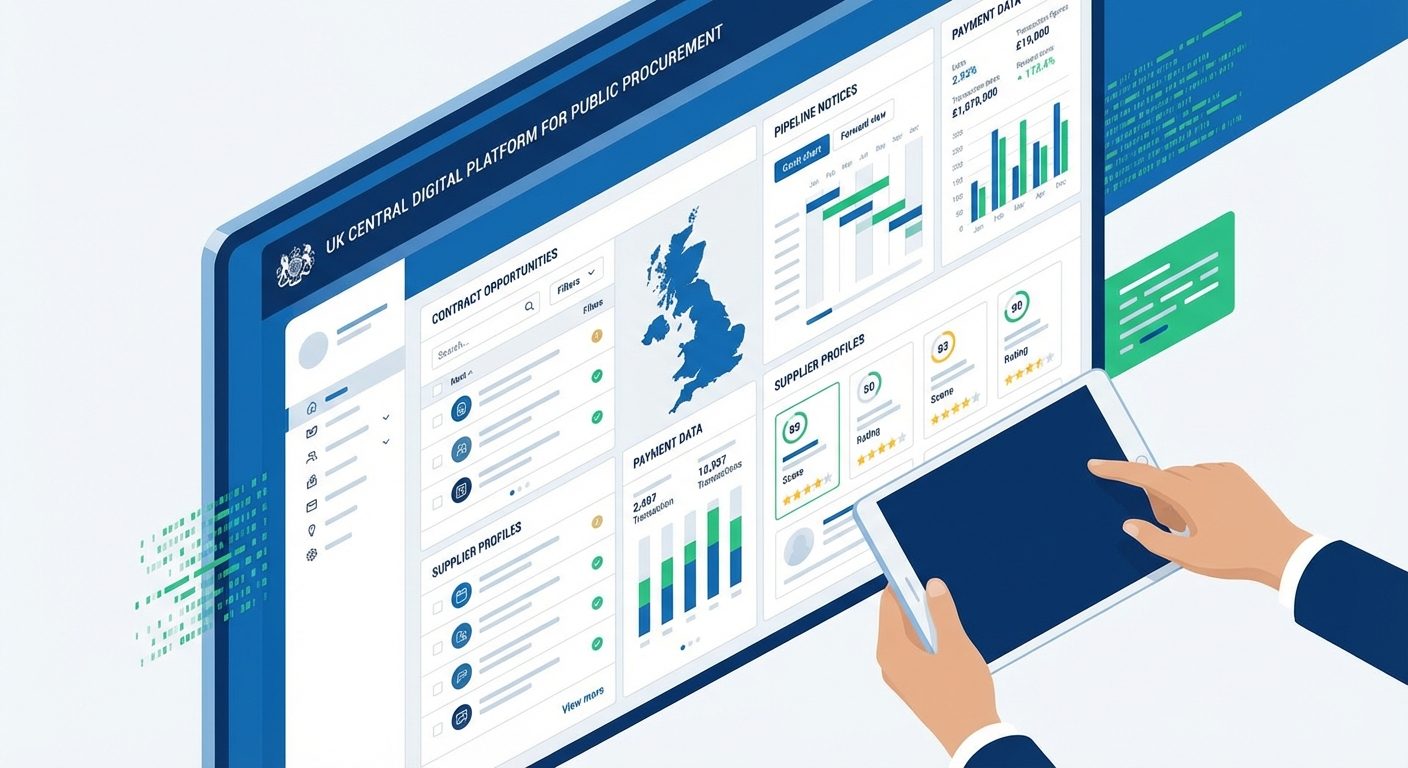
The Central Digital Platform dashboard showing contract opportunities and data
For suppliers accustomed to fragmented procurement portals, the transition to a single platform streamlines the bidding process. However, it also means you can't afford to let your profile lapse—your entire public sector presence hinges on this one system.
Payment Transparency and Supplier Monitoring
The requirement to publish all payments over £30,000 within 30 days creates unprecedented transparency in public procurement. For suppliers, this has several implications:
Pricing Benchmarking: You can now see what authorities are paying for similar services, helping you price competitively without undercutting your sustainability. Performance Indicators: Consistent, on-time payments to your company signal reliability to other authorities reviewing your track record. Conversely, payment disputes or delays become visible. Supply Chain Scrutiny: Authorities increasingly look at your entire supply chain. If you're receiving payments but failing to pay your subcontractors promptly, this can damage your reputation and future bid prospects.This transparency extends to ongoing contract management. The requirement to report KPIs for larger contracts means your performance is continuously monitored and publicly available. Strong KPI delivery becomes a powerful marketing tool for future bids—authorities can verify your track record with data, not just claims.
The Supplier Debarment List: Staying Eligible
The new debarment list is a critical compliance element. Suppliers can be excluded from public procurement for various reasons:
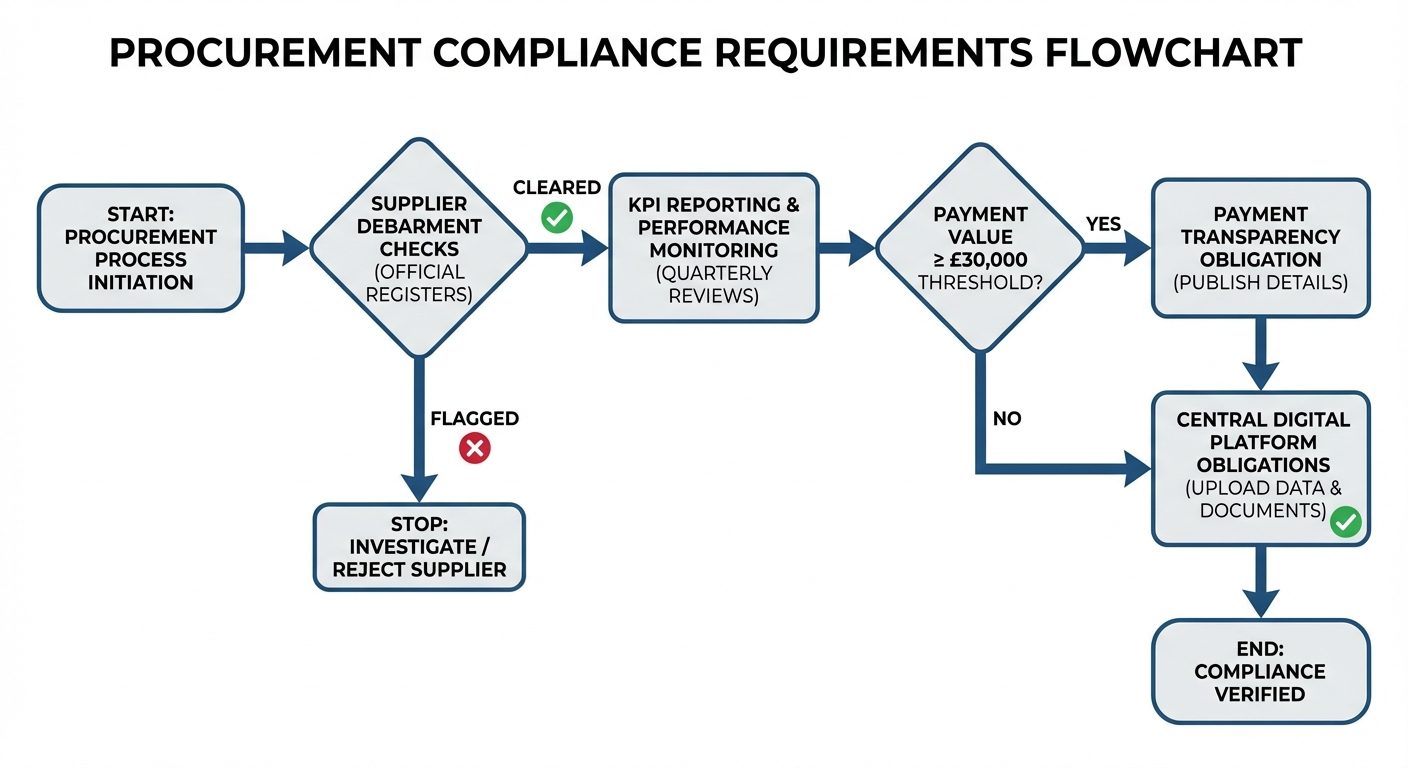
Procurement compliance requirements including debarment checks and KPI reporting
For suppliers, this means rigorous compliance across all areas of your business:
- Ensure all tax obligations are met and up-to-date
- Maintain robust anti-corruption and anti-bribery policies
- Comply with all environmental regulations
- Address any past performance issues with clear corrective actions
- Conduct due diligence on your supply chain to avoid guilt by association
The debarment list is public, searchable, and checked during procurement. Being listed is catastrophic for your public sector business. Prevention through comprehensive compliance is far easier than attempting to rehabilitate after exclusion.
Strategic Opportunities: SMEs and Specialist Providers
One of the explicit goals of the Procurement Act 2023 is opening public procurement to smaller, more innovative suppliers. The government has set an ambitious target: 33% of procurement spending (direct and indirect) should go to SMEs.
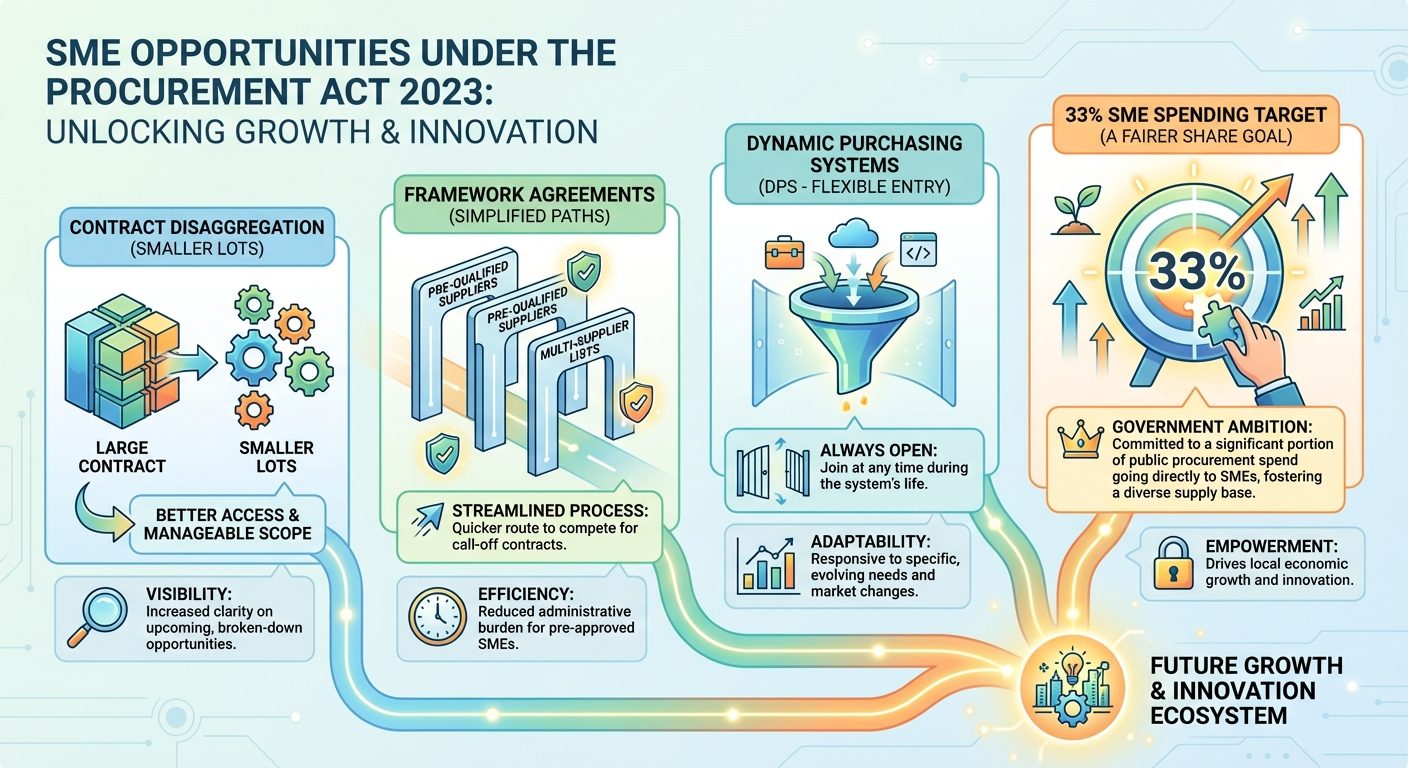
SME opportunities under the Procurement Act including contract lots and frameworks
Contract Disaggregation and Lot Structure
A key tool for achieving SME participation is contract disaggregation—breaking large procurements into smaller lots that align with SME capabilities.
Under the new Act, authorities must consider whether disaggregation is appropriate and document their reasoning. If a £50 million facilities management contract is tendered as a single lot, the authority must justify why smaller lots weren't feasible.
For SMEs, this creates opportunities to bid for specific lots where you have genuine expertise, rather than being shut out by requirement for national coverage or multi-disciplinary capability.
Strategies for SMEs bidding on lots: Target Your Strengths: Bid only for lots where you have proven capability and strong differentiators. Resist the temptation to stretch into areas where you're weak—focused excellence beats diluted coverage. Form Consortia: For larger lots or complementary services, partner with other SMEs or specialist providers. Consortia combine the agility of smaller firms with the scale required for complex contracts. Highlight Flexibility: SMEs often have shorter decision-making chains, greater flexibility, and more personalised client relationships. These are genuine advantages—articulate them clearly in your bid. Demonstrate Innovation: Smaller firms often drive innovation in their sectors. If you have novel approaches, technologies, or methodologies, the MAT framework rewards this creativity. Leverage Local Presence: Many lots prioritise local delivery. If you're embedded in the community, understand local context, and employ local staff, this is a significant differentiator.The lot structure is always detailed in the tender documents. Pay close attention to whether lots can be bid individually or in combination, and whether there are restrictions on how many lots a single supplier can win.
The Role of Framework Agreements and Dynamic Purchasing Systems
Framework agreements and Dynamic Purchasing Systems (DPS) remain important procurement routes under the Act, but with enhanced flexibility and transparency.
Framework Agreements: These establish terms with one or more suppliers for specific categories of goods or services over a set period (typically 4 years). Rather than running individual procurements, authorities can call off from the framework through mini-competitions or direct awards.For suppliers, securing framework placement provides a guaranteed route to opportunity. However, placement doesn't guarantee work—you still need to compete for call-offs.
Dynamic Purchasing Systems: A DPS is a two-stage process. First, suppliers apply to join the system and are assessed against eligibility criteria. Once admitted, you can bid on individual call-off contracts released through the system.The advantage of a DPS is ongoing admission—new suppliers can join at any time, unlike frameworks which have fixed entry windows. This is particularly beneficial for innovative SMEs who might develop capability after a framework tender closes.
Both routes benefit from the Central Digital Platform's transparency. You can track upcoming framework renewals, DPS opportunities, and call-off competitions systematically.
Building Capability and Track Record
A common challenge for SMEs is the "Catch-22" of public procurement: you need a track record to win contracts, but you need contracts to build a track record.
The Procurement Act 2023 addresses this through several mechanisms:
Reserved Contracts: Authorities can reserve certain below-threshold contracts for local or UK suppliers, or for specific groups like social enterprises. These reserved opportunities provide entry points for building public sector experience. Outcome-Based Specifications: By focusing on outcomes rather than prescriptive delivery methods, authorities enable innovative SMEs to propose novel approaches not yet reflected in traditional track records. Dynamic Markets: The DPS model's rolling admission means you can join and compete as soon as you develop relevant capability, rather than waiting years for the next framework tender. Weighting of Past Performance: While track record remains important, the MAT framework's broader evaluation criteria mean other factors—innovation, social value, local presence—can compensate for limited public sector history.For SMEs building capability:
Document Everything: Treat every project, even private sector or small-scale work, as a case study. Capture metrics, client testimonials, and outcomes that demonstrate your capability. Seek Lighter-Touch Routes: Start with lower-value contracts, DPS opportunities, or sub-contracting to larger primes. Build incrementally. Invest in Certifications: Industry-specific certifications, quality standards (ISO 9001), or social value accreditations (B Corp) provide third-party validation of your capability. Network Actively: Attend industry events, connect with contracting authorities at engagement sessions, and build relationships. Public procurement is relationship-driven, and visibility matters.Practical Bid Writing Strategies Under the MAT Framework
Understanding the regulatory framework is one thing—translating that knowledge into winning bids is another. Here are proven strategies for crafting compelling tender responses under the Procurement Act 2023.
Analysing Evaluation Criteria and Weightings
Every tender document includes an evaluation methodology section detailing the award criteria and their weightings. This section is a goldmine of strategic intelligence.
Map Your Response Structure to Criteria: If social value is weighted at 25%, innovation at 20%, and price at 35%, your bid should mirror this balance. Allocate word count, evidence, and emphasis proportionally. Identify Scoring Subcriteria: Criteria are often broken into subcriteria with granular scoring. For example, "Methodology" might subdivide into project planning (8 points), risk management (6 points), and quality assurance (6 points). Address each subcriterion explicitly with dedicated content. Decode Scoring Descriptors: Tender documents usually include scoring definitions (e.g., "Excellent: Fully addresses requirement with compelling evidence"). These descriptors reveal exactly what evaluators are looking for at each score level. Use this language in your response to align with evaluator expectations. Prioritise High-Weighting Criteria: Not all criteria are equal. Focus your strongest evidence, most detailed responses, and most innovative thinking on high-weighted criteria. For lower-weighted criteria, provide competent but proportionate responses.This analytical approach transforms bid writing from a generic pitch to a targeted response laser-focused on the client's stated priorities.
Writing for Social Value and Quality
Social value questions can feel nebulous compared to technical specifications, but they demand the same rigour and evidence-based approach.
Be Specific and Quantifiable: Vague commitments ("We'll support local employment") score poorly. Instead: "We commit to recruiting 40% of our project workforce from within a 15-mile radius of the contract site, creating approximately 23 jobs for local residents. We'll partner with [Local College Name] to offer 5 apprenticeships in [specific trades], with guaranteed employment upon completion." Align with Local Priorities: Research the contracting authority's strategic objectives—these are usually published in corporate plans or procurement strategies. If the council prioritises youth unemployment or net-zero transition, demonstrate how your social value commitments directly support these goals. Use Case Studies: The most powerful social value evidence comes from previous contracts where you delivered measurable impact. Use data: "On our previous contract with [Authority], we delivered 12 apprenticeships with an 83% conversion to permanent employment, contributing £340,000 in Living Wage employment to the local economy." Address All Dimensions: Social value encompasses economic, social, and environmental impact. Don't focus solely on employment to the exclusion of environmental or community benefits. A balanced approach across all dimensions demonstrates comprehensive commitment.For quality criteria, the same principles apply. Demonstrate quality through evidence of past delivery, client testimonials, quality assurance processes, and specific methodologies that go beyond generic best practices.
Pricing Strategy in a MAT World
Price remains a critical evaluation factor under MAT, but the approach to pricing requires strategic nuance.
Understand Price Weighting: If price is weighted at 40%, it's still the single most important factor—you can't ignore it. But if price is 20% and quality/social value combine for 60%, a moderate premium with superior quality can outscore a low-cost bid. Break Down Costs Transparently: The Act's transparency requirements extend to your pricing. Provide clear cost breakdowns by deliverable, phase, or resource type. This transparency builds trust and demonstrates value for money even if you're not the cheapest. Articulate Value Beyond Price: In your pricing narrative, connect costs to value. "Our proposed cost of £X includes embedded continuous improvement processes that reduced client costs by an average of 12% over contract lifetimes in previous projects." Avoid Unrealistic Low-Balling: Artificially low pricing raises red flags about deliverability, quality, or sustainability (including fair wages and supply chain resilience). Authorities increasingly scrutinise unrealistic pricing as a risk factor. Consider Whole-Life Costing: Where relevant, propose total cost of ownership rather than just acquisition cost. If your solution has higher upfront costs but lower operational, maintenance, or disposal costs, demonstrate this lifecycle value.The MAT framework rewards value-based pricing strategies over race-to-the-bottom approaches. Focus on demonstrating return on investment, risk mitigation, and long-term sustainability of your pricing model.
Innovation and Added Value
One of the most exciting opportunities under MAT is the explicit value placed on innovation and added value. This is where you can genuinely differentiate from competitors.
Understand the Difference Between Innovation and Novelty: Innovation solves problems or improves outcomes in meaningful ways. Novelty is just "different for the sake of different." Evaluators can tell the difference. Ground Innovation in Evidence: Propose innovative approaches backed by evidence—pilot projects, research, case studies, or demonstrable outcomes elsewhere. "We propose implementing [innovative approach], which we piloted on [previous contract] resulting in [measurable outcome]." Manage Innovation Risk: Innovation inherently carries risk. Acknowledge this and demonstrate how you'll mitigate it—phased implementation, proof-of-concept stages, fallback options, or robust monitoring. Go Beyond the Specification: Added value means offering benefits not explicitly required. This might be additional reporting, extended warranty, training for client staff, knowledge transfer, or complementary services that enhance outcomes. Make It Relevant: Don't innovate for innovation's sake. Your innovative approach must address the client's specific challenges or objectives. Generic "we use cutting-edge technology" claims fall flat; "We propose using [specific technology] to address your stated challenge of [client's problem], delivering [specific benefit]" resonates.Innovation questions are where smaller, agile suppliers can compete with larger incumbents. If you have genuinely creative approaches or deep specialist expertise, the MAT framework provides a platform to showcase it.
Sector-Specific Considerations
While the Procurement Act 2023 provides a universal framework, its application varies across sectors. Understanding sector-specific nuances strengthens your competitive position.
Construction and Infrastructure
Construction procurement under the Act emphasises whole-life value, environmental impact, and social value (particularly apprenticeships and local employment).
Carbon Reduction: Most construction tenders now include carbon reduction requirements. You'll need credible strategies for reducing embodied carbon in materials, operational carbon during construction, and lifecycle carbon of the completed asset. Modern Methods of Construction: Innovation in construction often centres on MMC—offsite manufacturing, modular construction, or digital technologies like BIM. If you have capability in these areas, they're highly valued. Supply Chain Resilience: Post-pandemic and post-Brexit supply chain vulnerabilities are a major concern. Demonstrating robust, diversified supply chains with UK content where possible provides assurance. Safety and Quality: Construction accidents damage communities and create liability. Your health and safety record, accreditations, and culture are heavily scrutinised.Healthcare and Social Care
Healthcare procurement is undergoing transformation, with increasing emphasis on outcomes over outputs, integration across services, and patient/service user experience.
Outcomes-Based Contracting: Rather than specifying how services should be delivered, healthcare authorities increasingly define desired outcomes—improved patient health, reduced hospital readmissions, enhanced quality of life. Integration and Collaboration: Bids that demonstrate how your service integrates with existing healthcare pathways, shares data appropriately, and collaborates with clinical teams are favoured. Person-Centred Care: Social value in healthcare centres on patient experience, dignity, and personalisation. Case studies demonstrating patient-centred approaches with measurable satisfaction outcomes are powerful. Innovation in Digital Health: Telehealth, remote monitoring, AI diagnostics, and digital therapeutics are high-priority innovation areas. If you have proven capability, this is a strong differentiator.Facilities Management and Support Services
FM contracts are often large, long-term, and touch every aspect of organisational operations. Evaluation criteria reflect this breadth and complexity.
Sustainability and Net-Zero: FM contracts have significant environmental footprints through energy use, waste, and consumables. Credible pathways to net-zero operations, waste reduction, and sustainable procurement are critical. Workforce Quality: FM is labour-intensive. Your approach to recruitment, retention, training, and workforce wellbeing—including Living Wage commitments—directly impacts service quality. Technology and Efficiency: Smart building technologies, IoT sensors, predictive maintenance, and data analytics that improve efficiency or reduce costs demonstrate innovation. Business Continuity: FM services are mission-critical. Your risk management, business continuity planning, and track record of uninterrupted service provision are heavily weighted.IT and Digital Services
Digital procurement is evolving rapidly, driven by cloud adoption, cybersecurity imperatives, and AI integration.
Security and Compliance: Cyber Essentials Plus or ISO 27001 certification is increasingly mandatory. Your approach to data protection, security architecture, and incident response is critical. Interoperability and Standards: Public sector IT is fragmented. Solutions that integrate with existing systems, use open standards, and avoid vendor lock-in are favoured. Cloud and Sovereignty: There's growing emphasis on UK sovereign cloud solutions and data residency. If you can demonstrate UK-based infrastructure with robust data sovereignty, this is advantageous. AI Ethics and Governance: As AI becomes embedded in public services, authorities scrutinise algorithmic transparency, bias mitigation, and ethical governance. If you're proposing AI solutions, address these concerns proactively.Common Pitfalls and How to Avoid Them
Even experienced suppliers make mistakes under the new framework. Being aware of common pitfalls helps you navigate them successfully.
Underestimating Compliance Requirements
The increased transparency and reporting requirements catch many suppliers off-guard. Failing to maintain up-to-date supplier profiles, missing KPI reporting deadlines, or overlooking payment publication requirements can damage your reputation and future prospects.
Solution: Treat compliance as a core business function, not an administrative afterthought. Assign clear responsibility, set internal deadlines ahead of statutory ones, and invest in systems that automate tracking and reporting.Generic, Copy-Paste Responses
With more tenders to respond to (due to lower thresholds), the temptation to recycle generic content is strong. Evaluators spot this instantly, and it tanks your score.
Solution: Create a well-organised library of case studies, methodologies, and evidence, but always customise to the specific tender. Reference the client by name, address their specific context, and align with their stated priorities.Ignoring Social Value
Some suppliers, particularly those from private sector backgrounds, treat social value questions as box-ticking exercises. Under MAT, this is a critical error—social value can account for 20-30% of your total score.
Solution: Embed social value into your business model, not just your bids. Build genuine partnerships with social enterprises, local colleges, or environmental organisations. Capture data on your social impact systematically, so you always have evidence ready.Weak Evidence and Vague Claims
Statements like "We're committed to quality" or "We deliver excellent customer service" without supporting evidence score zero.
Solution: Every claim must be backed by evidence—data, case studies, testimonials, certifications, or independently verifiable metrics. If you can't prove it, don't claim it.Poor Project Management of the Bid Process
Missing deadlines, submitting incomplete responses, or failing to answer questions properly are surprisingly common.
Solution: Implement a structured bid management process. Create a compliance matrix tracking every question. Set internal deadlines 48 hours before submission. Have independent reviewers check completeness and quality before submission.Ignoring the Shift to Outcomes
Traditional bids focus on inputs (we'll provide X staff with Y qualifications doing Z tasks). The MAT framework increasingly values outcomes (we'll achieve X% improvement in Y metric).
Solution: Frame your bid around outcomes and impacts, not just activities. Commit to measurable results and explain how your approach delivers them.The Role of Technology in Modern Tender Writing
The Procurement Act 2023 doesn't exist in isolation—it's part of a broader digital transformation in public procurement. Technology plays an increasingly central role in both tendering and contract delivery.
AI and Automation in Bid Writing
AI tools for tender writing have evolved significantly. Modern platforms can:
Analyse Tender Documents: AI can extract key requirements, evaluation criteria, and deadlines, creating automatic compliance matrices and highlighting high-risk areas. Generate First Drafts: For well-understood question types (company overview, policies, standard methodologies), AI can generate competent first drafts that subject matter experts then refine. Quality Assurance: AI tools can check for compliance gaps, inconsistent terminology, readability issues, or missing evidence citations. Knowledge Management: AI-powered knowledge bases allow instant retrieval of relevant case studies, CVs, certifications, or methodologies based on tender requirements.However, AI is a tool, not a replacement for expertise. Evaluators can spot generic AI-generated content. The winning approach combines AI efficiency with human insight, sector expertise, and genuine understanding of the client's context.
Platforms like mytender.io are specifically designed for this synergy—automating routine tasks while empowering bid teams to focus on strategy, innovation, and client-specific customisation.
Data-Driven Bid Strategy
The Central Digital Platform's data transparency enables sophisticated bid strategy:
Win Rate Analysis: Track your win rates by authority, sector, contract value, or evaluation criteria weighting. Identify where you're strongest and focus your resources accordingly. Competitor Intelligence: Analyse which competitors are winning in your sectors, what their pricing patterns are, and where they're vulnerable. Authority Profiling: Build detailed profiles of contracting authorities—their spending patterns, strategic priorities, evaluation preferences, and historical award decisions. Tailor your bids to align with their demonstrated preferences. Pipeline Optimisation: Use pipeline data to plan resource allocation, capability development, and teaming arrangements months in advance.This data-driven approach transforms bidding from an ad hoc reactive process to a strategic, evidence-based practice.
Collaboration Platforms and Workflow
Modern tender writing is collaborative, involving subject matter experts, commercial teams, graphic designers, and senior reviewers. Cloud-based collaboration platforms streamline this:
Version Control: Eliminate the chaos of email chains and conflicting versions. Centralised platforms ensure everyone works on the current draft. Workflow Automation: Automatically route questions to appropriate specialists, track progress against deadlines, and escalate bottlenecks. Audit Trails: Maintain complete records of contributions, reviews, and approvals—valuable for quality assurance and learning from past bids. Template Libraries: Store approved templates, style guides, case studies, and standard methodologies in searchable, reusable formats.The efficiency gains from proper collaboration tools are substantial—many organisations report 30-40% reduction in bid preparation time, allowing them to pursue more opportunities or invest more deeply in each bid.
Looking Ahead: The Future of UK Public Procurement
The Procurement Act 2023 isn't a static endpoint—it's the foundation for ongoing evolution in UK public procurement.
Anticipated Developments
Greater AI Integration: As AI becomes embedded in government operations, expect AI-assisted evaluation, automated compliance checking, and potentially AI-driven market matching between opportunities and suppliers. Increased Focus on Resilience: Supply chain vulnerabilities exposed by COVID-19, Brexit, and geopolitical instability will drive greater emphasis on resilience, diversification, and domestic capability. Outcome-Based Contracting: The shift from specifying inputs to purchasing outcomes will accelerate, particularly in complex service areas like healthcare, social care, and environmental services. Enhanced Sustainability Requirements: Net-zero commitments will translate into increasingly stringent environmental criteria—carbon budgets for contracts, circular economy requirements, and biodiversity net gain. SME Ecosystem Development: As the 33% SME target is pursued, expect more initiatives to support SME capability development, easier access to finance, and simplified consortium formation.Preparing Your Organisation for the Future
Staying competitive in this evolving landscape requires proactive adaptation:
Invest in Capability: Whether technical skills, digital tools, or social value infrastructure, continuous capability development is essential. The winners won't be those who master today's requirements, but those who anticipate tomorrow's. Build Relationships: As procurement becomes more collaborative and outcome-focused, relationships with contracting authorities, delivery partners, and local communities matter more than ever. Embrace Transparency: The trend towards transparency is irreversible. Organisations that embrace open-book accounting, public KPIs, and proactive disclosure will build trust that translates into competitive advantage. Focus on Impact: Shift your internal culture from "winning bids" to "delivering outcomes." Organisations genuinely committed to impact—not just rhetoric—will thrive under frameworks that reward results. Leverage Technology Strategically: Don't adopt technology for technology's sake, but strategically invest in tools that genuinely enhance your capability, efficiency, or insight.Conclusion: Thriving Under the New Framework
The Procurement Act 2023 represents both a challenge and an opportunity. The regulatory bar has been raised, compliance requirements have expanded, and competition for public sector work is intensifying.
But for suppliers willing to adapt, the rewards are substantial. The shift to MAT creates space for differentiation beyond price. The emphasis on SMEs and innovation opens doors previously closed to smaller or specialist providers. The transparency revolution enables data-driven strategy that was impossible under the old system.
Success under the new framework requires more than understanding the rules—it demands a strategic mindset that aligns your organisation's strengths with the evolving priorities of public sector clients.
Whether you're an established contractor adapting to new requirements or an ambitious SME seeking your first public sector contract, the principles remain the same: understand your clients deeply, demonstrate value comprehensively, deliver outcomes consistently, and continuously improve.
The Procurement Act 2023 is more than legislation—it's an invitation to raise standards, drive innovation, and contribute meaningfully to public services. For those ready to accept that invitation, the opportunities are extraordinary.
Tags
Ready to Transform Your Tender Writing?
See how MyTender's AI can help you write winning tenders in a fraction of the time.