

Open Procedure Tenders in 2026: How to Win When There Is No PQQ Filter
More public buyers are using open procedures to move faster. That changes bid strategy, evidence planning and bid/no-bid discipline. Here is how suppliers should respond.
mytender.io Research Team
Tender Writing & Bid Management Specialists
Open Procedure Tenders in 2026: How to Win When There Is No PQQ Filter
Open procedure tenders look simpler than they are.
There is no separate PQQ stage. No neat qualification gate. No early filter that removes the obvious non-starters before the real writing begins.
Everyone submits everything at once.
That sounds efficient for the buyer. For suppliers, it can be brutal. You have to make the bid/no-bid call faster, gather evidence earlier, write the quality response, prove compliance, price properly and still avoid wasting three weeks on an opportunity you were never likely to win.
In 2026, that matters more. Procurement teams are under pressure to move faster, publish more information, evidence value for money and keep competitions accessible. Open procedures are one way to do that.
For bid teams, the opportunity is real. So is the trap.
The suppliers that win open procedures are not always the ones with the biggest bid team. They are the ones that qualify hard, evidence fast and write with evaluator discipline from day one.
A bid manager reviewing an open procedure tender pack with compliance notes and quality response planning
Why Open Procedures Are Getting More Attention
A recent procurement trend scan shows buyers still focused on Procurement Act implementation, transparency notices, payment reporting, SME access, MAT scoring and faster routes to award.
Open procedures fit that mood.
They are direct. They reduce process stages. They can help buyers avoid months of pre-qualification before anyone sees a full solution. They also make the competition feel more accessible, especially for SMEs and challengers who might be put off by multi-stage procurement.
But accessibility does not mean easy.
In an open procedure, the buyer may receive a larger field. Some bidders will be excellent. Some will be wildly unsuitable. The evaluator still has to separate credible, compliant, deliverable responses from noise.
That creates a writing challenge.
Your bid has to pass the basic checks, prove you are eligible, show technical strength and make the value case in one submission. There is less room for a slow warm-up.
What an Open Procedure Actually Changes
In a restricted process, the first stage often asks: are you qualified enough to be shortlisted?
In an open procedure, the buyer asks a harder combined question: are you qualified, compliant, good value and the best choice, all at once?
That changes four things.
First, eligibility evidence moves closer to the writing deadline. Financial standing, insurance, policies, accreditations, case studies and declarations all compete with the quality response for attention.
Second, bid/no-bid decisions need to happen earlier. You cannot wait until the quality questions are half-written before admitting the contract is a poor fit.
Third, generic capability claims become more dangerous. If many suppliers submit, evaluators are looking for quick reasons to separate strong evidence from vague statements.
Fourth, compliance discipline matters more. A missing declaration, expired certificate or unanswered pass/fail requirement can kill a bid before the scored answer gets a proper read.
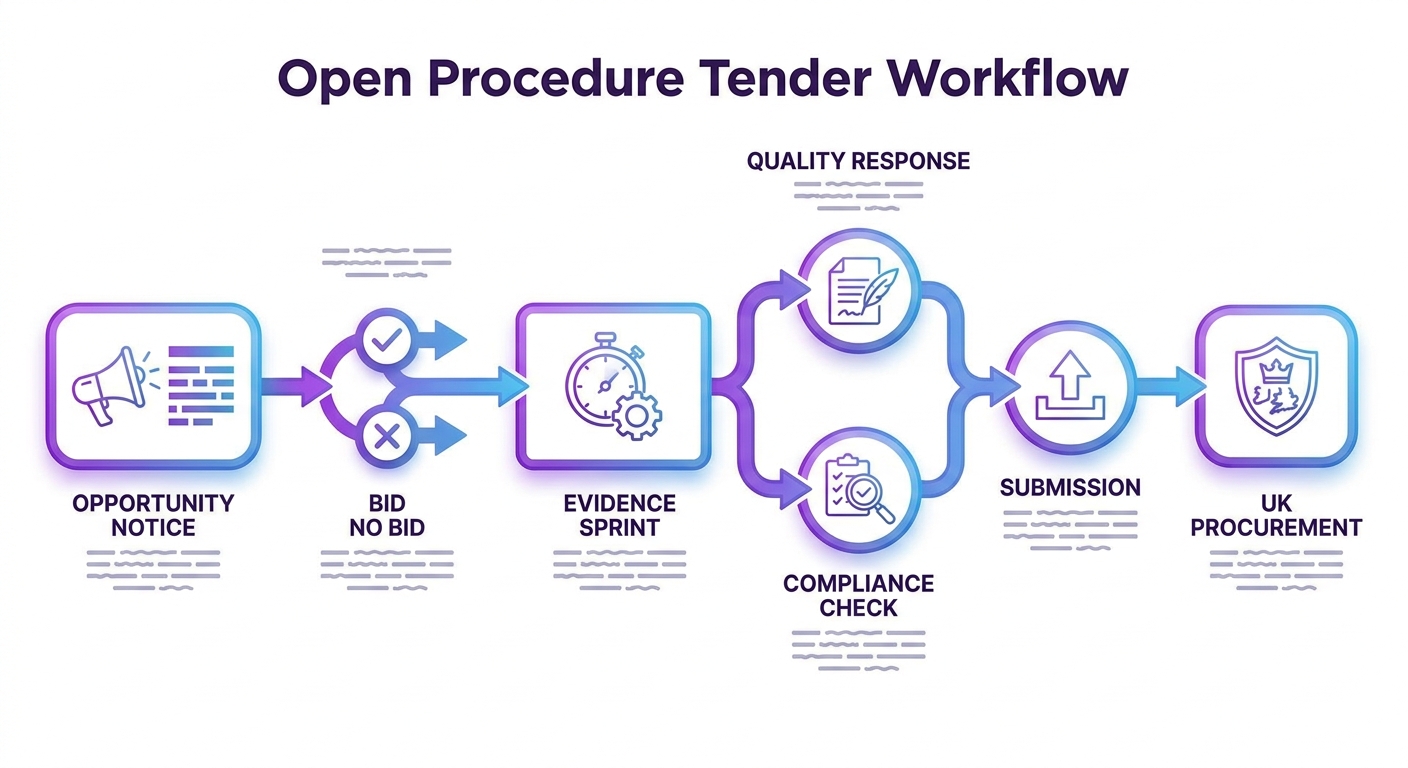
Infographic showing the open procedure workflow from opportunity notice to final submission
The SEO Opportunity: Practical Open Procedure Advice Is Thin
There is plenty of content explaining what an open procedure is.
That is not enough for a bid manager with ten working days, six quality questions, a pricing model, three subcontractors and a finance director asking whether the margin is worth it.
The real search gap is practical:
- how to decide whether to bid an open procedure
- how to organise evidence when there is no PQQ stage
- how to avoid being marked down for generic answers
- how to handle compliance and quality in one sprint
- how to compete when the field is likely to be crowded
That is why this post sits in the win-rate pillar, with a strong bid-capacity angle. Open procedure tendering is not just a procurement route. It is a pressure test for your bid operating system.
The Big Mistake: Treating It Like a Normal Tender With Fewer Stages
The lazy interpretation is this: open procedure equals standard tender, just without a PQQ.
Wrong.
The missing PQQ does not remove qualification work. It compresses it.
A weak open procedure response usually fails in one of five ways:
- the team bids because the contract looks attractive, not because it is winnable
- compliance is checked too late
- evidence is scattered across old bids, SharePoint folders and inboxes
- the quality answers sound capable but not specific
- pricing assumptions are disconnected from the delivery commitments
None of those are writing problems alone. They are process problems.
A good open procedure strategy starts before anyone writes the first answer.
Step One: Make the Bid/No-Bid Call Ruthlessly
Open procedures tempt teams into false optimism.
Because there is no shortlisting stage, it feels like everyone has a shot. Technically, they do. Commercially, they do not.
You need a sharper bid/no-bid screen than usual, not a looser one.
Score the opportunity against five tests:
- Fit: Is the service genuinely in your sweet spot, or are you stretching?
- Evidence: Can you prove recent, relevant delivery without recycling weak examples?
- Capacity: Can you produce a strong response without damaging live bids?
- Price: Can you win at a margin you would still be happy with after mobilisation?
- Incumbent position: Are you displacing someone beatable, or walking into a locked-in rebid?
If you cannot answer those clearly in the first 24 to 48 hours, pause.
That pause is not indecision. It is discipline.
A rushed yes is expensive. An honest no protects the bids you can actually win.
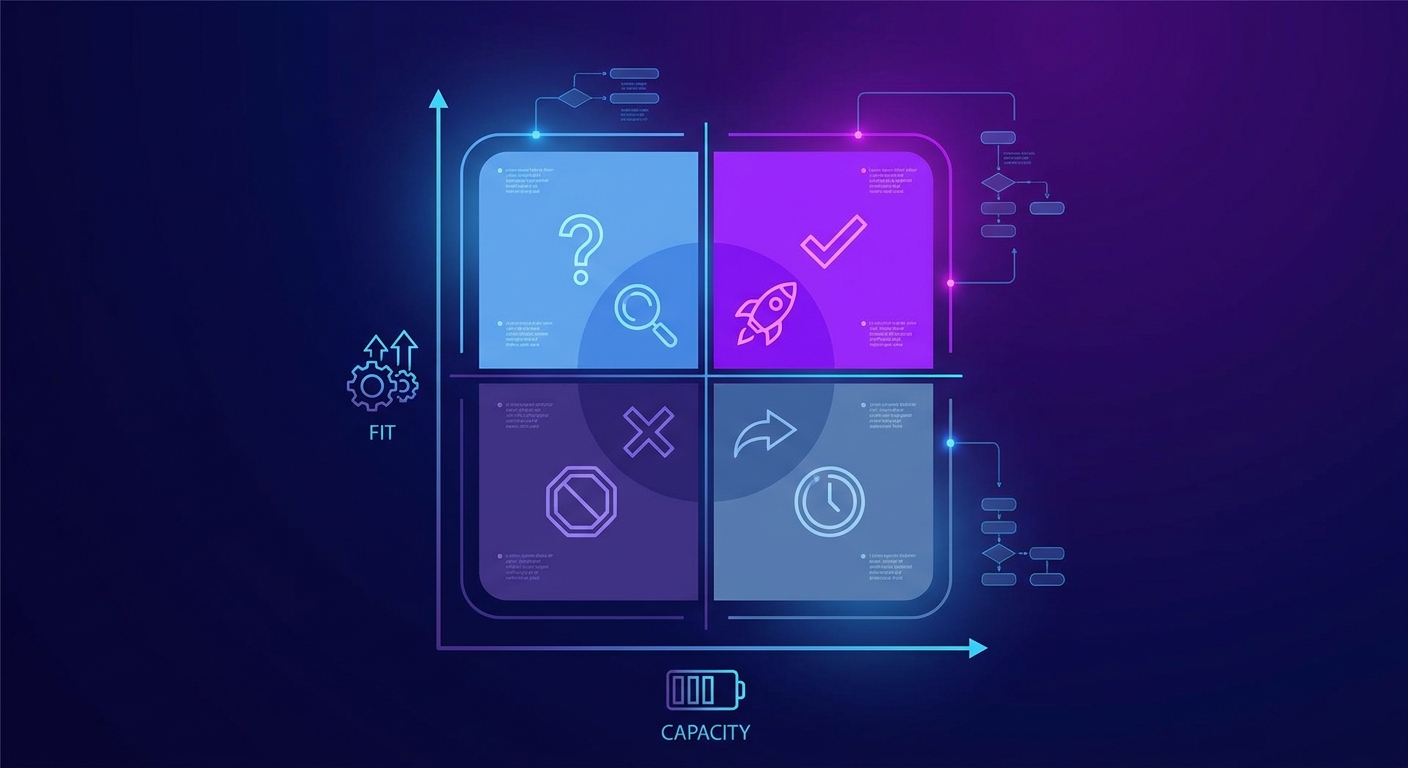
Decision matrix for deciding whether to bid an open procedure tender based on fit and capacity
A Simple Open Procedure Bid/No-Bid Framework
Use a four-box view.
High fit, high capacity
Bid hard. This is the sweet spot.
Assign the response lead, build the answer plan, lock review dates and start evidence gathering immediately.
High fit, low capacity
Bid only if you can narrow the workload.
That might mean reusing approved library content, asking for subject-matter input early, or dropping a weaker opportunity elsewhere. Do not pretend the team can absorb everything. That is how good bids become average.
Low fit, high capacity
Be careful.
Spare capacity is not a reason to chase poor-fit work. If the contract would pull you into a weak geography, unfamiliar service line or bad margin profile, it is probably a no.
Low fit, low capacity
Do not bid.
No heroic exceptions. No “brand visibility” excuse. No “we may as well”. You will not win, and the opportunity cost will be real.
Step Two: Build the Compliance Map Before the Answer Plan
Most teams want to start with the quality questions.
In an open procedure, start with the compliance map.
You need one place that captures every pass/fail item, every scored question, every attachment, every certificate, every declaration, every pricing schedule and every submission portal requirement.
At minimum, map:
- mandatory exclusion and debarment declarations
- financial standing requirements
- insurance levels
- accreditations and certifications
- policies, including modern slavery, health and safety, data protection and equality
- case study requirements
- TUPE or workforce information
- pricing schedules
- word counts and formatting rules
- portal upload limits
- signature requirements
Then assign an owner and deadline to each item.
This sounds basic. It is not. It is where many open procedure bids quietly fail.
A quality response can be excellent and still lose if the submission is non-compliant.
Step Three: Decide the Win Theme Earlier Than Feels Comfortable
Open procedures often attract more bidders. That means evaluators read more answers.
Your response needs a clear reason to choose you.
Not a slogan. A reason.
Good win themes are specific to the buyer, contract and risk profile. For example:
- “Lowest mobilisation risk because we already operate across neighbouring sites with the same service mix.”
- “Best value over the contract term because our maintenance model reduces reactive call-outs, not just day-one cost.”
- “Most credible social value plan because commitments are tied to named local partners and measurable outputs.”
- “Strongest continuity plan because our staffing model protects transferred knowledge and reduces churn.”
A weak win theme says you are experienced.
A strong win theme explains why that experience matters for this buyer.
Once you have it, use it everywhere: executive summary, method statements, case studies, risk register, mobilisation plan and pricing narrative.
Step Four: Turn Evidence Into a System, Not a Scramble
Open procedures punish messy evidence libraries.
If your proof lives in five places, the bid team spends half the deadline finding things and the other half forcing them into the answer. That is a grim way to work.
You need a repeatable evidence system.
For each major bid category, keep ready-to-use evidence blocks:
- client problem
- your solution
- contract scale
- delivery dates
- KPIs and performance outcomes
- named roles and governance
- social value outcomes
- lessons learned
- proof documents or references
Then tag them by sector, service, buyer type, geography and contract size.
This is where a good bid library earns its keep. It does not replace thinking. It gives the team the raw material to think faster.
At mytender.io, we see this pattern constantly: teams do not lack experience. They lack fast access to the evidence that proves it.
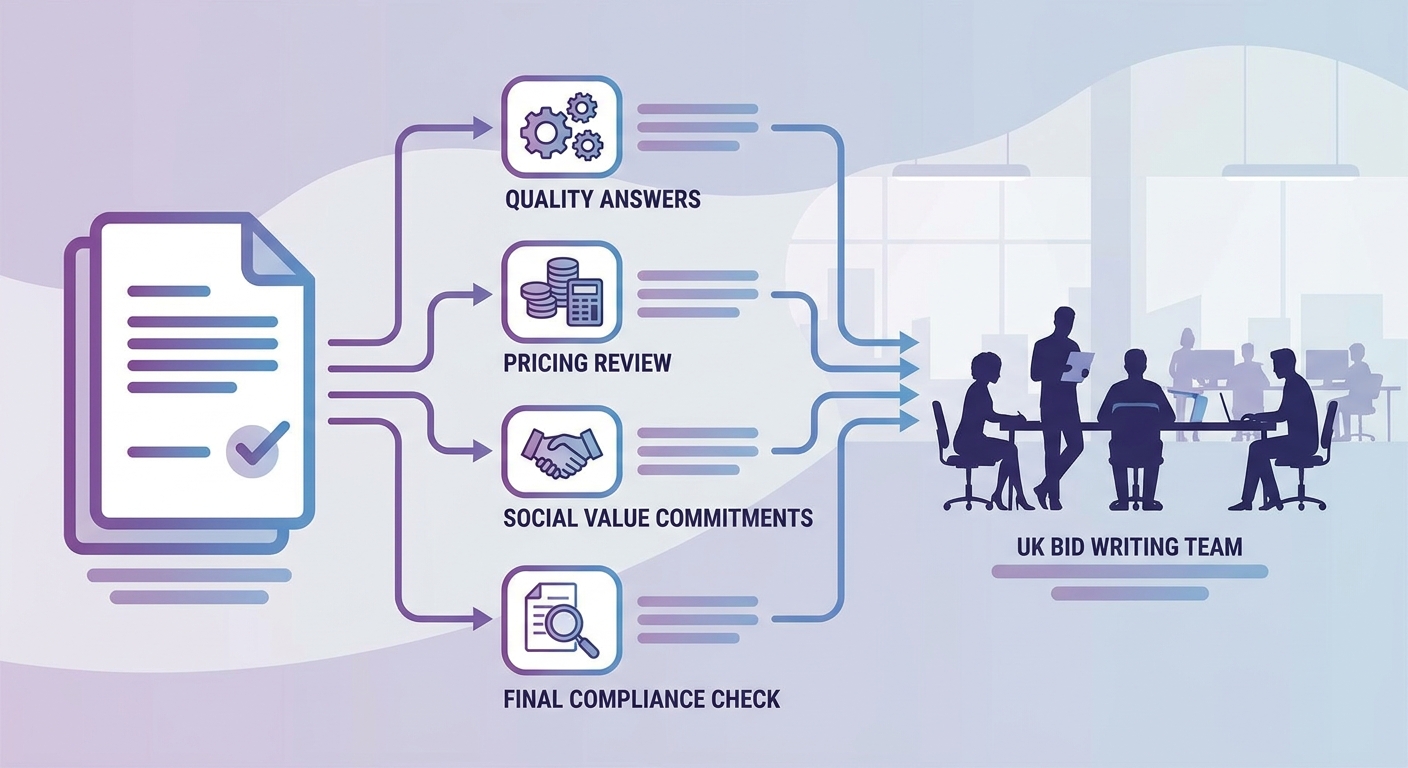
Illustration showing a tender evidence library feeding into quality answers, pricing review and compliance checks
Step Five: Write for a Tired Evaluator
Open procedure evaluators may have a large pile to read.
Do not make them hunt for the point.
A strong answer has a visible structure:
- direct answer to the question
- short explanation of the method
- named evidence from similar work
- delivery controls and ownership
- measurable outcomes
- risk management
- buyer-specific benefit
That structure works because it respects the scoring process.
Evaluators are not marking your brand. They are matching your response against criteria. Help them do that.
Before
“We have extensive experience delivering high-quality services for a wide range of public sector clients. Our established processes ensure successful mobilisation and continuous improvement throughout the contract term.”
After
“For a three-site council FM contract, we would mobilise in four workstreams: people, assets, suppliers and governance. Our mobilisation lead would run a weekly readiness tracker covering TUPE consultation, DBS status, asset verification, subcontractor onboarding and helpdesk testing. We used the same model on a 42-building local authority estate in 2025, reaching 98% planned preventive maintenance compliance by month three.”
The second version gives the evaluator something to score.
Step Six: Connect Quality Commitments to Price
Open procedures often compress commercial and quality thinking into one sprint.
That makes disconnects more likely.
The quality answer promises senior oversight, local employment, faster response times, enhanced reporting, carbon tracking, additional mobilisation support and monthly improvement workshops.
The pricing model quietly assumes a lean team with no room for any of it.
Evaluators may not see every internal assumption, but they can smell inconsistency. Commercial reviewers definitely can.
Before submission, check every major promise against price:
- Have you allowed enough mobilisation resource?
- Are social value commitments costed or genuinely absorbed?
- Do response times match staffing levels?
- Are reporting commitments supported by systems and people?
- Have you priced subcontractor management properly?
- Does the risk register match the commercial assumptions?
A bid that is cheap but unbelievable is not good value. It is a future contract problem.
Step Seven: Use Clarification Questions Properly
In an open procedure, clarification questions are not admin. They are a strategic tool.
Use them to remove ambiguity that affects compliance, price or delivery risk.
Good clarification topics include:
- missing TUPE data
- unclear asset lists
- ambiguous service volumes
- inconsistent site information
- unclear KPI baselines
- contract terms that affect risk pricing
- social value reporting expectations
- whether alternative delivery approaches are acceptable
Do not ask questions that reveal you have not read the documents.
Do not ask for special treatment.
Do ask for the information needed to submit a compliant, fairly priced and deliverable bid.
Step Eight: Treat the Executive Summary as a Scoring Guide
Some bid teams write the executive summary last and treat it as a polite introduction.
That is a waste.
In an open procedure, the executive summary should do three jobs:
- show you understand the buyer’s problem
- state your win theme clearly
- point the evaluator to the proof they will find in the response
Keep it tight. No company history essay.
A useful structure is:
- one paragraph on the buyer’s need
- one paragraph on your proposed solution
- three to five proof points
- one paragraph on delivery confidence
For example:
“Your main risk is not appointing a supplier that can technically deliver the service. It is appointing one that cannot mobilise safely across all sites while protecting service continuity. Our response is built around a controlled 90-day mobilisation, a named transition team and live performance reporting from week one.”
That is better than “We are delighted to submit our response”. Everyone is delighted. Nobody cares.
How Procurement Act Changes Affect Open Procedure Bids
The Procurement Act has changed the wider context around public sector bidding.
For open procedures, three themes matter most.
MAT scoring makes the value case broader
The shift from MEAT to MAT puts more emphasis on the most advantageous tender, not just the lowest compliant price.
That does not mean price is unimportant. It means you need to show why your offer is advantageous in the round: service quality, resilience, social value, deliverability, risk control and public benefit.
Transparency raises the stakes
More notices, more published information and stronger reporting duties mean poor performance can become more visible over time.
Your bid should show how you will manage the contract after award, not just how you will win it.
Exclusion and supplier conduct are harder to ignore
Debarment, payment performance, conflicts and past performance are more visible topics. Bid teams need clean declarations, strong governance and evidence that the organisation is a safe supplier to appoint.
That is not box-ticking. It is trust-building.
Sector Examples: What Good Looks Like
Facilities management
A weak FM answer lists services: cleaning, M&E, helpdesk, security, grounds.
A strong FM answer shows how the operating model will protect continuity across sites.
It explains mobilisation sequencing, TUPE handling, asset validation, CAFM setup, reactive response cover, subcontractor control and reporting cadence. It uses evidence from similar estates, not generic “multi-site experience”.
Construction
A weak construction answer leans on accreditations and project lists.
A strong construction answer connects capability to risk: design coordination, dutyholder competence, supply-chain assurance, programme control, health and safety, quality inspections and change management.
It proves the contractor can deliver under pressure without hiding commercial or safety risk.
Waste and environmental services
A weak waste answer describes vehicles, depots and collection experience.
A strong waste answer evidences route design, mobilisation of crews, contamination reduction, customer communication, missed collection recovery, data reporting and resilience during fleet or staffing disruption.
It shows the council what will happen on Tuesday morning when the service actually starts.
The Review Process That Saves Open Procedure Bids
Do not leave review until the day before submission.
Use three review passes.
Pass one: compliance
Check every requirement is answered, every document attached and every instruction followed.
This should happen early enough to fix gaps.
Pass two: scoreability
Read each quality answer against the scoring criteria.
Ask: if I were the evaluator, what mark would I give this and why?
If the answer lacks evidence, ownership, outcomes or buyer-specific relevance, rewrite it.
Pass three: consistency
Check that quality, price, risk, mobilisation, social value and contract management all tell the same story.
This is where you catch the dangerous contradictions.
A Practical 10-Day Open Procedure Plan
If the deadline is tight, use this rhythm.
Day 1: qualify
Read the documents, run the bid/no-bid screen, identify red flags and decide whether to proceed.
Day 2: map
Build the compliance map, question matrix, evidence list and owner plan.
Days 3 to 5: draft
Write the core quality answers with subject-matter input. Pull evidence as you go, not after.
Day 6: commercial alignment
Review price against delivery commitments. Check assumptions, risk and margin.
Day 7: evidence upgrade
Replace generic claims with case studies, numbers, named controls and outcomes.
Day 8: review
Run compliance and scoreability reviews.
Day 9: final polish
Tighten the writing, check consistency and prepare uploads.
Day 10: submit early
Do not be the team discovering a portal upload limit at 11:42am.
What to Put in Your Bid Library Before the Next Open Procedure Lands
The best time to prepare is before the notice appears.
Build these assets now:
- approved company information and certificates
- live insurance details
- current policies
- case studies by sector and service line
- CVs and role profiles
- mobilisation plans
- contract management model
- risk registers
- social value evidence
- carbon and sustainability evidence
- payment performance and supply-chain governance evidence
- pricing assumption templates
- previous clarification question logs
Keep them current. A stale bid library is almost as bad as no library.
The point is not to paste old answers. The point is to remove avoidable admin so the team can spend time on the judgement calls that win marks.
Common Open Procedure Red Flags
Be especially careful if you see these:
- unusually short deadline for a complex service
- poor or missing TUPE information
- vague volumes or asset data
- heavy social value requirement with no clear scoring method
- contract terms that transfer unmanageable risk
- incumbent-friendly specification
- low price weighting but aggressive affordability pressure
- unclear mobilisation expectations
- portal instructions that conflict with the ITT
A red flag does not always mean no-bid. It does mean you need a plan.
If the plan is “we’ll work it out later”, that is not a plan.
How AI Helps, and Where It Does Not
AI can be genuinely useful in open procedure bids.
It can summarise requirements, build compliance matrices, search your library, draft first-pass answers, compare responses against scoring criteria and spot contradictions.
That saves time.
But AI will not make a poor-fit opportunity winnable. It will not invent credible evidence. It will not fix a price that cannot support the delivery model.
Used well, AI gives bid teams more time for strategy, evidence and judgement. Used lazily, it produces fluent generic answers faster.
There is a big difference.
The Bottom Line
Open procedure tenders reward speed, but not panic.
They reward accessibility, but not wishful thinking.
They reward complete submissions, but the winning bid still needs a clear reason to choose you.
If you do three things well, your odds improve:
- qualify the opportunity ruthlessly
- build the compliance and evidence map early
- write every answer so the evaluator can score it without working hard
That is the practical discipline open procedures demand.
If you want to find live public sector opportunities that match your sector and avoid wasting time on poor-fit tenders, the mytender.io Tender Finder is free to use. It is a useful first filter before the bid/no-bid meeting starts.
Tags
Ready to Transform Your Tender Writing?
See how MyTender's AI can help you write winning tenders in a fraction of the time.