

Most Advantageous Tender (MAT) Guide 2026: Winning Under the New UK Procurement Act
Master the shift from lowest price to Most Advantageous Tender under the UK Procurement Act 2023. Complete guide to MAT evaluation, social value, innovation, and winning strategies for 2026.
Evie
PA & Office Admin at mytender.io
The UK public sector tendering landscape underwent its most significant transformation in decades with the full implementation of the Procurement Act 2023 on 24 February 2025. At the heart of this change lies a fundamental shift in how public contracts are awarded: the move from prioritising the lowest price to selecting the "Most Advantageous Tender" (MAT).
For businesses bidding on public sector contracts in 2026, understanding MAT isn't optional—it's essential. This comprehensive guide explains what MAT means in practice, how evaluation criteria have evolved, and the strategies that win under the new procurement regime.
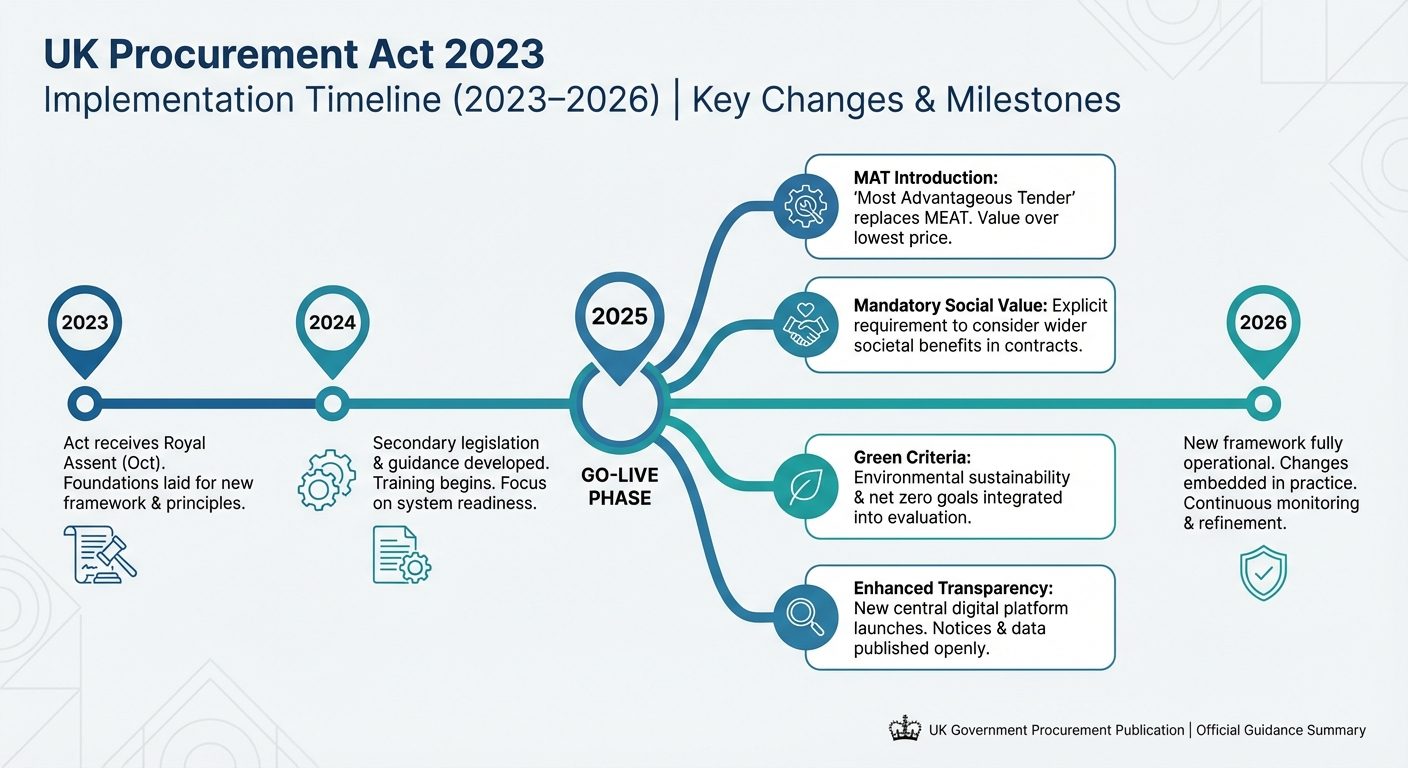
Timeline of UK Procurement Act 2023 implementation showing the shift to Most Advantageous Tender
What Is Most Advantageous Tender (MAT)?
Most Advantageous Tender represents a paradigm shift in public procurement evaluation. Rather than automatically favouring the cheapest bid, contracting authorities must now identify the tender that offers the best overall value when considering multiple factors beyond price.
The Procurement Act 2023 defines MAT as the tender that provides the greatest benefit to the contracting authority, taking into account a range of award criteria that reflect the authority's priorities and the specific nature of the contract. This approach recognises that the lowest price often doesn't deliver the best outcomes for public services or taxpayers.
Under MAT, a £100,000 bid that delivers superior quality, better social value, stronger environmental credentials, and more innovation can—and should—win against a £90,000 bid that only meets minimum requirements. The evaluation framework must be transparent, objective, and disclosed in advance, but it fundamentally changes what "winning" means.
Why the Shift from Lowest Price?
The previous procurement regime, governed primarily by the Public Contracts Regulations 2015, allowed for considerations beyond price but in practice often defaulted to "economically most advantageous tender" (EMAT), which frequently emphasised cost. This led to several systemic problems that MAT aims to address.
Public sector contracts awarded solely on lowest price often resulted in poor quality outcomes. Contractors cutting corners to meet unrealistic price points delivered substandard services, required costly remediation, and sometimes failed completely, necessitating expensive emergency re-procurements. The construction sector, in particular, saw numerous high-profile failures where the cheapest bid led to project collapses, safety issues, and budget overruns that ultimately cost taxpayers far more than selecting a higher-quality, higher-priced contractor would have.
The lowest-price approach also discouraged innovation. Why invest in developing better methodologies, more efficient processes, or cutting-edge solutions if the procurement system only rewards whoever quotes the lowest number? This created a race to the bottom that stifled progress and prevented public services from benefiting from advances that could save money, improve outcomes, or better serve communities over the longer term.
Social value and sustainability goals suffered under price-focused procurement. Local employment opportunities, environmental protections, support for disadvantaged groups, and other broader societal benefits carried minimal weight compared to shaving a few percentage points off the contract price. This misalignment between procurement decisions and wider government policy objectives undermined efforts to address inequality, climate change, and economic development through public spending.
The MAT framework corrects these imbalances by mandating a holistic evaluation that considers the full spectrum of what makes a tender truly advantageous. Price remains important—public bodies must demonstrate value for taxpayers—but it becomes one factor among many rather than the overriding determinant.
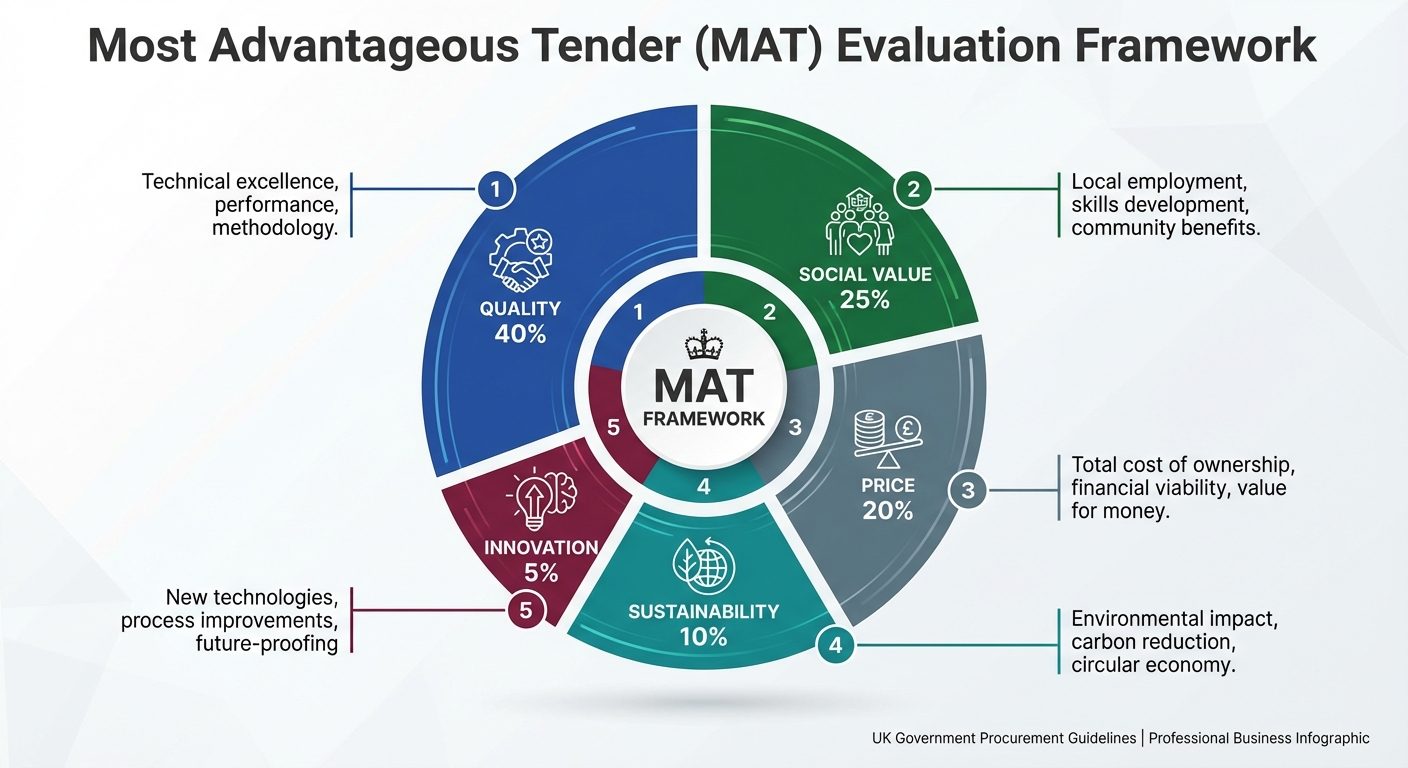
Most Advantageous Tender evaluation framework showing balanced criteria weighting
Core MAT Evaluation Criteria
While each contracting authority has flexibility to tailor evaluation criteria to their specific needs, the Procurement Act 2023 and accompanying statutory guidance establish several core categories that typically feature in MAT assessments.
Quality and technical merit now receive substantially greater weight than under previous regimes. Evaluators examine the robustness of proposed methodologies, the experience and qualifications of key personnel, evidence of past performance on similar contracts, and the credibility of delivery plans. A bidder offering cutting-edge approaches backed by a proven track record will score highly even if their price is premium.
Social value has moved from optional consideration to mandatory requirement. The Social Value Act 2012 already required consideration of social, economic, and environmental benefits, but enforcement was inconsistent. Under MAT, contracting authorities must explicitly evaluate social value commitments and demonstrate how they influenced the award decision. This typically encompasses local employment and training opportunities, support for SMEs and voluntary organisations, initiatives to reduce inequality, community engagement, and broader contributions to regional economic development.
Environmental sustainability and carbon reduction have become central evaluation factors. With the UK government committed to net zero by 2050 and green criteria becoming mandatory in government tenders, successful bids must demonstrate concrete environmental credentials. This includes carbon footprint assessments, circular economy principles, biodiversity protection, sustainable supply chains, and measurable commitments to reducing environmental impact throughout the contract lifecycle.
Innovation and continuous improvement increasingly differentiate winning bids. Contracting authorities want suppliers who will help them evolve and improve, not simply maintain the status quo. Bids should articulate how new technologies, processes, or approaches will deliver better outcomes, how lessons learned will be captured and applied, and what mechanisms exist for ongoing service enhancement. The Act encourages authorities to be more open to innovative solutions that might initially seem higher risk but offer significantly greater long-term benefits.
Value for money remains critical but is interpreted more holistically. Rather than simply comparing quoted prices, evaluators consider total cost of ownership, including maintenance, operational costs, disposal, and the financial implications of quality, reliability, and performance levels. A slightly higher upfront price that delivers lower running costs, fewer defects, and longer asset life represents better value than the superficially cheaper option.
Delivery confidence and risk management receive enhanced attention. Public authorities want assurance that contractors will deliver on their promises. Evaluation criteria therefore examine financial stability, business continuity plans, risk mitigation strategies, contract management approaches, and contingency arrangements. Recent high-profile contract failures have made contracting authorities more risk-aware, and MAT frameworks reflect this through explicit assessment of bidder robustness and resilience.
MAT Weighting and Scoring Models
Understanding how contracting authorities weight different criteria is crucial to crafting a winning bid. While weightings vary by contract type and authority priorities, certain patterns are emerging in 2026 MAT evaluations.
A typical complex services contract might allocate 40% to quality and technical capability, 30% to price, 20% to social value and sustainability, and 10% to innovation and added value. This contrasts sharply with pre-MAT procurements where price might have accounted for 60-70% of the total score.
For construction and infrastructure projects, weightings often shift to reflect the sector's challenges with quality and safety. Quality and methodology might receive 35%, social value and local economic benefit 25%, price 25%, sustainability and environmental impact 10%, and innovation 5%. These weightings recognise that in construction, getting the methodology and quality right from the start prevents costly failures and delays.
Professional services and consultancy contracts typically emphasise expertise and approach over price. A common model allocates 50% to quality (methodology, team expertise, understanding of requirements), 25% to social value and EDI (equality, diversity, inclusion), 20% to price, and 5% to innovation. The higher quality weighting reflects that the value of professional services lies primarily in the knowledge and capability of the people delivering them.
Technology and digital transformation procurements increasingly prioritise innovation and long-term value. Weightings might be 30% technical solution and architecture, 25% implementation approach and change management, 20% price, 15% social value, and 10% innovation and future-proofing. These procurements recognise that technology decisions have long-term implications and that getting the solution right matters more than initial cost.
Scoring within each criterion typically follows a 0-5 or 0-10 scale with defined descriptors. A quality score might use: 0 (unacceptable - fails to meet minimum requirements), 1-2 (poor - significant weaknesses), 3-4 (acceptable - meets requirements with some minor issues), 5-6 (good - meets requirements with some strengths), 7-8 (very good - exceeds requirements in several areas), and 9-10 (excellent - comprehensively exceeds requirements with innovative approaches). Understanding these scoring thresholds helps bidders calibrate their responses appropriately.
Some authorities employ more sophisticated scoring methodologies, such as comparative assessment where bidders are scored relative to one another rather than against absolute standards, or threshold-based approaches where certain criteria must achieve minimum scores before a bid can be considered. The procurement documents should clearly explain the scoring model—read them carefully and structure responses accordingly.
Social Value Under MAT: What Really Matters
Social value has transformed from a theoretical consideration to a practical requirement with teeth. The Procurement Act 2023 requires contracting authorities to "have regard to" the importance of improving economic, social, and environmental wellbeing, and this translates into explicit evaluation criteria in MAT frameworks.
Effective social value commitments must be specific, measurable, achievable, relevant, and time-bound (SMART). Vague promises like "we will support the local community" score poorly. Winning bids commit to concrete outcomes: "We will employ 12 local apprentices within the first six months of contract mobilisation, with at least 40% from backgrounds currently underrepresented in the sector, and provide them with Level 3 qualifications paid for through the contract."
Local economic benefit features prominently. Contracting authorities want to see money circulating in their regions, supporting local employment, and building local supply chains. Successful bids demonstrate how contract spend will flow to local businesses, how many local jobs will be created (distinguishing between new roles and existing team members), what skill levels these jobs represent, and how local content will be maximised while maintaining quality and value.
Employment and skills development extends beyond simply hiring locally. Authorities value commitments to apprenticeships, work experience placements, training programmes, upskilling existing workforce, support for career progression, and pathways from unemployment or education into sustainable employment. The National TOMs (Themes, Outcomes, and Measures) framework, developed by the Social Value Portal, provides standardised metrics that many authorities now use to evaluate and compare social value commitments.
Support for disadvantaged groups demonstrates corporate responsibility and alignment with equality objectives. This might include commitments to employ or subcontract with organisations supporting long-term unemployed individuals, care leavers, ex-offenders, disabled people, or other marginalised groups. However, these commitments must be genuine and evidenced—authorities can request proof of delivery and may include social value KPIs in contract performance management.
Community engagement and investment show long-term commitment to place. Winning bids might commit to volunteering hours for local charities, in-kind support for community organisations, educational programmes in local schools, participation in local events, or infrastructure improvements that benefit residents beyond the contract's direct scope. The key is ensuring these activities are material, sustained, and aligned with local priorities rather than tokenistic corporate social responsibility exercises.
Environmental and climate action forms an increasingly important component of social value. Beyond the environmental sustainability criteria evaluated separately, social value sections often assess broader community environmental benefits: tree planting schemes, habitat restoration, community renewable energy projects, environmental education programmes, or initiatives that improve local environmental quality. With climate change a pressing concern for communities across the UK, these commitments resonate strongly with evaluators.
Measuring and reporting social value matters as much as delivering it. Winning bids include robust measurement frameworks, clear reporting mechanisms, and commitment to independent verification. Many authorities now require regular social value reports as part of contract management, with performance linked to payment mechanisms or contract extensions. Demonstrate that you have the systems, processes, and commitment to track and evidence your social value delivery.
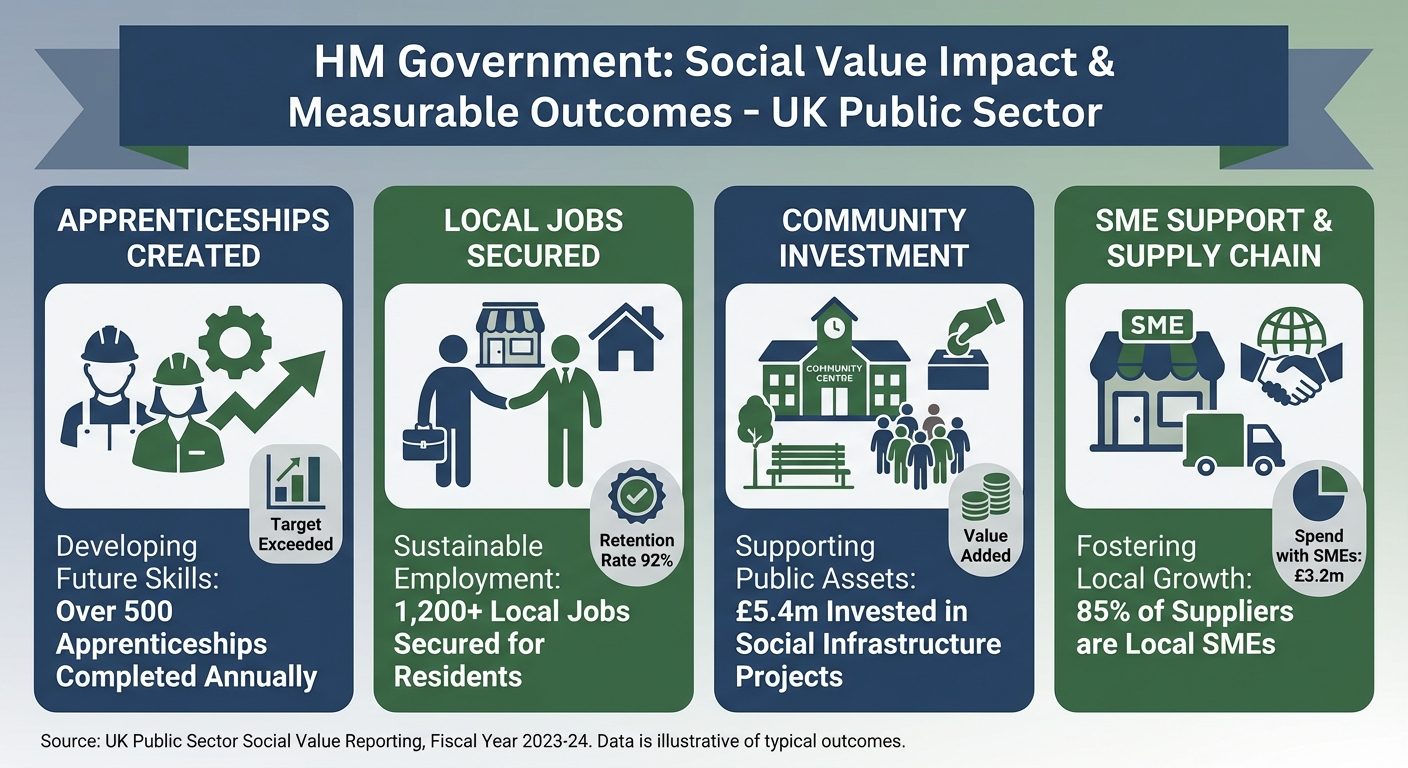
Social value impact metrics showing measurable community outcomes
Innovation and Added Value Strategies
Innovation criteria in MAT evaluations reward suppliers who help public services evolve and improve. However, innovation doesn't mean proposing untested, risky experiments. Successful innovative approaches balance novelty with pragmatism, clearly articulating benefits and managing risks.
Process innovation often scores more highly than technological innovation. A radically new approach to service delivery that demonstrably improves efficiency, user experience, or outcomes can be more valuable than deploying the latest technology if that technology doesn't address core challenges. Consider how established processes could be redesigned using human-centred design principles, lean methodology, or insights from behavioural science.
Proven innovation in other contexts carries less risk than entirely novel concepts. If you've successfully implemented an innovative approach for private sector clients or in other regions, that track record provides confidence. Frame it as "proven innovation, new to public sector" rather than "completely untested experiment." Evidence the benefits achieved elsewhere and explain how you'll adapt the approach for the specific context of the tender.
Co-design and collaboration demonstrate innovative thinking about service delivery models. Proposals that involve users, frontline staff, and communities in shaping the service rather than imposing top-down solutions align with modern public service philosophy. Outline participatory approaches, user research methodologies, iterative development cycles, and feedback mechanisms that ensure the service evolves to meet genuine needs.
Digital innovation must focus on user benefit, not technology for its own sake. Proposing cutting-edge AI, blockchain, or other trendy technologies without clearly linking them to improved outcomes and user experience will score poorly. Instead, demonstrate deep understanding of user needs (especially digitally excluded or vulnerable users), explain how technology choices address specific pain points, and show how digital solutions integrate with human support to create inclusive services.
Sustainability innovation addresses both environmental performance and long-term viability. This might include circular economy principles that eliminate waste, nature-based solutions that deliver multiple benefits, community wealth building models that keep value local, or innovative financing that reduces public sector cost while delivering better outcomes. Frame these innovations in terms of value creation and risk reduction, not just environmental credentials.
Continuous improvement mechanisms show commitment to ongoing innovation throughout the contract. Describe how you'll identify improvement opportunities, test and implement enhancements, measure impact, and share learning. Innovative contract structures like gainshare arrangements, where efficiency savings are split between contractor and authority, align incentives for continuous improvement.
Quantify the value of innovation wherever possible. "This innovative approach will reduce processing time by 35%, improving user experience and freeing up £200,000 annually for investment in frontline services" is far more compelling than "We will take an innovative approach." Link innovation to the outcomes the authority cares about: cost savings, better service quality, reduced carbon emissions, improved user satisfaction, or enhanced social value.
Environmental Sustainability Requirements
Environmental criteria in MAT evaluations have moved from aspirational to mandatory. With green criteria becoming standard in government tenders and net zero targets driving policy, successful bids must demonstrate genuine environmental commitment backed by credible evidence.
Carbon accounting and reduction targets form the baseline expectation. Authorities increasingly require bidders to calculate the carbon footprint of their proposed delivery, identify reduction opportunities, and commit to measurable reductions over the contract period. This requires Scope 1 (direct emissions), Scope 2 (purchased energy), and increasingly Scope 3 (supply chain and indirect emissions) assessments using recognised methodologies like the Greenhouse Gas Protocol.
Successful bids don't simply report their baseline carbon footprint—they articulate a credible pathway to reduction. This might include transitioning to electric or hydrogen vehicles, sourcing renewable energy, optimising logistics to reduce transport miles, specifying low-carbon materials, engaging supply chains on carbon reduction, and offsetting residual emissions through certified schemes. Authorities want to see year-on-year reduction trajectories, not one-off gestures.
Circular economy principles demonstrate sophisticated environmental thinking. Rather than the linear "take-make-dispose" model, circular approaches design out waste, keep materials in use, and regenerate natural systems. For product-based contracts, this means considering product longevity, repairability, recyclability, and take-back schemes. For services, it means minimising resource consumption, reusing and repurposing materials, and closing resource loops.
Biodiversity and nature-based solutions receive increasing attention. Contracts that involve land use, construction, grounds maintenance, or significant environmental footprint should address biodiversity impacts. Winning bids demonstrate biodiversity net gain (now a legal requirement for development), habitat creation or enhancement, protection of important species and ecosystems, and where appropriate, nature-based solutions that deliver multiple benefits like natural flood management or urban cooling.
Supply chain environmental standards extend responsibility beyond the immediate contractor. Authorities recognise that Scope 3 emissions and environmental impacts in supply chains often dwarf the contractor's direct footprint. Demonstrate how you'll engage suppliers on environmental performance, require environmental standards in subcontracting, support SMEs in improving their environmental credentials, and trace environmental impact through complex supply chains.
Environmental management systems and certification provide assurance of competent environmental management. ISO 14001 certification, carbon reduction commitments validated by the Science Based Targets initiative, or sector-specific environmental standards demonstrate systematic, audited approaches to environmental management. While certification isn't always required, it provides credibility that supports high environmental criterion scores.
Measuring and reporting environmental performance throughout the contract lifecycle ensures accountability. Specify environmental KPIs, measurement methodologies, reporting frequency, and verification approaches. Increasingly, authorities link environmental performance to payment mechanisms—delivering on environmental commitments isn't optional once the contract is won.
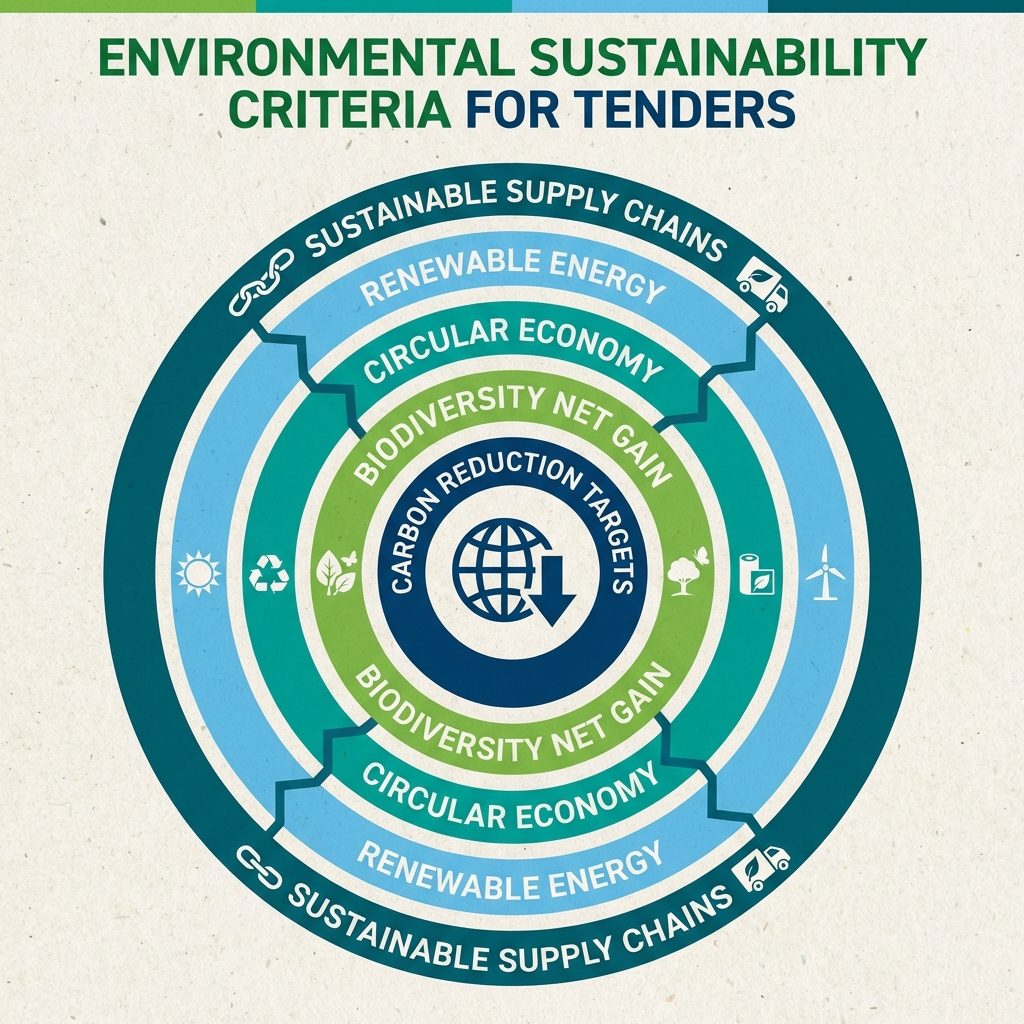
Environmental sustainability criteria framework for tender evaluation
Quality and Technical Excellence
Quality criteria typically receive the highest weighting in MAT frameworks, reflecting the emphasis on best value over lowest price. Demonstrating quality and technical excellence requires more than generic claims of competence—it demands evidence, specificity, and deep understanding of the requirement.
Methodology and approach form the core of quality evaluation. Evaluators want to understand exactly how you will deliver the requirement, not just that you can. A winning methodology section breaks down the requirement into component parts, explains the approach to each part, describes how components integrate into a coherent whole, identifies risks and dependencies, and articulates quality control mechanisms at each stage. Use process diagrams, flowcharts, and visual aids to make complex methodologies comprehensible.
Relevant experience provides confidence in your ability to deliver. However, simply listing previous contracts achieves little. Instead, describe contracts of similar scale, complexity, and context, explain specific challenges encountered and how they were overcome, evidence outcomes achieved with quantified results, and draw clear parallels between the experience described and the specific tender requirements. Evaluators want to see that you've successfully navigated situations like the one they're procuring.
Team competence and capability receive close scrutiny. CVs and organisational charts demonstrate who will work on the contract, but winning submissions go further. Explain why specific individuals are assigned to particular roles based on their experience and skills, describe team structure and communication pathways, identify the decision-making authority and escalation process, evidence team members' relevant qualifications and certifications, and explain resource allocation and how you'll maintain service continuity despite holidays, illness, or staff turnover.
Quality assurance and control mechanisms demonstrate systematic attention to excellence. Describe your quality management system (QMS), explain how quality standards will be defined and communicated, outline inspection and testing regimes, articulate how non-conformances will be identified and corrected, describe continuous improvement processes, and evidence your track record of maintaining quality standards. If you hold quality certifications like ISO 9001, explain how the certified QMS will be applied to this specific contract.
Risk management demonstrates mature understanding of what could go wrong and how you'll prevent or mitigate it. Identify key risks to successful delivery (be realistic—pretending no risks exist undermines credibility), assess likelihood and impact of each risk, articulate mitigation measures that reduce probability or severity, describe contingency plans if risks materialise, and explain governance arrangements for monitoring and managing risk throughout the contract. Authorities value contractors who anticipate problems and have plans to deal with them over those who promise everything will go smoothly.
Mobilisation planning shows you've thought through the critical transition from bid to live service. Describe the mobilisation timeline and key milestones, explain how you'll establish governance and operational structures, articulate stakeholder engagement and communication during mobilisation, identify mobilisation risks and mitigation strategies, and demonstrate how you'll ensure service continuity and minimise disruption during transition. Poor mobilisation jeopardises the entire contract—demonstrating a robust mobilisation plan provides important assurance.
Price and Value for Money
While MAT de-emphasises price compared to previous regimes, it remains a significant evaluation factor. The key is demonstrating value for money in a holistic sense—not just a low number, but credible costing that represents genuine value when considered alongside quality, social value, sustainability, and innovation.
Transparent and comprehensive pricing builds confidence. Break costs down into labour, materials, overhead, profit margin, and risk allowance. Explain the basis for key cost assumptions and rates. Identify any costs that are variable or subject to adjustment mechanisms. Distinguish between one-off costs (mobilisation, capital investment) and ongoing costs (service delivery, maintenance). Evaluators are suspicious of inexplicably low prices that appear unrealistic or unsustainable—detailed cost breakdowns address these concerns.
Total cost of ownership provides a fuller picture than upfront price. For contracts involving equipment, technology, or infrastructure, consider acquisition cost, installation and commissioning, operation and maintenance, consumables and utilities, training and support, and eventual disposal or replacement. A higher capital cost with lower running costs may deliver better value than a cheaper initial price with expensive ongoing costs.
Risk pricing requires careful judgment. Price risk too conservatively and you may be uncompetitive; price it too aggressively and you're committing to deliver for a sum that might prove insufficient, damaging both your profitability and your ability to maintain quality. Clearly identify the risks you've priced for, explain the methodology used to price risk, and describe the management approach that will keep costs within budget.
Innovative pricing models can enhance competitiveness. Gainshare arrangements where efficiency savings are split between contractor and authority align incentives and demonstrate confidence in your ability to improve performance. Outcomes-based pricing links payment to results achieved rather than inputs provided, though it requires robust measurement and both parties accepting performance risk. Social value reinvestment mechanisms that direct a percentage of profit to social value activities can enhance that evaluation criterion while demonstrating values alignment.
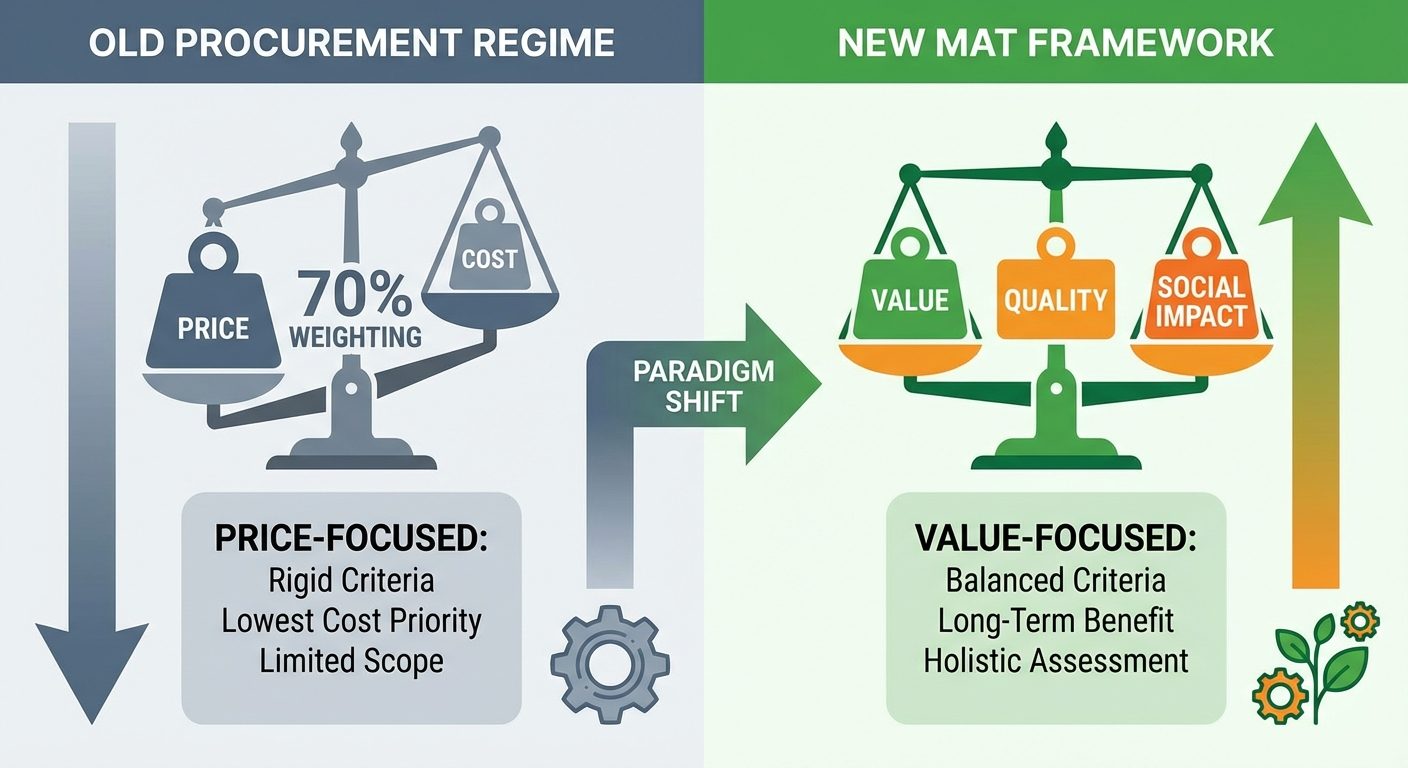
Comparison of old price-focused regime versus new MAT value-focused framework
Price competitiveness must be balanced with sustainability. If your price is significantly below the authority's budget or other bidders' prices, be prepared to justify it. Extremely low prices raise concerns about financial viability, whether quality will be compromised, if staff will be paid fairly, or if the bid is based on unrealistic assumptions. A price that's competitive but credible—sitting perhaps 10-15% below budget rather than 40% below—often scores better than the absolute lowest.
Common MAT Pitfalls to Avoid
Even experienced bidders make mistakes when adapting to the MAT framework. Avoiding these common pitfalls improves your chances of success significantly.
Recycling price-focused bids for MAT evaluations consistently fails. If your bid reads like one written for the old regime, with minimal attention to social value, sustainability, and innovation, evaluators will notice. MAT requires fundamentally different responses that foreground value across multiple dimensions, not just competitive pricing. Tailor every response specifically for the MAT criteria and weightings disclosed in the tender documents.
Vague social value commitments without concrete KPIs and measurement mechanisms score poorly. Evaluators can distinguish between genuine commitment and box-ticking. If you claim to deliver social value but provide no detail on what, how, how much, when, or how it will be measured, you'll receive low scores in social value criteria that may account for 20-25% of total evaluation. Invest time in developing specific, measurable, resourced social value programmes that demonstrably align with local authority priorities.
Underestimating the importance of contract-specific tailoring leads to generic responses. Every reference to "the client," "the requirement," "the service," or "the contract" should be specific. Use the authority's name. Quote from their strategic documents. Reference local context and priorities. Demonstrate that this response was written specifically for this tender, not adapted from a template. Evaluators reading dozens of bids notice and reward specificity.
Failing to evidence claims with data and case studies weakens credibility. Every assertion about your capabilities, experience, or proposed approach should be backed by evidence. If you claim excellent quality performance, cite customer satisfaction scores, complaint rates, or audit results. If you propose an innovative methodology, provide a case study showing where it's worked before. Evidence transforms claims into persuasive arguments.
Ignoring the scoring model and weighting undermines strategic bidding. If quality accounts for 40% of evaluation and price 30%, your bid should reflect that balance. Spending 70% of effort on price and 30% on quality mis-allocates resources. Similarly, understand scoring thresholds—if "acceptable" scores 5/10 and "good" scores 7/10, ensure every response achieves at least "good" standard on the stated criteria. A scattering of excellent, acceptable, and poor responses often scores lower than consistent good performance across all criteria.
Poor presentation and lack of structure makes high-quality content inaccessible to evaluators. Time-pressured evaluators reading dozens of bids won't wade through dense paragraphs hunting for key information. Structure responses with clear headings matching evaluation criteria, use bullet points for clarity, include executive summaries for long sections, employ diagrams and visuals to convey complex information, and use clear, professional formatting. Excellent content poorly presented scores lower than good content well presented.
Building a Winning MAT Strategy
Success under the MAT framework requires strategic thinking before you start writing. A clear bid strategy aligned with the evaluation criteria and weightings dramatically improves win probability.
Begin with thorough evaluation criteria analysis. Map every criterion, sub-criterion, and question in the tender documents. Note the weighting for each. Identify where most points are available. Understand the scoring model and what constitutes excellent, good, acceptable, and poor responses. This analysis reveals where to focus effort and what standard each response must achieve.
Assess your competitive positioning honestly. Where are your genuine strengths relative to likely competitors? What compelling differentiators can you evidence? Which evaluation criteria play to your strengths, and which expose weaknesses? Successful bid strategy emphasises your strengths while ensuring adequate performance across all criteria. If a competitor has stronger sustainability credentials but you excel on innovation and local presence, your strategy should maximise innovation and local benefit scoring while ensuring sustainability responses meet acceptability thresholds.
Develop specific win themes that resonate with the authority's priorities. Win themes are the core messages that differentiate your bid and align with what the authority values. For example, "local partner with deep regional relationships," "proven innovator in service transformation," "sustainability leader with verified net zero commitment," or "quality specialist with zero service failures." These themes should thread through your entire response, reinforcing your positioning.
Align resources with evaluation weightings. If social value represents 20% of marks, allocate roughly 20% of bid development resource to crafting an excellent social value response. This might mean involving different team members—your commercial team leads pricing, operational experts lead methodology, and your CSR manager leads social value rather than leaving the bid writer to cover everything. Specialist input dramatically improves response quality in technical and specialist areas.
Engage stakeholders early and throughout. Social value commitments benefit from discussions with local employment agencies, training providers, community organisations, and SMEs who might join your supply chain. Environmental commitments should involve your sustainability team and supply chain partners. Innovation proposals might need input from R&D, digital specialists, or external partners. Early engagement ensures commitments are realistic and resourced, not just bid candy that will prove undeliverable.
Test and iterate responses before submission. Develop initial drafts well before deadline to allow time for review, feedback, and improvement. Use internal reviews with people unfamiliar with the bid to identify unclear or unconvincing content. Score your own bid against the evaluation criteria—would an evaluator reading your response objectively award high marks? Be honest, and improve until the answer is yes.
Technology and Tools for MAT Bidding
The complexity of MAT evaluations, combined with increasingly tight timelines, makes technology support valuable for efficient bid development and quality responses.
Bid management platforms provide structure and collaboration features. Tools like SharePoint, Qorus, RFPIO, or similar platforms help manage bid timelines, allocate responsibilities, track progress, version control, and enable collaborative writing. For organisations responding to frequent tenders, investing in bid management technology improves efficiency and quality.
AI-powered writing assistance, when used appropriately, can improve response quality and efficiency. Modern AI tools like mytender.io specialise in tender writing, helping structure responses, identify evaluation criteria, suggest relevant experience and case studies from your database, check compliance with requirements, analyse competitors and differentiate positioning, and ensure responses directly address questions asked. However, AI is a tool to augment human expertise, not replace it—final content must be reviewed, refined, and validated by skilled professionals.
Carbon accounting tools support environmental criteria responses. Calculating Scope 1, 2, and 3 emissions requires specialised knowledge and data. Tools like the Carbon Trust's calculator, Planet Mark, or industry-specific tools help produce credible carbon assessments that support environmental scoring. Without this data, environmental responses remain generic and score poorly.
Social value measurement frameworks like the National TOMs provide standardised metrics that evaluators understand and can compare across bids. Using recognised frameworks rather than inventing your own social value measures provides credibility and enables apples-to-apples comparison with competitors' social value offers.
Collaboration and communication tools ensure dispersed teams can contribute effectively. Bid development often involves subject matter experts across multiple locations and organisations. Video conferencing, instant messaging, shared document editing, and project management tools ensure everyone can contribute despite geographical dispersion.
Conclusion: Thriving Under the MAT Framework
The shift to Most Advantageous Tender evaluation under the Procurement Act 2023 fundamentally changes what winning looks like in UK public sector procurement. Success requires moving beyond price competition to demonstrate comprehensive value across quality, social value, sustainability, innovation, and long-term delivery confidence.
For organisations willing to invest in developing strong MAT capabilities—understanding evaluation frameworks, building genuine social value and sustainability programmes, fostering innovation, and evidencing quality and delivery confidence—the new regime creates opportunities to differentiate and win based on real value rather than price alone. The lowest price no longer wins by default, creating space for organisations delivering superior outcomes, supporting communities, protecting the environment, and bringing innovation to win the recognition and contracts they deserve.
The key to MAT success lies in authenticity. Contracting authorities are sophisticated evaluators who can distinguish genuine commitment from superficial box-ticking. Build social value, sustainability, quality, and innovation into your organisation's DNA rather than treating them as procurement add-ons. Measure, evidence, and continuously improve performance against these dimensions. When MAT evaluation criteria assess these factors, you'll have genuine capability and track record to evidence, not just aspirational commitments.
As we progress through 2026 and beyond, expect MAT frameworks to evolve further, with potentially greater emphasis on outcomes over inputs, increased data-driven performance evaluation, stronger links between procurement and broader policy goals, and more sophisticated value assessment methodologies. Organisations that embrace the spirit of MAT—genuinely delivering best value across multiple dimensions—will thrive in this new procurement landscape.
Tags
Ready to Transform Your Tender Writing?
See how MyTender's AI can help you write winning tenders in a fraction of the time.