
Writing a Mobilisation Plan That Actually Convinces Evaluators
A practical, evaluator-facing guide to writing the mobilisation plan section of an FM tender. What scoring panels actually look for, the five phases your plan must cover, the mistakes that cost marks, and how to write each section so it earns the score you need.
mytender.io Research Team
Tender Writing & Bid Management Specialists
Writing a Mobilisation Plan That Actually Convinces Evaluators
Picture the evaluator. They are at their desk on a Wednesday afternoon with seven bids printed out, two coffees in, and your mobilisation plan section open in front of them. They have eight minutes before the next one.
They are not reading for pleasure. They are looking for specific things on a scoresheet, and they are tired of generic answers.
That is the audience your mobilisation plan has to land with. Not a procurement theorist. A real person, scoring against criteria, who has read 30 versions of the same section before lunch.
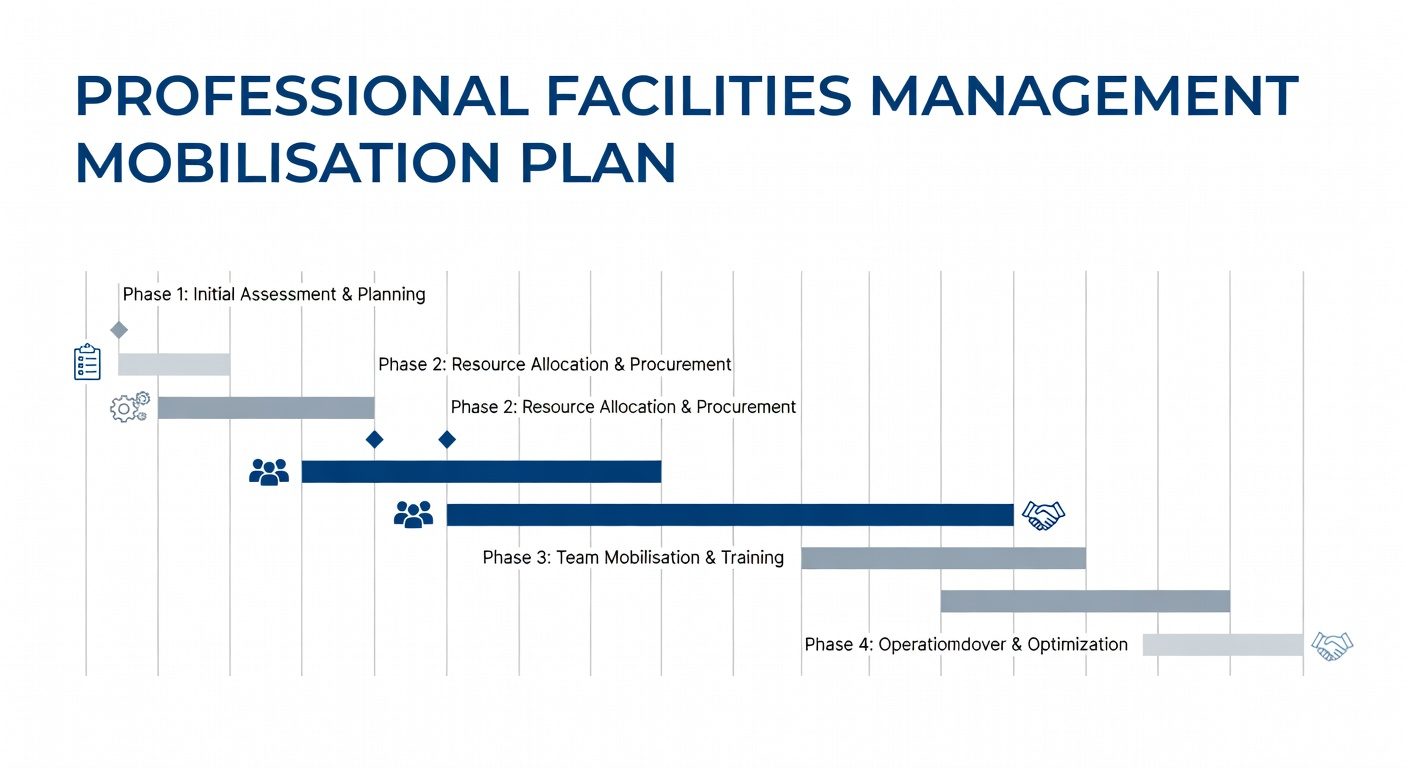
Professional facilities management mobilisation plan document with Gantt chart timeline
This guide is for the FM bid manager writing this section right now. It covers what evaluators actually score, the five phases your plan needs to address, the mistakes that quietly cost you marks, and how to structure each part of the answer so it lands.
What Evaluators Actually Want From a Mobilisation Plan
The brief from the buyer usually says something bland: "describe your approach to mobilising this contract within the specified timescale." The scoresheet behind it is more specific.
In most FM tenders, evaluators are scoring four things, sometimes weighted, sometimes wrapped into a single mark:
- Have you understood this contract, not mobilisation in general?
- Is your timeline credible, dated, and owned by named people?
- Have you identified the right risks and shown how you will mitigate them?
- Will the steady-state service look the way the buyer expects on day one?
The bids that score high answer all four. The bids that score badly tend to nail one or two and skim the rest.
The evaluator is not impressed by generic project management language. They are impressed by evidence you have already thought about their site, their workforce, and their operational pressure points. If your plan could be lifted into a different tender by changing the client name, it scores 60. If it could not, it scores 80 or above.
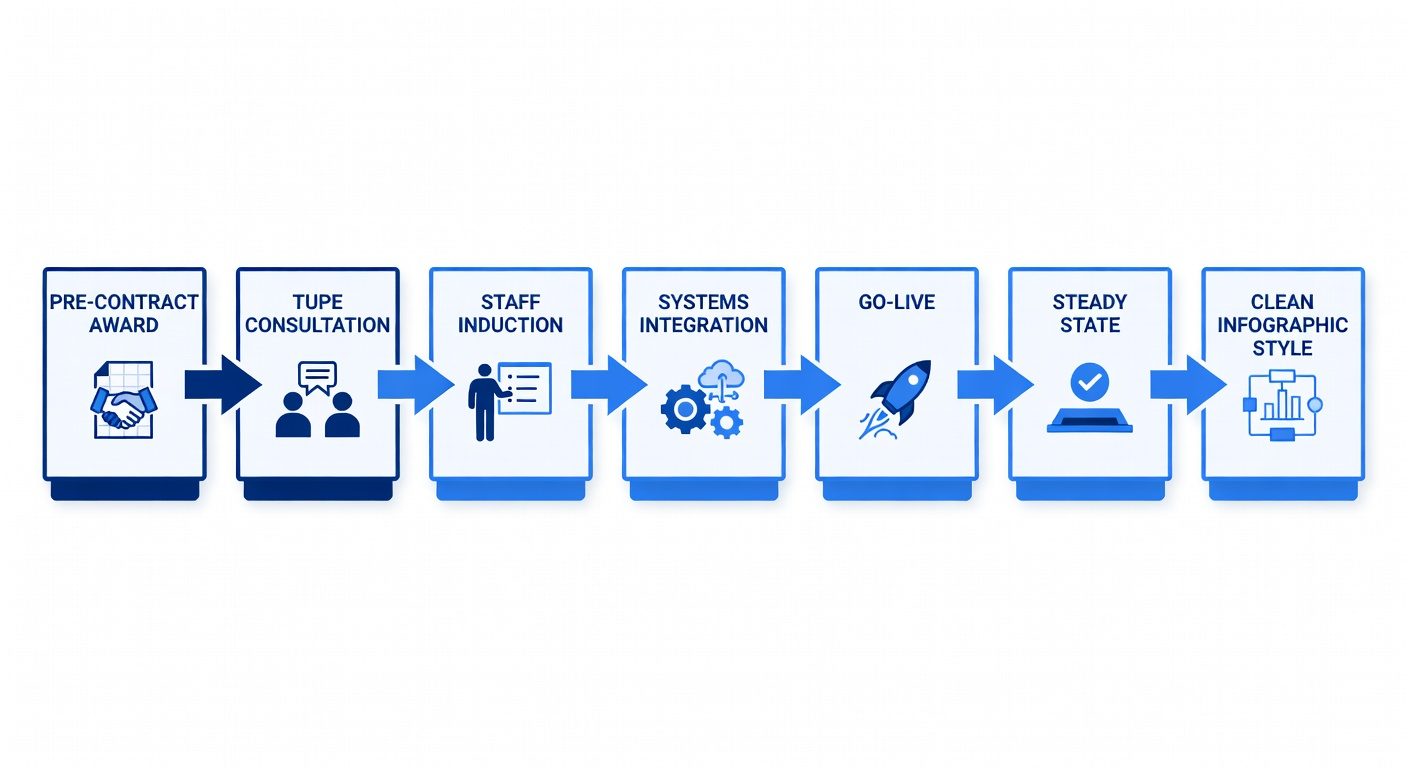
Mobilisation plan phases flowchart showing pre-contract through steady state
The Five Phases Your Plan Must Cover
Most FM mobilisation plans break down into five phases. You do not have to call them this, but the evaluator will be looking for all five whether you label them or not.
Phase 1: Pre-Contract Award (Bid Submission to Day 0)
The work you do in the bid window so that day one is not a scramble. Standing up the mobilisation team. Drafting communications. Pre-engaging supply chain partners on a contingent basis. Getting NDAs in place so the buyer can share employee liability information promptly.
Most bids skip this phase entirely. They start the timeline at contract award. That is a mistake. Buyers like seeing that you are already moving before the ink dries.
Phase 2: TUPE Consultation and Workforce Planning (Weeks 1 to 4)
This is the make-or-break phase for soft FM contracts. Receipt of full ELI, validation of pay and pension data, election of employee representatives, formal Section 188 consultation if you are proposing measures, individual transfer meetings.
The evaluator wants dates, named HR leads, and an honest acknowledgement that timelines compress if ELI arrives late. If you do not mention ELI quality at all, the panel assumes you have not thought about it. (See our TUPE in FM tenders guide for the detail on this phase.)
Phase 3: Recruitment, Induction and Training (Weeks 2 to 8)
Filling any gaps the TUPE list does not cover. Inducting transferring staff into your systems, uniforms, ID badges, mandatory training (safeguarding, manual handling, COSHH, fire warden refreshers). Site familiarisation walkovers with the incumbent where possible.
Be specific. "We will induct 47 transferring colleagues across three two-day sessions in weeks 5 and 6, run from the on-site training room, with attendance tracked through our LMS" beats "we will deliver comprehensive induction training."
Phase 4: Systems, Supply Chain and CAFM Integration (Weeks 4 to 10)
Standing up your CAFM and helpdesk. Migrating asset registers. Validating PPM schedules against the asset list and the SFG20 standard. Onboarding subcontractors. Activating procurement frameworks. Issuing access cards and IT credentials.
The hard FM equivalent of TUPE risk lives here. If the asset register is wrong or incomplete, your PPM compliance from week one will be wrong. Say so, and show how you will validate it before go-live.
Phase 5: Go-Live and Steady State (Weeks 10 to 16, sometimes longer)
The handover from mobilisation team to operational team. KPI baselining. First service review. Punch-list resolution. A defined point at which mobilisation is declared complete and BAU operations take over.
Evaluators want to see that you know mobilisation has an end date, and that you have planned for the transfer of accountability. Plans that drift into "ongoing improvement" without a defined steady-state milestone score lower.
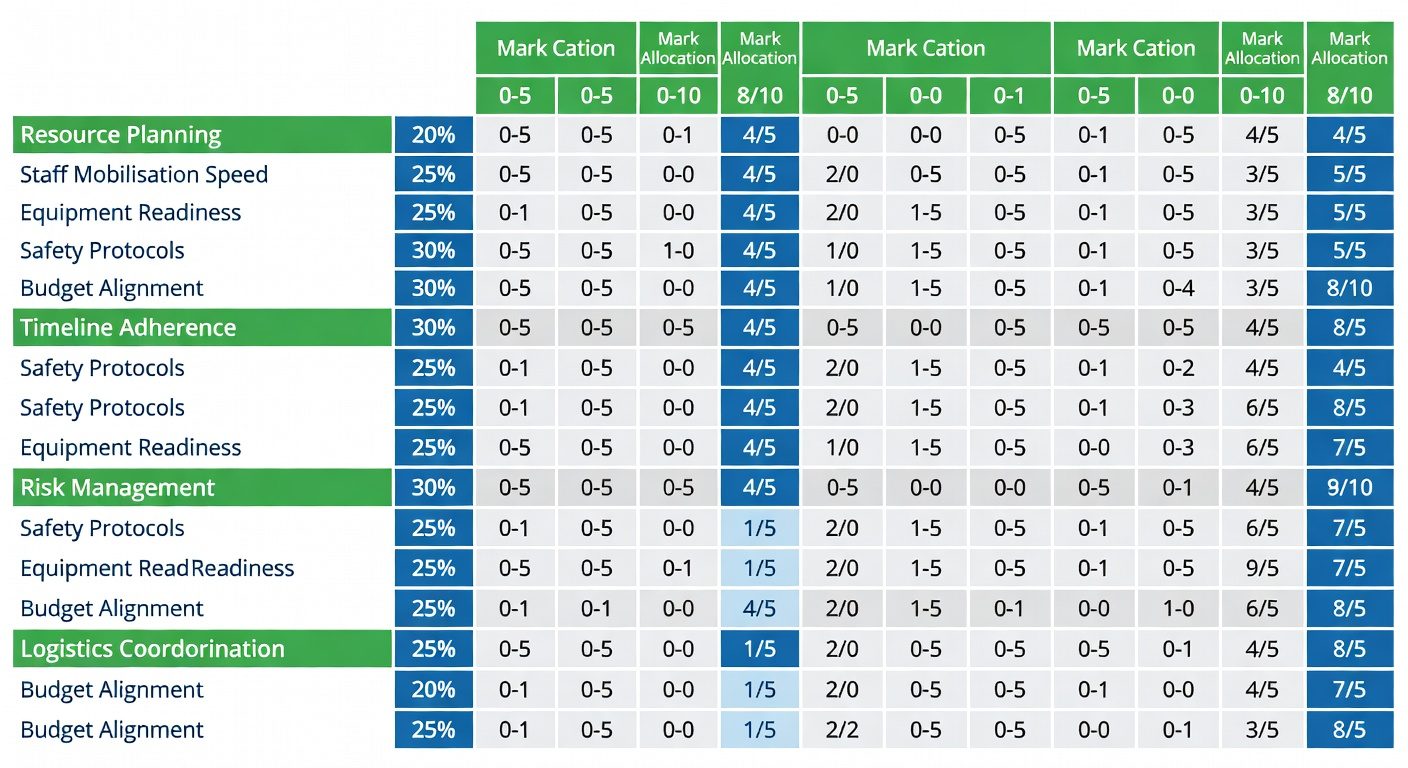
Tender evaluation scoring matrix for mobilisation plans showing criteria weights
Common Mistakes That Cost Marks
Across the FM mobilisation sections we have reviewed, the same handful of mistakes come up again and again. Avoid these and you are usually in the top quartile already.
Vague timelines. "Week 1 to 4: TUPE consultation" is not a timeline. It is a heading. Evaluators want sub-tasks with start dates, owners, and dependencies. A Gantt chart in an appendix beats a paragraph every time. Generic staffing plans. If your mobilisation team is described as "an experienced mobilisation manager supported by appropriate functional leads," you have told the evaluator nothing. Name the role, give the FTE allocation, give a one-line bio reference. "Mobilisation Director: Sarah Lin, 0.6 FTE for the full 16 weeks, who led the 2024 mobilisation of the [comparable contract]" is what scores. No real risks. A risk register that lists "weather", "supply chain disruption" and "staff resistance" with a generic 3x3 RAG matrix is not a risk register. It is filler. The risks evaluators want to see are the ones specific to this contract: incomplete ELI, asset register gaps, incumbent disengagement, parallel statutory inspections falling due in week 2, holiday absence clustering in the consultation window. Boilerplate that does not match the spec. If the ITT says the buyer wants a 12-week mobilisation and your plan describes a 16-week one, you have failed to read the document. This sounds obvious. It happens on roughly one bid in three. No handover from mobilisation to BAU. Plans that just stop at "go-live" leave the evaluator wondering who owns the contract from week 11 onwards. Name the transition. "Mobilisation accountability transfers from [Sarah Lin] to [the named Account Director] at the week 12 service review." Missing the buyer's pressure points. If the contract is replacing an incumbent the buyer is unhappy with, the evaluator wants to see you understand the unhappiness and have planned to fix it in the first 30 days. If the buyer is a hospital with infection-control sensitivities, your mobilisation plan should reflect that. Generic plans miss this entirely.How to Write Each Section
A practical structure that works for almost every FM mobilisation plan:
Opening paragraph. Acknowledge the buyer's specific context in two sentences. The site or estate, the workforce size, the service mix, the operational sensitivities. This is the part that proves you have read the ITT properly. Governance and team. Name the mobilisation director, the workstream leads, the steering group cadence, and the buyer's main point of contact on your side. Include FTE allocations. If you can include a real photo or a named LinkedIn reference, even better. (Check with the people involved first.) The phased plan. Use the five phases above, with dated milestones inside each one. A summary Gantt chart works well as a visual. The narrative should explain why each milestone falls when it does, not just what it is.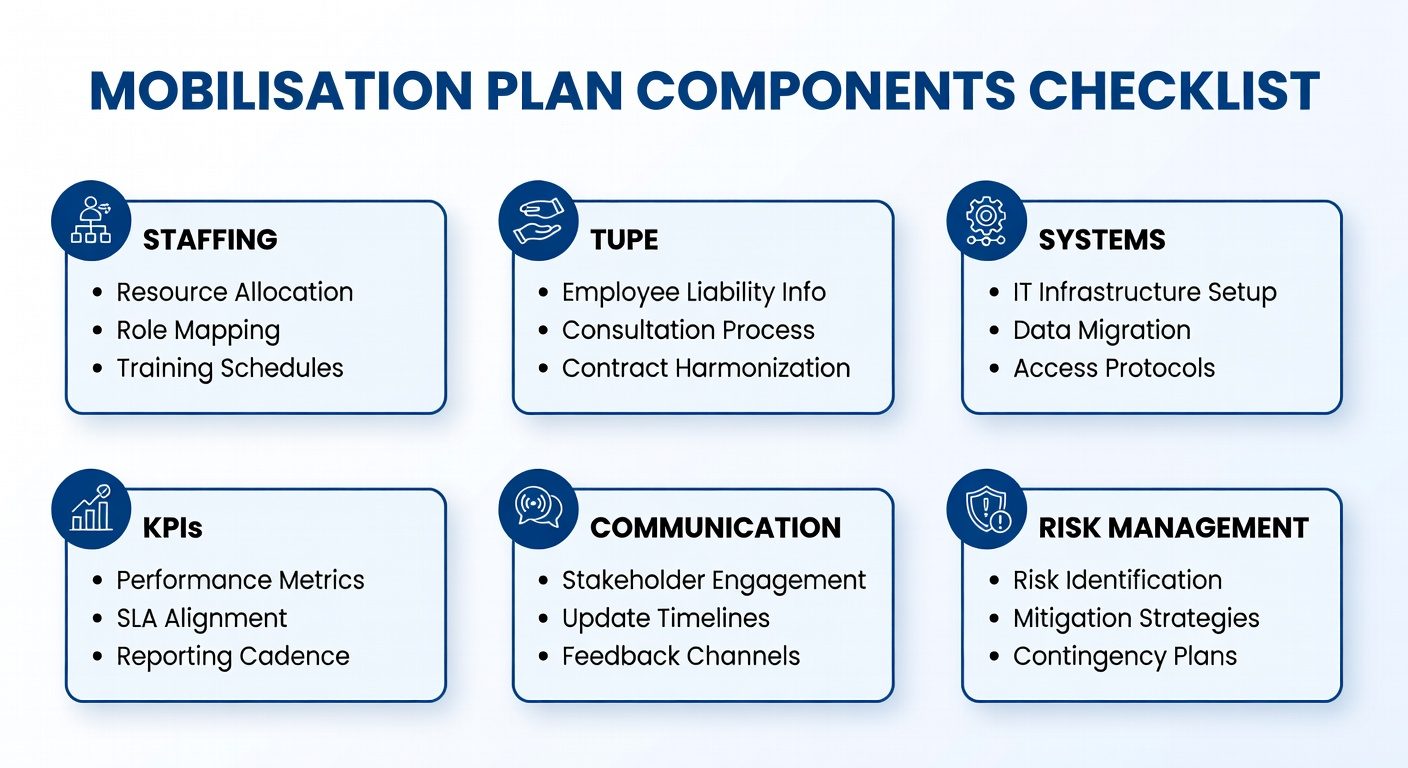
Mobilisation plan components checklist infographic
Evidencing Your Track Record
A mobilisation plan without evidence is an aspiration. The evaluator wants to know you have actually done this before, on something comparable, recently, and that it went well.
Three things help:
A short case study sidebar, ideally one paragraph, showing a comparable mobilisation. Contract type, scale, transfer numbers, timescale, outcome. "In 2024 we mobilised the [comparable] contract: 84 transferring staff, 12-week timeline, zero unfilled rota gaps in week one, first quarter KPI score 94 percent."
A named reference the buyer can call. Even if they never do, naming one signals confidence.
Lessons learned. Pick one thing that did not go perfectly on a previous mobilisation and explain what you have changed since. This is counter-intuitive: admitting a small problem makes the rest of your bid more credible, not less. The evaluator has read 12 bids today claiming flawless mobilisations on every contract. Yours stands out.

Facilities management handover meeting in a modern office building
Where mytender.io Fits
A mobilisation plan section is where the evidence library really earns its keep. The fastest way to write a credible one is to pull the right case studies, the right named leads, the right risk-register examples, and the right phased templates from previous wins, and then re-shape them around this buyer.
That is exactly what mytender.io is built for. Bid teams using our bid library and AI drafting tools typically cut the time spent on mobilisation sections by half, because the boilerplate phases are already drafted and the case-study evidence is already tagged by service line. The bid manager spends their time on the bits that move the score: the buyer-specific framing, the named risks, the dated milestones.
If you want to see how your current mobilisation section stacks up against what evaluators score highly, the tool is a useful place to start.
The Quick Test
Before you submit, read your mobilisation section back as if you were the evaluator. Ask three questions.
Could a competitor use this same section by changing two words? If yes, it is too generic.
Could a buyer's estates director read this and say "yes, that is what would actually happen on our site"? If not, it is too abstract.
Does it have a clear end? Mobilisation must finish, and BAU must start, on a named date with a named owner. If your plan trails off into "continuous improvement", you have lost the last mark.
Get those three right and the rest tends to follow.
If you want a structured way to draft, evidence, and review the mobilisation section of your next FM bid, start a free trial of mytender.io or browse live FM tenders in our Tender Finder.
Tags
Ready to Transform Your Tender Writing?
See how MyTender's AI can help you write winning tenders in a fraction of the time.