

Late Payment Risk in Public Sector Tenders: How to Protect Cashflow Before You Bid
Late payment reform is moving up the agenda in 2026, but suppliers still need to protect cashflow before they bid. Here is how to spot payment risk in tenders and price it properly.
mytender.io Research Team
Tender Writing & Bid Management Specialists
Late Payment Risk in Public Sector Tenders
Late payment is not just a finance problem. In tendering, it is a bid strategy problem.
You can win a contract, mobilise the team, carry the payroll, pay your own suppliers, deliver the service well, and still end up under pressure because the money arrives later than your model assumed. That is the quiet risk in public sector work. The contract looks safe because the buyer is credible. The cashflow can still hurt.
2026 has pushed payment terms back into the spotlight. Government has been moving on late payment reform, public buyers are under more pressure to treat suppliers fairly, and SMEs are watching working capital more closely than ever. That does not mean you can stop reading the payment clauses.
It means you need to read them earlier.

Commercial director reviewing tender payment terms before a bid decision
This guide is for commercial leaders, bid directors and SME owners who need to decide whether a tender is worth the strain on cashflow. It covers where payment risk hides, how to test it before you bid, how to write about financial resilience without sounding defensive, and when the right decision is to walk away.
Why Payment Risk Belongs in Bid Strategy
Most bid teams treat payment terms as a contract review issue. Legal looks at them after the opportunity has already passed the first bid no-bid meeting. Finance may see them when pricing is nearly finished. Operations may not see them at all.
That sequencing is backwards.
Payment terms affect the whole commercial shape of a bid. They influence mobilisation cost, margin, supplier terms, payroll pressure, retention, dispute risk and the amount of management attention the contract will need in its first six months.
If the bid team only asks "can we deliver this service?", the answer might be yes. If they ask "can we fund this service under these payment conditions?", the answer can change.
That is especially true in contracts with:
- Heavy mobilisation spend before the first invoice
- Labour-intensive delivery with weekly or monthly payroll
- Long supply chains where subcontractors need paying before you are paid
- Retentions, milestone payments or performance deductions
- Unclear invoice approval routes
- Seasonal peaks that force you to carry cost ahead of revenue
The public sector is often a strong payer once invoices are approved. The risk is usually not that the buyer cannot pay. The risk is that your contract model assumes a clean payment rhythm, while the real contract creates delay, dispute or upfront working capital pressure.
What Changed in 2026
Late payment has become a bigger political and commercial issue. The direction of travel is clear: buyers and large businesses are being pushed toward shorter, cleaner payment terms and better reporting.
That is good news for suppliers. It is not a reason to be casual.
Reform does not remove the practical details that decide whether a contract feels healthy month to month. You still need to check how the tender handles invoice approval, what happens when performance data is disputed, whether payment depends on client sign-off, and whether subcontractor payment obligations flow through the chain.
The key point for bidders is simple: better regulation raises the floor, but it does not write your cashflow model for you.
Where Late Payment Risk Hides in Tender Documents
Payment risk rarely sits under a heading called "late payment risk". It is scattered across the ITT, contract terms, pricing schedule, performance framework and mobilisation requirements.
You need to read those documents together.
The Payment Clause
Start with the obvious clause. Look for:
- Payment period from invoice date
- Payment period from invoice approval date
- Any requirement for purchase order matching
- Whether disputed amounts can hold up the whole invoice
- Interest rights and whether they are mentioned clearly
- Payment frequency: monthly, milestone-based, quarterly or after completion
The phrase that should make you slow down is "from approval". Thirty days from invoice date is not the same as thirty days from approval. If approval can take ten working days, your actual cash receipt may be much later than the headline term suggests.
The Mobilisation Schedule
Mobilisation is often where cashflow pressure starts. You may need to recruit, buy equipment, train staff, onboard systems, set up reporting, secure vehicles or prepare premises before the first billable month.
If the tender requires a full mobilisation plan, ask a finance question as well as an operations question: what cash leaves the business before the first invoice is paid?
That number belongs in your bid model.
The Performance Framework
Performance deductions can create payment volatility. A contract with modest margins and aggressive service credits can become painful quickly if early performance data is disputed.
Look closely at:
- KPI measurement rules
- Service credit caps
- Rectification periods
- Who owns the performance data
- Whether deductions apply automatically
- Whether deductions can be challenged before payment is reduced
This matters most in facilities management, waste, security, cleaning, maintenance and construction support contracts, where operational data can be messy in the first few months.
The Pricing Schedule
Pricing schedules sometimes force cost into places where payment does not follow. A buyer may ask you to spread mobilisation cost across the contract term, include transition costs in the monthly service fee, or price a fixed annual sum paid monthly in arrears.
That may be commercially normal. It may also mean you are funding the buyer's transition.
Neither is automatically wrong. But you need to know which one you are agreeing to.
Flow-Down Clauses
If you use subcontractors, check whether the contract imposes payment commitments on you that are faster than the payment terms you receive from the buyer.
That can be the right thing to do. It can also create a funding gap.
For example, if your subcontractor terms require payment in 14 days but the buyer pays you 30 days after approval, your cashflow model needs to carry the difference. If you ignore it, you have not priced the contract properly.
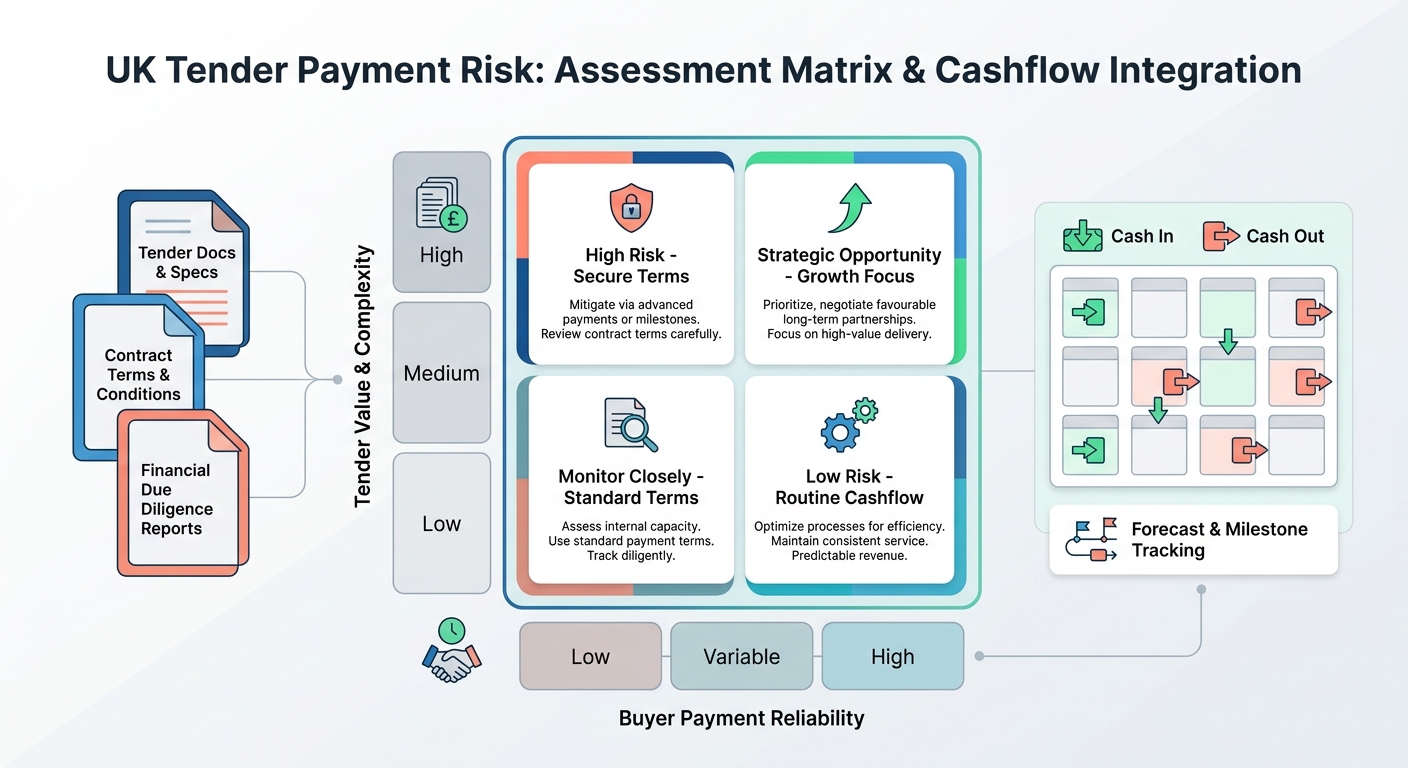
Payment risk assessment matrix for reviewing tender documents before bidding
Build a Payment Risk Matrix Before Bid No-Bid
A proper bid no-bid meeting should not just score strategic fit, competition and margin. It should score payment risk.
Use a simple matrix with two axes:
- Cash exposure before first payment
- Confidence in clean, timely payment
That gives you four outcomes.
Low Exposure, High Confidence
This is the easy quadrant. The contract has modest mobilisation cost, clear monthly invoicing, clean approval rules and a buyer with familiar systems.
You still review the terms, but payment risk should not drive the bid decision.
High Exposure, High Confidence
This can be attractive if the margin supports it. You may be funding mobilisation, but the payment process is clear and the buyer's requirements are predictable.
The question becomes whether the contract return justifies tying up working capital.
This is where commercial leaders should ask for a cashflow stress test, not just a margin model.
Low Exposure, Low Confidence
These are annoying contracts. The financial exposure may be limited, but the management overhead can be high if invoice approval is messy or performance deductions are vague.
Bid if the strategic value is strong. Otherwise, be wary. Small contracts with messy administration can drain time out of proportion to revenue.
High Exposure, Low Confidence
This is the danger quadrant.
The contract asks you to fund mobilisation or delivery upfront, while payment depends on unclear approvals, disputed data, milestone sign-off or heavy deductions. These opportunities need senior review. They may still be worth bidding, but only if you can negotiate terms, price the risk, or limit your exposure.
If you cannot do any of those things, walking away is not cowardice. It is good commercial discipline.
The Bid No-Bid Questions Finance Should Ask
Finance should be in the room before the bid is approved, not after pricing is already locked.
Here are the questions that matter.
When Is the First Cash Receipt?
Do not ask when the first invoice is raised. Ask when cash lands.
Map the full chain:
- Contract award
- Mobilisation start
- Service start
- First invoice date
- Buyer approval window
- Payment run
- Cash receipt
That timeline often reveals a 60 to 120 day gap between first meaningful cost and first meaningful cash.
For an SME, that can decide whether a contract is healthy.
What Costs Arrive Before Revenue?
List the real costs. Payroll. Recruitment. Uniform. vehicles. equipment. software licences. security screening. training. depot changes. insurances. subcontractor mobilisation. consultant support. bid bonds or performance guarantees if required.
Then decide which costs are one-off, which repeat monthly, and which can be staged.
A tender with a 12% margin can still be a bad deal if it demands a large upfront cash commitment that the business cannot comfortably absorb.
What Happens if the First Invoice Is Disputed?
This is the scenario most optimistic bid models miss.
What if the first invoice is queried? What if the buyer disputes a KPI deduction? What if a purchase order is missing? What if the contract manager is away and approval slips into the next payment run?
None of that means the buyer is acting badly. It is normal contract administration friction. Your model should survive it.
Are We Funding the Supply Chain?
If you rely on subcontractors, check the gap between when they expect payment and when you receive payment.
Public sector buyers increasingly care about prompt payment down the chain. That is good practice. But if the commercial model leaves you carrying the whole gap, that needs to be priced or negotiated.
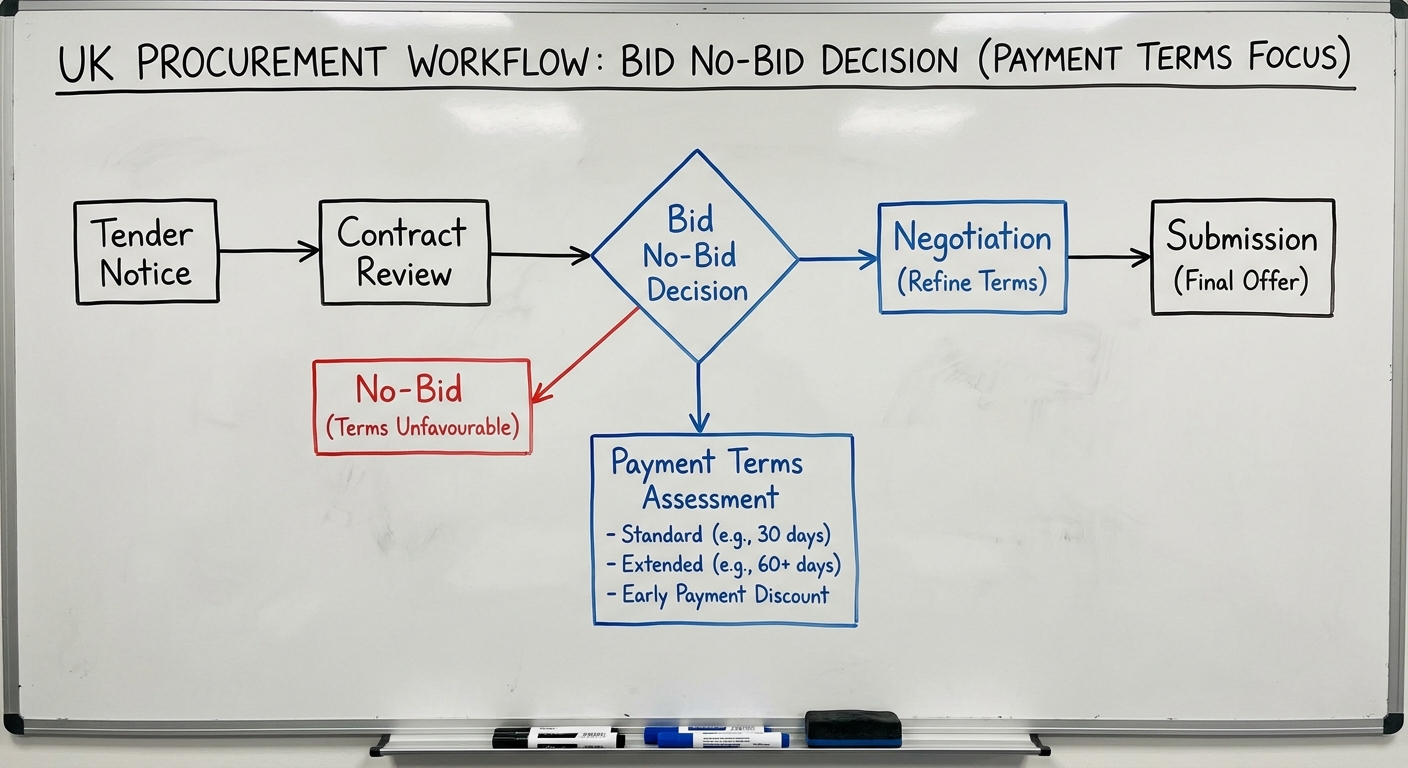
Bid no-bid workflow showing payment term checks before submission
How to Price Payment Risk Without Killing the Bid
The lazy answer is to add a big risk premium. That usually makes you uncompetitive.
The better answer is to price the specific risk.
Separate Cost, Risk and Funding
Do not bury everything in margin. Break the issue into three buckets:
- Actual cost: what you must spend to deliver
- Risk allowance: what could go wrong
- Funding cost: the cost of carrying cash exposure
This makes the commercial discussion cleaner. It also helps you decide which risks can be reduced through contract clarification rather than price.
Use Clarification Questions Properly
Clarification questions are not just for technical gaps. Use them to make payment risk visible before submission.
Good questions include:
- Can the authority confirm whether the payment period runs from invoice receipt or invoice approval?
- Will undisputed invoice amounts be paid where only part of an invoice is queried?
- What is the expected purchase order process before contract start?
- Can mobilisation costs be invoiced separately or through an agreed milestone?
- What evidence is required for KPI sign-off before invoice approval?
- Are payment runs weekly, fortnightly or monthly?
The tone matters. Do not sound like you are accusing the buyer of poor payment practice. Frame the question around accurate pricing and smooth mobilisation.
Offer a Cleaner Commercial Option
Sometimes you can reduce payment risk with an alternative pricing structure.
For example:
- A mobilisation milestone paid on completion of agreed tasks
- A lower monthly fee if mobilisation is paid separately
- A phased implementation plan tied to payment milestones
- A clear rule that undisputed sums are paid while disputed items are resolved
- A shared performance data sign-off meeting before invoicing
Public buyers may not accept every suggestion. But a well-framed commercial option can help them see that payment structure affects delivery confidence, not just supplier preference.
Do Not Overprice a Risk You Can Control
Some payment risk is actually process risk inside your own business. Late invoices, missing purchase order references, weak evidence packs and sloppy KPI reporting all slow payment.
If your internal process is the problem, fix the process. Do not price your own admin weakness into the bid and expect to stay competitive.
Cashflow Stress Testing: The 90-Day View
A tender margin model tells you whether the contract is profitable. A cashflow stress test tells you whether you can live long enough to enjoy the profit.
For most service contracts, build a 90-day view from contract award.
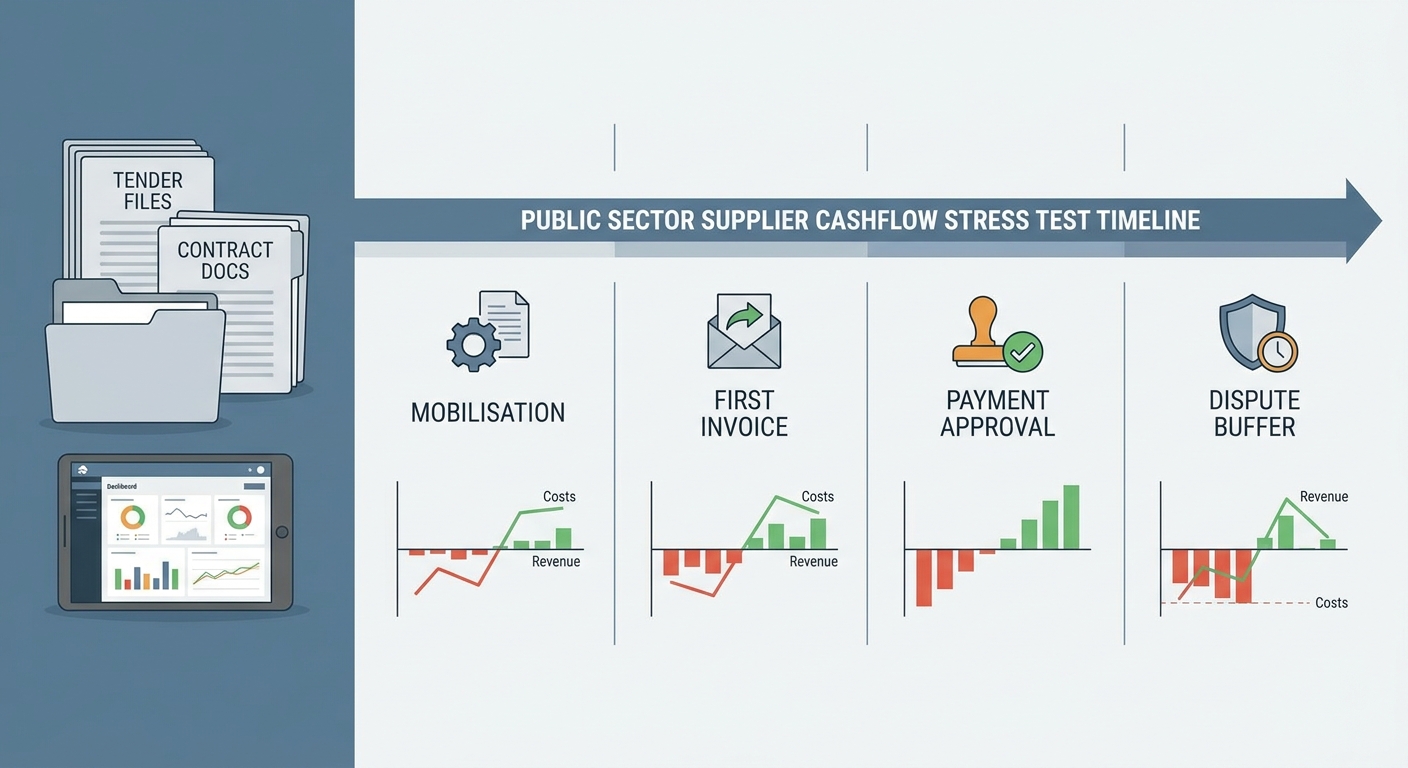
Cashflow stress test timeline from mobilisation spend to first payment
Your stress test should include:
- Mobilisation cost by week
- Payroll timing
- Subcontractor payment timing
- Equipment and vehicle deposits
- Insurance and compliance costs
- First invoice date
- Expected payment date
- A one-cycle payment delay
- A partial dispute on the first invoice
- Working capital headroom
The stress test does not need to be beautiful. It needs to be honest.
The One-Cycle Delay Test
Every bid should pass this test: if the first invoice slips by one payment cycle, can we still operate without emergency action?
If the answer is no, you have three choices:
- Negotiate the payment structure
- Reduce upfront exposure
- Do not bid
That sounds blunt because it should be blunt. Winning a contract that creates a cash crisis is not growth. It is a very expensive way to look busy.
The Partial Dispute Test
Model what happens if 15% of the first invoice is held back for a KPI or mobilisation dispute.
Can you still pay your team and suppliers? Can you resolve the dispute without damaging the relationship? Does your evidence pack support a quick decision?
If the model only works when every invoice is approved perfectly, the model is too fragile.
Writing Financial Resilience Into the Tender Response
Some suppliers avoid mentioning cashflow in their tender responses because they worry it makes them sound weak.
That is the wrong read.
Buyers want suppliers who understand contract risk and can manage it. The trick is to write about financial resilience as delivery assurance, not as a plea for sympathy.
Where to Mention It
You do not need a standalone section called "cashflow". Instead, build it into:
- Mobilisation plan
- Risk register
- Contract management method statement
- Supply chain management section
- Business continuity response
- Social value or SME supply chain commitments
The message should be: we have thought through the financial mechanics of delivery, so the service will not wobble when the contract starts.
What Evidence Helps
Use evidence that gives evaluators confidence:
- Named finance owner for contract mobilisation
- Invoice approval timetable built into mobilisation governance
- Weekly mobilisation cost tracking
- Supplier payment process and escalation route
- Previous examples of similar mobilisation scale
- Credit facilities or working capital headroom where appropriate
- Clean purchase order and invoicing controls
- KPI evidence packs prepared before invoice submission
Avoid vague claims like "we have strong financial controls". Everyone writes that. Show the mechanism.
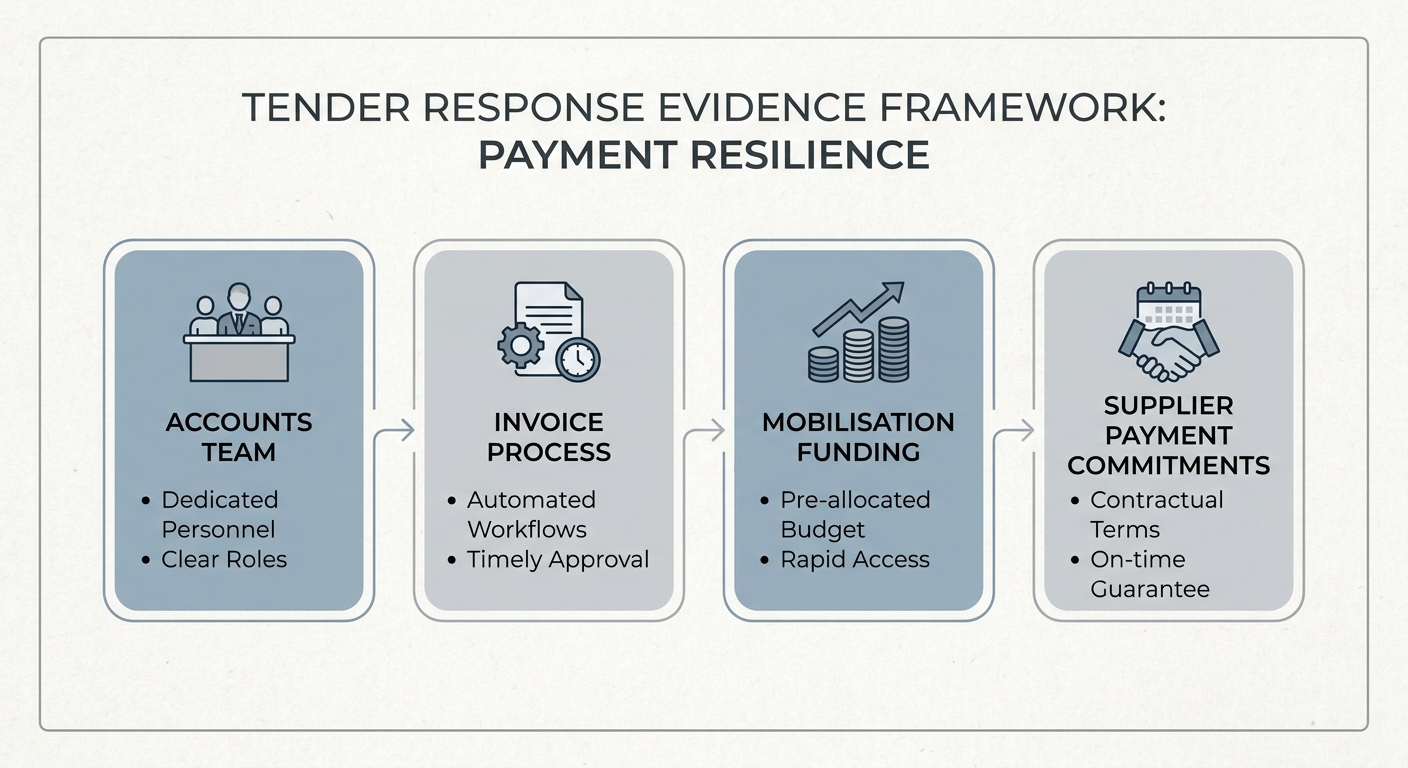
Evidence framework for proving payment resilience in tender responses
How This Differs by Sector
Payment risk looks different depending on the contract type.
Facilities Management
FM contracts often combine labour, equipment, subcontractors and performance deductions. Cashflow pressure usually appears in mobilisation, TUPE, equipment purchase and early KPI disputes.
Integrated FM contracts need extra care because one disputed service line can affect broader invoice approval if the contract is poorly structured. Make sure the payment mechanism does not let a small issue in one area hold up payment for the whole service.
Construction
Construction suppliers need to watch retentions, milestone certification, variations and pay-when-certified behaviour in the chain. Payment risk often sits in valuation timing and dispute resolution rather than simple monthly invoicing.
If the tender includes design responsibility, Building Safety Act competence requirements or complex approvals, model the cash impact of delayed sign-off.
Waste and Environmental Services
Waste contracts are operationally intense from day one. Vehicles, depots, staffing and route changes can create large upfront exposure.
Payment risk often appears when performance data is disputed during bedding-in. Missed collections, contamination rates, tonnage reporting and resident complaint data all need clean evidence if they affect payment.
Healthcare and Social Care
These contracts can involve strict staffing levels, compliance checks and mobilisation before revenue flows. If the service needs recruitment, screening or training before go-live, cashflow exposure can build quickly.
You also need to check whether payment depends on activity volumes, authorised hours or accepted records. A small admin delay can become a cash delay.
What to Do When the Terms Look Bad
Bad terms do not always mean no bid. They mean you need a decision.
Ask Clarification Questions First
Sometimes the tender wording is clumsy rather than hostile. A clarification can reveal that the buyer intends to pay undisputed sums, approve invoices promptly, or agree mobilisation milestones.
Do this early. Late clarification questions rarely change commercial reality.
Escalate Internally
If payment risk is material, the bid should go to the person who owns working capital, not just the person who owns sales target.
That might be the MD, CFO, Finance Director or Commercial Director. Whoever it is, they need a short note with:
- Contract value
- Expected margin
- Upfront exposure
- First cash receipt date
- Worst credible payment delay
- Mitigation options
- Recommendation
Keep it clear. Senior decision-makers do not need twenty pages. They need the commercial truth.
Decide What Would Make the Bid Acceptable
Before walking away, define what would make the opportunity bid-worthy.
For example:
- Mobilisation milestone agreed
- Payment period confirmed from invoice receipt
- Undisputed amounts paid separately
- Service credit cap clarified
- Performance data sign-off added
- Price adjusted to reflect funding cost
If the buyer will not move and the numbers do not work, you have your answer.
How AI Can Help Without Replacing Commercial Judgement
AI is useful here because payment risk is hidden across documents. Humans miss things when the tender pack is long and the deadline is short.
mytender.io can help bid teams interrogate tender documents, pull out payment clauses, compare them with previous contracts, and draft clarification questions against the actual wording. It can also help build first-draft risk responses that link payment mechanics to mobilisation confidence.But the decision still needs a human. AI can surface the clause. It cannot decide how much working capital your business should tie up in a contract.
That decision belongs with commercial leadership.
A Practical Payment Risk Checklist
Before you approve the next public sector bid, run this checklist.
Document Review
- Have we found every payment clause across the tender pack?
- Does payment run from invoice date, receipt date or approval date?
- Can disputed amounts delay undisputed payment?
- Are payment runs monthly, fortnightly or weekly?
- Are mobilisation costs recoverable before service start?
Commercial Model
- What is the first cash receipt date?
- What is the peak cash exposure before first payment?
- What happens if payment slips by one cycle?
- What happens if 15% of the first invoice is disputed?
- Are we paying subcontractors faster than we are paid?
Bid Response
- Have we shown financial resilience in the mobilisation plan?
- Have we named owners for invoice and payment governance?
- Have we included payment risk in the risk register?
- Have we asked clarification questions early enough?
- Have we priced funding cost separately from delivery cost?
Decision
- Is the margin strong enough for the working capital exposure?
- Can we negotiate the payment structure?
- Does the contract support our strategy beyond revenue?
- Are we comfortable explaining the risk to the board?
- Would we still bid if the first payment arrived one month late?
If the last answer is no, pause. That is the question that cuts through the optimism.
The Contracts Worth Winning Are the Ones You Can Fund
Public sector contracts can be brilliant. They can give you multi-year revenue, strong references, sector credibility and a platform for growth.
But revenue is not cash. A signed contract is not a payment. A high score is not working capital.
The best bid teams understand that before they write. They read payment terms early, stress test the cashflow, ask better clarification questions, and price the real contract rather than the imagined one.
That does not make them cautious. It makes them serious.
If you want to find public sector opportunities that match your sector and capacity, the Tender Finder is free to use. Use it to build a pipeline, then use the payment risk checklist before you commit your bid team to the work.
Tags
Ready to Transform Your Tender Writing?
See how MyTender's AI can help you write winning tenders in a fraction of the time.