

Integrated FM vs Single-Service Bidding: Choosing the Right Lot Strategy
A commercial guide for FM directors deciding between bidding for an integrated contract or targeting single-service lots. Win probability, margin maths, evaluator behaviour, and the questions to ask before you commit a bid budget.
mytender.io Research Team
Tender Writing & Bid Management Specialists
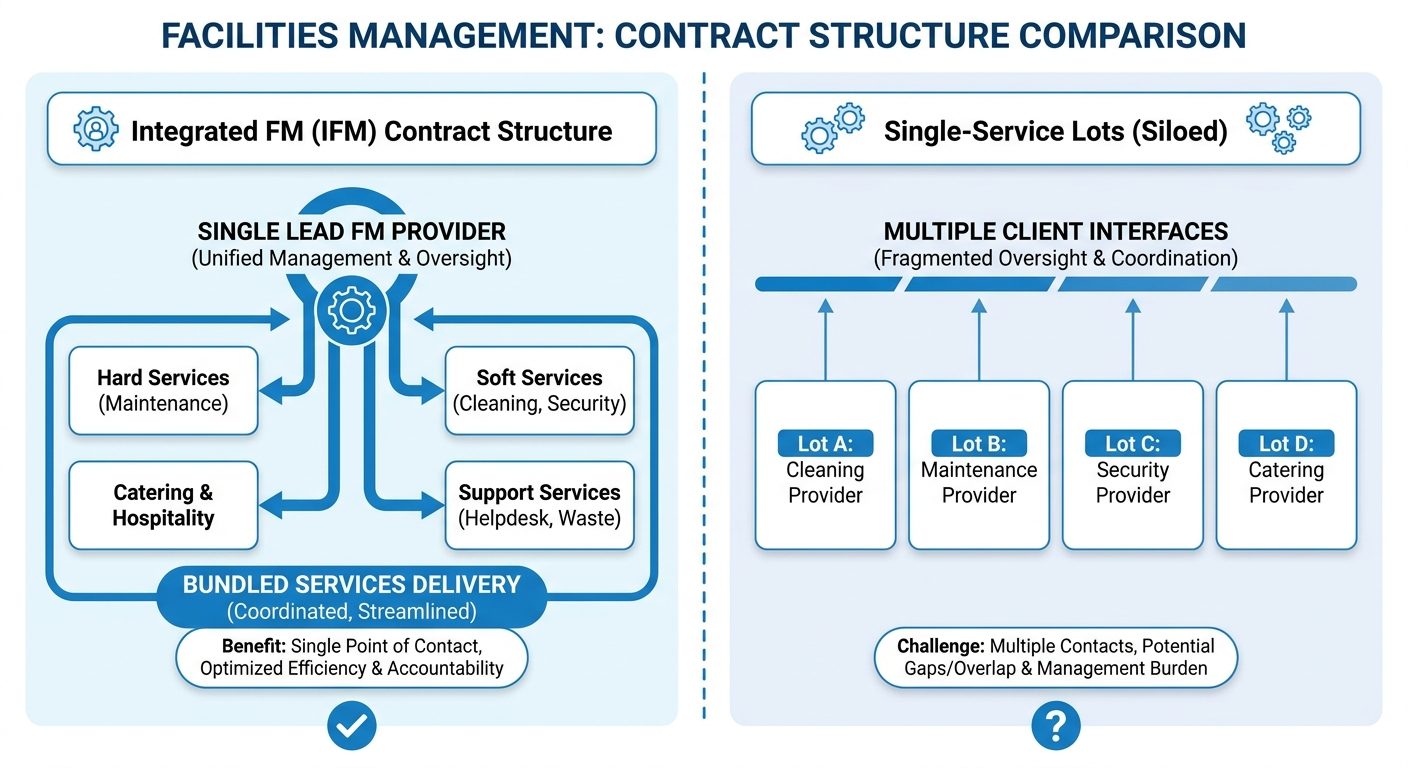
Integrated FM vs single-service lot structure comparison
Most FM contracts above £5m come to market with a lot structure decision already baked in. Some buyers package the whole estate as one integrated contract. Others slice it: cleaning here, M&E there, security as a separate lot, grounds in another. As the bidder, you do not get to choose how the buyer publishes the notice. You do get to choose which lots to chase, whether to bid integrated when the option is open, and how to position your offer.
That decision shapes everything downstream. Bid cost, evaluator scoring, win probability, mobilisation risk, the contract margin you can defend on day one. Get the call wrong and you either spend six weeks writing a bid you cannot deliver, or you walk away from revenue you could have won.
This is a commercial framework, not a procurement primer. It is written for the person signing off the bid/no-bid decision.
What integrated and single-service actually mean in a tender
An integrated FM contract packages multiple services (hard FM, soft FM, lifecycle, helpdesk, sometimes catering and security) under one prime supplier with one management interface. The buyer wants joined-up accountability and is willing to pay for it.
A single-service lot is one discrete service line, normally let alongside other lots from the same buyer. The buyer is buying depth in a specific category. They may use multiple suppliers across the estate, or run a framework with mini-competitions per service.
A third pattern is increasingly common: bundled lots. The buyer slices the estate into two or three lots (typically hard, soft, and specialist) without going fully integrated. Lots are big enough to attract national players but narrow enough that mid-market specialists can still compete.
The terminology matters because evaluators score each differently, and your bid economics flip depending on which you are chasing.
When integrated bidding earns its place
Integrated bids look attractive on the topline. One contract, one mobilisation, one customer relationship, a revenue number with the right number of zeros. The reality is that integrated FM is structurally harder to win and harder to deliver.
Bid for integrated when you can answer yes to most of these:
- You self-deliver across the core service lines in the scope. Subcontracting one or two specialist trades is fine. Subcontracting half the contract is not, and evaluators will spot it in your management structure and supply chain section.
- You have a credible mobilisation track record at the value being procured. If the contract is £15m and your largest mobilisation last year was £4m, you are explaining a step-change. That can be done, but it has to be evidenced.
- The buyer's scoring weights joined-up management, lifecycle thinking, and innovation across services. You can see this in the quality criteria. Look for phrases like "integrated approach", "single point of accountability", "cross-service initiatives", and the weighting that sits behind them.
- You have account management capacity. Integrated contracts need a senior contract director and a layer of service leads on day one. If those people are already booked on other accounts, the offer falls apart in delivery.
- The margin works at the integrated scale. Integrated contracts win bigger revenue but at noticeably thinner gross margin. If you cannot land it at 6 to 9 per cent operating margin without cutting corners, walk.
If you can tick most of those, integrated bidding gives you a structural advantage that smaller competitors cannot match. The buyer is paying for orchestration, and orchestration is genuinely hard. That is your moat.
When single-service is the right call
Single-service bidding is undervalued by ambitious mid-market FM firms. It feels like a downgrade. Commercially, it often is not.
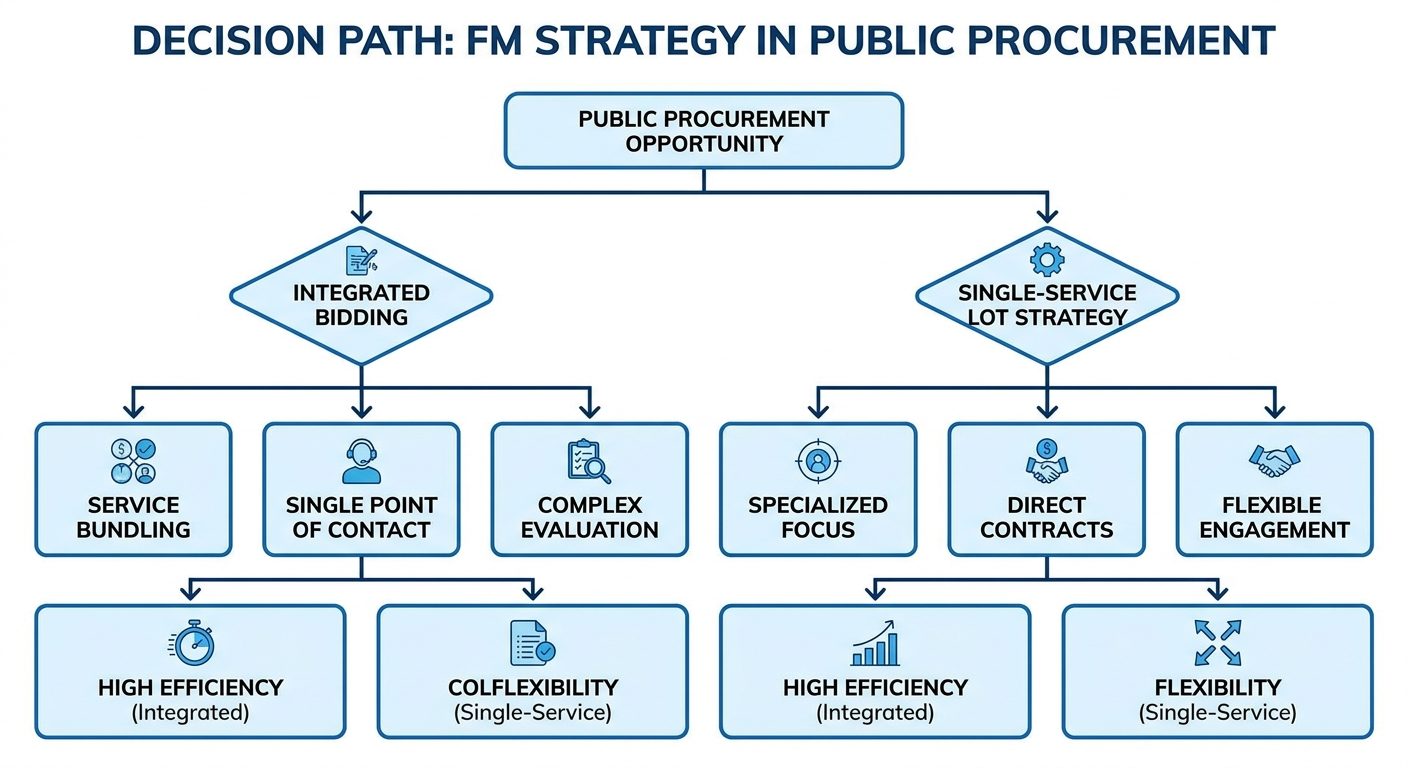
Decision framework for FM lot strategy
Single-service makes more sense when:
- Your capability is genuinely deeper in one service line. A cleaning specialist bidding integrated FM is competing with hard FM giants on hard FM, and losing. The same firm bidding the cleaning lot competes on its actual strengths.
- Competition is thinner. Three or four credible bidders is the sweet spot for single-service lots. Integrated lots routinely attract eight to twelve, including the global tier.
- The scoring ceiling is higher. On a single-service lot, evaluators score depth: technical method, sector experience, named project references, specialist accreditation. If you have those, you can score 90+ on quality where a generalist scores 70.
- Bid cost is materially lower relative to contract value. A serious integrated bid costs £40k to £120k in bid team time, supply chain coordination, mobilisation modelling, and pricing. A single-service bid for a comparable contract value is half that or less.
- You can stack lots from the same buyer. Winning two single-service lots from one trust or local authority gives you the same revenue as the integrated alternative, often at better blended margin, and reduces concentration risk because you are not the prime on either.
The mid-market trap is bidding integrated because it sounds ambitious, then losing every time because the buyer can see you are not a true integrator. That trains evaluators to discount your future bids.
How evaluators score the two differently
This is the part most bid teams misread. Integrated and single-service tenders are scored against different mental models, and your method statements need to reflect that.
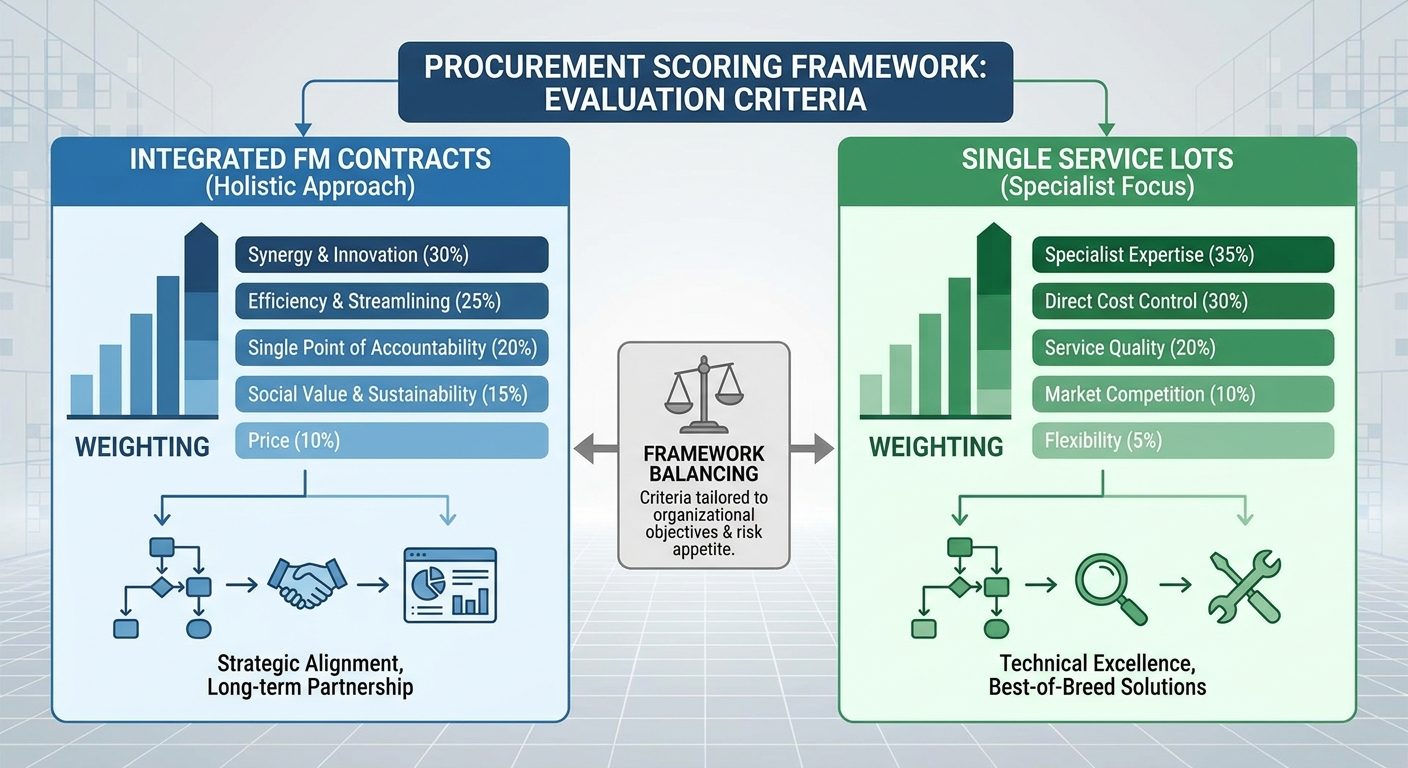
FM tender evaluation scoring criteria
Integrated bids
Evaluators are reading for:
- Single point of accountability. A clean management structure with one contract director, named service leads reporting in, and a credible governance rhythm. If your org chart looks like a federation of subcontractors with a thin coordination layer on top, you lose marks.
- Cross-service value. Where does integrated thinking actually save the client money or reduce risk? Shared mobile engineers across cleaning supervision and security patrols? Combined planned maintenance and lifecycle modelling? A single helpdesk that triages across services? Show the cash and the operational logic, not the slogan.
- Lifecycle and innovation across the estate. Buyers running integrated procurements expect a five to ten year view: condition surveys, lifecycle replacement plans, net zero pathways, technology investment. Single-service bidders rarely have to evidence this.
- Mobilisation as one event. TUPE, systems integration, asset register validation, day-one helpdesk coverage. The evaluator is looking for whether you have done this at scale recently, and what went wrong last time.
Single-service bids
Evaluators are reading for:
- Depth of technical method. How exactly do you deliver this service, with what process, what frequencies, what KPIs, what tooling? Generic descriptions get average marks. Sector-specific detail wins.
- Dedicated management on this contract. A named contract manager, allocated supervision ratios, not shared overhead. Evaluators on single-service lots are sceptical of "matrix" structures because they have seen them fail.
- Sector specialism. NHS cleaning is not commercial cleaning. School catering is not corporate catering. Evaluators want references in the same sub-sector at similar scale.
- Compliance depth. The specific accreditations, audit history, and quality systems for that service line. On an integrated bid you can lean on overall ISO certifications. On a single-service bid you need the deep stack: BICSc, NICEIC, SIA, Safe Contractor, sector-specific, with audit trails.
If you write an integrated-style answer in a single-service bid, you score average. If you write a single-service answer in an integrated bid, the evaluator concludes you cannot orchestrate. Either mismatch costs you the contract.
The commercial reality: revenue, margin, and risk
The headline financial trade-off is well known, but worth restating with the numbers.
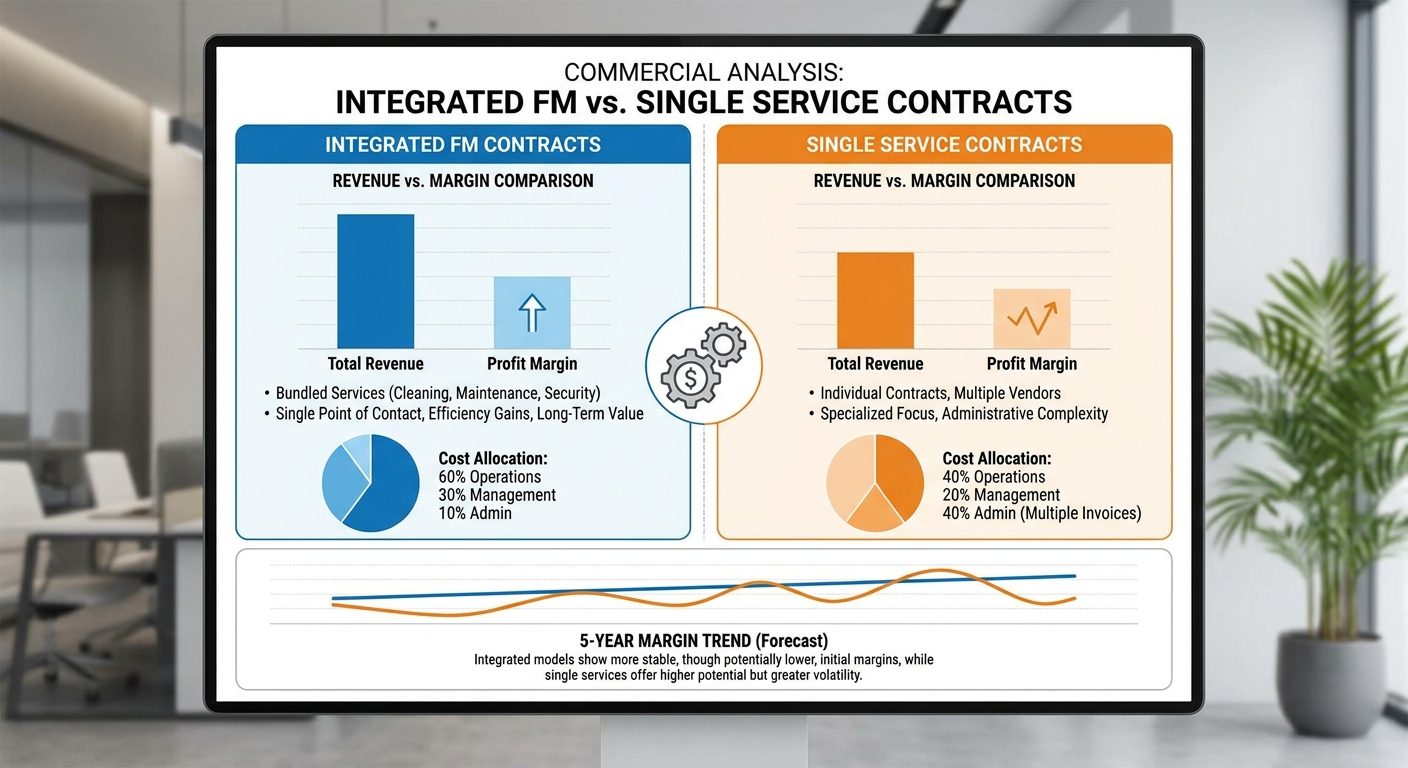
Commercial analysis of integrated FM vs single-service contracts
Integrated contracts:
- Larger revenue per win, often 3x to 8x a single-service equivalent.
- Operating margin typically 5 to 8 per cent in competitive procurements. Sometimes lower on the largest public sector deals.
- Higher delivery risk concentrated in one contract. One bad year cuts your earnings visibly.
- Longer mobilisation, 8 to 16 weeks. Mobilisation cost is real and rarely fully recovered.
- Lower bid-to-win ratio, structurally. National competitors are bidding the same lots.
Single-service contracts:
- Smaller revenue per win, but stackable. Five wins of £1.5m each is £7.5m of revenue with diversified risk.
- Operating margin typically 8 to 14 per cent depending on service line and procurement competitiveness.
- Mobilisation is faster, 2 to 6 weeks, and cheaper.
- Higher bid-to-win ratio if you target lots where you have genuine depth.
- Customer concentration risk is lower because you have multiple clients rather than one prime contract.
The strategic question is not which is "better" in the abstract. It is which one your business is actually built to win and deliver. Most mid-market FM firms are structurally a single-service operator with integrated ambitions. The honest answer is to win single-service lots until you have built the management depth to deliver integrated, then graduate.
A practical framework for the bid/no-bid call
Before you commit a bid budget, work through these in order. If any answer is weak, the bid is at risk regardless of how attractive the contract looks.
- Read the lot structure first, not the scope. How has the buyer sliced the work? Are integrated bids permitted, encouraged, or required? Is there a lot you can bid in isolation? Lot structure tells you what the buyer thinks they are buying.
- Decode the scoring weights. Get the quality/price split, then dig into the quality sub-criteria. If "integrated management" or "cross-service innovation" is weighted at 15 per cent or more, this is an integrated bid in spirit even if it permits single-lot offers. If quality sub-criteria are dominated by service-specific method, depth, and references, it is a single-service procurement.
- Map your self-delivery honestly. What percentage of the scope do you actually deliver in-house with directly employed staff? If the answer is below 70 per cent for integrated, and you cannot get there through credible supply chain partners with track record, do not bid integrated.
- Check the competition. Who else is likely to bid? Procurement portals show prior award history with the same buyer. If the last three integrated awards went to the same two national primes, ask whether you are bidding to win or bidding to be a stalking horse.
- Run the margin maths at submitted price minus 5 per cent. Buyers negotiate. If your margin disappears when the price drops 5 per cent in clarification, the bid is unsafe before it has even gone in.
- Stage-gate the bid effort. Commit to the SQ or qualification stage first. Re-decide at ITT. Too many FM firms commit £80k of bid effort upfront and discover halfway through that they are not really competitive.
Common mistakes that cost the contract
A short list of patterns that surface in lost-bid debriefs:
- Bidding integrated when you are a single-service operator wearing a coat. Evaluators read management structures and supply chain. They can tell.
- Scoping too wide on integrated to chase the revenue number. Method quality dilutes. Your cleaning answer is generic because you wrote eight other service answers. The cleaning specialist on the lot version of the same contract scores 25 per cent higher and wins.
- Treating single-service lots as "lesser" bids. Your A-team is on the integrated bid, your B-team writes the lots, and you wonder why the lots lose. The lots are often the more winnable bid.
- Missing the buyer's hidden preference. Some buyers publish lots but clearly want one prime. Others publish integrated but would accept lot bids if they could justify it. The pre-tender market engagement events are where this gets signalled. Show up to them.
- Ignoring lot-stacking opportunities. If the buyer is letting six lots, the question is not "which one do we bid". It is "which two or three give us the right revenue, margin, and operational footprint?" Win-rate maths beats lot-size maths most of the time.
Where to start
The first job is finding the right opportunities, with lot structure visible before you commit. Filter by sector, by buyer, by lot structure, and by value band. Read the notice, look at past awards, see who has won similar work from the same buyer, then make the bid/no-bid call with that context in hand. That is where mytender.io earns its place: opportunity discovery, lot filtering, and AI-assisted response drafting for FM teams that want to bid smarter, not just more. Worth a look if you are sizing up the next quarter's pipeline.
Tags
Ready to Transform Your Tender Writing?
See how MyTender's AI can help you write winning tenders in a fraction of the time.