

The Public Interest Test for FM Tenders: How Suppliers Should Prepare Before 2027
The end of outsourcing by default will change how public bodies justify FM contracts. Here is how facilities management suppliers can prepare better evidence before the public interest test arrives.
mytender.io Research Team
Tender Writing & Bid Management Specialists
The Public Interest Test for FM Tenders: How Suppliers Should Prepare Before 2027
For years, many FM suppliers could assume one thing: if a public body had outsourced cleaning, maintenance, security, helpdesk, waste, or estates services before, the next tender would probably look familiar.
That assumption is getting weaker.
In June 2026, the UK government signalled the end of "outsourcing by default" for central government service contracts. From April 2027, government departments will need to apply a public interest test before outsourcing services worth more than £1 million.
For facilities management suppliers, that matters.
It does not mean outsourced FM is finished. That would be a lazy reading. Public bodies will still need specialist providers, workforce resilience, technical compliance, supply chain capacity, and service innovation.
But it does mean the question changes.
The buyer is no longer just asking: "Which supplier offers best value?"
They may first need to ask: "Should this service be outsourced at all?"

Facilities management bid team preparing evidence for a public interest test
That puts pressure on your bid evidence before the tender even lands.
If you wait until the ITT is published, you will be late.
What Has Changed?
The government has announced a mandatory public interest test for central government service contracts over £1 million, due to apply from April 2027.
Departments with annual outsourcing spend above £100 million are also expected to publish five-year insourcing strategies.
The political message is clear enough: outsourcing should be justified, not automatic.
That fits a broader 2026 procurement pattern. The Procurement Act 2023 has already shifted attention towards public benefit, transparency, supplier performance, KPI reporting, payment practice, resilience, and long-term value. Contract performance notices and payment compliance notices are making delivery records more visible. The Central Digital Platform is making supplier and contract data easier to find.
The public interest test sits in the same family.
It asks whether outsourcing is genuinely in the public interest, not just whether a procurement process can produce a compliant contract.
For FM bidders, that creates a new evidence burden.
You will need to show why an external provider creates better outcomes than an in-house model, and why those outcomes are credible for this buyer, this estate, this workforce, and this budget.
That is a much higher bar than writing "we deliver best value through innovation" and hoping nobody notices.
Why This Hits Facilities Management First
Facilities management sits right in the firing line because it is one of the most visible forms of public sector outsourcing.
Cleaning, maintenance, security, reception, waste, catering, grounds, and helpdesk services are easy for stakeholders to understand. Everyone sees them. Everyone has an opinion on them.
They also involve people.
TUPE, pay, local jobs, supervision, sickness cover, training, retention, and workforce engagement are not side issues in FM tenders. They are often the service.
When a public body considers whether to outsource, the argument will rarely be purely financial. It will include service resilience, workforce treatment, user experience, accountability, local economic impact, risk transfer, technical capability, and whether the buyer has the internal capacity to manage delivery itself.
That is why generic FM tender copy will struggle.
A buyer applying a public interest test will not be persuaded by vague claims about efficiency. They will need evidence that outsourcing solves a real problem without creating a worse one somewhere else.
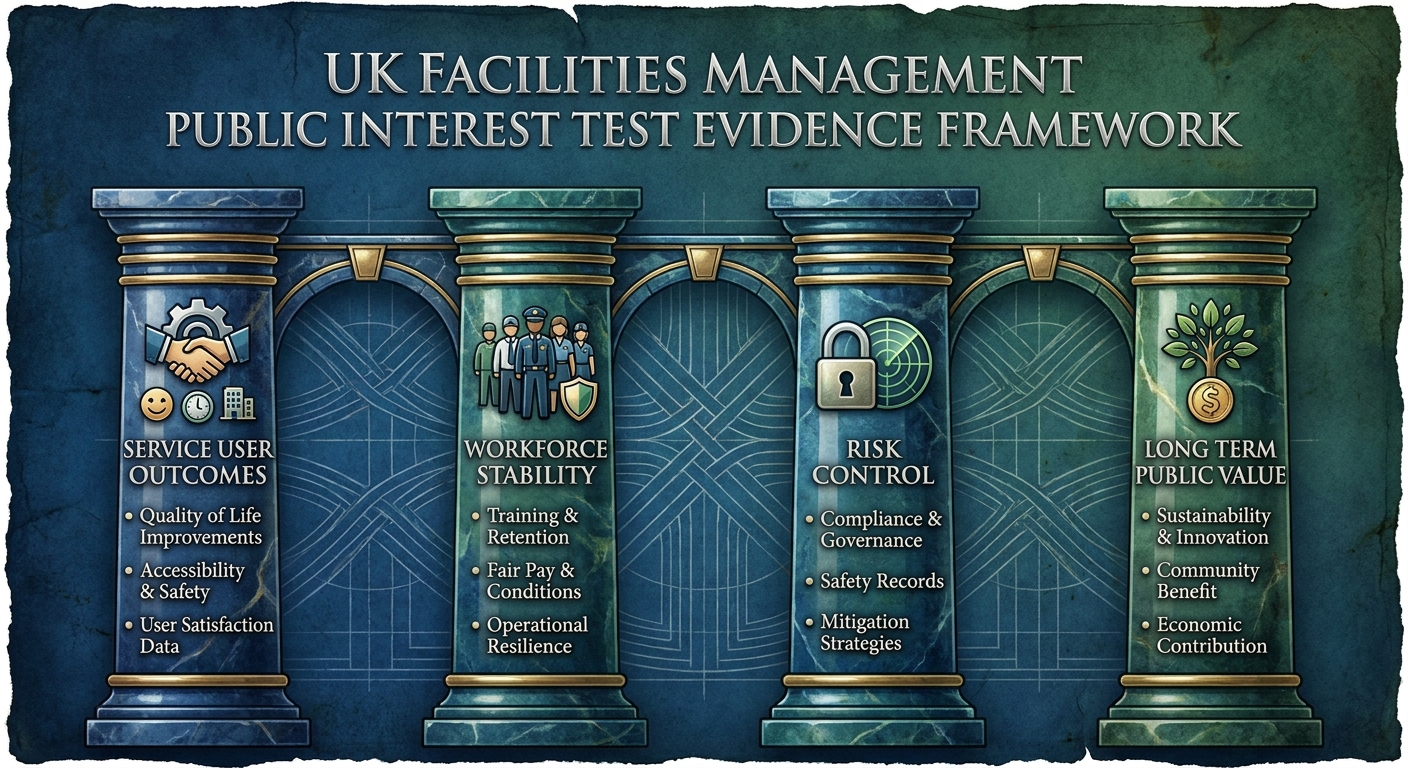
Framework showing the four evidence areas FM suppliers need for the public interest test
The Four Questions Your Evidence Must Answer
You do not need to know the final test wording to prepare. The likely evidence challenge is already visible.
A strong FM supplier will need to answer four questions.
1. Why Is Outsourcing Better for Service Users?
This is the most important question.
If the only argument for outsourcing is lower cost, the bid is fragile. Public bodies have heard that argument for decades. They have also seen what happens when low-cost contracts fail.
You need to show how your model improves the experience of the people using the buildings.
That might mean:
- faster reactive maintenance response
- better cleaning audit scores
- fewer complaints
- stronger statutory compliance
- more reliable security cover
- better helpdesk visibility
- clearer escalation routes
- better out-of-hours resilience
The evidence should be specific.
A statement like "we improve service quality" does very little. A chart showing a 31% reduction in repeat maintenance jobs after introducing root-cause reviews does much more.
A case study showing cleaning complaints falling after a revised supervision model is useful. A paragraph about "continuous improvement culture" is not.
2. Why Is Outsourcing Better for the Workforce?
This is where many FM bids get nervous.
They either avoid the workforce question, or they fill it with bland commitments about being a good employer.
That will not be enough.
If outsourcing is being tested against public interest, the workforce case has to be clear. You need evidence that staff are not simply being moved into a cheaper, thinner, less secure model.
That means showing:
- how you manage TUPE properly
- how you protect service knowledge during transfer
- how you engage staff before and after mobilisation
- how you reduce vacancies and absence
- how you train supervisors
- how you handle pay, progression, and wellbeing
- how you avoid agency dependency
For FM suppliers, workforce evidence is competitive evidence.
A buyer considering insourcing may believe it can treat staff better directly. Your answer cannot be defensive. It has to show why your operating model gives staff better support, clearer management, and more specialist development than the buyer could realistically provide in-house.
That is not always easy.
But if it is true, prove it.
3. Why Is Outsourcing Better for Risk?
A public body does not outsource only to save money. It often outsources because delivery risk is hard to manage internally.
FM risk is broad.
It includes statutory compliance, health and safety, fire systems, asbestos, legionella, security incidents, cleaning standards, asset data, lone working, winter maintenance, waste compliance, subcontractor performance, and business continuity.
A good supplier can absorb, manage, and report those risks better than a stretched internal team.
But again, the bid has to evidence it.
Show the buyer:
- which risks transfer to you
- which risks remain shared
- how risks are monitored
- who owns escalation
- what leading indicators you track
- how you report risk trends
- how you prevent repeat failures
Do not write a risk register that could apply to any contract. Tie the risks to the estate, the service model, and the decision to outsource.
The public interest case is strongest when outsourcing gives the authority more control, not less.
4. Why Is Outsourcing Better for Long-Term Value?
The word "value" gets abused in tenders.
Here, it needs to mean something concrete.
Long-term value might include energy efficiency, lifecycle maintenance planning, lower asset failure, better planned preventative maintenance, reduced void time, improved building availability, lower waste disposal costs, stronger social value delivery, or better data for future estate decisions.
The key is to avoid treating these as extras.
If your FM model genuinely creates long-term value, build the chain of evidence:
- What intervention do you make?
- What operational metric changes?
- What financial or public benefit follows?
- How do you measure it over the contract term?
For example:
- improved PPM compliance reduces reactive callouts
- fewer reactive callouts reduces disruption and cost
- better asset data improves capital planning
- improved planning reduces emergency spend
That is a public interest argument.
"We use innovation to deliver value" is not.
How the Test Could Change Tender Questions
The public interest test may sit before procurement, but its logic will bleed into tender documents.
FM suppliers should expect more questions that ask for proof of public benefit, workforce resilience, service continuity, and contract outcomes.
You may see questions like:
- "Describe how your delivery model supports the authority's public interest objectives."
- "Explain how your approach protects workforce stability during mobilisation."
- "Provide evidence of improved service outcomes under comparable outsourced contracts."
- "How will your contract management model maintain accountability and transparency?"
- "How will you ensure outsourcing delivers better value than an internal delivery model?"
Those questions are awkward if your bid library is built around service descriptions.
They are much easier if your library already contains outcome evidence.
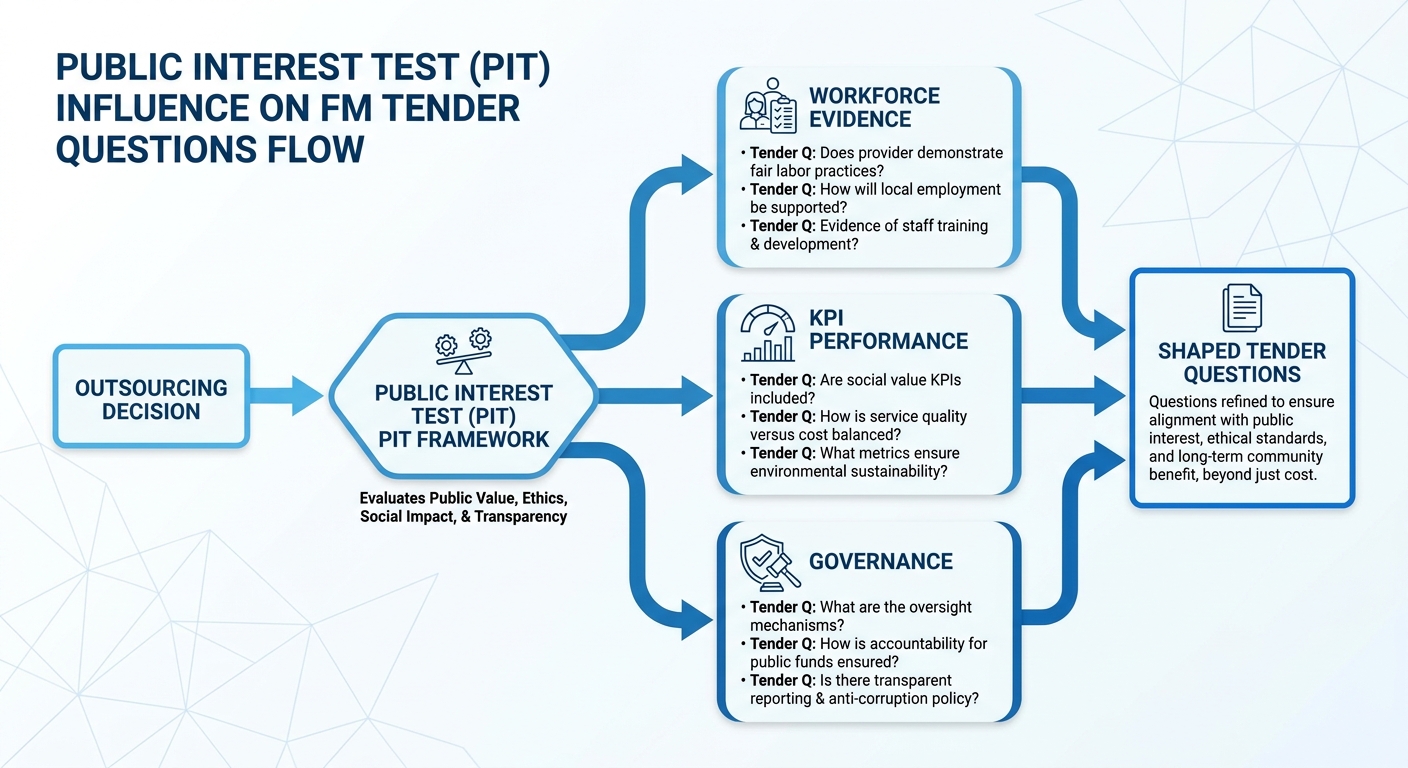
Flowchart showing how the public interest test can shape FM tender questions
What To Build Into Your Bid Library Now
The best time to prepare for 2027 is now, while you still have time to gather evidence from live contracts.
Here is what FM suppliers should add to their bid library.
Public Benefit Case Studies
Do not just store case studies by service line.
Store them by public benefit theme:
- improved building availability
- reduced complaints
- improved compliance
- lower energy use
- local employment
- apprenticeships
- SME supply chain spend
- community volunteering
- waste reduction
- reduced emergency callouts
Each case study should include the starting point, the action taken, the result, and the proof.
If you cannot show the baseline, the result is weaker.
Workforce Transition Evidence
Your TUPE and mobilisation answers should not be generic.
Build evidence packs that show how previous transfers actually worked.
Useful evidence includes:
- mobilisation timelines
- consultation plans
- staff engagement results
- vacancy levels before and after transfer
- training completion rates
- grievance or escalation data
- supervisor induction plans
- retention figures after 6 and 12 months
This is not just HR detail. It is public interest evidence.
KPI Performance Trends
The Procurement Act regime is making contract performance more visible, especially for contracts over £5 million.
That makes your KPI history more important.
Do not rely on one good month. Build trend evidence.
For each relevant contract, capture:
- KPI definitions
- monthly performance
- failures and recoveries
- lessons learned
- improvement actions
- client sign-off
- independent audit results where available
A mature bidder can say: "Here is how we perform over time. Here is what happens when performance dips. Here is how we recover."
That is far more convincing than pretending everything is perfect.
Insourcing Comparison Points
This is the bit most suppliers will miss.
You need to understand the in-house alternative.
That does not mean attacking public sector teams. It means explaining where specialist FM providers can add capacity, expertise, systems, resilience, or economies of scale.
Build comparison points around:
- access to specialist engineers
- training infrastructure
- CAFM and helpdesk systems
- compliance management
- out-of-hours cover
- procurement of materials and subcontractors
- benchmarking across multiple estates
- mobilisation expertise
- temporary resource cover
Keep it respectful.
The strongest argument is not "the public sector cannot do this". It is "this specific service model gives the authority better outcomes because it adds capabilities that are hard to maintain internally at this scale."
The Mistakes That Will Cost Suppliers Marks
Some bid teams will respond badly to this shift.
They will treat the public interest test as a political announcement rather than a practical bidding risk. That is a mistake.
Here are the traps to avoid.
Mistake 1: Making a Cost-Only Argument
Cost matters. It always will.
But if the authority is testing public interest, cost is only part of the answer. A cheap outsourced service that creates poor workforce outcomes, weak resilience, or opaque accountability will be hard to defend.
Show whole-life value, not just annual price.
Mistake 2: Using Generic Social Value Copy
Public interest and social value overlap, but they are not the same.
A volunteering day and a local apprenticeship pledge may help, but they do not prove the core service should be outsourced.
The public interest case needs to connect directly to the FM service model.
Mistake 3: Ignoring Contract Management
Outsourcing fails when accountability is weak.
If your governance answer is a meeting schedule, it is not enough. Explain decision rights, escalation routes, performance reporting, audit trails, issue ownership, and how the client keeps visibility without having to manage every operational detail.
Mistake 4: Hiding Behind Subcontractors
Many integrated FM models rely on specialist subcontractors.
That is fine, but the authority needs to know you control the delivery chain. Name the governance model. Show performance monitoring. Explain step-in rights. Evidence payment practice. Prove subcontractors will not become a black box.
Mistake 5: Treating TUPE as a Legal Appendix
TUPE is not just compliance paperwork. In FM, it can decide whether mobilisation succeeds.
Bring workforce transition into the main delivery story. Evaluators need to believe the service will be stable from day one.
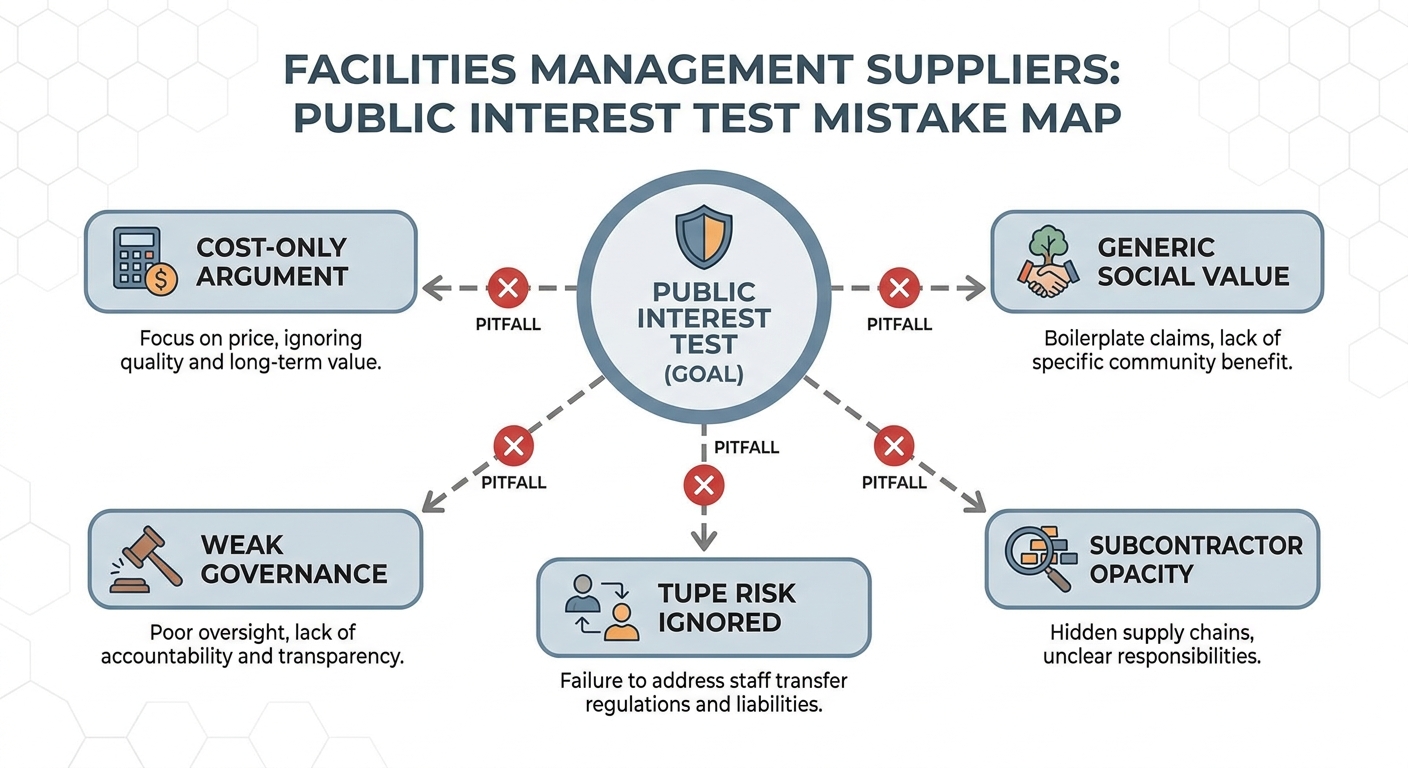
Mistake map for FM suppliers preparing for the public interest test
A Practical Preparation Plan for the Next Six Months
You do not need to rewrite every bid answer today.
You do need a plan.
Month 1: Audit Your Evidence
Pick your last five public sector FM bids.
For each one, ask:
- Did we prove public benefit, or just claim it?
- Did we evidence workforce outcomes?
- Did we explain why outsourcing was better than the alternative?
- Did we show performance over time?
- Did we connect price to long-term value?
Score each answer honestly.
If it feels uncomfortable, good. That is where the work is.
Month 2: Collect Live Contract Data
Speak to operations, not just the bid team.
Ask for KPI trends, complaint data, audit results, mobilisation lessons, workforce retention, training records, helpdesk performance, and client feedback.
Bid teams often have weaker evidence than the business actually possesses. The problem is not absence. It is access.
Month 3: Build Public Interest Evidence Blocks
Create reusable evidence blocks for:
- service user outcomes
- workforce transition
- risk transfer
- long-term value
- contract transparency
- social value linked to service delivery
Keep them modular. You will need to adapt them by contract.
Month 4: Rewrite Case Studies
Most FM case studies are too descriptive.
Rewrite them around before, action, result, proof.
For example:
- Before: high reactive maintenance backlog and poor visibility
- Action: asset validation, revised PPM schedule, helpdesk triage rules
- Result: backlog reduced and response times improved
- Proof: KPI trend, client quote, audit result
That structure makes case studies much easier to use in tender answers.
Month 5: Strengthen Governance Answers
Review your contract management content.
If it reads like a list of meetings, rebuild it.
A strong governance answer should show:
- who owns what
- what data is reviewed
- how issues escalate
- how performance is challenged
- how improvement actions are tracked
- how the client gets transparency
- how subcontractors are held to account
This is where integrated FM suppliers can separate themselves from loose aggregator models.
Month 6: Create an Insourcing Comparison Brief
Build a short internal brief your bid team can use when a tender hints at insourcing risk.
It should cover:
- where your model adds capability
- where your model reduces risk
- where your systems improve visibility
- where your scale improves resilience
- where your workforce model improves stability
- where your delivery record proves the point
Do not copy it blindly into bids. Use it to sharpen the argument.
How mytender.io Helps Bid Teams Handle This Shift
The hard part is not knowing that evidence matters. Every bid team knows that.
The hard part is finding the right evidence quickly when the tender asks a slightly different question from last time.
This is where a structured bid library becomes more than a storage folder.
A platform like mytender.io helps teams connect tender requirements to previous answers, case studies, policies, KPI evidence, and contract examples. That matters when buyers start asking public interest questions that cut across operations, HR, finance, compliance, and social value.
You still need human judgement. You still need real proof.
But you should not be hunting through old SharePoint folders at 11pm trying to find the one mobilisation example that proves your point.
What This Means for FM Bid Strategy
The public interest test should change how FM suppliers think about qualification.
Before chasing a tender, ask:
- Is the buyer politically or operationally likely to consider insourcing?
- Does the service involve high workforce sensitivity?
- Do we have evidence that outsourcing improves outcomes here?
- Can we show public benefit beyond price?
- Do we have performance data from similar contracts?
- Can we explain why our model gives the buyer more control?
If the answer is no, think carefully.
This does not mean walking away from every hard tender. It means knowing where the bid needs strengthening before you commit weeks of effort.
For FM suppliers with strong evidence, this shift could actually be helpful.
Weak outsourcing models will be harder to defend. Thin margins, poor workforce planning, vague governance, and unsupported social value claims will look worse under scrutiny.
Suppliers that can prove genuine public benefit will have a sharper story.
The Bottom Line
The end of outsourcing by default is not the end of outsourced FM.
It is the end of lazy outsourcing arguments.
Public bodies will still need suppliers that can deliver safe, compliant, resilient, well-managed services. They will still need specialist capability. They will still need partners who can handle complex estates and protect service users.
But they will need to justify the choice more clearly.
Your job is to make that justification easier.
Build the evidence now: service outcomes, workforce stability, risk control, long-term value, and transparent governance. If you can prove those things, the public interest test becomes less of a threat and more of a filter.
It filters out suppliers who only had a price story.
If you want to see live FM and public sector opportunities your team can qualify properly, the Tender Finder is free to use.
Tags
Ready to Transform Your Tender Writing?
See how MyTender's AI can help you write winning tenders in a fraction of the time.