

Incumbent Supplier Rebid Strategy: How to Defend and Win Your Contract Renewal in 2026
When your public sector contract goes back to market, incumbency is both an advantage and a vulnerability. This complete guide shows you how to leverage your position, prepare 12–18 months ahead, and write a winning rebid that new competitors cannot match.
mytender.io Research Team
Bid Strategy & Procurement Specialists
There is a persistent myth in procurement circles that incumbent suppliers hold an unassailable advantage when their contracts come back to market. The thinking goes: you know the client, you've proven delivery, you have embedded relationships — surely you're the safe choice?
The reality is considerably more complicated. Public sector incumbent suppliers lose their rebids at a striking rate — industry estimates suggest anywhere from 30% to 45% of incumbents fail to retain contracts when they go back to market. The reasons are predictable, avoidable, and almost always rooted in complacency rather than genuine competitive inferiority.
This guide is for suppliers who want to approach rebidding with the rigour it deserves. Whether your contract end date is 18 months away or you're already in the thick of a live procurement, these principles will help you leverage your genuine advantages, neutralise your vulnerabilities, and produce a tender response that wins on merit.
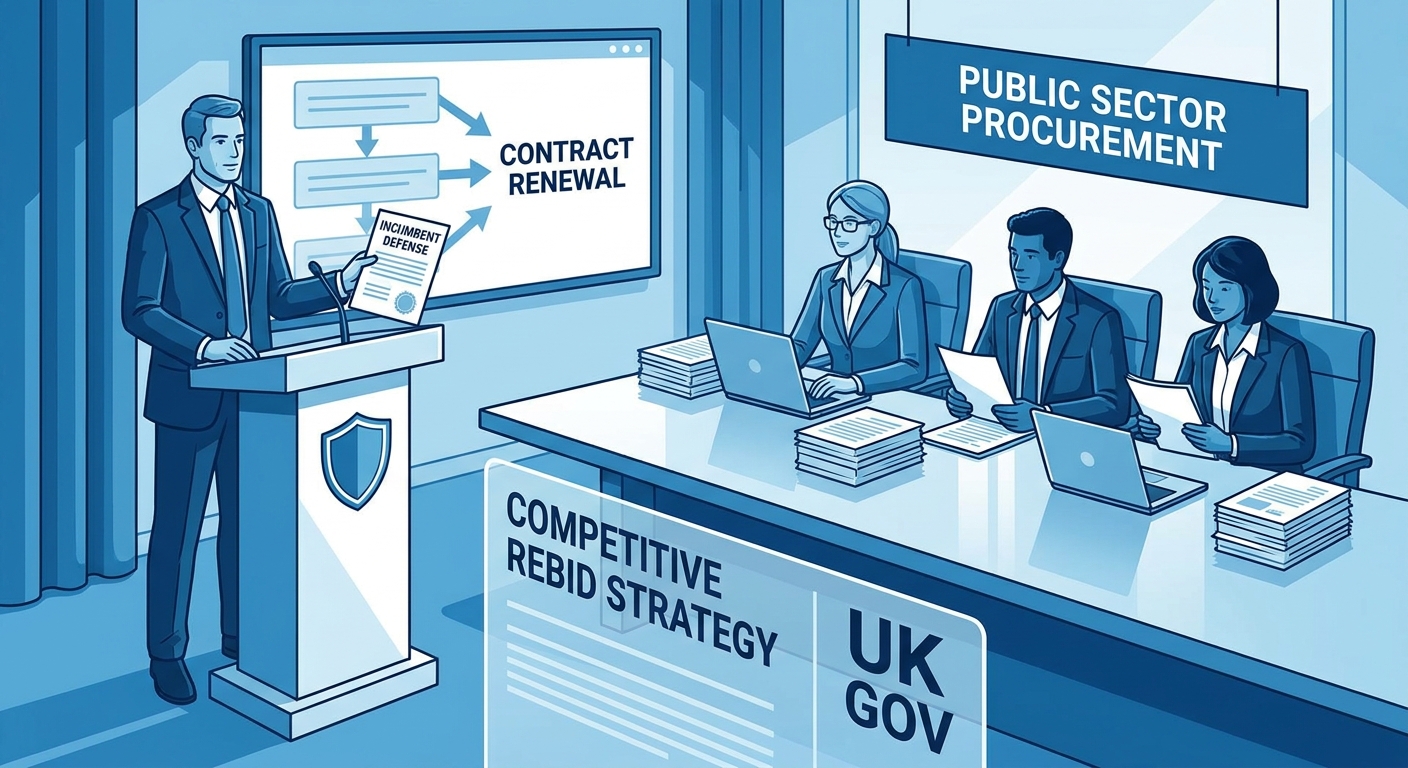
Incumbent supplier rebid strategy overview
Why Incumbents Lose Contracts They Should Win
Before building a winning rebid strategy, it's worth understanding precisely why incumbents fail. The causes cluster into three broad categories: complacency, evidence failure, and strategic misreading.
Complacency is the most common killer. After years of delivering a contract, suppliers begin to assume the client relationship will carry the submission. They spend less time on bid preparation than they would for a new opportunity. They recycle old content. They fail to articulate the value of everything they've delivered because it feels obvious to them — even though evaluators may have little institutional memory of the contract's history, particularly if the team has turned over.The most dangerous form of complacency is assuming your day-to-day relationship with the client will translate into evaluation scores. In a compliant procurement, evaluators must score responses based on written submissions against published criteria. The relationship you've built with the facilities manager counts for nothing if it doesn't appear in your written response with evidence.
Evidence failure strikes even suppliers who do work hard on their rebids. The trap is this: incumbents accumulate enormous volumes of delivery data, client communications, performance reports, and improvement initiatives over the contract term — and then fail to systematically extract and present that evidence in their tender response. Years of monthly KPI reports sit in shared drives untouched while the bid team writes generic performance claims that any competitor could make.New entrants cannot match your lived experience of this specific contract. But if your response doesn't demonstrate that experience with specificity and evidence, evaluators have no way to distinguish you from a competitor who has delivered a similar contract somewhere else.
Strategic misreading occurs when incumbents fail to understand how the procurement landscape has shifted since they were last in competition. Buyer priorities evolve. The Procurement Act 2023 has changed evaluation frameworks significantly. Social value weightings have increased. Carbon reduction commitments, digital transformation requirements, and workforce development expectations have all become standard evaluation criteria. An incumbent who wrote a winning response seven years ago and updates the same document for 2026 is bidding into a fundamentally different procurement environment.The Incumbent Advantage: What You Actually Have
Despite these failure modes, incumbency does confer genuine advantages — when you know how to use them.
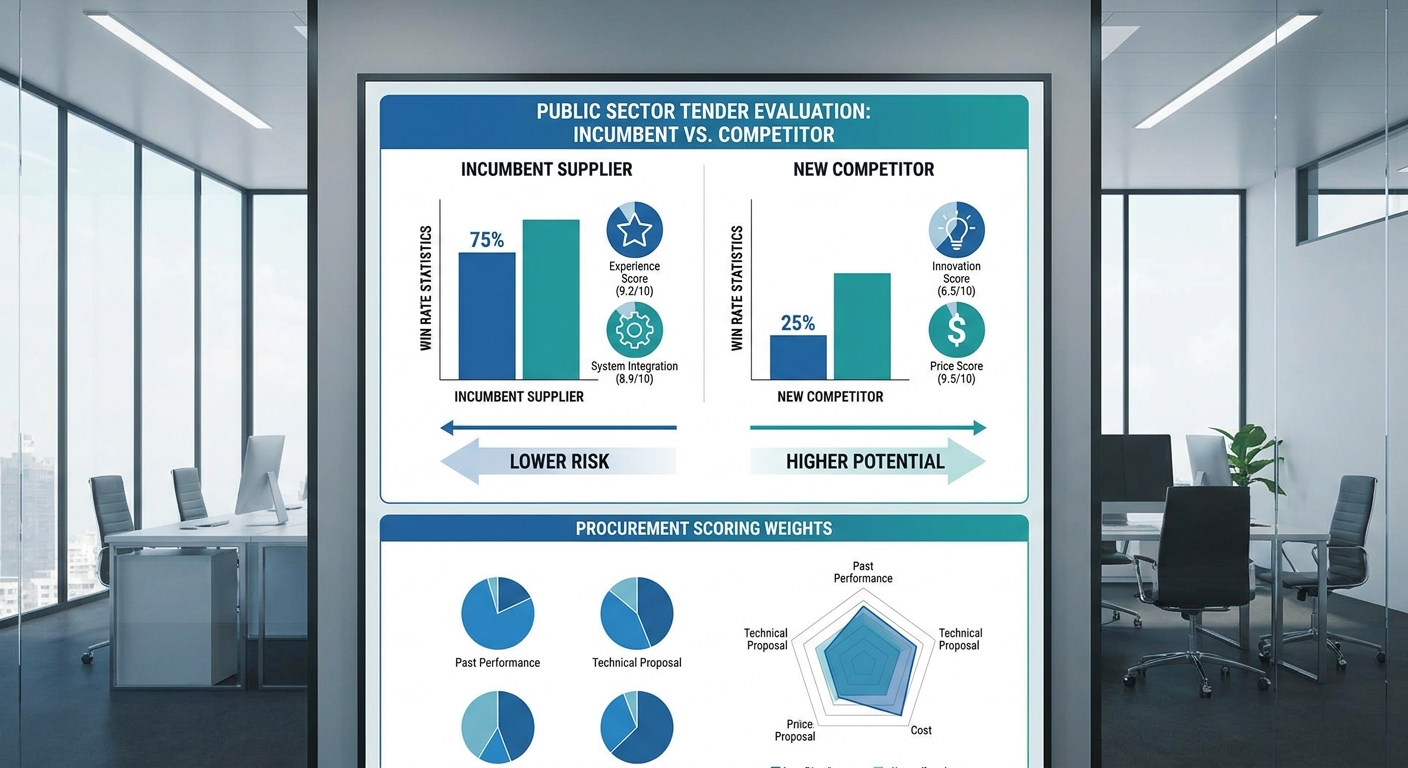
Incumbent advantage analysis chart
Note the important qualification here: using relationship intelligence to shape your written response is legitimate and smart. Using it to seek information not available to other bidders, or to gain commercial advantage outside the procurement process, creates legal and reputational risk. The line matters.
Mobilisation certainty is an underused advantage. Every new entrant faces mobilisation risk — TUPE transfers, system migrations, knowledge transfers, staff inductions. These risks are real and buyers know it. An incumbent who explicitly addresses mobilisation risk in their response, and demonstrates that they eliminate it entirely by virtue of continuity, addresses a material buyer concern that competitors cannot neutralise. Existing infrastructure delivers genuine cost advantages. You've already absorbed equipment purchases, system setup, staff training, and process development costs. Depending on the contract, you may be able to offer improved pricing on rebid simply because you're not rebuilding from scratch. Demonstrating this in your pricing narrative — without revealing confidential margin information — strengthens your commercial case.The 12–18 Month Rebid Preparation Framework
The single most reliable indicator of rebid success is how early preparation begins. Suppliers who start serious rebid preparation 12–18 months before contract expiry consistently outperform those who treat the rebid as a bid management task beginning when the ITT drops.
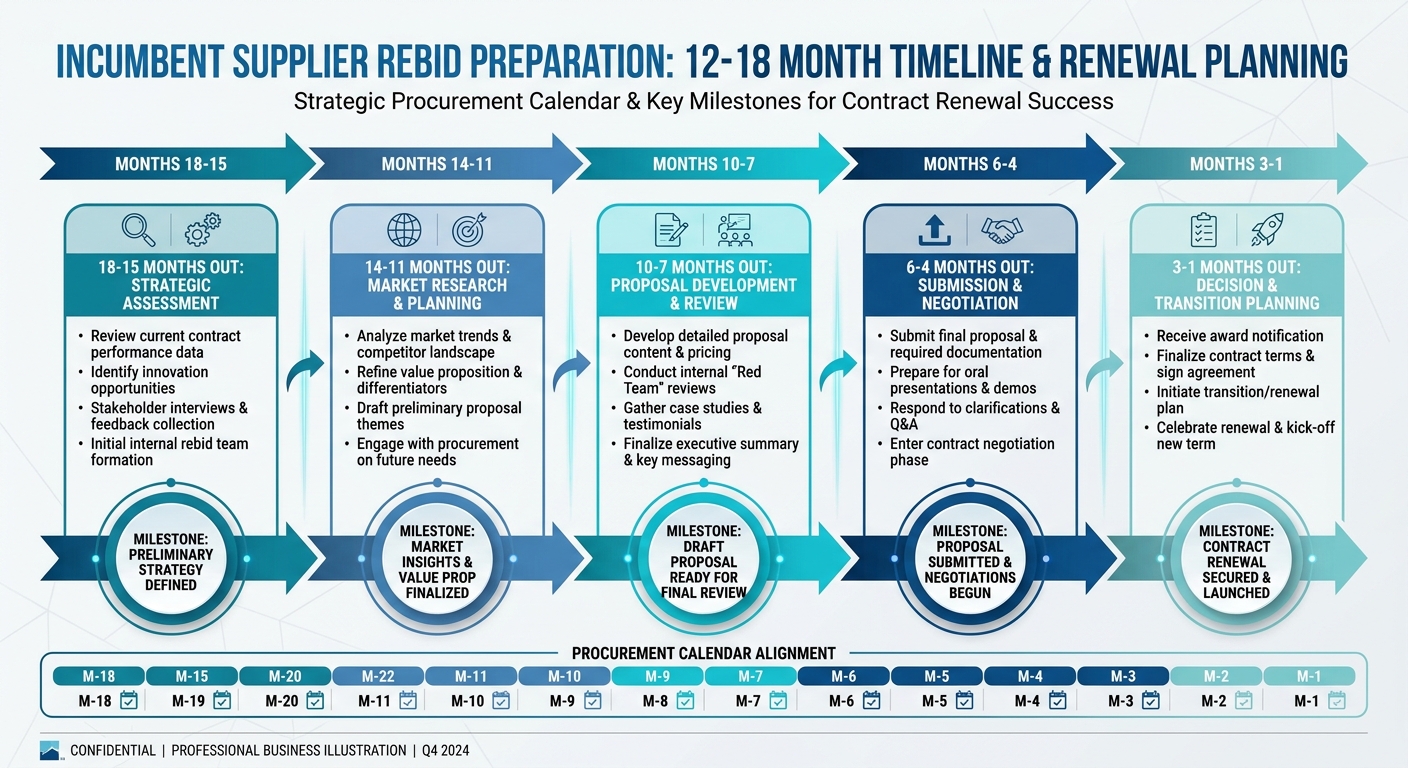
Incumbent rebid preparation timeline
This phase is about systematically building the evidence base you'll need for your tender response, and actively managing the client relationship to understand how priorities are shifting.
Begin extracting performance data now. Don't wait until the ITT arrives to start pulling KPI reports, client satisfaction surveys, innovation logs, and service improvement records. Create a structured evidence library organised by the evaluation themes that typically appear in contracts of this type — quality, value, social value, sustainability, staffing, and so on. Every piece of evidence should include: what happened, when, what the measured outcome was, and what the client's response was.
Conduct a structured review of contract delivery with your senior team. Identify genuine achievements — cost savings, service improvements, innovations introduced, incidents successfully managed. Also identify weaknesses: service failures, client complaints, areas where performance has been marginal. You need to know what questions a well-briefed competitor might raise about your delivery before those questions arrive in an evaluation.
Engage with the client about their future priorities. Most procurement regulations permit normal contract management conversations right up until the formal procurement begins. Use this window to understand whether their priorities are shifting, whether there are service improvements they haven't formally requested but would value, and whether there are concerns about the contract they haven't raised formally.
Check market developments. What are competitors offering that you're not? What innovations have emerged in your service sector? What pricing changes are happening in your supply chain? Going into a rebid at the same price with the same service model as five years ago is a losing strategy if the market has moved on.
Months 12–9 before contract end: Strategy and differentiationBy this stage you should have a clear picture of your evidence base and a preliminary view of where the competitive landscape sits. Use this phase to develop your rebid strategy — the distinctive positioning that will carry your response.
Define your rebid narrative. This is the 2–3 sentence story of why you are the best choice for this contract, grounded in specific evidence and forward-looking commitment. Something like: "For the past six years we have delivered FM services across 47 sites with 99.4% KPI compliance, zero formal complaints, and £340,000 in verified cost savings — and our 2026–2031 proposal builds on that foundation with next-generation monitoring technology, enhanced social value commitments, and a mobilisation-free transition that eliminates the continuity risk every alternative carries."
Identify your three or four strongest differentiators and build the response architecture around them. These should be things that are genuinely true about your delivery, verifiable from your evidence library, and difficult for new entrants to credibly claim.
Review the likely evaluation criteria and weightings. Previous ITTs for this contract, framework documents, and the buyer's published procurement strategy all give signals. Look at how criteria weightings have shifted since your original award — social value and sustainability typically carry heavier weightings now than they did pre-2020.
Conduct a formal gap analysis. Where does your current service delivery fall short of what the rebid is likely to require? What investments, partnerships, or capability developments do you need to make in the next six months to address those gaps — and to be able to evidence them in your response?
Months 9–6 before contract end: Preparation and investmentExecute on the gap analysis. If you've identified that the rebid will require enhanced digital reporting capabilities, now is the time to develop and deploy them — both because you'll deliver better value to the client in the remaining contract term, and because you'll have evidence of live capability rather than a promise when the ITT arrives.
Build your bid team and begin content development. Don't wait for the ITT. Draft response frameworks based on expected evaluation themes. Develop case studies. Write up your innovation log. Prepare your social value methodology. This advance work dramatically reduces the pressure when the ITT actually arrives.
Begin stakeholder engagement for letters of support. Subcontractor commitments, supply chain confirmations, and letters from community partners supporting your social value claims all take time to arrange. Starting now means you'll have strong supporting documentation rather than scrambling to assemble it in a four-week ITT window.
Review your pricing model. Based on market intelligence and your cost efficiency improvements during the contract term, develop a preliminary pricing position. In most public sector procurements, commercial scores are significant — typically 20–30% of overall weighting. Coming in with a credible, competitive price is non-negotiable, but you also need the narrative to explain how you're achieving value rather than simply undercutting.
Months 6–0 before contract end: ITT response and submissionWhen the ITT arrives, your preparation means you're translating existing evidence and strategy into formatted responses rather than building from scratch under deadline pressure. This quality difference shows in scores.
Respond to every question with evidence from your contract-specific delivery. Generic statements about your company's capabilities should appear rarely if at all. Every answer should reference actual performance, named initiatives, verified outcomes, or specific commitments.
Have your response reviewed externally before submission. Bid writing is a specific skill, and teams who have lived with a contract for years often lose perspective on what needs explaining and what reads as jargon. An external reviewer — whether an internal bid management function or an external bid writing consultant — consistently identifies gaps that the core team misses.
Avoiding the Most Common Incumbent Mistakes
Even well-prepared incumbents make avoidable errors. These are the mistakes that most consistently cost incumbent suppliers their contracts.
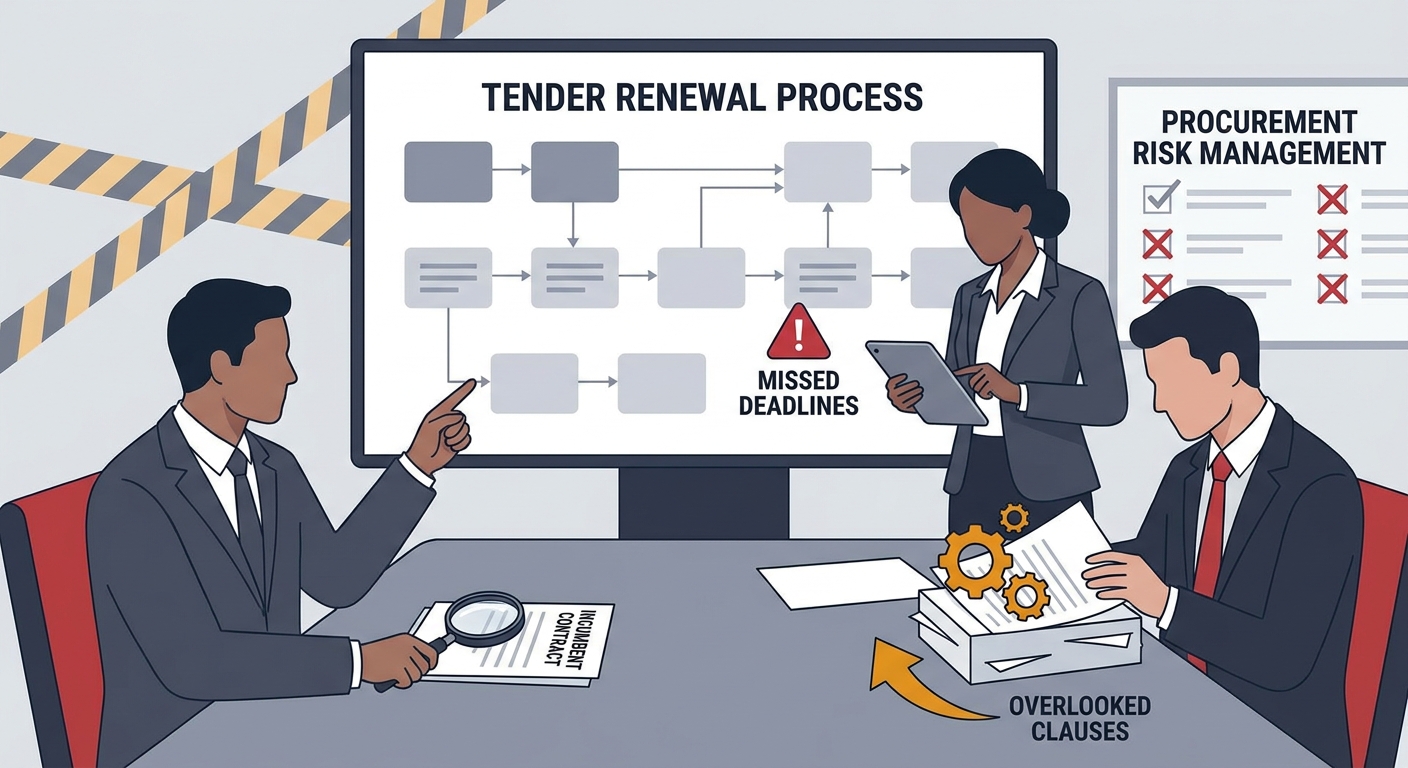
Common incumbent rebid mistakes to avoid
Incumbents have a genuine advantage here: you already have social value delivery to evidence from the current contract term. A new entrant can only make promises. You can make promises backed by a track record. If you haven't tracked social value metrics during the current contract, start now — immediately — and build that evidence base before the ITT arrives.
Underestimating new entrant quality. The incumbent who has delivered satisfactorily but without distinction is vulnerable to a new entrant who brings a compelling narrative of transformation, innovation, and fresh thinking. Buyers sometimes genuinely want change — to refresh relationships, introduce new ideas, or reset service expectations. If your current contract delivery has been adequate rather than excellent, a new entrant can construct a credible case for change. The antidote is to have delivered, and evidenced, a genuinely excellent service. Disclosing incumbent-only information in pre-market engagement. The pre-market consultation phase that often precedes formal procurements can create complications for incumbents. You may be invited to contribute to requirements development based on your contract knowledge. This is legitimate — but be scrupulously transparent. Any information shared with you in this phase that isn't available to competitors can invalidate the procurement. Protect your position by ensuring all such information passes through formal procurement channels. Neglecting price. Some incumbents believe that strong quality scores will protect them from commercially aggressive competitors. Under most evaluation frameworks this is a miscalculation. A competitor who scores 5–8% better on price can often offset quality score differences, particularly in procurements with 30%+ commercial weighting. Your incumbent knowledge should enable you to develop a genuinely efficient delivery model — and to price it accordingly.Writing Your Rebid Response: Evidence-Led Structure
The mechanics of your written response deserve detailed attention. The principles are straightforward but require disciplined execution.
Lead with outcomes, not activities. Every response section should open with the outcome you delivered or will deliver, not the process you followed or will follow. "Our reactive maintenance team resolved 94% of reported faults within four hours during the 2024–25 contract year, against a KPI target of 85%, verified in [Client]'s monthly performance dashboard" is categorically more compelling than "We have an experienced reactive maintenance team who respond promptly to all reported faults." Use the STAR framework for evidence. Situation, Task, Action, Result. For incumbent suppliers, the situation and task context is often the actual contract environment — which you know intimately. The action is what you specifically did. The result is the measurable outcome. Where possible, include client verification of the result. Structure responses around the buyer's evaluation criteria, not your company's structure. Incumbents often instinctively organise responses around their service delivery model rather than the evaluation questions. This creates friction for evaluators who must mentally map your answer onto their scoring criteria. Make their job easier: answer the question asked in the order it's asked, with the evidence that directly addresses each criterion. Quantify everything that can be quantified. Percentages, absolute numbers, time periods, financial values, headcount, survey scores. Evaluators are comparing responses across multiple bidders. Specific numbers create cognitive anchors that generic statements cannot. "We have achieved a 97.2% client satisfaction rating across four consecutive annual satisfaction surveys" is a fact. "We consistently achieve high client satisfaction" is a claim any competitor can make. Address the future explicitly. For each major service area, include a forward-looking commitment section: what you will do differently or better in the next contract term, and why. Ground this in evidence from your contract delivery that demonstrates you've identified improvement areas and have a credible plan to address them. This shows learning capability — a quality that buyers value but that generic responses almost never demonstrate.Pricing Your Rebid Effectively
Commercial evaluation in public sector tenders typically uses a price-quality ratio, with commercial scores representing 20–40% of overall evaluation weighting depending on the procurement. Getting pricing right is therefore critical — but "getting pricing right" doesn't mean "submitting the lowest price."
Cost modelling with incumbent intelligence. You know the real cost of delivering this contract in ways that competitors estimating from first principles do not. You know the actual maintenance costs of specific assets, the real demand patterns, the staffing levels that genuinely work. This intelligence should inform a realistic cost model that neither inflates prices to protect margin nor undercuts to the point of delivery risk. Demonstrating value for money, not just low price. Evaluators assess commercial submissions on value for money, which means the relationship between price and quality. A bid priced 10% above the lowest competitor, with demonstrably superior quality and zero mobilisation risk, can represent better value for money than the cheapest submission. Frame your commercial narrative around total cost of ownership, mobilisation cost savings, performance risk reduction, and long-term partnership value. Pricing innovations. If your rebid includes service innovations — new technology, improved processes, extended service parameters — price them transparently. Show evaluators what additional value they receive for any price increase relative to the current contract. Conversely, if efficiency improvements enable you to offer improved pricing, quantify the efficiency gain and show how you're passing it to the buyer. Avoiding the complacency premium. Some incumbents price rebids at a margin above competitors, assuming their incumbent position justifies a premium. In competitive public sector procurement, this rarely holds. Unless you have a genuine, demonstrable advantage that no competitor can match, your pricing should be competitive within the market. The mobilisation-free transition you offer has value — but that value should be presented in your quality response, not hidden in your price.Using AI Tools to Strengthen Your Rebid
The emergence of AI-powered bid writing tools has fundamentally changed what's possible in tender preparation — and incumbents are particularly well-placed to benefit.

AI bid writing tool helping with incumbent rebid
The key principle is that AI tools amplify the quality of your input. An incumbent with strong contract performance data, clear strategic thinking, and well-developed evidence will produce far stronger AI-assisted responses than an incumbent who attempts to use AI to compensate for weak delivery or insufficient preparation. Start early, build your evidence base, and let AI tools help you turn that evidence into compelling written responses.
Contract Management During the Rebid Period
A commonly neglected dimension of rebid strategy is what happens during active service delivery in the final 12–18 months before the contract end date. This period is simultaneously your last opportunity to build the evidence base for your rebid and your highest-risk window for the service failures that could undermine it.
Visible delivery improvement. If your rebid narrative includes commitments to enhanced service delivery, demonstrating those improvements in the live contract before ITT submission provides powerful supporting evidence. Rolling out a new digital reporting system, implementing additional community programmes, or achieving an environmental certification during the final contract year is far more credible than promising to do so in the next term. Stakeholder relationship management. The final contract months are not the time to coast. Client satisfaction surveys conducted in this period will be cited in evaluation panels. Relationship quality with senior client stakeholders will influence whether the client's internal view of your performance is positive or qualified. Invest disproportionately in client relationship management during the rebid window. Managing service risk. A significant service failure in the final 12 months of a contract — even if quickly resolved — can fundamentally damage a rebid. Evaluators who know about a recent incident will look for evidence that it was addressed and lessons embedded. Ensure your quality management and incident response processes are sharp, and that any incidents during this period are handled with maximum transparency and documented resolution. Transition planning. Regardless of rebid outcome, you have contractual obligations around contract transition. Developing a thorough transition plan as part of your rebid response demonstrates professionalism and reduces buyer risk. It also positions you well if you win — the transition plan becomes the operational framework for the next contract period.After the Submission: Standstill, Debrief, and Challenge
The submission of your rebid response is not the end of the process. Understanding what happens between submission and award — and how to navigate it — can make the difference between retaining and losing a contract.
Standstill period obligations under the Procurement Act 2023. Following the issue of award decisions, contracting authorities must observe an eight-day standstill period before entering into contract. During this window, unsuccessful bidders have the right to request debrief information and, if grounds exist, to seek an automatic suspension pending legal challenge. As an incumbent, understanding this process protects your position if a new entrant attempts to challenge an award in your favour — and equips you to challenge appropriately if you believe an award against you was flawed. Requesting your debrief proactively. Whether you win or lose your rebid, request a formal debrief. If you've won, understanding what scored well and what was marginal strengthens your performance management and future bid capability. If you've lost, debrief information is essential intelligence — both for any challenge consideration and for understanding what you need to do differently in future procurements.Under the Procurement Act 2023, contracting authorities now face enhanced transparency obligations. Published award notices must include more detail about evaluation outcomes, and debriefs must cover scoring, strengths, weaknesses, and the comparative position of other bidders. Use this information rigorously.
Grounds for legal challenge. Procurement law provides mechanisms for challenging award decisions in cases of procedural irregularity, evaluation error, or manifest unreasonableness in scoring. These aren't routes to be taken lightly — procurement challenges are expensive, time-consuming, and damage relationships even when successful. But where there are genuine grounds — clear scoring errors, departure from published criteria, undisclosed conflicts of interest — challenge rights exist and should be understood. Transition obligations whether you win or lose. If you lose a rebid, your obligations don't end at contract expiry. TUPE regulations, asset transfer requirements, data handover, and knowledge transfer obligations all continue. Managing exit professionally — even from a contract you've lost — protects your reputation, supports your former staff, and preserves the relationships that may lead to future opportunities with this client.Building a Long-Term Rebid Culture
The organisations that consistently retain public sector contracts don't treat rebidding as an event — they treat it as a continuous process. Rebid readiness is built into how they manage contracts, not bolted on when notice of re-procurement arrives.
Practically, this means several things. Performance data is captured systematically from day one of every contract, not retrospectively assembled for bid purposes. Innovation and improvement are documented in real time, not reconstructed from memory. Client relationship management includes regular structured conversations about satisfaction, priorities, and future direction, not just operational delivery meetings.
It also means investing in bid capability as an organisational function rather than a response to individual opportunities. Suppliers who maintain dedicated bid management resources — whether internal teams or retained external expertise — consistently outperform those who assemble ad hoc teams for each submission. The bid management function carries institutional knowledge about evaluation criteria, procurement trends, and response quality standards that isn't recreatable on a per-opportunity basis.
Finally, it means treating every procurement decision — including losses — as structured learning. The best organisations do post-submission reviews after every tender, regardless of outcome. They compare submitted responses against evaluation feedback, identify systematic patterns in strengths and weaknesses, and embed lessons in their bid playbooks. Over time, this systematic approach produces measurable win rate improvements that compound into significant revenue differences.
Conclusion: Incumbency Is an Asset, Not a Guarantee
Incumbent suppliers who approach rebidding strategically — starting early, building comprehensive evidence, positioning distinctively, and writing with rigour — retain their contracts at far higher rates than the industry average. The 30–45% incumbent loss rate isn't inevitable. It largely reflects the complacency and preparation failures described in this guide.
Your years of delivery experience represent genuine, transferable value. The knowledge you've accumulated about this specific contract, client, and operational environment cannot be replicated by any new entrant. The performance data you've generated is irreplaceable evidence of delivery capability. The relationships you've built support a level of insight into client priorities that competitors must guess at.
But none of that converts into evaluation scores unless it appears in your written submission, evidenced, specific, and structured around what the buyer is actually trying to achieve. The gap between the value you've delivered and the value you've communicated in your rebid response is where most incumbent losses are actually decided.
mytender.io's AI-powered platform is built for exactly this challenge. It helps incumbent suppliers extract and synthesise years of contract performance data into compelling, evidence-rich tender responses — ensuring that your lived experience of delivering this contract is visible, structured, and persuasive to the evaluators who will decide whether you keep it. From evidence management and response drafting to quality review and compliance checking, mytender.io transforms the rebid process from a high-stress scramble into a systematic, repeatable advantage.
Whether you're 18 months from your contract end date or responding to an ITT that arrived this week, the principles in this guide apply. The earlier you start, the stronger your position. Start now.
Tags
Ready to Transform Your Tender Writing?
See how MyTender's AI can help you write winning tenders in a fraction of the time.