

How to Beat the Incumbent: A Complete Guide to Winning Contracts from Established Suppliers
Incumbent suppliers win most public sector re-tenders — but not because challengers can't compete. This guide reveals exactly how to displace an entrenched supplier, exploit their blind spots, and build a bid that forces evaluators to choose you.
mytender.io Research Team
Tender Writing & Bid Management Specialists
There is a persistent myth in UK public sector procurement: that the incumbent always wins. That buyers favour the status quo. That challenging an entrenched supplier is expensive, time-consuming, and ultimately futile.
That myth is wrong — but only for bidders who know what they're doing.
The truth is more nuanced. Incumbents do win most re-tenders. Research consistently shows that the current supplier retains the contract in somewhere between 60–75% of competitive re-procurements. But that figure masks something important: in the vast majority of cases where challengers lose, they lose because of how they bid — not because the incumbent was genuinely better. They submitted generic content. They failed to understand what the buyer actually wanted to change. They didn't exploit the incumbent's weaknesses. They gave evaluators no compelling reason to switch.
This guide is for bid teams who want to be in the 25–40% who displace an incumbent. It covers the psychology of re-procurement, the structural weaknesses incumbents always expose, how to build a differentiated bid that creates genuine pressure, and how modern AI-powered tools like mytender.io can give challenger suppliers the edge they need.
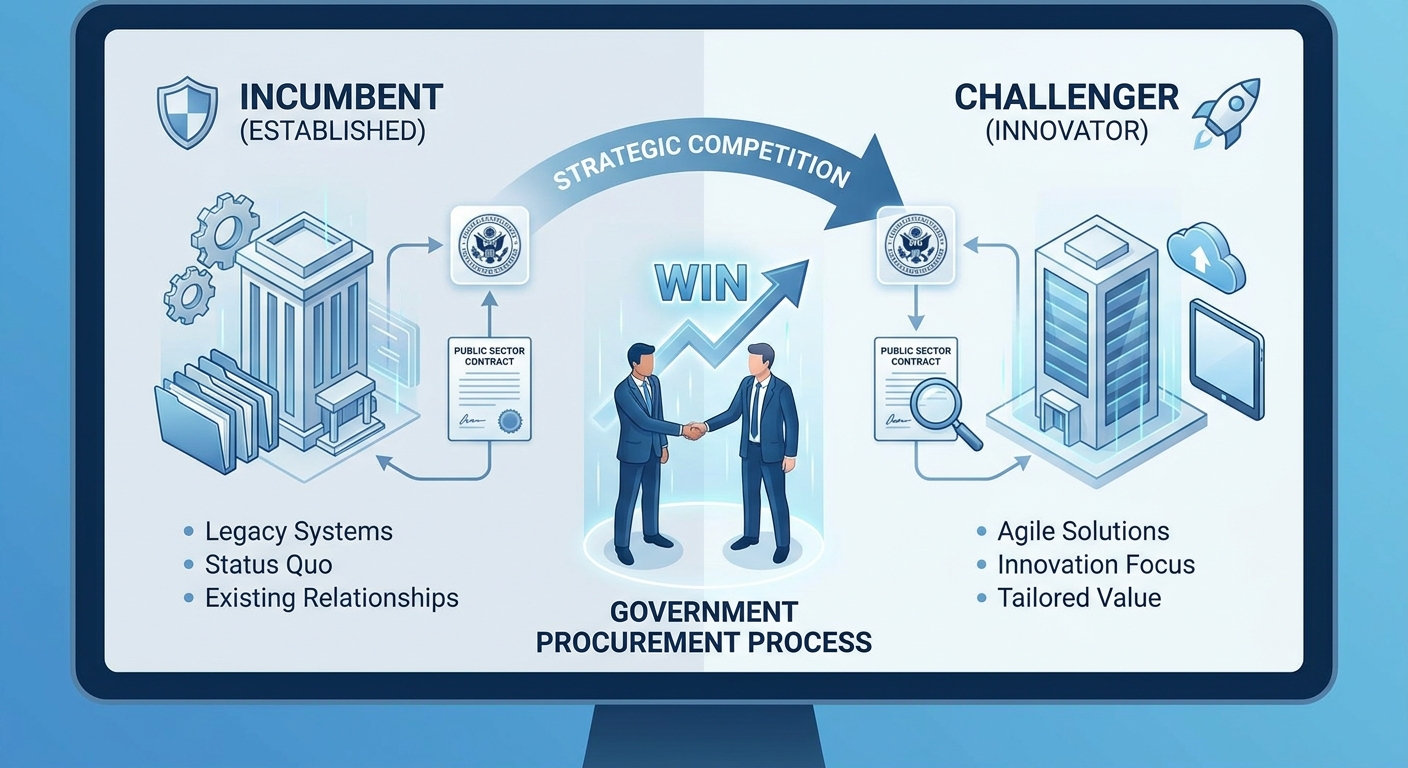
Professional bid strategy showing a challenger supplier competing against an incumbent to win a public sector government contract
Why Incumbent Suppliers Win (And Why It's Not What You Think)
Before you can displace an incumbent, you need to understand why they keep winning. The reasons are more strategic than most challengers assume.
Switching Costs Are Real — But Overstated
Buyers cite switching costs frequently. Onboarding a new supplier requires staff time, system integrations, process changes, and risk management. For a complex services contract, a poorly managed transition can disrupt live services for months. Buyers remember bad transitions viscerally — in a way they rarely remember the slow decline of a mediocre incumbent's performance.
This is a real factor. But it's frequently overstated, and more importantly, it's manageable. A challenger who directly addresses transition risk in their bid — with a credible, detailed mobilisation plan — removes the switching cost objection from the evaluator's calculus entirely. The problem is that most challengers barely mention mobilisation, or treat it as a formality rather than a competitive differentiator.
Incumbents Know the Language
The incumbent has spent years in contact with the buyer. They know the jargon, the internal priorities, the names of the senior people, and the specific problems the service is currently solving. When they write their re-tender bid, they write it in the buyer's own language. It feels familiar. It feels safe.
Challengers rarely have this advantage — but they can close the gap. Procurement portals, contract registers, Proactis, Bluebird, and Simply Tenders publish the underlying specification documents. FOIA requests can surface incumbent KPI reports, performance data, and contract extension notices. OJEU award notices give contract values and award dates. The information asymmetry is narrower than most challengers assume.
The Risk Aversion Problem
Public sector evaluation panels are not risk-neutral. They are accountable for contract performance, and a switch to a new supplier that goes badly is professionally damaging in a way that a mediocre incumbent renewal simply is not. The evaluation criteria may score on quality, social value, and price — but there is an unwritten criterion in the room: who are we most comfortable defending to our management?
This is not corruption. It is human psychology. Your bid needs to make choosing you feel safe, not exciting.
The Procurement Act 2023 and What It Changes for Challengers
The Procurement Act 2023, which came into force on 24 February 2025, changed the competitive landscape in ways that specifically benefit challenger suppliers. Understanding these changes is essential for any serious bid strategy in 2026.
Market engagement transparency. Contracting authorities are now required to publish preliminary market engagement notices on the Find a Tender Service (FTS). This means challengers can see when a buyer is actively thinking about a new contract, often six to twelve months before the ITT drops. That lead time is invaluable — it allows you to build relationships, attend market engagement events, and shape your bid strategy long before your competition has started thinking about it. Standstill periods and debrief rights. Under the new Act, unsuccessful bidders have stronger rights to detailed feedback, including comparative scoring against the winning bid on each criterion. For a challenger who narrowly lost, this intelligence is gold. You can see precisely where the incumbent scored higher, identify the specific narrative gaps in your submission, and build a materially better bid for the next contract in the category. KPI publication requirements. Contracts over £2 million published after the Act came into force must include KPIs, and contracting authorities must publish the incumbent's performance against those KPIs every year. For challenger suppliers, this is a gift. If the incumbent is underperforming on published KPIs — and many are — you have objective, third-party evidence of their shortcomings that you can weave into your own bid narrative. Dynamic Markets. The new Dynamic Markets mechanism replaces Dynamic Purchasing Systems and is designed to be more accessible for SMEs and new market entrants. If the buyer is using a Dynamic Market framework, the barriers to entry are lower than ever.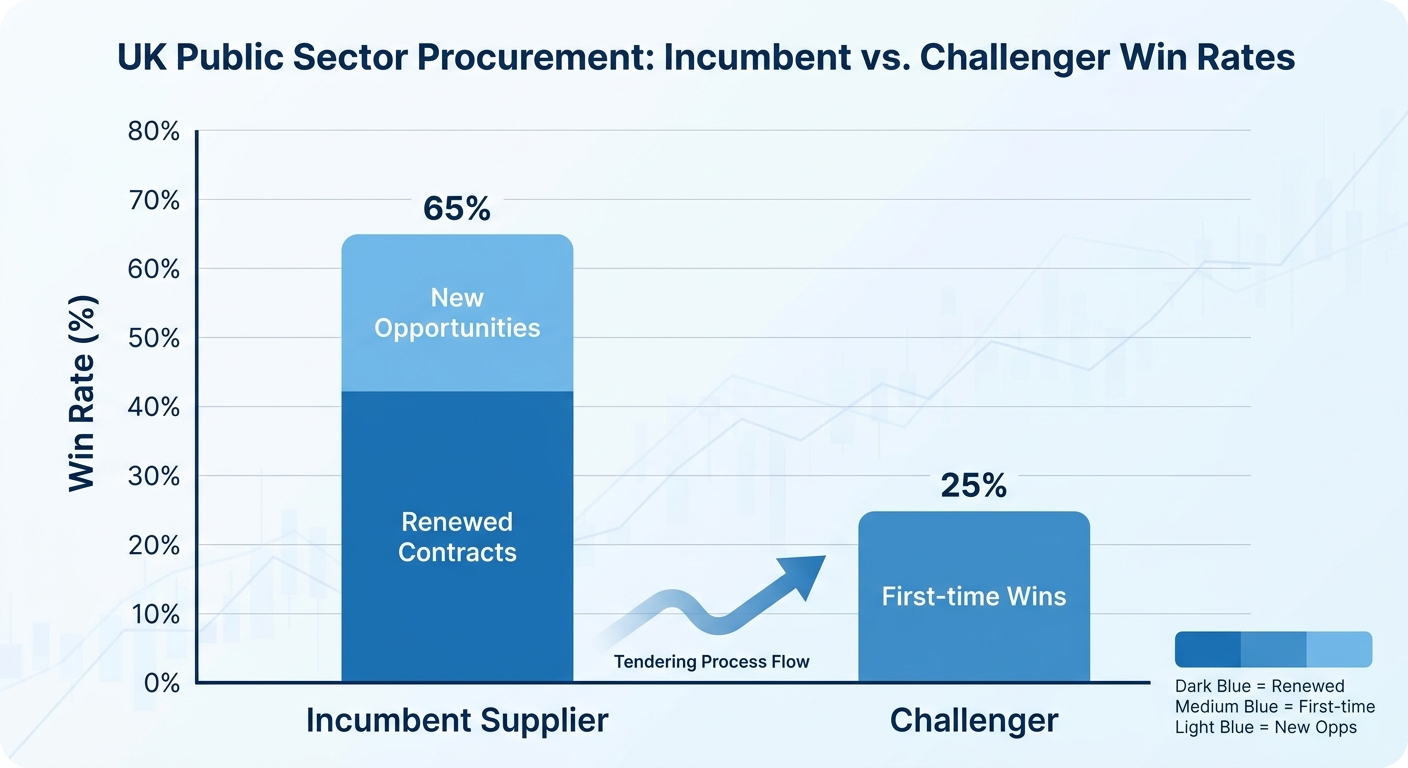
Bar chart comparing incumbent supplier vs challenger win rates in UK public sector procurement
The Five Weaknesses Every Incumbent Exposes
If you study enough re-tenders carefully, you see the same patterns in failing incumbents. They are not random. They are structural — the predictable consequence of years operating in a single contract without competitive pressure. Understanding these weaknesses tells you where to attack.
1. Complacency in the Written Bid
Here is the dirty secret of public sector procurement: many incumbent re-tender bids are surprisingly poor. After years in the contract, the bid team writes from familiarity rather than rigour. They reference "our established relationship" rather than demonstrating what they will do differently. They recycle language from the original winning bid without updating it to reflect the buyer's current priorities. They assume that performance history will carry the day — and sometimes it does. But evaluators who have identified real problems with the current contract are actively looking for something better.
A challenger who submits a genuinely excellent, insight-driven, tightly structured bid will often score significantly higher on quality than the incumbent's tired re-tread — even without the relationship advantage.
Your strategy: Treat every quality question as if you were writing from zero. No filler. No generic claims. Specifics only. Show you understand the contract better than the incumbent describes it.2. Price Drift
Incumbents tend to increase prices at each renewal, often through a combination of annual uplifts, scope creep charges, and re-pricing of resources in their retender submission. After three or five years, the gap between what the incumbent is charging and what the market rate actually is can be substantial.
Buyers notice this, but they often lack the independent benchmarking to challenge it effectively. A well-priced challenger submission — competitive without being recklessly cheap — creates an enormous amount of pressure. When the evaluation panel is looking at a quality score difference of a few points but a price difference of 15–20%, the conversation about switching costs changes dramatically.
Your strategy: Price competitively, but price with evidence. Use subcontractor quotes, labour market data, and publicly available framework rates to demonstrate the credibility of your pricing. Don't just undercut — explain why your price is what it is.3. The Innovation Gap
Incumbents are optimised for the contract they won, not the contract that would be ideal today. Technology has moved on. Best practice has evolved. The regulatory environment has changed. And the buyer — who has been living with the limitations of the incumbent's service model for years — almost certainly has a private wish list of things they'd do differently if they could.
You don't know that wish list. But you can infer a great deal of it from specification documents, industry reports, and the buyer's published strategy documents. And you can build a bid that positions you not as a like-for-like replacement for the incumbent, but as a meaningful step forward.
Your strategy: Read everything. The buyer's corporate plan. Their sustainability strategy. Their digital transformation roadmap. Their recent committee reports. Identify what they're trying to achieve and show how your service model accelerates that agenda. The incumbent is defending yesterday's solution. You're selling tomorrow's.4. Relationship Fatigue
This sounds counterintuitive — surely the incumbent's long relationship with the buyer is an advantage? Often it is. But not always.
After years in a contract, the incumbent's relationship with the buyer can become transactional, even antagonistic. Disputes over scope. Missed KPIs that are managed through negotiation rather than performance improvement. Escalations that create resentment. A buyer who feels trapped rather than supported. These dynamics are remarkably common in long-running public sector service contracts, and buyers who re-tender are often motivated partly by a desire to reset a relationship that has become difficult.
If you can identify those pressure points — through contract notices, published KPI data, FOIA requests, or simply reading the tone of the specification — you can position your bid as a fresh start. Not by attacking the incumbent explicitly (that almost always backfires), but by understanding the buyer's pain and showing that you understand it.
Your strategy: Frame your bid around the buyer's future, not the incumbent's past. Use language that signals you understand what they've been through without naming it. Buyers are remarkably responsive to suppliers who seem to genuinely understand their world.5. Compliance Risk
Regulatory requirements evolve constantly. Carbon reduction plans. Social value commitments. Modern slavery statements. Employment Rights Act 2025 obligations. Cyber security frameworks. Each new requirement is an opportunity for an incumbent who has not invested in compliance to fall short.
Many incumbents manage compliance reactively — they update their documentation when asked, but they haven't built it into their service model. A challenger who has invested in proactive compliance — who can demonstrate a Living Wage commitment, a credible carbon reduction plan, a published social value methodology with measurement frameworks — signals that they are operating to a higher standard across the board.
Your strategy: Build genuine compliance depth. Don't just tick boxes. Demonstrate that your compliance commitment is structural, not cosmetic. In a close evaluation, this can be decisive.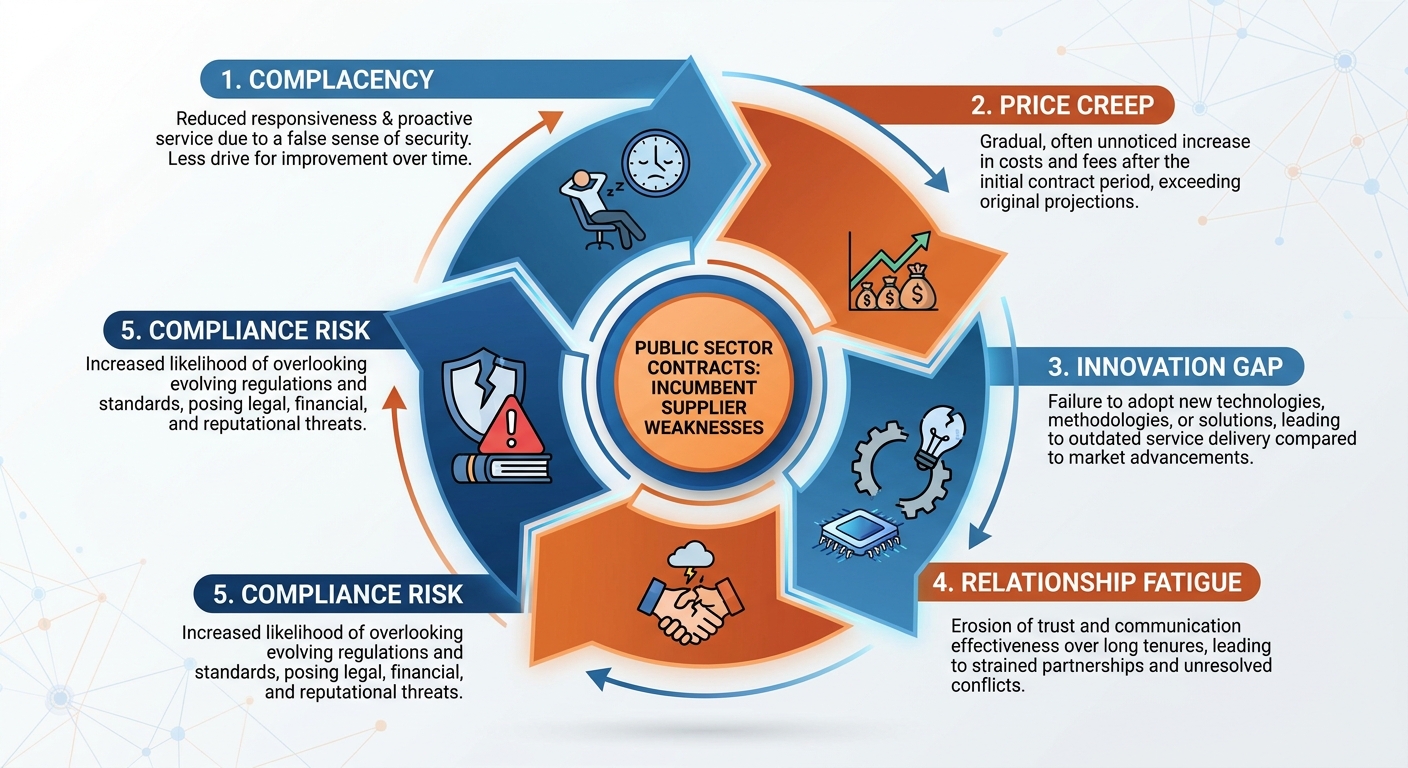
Diagram showing five key weaknesses of incumbent suppliers in public sector tenders
Building Your Challenger Bid Strategy
Knowing the incumbent's weaknesses is necessary but not sufficient. You also need to translate that intelligence into a bid structure and narrative that forces evaluators to engage with the comparison.
Start With the Intelligence Phase
The biggest mistake challenger bidders make is starting with the bid document. Start instead with three to four weeks of intelligence gathering:
Review all available public contract information. The contract award notice gives you contract value, start date, and sometimes the number of bids received. If there's been an extension, that tells you the buyer hasn't been fully satisfied but doesn't want the disruption of switching yet. Previous tender documents — often cached on Contracts Finder — reveal how evaluation criteria have evolved. Request the KPI performance data. Under the Procurement Act 2023, performance data should be published proactively for contracts over £2 million. For older contracts, FOIA requests to the contracting authority can surface a remarkable amount of information: KPI scores, service reviews, contract management meeting minutes, and correspondence about performance issues. The response rate is imperfect, but the hit rate is higher than most suppliers assume. Attend market engagement events. If the buyer has published a preliminary market engagement notice, attend the event or respond in writing. These events are your opportunity to understand what the buyer wants to change, ask questions that reveal their dissatisfaction with the current model, and begin to position yourself as a serious challenger before anyone else has entered the picture. Map the evaluation panel. Who is likely to be scoring this tender? The procurement officer, yes, but also the contract manager, the service director, and often a representative from the team who will actually use the service. Each of them has different priorities. The service director cares about strategic alignment and risk. The contract manager cares about day-to-day deliverability and responsiveness. The service users care about whether your people are actually good at the job. Your bid needs to speak to all of them.Define Your Differentiation Clearly Before You Write
Before anyone writes a single word of bid response, agree on your differentiation. What is the specific, demonstrable claim you are making that the incumbent cannot make? This should be a short statement — no more than two or three sentences — that answers the question: "Why should this buyer choose us over the incumbent?"
Common challenger differentiations include:
- Technology advantage: A proprietary platform, a reporting dashboard, or a digital workflow that the incumbent doesn't offer and the buyer genuinely wants
- Specialist expertise: A depth of sector-specific experience in a particular sub-area that the incumbent is weaker in
- Innovation in delivery model: A service model that is materially more efficient, responsive, or flexible than what the incumbent provides
- Commercial advantage: A pricing model that reflects current market rates, potentially with open-book accounting or gain-share mechanisms that demonstrate confidence
- Local presence or social value commitment: For contracts where social value is heavily weighted, a credible community benefit programme that the incumbent hasn't invested in
Whatever your differentiation is, it should run through every question in your bid like a thread. The evaluator reading your submission should encounter your core claim consistently, from the executive summary to the final appendices.
Write the Mobilisation Plan as a Competitive Weapon
Most challenger bids treat the mobilisation plan as an administrative formality — a Gantt chart appended at the end, showing tasks and dates without revealing genuine thinking. This is a serious missed opportunity.
A detailed, credible mobilisation plan does three things simultaneously: it demonstrates that you have genuinely thought through the complexity of transitioning from the incumbent; it removes the buyer's primary objection to switching (the fear of disruption); and it signals organisational maturity and delivery confidence.
Great mobilisation plans include:
- A week-by-week transition timeline with clear milestones and named accountabilities
- A dedicated transition manager (named individual, with a CV) who is separate from the contract delivery team
- An explicit description of how you will manage knowledge transfer from the incumbent — including what you'll do if the incumbent is uncooperative
- A parallel running period, if relevant, with specific criteria for sign-off
- Communication plans for service users
- Risk registers with mitigations for the specific risks of this contract's transition
When a buyer reads a mobilisation plan at this level of detail, they stop worrying about the switch. And when they stop worrying about the switch, they can evaluate your quality and price on their merits.
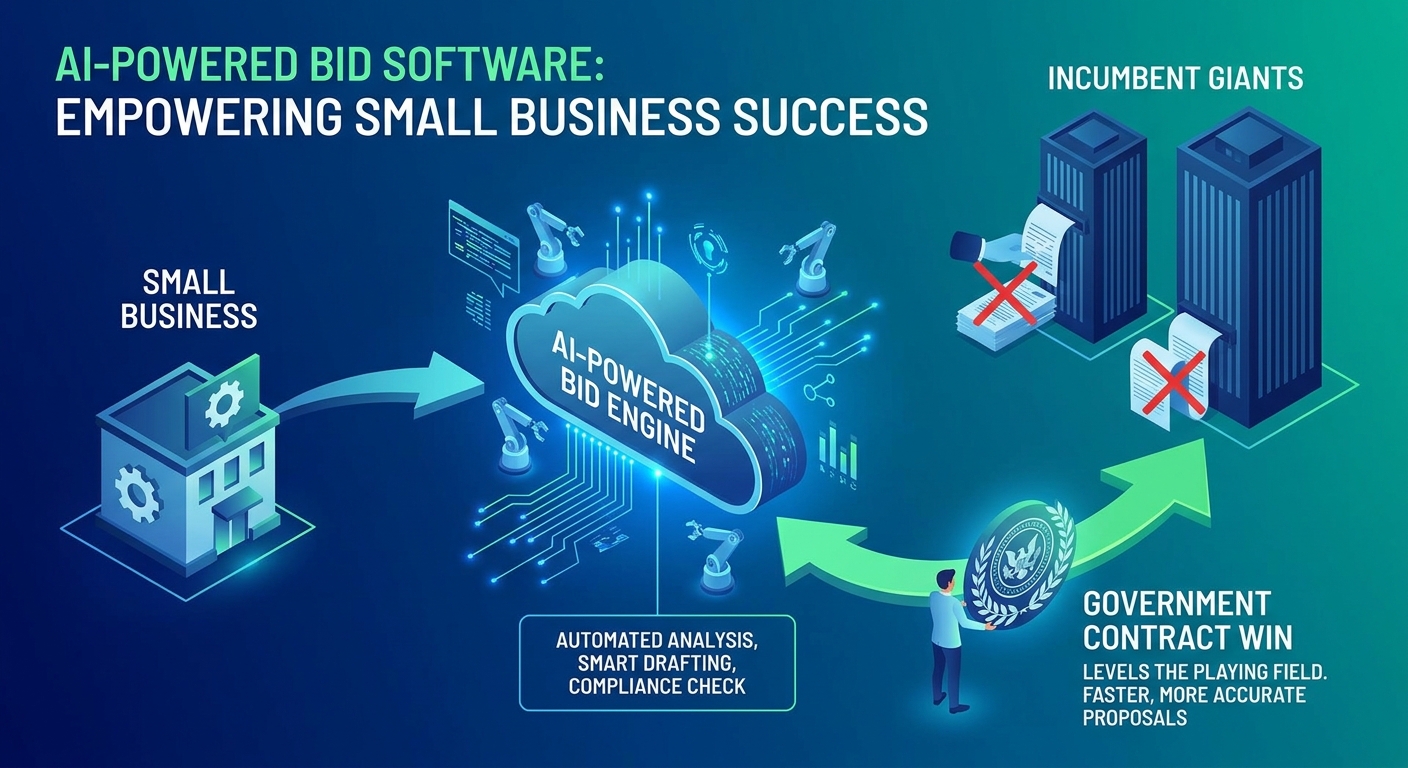
AI-powered bid writing software helping challenger suppliers win government contracts against incumbents
The Quality Response: How to Actually Write Better Than the Incumbent
The heart of every competitive tender is the quality responses — typically the method statements, case studies, and team profiles that explain how you will deliver the contract. This is where most challengers underperform, and where the gap between winning and losing is usually determined.
The "So What" Test
Every paragraph of every quality response should pass a simple test: so what? If you wrote "We have fifteen years of experience in facilities management services," the immediate follow-up question is: so what? How does that experience manifest in better outcomes for this specific contract? What did you learn from those fifteen years that you'll deploy here? What mistakes did you make that you won't make again?
The incumbent will almost certainly write in generalities. They'll claim "proven track record" and "experienced team" and "robust processes." These claims are unchallengeable because they're meaningless. Your job is to write with specificity that makes those generalities look thin by comparison.
Compare these two approaches to the same question ("Describe your approach to contract management"):
Generic (incumbent style): "We adopt a structured contract management approach with regular performance reviews, clear KPI reporting, and dedicated account management. Our experienced team proactively manages risks and maintains strong communication with all stakeholders throughout the contract lifecycle." Specific (challenger style): "Our contract management model is built around a single point of accountability principle: the named Contract Director holds personal responsibility for all KPI performance and is directly accessible to your Head of Estates — not filtered through a call centre or a junior account manager. In our current contract with [similar authority], this model reduced escalations to the Director level by 68% in Year 1 as issues were resolved at team level before they needed senior intervention. We propose a structured governance framework with monthly operational reviews, quarterly strategic reviews, and a real-time performance dashboard accessible to your nominated staff at any time..."The difference is not wordcount. It's specificity, evidence, and direct relevance to what the buyer will care about.
Case Studies: The Incumbent's Structural Disadvantage
Here is one area where challengers genuinely have the advantage: case studies. The incumbent must use examples from their existing contract with this buyer — but they cannot talk about their own performance objectively without risking contradiction, and they cannot use their relationship with the buyer as evidence because it would seem presumptuous.
A challenger, by contrast, can draw on their best work from across their portfolio. If you have delivered a genuinely outstanding contract somewhere in your history, this is the place to put it. Not in a dry summary format, but as a narrative: what was the challenge, what specifically did you do, and what were the measurable outcomes?
Well-constructed case studies do something powerful: they allow evaluators to visualise your delivery. They move from abstract claims to concrete experience. And they stay in the evaluator's memory in a way that bullet-pointed service descriptions simply do not.
Structure every case study around: the client's challenge, your specific solution (not generic service description), your measurable outcomes (with numbers), and a brief reflection on what this example demonstrates about your approach. If you have a client reference who will speak to the evaluator, say so. A direct endorsement from a satisfied current client can be decisive.
Social Value: Don't Treat It as a Box-Tick
Social value weighting in public sector tenders has increased substantially over the past five years. Many frameworks and authorities now weight it at 10–20% of the total evaluation score. For challengers, this is an opportunity that incumbents frequently squander.
Incumbents often treat social value as a legacy bolt-on — a few commitments added to the original bid that get reported on at contract reviews without generating genuine community impact. Buyers know this. The social value methodology evaluators who review responses have seen every flavour of generic commitment, and they are increasingly sophisticated at identifying the difference between structural social value delivery and window dressing.
A challenger who invests in building a genuine social value programme — with local employment commitments, named third sector partnerships, skills development pathways, and a clear measurement framework mapped to the relevant national themes and outcomes — creates a meaningful gap at this criterion. And in a tight evaluation, that gap wins contracts.
The key is to make your social value offering specific to this contract and this community. A commitment to "creating 10 apprenticeships in the local area" is far stronger than "supporting local employment." A named partnership with a specific local college or community organisation is far stronger than "working with the voluntary sector." The more specific you are, the more credible you are.
Common Mistakes Challengers Make (And How to Avoid Them)
Even well-resourced bid teams make predictable errors when competing against incumbents. Here are the most damaging:
Attacking the incumbent directly. Some challengers make the tactical error of implicitly or explicitly criticising the current supplier in their bid. This almost always backfires. Evaluators often have relationships with the incumbent's team. Criticising a supplier the buyer has been working with for five years can feel like criticising the buyer's judgement. Stay relentlessly positive about your own proposition and let the comparison speak for itself. Underestimating word limits. Word and page limits in tender documents are not suggestions. Overrunning them is an automatic disqualification in some procurement processes and a negative scoring indicator in others. More importantly, bids that consistently hit the word limit without wasting words signal a team that is disciplined and focused — a quality many evaluators associate with contract delivery performance. Neglecting the financial questionnaire. The Selection Questionnaire (SQ) stage filters out bidders on financial standing, insurance, and past performance. Challengers sometimes invest heavily in their ITT responses while under-investing in the SQ. A stumble at SQ stage is an expensive waste. Submitting generic case studies. A case study from a contract that bears only superficial resemblance to the one you're bidding for is worse than no case study at all — it signals a lack of genuine relevant experience. If your best case study is from a different sector, explain the transferable lessons explicitly. Don't assume evaluators will make the connection. Ignoring the incumbent's published performance. If the buyer has published KPI data showing the incumbent underperforming, and you don't reference this intelligence anywhere in your bid strategy, you are wasting an enormous advantage. You don't need to name the incumbent. You can simply demonstrate that your service model addresses the specific failure modes visible in the published data.Using mytender.io to Close the Challenger Gap
The structural challenge for most challenger bidders is not capability — it's capacity. Writing a genuinely differentiated bid requires deep reading of the specification, careful intelligence gathering, multiple rounds of drafting and revision, and tight coordination across the bid team. For SMEs and mid-market suppliers competing without dedicated in-house bid teams, this is a real constraint.
mytender.io is purpose-built to address that constraint.
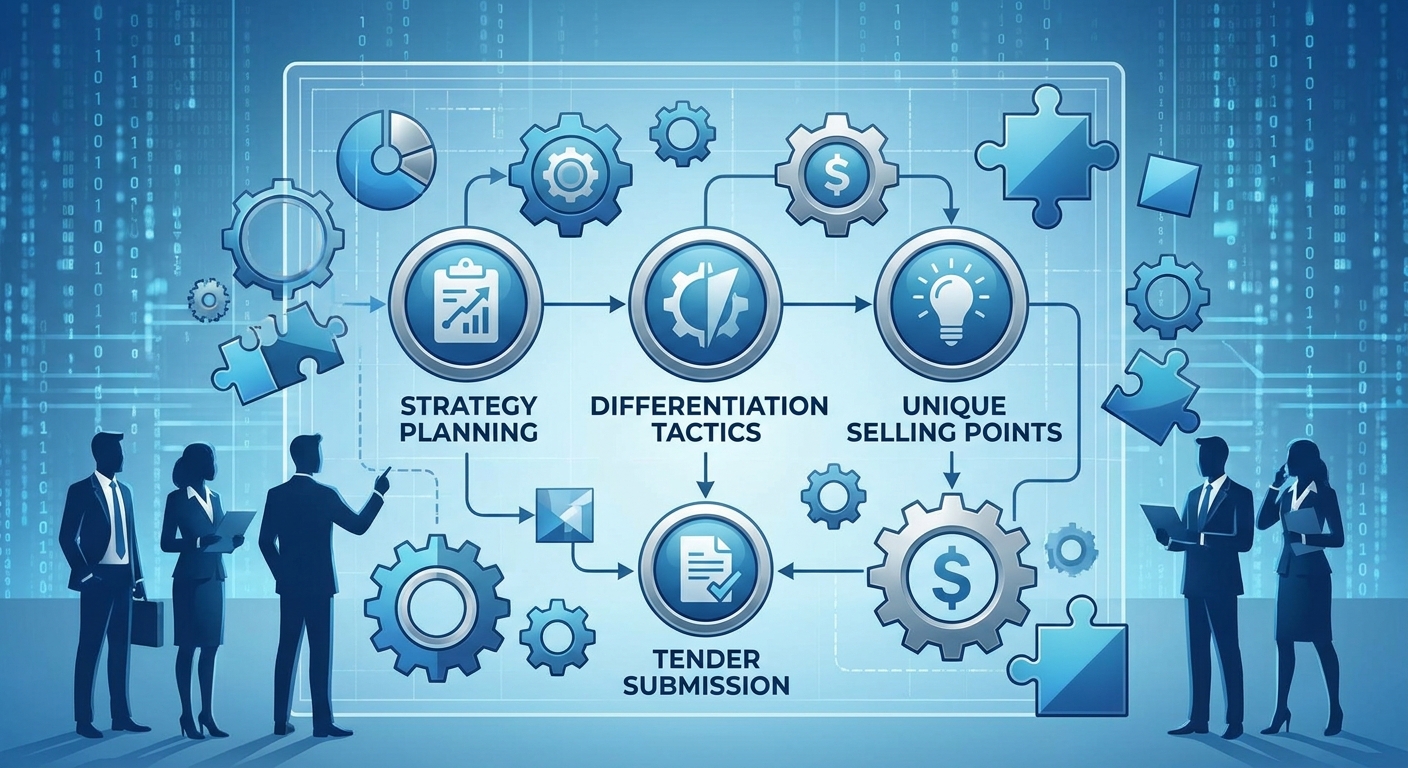
Bid strategy planning showing differentiation tactics for a tender submission
Intelligent Document Analysis
When you upload the tender specification and related documents to mytender.io, the platform reads them comprehensively — not just the ITT questions, but the evaluation criteria, the scoring weightings, the specification requirements, and any buyer guidance documents. It surfaces the key themes the buyer has emphasised, the specific requirements you must address, and the scoring implications of each section.
This is the intelligence work that most challengers rush or skip. With mytender.io doing this analysis automatically, your bid team can focus on the strategic decisions — what to say — rather than the administrative work of working out what you need to say and where.
Company Knowledge Library
mytender.io allows you to upload your company's existing materials — case studies, CVs, accreditation certificates, previous bid responses, policy documents, and delivery frameworks — into a searchable knowledge library. When you're writing a response to a complex quality question, the platform can draw on your company's real evidence base rather than generating generic text.
This is particularly powerful for challenger bidders. Instead of writing from scratch on every question, your team is building on a curated foundation of your best existing content, adapted and refined for this specific opportunity.
Quality Scoring and Gap Analysis
Before you submit, mytender.io provides a quality score against each evaluation criterion and identifies the specific gaps between your current response and what a maximum-scoring answer would contain. For a challenger bid, this is invaluable. You can see where your responses are strong, where they're thin, and where you've made generic claims that need to be replaced with specific evidence.
The platform also identifies inconsistencies across your bid — places where different sections give contradictory information, or where a claim made in one response isn't supported elsewhere. These are exactly the kinds of errors that cost points in evaluation.
Faster Iteration
The most important thing about AI-assisted bid writing isn't the quality of the first draft — it's the ability to iterate rapidly. With mytender.io, a quality response that would take two to three days to draft and review manually can go through multiple rounds of refinement in hours. That time compression allows bid teams to focus their human expertise on the decisions that matter most — competitive strategy, differentiation, and the specific knowledge that no AI can replicate.
The Timeline: Planning Your Challenger Campaign
Winning a contract from an incumbent is not primarily about the bid document. It's about the twelve months before the bid document is released.
12+ months before ITT: Monitor the contract register for renewal dates. Start attending relevant framework events and industry forums. Identify the buyer's key decision-makers and begin legitimate relationship building through conference networks and market engagement events. 6–9 months before ITT: Research the buyer's priorities in depth. Read their corporate plan, digital strategy, sustainability commitments, and recent committee reports. Begin developing your differentiation strategy. If a preliminary market engagement notice has been published, respond to it. 3–6 months before ITT: Invest in compliance infrastructure that you genuinely lack — carbon reduction plan, social value programme, Living Wage accreditation. These cannot be credibly invented at bid stage. If you need to develop case studies, begin capturing the evidence and impact data now. ITT release: Upload immediately to mytender.io. Prioritise the analysis phase over the drafting phase. Agree your differentiation statement before writing a single word. Allocate your best writer to the highest-weighted quality questions. Final two weeks: Internal review, external review if possible, quality scoring, and gap-closing. Submit with time to spare — last-minute portal submissions invite technical problems.When Not to Bid Against an Incumbent
This may seem counterintuitive in a guide about beating incumbents, but knowing when not to bid is as strategically important as knowing how to bid.
You should probably not bid against an incumbent if:
- You have no genuine differentiation from what the incumbent offers
- The buyer has given no public signal of dissatisfaction with current service
- You lack the financial standing to pass the SQ
- You cannot adequately staff the transition period in addition to your existing commitments
- Your case study evidence base is not credibly relevant to this contract
Submitting a weak bid against a well-entrenched incumbent doesn't just cost you this contract — it establishes a negative reputation with the buyer that will affect future opportunities. A professional, strategic decision not to bid, combined with market engagement that signals serious intent for the next cycle, is a better investment than a marginal submission.
Building a Long-Term Challenger Strategy
The suppliers who consistently win contracts from incumbents don't do it by finding a magic formula for individual bids. They do it by building systematic bid capability over time.
That means:
A living knowledge library. Every bid you write generates content, evidence, and insight. Capture it. Build a library of your best case studies, your strongest responses by question type, your pricing models, and your social value frameworks. mytender.io makes this straightforward — every upload and response automatically enriches your knowledge base for future bids. Post-bid learning. Win or lose, request a debrief. Use the comparative scoring data available under the Procurement Act 2023 to understand precisely where you sat against the winning bid on each criterion. Build that intelligence into your next attempt. Pipeline discipline. Not every tender is worth chasing. Develop a rigorous bid/no-bid framework that filters opportunities by win probability, strategic fit, and resource cost. Concentrate your investment on the bids you can win — and invest enough in those to actually win them. Relationship investment. The buyers who re-tender contracts every three to five years are a finite group. The relationships you build through market engagement, industry events, and professional conduct compound over time. The challenger who was unknown in year one can be the preferred alternative by year three — not through lobbying, but through demonstrating credibility, expertise, and genuine understanding of the buyer's world.Conclusion: The Gap Is Closable
Incumbents win most re-tenders. But most re-tenders are not won by genuinely superior performance — they're won by the combination of familiarity, switching cost anxiety, and challenger bids that didn't try hard enough to make the case for change.
The gap between a well-constructed challenger bid and a typical incumbent re-tender is often larger than people assume. Incumbents get lazy. Their prices drift. Their bids recycle old content. Their mobilisation plans are non-existent. Their social value commitments are token gestures. Their case studies reference work from years ago.
A challenger who invests in intelligence, builds a genuine differentiation, writes with specificity and evidence, addresses switching risk head-on, and uses tools like mytender.io to maximise quality — that challenger wins. Not every time, but consistently enough to build a public sector revenue stream that transforms a business.
The incumbents who are currently sitting comfortably in their contracts don't know which of their challengers is quietly building that capability. If you're reading this guide, it might be you.
---
mytender.io is purpose-built AI software for bid and tender writing. Our platform helps challenger suppliers develop differentiated bids faster, with higher quality scores and less internal resource. Start your free trial today and see why bid teams across the UK trust mytender.io to help them win.Tags
Ready to Transform Your Tender Writing?
See how MyTender's AI can help you write winning tenders in a fraction of the time.