

Healthcare Procurement Tenders in 2026: A Complete Guide to Winning NHS and Private Healthcare Contracts
Master healthcare procurement with our comprehensive 2026 guide. Learn winning strategies for NHS tenders, private healthcare contracts, compliance requirements, and value-based procurement approaches that secure healthcare deals.
Evie
PA & Office Admin at mytender.io
Healthcare Procurement Tenders in 2026: A Complete Guide to Winning NHS and Private Healthcare Contracts
The healthcare procurement landscape in 2026 represents one of the most complex and rapidly evolving sectors for tender opportunities. With the NHS managing over £30 billion in annual procurement spend and private healthcare providers increasingly professionalising their buying processes, understanding how to win healthcare tenders has never been more critical for suppliers across medical devices, facilities management, pharmaceuticals, digital health solutions, and professional services.
This comprehensive guide draws on the latest industry insights, regulatory developments, and successful bidding strategies to help you navigate the unique challenges of healthcare procurement and craft winning tender responses that demonstrate genuine value to healthcare organisations.
Understanding the Healthcare Procurement Landscape in 2026
Healthcare procurement has undergone a fundamental transformation in recent years, moving far beyond simple cost-based purchasing to embrace strategic value creation, clinical outcomes measurement, and long-term partnership models. The sector now operates at the intersection of stringent regulatory compliance, rapid technological innovation, persistent cost pressures, and an unwavering focus on patient safety and care quality.
The Scale and Structure of Healthcare Procurement
The UK healthcare procurement market encompasses a diverse range of buying organisations, each with distinct priorities, processes, and tender requirements. The NHS remains the dominant procurer, with its complex structure of Integrated Care Boards (ICBs), NHS trusts, and national procurement frameworks coordinated through bodies like NHS Supply Chain and the Crown Commercial Service. Private healthcare providers—including major hospital groups like HCA Healthcare, Spire Healthcare, and Nuffield Health—operate their own procurement functions, often with more streamlined processes but equally rigorous quality standards.
Understanding this structure matters because it determines everything from tender advertising channels to evaluation criteria, contract terms, and payment mechanisms. NHS tenders typically prioritise social value, sustainability credentials, and alignment with strategic health priorities, whilst private providers may focus more heavily on service flexibility, innovation potential, and commercial terms.
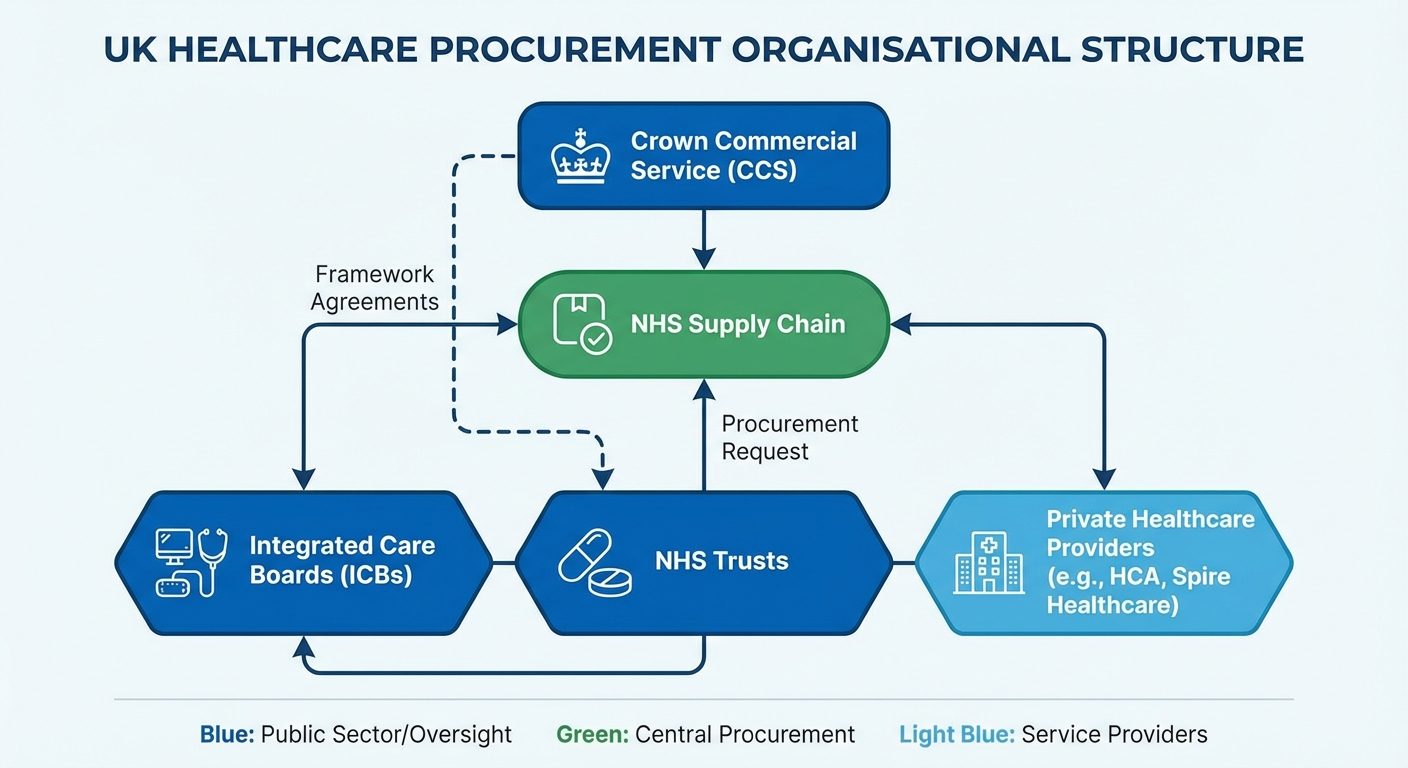
Healthcare procurement organisational structure diagram
Key Drivers Reshaping Healthcare Procurement in 2026
Several powerful forces are fundamentally changing how healthcare organisations approach procurement, creating both challenges and opportunities for suppliers who understand these dynamics.
Digital transformation and AI integration now permeate every aspect of healthcare procurement. From AI-enabled demand forecasting and automated supplier risk monitoring to digital twins for medical equipment planning and blockchain-based supply chain transparency, technology is revolutionising how healthcare buyers identify needs, evaluate suppliers, and manage contracts. Suppliers who can demonstrate digital maturity, data interoperability, and technology-enabled service delivery gain significant competitive advantages in tender evaluations. Value-based procurement has moved from aspirational concept to operational reality. Healthcare buyers increasingly evaluate tenders not just on upfront costs but on total lifetime value, clinical outcomes impact, and contribution to strategic objectives like reducing hospital readmissions, improving patient experience scores, or accelerating treatment pathways. This shift requires suppliers to articulate value in healthcare outcomes language, backed by robust evidence of clinical effectiveness and economic impact. Supply chain resilience has become a strategic imperative following pandemic-era disruptions, geopolitical instability, and raw material volatility. Procurement teams now scrutinise supplier business continuity plans, manufacturing diversification, inventory management capabilities, and crisis response protocols. Tenders increasingly include specific questions about supply security, risk mitigation strategies, and the ability to maintain service delivery during disruptions. Sustainability and net-zero commitments drive procurement decisions across both NHS and private providers. Healthcare organisations face regulatory pressure and reputational expectations to reduce carbon emissions, eliminate single-use plastics, promote circular economy principles, and ensure ethical supply chains. Modern healthcare tenders embed detailed sustainability criteria, often weighted at 10-20% of the total evaluation score, covering everything from product lifecycle carbon footprints to supplier diversity programmes and social value contributions. Regulatory complexity continues to intensify, particularly around medical devices and diagnostics following the full implementation of MDR (Medical Device Regulation) and IVDR (In Vitro Diagnostic Regulation). Suppliers must demonstrate comprehensive compliance documentation, post-market surveillance capabilities, and robust quality management systems. Procurement teams use compliance as a binary pass/fail criterion, making meticulous attention to regulatory requirements essential for tender success.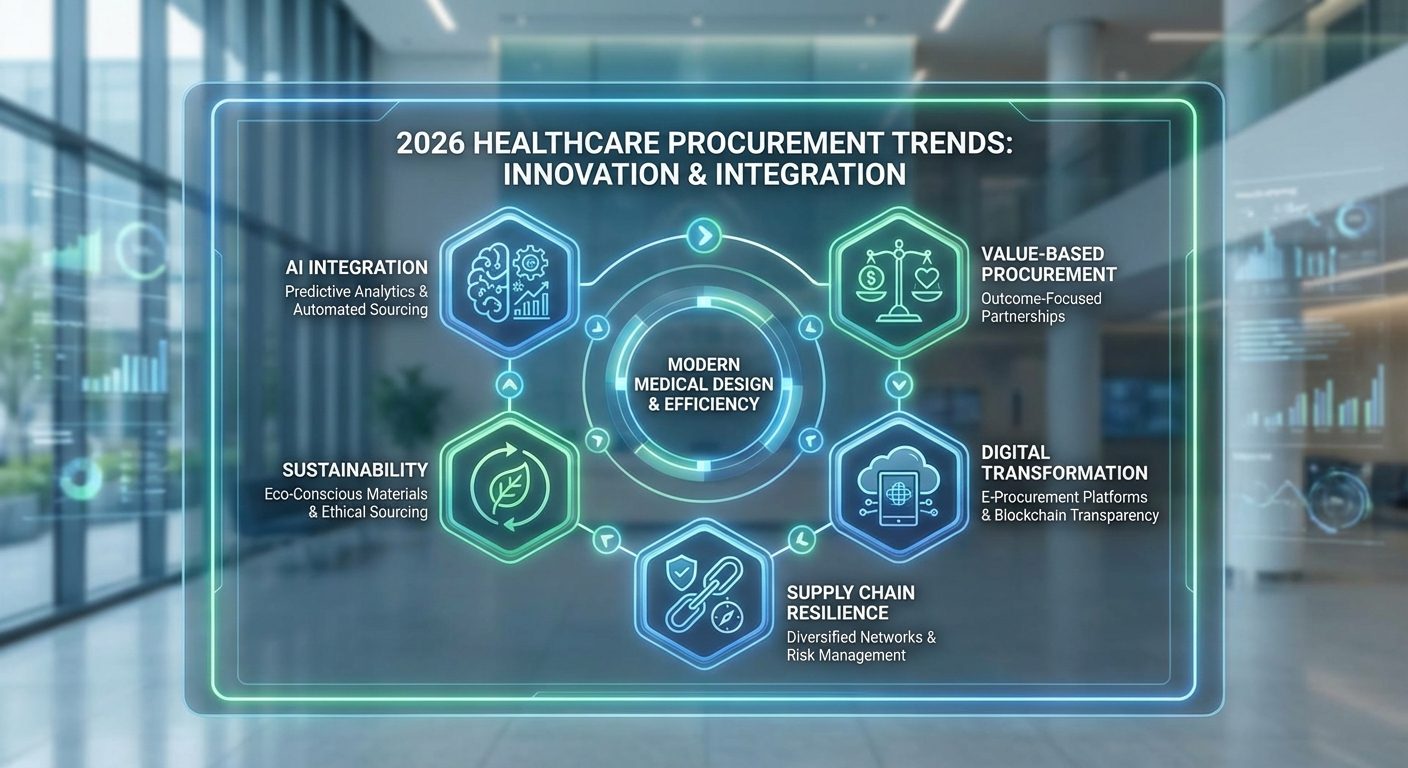
Key healthcare procurement trends in 2026
NHS Procurement: Navigating the Public Sector Pathway
The National Health Service operates one of the world's largest and most complex public procurement systems, governed by strict regulations, transparency requirements, and social value obligations. Understanding NHS procurement mechanisms is fundamental to accessing these substantial opportunities.
NHS Procurement Routes and Frameworks
NHS organisations access suppliers through various routes, each with distinct characteristics, timescales, and strategic implications.
National framework agreements, managed by NHS Supply Chain, Crown Commercial Service, and other approved bodies, provide pre-competed routes to market for commonly purchased categories. These frameworks significantly simplify the procurement process for NHS trusts whilst offering suppliers access to multiple organisations through a single tender process. However, framework positions are highly competitive, typically awarded through rigorous OJUK-advertised tenders with substantial documentation requirements and multi-stage evaluation processes. Individual NHS trust tenders allow organisations to procure directly for specific requirements not adequately served by frameworks or for high-value, specialised needs. These tenders offer greater opportunity for tailored solutions and direct relationship building but involve longer procurement timescales and higher bid preparation costs. Trust-level procurement values typically range from £50,000 for minor works to tens of millions for major capital projects or multi-year service contracts. Integrated Care Board (ICB) collaborative procurement brings together multiple organisations to aggregate demand and improve value for money across geographical areas or clinical pathways. These tenders can be particularly attractive for suppliers able to deliver at scale with consistent quality, though they also require the operational capacity to service multiple sites and stakeholder groups simultaneously. Dynamic Purchasing Systems (DPS) provide flexible, ongoing frameworks where suppliers can join at any time, and mini-competitions determine specific contract awards. DPS arrangements work well for categories where innovation is rapid, requirements vary significantly between organisations, or market capacity needs to remain broad.The NHS Tender Evaluation Process
NHS tenders must comply with public procurement regulations that mandate transparency, equal treatment, and non-discrimination. This translates into highly structured evaluation processes that reward suppliers who understand the rules and craft their responses accordingly.
Most NHS tenders use a two-stage evaluation: an initial pass/fail assessment of mandatory requirements (financial standing, insurance, regulatory compliance, anti-slavery policies, cyber security standards) followed by scored evaluation of quality and price elements.
The quality/price split varies by category but typically ranges from 60/40 to 80/20 in favour of quality for complex services and clinical products, whilst commodity items may see heavier price weighting. Understanding the specific weighting for your tender is crucial for resource allocation during bid preparation.
Quality evaluation follows published award criteria and sub-criteria, with responses typically scored on a 0-5 or 0-10 scale against defined standards. Evaluators look for evidence-based responses that directly address each requirement, demonstrate thorough understanding of NHS challenges, and provide concrete examples of successful delivery in comparable healthcare settings. Social value represents a mandatory minimum 10% weighting in NHS tenders since January 2021, though many organisations apply higher weightings. Social value responses should align with the NHS's strategic priorities: fighting climate change, tackling inequality, creating opportunity, and improving wellbeing. Successful responses move beyond generic corporate social responsibility statements to propose specific, measurable commitments relevant to the local health economy.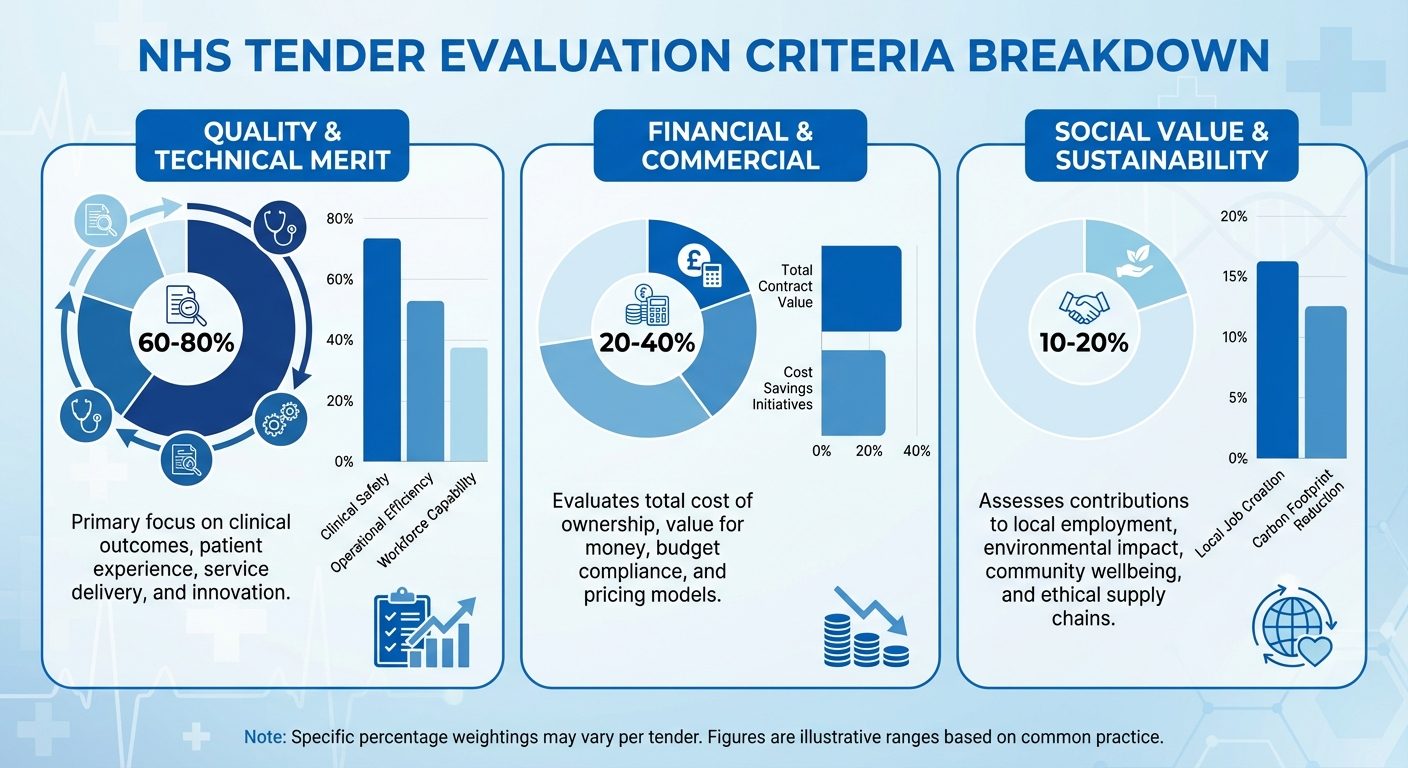
NHS tender evaluation criteria breakdown
Common Challenges in NHS Tendering
Several recurring challenges trip up even experienced suppliers when bidding for NHS contracts, and understanding these pitfalls helps you avoid them.
Underestimating documentation requirements is perhaps the most common error. NHS tenders demand comprehensive responses across financial standing, quality standards, technical specifications, delivery methodologies, risk management, sustainability, social value, and implementation planning. Allocating insufficient time or resources to prepare thoroughly evidenced responses inevitably results in weak scores or outright disqualification. Failing to demonstrate NHS-specific understanding represents another frequent shortcoming. Generic responses that could apply to any sector or customer rarely succeed in NHS procurement. Evaluators look for evidence that you understand the NHS context—its pressures, priorities, clinical pathways, patient populations, regulatory environment, and strategic objectives. Demonstrating this understanding requires genuine research and thoughtful tailoring of your response. Weak case studies and evidence undermine otherwise strong technical or commercial propositions. NHS evaluators expect case studies from directly comparable healthcare settings (not generic public sector or corporate examples), with quantified outcomes, verifiable references, and clear relevance to the specific tender requirements. Investing in robust case study development, including gathering quantitative impact data and securing reference permissions, pays dividends across multiple bids. Insufficient mobilisation planning creates risk in evaluators' minds. NHS organisations need confidence you can transition smoothly from incumbent providers, integrate with existing systems and processes, train staff effectively, and achieve steady-state performance within defined timeframes without disrupting patient care. Detailed, credible mobilisation plans with clear milestones, risk mitigation strategies, and resource commitments demonstrate your readiness to deliver.Private Healthcare Procurement: A Different Playing Field
Whilst private healthcare providers share many clinical and quality priorities with the NHS, their procurement approaches reflect commercial imperatives, faster decision-making cycles, and greater flexibility in sourcing strategies.
Key Differences from NHS Procurement
Private healthcare procurement operates under different rules and rhythms than NHS tendering, creating distinct opportunities for suppliers who understand these variations.
Regulatory flexibility allows private providers more discretion in procurement processes, with no obligation to advertise tenders publicly or follow OJUK procedures for most categories. Many opportunities arise through direct engagement, relationship development, and invitation-based tendering rather than open competitive processes. This places a premium on market intelligence, networking, and proactive business development. Faster decision cycles reflect commercial pressures and streamlined governance structures. Where NHS procurement often spans six to twelve months from specification to contract award, private providers may complete equivalent processes in weeks or months. This compressed timeline rewards suppliers who can mobilise bid resources quickly, respond with agility, and demonstrate readiness for rapid implementation. Innovation appetite tends to be higher in private healthcare settings, where commercial differentiation and competitive positioning create incentives to adopt new technologies, service models, or clinical approaches ahead of the broader market. Suppliers with genuinely innovative solutions that demonstrably improve patient outcomes, operational efficiency, or market positioning can find more receptive audiences than in NHS organisations bound by risk-averse cultures and budget constraints. Commercial negotiations play a larger role in private sector procurement, with more room for creative deal structuring, performance-based pricing, revenue sharing arrangements, and mutually beneficial terms beyond simple supplier/customer transactions. Understanding your buyer's commercial drivers—whether revenue growth, margin improvement, market expansion, or reputation enhancement—enables you to craft proposals aligned with their business objectives.Winning Strategies for Private Healthcare Tenders
Success in private healthcare procurement requires different emphases than NHS tendering, though fundamental principles of thorough preparation, evidence-based propositions, and customer-centric thinking remain constant.
Relationship-based selling matters enormously in private healthcare markets. Clinical directors, procurement managers, and executive teams often rely on trusted relationships and peer recommendations when evaluating suppliers, particularly for significant investments or strategic partnerships. Investing in relationship development through clinical engagement, thought leadership, conference presence, and ongoing stakeholder nurturing creates the foundations for tender success. Commercial value articulation should speak the language of private business: return on investment, revenue enablement, cost per patient, market differentiation, and competitive positioning. Whilst clinical outcomes remain paramount, demonstrating how your solution contributes to the organisation's commercial success—whether through patient attraction, payer satisfaction, operational efficiency, or brand enhancement—resonates strongly with private provider decision-makers. Flexibility and customisation capabilities distinguish winners in private healthcare procurement. These organisations seek suppliers who can adapt solutions to specific clinical protocols, integrate with proprietary systems, accommodate varied operational models across multi-site operations, and evolve services alongside changing business needs. Demonstrating this adaptability through case examples and flexible contract structures enhances your competitive positioning. Speed to value translates to compressed implementation timelines, rapid ROI, and minimal disruption. Private providers cannot afford lengthy mobilisation periods that defer benefits or disrupt revenue-generating clinical services. Proposals that promise and deliver quick wins, phased implementations that maintain business continuity, and accelerated paths to full value realisation align with commercial imperatives.Critical Success Factors in Healthcare Tender Writing
Regardless of whether you're bidding for NHS or private healthcare contracts, certain fundamental principles separate winning submissions from also-rans. These success factors reflect both the unique characteristics of healthcare procurement and timeless best practices in competitive tendering.
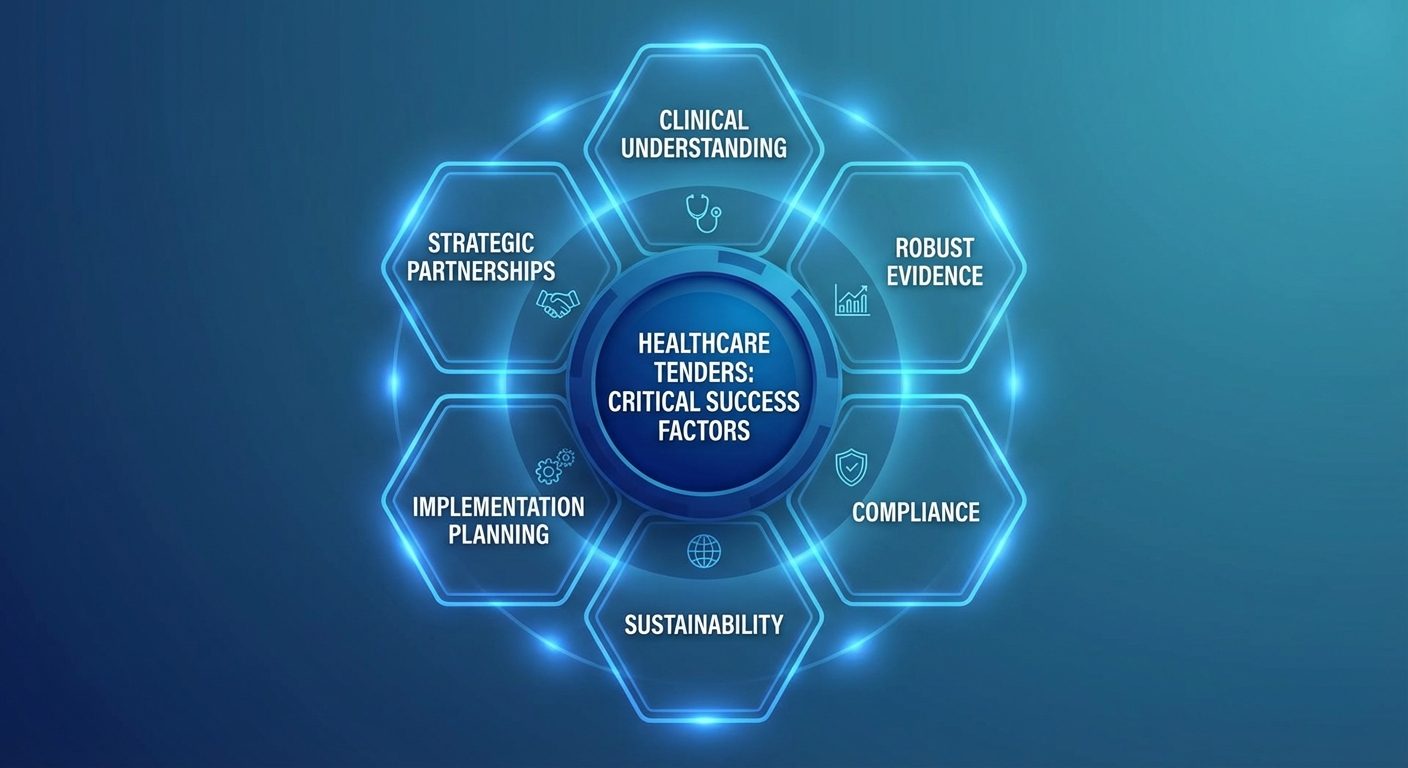
Critical success factors for healthcare tender responses
Deep Understanding of Clinical Context
Healthcare procurement exists to serve clinical outcomes and patient welfare, not as an end in itself. Procurement teams, clinical stakeholders, and executive decision-makers all evaluate supplier responses through the lens of patient impact, care quality, and clinical effectiveness.
This means successful tender responses must demonstrate genuine understanding of the clinical context: the patient populations served, the clinical pathways involved, the care quality measures that matter, the regulatory standards that apply, and the operational realities of healthcare delivery environments. Generic responses that could apply to any industry or setting simply do not succeed in healthcare procurement.
Building this understanding requires research into the specific organisation's clinical services, patient demographics, quality ratings, strategic priorities, and recent developments. NHS trust websites, CQC inspection reports, local health system plans, and clinical commissioning strategies all provide valuable insights. For private providers, company reports, market positioning, specialisms, and recent announcements offer similar intelligence.
Your response should reflect this research through appropriate clinical terminology, references to relevant care pathways or clinical guidelines, understanding of specific patient needs, and alignment with published quality improvement priorities. When you write about how your solution supports clinical teams, improves patient outcomes, or enhances care quality, specificity and credibility matter enormously.
Robust Evidence Base
Healthcare organisations make procurement decisions based on evidence, not claims. The culture of evidence-based medicine extends to purchasing decisions, with procurement teams and clinical stakeholders expecting suppliers to substantiate every assertion with credible proof.
This evidence takes multiple forms across different tender requirements. For clinical effectiveness, peer-reviewed research, clinical trial data, real-world evidence studies, and independent evaluations carry weight. For operational performance, case studies from comparable healthcare settings, verified customer references, performance data, and quality certifications demonstrate capability. For innovation claims, patents, regulatory approvals, clinical validations, and adoption data from leading healthcare institutions provide credibility.
The strongest tender responses present evidence systematically for each claim or commitment, making it easy for evaluators to verify your capabilities and build confidence in your ability to deliver. This means investing in case study development, gathering quantitative impact data, securing reference permissions, obtaining third-party validations, and documenting success stories in formats readily usable across multiple bids.
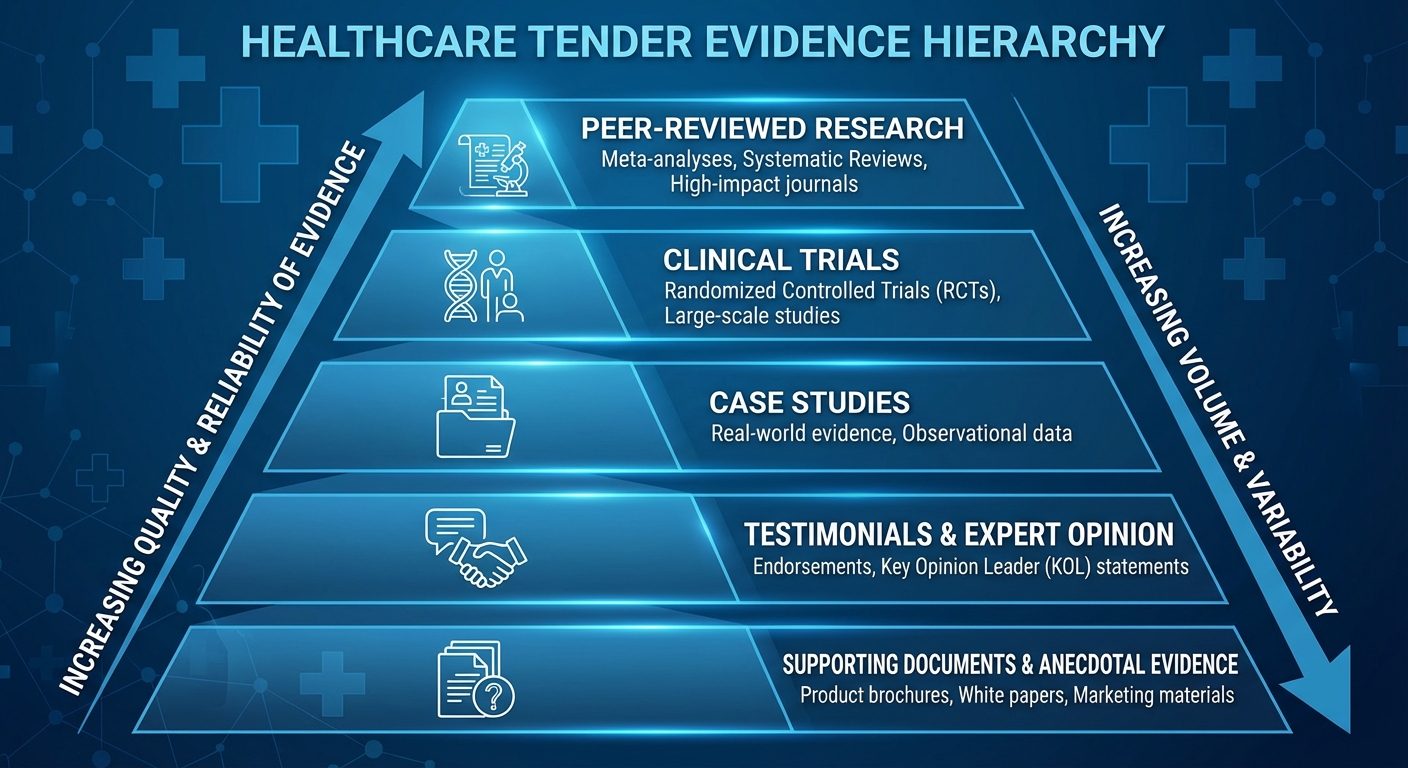
Evidence hierarchy for healthcare tender responses
Compliance and Quality Systems
Healthcare procurement involves heightened regulatory scrutiny and quality expectations given the direct impact on patient safety and care outcomes. Suppliers must demonstrate comprehensive compliance across multiple dimensions whilst maintaining accessible, user-friendly response structures.
Regulatory compliance forms the foundation, with requirements varying by category. Medical device suppliers must provide CE/UKCA marking evidence, MDR/IVDR technical files, post-market surveillance data, and incident reporting procedures. Pharmaceutical suppliers face MHRA licensing, GMP certifications, pharmacovigilance systems, and supply chain integrity requirements. Service providers need CQC registration where applicable, professional indemnity insurance, information governance compliance, and adherence to relevant clinical standards. Quality management systems demonstrate organisational capability to deliver consistently high standards. ISO certifications (particularly ISO 13485 for medical devices, ISO 9001 for general quality management), accreditations from professional bodies, audit results, and quality improvement methodologies signal commitment to excellence. Healthcare buyers look for evidence of continuous improvement cultures, robust incident investigation processes, and systematic approaches to quality assurance. Information governance and cyber security have become critical procurement considerations following high-profile NHS cyber attacks and stringent data protection regulations. Suppliers must demonstrate GDPR compliance, Data Security and Protection Toolkit completion (for NHS suppliers), ISO 27001 certification or equivalent, penetration testing results, incident response capabilities, and staff training programmes. For digital health solutions, demonstrating adherence to DCB0129/0160 clinical safety standards is often mandatory.Sustainability and Social Value
Environmental sustainability and social value have moved from peripheral considerations to core procurement criteria across healthcare organisations, reflecting both regulatory requirements and genuine organisational commitments to health equity and environmental stewardship.
Environmental impact spans product lifecycle analysis, carbon footprint reduction, circular economy principles, single-use plastic elimination, sustainable packaging, and end-of-life management. Strong tender responses quantify environmental benefits—tonnes of CO2 avoided, percentage of recycled content, waste reduction achieved, energy efficiency improvements—and align with healthcare-specific sustainability targets such as the NHS's net-zero by 2040 commitment. Social value in healthcare contexts emphasises local economic development, healthcare workforce development, health inequality reduction, and community wellbeing improvements. Successful responses propose specific, measurable commitments: apprenticeships created, local SME supply chain spend, health education programmes delivered, or targeted employment opportunities for underrepresented groups. The most compelling social value propositions connect directly to the healthcare organisation's local population health challenges and strategic priorities. Ethical supply chains have gained prominence following modern slavery legislation and growing awareness of global supply chain risks. Healthcare organisations expect suppliers to demonstrate due diligence across their supply chains, ethical labour practices, supplier diversity programmes, and transparent sourcing. This includes modern slavery statements, ethical trading memberships, supply chain audits, and conflict minerals policies where relevant.Implementation and Mobilisation Planning
Healthcare organisations need confidence that you can transition smoothly from contract award to effective service delivery without disrupting patient care or clinical operations. Weak mobilisation planning creates risk in evaluators' minds and frequently costs tenders even when technical and commercial elements are strong.
Detailed implementation plans should map out every phase from contract signature through mobilisation to steady-state operations, with clear milestones, dependencies, resource commitments, and success criteria. Healthcare-specific considerations include clinical engagement strategies, integration with existing clinical systems and pathways, staff training and change management, patient communication, and contingency arrangements to maintain care continuity during transitions. Risk management demonstrates mature understanding of implementation challenges and proactive mitigation strategies. Identify realistic risks specific to healthcare settings—clinical resistance to change, integration complexities with legacy systems, infection control requirements, safeguarding considerations—and articulate credible mitigation approaches backed by examples from previous healthcare mobilisations. Resource allocation should demonstrate you have dedicated, experienced personnel committed to successful implementation. Healthcare organisations want to see senior management engagement, clinical expertise within your team, dedicated project management resources, and clear escalation routes for resolving issues rapidly.Leveraging Technology and AI in Healthcare Tender Responses
The digital transformation of healthcare creates opportunities to enhance tender responses through intelligent use of technology, whilst also raising buyer expectations about suppliers' digital capabilities.
Demonstrating Digital Maturity
Healthcare organisations increasingly expect suppliers to demonstrate digital sophistication across products, services, and operations. This manifests in tender evaluation criteria around interoperability, data analytics capabilities, digital security, and technology roadmaps.
Interoperability with existing clinical and administrative systems represents a critical requirement, particularly for digital health solutions, medical devices with connectivity, and service delivery platforms. Tender responses should detail compliance with relevant interoperability standards (HL7 FHIR for data exchange, SNOMED CT for clinical terminology, IHE profiles for imaging), proven integration experience with NHS systems like EPR platforms and PAS systems, and your approach to managing interface development and ongoing system evolution. Data analytics and AI capabilities differentiate modern healthcare solutions from traditional offerings. Whether through clinical decision support, predictive risk modelling, operational efficiency optimisation, or population health management, AI-enabled capabilities can deliver significant value to healthcare organisations. Articulating these capabilities clearly, with evidence of clinical validation, regulatory compliance, and user acceptance, strengthens competitive positioning for technology-enabled suppliers. Cyber security and data protection move beyond compliance checkbox exercises to genuine competitive differentiators. Healthcare data breaches carry severe consequences—regulatory penalties, reputational damage, operational disruption, and patient harm—making procurement teams highly risk-averse. Demonstrating security-by-design principles, proactive threat monitoring, incident response capabilities, regular penetration testing, and a track record of secure operations builds essential confidence.Using AI Tools in Tender Preparation
Artificial intelligence is transforming not just healthcare delivery but also healthcare procurement processes, including how suppliers prepare tender responses. Intelligent application of AI tools can significantly enhance response quality, consistency, and efficiency.
Content development assistance through AI platforms like mytender.io helps teams rapidly draft comprehensive responses to technical requirements, case study questions, and methodology descriptions. The most effective approach combines AI-generated foundation content with expert human refinement, ensuring responses remain accurate, relevant, and aligned with your genuine capabilities whilst accelerating initial drafting. Response optimisation using AI analysis can identify gaps, inconsistencies, or weak evidence in draft submissions before evaluator scrutiny. Advanced platforms assess whether responses fully address question requirements, provide sufficient evidence, maintain consistent terminology, and align with best practice structures based on successful healthcare tender examples. Knowledge management powered by AI enables organisations to build searchable repositories of case studies, evidence, previous responses, and capability statements that can be rapidly retrieved and adapted for new opportunities. This dramatically reduces reinvention whilst ensuring responses leverage your organisation's full experience and evidence base. Quality assurance through AI-assisted review can catch formatting errors, compliance gaps, scoring misalignments, and requirement coverage issues that human reviewers might miss under deadline pressure. However, AI tools complement rather than replace human expertise—healthcare tender evaluation remains fundamentally about demonstrating human understanding of patient needs and clinical contexts.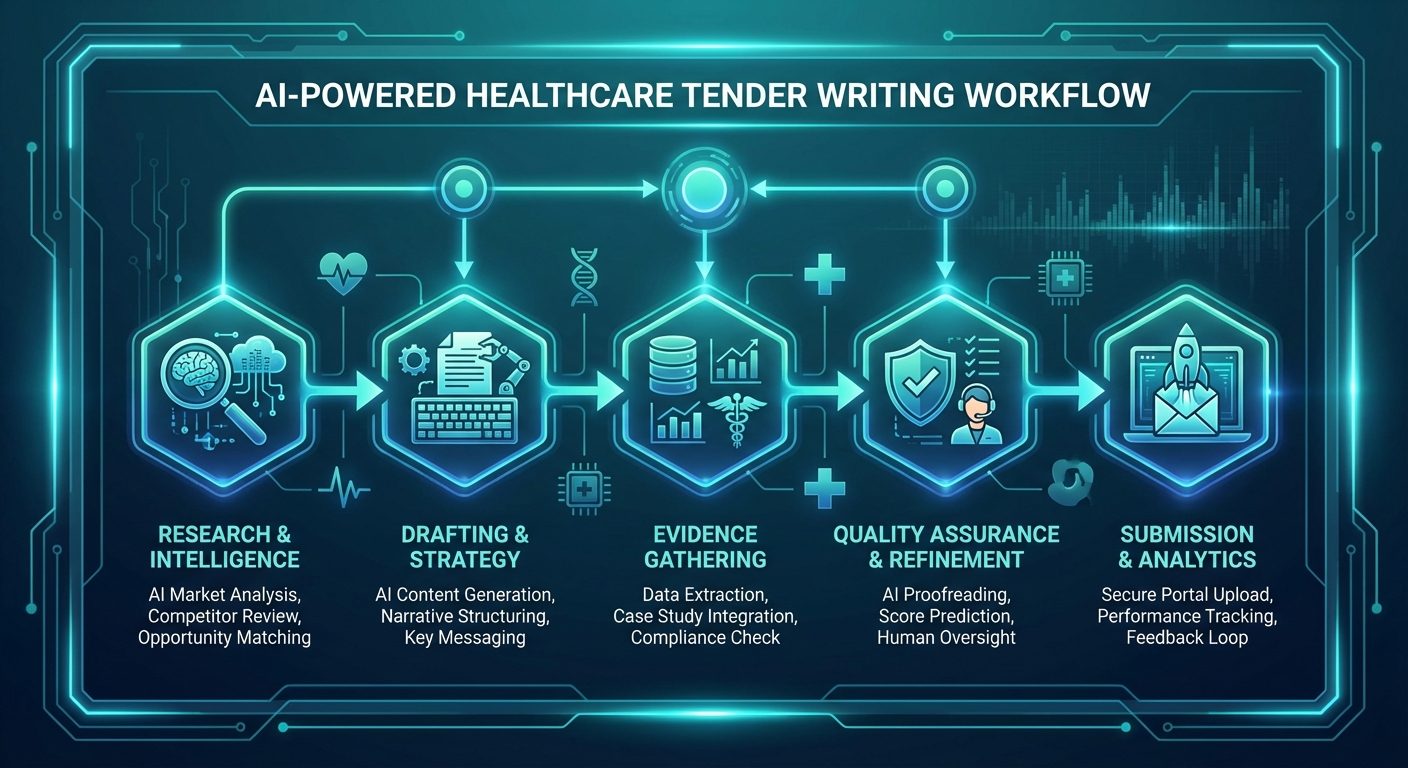
AI tender writing workflow for healthcare bids
Common Healthcare Tender Mistakes and How to Avoid Them
Even experienced suppliers make predictable errors when responding to healthcare tenders. Awareness of these common pitfalls helps you avoid them and strengthen your competitive positioning.
Generic, Non-Healthcare-Specific Responses
Perhaps the single most damaging error is submitting responses that could apply to any sector or customer. Healthcare procurement teams can immediately identify generic content repurposed from corporate or public sector templates, and such responses score poorly or fail completely.
The problem: Evaluators need confidence you understand healthcare's unique characteristics—clinical governance, patient safety primacy, regulatory complexity, integration with clinical pathways, multi-stakeholder environments, and public health imperatives. Generic responses undermine this confidence. The solution: Invest time researching each healthcare organisation, understanding their clinical services, patient populations, strategic priorities, and current challenges. Reference specific clinical pathways, regulatory frameworks, quality standards, and healthcare terminology throughout your response. Use case studies exclusively from healthcare settings, not generic public sector or commercial examples. Demonstrate you think like a healthcare partner, not just a supplier.Insufficient Evidence and Validation
Healthcare organisations make evidence-based decisions. Unsupported claims, aspirational statements, or vague assertions about capabilities simply do not succeed in competitive healthcare procurement.
The problem: Evaluators cannot award points for capability you claim but cannot prove. Without robust evidence—quantified outcomes, verified references, clinical validations, quality certifications—your response lacks credibility regardless of actual capability. The solution: Systematically back every claim with specific evidence. For clinical effectiveness, provide peer-reviewed research, trial data, or real-world evidence studies. For operational performance, offer case studies with quantified outcomes and verifiable references. For innovation, present patents, regulatory approvals, or independent validations. Create a library of evidence assets you can draw upon across multiple bids, ensuring case studies include metrics, references, and permissions for use.Poor Understanding of Value-Based Procurement
Healthcare procurement has evolved beyond simple cost comparison to sophisticated value assessment considering total lifetime costs, clinical outcomes impact, and strategic objective contribution. Suppliers still focused purely on competitive pricing miss the point.
The problem: Price remains important but rarely determines awards in isolation for complex healthcare categories. Evaluators assess value—the relationship between what you charge and the outcomes, benefits, and strategic contribution you deliver. Lowest price often signals lowest value in healthcare contexts. The solution: Articulate value in healthcare outcomes language. Quantify how your solution improves patient outcomes, reduces hospital readmissions, shortens treatment pathways, enhances patient experience, or enables prevention rather than intervention. Demonstrate return on investment through total lifetime cost analysis, including implementation, operation, maintenance, and disposal costs. Connect your solution to strategic healthcare priorities like health inequality reduction, population health improvement, or system sustainability.Weak Mobilisation and Risk Management
Healthcare organisations cannot tolerate implementation failures that disrupt patient care. Weak mobilisation planning or superficial risk management creates doubts about your ability to deliver.
The problem: Implementation complexity in healthcare settings—clinical engagement requirements, system integration challenges, infection control protocols, patient safety considerations—demands sophisticated planning. Generic project plans copied from non-healthcare contexts fail to address healthcare-specific realities. The solution: Develop detailed, healthcare-specific mobilisation plans addressing clinical engagement, patient communication, system integration, staff training, infection control, safeguarding, and care continuity during transitions. Identify realistic healthcare risks—clinical resistance, legacy system complexity, competing clinical priorities—and articulate credible mitigation approaches with examples from previous healthcare implementations. Allocate senior resources and clinical expertise to implementation, not just delivery.Ignoring Social Value and Sustainability
With mandatory minimum weightings in NHS tenders and growing importance in private healthcare procurement, weak social value and sustainability responses cost valuable points and potentially determine win/loss outcomes.
The problem: Generic corporate social responsibility statements or aspirational commitments without specific measurement fail to score in modern healthcare procurement. Evaluators seek concrete, measurable contributions aligned with healthcare priorities. The solution: Propose specific social value commitments relevant to the healthcare organisation's local population: apprenticeships in health-related fields, targeted employment from underrepresented groups facing health inequalities, health education programmes addressing local priorities, local SME supply chain spend in healthcare categories. Quantify environmental benefits aligned with NHS net-zero targets or private provider sustainability strategies. Ensure commitments are measurable, time-bound, and genuinely deliverable.The Future of Healthcare Procurement: Trends to Watch
Healthcare procurement continues to evolve rapidly, with several emerging trends likely to reshape tendering requirements and evaluation priorities in coming years.
Value-based contracting will deepen beyond current approaches to incorporate clinical outcomes measurement, risk-sharing arrangements, and payment models tied directly to patient results rather than activity volumes. Suppliers should prepare to demonstrate outcomes tracking capabilities, accept performance-based payment terms, and invest in evidence generation infrastructure. Digital-first procurement leverages AI for specification development, automated compliance checking, dynamic pricing, and supplier performance monitoring. Suppliers need digital capabilities not just in products but also in procurement interaction, contract management, and performance reporting. Integrated care system procurement brings together NHS organisations, local authorities, voluntary sector providers, and private partners in collaborative commissioning across health and social care. This creates opportunities for suppliers who can deliver across traditional boundaries but requires understanding of integrated care ambitions and multi-stakeholder engagement skills. Personalised and precision medicine procurement addresses genomics, rare disease treatments, and individually tailored therapies requiring fundamentally different supply chain, procurement, and contracting approaches than traditional pharmaceutical or device purchasing. Climate emergency response elevates sustainability from box-ticking to strategic imperative, with healthcare organisations seeking suppliers committed to science-based targets, circular economy principles, and demonstrable emissions reduction across scope 1, 2, and 3 sources.Conclusion: Your Healthcare Tendering Success Pathway
Winning healthcare tenders in 2026 demands far more than generic public sector bidding skills or transactional supplier relationships. Success requires deep understanding of healthcare contexts, robust evidence of capability and impact, sophisticated articulation of value beyond price, comprehensive compliance demonstration, and genuine commitment to healthcare outcomes and sustainability.
The healthcare organisations achieving best value from procurement—whether NHS trusts, ICBs, or private providers—partner with suppliers who think like healthcare providers, speak clinical outcomes language, demonstrate evidence-based impact, and commit to continuous improvement in patient care and system sustainability.
For suppliers prepared to invest in healthcare-specific capability development, evidence building, relationship nurturing, and response excellence, the healthcare procurement opportunity in 2026 and beyond remains substantial and rewarding. The organisations that master these success factors will not only win individual contracts but build enduring partnerships with healthcare providers committed to transforming care delivery.
Whether you're pursuing your first NHS framework position, expanding into private healthcare markets, or seeking to strengthen performance in existing healthcare accounts, the principles outlined in this guide provide a foundation for sustainable success in this critical, complex, and continually evolving sector.
Tags
Ready to Transform Your Tender Writing?
See how MyTender's AI can help you write winning tenders in a fraction of the time.