

Framework Agreements and DPS Tenders: How to Build a Smarter Bid Strategy in 2026
Framework agreements and dynamic purchasing systems can quietly decide your public sector pipeline. Here is how to choose the right route, protect bid capacity, and avoid wasting months on the wrong opportunities.
mytender.io Research Team
Tender Writing & Bid Management Specialists
Framework Agreements and DPS Tenders: How to Build a Smarter Bid Strategy in 2026
Most bid teams do not lose framework work on the day the mini competition lands. They lose it months earlier.
They miss the renewal window. They join a framework without a call-off plan. They treat a DPS as a shortcut, then realise every decent opportunity still needs a sharp, evidenced response. Or they spend three weeks chasing a place on a framework that will never send them work.
That is the quiet problem with frameworks and dynamic purchasing systems. They look like routes to market, but they are really pipeline decisions.
If you get them right, they give your team a repeatable flow of winnable public sector work. If you get them wrong, they soak up bid capacity, clutter the CRM, and create the horrible illusion that you are closer to revenue than you are.
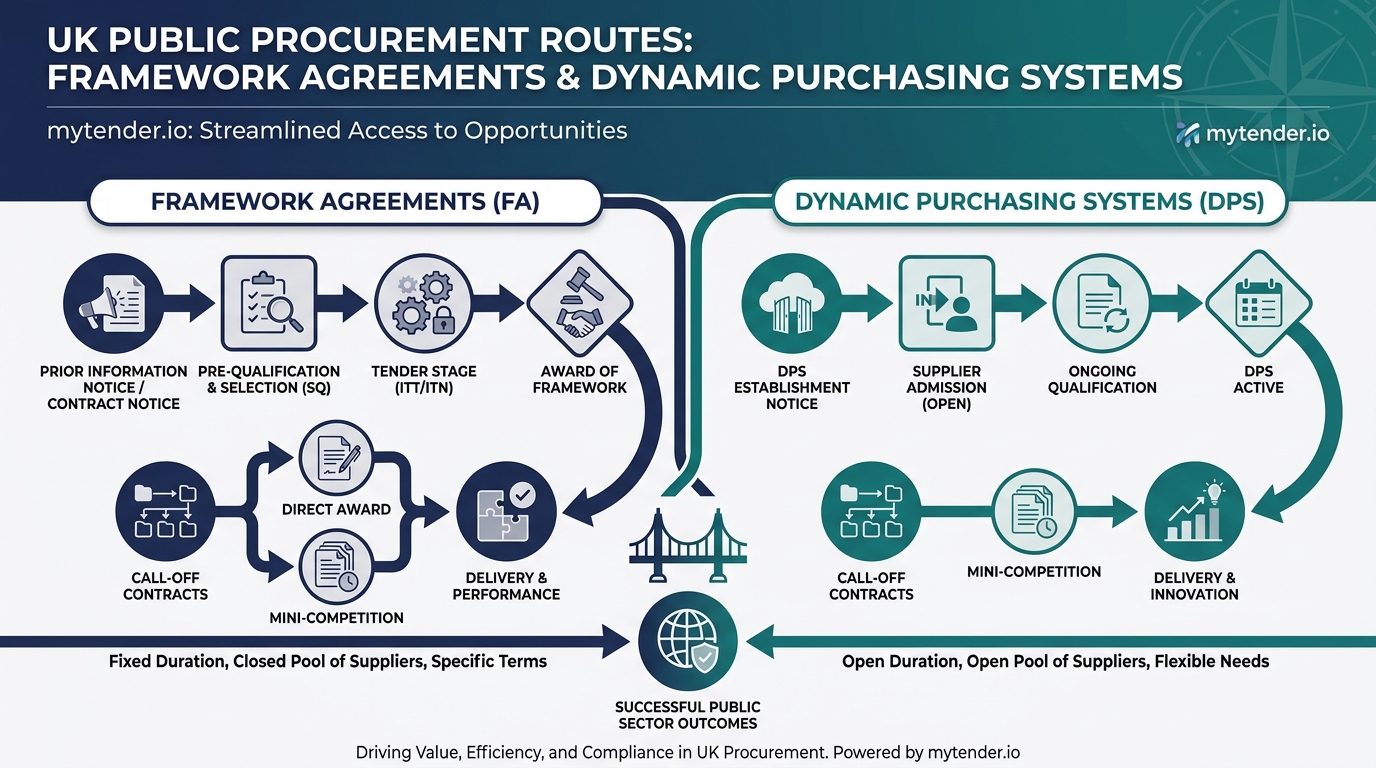
Framework agreements and DPS tender strategy illustration
This guide is for commercial leaders, bid managers and accidental bid writers who need a practical way to decide which frameworks to chase, which DPS lists to join, and how to turn access into actual contracts.
Why this matters more in 2026
Public sector buying has become more transparent, but not simpler.
The Procurement Act 2023 has pushed more notices, supplier information and contract data into view. The Central Digital Platform is intended to reduce repeated supplier admin. The Act also keeps the competitive flexible procedure, which gives buyers room to design more varied processes.
That is useful. It is also noisy.
Suppliers now face more visible pipelines, more framework routes, more call-offs, more portals, and more buyer-specific procurement design. The teams that win will not be the teams that monitor the most opportunities. They will be the teams that decide faster.
The pressure is especially sharp for SMEs and mid-market suppliers. You can rarely afford to bid everything. A single framework application can consume the same energy as a live contract tender, and a mini competition can arrive with a brutal deadline.
The strategic question is not “can we bid this?” It is “does this route give us a realistic path to revenue?”Framework agreement vs DPS vs open tender
The terms get thrown around as if everyone in the room has the same definition. They often do not.
A framework agreement is a pre-approved supplier arrangement. Buyers can award work through it during the framework term, often through direct award or mini competition. Getting onto the framework is only the first gate.
A dynamic purchasing system, or DPS, is more open. Suppliers can usually join during its lifetime if they meet the criteria. Buyers then run competitions among admitted suppliers for specific requirements.
An open tender is the more familiar route. The opportunity is published, suppliers submit, the buyer evaluates, and one or more contracts are awarded.
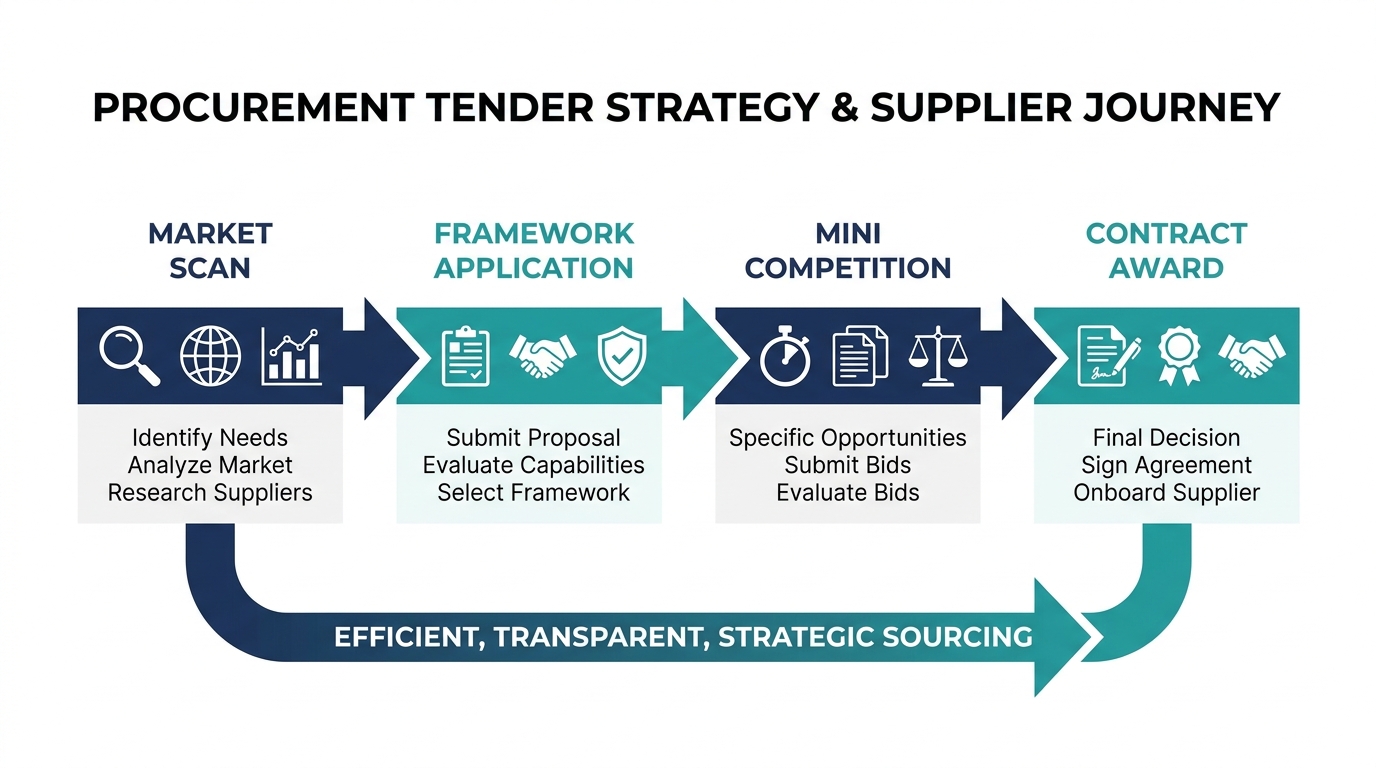
Supplier journey through framework agreements, DPS and mini competitions
The difference matters because each route creates a different bid-capacity problem.
Open tenders need a full go/no-go decision at the point of opportunity. Frameworks need an earlier market-position decision, then a second decision at mini competition stage. DPS routes need a light-touch entry decision, then repeated call-off discipline.
If you use the same process for all three, you will waste time.
The mistake: treating framework entry as the win
This is the most common failure.
A team sees a large framework notice. The headline value looks enormous. Everyone gets excited. The bid team spends weeks proving capability, turnover, insurance, accreditations, case studies and methodology.
Then they get appointed.
And nothing happens.
No call-off plan. No buyer mapping. No mini competition calendar. No named owner for the framework. No content library tagged to the lots. Six months later someone asks why the framework has not produced revenue, and the answer is awkward: because the appointment was treated as the finish line.
A framework place is access. It is not demand.
Before bidding for a framework, ask these questions:
- Which buyers actually use it?
- Which lots fit your strongest evidence?
- How often have similar call-offs happened before?
- Who are the likely incumbents?
- Can you resource the mini competitions when they land?
- What will you do in the first 90 days after appointment?
If you cannot answer those, you are not making a strategy decision. You are buying a badge.
How to decide which route deserves your time
You need a simple route-selection matrix. Not a 40-tab spreadsheet. Just enough structure to stop enthusiasm overruling evidence.
Score each opportunity across five areas.
1. Route fitDoes this procurement route suit how you sell? If your strength is complex consultative work, a price-heavy DPS may be a poor fit. If you win through speed, coverage and operational consistency, a high-volume DPS may be perfect.
2. Evidence fitCan you prove relevant experience for the lot or category? Not generic experience. Relevant evidence. Buyers do not care that you have “worked with the public sector” if the question asks for mobilisation across 120 occupied housing sites.
3. Buyer accessDo you know the authorities likely to use the route? Have you attended engagement events? Do you understand their current suppliers, pain points and budget pressure?
4. Call-off probabilityIs there a realistic volume of future work? Some frameworks have impressive total values but weak activity in your specific lot. Some DPS arrangements are technically open but practically dominated by a few repeat players.
5. Bid capacityCan you support both the entry bid and the downstream competitions? If not, the route may damage your win rate by pulling resource away from stronger opportunities.
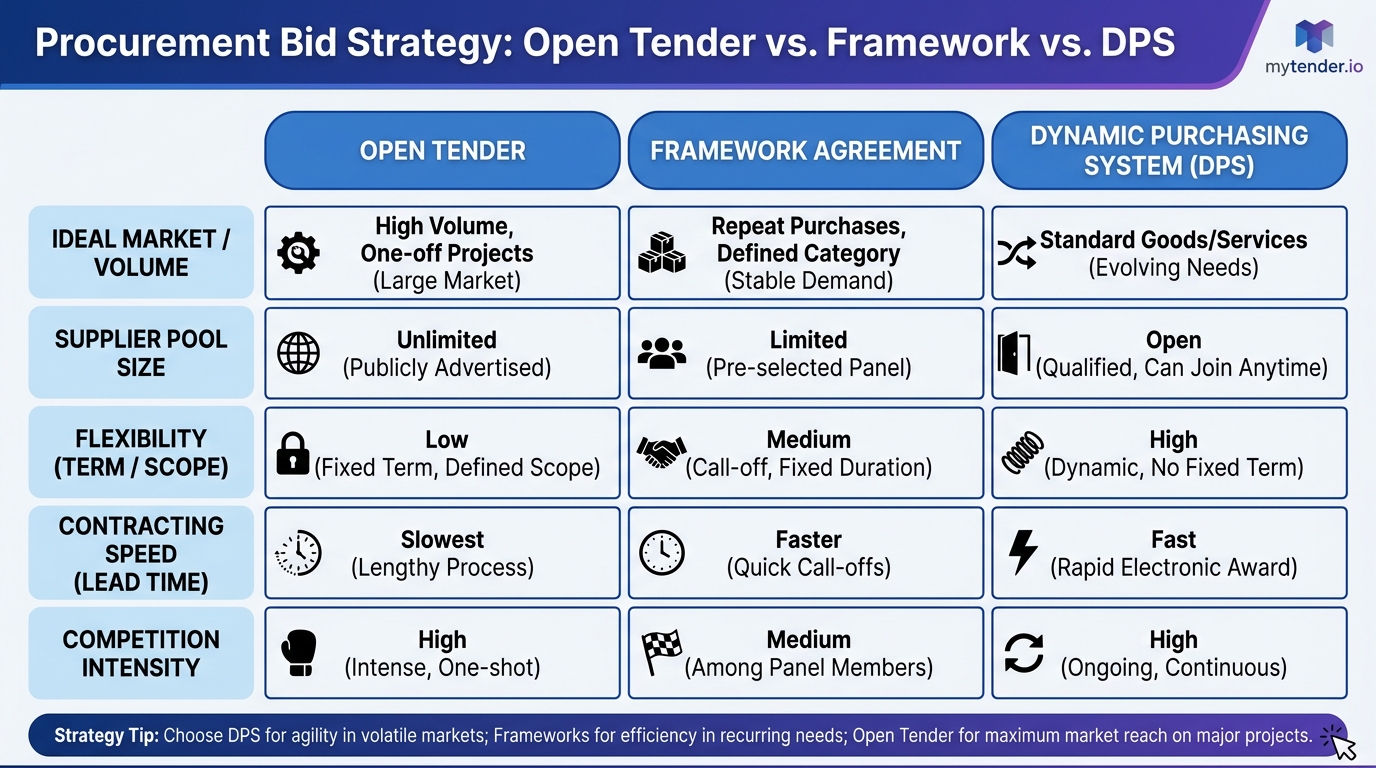
Decision matrix for open tender, framework agreement and DPS routes
A simple rule helps: do not bid for access unless you have a plan to convert that access.
When a framework is worth bidding
A framework is worth serious bid effort when it gives you one of four things.
First, it gives you access to buyers you already understand. If you know the sector, have relevant case studies, and can map your offer to known buyer needs, the framework can concentrate demand.
Second, it creates repeatable mini competitions. This is the dream. You build a response library once, then tailor it repeatedly. Your first competition is hard; your fifth should be much faster.
Third, it helps you defend or expand an incumbent position. If your current customer will buy through the new framework, missing it can shut you out.
Fourth, it gives strategic credibility. Some sectors expect suppliers to be present on certain frameworks. Not being there can quietly remove you from buyer shortlists.
But the reverse is also true. A framework is probably not worth it if the lots are too broad, the buyer base is unclear, the evaluation is heavily price-led, or your evidence is thin.
The worst framework bid is the one you submit because the headline value made everyone nervous.
When a DPS makes sense
A DPS can be brilliant for suppliers who are fast, organised and selective.
Because suppliers can often join during the life of the DPS, the entry process may feel less dramatic than a fixed framework competition. That can be useful. It can also make teams lazy.
A DPS makes sense when:
- The category has frequent, relevant call-offs
- You can respond quickly without starting from a blank page
- You have clear pricing rules and margin guardrails
- You can track opportunities reliably
- You know which buyers use the system
A DPS is dangerous when it becomes a dumping ground for every marginal opportunity. Because the barriers to entry feel lower, teams can end up responding to more competitions than they should.
Treat every DPS call-off like a fresh go/no-go decision. The fact you are admitted does not mean you should bid.
Mini competitions are where the real work begins
A mini competition is not a smaller tender. It is a compressed tender.
The buyer already knows the supplier pool is qualified, so the scoring often shifts towards the things that separate credible suppliers from each other: delivery model, mobilisation, social value, reporting, quality assurance, price, and evidence.
That means generic framework responses do not win.
A strong mini competition response usually does five things well.
It starts with the buyer’s specific problem. Not your company history. Not a copied framework method statement. The first page should make it obvious you have read the call-off properly.
It reuses the right evidence, not all evidence. The best bid libraries are not just collections of case studies. They are tagged by sector, contract size, service line, buyer type, mobilisation model, KPIs and outcomes.
It adapts the framework promise to the local requirement. If the framework entry said you could mobilise nationally, the mini competition needs to explain how you will mobilise this site, this geography, this workforce and this reporting regime.
It answers the evaluation model. If quality is 60 percent and mobilisation is half of that, do not bury mobilisation under a generic operations section.
It protects margin. Framework competition can encourage price panic. Commercial review needs to happen before submission, not after everyone falls in love with the win.
Build a framework pipeline, not a list
A list of frameworks is not a pipeline. It is a spreadsheet with hope in it.
A proper framework pipeline has stages:
- Market watch: upcoming renewals, PINs, buyer engagement, category plans
- Route qualification: whether the route fits your target sectors and evidence
- Entry bid: the application or framework tender itself
- Activation: buyer mapping, content tagging, account ownership and launch activity
- Call-off pursuit: mini competition triage and response
- Performance feedback: win/loss data, buyer comments, pricing lessons and library updates
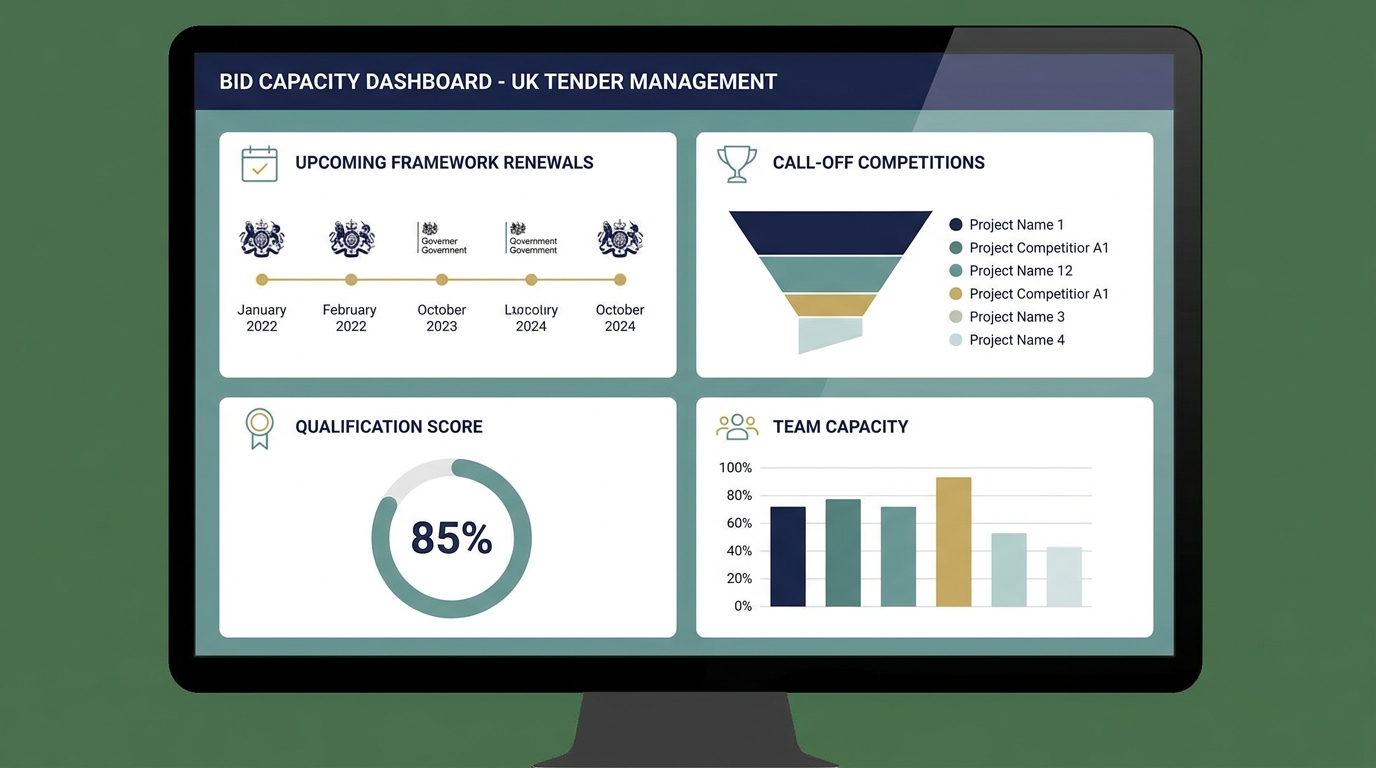
Framework pipeline dashboard for bid capacity and mini competitions
This is where many teams need discipline. The exciting work is the bid. The valuable work is everything around it.
If nobody owns activation, the framework will drift. If nobody tracks call-off outcomes, the team will repeat the same mistakes. If nobody updates evidence after delivery, the next response will sound stale.
The 90-day activation plan after appointment
When you win a place on a framework, move quickly. The first 90 days decide whether the appointment becomes revenue or wallpaper.
Days 1 to 15: understand the routeRead the framework documents again, but this time as a sales plan. Which buyers can use it? What lots are you on? What are the direct award rules? What does the mini competition process look like? What data will you receive?
Days 16 to 30: map the buyersBuild a target list. Prioritise buyers by fit, likely need, geography, incumbent vulnerability and relationship strength. If the framework allows supplier engagement, plan it properly. If it does not, respect the rules and focus on permitted routes.
Days 31 to 60: prepare the response engineTag your case studies. Create mini competition templates. Prepare mobilisation, social value, reporting, risk and pricing content. Do not wait for the first deadline to discover your evidence is scattered across seven folders.
Days 61 to 90: run the first pursuit cycleReview live and expected call-offs. Apply a go/no-go threshold. Assign owners. Capture lessons from every submission, including the ones you decline.
This is not glamorous work. It is how frameworks become contract value.
What to put in your framework bid
Framework bids often ask broad questions. That tempts suppliers into broad answers.
Resist it.
The evaluator still needs proof. They want to know whether you can deliver repeatedly, across varied buyers, without becoming risky or administratively painful.
Prioritise five kinds of evidence.
Relevant delivery examplesUse examples that mirror the lot, buyer type and contract complexity. If the framework covers local authorities, NHS bodies and housing associations, do not use one generic case study for all three. Show range.
Mobilisation controlFramework buyers worry about transition risk. Explain your mobilisation governance, critical path, dependencies, TUPE handling where relevant, and early-life support.
Performance managementGive real KPIs, reporting cadence, escalation routes and examples of corrective action. A dashboard screenshot or anonymised performance pack often beats three paragraphs of claims.
Supply chain resilienceThe Procurement Act environment has sharpened attention on exclusion, debarment, payment practices and supplier resilience. Explain how you manage subcontractors, prompt payment, continuity and compliance.
Continuous improvementFrameworks run for years. Buyers want suppliers who improve, not suppliers who repeat the same year-one model forever. Give examples of service improvement, cost reduction, carbon reduction, user feedback, or quality gains.
Common mistakes that cost marks
The mistakes are depressingly predictable.
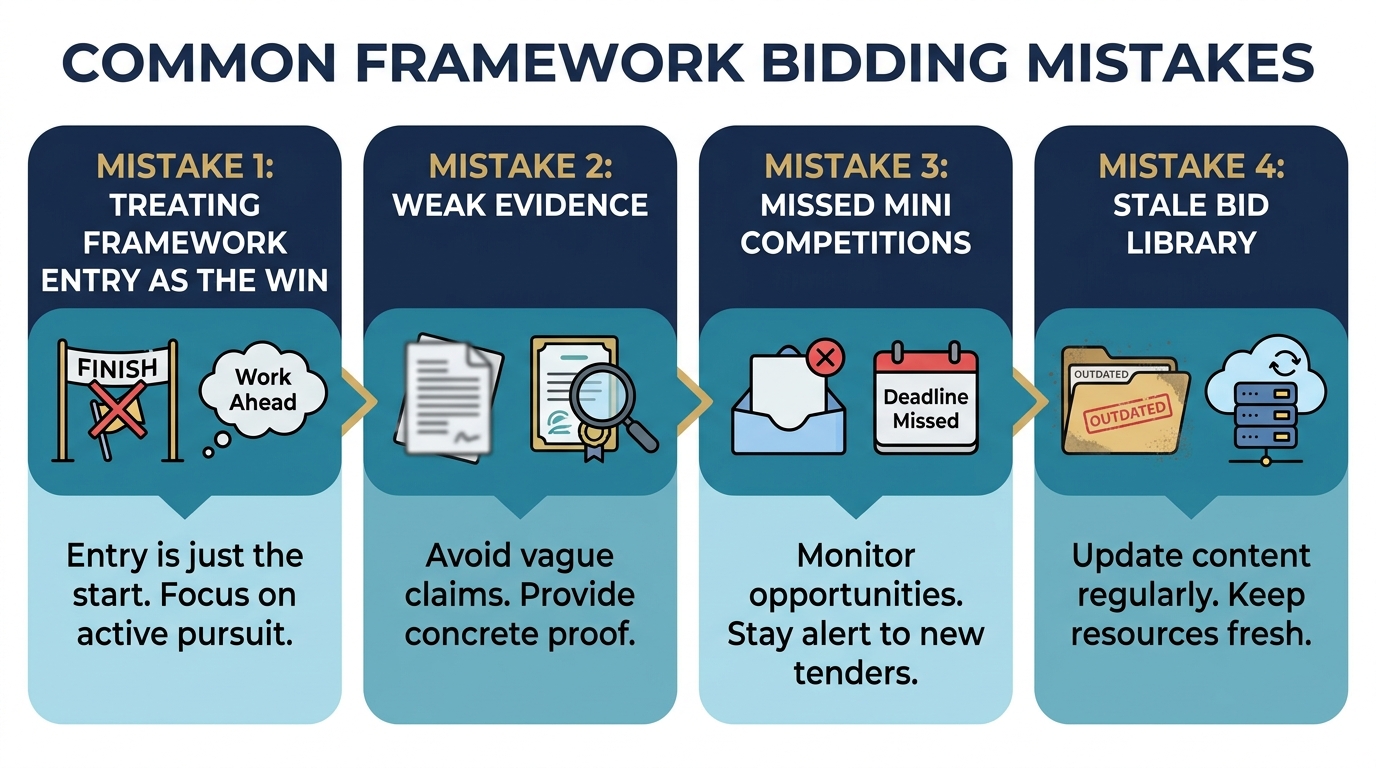
Common mistakes in framework and DPS bidding
A framework bid needs to prove repeatability. An open tender often proves suitability for one contract. If you paste the same narrative into both, it will feel thin.
Mistake 2: weak lot strategyBidding every lot looks ambitious. It often reads as unfocused. If your evidence is strong for Lots 1 and 3 but thin for Lot 4, think carefully before chasing the full set.
Mistake 3: no mini competition planEvaluators may not score your future sales plan directly, but the absence shows up. Your answers sound generic because you have not thought about how the framework will actually be used.
Mistake 4: underestimating adminFrameworks and DPS arrangements have reporting, catalogue, pricing, insurance, compliance and portal obligations. If nobody owns them, opportunities get missed.
Mistake 5: stale case studiesA case study from five years ago with no outcomes is not evidence. It is nostalgia. Keep your proof current.
How AI helps, and where it does not
AI can make framework bidding much faster, but only if your underlying material is good.
A specialist bid platform can help you analyse framework documents, pull out requirements, structure response plans, reuse approved content, and tailor evidence to each lot or mini competition. That is valuable because framework work is repetitive without being identical.
But AI cannot decide your commercial strategy for you. It cannot know whether a framework is politically important, whether the incumbent is vulnerable, or whether your team has the appetite to support ten mini competitions in a month.
Use AI to reduce drafting drag. Do not use it to avoid judgement.
At mytender.io, the strongest teams use their bid library and tender history together. They are not just asking for “a good answer”. They are asking: which evidence has won before, which answer style fits this evaluator, and which gaps need human attention?
That is the right division of labour.
A practical go/no-go checklist
Before you commit bid time to a framework, DPS or call-off, ask these questions.
Commercial fit- Is this buyer route aligned with our target sectors?
- Is the likely contract value worth the effort?
- Are the pricing rules commercially viable?
- Does winning help us build a stronger future position?
- Do we have recent, relevant case studies?
- Can we evidence outcomes, not just activity?
- Do we have named experts or delivery leads?
- Can we prove compliance without scrambling?
- Can we submit properly without damaging higher-priority bids?
- Who owns the response?
- Who reviews quality and price?
- Can we support downstream call-offs?
- How often is this framework or DPS used?
- Which buyers use it?
- Are there incumbents with structural advantage?
- Do we understand the mini competition process?
If the answer is mostly “not sure”, pause. Uncertainty is not always a reason to decline, but it is a reason to investigate before the bid team loses a week.
What good looks like
A good framework strategy feels slightly boring. That is a compliment.
The team knows which frameworks matter. Renewal dates are tracked. Buyer engagement is planned. Evidence is tagged. Mini competitions are triaged quickly. Declined opportunities are recorded without drama. Win/loss feedback feeds the library.
No heroics. No last-minute folder archaeology. No “has anyone got a case study for this?” at 11pm.
That is the point. Good bid operations make winning feel less chaotic.
Final thought
Frameworks and DPS routes can be brilliant. They can also be traps.
The difference is not the procurement route itself. It is the discipline around it. Choose the routes that match your evidence, activate them properly, and treat every call-off as a commercial decision rather than an obligation.
If you want to see live opportunities matched to your sector, the Tender Finder is free to use. It is a useful place to start if your current pipeline is more spreadsheet than strategy.
Tags
Ready to Transform Your Tender Writing?
See how MyTender's AI can help you write winning tenders in a fraction of the time.