

FM Asset Management Tender Evidence: How to Prove PPM, CAFM and Lifecycle Control in 2026 Bids
A practical guide for facilities management bidders on writing stronger asset management tender responses, covering asset registers, PPM, CAFM, statutory compliance and lifecycle planning.
mytender.io Research Team
Tender Writing & Bid Management Specialists
FM Asset Management Tender Evidence: How to Prove PPM, CAFM and Lifecycle Control in 2026 Bids
A weak asset management answer usually sounds calm. That is the problem.
It says you will maintain a full asset register, use planned preventative maintenance, monitor compliance, report through a CAFM system and manage lifecycle risk. None of that is wrong. It is also what nearly every other facilities management bidder says.
The bids that score well do something different. They show how asset data becomes operational control. They explain where the register comes from, how it is validated, who owns it, what happens when data is missing, how statutory compliance is protected, how lifecycle risk is reported, and how the client will see decisions before they become expensive surprises.

Facilities management team reviewing an asset register, compliance dashboard and lifecycle plan for a public sector tender
That matters more in 2026 because public sector FM buyers are under pressure from three sides. Estates are ageing. Budgets are tight. The Procurement Act 2023 has pushed evaluation further towards evidence, transparency and defensible supplier performance. A buyer cannot simply trust a polished method statement. They need confidence that the bidder can control thousands of assets, maintain safety-critical systems and make sensible lifecycle decisions after contract award.
This guide explains how to write stronger FM asset management tender responses. It covers asset registers, PPM, statutory compliance, CAFM, lifecycle planning, mobilisation, performance reporting and the evidence evaluators actually trust.
Why asset management is now a scoring issue, not an operational footnote
Asset management used to sit quietly in the hard FM section. It was treated as a delivery detail. Keep the register up to date, schedule planned works, respond to faults, close jobs, report monthly. Fine.
That is no longer enough.
Public sector estates teams are dealing with backlog maintenance, net zero targets, building safety duties, energy pressure, ageing plant, tighter budgets and more visible performance reporting. They need suppliers who can help them make decisions, not just complete tasks.
A boiler nearing end of life is not only a maintenance issue. It is a budget risk, service continuity risk, carbon risk, health and safety risk and potentially a reputational risk. The same is true for lifts, fire systems, water hygiene assets, emergency lighting, ventilation plant, access systems, medical support areas, security infrastructure and specialist building fabric.
The evaluator is asking a simple question: will this bidder give us control, or will they give us a monthly report after the problem has already happened?
A strong asset management response shows control in five areas:
- Data confidence: the buyer can trust what is in the asset register.
- Maintenance discipline: PPM is planned, prioritised and completed properly.
- Compliance protection: statutory tasks are visible, owned and escalated.
- Lifecycle insight: replacement, refurbishment and risk are forecast early.
- Decision support: the client gets clear recommendations, not raw data dumps.
That is the difference between a generic hard FM answer and a high-scoring asset management answer.
Start with the buyer's real anxiety
Most bid teams start this section by describing their system. That is backwards.
The buyer is not worried about whether CAFM exists. They assume it does. They are worried about what happens when the inherited data is poor, when an asset has no tag, when the PPM regime does not match site reality, when a statutory visit is missed, when an engineer closes a job with a vague note, or when the client discovers a major replacement need six weeks before budget approval.
So the answer should start with the risk the buyer recognises.
For example:
A public sector estate often inherits asset data from multiple contractors, surveys and project teams. Records may be incomplete, duplicated or out of date. Our first priority is therefore to stabilise the asset baseline, confirm safety-critical assets, align maintenance tasks to statutory and manufacturer requirements, and give the client early visibility of lifecycle risk.
That opening is stronger than saying you will provide a comprehensive asset management service. It proves you understand the messy handover reality.
The best responses name the common failure points:
- incomplete asset registers from the previous contract
- inconsistent naming conventions across sites
- assets with no condition grade or lifecycle date
- critical spares that are not identified
- PPM tasks based on old frequencies rather than risk
- statutory jobs mixed into routine maintenance queues
- poor fault coding, making trend analysis impossible
- reactive repairs hiding bigger asset failure patterns
- client reports that show activity but not risk
You do not need to criticise the buyer or the incumbent. Just show that you know where asset control usually breaks.
Build the answer around the asset management chain
A practical way to structure the response is to describe the asset management chain. This turns a broad method statement into a clear operating model.
The chain has six steps:
- capture and validate the asset baseline
- classify criticality and compliance requirements
- build the planned maintenance regime
- deliver, evidence and quality check the work
- analyse performance, condition and failure trends
- recommend lifecycle actions and budget priorities
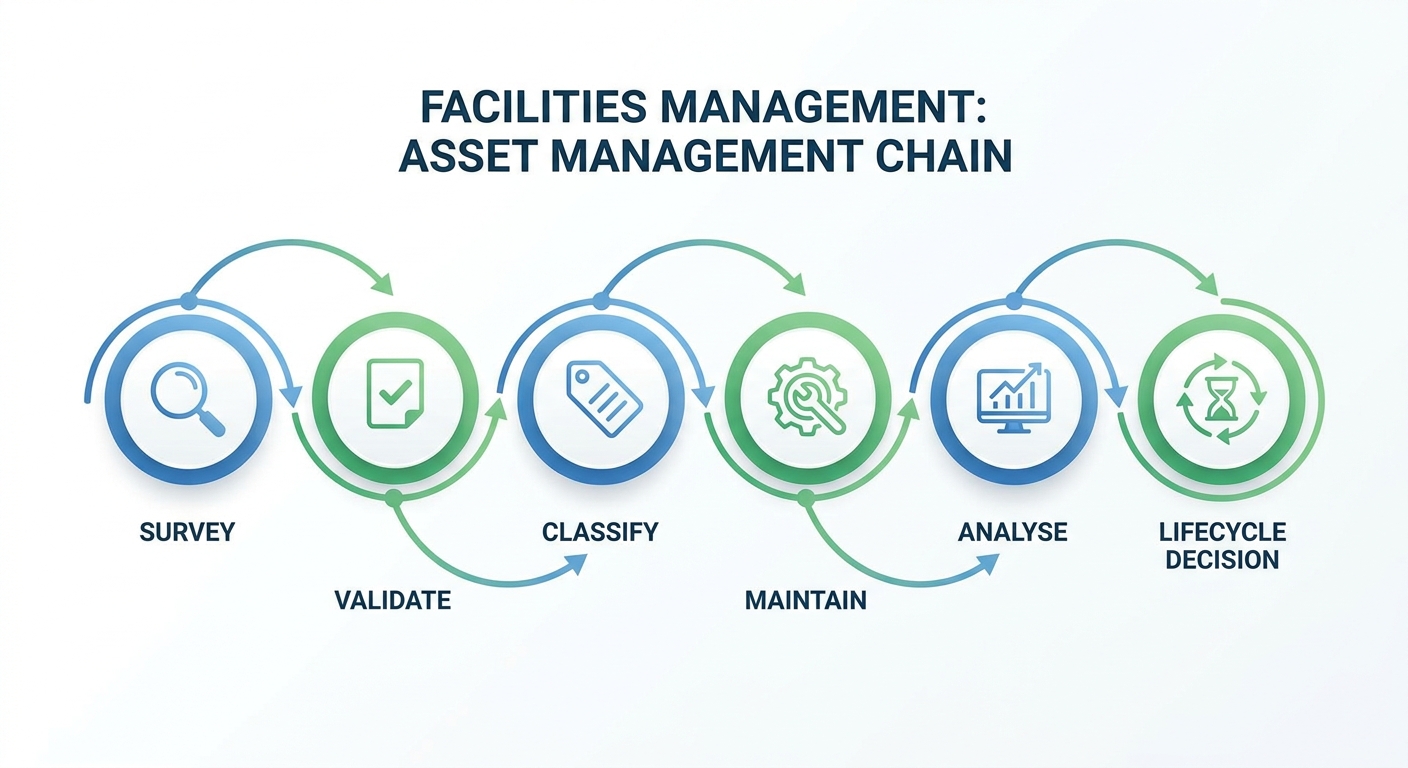
Process map showing how FM asset data moves from survey and validation through PPM, compliance control, performance reporting and lifecycle decisions
This structure works because it mirrors how the service actually runs. It also gives evaluators something easy to score. Each step has an input, method, owner, output and evidence trail.
1. Capture and validate the asset baseline
The first scoring opportunity is mobilisation. Buyers know that an asset register is only useful if it reflects the estate. They also know that the first 90 days can make or break a hard FM contract.
A strong response explains how you will validate the baseline without overwhelming the client.
That might include:
- reviewing the incumbent asset register before contract start
- mapping assets to sites, buildings, floors, rooms and systems
- identifying safety-critical and business-critical assets first
- completing sample checks before full verification
- tagging unlabelled assets where required
- capturing make, model, serial number, age, condition, warranty and maintenance history
- reconciling duplicate or inactive records
- agreeing naming conventions with the client
- loading verified data into the CAFM system
- issuing an asset data confidence report at the end of mobilisation
The phrase asset data confidence report is useful because it shows you are not pretending everything will be perfect on day one. You are giving the client a visible route from inherited data to trusted data.
If the tender includes multiple sites, explain how you will prioritise. Safety-critical systems, high-footfall sites, known problem assets and statutory compliance assets should come first. Low-risk decorative assets can wait.
2. Classify criticality and compliance requirements
Not every asset needs the same level of attention. Evaluators want to know that you understand criticality.
A water hygiene asset, fire alarm panel, lift, emergency lighting system or pressure system carries a different risk profile from a non-critical door closer. A ventilation asset serving a clinical or public-facing area may need a different response from one serving a store room. A heating asset in a school, hospital, care setting or civic building can become a service continuity issue very quickly.
Your response should explain the classification model. Keep it simple.
For each asset or asset group, define:
- statutory risk: legal or mandatory inspection requirement
- service criticality: impact on users if the asset fails
- health and safety impact: risk to occupants, staff or visitors
- condition: current age, performance and visible deterioration
- replacement risk: lead time, cost, spares availability and disruption
- carbon impact: energy use, emissions and net zero relevance
This gives the buyer confidence that maintenance priorities are not set by whoever shouts loudest. They are based on risk.
3. Build the planned maintenance regime
Planned preventative maintenance is one of those phrases that appears in almost every FM tender. The evaluator has read it a thousand times.
To make it score, you need to show how the regime is built.
A good answer explains that PPM tasks are developed from a blend of statutory requirements, manufacturer guidance, SFG20 or relevant industry standards, site risk, asset condition, client requirements and operational access constraints. It should also explain how changes are controlled. If a frequency is increased, reduced or amended, who approves it? How is the reason recorded? How does the client know?
This is where many bids go vague. They say PPM schedules will be maintained in CAFM. Fine. But the scoring question is whether the schedule is correct, risk-based and actively managed.
A stronger answer says:
- statutory tasks are locked and separately monitored
- PPM tasks are linked to asset records, not generic site calendars
- job sheets include expected checks, readings and evidence requirements
- engineers record exceptions, defects and recommended follow-on work
- missed or overdue statutory tasks trigger same-day escalation
- non-statutory overdue tasks are risk-ranked and recovered through an agreed plan
- repeat failures trigger root cause review, not endless reactive visits
- client changes are version controlled and auditable
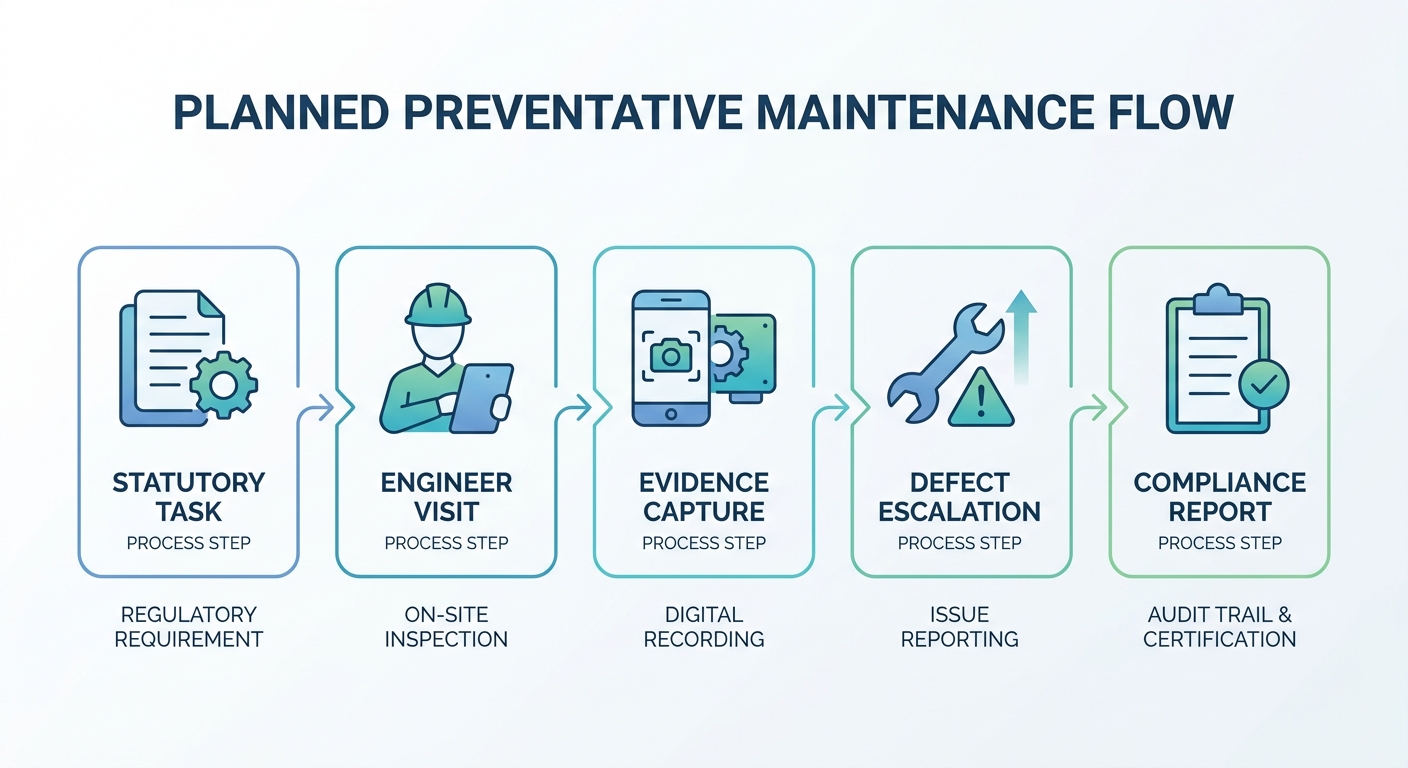
Workflow diagram for planned preventative maintenance, showing statutory task lock-in, engineer evidence capture, defect escalation and client reporting
That level of detail reassures the buyer that PPM is not just a calendar. It is a controlled service.
What evaluators want to see from CAFM
CAFM is often oversold in tender responses. Bidders describe dashboards, portals, mobile apps and real-time reporting as if the technology itself solves the problem.
It does not.
A CAFM system is only valuable if it supports better decisions. Evaluators know this. They have seen systems full of poor data, late updates, vague closure notes and reports that measure volume rather than risk.
Your response should explain what the system will actually do for the client.
A strong CAFM section covers six points.
Asset-level traceability
Every job should link back to the relevant asset, location, priority, task type and evidence requirement. That matters because the client needs to move from individual work orders to asset performance patterns.
If three reactive repairs hit the same pump in two months, the system should help the team see a developing issue. If a fire door inspection produces repeated remedials in one building, the client needs that trend. If energy-intensive plant is repeatedly failing, that might affect lifecycle and decarbonisation planning.
Mobile evidence capture
Engineer notes should be specific enough to be useful. Photos, readings, test results, parts used, time on site, follow-on recommendations and access issues should be captured at the point of work.
Avoid promising endless paperwork. The point is proportionate evidence. Statutory and safety-critical jobs need stronger records than low-risk routine tasks.
Compliance visibility
The system should separate statutory compliance from general maintenance activity. This helps the client see legal risk quickly.
A monthly report showing 96 percent overall PPM completion can hide a serious issue if the missing 4 percent includes statutory inspections. A better dashboard shows statutory completion separately, by site, discipline and risk category.
Client access
Explain what the client can see and when. This might include dashboards, scheduled reports, open actions, overdue tasks, compliance certificates, lifecycle risk logs, performance trends and meeting packs.
The best answer is not more data. It is the right data at the right time.
Data governance
Who can create, edit or retire assets? Who approves changes to criticality? How are duplicate assets removed? How are documents version controlled? How is audit history retained?
These details sound dull, but they are exactly what separates a credible answer from a glossy one.
Reporting that leads to action
Reports should create decisions. That might mean a red, amber, green lifecycle risk log, a top ten recurring faults list, a statutory compliance exception report, a recommended capital works schedule or a monthly asset condition movement summary.
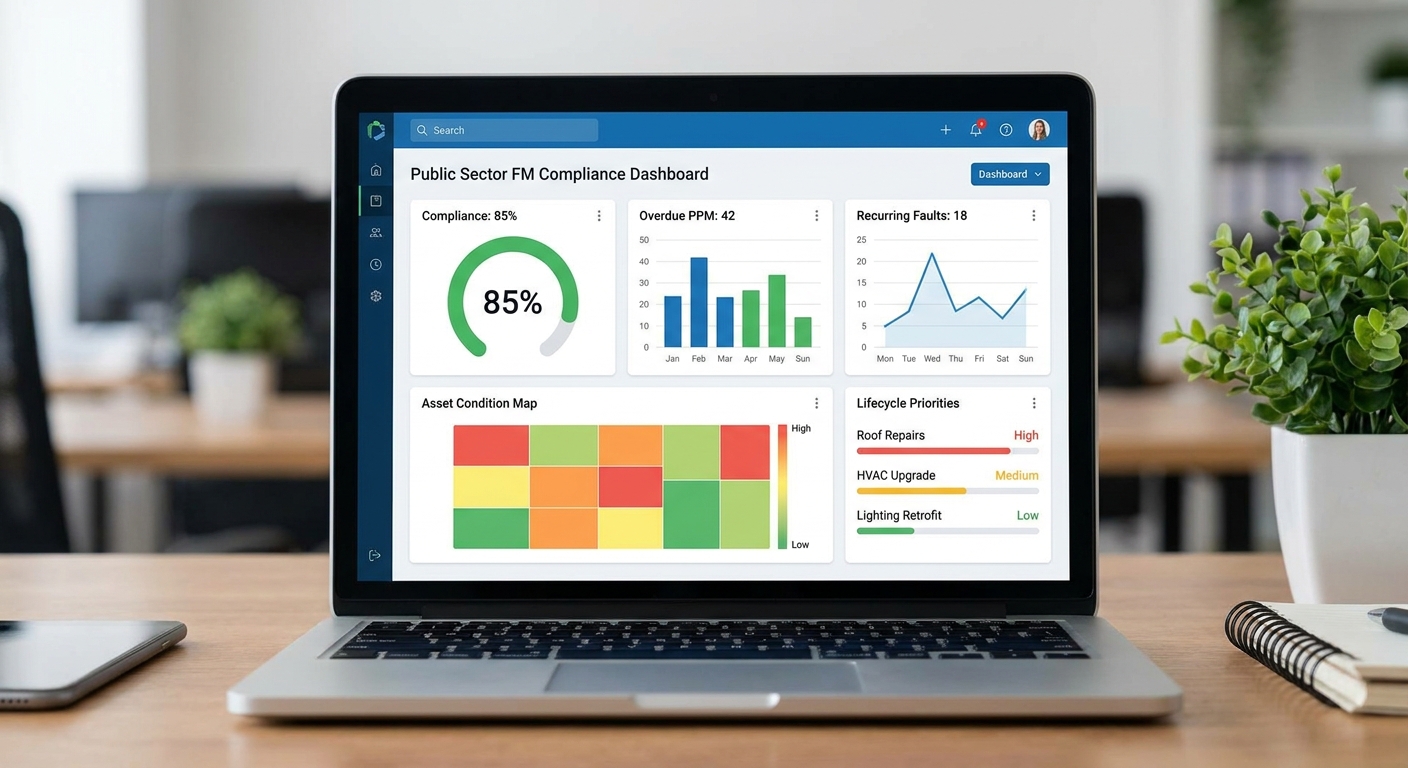
CAFM dashboard illustration showing statutory compliance, overdue PPM, recurring faults, asset condition movement and lifecycle replacement priorities
If your report does not help the client decide something, it is probably noise.
How to evidence statutory compliance without sounding complacent
Statutory compliance is where evaluators become least forgiving.
You should avoid language that sounds like compliance will look after itself. It will not. A high-scoring answer shows prevention, visibility and escalation.
Start by naming the types of compliance areas relevant to the contract. Depending on scope, this might include fire systems, emergency lighting, lifts, water hygiene, pressure systems, gas, electrical testing, asbestos interfaces, access equipment, ventilation, alarms, security systems, fixed wire testing and specialist inspections.
Then explain the control model.
A useful structure is:
- Identify: map statutory assets and obligations during mobilisation.
- Schedule: lock statutory tasks into CAFM with correct frequencies.
- Deliver: assign competent engineers or approved specialists.
- Evidence: capture certificates, readings, photos and remedial actions.
- Escalate: flag missed access, defects or overdue actions immediately.
- Review: include compliance exceptions in contract meetings until closed.
This makes the answer operational. It also shows the buyer that compliance is not buried inside general PPM.
Be careful with absolute claims. Do not say you will guarantee zero overdue tasks unless the delivery team can stand behind it. It is stronger to explain how you prevent overdue tasks, how exceptions are managed, and how the client is informed if access or site conditions create a risk.
A credible response might say that any statutory task at risk of becoming overdue is escalated to the contract manager and client representative before the due date, with the reason, recovery action, access support required and revised completion date. That is more believable than a blanket promise.
Lifecycle planning is where marks are often won
Many bidders treat lifecycle planning as an appendix. The best bidders put it at the centre of the answer.
Why? Because clients are trying to avoid surprises.
A buyer does not want to discover in December that three major assets need replacement before March. They want a rolling view of condition, risk, cost and timing. They also want advice that is practical. Replace now, refurbish next year, monitor quarterly, hold critical spares, include in capital planning, or align replacement with a decarbonisation project.
Lifecycle evidence should include:
- condition grading
- expected remaining life
- replacement cost bands
- risk impact if the asset fails
- maintenance cost trend
- energy or carbon impact
- spares availability
- recommended action
- priority and timing
- client decision required
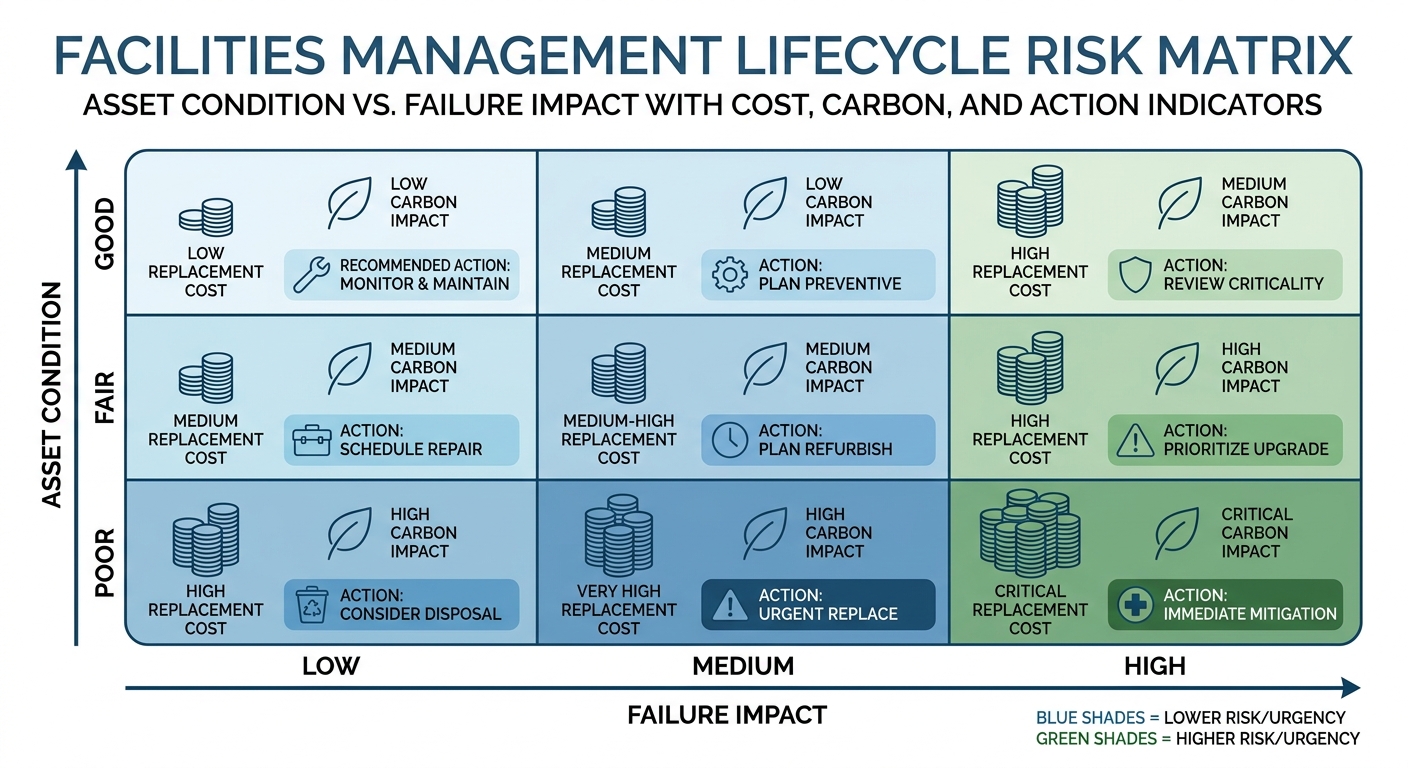
Lifecycle risk matrix for FM tenders, comparing asset condition, failure impact, replacement cost, carbon impact and recommended client action
This is especially useful for public sector clients because capital planning can be slow. If your team gives earlier visibility, the client has more time to build a business case, align budgets and reduce disruption.
Do not just say you will provide lifecycle reports. Explain the decision rhythm.
For example:
- first lifecycle risk review after mobilisation baseline validation
- quarterly lifecycle update with changes in condition and risk
- annual forward maintenance and replacement plan
- client workshop before budget planning cycles
- urgent risk escalation where an asset threatens statutory compliance or service continuity
This shows the evaluator that asset management supports estate strategy, not just maintenance delivery.
The mobilisation plan should show what happens in the first 30, 60 and 90 days
Tender evaluators are sceptical of mobilisation promises because the period is messy. They want detail.
For asset management, a strong 90-day plan is one of the easiest ways to improve the response.
Days 1 to 30: stabilise risk
The first month should focus on critical information and service continuity.
Key actions might include:
- confirm statutory compliance schedule and immediate due dates
- identify high-risk assets and sites
- review incumbent data and known issues
- agree escalation routes with the client
- load or verify priority assets in CAFM
- confirm specialist subcontractor access and certification routes
- review open remedials and outstanding defects
- issue an initial mobilisation risk log
The message is simple: we protect compliance first.
Days 31 to 60: validate and standardise
The second month should move from stabilisation to data confidence.
Actions might include:
- complete asset verification by priority group
- reconcile duplicate or incomplete records
- apply naming conventions and criticality ratings
- confirm PPM frequencies and job sheets
- align certificates and document storage
- begin recurring fault analysis
- agree client dashboard format
- issue an asset data confidence update
This shows the buyer that the register is becoming more reliable.
Days 61 to 90: move into improvement
By the third month, the answer should start to show insight.
Actions might include:
- issue first lifecycle risk register
- present top recurring asset failures
- recommend early remedial or replacement priorities
- agree reporting cadence and meeting packs
- review PPM completion and access blockers
- identify quick wins around energy, downtime or compliance visibility
- lock the steady-state governance model
This gives the evaluator a clear route from transition to long-term control.
How to write stronger evidence examples
Case studies in FM asset management often fail because they are too vague.
A weak example says:
We improved asset management for a public sector client by implementing CAFM and improving PPM compliance.
A stronger example says:
On a multi-site public estate, inherited asset records contained duplicate plant items, missing statutory inspection dates and inconsistent location data. During mobilisation, we prioritised fire, lift, water hygiene and electrical assets, completed a risk-based verification programme, rebuilt the PPM schedule against asset criticality and introduced a weekly compliance exception report. Within the first quarter, the client had a validated critical asset baseline, a single view of overdue remedials and a forward lifecycle risk log for budget planning.
That example works because it includes a problem, method and outcome. It does not need to reveal confidential details. It simply proves the bidder has done the work before.
When preparing examples, ask these questions:
- What was wrong or risky at the start?
- Which assets, sites or services were involved?
- What did the team do first?
- How was data validated?
- What changed in the maintenance regime?
- How did the client see performance?
- What measurable or observable improvement followed?
- What lesson transfers to this tender?
If you cannot answer those questions, the example is not ready for a scored response.
The KPI set should measure control, not just activity
FM tenders often include standard KPIs: PPM completion, reactive response, first-time fix, overdue tasks, helpdesk performance and customer satisfaction. Those are useful, but they do not tell the whole asset story.
For asset management, add measures that show control.
Good examples include:
| KPI | Why it matters |
|---|---|
| Critical asset verification completed | Shows mobilisation data confidence |
| Statutory task completion by risk category | Prevents legal risk being hidden in overall PPM figures |
| Overdue statutory remedials | Tracks whether defects are actually closed |
| Repeat reactive jobs by asset | Identifies assets that need root cause review |
| Condition grade movement | Shows whether the estate is improving or deteriorating |
| Lifecycle risks presented on time | Supports client budget planning |
| PPM tasks completed with required evidence | Measures quality, not just closure |
| Access-related non-completions | Separates contractor failure from site access blockers |
A strong answer might say that repeat failures are reviewed monthly, with assets moving into a watchlist where repair history, cost, condition and operational impact justify either enhanced maintenance, refurbishment or replacement. That sounds like an asset management service, not a ticket-closing service.
How AI can help without weakening the bid
AI can help bid teams write better asset management answers, but only if it is grounded in real evidence.
The danger is obvious. AI can produce fluent FM language that sounds plausible and says nothing specific. Evaluators are getting better at spotting this. Generic claims about proactive maintenance, real-time dashboards and continuous improvement will not stand out.
The useful application is different. AI can help organise evidence, compare tender requirements against your asset management process, identify missing proof, draft from approved case studies and turn technical documents into clearer buyer-facing answers.
That is where a controlled platform such as mytender.io helps. The value is not magic wording. It is the ability to connect the tender question to your existing policies, mobilisation plans, PPM evidence, case studies and review notes, then help the bid team shape a response that humans can check.
For asset management, that matters because the evidence is usually scattered. The CAFM report is in one place. The mobilisation plan is in another. Case studies sit in old submissions. The lifecycle method is in an operations document. The compliance escalation process may live with the contract team.
The bid team's job is to pull that into one coherent answer. AI can speed that up, but the proof still needs to be real.
A practical answer structure you can reuse
If you are staring at a blank tender response, use this structure.
Paragraph 1: acknowledge the buyer's risk
Show that you understand why asset management matters for their estate. Mention data quality, statutory compliance, service continuity, lifecycle planning and budget visibility where relevant.
Paragraph 2: state your operating model
Summarise how you manage the asset chain from mobilisation through steady-state delivery. Keep it tight.
Paragraph 3: explain mobilisation
Describe the first 30, 60 and 90 days. Focus on critical assets, statutory schedules, data validation, CAFM setup and early risk reporting.
Paragraph 4: explain PPM and compliance control
Show how tasks are created, scheduled, delivered, evidenced and escalated. Separate statutory compliance from general PPM.
Paragraph 5: explain CAFM and reporting
Describe what the client can see, how evidence is captured, how reports are used and how decisions are made.
Paragraph 6: explain lifecycle planning
Show how condition, cost, criticality, carbon and service impact feed into recommendations. Explain the quarterly and annual review rhythm.
Paragraph 7: provide evidence
Include a relevant example with problem, action and outcome. Add specific tools, templates, roles and governance where allowed.
Paragraph 8: close with client benefit
Bring it back to the buyer. Less uncertainty, fewer compliance surprises, better budget planning, safer buildings and clearer decisions.
That structure is simple, but it stops the answer drifting into system description.
Common mistakes that lose marks
The same mistakes appear again and again.
Mistake 1: treating CAFM as the answer
CAFM is a tool. The answer is the operating model around it.
If the response spends more time naming system features than explaining how asset risk is controlled, it will feel thin.
Mistake 2: hiding statutory compliance inside overall performance
Overall PPM completion is not enough. Statutory tasks need separate visibility, escalation and evidence.
Mistake 3: promising a perfect register from day one
Inherited data is rarely perfect. It is more credible to explain how you will validate, prioritise and improve it.
Mistake 4: reporting activity instead of insight
The client does not need a long list of completed jobs. They need to know what the pattern means.
Mistake 5: leaving lifecycle planning too late
Lifecycle is not an annual appendix. It should start during mobilisation and mature through quarterly reviews.
Mistake 6: using examples without numbers or specifics
A case study without a clear starting problem, method and outcome will not do much work for you.
Mistake 7: forgetting the client user's experience
Asset failure affects people. Staff, visitors, tenants, pupils, patients and the public all feel the impact of poor FM control. The best answers connect technical discipline to service continuity.
What good looks like to an evaluator
A high-scoring FM asset management answer makes the evaluator feel three things.
First, the bidder understands the estate risk. They are not pretending asset data is neat, complete and perfectly inherited. They know mobilisation will require verification, prioritisation and client decisions.
Second, the bidder has a controlled method. PPM, statutory compliance, CAFM, lifecycle planning and reporting are connected. The answer has owners, timings, evidence and escalation routes.
Third, the bidder will help the client make better decisions. The response does not stop at maintenance delivery. It supports budget planning, risk reduction, carbon decisions, compliance assurance and service continuity.
That is the standard to aim for.
Final checklist before you submit
Before submitting an FM asset management response, check whether the answer covers:
- the inherited asset data risk
- how the baseline will be validated
- criticality and statutory classification
- how PPM frequencies are set and changed
- separate statutory compliance visibility
- engineer evidence capture and quality checks
- CAFM governance and client access
- repeat fault and root cause analysis
- lifecycle risk reporting and budget planning
- mobilisation actions across 30, 60 and 90 days
- a specific, transferable example
- clear client benefits
If one of those is missing, the answer probably has a scoring gap.
A useful next step
If you want to see live FM opportunities while your team strengthens its asset management evidence, the mytender.io Tender Finder is free to use.
And if your bid library is full of old CAFM paragraphs, PPM promises and lifecycle wording that nobody quite trusts, it is worth fixing that before the next hard FM tender lands. The best time to improve asset management evidence is before the clock starts.
Tags
Ready to Transform Your Tender Writing?
See how MyTender's AI can help you write winning tenders in a fraction of the time.