

ESG and Sustainability in Tenders: The 2026 Compliance Guide
Navigate the new landscape of sustainability requirements in public sector tenders. Learn how to demonstrate ESG credentials, meet mandatory environmental criteria, and win contracts in the age of sustainable procurement.
Evie
PA & Office Admin at mytender.io
The landscape of public sector tendering has fundamentally transformed. What was once a differentiator has become a baseline expectation: sustainability and Environmental, Social, and Governance (ESG) criteria are now mandatory elements of government tenders across the UK, EU, and beyond. In 2026, organisations that fail to demonstrate robust ESG credentials will find themselves locked out of lucrative public sector contracts, regardless of their technical capabilities or competitive pricing.
This shift represents more than regulatory compliance. It reflects a fundamental reorientation of public procurement toward value creation that extends beyond cost efficiency. Tenders are increasingly evaluated on their contribution to climate targets, social value, ethical supply chains, and long-term resilience. For organisations serious about winning public sector work, understanding and mastering ESG requirements is no longer optional.
This comprehensive guide provides everything you need to navigate the new era of sustainable procurement. Whether you're responding to your first sustainability-focused tender or refining an existing approach, you'll learn how to demonstrate ESG credentials effectively, meet mandatory environmental criteria, and position your organisation for success in an increasingly values-driven marketplace.
The Regulatory Landscape: Why Sustainability Became Mandatory
The transformation of ESG from voluntary best practice to mandatory requirement didn't happen overnight. It emerged from converging regulatory pressures, international climate commitments, and growing public demand for responsible government spending.
The Corporate Sustainability Reporting Directive (CSRD), which came into force across the EU in phases from 2024, requires large companies to disclose detailed information about sustainability risks and impacts. This directive extends reporting obligations to approximately 50,000 companies across Europe, creating unprecedented transparency around environmental and social performance. Public sector buyers can now verify sustainability claims with standardised, audited data rather than relying on self-reported marketing materials.
Supply chain due diligence legislation has added another layer of accountability. Germany's Supply Chain Due Diligence Act and similar legislation across multiple jurisdictions require companies to identify, prevent, and remediate human rights violations and environmental damage throughout their supply chains. Organisations bidding for public contracts must demonstrate not only their own compliance but also robust oversight of suppliers, subcontractors, and partners.
The UK's Procurement Act 2023, fully implemented in February 2025, represents perhaps the most significant domestic shift. The move from "Most Economically Advantageous Tender" (MEAT) to "Most Advantageous Tender" (MAT) explicitly broadens evaluation beyond economic factors alone. Quality, sustainability, and social value now carry equal or greater weight than price in many procurement decisions. The Act also introduces enhanced supplier debarment provisions for environmental and social violations, creating real consequences for poor ESG performance.
These regulatory changes reflect government commitments to achieving net zero emissions targets, typically by 2050. Public procurement represents approximately 14% of GDP across OECD countries. By leveraging this enormous purchasing power, governments aim to accelerate the transition to sustainable economies, driving market transformation through demand-side intervention.
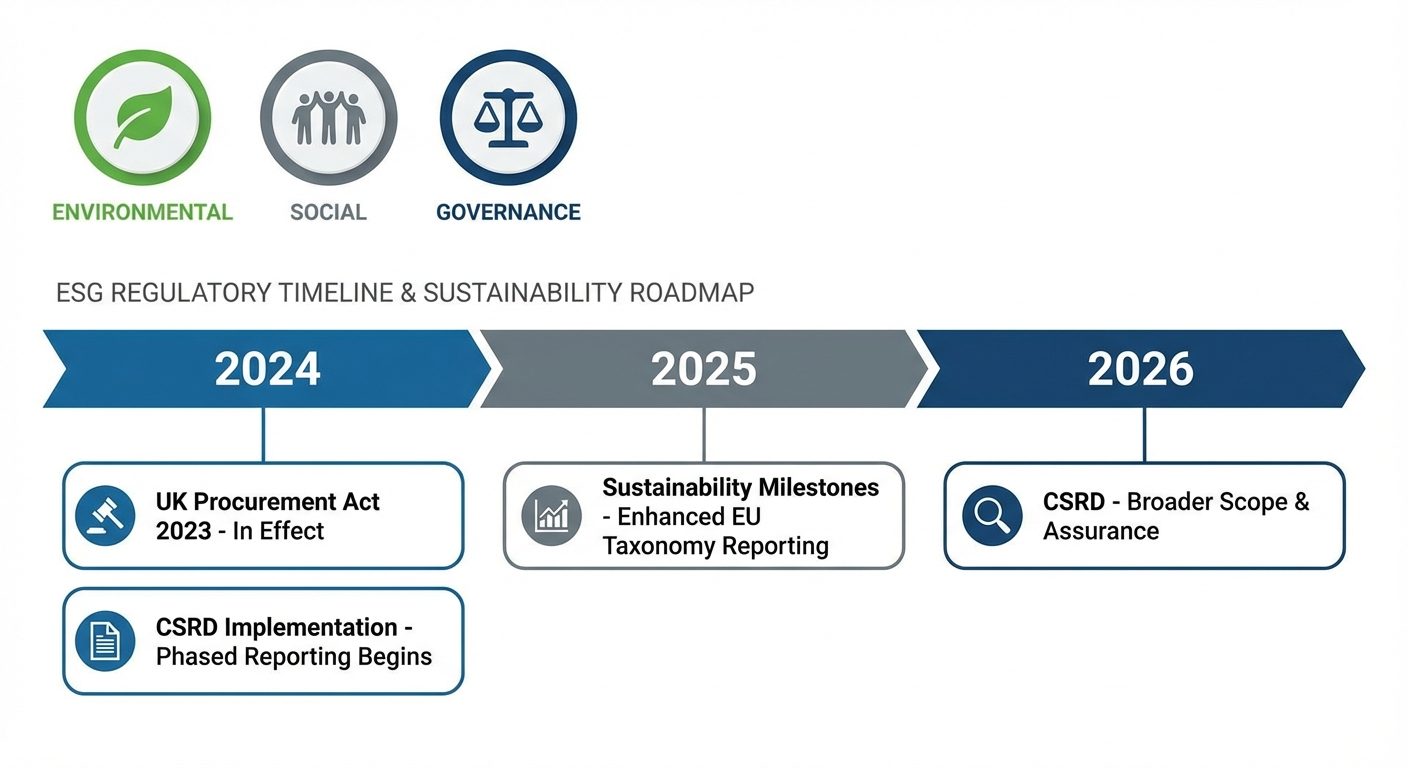
Regulatory timeline showing CSRD, Procurement Act, and sustainability milestones
For organisations responding to tenders, this regulatory environment creates both challenges and opportunities. The bar for entry has risen, eliminating competitors who cannot demonstrate genuine sustainability credentials. But for organisations genuinely committed to ESG principles, the new framework rewards authenticity and performance rather than greenwashing and rhetoric.
Understanding ESG Components in Tender Evaluation
ESG criteria in tenders encompass three distinct but interconnected dimensions: Environmental, Social, and Governance. Each dimension contains specific evaluation factors that procurement teams use to assess supplier suitability and award scores.
Environmental Criteria
Environmental criteria form the most visible and frequently weighted component of ESG evaluation. They typically include:
Carbon intensity and emissions management: Organisations must demonstrate measurement and reduction of Scope 1, 2, and increasingly Scope 3 emissions. This includes direct emissions from owned or controlled sources, indirect emissions from purchased energy, and emissions from the entire value chain including suppliers and product use. Tender responses should provide baseline emissions data, reduction targets aligned with science-based pathways, and evidence of year-on-year progress. Resource efficiency and circular economy principles: Procurement teams evaluate how organisations minimise resource consumption, reduce waste, and design products and services for reuse, repair, and recycling. This extends beyond simple recycling rates to encompass life cycle thinking, material selection, and end-of-life planning. Strong responses demonstrate closed-loop thinking and innovation in resource management. Biodiversity and ecosystem impact: Increasingly, tenders assess how organisations protect and enhance natural capital. This includes minimising pollution, avoiding harm to protected species and habitats, and contributing to nature recovery. Construction and infrastructure projects face particularly stringent biodiversity requirements, including mandatory biodiversity net gain provisions. Water management: Water stress is a growing global concern, reflected in tender requirements around water consumption reduction, wastewater treatment, and watershed protection. Organisations operating in water-stressed regions or water-intensive sectors face elevated scrutiny. Sustainable procurement practices: Your own supply chain sustainability matters. Procurement teams want evidence that you cascade sustainability requirements to suppliers, monitor their performance, and hold them accountable. This creates a multiplier effect, extending sustainability impact beyond direct contracting relationships.Social Criteria
Social criteria evaluate how organisations impact people, both within their own operations and across their broader sphere of influence.
Fair labour practices and decent work: This encompasses minimum wage compliance, working hours, health and safety standards, and freedom of association. Organisations must demonstrate not only legal compliance but also commitment to fair treatment throughout supply chains. Evidence might include Fair Trade or Ethical Trading Initiative membership, supplier audits, and grievance mechanisms. Diversity, equity, and inclusion: Tender evaluations increasingly assess workforce diversity across gender, ethnicity, disability, and other protected characteristics. This extends beyond representation to include inclusive practices, pay equity, and career progression opportunities. Organisations should provide disaggregated workforce data and demonstrate active DEI programmes. Skills development and employment: Many public sector contracts now require commitments to training, apprenticeships, and local employment. This reflects government priorities around levelling up and economic opportunity. Strong responses specify the number of apprenticeships created, training hours provided, and partnerships with educational institutions. Community engagement and social value: The Public Services (Social Value) Act 2012 requires public bodies to consider social value in procurement. Responses should detail how contracts will generate broader community benefits beyond the specific service delivered. This might include local supplier engagement, community investment, or support for vulnerable groups. Health, safety, and wellbeing: Beyond statutory compliance, tenders assess organisational commitment to physical and mental health. This includes wellbeing programmes, occupational health provision, and zero-harm cultures.Governance Criteria
Governance criteria assess organisational systems, structures, and accountability mechanisms that ensure ESG commitments translate into practice.
ESG policy and strategy: Organisations must demonstrate board-level accountability for sustainability, clear policies addressing key ESG risks, and integration of sustainability into core business strategy. Tender responses should reference published sustainability reports, board oversight structures, and executive remuneration linked to ESG targets. Ethics and anti-corruption: This includes anti-bribery policies, whistleblowing procedures, conflicts of interest management, and ethical business conduct. Organisations should provide evidence of training, due diligence processes, and incident response procedures. Risk management: Procurement teams evaluate how organisations identify, assess, and mitigate ESG-related risks. This includes climate-related financial risk disclosure aligned with TCFD recommendations, modern slavery risk mapping, and scenario planning. Stakeholder engagement: Effective governance requires listening to stakeholders including employees, communities, customers, and civil society. Tender responses should demonstrate structured engagement processes and evidence of responsiveness to stakeholder concerns. Transparency and reporting: Organisations must demonstrate commitment to honest, comparable, and verified ESG reporting. This includes adherence to recognized reporting standards (GRI, SASB, TCFD), external assurance of data, and public disclosure of performance.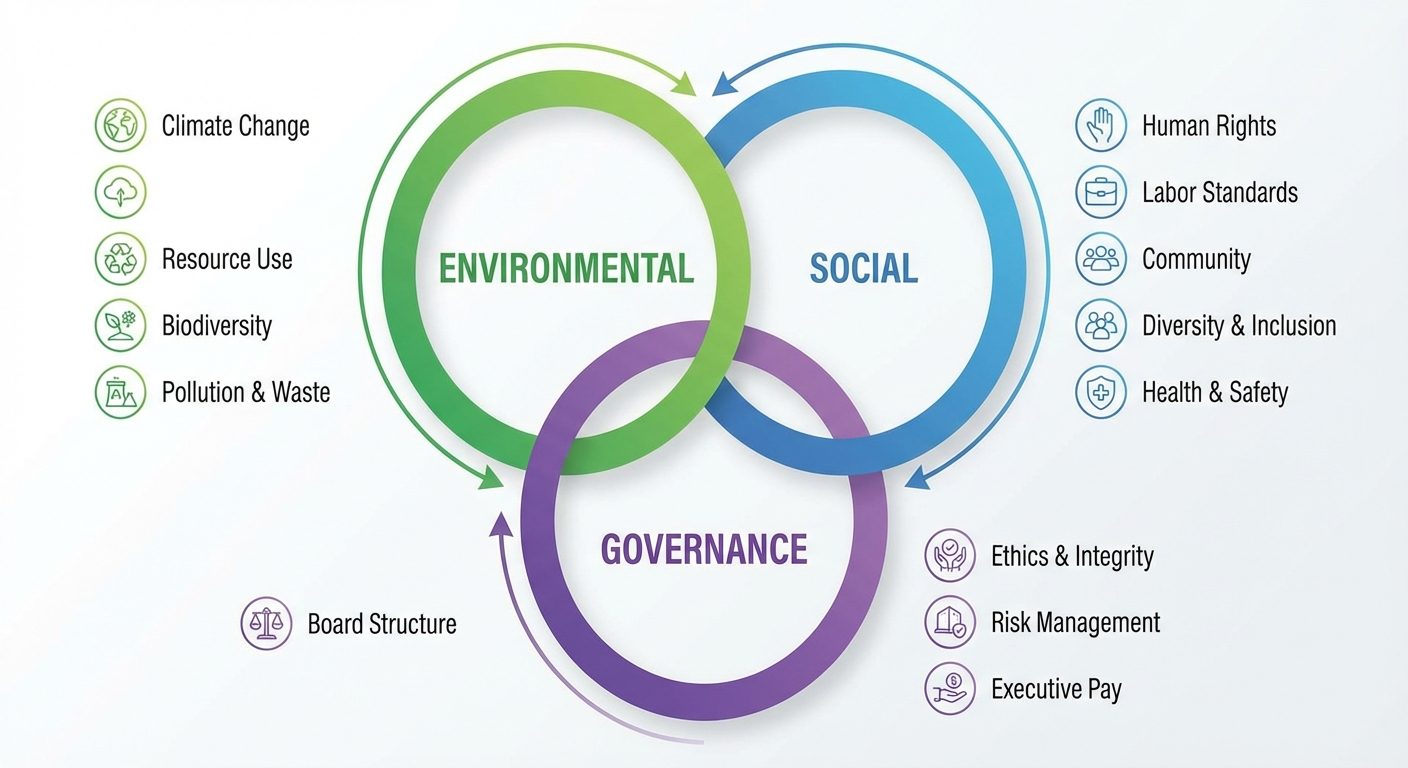
Diagram showing the interconnection of Environmental, Social, and Governance criteria
Understanding these components allows organisations to structure comprehensive tender responses that address evaluators' concerns systematically. The key lies in demonstrating not just policy existence but also implementation, monitoring, and continuous improvement.
Mandatory Environmental Criteria: What You Must Demonstrate
The shift from voluntary to mandatory environmental requirements represents the most significant change in public sector tendering over the past two years. Organisations can no longer opt out of sustainability considerations or treat them as secondary factors. Failure to meet mandatory environmental criteria results in automatic exclusion, regardless of price competitiveness or technical capability.
Carbon Reporting and Net Zero Commitments
Carbon reporting has evolved from optional disclosure to mandatory requirement in most government tenders. Organisations must provide:
Baseline carbon footprint: A comprehensive greenhouse gas inventory covering Scope 1, 2, and relevant Scope 3 emissions, calculated according to the GHG Protocol or ISO 14064 standards. This baseline should cover at least the most recent complete financial year and ideally show trend data over multiple years. Science-based reduction targets: Commitments to reduce emissions aligned with climate science. The Science Based Targets initiative (SBTi) provides the gold standard framework, requiring reductions consistent with limiting global warming to 1.5°C. Organisations should demonstrate targets for 2030 and 2050, interim milestones, and progress against these targets. Net zero pathway: A credible plan to achieve net zero emissions by 2050 or earlier. This must detail emission reduction levers (energy efficiency, renewable energy, fleet electrification, supply chain engagement), timelines, investment commitments, and the minimal role of offsetting. Procurement teams are increasingly sceptical of net zero claims heavily dependent on carbon offsets rather than actual emission reductions. Contract-specific emissions: For many tenders, especially construction, transport, and facilities management, organisations must project the carbon footprint of delivering the specific contract. This allows procurement teams to compare carbon intensity across bidders and select lower-carbon solutions. Responses should include methodology, assumptions, and opportunities for further reduction during contract delivery.Organisations without existing carbon measurement systems face significant challenges. Establishing comprehensive carbon accounting requires data collection infrastructure, allocation methodologies, and often external verification. Mytender.io's AI assistance can help structure carbon disclosures and ensure responses address all evaluator requirements, but the underlying data and strategy must be genuine.
Circular Economy and Waste Reduction
Linear "take-make-dispose" models are no longer acceptable in public procurement. Tenders increasingly mandate circular economy approaches that keep materials and products in use, eliminate waste, and regenerate natural systems.
Waste minimisation: Organisations must demonstrate strategies to prevent waste generation at source. For construction, this includes material optimisation and prefabrication. For facilities management, it encompasses procurement practices that favour durable, repairable products. Tender responses should provide waste reduction targets, historical performance data, and specific measures applicable to the contract. Reuse and repair: Tenders favour solutions that extend product lifespans through repair, refurbishment, and remanufacturing. IT procurement increasingly requires equipment refurbishment programmes. Facilities management contracts specify repair-first approaches for furnishings and equipment. Organisations should detail take-back schemes, repair capabilities, and product design for longevity. High-quality recycling: When materials do reach end-of-life, tenders require demonstrable recycling into high-value applications rather than downcycling or energy recovery. This requires segregation systems, supplier partnerships, and closed-loop thinking. Construction contracts often mandate minimum recycled content percentages and end-of-project material recovery rates. Circular business models: Some tenders actively encourage product-as-service, leasing, or sharing models that align supplier incentives with resource efficiency. These models reduce waste by retaining product ownership and maximising asset utilisation.Supply Chain Sustainability
Your supply chain's environmental performance is increasingly treated as your own. Tenders require evidence of:
Supplier environmental standards: Procurement policies that cascade sustainability requirements to suppliers, including carbon disclosure, environmental management systems (ISO 14001), and specific performance criteria relevant to your sector. Supply chain mapping and risk assessment: Understanding of environmental hotspots in your supply chain, including high-carbon inputs, deforestation risks, water-intensive materials, and pollution risks. Organisations should demonstrate risk-based prioritisation of suppliers for enhanced due diligence. Supplier engagement and improvement: Active programmes to support supplier environmental performance improvement, including capacity building, collaborative target setting, and recognition schemes. Evidence might include supplier sustainability workshops, joint carbon reduction projects, or innovation partnerships. Transparency and traceability: Increasingly, organisations must demonstrate visibility beyond Tier 1 suppliers to understand impacts in lower tiers. This is particularly important for commodities linked to deforestation (palm oil, soy, beef, timber) or human rights concerns (cobalt, cotton, electronics).Biodiversity and Nature Recovery
Following the UK's Environment Act 2021 and global momentum from the Kunming-Montreal Global Biodiversity Framework, biodiversity considerations are entering mainstream procurement.
Biodiversity net gain: Construction and infrastructure contracts often require minimum 10% biodiversity net gain, meaning projects must deliver measurably greater biodiversity value than existed before development. This requires ecological baseline surveys, biodiversity metric calculations, and either on-site habitat creation or purchase of biodiversity units. Nature-based solutions: Tenders increasingly favour solutions that work with natural processes rather than engineering around them. This includes sustainable drainage systems, green infrastructure, and nature-based flood management. Pollution prevention: Organisations must demonstrate controls to prevent pollution affecting ecosystems, including wastewater treatment, chemical management, and air quality protection.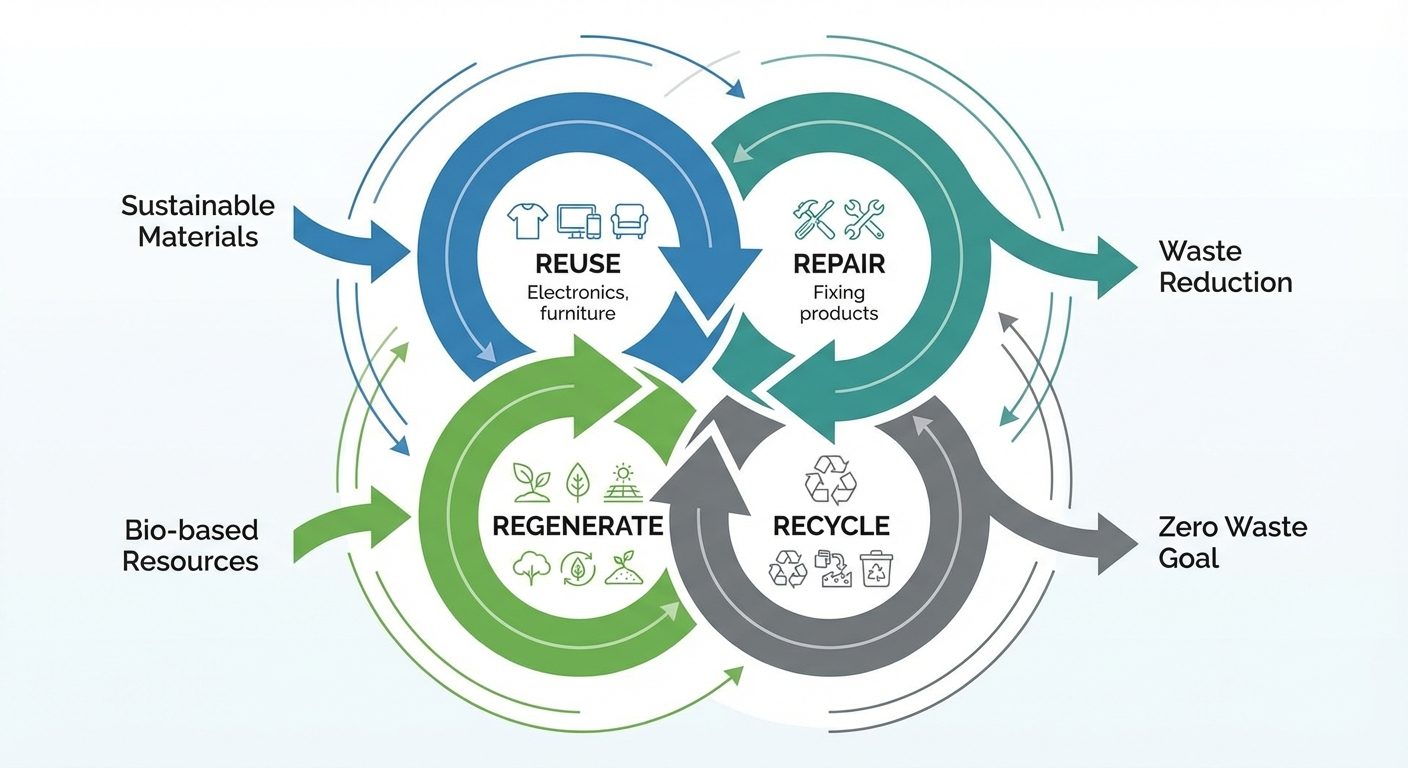
Circular economy principles diagram showing reuse, repair, recycle loops
Meeting mandatory environmental criteria requires genuine organisational commitment backed by data, systems, and resources. Procurement teams can identify greenwashing through lack of specificity, absence of verified data, or disconnect between stated commitments and actual plans. Authenticity and transparency, even when acknowledging areas for improvement, consistently score higher than exaggerated claims lacking substance.
Social Value Requirements: Beyond Environmental Impact
Environmental sustainability dominates ESG conversations, but social criteria increasingly determine tender outcomes. The Public Services (Social Value) Act 2012 requires public bodies to consider how procurement might improve economic, social, and environmental wellbeing. In 2026, social value weighting in tender evaluation commonly reaches 20-30%, occasionally exceeding price as a scoring factor.
Local Economic Benefit and Employment
Public sector buyers want procurement to generate broader economic benefits for communities, particularly in levelling up priority areas.
Local employment commitments: Tenders often require specific percentages of workforce drawn from local populations, defined by postcode or travel-to-work areas. Organisations should detail recruitment partnerships with local Jobcentre Plus offices, community organisations, and education providers. Evidence of past performance in local recruitment strengthens credibility. Apprenticeships and skills development: Many contracts mandate apprenticeship creation, expressed as numbers or percentages of total workforce hours. Organisations must demonstrate apprenticeship frameworks, partnerships with training providers, and commitment to quality training leading to recognised qualifications. Graduate placements and work experience opportunities for young people also generate social value scores. Supply chain localism: Where feasible, organisations should demonstrate commitment to engaging local suppliers, particularly SMEs. This might include commitment to advertising subcontracting opportunities through local business networks, prompt payment terms for smaller suppliers, and capacity-building support. Living Wage commitment: Increasing numbers of tenders require payment of Real Living Wage (as calculated by the Living Wage Foundation) rather than statutory National Living Wage. This extends to all staff working on the contract, including subcontractors and agency workers. Organisations should provide evidence of Living Wage accreditation where possible.Diversity, Equity, and Inclusion
DEI considerations extend beyond legal compliance to encompass active programmes addressing structural inequalities.
Workforce diversity: Tender responses should provide data on workforce composition across protected characteristics (sex, ethnicity, disability, age, sexual orientation) at different organisational levels. Evaluators look for representation across all levels, not just entry positions, and evidence of progress over time. Inclusive recruitment and progression: Organisations must demonstrate practices that remove barriers to employment and advancement for underrepresented groups. This includes blind CV screening, diverse interview panels, flexible working options, reasonable adjustments for disabled candidates, and mentoring programmes. Specific commitments relevant to the contract, such as recruiting disabled people or ethnic minorities into roles on the contract, carry particular weight. Pay equity: Gender and ethnicity pay gap reporting is increasingly expected, alongside evidence of action plans to close identified gaps. Procurement teams recognise that pay equity reflects broader organisational culture and values. Inclusive supply chains: Social value scores reward organisations that actively engage diverse suppliers, particularly businesses owned by women, ethnic minorities, disabled people, or social enterprises. This requires supplier diversity programmes with targets, measurement, and active outreach.Community Engagement and Investment
Tenders assess how organisations will engage with and contribute to local communities affected by contract delivery.
Stakeholder engagement: For contracts with significant community impact (construction, transport, waste management), organisations must detail engagement approaches including consultation methods, frequency, accessibility for diverse communities, and responsiveness to concerns. Evidence from past projects demonstrating effective engagement strengthens responses. Community investment: Many tenders require or reward volunteering commitments (employee days supporting local charities or community projects), charitable donations (often as percentage of contract value), or in-kind support (equipment, expertise, facilities access). Organisations should detail partnerships with community organisations and mechanisms for ensuring investment responds to locally identified needs. Social outcomes aligned with local priorities: The most effective responses demonstrate understanding of specific local challenges and opportunities, aligning social value commitments with local authority strategic priorities. This might include supporting food banks in areas of deprivation, digital inclusion initiatives in areas with connectivity challenges, or environmental volunteering in areas with green space deficits.Health, Safety, and Wellbeing
Social value extends to workforce wellbeing, assessed through:
Health and safety culture: Beyond legal compliance, procurement teams evaluate organisational commitment to zero harm, worker participation in safety management, near-miss reporting cultures, and continuous improvement. Organisations should provide RIDDOR statistics, lost-time injury rates, and evidence of proactive safety initiatives. Mental health and wellbeing support: Tender responses should detail mental health awareness training, access to counselling or employee assistance programmes, workplace wellbeing initiatives, and stigma reduction efforts. This is particularly important for high-stress sectors or contracts involving vulnerable workers. Fair work practices: This encompasses reasonable working hours, work-life balance support, security of employment (minimising zero-hours contracts and bogus self-employment), and employee voice mechanisms including union recognition where requested.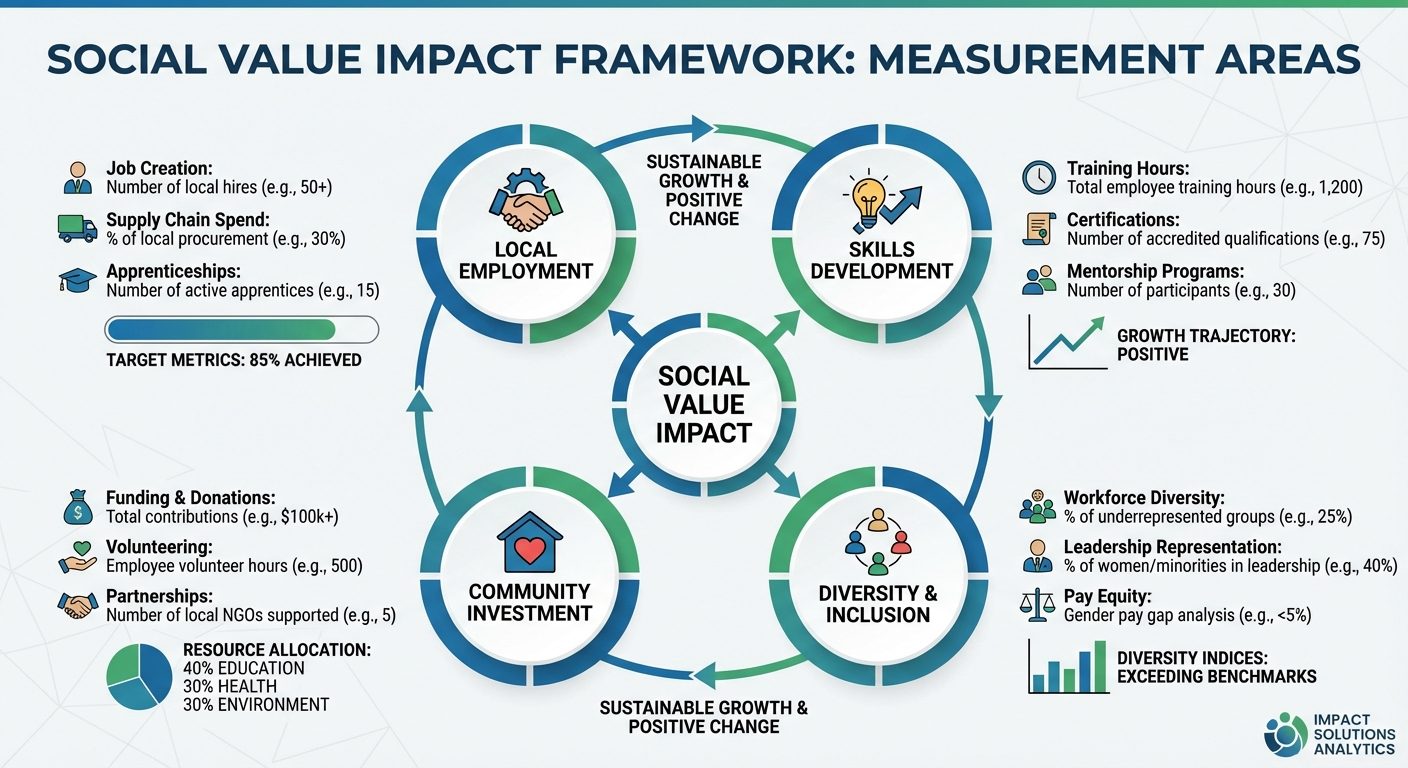
Infographic showing social value impact areas and measurement
Social value requirements offer opportunities for differentiation beyond price and standard technical specifications. Organisations genuinely committed to social outcomes, with systems to deliver and measure impact, gain competitive advantage. Those treating social value as box-checking or making vague commitments without delivery mechanisms will score poorly. Specificity, measurability, and credibility derived from past performance are essential.
Creating Credible ESG Documentation
ESG credentials mean nothing without robust documentation that procurement teams can verify. The shift toward mandatory sustainability requirements has elevated evidence standards significantly. Vague commitments and aspirational statements no longer suffice. Evaluators demand specific data, certified reports, and third-party verification.
Essential ESG Certifications and Standards
Recognised certifications provide independent validation of ESG claims, significantly strengthening tender responses.
ISO 14001 Environmental Management Systems: This international standard demonstrates systematic environmental management covering policy, objectives, legal compliance, and continuous improvement. Certification by accredited bodies (UKAS in UK) provides assurance that environmental commitments are embedded in organisational operations rather than existing only on paper. Procurement teams familiar with ISO 14001 can request specific documents (environmental policy, objectives, management review records) to verify active implementation. ISO 45001 Occupational Health and Safety: This standard demonstrates systematic health and safety management. For contracts with significant safety risks (construction, facilities management, manufacturing), ISO 45001 certification significantly enhances social credibility. Some high-risk tenders mandate certification as a minimum requirement. ISO 50001 Energy Management: This standard focuses specifically on energy efficiency and consumption reduction. It's particularly relevant for energy-intensive organisations and contracts where energy forms a significant operational cost. Certification demonstrates capability to manage and reduce energy use systematically. B Corporation Certification: B Corp certification assesses overall social and environmental performance against rigorous standards covering governance, workers, community, environment, and customers. Achieving B Corp status (minimum score of 80/200 and legal commitment to stakeholder governance) provides powerful evidence of comprehensive ESG commitment. The certification's public transparency and regular recertification requirements give procurement teams confidence in authenticity. Carbon Trust Standard: This certification validates carbon measurement, management, and reduction. The Carbon Trust verifies emission inventories, reduction strategies, and year-on-year progress. For organisations at earlier stages of carbon management maturity, this provides accessible third-party validation. Social Value certification schemes: Various schemes measure and verify social value impact, including Social Value Portal, TOMs (Themes, Outcomes, Measures) framework compliance, and National Social Value Taskforce principles. These help standardise social value measurement and provide comparable data across bidders. Industry-specific standards: Many sectors have specialised sustainability standards. Construction has BREEAM, CEEQUAL, and Passivhaus. Forestry has FSC and PEFC. Seafood has MSC. Electronics has TCO Certified. Procurement teams familiar with sector standards expect to see relevant certifications.Structuring Your Sustainability Report
Comprehensive sustainability reporting provides the foundation for tender responses. While small organisations may not have resources for glossy annual sustainability reports, structured documentation covering key ESG dimensions is essential.
Governance and oversight: Detail board-level responsibility for sustainability, management structures, and integration into business strategy. Specify committees, roles, and reporting lines. Demonstrate that sustainability isn't isolated in a single department but embedded across operations. Materiality assessment: Identify and prioritise ESG issues most relevant to your business, sector, and stakeholders. Explain methodology (stakeholder engagement, risk assessment, industry analysis) and how priorities inform strategy and reporting. Procurement teams value materiality-driven reporting over generic content covering all possible ESG topics superficially. Performance data: Provide quantitative data on key environmental metrics (emissions, energy, water, waste), social metrics (workforce diversity, training hours, safety statistics, community investment), and governance metrics (board diversity, ethics training completion, supplier audits). Present data with clear baselines, trends over multiple years, and comparison against targets. Targets and commitments: Specify quantified targets with clear timelines. These might include carbon reduction percentages by specific years, diversity representation targets, waste reduction goals, or social value investment commitments. Explain methodology for target-setting (science-based, industry benchmarks, stakeholder-informed) and demonstrate ambition while maintaining credibility. Narrative and case studies: Quantitative data gains meaning through context. Explain challenges overcome, innovations implemented, and lessons learned. Case studies demonstrating successful sustainability initiatives, particularly those relevant to public sector contracts, strengthen credibility. Include stakeholder perspectives (employee testimonials, community partner quotes, customer feedback) where possible. Assurance and verification: External assurance by independent third parties significantly increases report credibility. This might range from limited assurance of specific data points to reasonable assurance of comprehensive reports. Clearly state scope and level of assurance provided. Alignment with reporting frameworks: Structure reports according to recognised frameworks (GRI, SASB, TCFD, IFRS Sustainability Disclosure Standards). This ensures comprehensive coverage, stakeholder-relevant content, and comparability. Most frameworks are freely accessible and include detailed guidance.Building Your Evidence Library
Tender responses require extensive supporting documentation. Creating an organised evidence library allows rapid, comprehensive responses.
Policy documents: Maintain up-to-date policies covering environmental management, health and safety, anti-bribery and corruption, modern slavery, whistleblowing, diversity and inclusion, and social value. Policies should include version control, approval dates, and review schedules. Performance data: Maintain spreadsheets or databases tracking key performance indicators over time. This should include environmental metrics (energy consumption by site and source, waste by type and disposal route, water consumption, emissions by scope), social metrics (workforce demographics, training records, safety incidents, social value activities), and governance metrics (ethics training completion, supplier audits, board meeting attendance). Certificates and accreditations: Maintain current copies of all relevant certifications (ISO standards, industry schemes, trade association memberships, award recognitions). Track expiry dates and renewal requirements to ensure documentation remains current. Case studies: Document successful projects, particularly those demonstrating relevant ESG outcomes. For each case study, include client name (with permission), contract details, specific ESG challenges, solutions implemented, and quantified outcomes. Photographs and client testimonials strengthen impact. Supply chain documentation: Maintain supplier sustainability assessments, audit reports, and evidence of supplier engagement on ESG issues. Document your supplier selection criteria, sustainability requirements in contracts, and monitoring processes. Stakeholder engagement records: Document consultation exercises, community feedback, employee surveys, and responses to stakeholder concerns. This demonstrates genuine engagement rather than tokenistic exercises.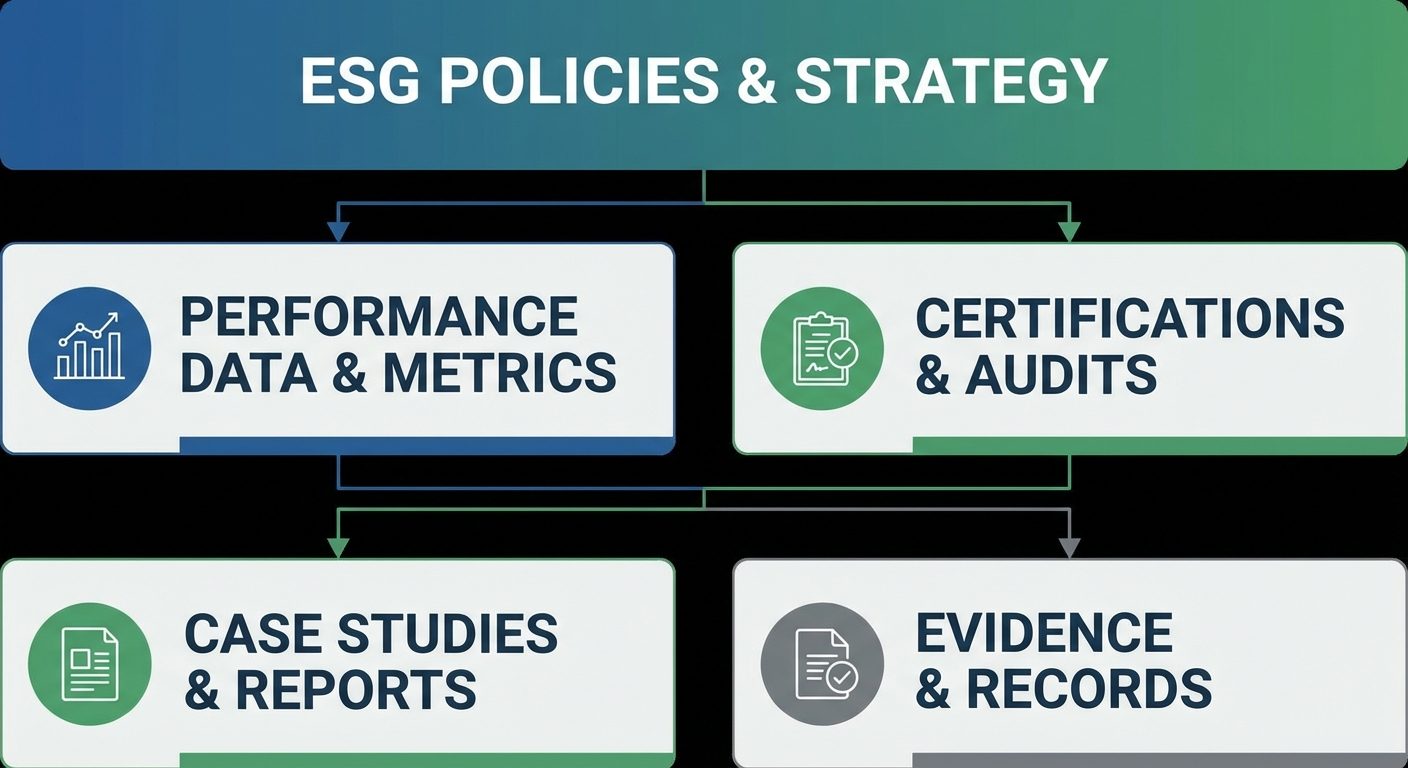
Diagram of ESG documentation hierarchy and evidence requirements
Comprehensive documentation requires investment but pays dividends across multiple tenders. Organisations with mature ESG documentation systems can respond to detailed sustainability questions rapidly and comprehensively, while competitors without organised evidence struggle to provide credible responses within tender deadlines.
Responding to Sustainability Questions: Practical Frameworks
ESG questions in tenders range from simple yes/no checkboxes to complex open-ended questions requiring detailed responses within strict word limits. Understanding common question types and effective response frameworks maximises scores.
Carbon and Climate Questions
Climate questions typically follow one of several patterns:
Question type: Baseline emissions and reduction commitmentsThis question asks for your organisation's total greenhouse gas emissions, baseline year, and reduction targets.
Response framework: State total emissions figure with scope breakdown (Scope 1, 2, 3), methodology used (GHG Protocol, ISO 14064), and verification status. Specify baseline year and why chosen. Detail reduction targets as percentage reductions from baseline by specific years (e.g., 50% reduction by 2030, net zero by 2050). Explain if targets are science-based (SBTi validated) and alignment with Paris Agreement temperature goals. Provide annual emissions trend data showing progress. Include governance structure for climate strategy (board oversight, executive responsibility). Scoring differentiators: SBTi-validated targets score higher than non-validated targets. Scope 3 inclusion demonstrates maturity. External verification increases credibility. Evidence of consistent year-on-year reductions demonstrates capability beyond commitment. Specific interim milestones show serious implementation plans. Question type: Contract-specific carbon footprintThis question requests projected emissions from delivering the specific contract being tendered.
Response framework: Estimate emissions across relevant sources (energy use in buildings, transport and logistics, purchased goods and services, business travel, employee commuting, waste). Specify methodology, data sources, and assumptions. Compare projected emissions to industry benchmarks or similar past contracts. Detail opportunities for emission reduction during contract delivery (renewable energy procurement, fleet electrification, supply chain engagement, circular economy approaches, digital solutions reducing travel). Quantify potential reductions and implementation timeline. Commit to monitoring and reporting actual emissions during contract period. Scoring differentiators: Granular, transparent calculations score higher than high-level estimates. Ambitious but credible reduction opportunities demonstrate innovation. Commitments to regular monitoring and transparency show accountability. Offering carbon-neutral or carbon-negative contract delivery (through verified emission reductions, not offsets alone) provides differentiation. Question type: Climate risk and adaptationThis question assesses understanding of climate risks to contract delivery and adaptation measures.
Response framework: Identify relevant physical climate risks (extreme weather, flooding, heat stress, water scarcity) and transition risks (policy changes, carbon pricing, market shifts, reputation) affecting contract delivery. Assess likelihood and potential impact. Detail adaptation measures to maintain service continuity (infrastructure resilience, supply chain diversification, flexible workforce arrangements, business continuity planning). Demonstrate integration with broader enterprise risk management. Reference TCFD framework to structure response. Scoring differentiators: Specific, evidence-based risk assessment rather than generic climate risk lists. Adaptation measures tailored to identified risks. Integration with business continuity and resilience planning. Evidence of scenario analysis considering different climate futures.Circular Economy and Resource Efficiency Questions
These questions assess commitment to minimising waste and maximising resource productivity.
Question type: Waste management approachThis question examines waste prevention, reuse, recycling, and disposal strategies.
Response framework: Detail waste hierarchy approach (prevent, reduce, reuse, recycle, recover, dispose) with specific measures at each level. Quantify current waste generation and diversion rates from landfill. Set specific waste reduction targets for the contract. Describe segregation systems, staff training, and monitoring processes. Detail partnerships with waste management contractors and evidence of their environmental credentials. For construction, specify commitments to Site Waste Management Plans. Provide case study of successful waste reduction from similar contract. Scoring differentiators: Ambitious waste reduction targets (e.g., zero waste to landfill). High-quality recycling into closed-loop systems rather than downcycling. Evidence of waste prevention at source rather than end-of-pipe recycling focus. Segregation systems that capture high percentages of recyclable materials. Transparency through waste data monitoring and reporting. Question type: Circular economy business modelThis question explores business model innovation to eliminate waste.
Response framework: Describe how your proposed solution embodies circular principles. This might include: product-as-service models retaining ownership and incentivising durability; take-back schemes ensuring end-of-life recovery; design for disassembly enabling component reuse; remanufacturing programmes restoring products to as-new condition; sharing platforms maximising asset utilisation. Quantify circular economy benefits (waste eliminated, materials kept in use, resource consumption avoided). Reference Ellen MacArthur Foundation principles or BS 8001 circular economy framework. Scoring differentiators: Genuine business model innovation rather than incremental improvements. Quantified environmental benefits from circularity. Evidence of successful circular model implementation in past contracts. Demonstration that circular approach benefits client (cost savings, reduced replacement cycles, guaranteed performance) alongside environmental benefits.Social Value Questions
Social value questions assess community benefit, employment, and inclusive growth.
Question type: Local employment and skills developmentThis question seeks commitments to employment, training, and apprenticeships.
Response framework: Commit to specific percentages or numbers of local workers, defined by geography relevant to contract. Detail recruitment methods (partnerships with Jobcentre Plus, community organisations, local colleges). Specify apprenticeship numbers or percentage of contract hours, with frameworks and training providers identified. Include work experience placements for young people or disadvantaged groups. Describe support for long-term unemployed, care leavers, ex-offenders, or other priority groups. Provide monitoring methodology and reporting commitment. Reference past performance delivering similar commitments. Scoring differentiators: Specific, quantified commitments rather than vague aspirations. Partnerships with named local employment support organisations. Commitments to Real Living Wage for all workers. Focus on sustainable employment and career progression rather than short-term placements. Evidence of past success delivering employment commitments. Question type: Community engagement and investmentThis question examines how contracts will benefit local communities beyond service delivery.
Response framework: Detail community consultation approach, ensuring accessibility for diverse groups. Commit to specific community investment (volunteering days, charitable donations, in-kind support) with delivery mechanisms. Identify partnerships with community organisations addressing locally relevant issues (verified through pre-tender engagement or local authority strategic plans). Describe approach to minimising negative impacts (traffic, noise, disruption) and maximising positive spillovers. Commit to measurement using recognised frameworks (HACT values, Social Value Portal) and regular reporting. Provide case study demonstrating successful community engagement from past contract. Scoring differentiators: Community investment commitments tied to contract value (e.g., 1% contract value as community investment). Evidence of pre-tender community engagement informing social value approach. Partnerships with named local organisations addressing priority local issues. Measurement commitments using recognised frameworks enabling value quantification. Mechanisms for community input into social value priorities during contract.Supply Chain Sustainability Questions
These questions assess management of sustainability risks and opportunities in supply chains.
Question type: Supplier sustainability requirementsThis question examines how you cascade and enforce sustainability standards among suppliers.
Response framework: Detail sustainability requirements embedded in supplier contracts (carbon disclosure, environmental management systems, labour standards, diversity). Describe supplier selection process and how sustainability factors into decision-making. Explain monitoring approach (self-assessment questionnaires, audits, performance reviews) with frequency and coverage. Detail escalation process for non-compliance and examples of enforcement. Describe supplier engagement and support programmes (capacity building, collaborative target setting, recognition). Provide evidence of supply chain sustainability maturity through certifications (ISO 20400 Sustainable Procurement) or assessments. Scoring differentiators: Mandatory sustainability requirements in supplier contracts rather than voluntary guidelines. Risk-based approach prioritising high-impact suppliers for detailed assessment. Evidence of supplier engagement and improvement rather than merely policing compliance. Transparency commitments extending beyond Tier 1 suppliers. Past examples of addressing supply chain sustainability issues effectively.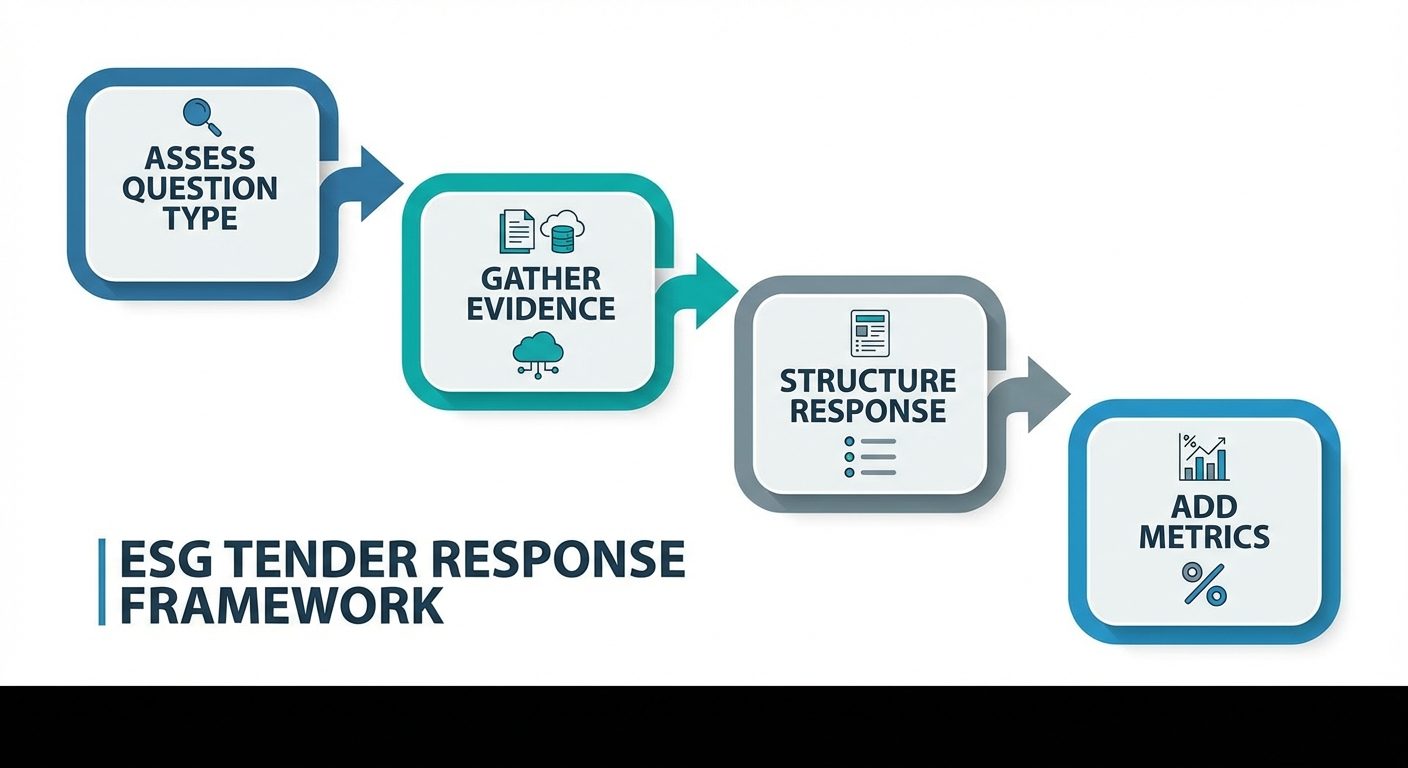
Framework diagram for responding to different ESG question types
Effective tender responses combine several elements: direct answering of every element within questions, specific and quantified commitments rather than vague statements, evidence from past performance demonstrating capability, transparency about challenges alongside achievements, and clear governance ensuring delivery of commitments. Organisations that invest in comprehensive ESG systems find responding to sustainability questions significantly easier, as documentation and evidence exist ready for deployment rather than requiring creation under tender pressure.
Common ESG Pitfalls and How to Avoid Them
Even organisations with genuine sustainability commitments make preventable mistakes in tender responses that cost scores. Understanding common pitfalls allows proactive avoidance.
Greenwashing and Credibility Gaps
Procurement teams are increasingly sophisticated in detecting exaggerated or unsubstantiated sustainability claims. Several red flags trigger scepticism:
Vague commitments without specifics: Statements like "we are committed to sustainability" or "we take environmental issues seriously" provide no evaluable information. Evaluators need specific policies, quantified targets, and evidence of implementation. Every sustainability claim should be backed by specific examples or data. Cherry-picking positive data: Highlighting selected positive metrics while omitting problematic areas damages credibility more than balanced reporting acknowledging challenges. If your carbon emissions increased last year, explain why and detail corrective actions rather than omitting the data. Offsetting instead of reducing: Over-reliance on carbon offsets to claim "carbon neutrality" while actual emissions remain high or increase attracts criticism. Procurement teams prioritise genuine emission reductions. Offsets should play a minimal role, limited to truly unavoidable residual emissions after comprehensive reduction efforts. Misuse of terminology: Using terms like "net zero," "carbon neutral," or "circular" without meeting established definitions erodes trust. Net zero requires emission reductions aligned with climate science plus removal of residual emissions. Carbon neutral might include offsetting without deep reductions. Circular economy means redesigning systems to eliminate waste, not merely recycling. Use terms precisely and accurately. Copying generic responses: Template responses not tailored to specific contracts are easily identified. Generic social value commitments not connected to local priorities score poorly compared to responses demonstrating understanding of local context and needs. Lack of third-party verification: Claims without independent verification face scrutiny. Where possible, reference certified reports, external audits, or third-party assurance of data.To avoid greenwashing perceptions: be specific, provide evidence, acknowledge limitations honestly, demonstrate year-on-year improvement, and secure independent verification where possible. Authenticity consistently outperforms exaggeration in tender evaluation.
Insufficient Evidence and Documentation
Many organisations have genuine sustainability programmes but fail to document them adequately for tender purposes.
Missing baseline data: Committing to targets without stating baseline makes assessment impossible. Always specify baseline year and measurement when setting targets. If you lack historical data, state current position as baseline and commit to future target achievement from that point. Policies without implementation evidence: Stating that policies exist without demonstrating implementation through examples, data, or case studies provides weak evidence. For every policy mentioned, include specific examples of application and results achieved. Outdated documentation: Submitting certifications that have expired or data more than two years old suggests sustainability is not an ongoing priority. Maintain current certifications and update key performance data annually. Inconsistent data: Contradictory figures or inconsistent terminology across tender responses damages credibility. Maintain centralised ESG data repositories ensuring consistency. Unable to disaggregate data: Organisations may have company-wide data but lack division, region, or site-level granularity needed for specific contracts. Structure data collection systems to enable relevant disaggregation.Unrealistic Commitments
Enthusiasm can lead to over-commitment, creating delivery and reputation risks.
Targets beyond capability: Committing to apprenticeship numbers, carbon reductions, or social value outputs beyond realistic delivery capacity creates future problems. Disappointed clients, negative performance reviews, and damaged reputation follow. Set ambitious but achievable targets grounded in past performance and realistic capacity. Lack of delivery mechanisms: Promising outcomes without clear delivery plans raises questions. Every commitment should come with identifiable actions, responsible individuals, resources, and monitoring processes. Ignoring trade-offs: Some sustainability goals involve trade-offs. Carbon reduction through material substitution might increase costs. Local employment might require extended recruitment timelines. Acknowledge trade-offs honestly and explain management approaches rather than claiming all sustainability actions deliver universal benefits without challenges. Copying competitors' best practice without capacity: Seeing competitors offer extensive sustainability commitments and matching them without genuine capability is risky. Differentiate based on your authentic strengths rather than attempting to match competitor claims lacking substance in your organisation.Misalignment with Client Priorities
Tender responses succeed by addressing client-specific priorities rather than generic sustainability topics.
Generic social value not matching local needs: Offering standardised community investment (tree planting, charity donations) without connection to local strategic priorities scores lower than targeted responses addressing identified local challenges. Research local authority priorities through published strategies, community plans, and direct engagement. Environmental focus when social factors dominate weighting: Some tenders weight social value at 30% while environmental factors receive 10%. Allocating response effort proportionately maximises scores. Check evaluation weightings carefully and emphasise accordingly. Technical solutions missing social co-benefits: Some tenders seek technical solutions with embedded social benefits. For example, waste management contracts might prioritise solutions creating local employment or community education programmes. Identify opportunities to align technical approach with social outcomes. Over-emphasising initiatives outside contract scope: Discussing corporate-level sustainability initiatives unrelated to contract delivery dilutes responses. Focus on sustainability commitments directly relevant to contract performance.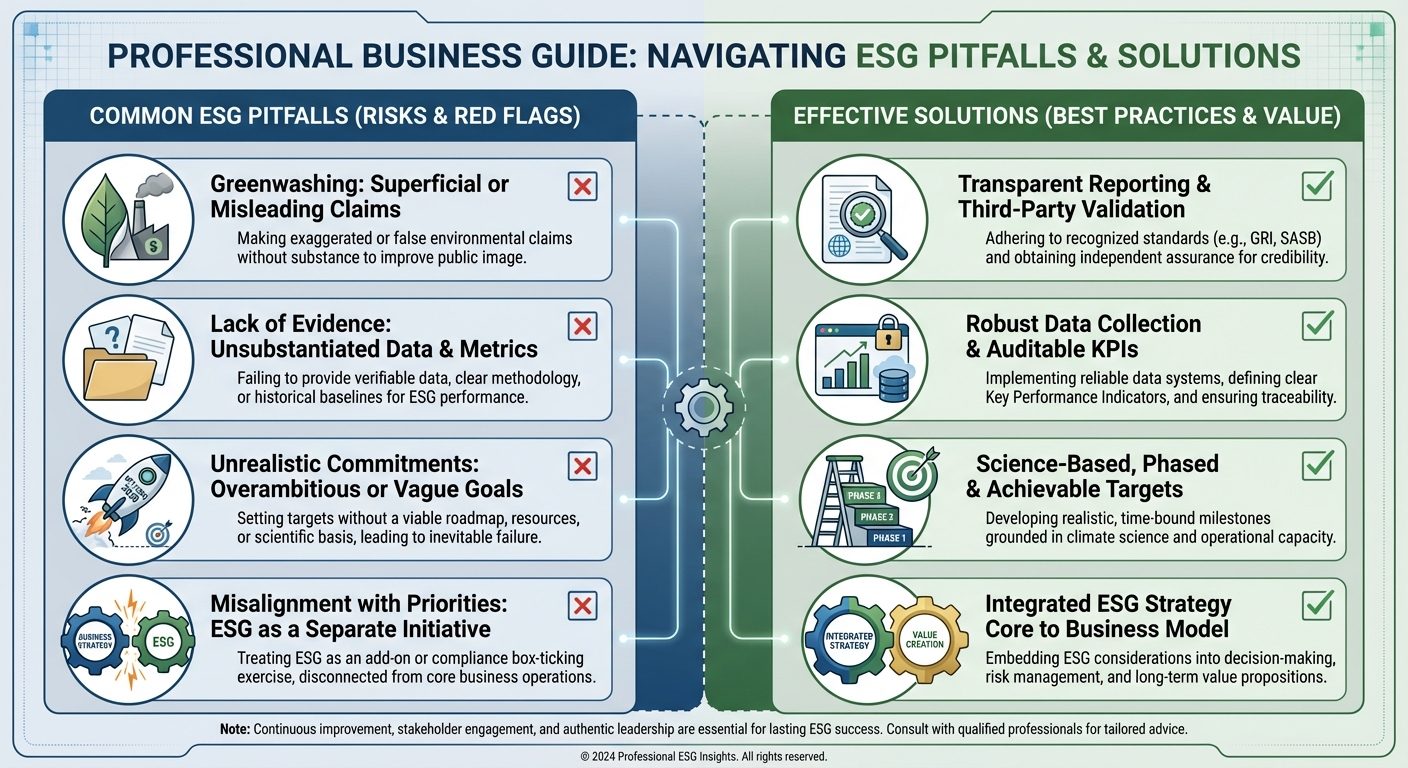
Common ESG pitfalls checklist with solutions
Avoiding these pitfalls requires combination of genuine sustainability capability, comprehensive documentation, and tailored responses addressing specific tender requirements. Organisations that invest in authentic ESG programmes, document them thoroughly, and respond strategically consistently outperform those with superficial sustainability efforts or poorly articulated genuine programmes.
Tools and Technology for ESG Compliance
Managing ESG requirements across multiple tenders and contracts requires appropriate tools and systems. Technology solutions range from simple spreadsheets to comprehensive enterprise platforms, with choice depending on organisation size, sector, and procurement activity volume.
Carbon Measurement and Reporting Tools
Accurate carbon footprinting forms the foundation of environmental credential demonstration. Several tools support measurement:
Carbon accounting platforms: Solutions like Normative, Watershed, or Emitwise provide cloud-based carbon accounting aligned with GHG Protocol standards. They connect to financial and operational systems to automate emission calculations across Scopes 1, 2, and 3. Benefits include consistency, automation reducing manual effort, and audit trails supporting verification. Many platforms also support scenario modelling for reduction strategies and tracking against science-based targets. Spreadsheet-based calculators: For smaller organisations or those early in carbon management journey, validated spreadsheet tools provide accessible starting points. The UK Government's GHG Conversion Factors are published annually, enabling manual calculation. Various consultancies and trade associations provide sector-specific calculator templates. While requiring more manual data input, these tools provide transparent, auditable calculations at low cost. Integrated ERP carbon modules: Larger organisations with Enterprise Resource Planning systems (SAP, Oracle, Microsoft Dynamics) can utilise carbon accounting modules within existing infrastructure. This ensures carbon management integrates with broader operational management and leverages existing data flows. Product carbon footprint tools: For organisations needing product or service level footprints (common in construction, manufacturing, facilities management), tools like SimaPro or GaBi provide life cycle assessment capabilities. These support detailed footprinting incorporating materials, energy, transport, and end-of-life phases.Social Value Measurement Platforms
Quantifying and reporting social value benefits has become essential for public sector tenders. Platforms standardise measurement using recognised frameworks:
National TOMs framework: The National Themes, Outcomes, Measures (TOMs) framework provides standardised metrics for social value measurement. The Social Value Portal platform enables organisations to plan, track, and report social value using TOMs, providing monetary proxy values (£) for outcomes like apprenticeship creation, local employment, or community volunteering. This enables comparison across different social value interventions and aggregation of total social value delivered. Hact Social Value Bank: Hact provides evidenced values for social outcomes particularly relevant to housing, health, and social care sectors. Organisations can calculate and report social value in standardised terms, particularly useful when working with local authorities and housing associations familiar with Hact methodology. Bespoke social value tracking: Some organisations build internal systems using database or project management tools to track social value activities (apprenticeships, volunteering, local spend). While requiring more manual value calculation, these provide flexibility to track organisation-specific metrics beyond standardised frameworks.ESG Reporting and Management Systems
Comprehensive ESG management requires coordinating data collection, target tracking, stakeholder engagement, risk management, and reporting across environmental, social, and governance dimensions.
Integrated ESG platforms: Solutions like Workiva, Diligent, or Sweep provide end-to-end ESG management including data collection workflows, performance dashboards, reporting aligned with multiple frameworks (GRI, SASB, TCFD), and assurance collaboration. These suit larger organisations with comprehensive ESG programmes and multiple stakeholders requiring access to ESG data. Sustainability reporting software: Tools like Plan A, Greenstone, or Sphera focus specifically on sustainability reporting, providing templates for recognised frameworks, progress tracking against targets, and report generation. These balance comprehensiveness with accessibility for organisations not needing full enterprise ESG platforms. Project and task management tools: For organisations at earlier maturity stages, adapted use of tools like Monday.com, Asana, or Microsoft Project enables tracking of ESG initiatives, responsibilities, and milestones. Combined with spreadsheets for quantitative data, this provides foundational ESG management at minimal cost.Supply Chain Sustainability Management
Managing supplier sustainability at scale requires dedicated tools and processes:
Supplier assessment platforms: EcoVadis, Sedex, or Supplier Ethical Data Exchange provide standardised sustainability assessments, audits, and scoring for suppliers. These platforms enable efficient supplier screening, identification of high-risk suppliers, and benchmarking across industry. Many large organisations require suppliers to maintain current EcoVadis or Sedex assessments, creating efficiency through single assessment serving multiple customers. Supply chain mapping tools: Understanding tiered supply chains, particularly for Scope 3 carbon or human rights risks, requires visibility tools. Solutions map supplier networks, identify geographic and sector risks, and prioritise suppliers for deeper engagement. Particularly relevant for complex global supply chains. Procurement platforms with ESG integration: Modern e-procurement platforms increasingly integrate sustainability criteria into sourcing and supplier selection. This embeds sustainability into standard procurement processes rather than treating it as separate exercise.Tender Response Management
While ESG-specific tools manage underlying data and programmes, tender response efficiency benefits from broader bid management systems:
Bid management software: Platforms like Loopio, Qvidian, or RFP360 provide content libraries, collaboration workflows, and response automation. For ESG content specifically, maintaining pre-approved responses to common sustainability questions (carbon footprint, policies, targets) enables rapid, consistent tender responses. These systems ensure responses leverage best available evidence and remain current as data updates. AI-assisted bid writing: Platforms like mytender.io leverage artificial intelligence to analyse tender questions, retrieve relevant content, and draft responses. For ESG questions particularly, AI assistance can structure responses effectively, ensure all question elements receive attention, and maintain appropriate tone and format. This significantly reduces time required for comprehensive sustainability responses while improving quality and consistency.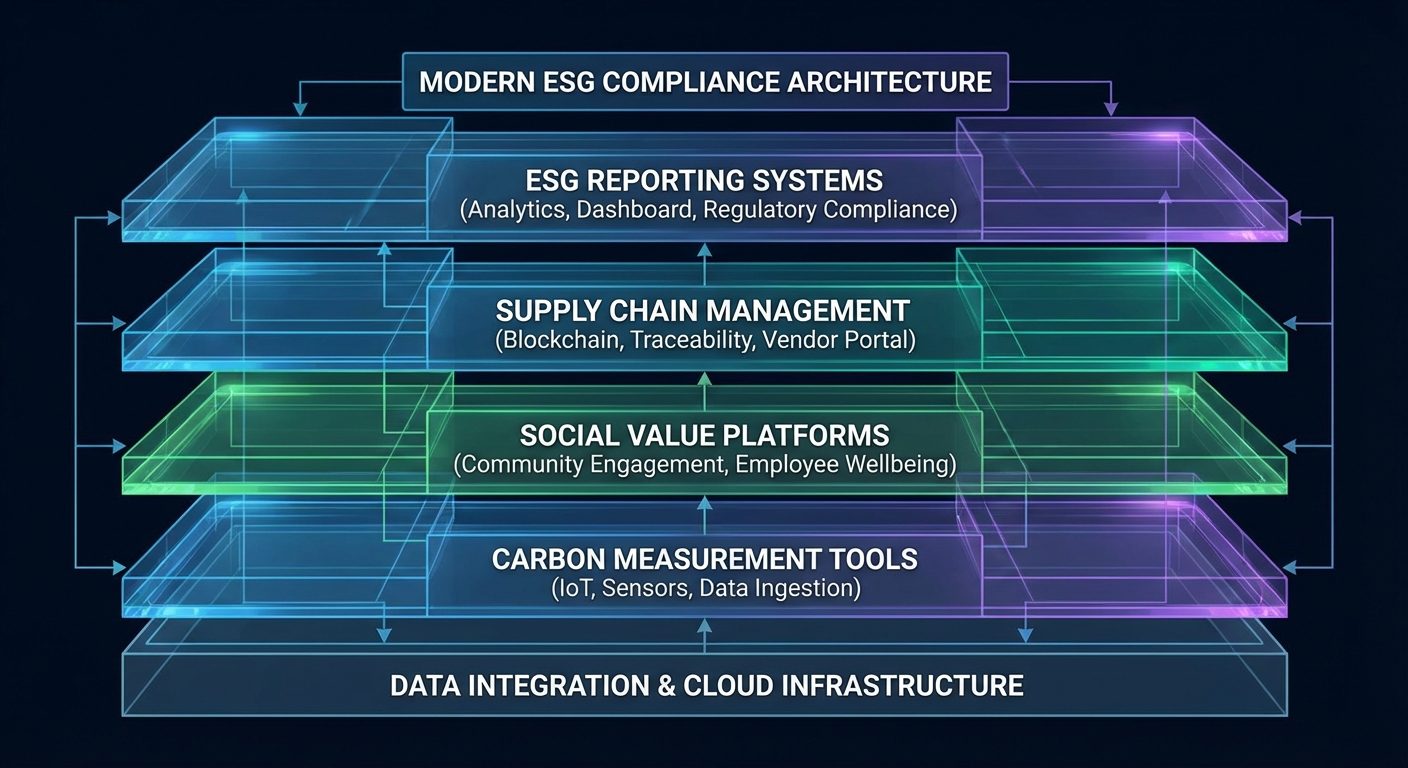
Technology stack diagram for ESG compliance management
Technology choices should align with organisational maturity, scale, and strategic priorities. Starting with accessible tools (spreadsheets, free calculators, manual tracking) enables progress without large upfront investment. As ESG sophistication and tender activity grow, investment in dedicated platforms delivers efficiency gains, quality improvements, and better decision support. The key lies in ensuring technology serves strategy rather than allowing tool selection to drive ESG approach.
Preparing for Different Procurement Frameworks
ESG requirements manifest differently across procurement frameworks, each with particular emphases, evaluation approaches, and compliance expectations. Understanding framework-specific characteristics allows tailored response strategies.
UK Public Procurement (Procurement Act 2023)
The Procurement Act 2023, fully implemented from February 2025, transformed UK public procurement with explicit focus on social value, commercial, and sustainability considerations.
Key ESG features: The shift from Most Economically Advantageous Tender (MEAT) to Most Advantageous Tender (MAT) removes primacy of economics, enabling much greater weighting for sustainability and social value. Contracting authorities can now prioritise quality, sustainability, and social value ahead of price where strategically justified. Enhanced oversight and transparency: The new framework requires publication of tender awards, contract details, and supplier performance information on the new central digital platform. This increased transparency extends to sustainability commitments and performance, creating accountability for delivery of ESG promises made during tender process. Supplier debarment: The Act strengthens debarment provisions for serious environmental, labour, and human rights violations. Organisations with poor ESG track records face exclusion from public contracts. This creates strong incentive for proactive ESG management rather than reactive responses to tender requirements. Flexibility for innovation: The Act explicitly encourages innovation and flexibility, moving away from overly prescriptive specifications. For sustainability, this creates opportunity to propose innovative circular economy solutions, low-carbon approaches, or novel social value models that exceed minimum requirements specified in tenders. Response implications: Organisations responding to UK public sector tenders under the new Act should expect heavier ESG weighting than historically experienced, detailed evaluation of past ESG performance including published supplier ratings, and opportunity to differentiate through innovative ESG approaches beyond standard compliance.EU Procurement Directives and CSRD
European procurement operates under established directives (2014/24/EU for public sector, 2014/25/EU for utilities) supplemented by newer sustainability requirements.
CSRD reporting requirements: The Corporate Sustainability Reporting Directive affects thousands of EU companies, requiring detailed sustainability reporting following European Sustainability Reporting Standards (ESRS). While CSRD is reporting legislation rather than procurement policy, it enables procurement teams to verify sustainability claims against audited disclosures for companies within CSRD scope. Organisations subject to CSRD should reference published sustainability statements in tender responses, providing independent verification. Green Public Procurement (GPP): The European Commission's GPP programme provides voluntary criteria for environmentally-focused procurement across numerous product and service categories. While voluntary for member states, many have adopted GPP criteria or developed similar national standards. Responses to EU public procurement should demonstrate alignment with relevant GPP criteria where they exist. Mandatory green procurement: Certain product categories (vehicles, IT equipment, buildings) have mandatory minimum environmental specifications in EU procurement. Understanding category-specific requirements is essential for compliant responses. Social considerations: EU procurement law explicitly permits social considerations, though application varies across member states. Some prioritise labour standards and fair trade, while others emphasise local employment and SME engagement. Research national priorities within target member states. Response implications: For EU procurement, reference CSRD sustainability statements where applicable, demonstrate alignment with GPP criteria, ensure compliance with any mandatory environmental specifications for your product category, and research member state-specific social priorities.Frameworks and Dynamic Purchasing Systems
Many organisations access public contracts through frameworks (pre-competed agreements) or Dynamic Purchasing Systems rather than individual competitive tenders. ESG considerations apply but with some distinctions.
Framework establishment: ESG credentials often form selection criteria for framework admission. Organisations must demonstrate sustainability capability to qualify for framework inclusion. Once on framework, individual call-offs may assess ESG less intensively or focus on contract-specific sustainability plans rather than general credentials. Further competition: When frameworks run further competitions for specific contracts, ESG criteria may feature prominently in minicompetition evaluation. Organisations should maintain current ESG documentation throughout framework duration to support call-off bids. Framework management reviews: Some frameworks include periodic performance reviews or require updated ESG information during framework duration. Maintain engagement with framework sustainability requirements beyond initial qualification. Response implications: For framework applications, invest heavily in comprehensive ESG evidence as initial qualification determines future opportunities. For call-offs from existing frameworks, focus on contract-specific ESG plans demonstrating how general capabilities apply to particular requirements.International Development and Multilateral Organisations
Organisations like World Bank, Asian Development Bank, UN agencies, and bilateral development organisations have sophisticated ESG requirements reflecting development objectives.
Environmental and Social Safeguards: Most multilateral organisations operate mandatory environmental and social safeguard policies. These require detailed Environmental and Social Impact Assessments, stakeholder consultation, grievance mechanisms, and ongoing monitoring. Understanding and demonstrating capacity to implement safeguard requirements is essential for development sector tenders. Inclusion and gender equality: Development procurement strongly emphasises gender equality, social inclusion, and disadvantaged group participation. Responses should detail specific mechanisms for ensuring women, minorities, persons with disabilities, and other excluded groups benefit from and participate in projects. Local capacity building: Development procurement prioritises local economic benefit and capacity building. Tenders often require partnerships with local organisations, knowledge transfer, training programmes, and sustainable local systems rather than temporary external service delivery. Transparency and accountability: Development organisations expect high standards of transparency, anti-corruption measures, and accountability. Responses should detail ethics policies, financial controls, whistleblowing mechanisms, and transparency commitments. Response implications: Development sector responses require demonstrable experience with environmental and social safeguards, specific commitments to inclusion and gender equality, partnership strategies with local organisations, and robust transparency and accountability systems.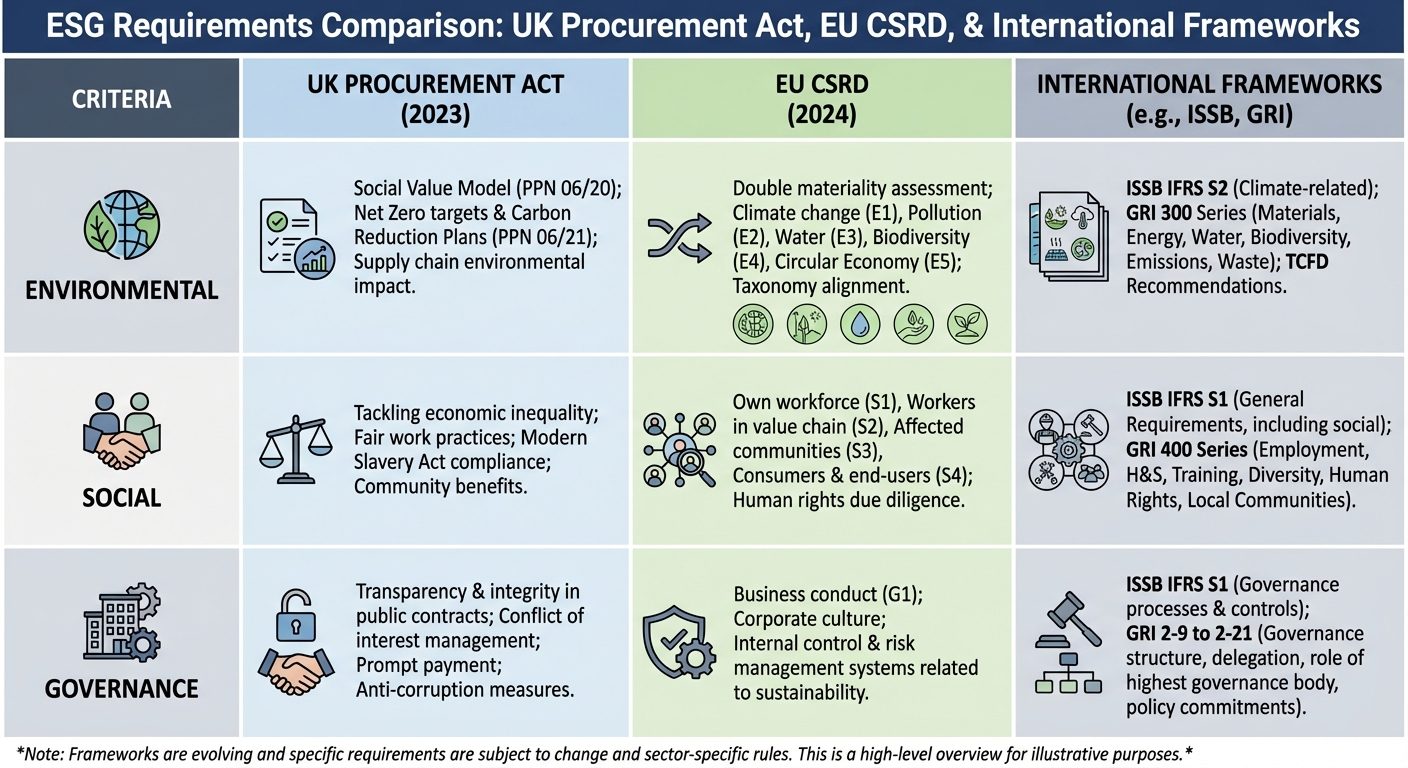
Comparison table of ESG requirements across different procurement frameworks
While all procurement frameworks increasingly emphasise ESG, specific priorities, evaluation approaches, and compliance expectations vary. Organisations operating across multiple frameworks should maintain core ESG documentation applicable across contexts, supplemented by framework-specific additions addressing particular requirements. The most successful bidders develop procurement intelligence understanding buyer-specific ESG priorities beyond generic framework requirements.
Case Studies: Winning with Strong ESG Credentials
Examining successful ESG-focused tender responses provides concrete examples of effective approaches and demonstrates value of genuine sustainability commitment.
Case Study 1: Facilities Management Contract with 40% ESG Weighting
A mid-sized facilities management provider bid for a five-year contract covering 50 public buildings across a metropolitan borough. The tender weighted price at 40%, technical quality at 20%, and ESG criteria at 40% (environmental 20%, social 20%).
ESG approach: The company invested three months prior to tender in developing robust ESG documentation. They achieved ISO 14001 and ISO 45001 certification, established science-based carbon targets validated by SBTi, and developed detailed social value proposals informed by consultation with local community organisations and the borough's strategic priorities. Response highlights:- Committed to net zero contract delivery through 100% renewable electricity, electric vehicle fleet, supplier engagement on carbon reduction, and quarterly carbon reporting to the client
- Proposed circular economy approach to furnishing and equipment, extending product lifespans by average 40% through repair-first philosophy and partnership with social enterprise furniture restoration organisation providing employment for long-term unemployed people
- Committed to 15% local employment target, 5 apprenticeships across contract duration, Real Living Wage for all staff including subcontractors, and 5 employee volunteering days annually supporting borough priorities (food insecurity, green space maintenance, digital inclusion)
- Detailed social value measurement using National TOMs framework, projecting £2.8 million total social value across contract life
Case Study 2: Construction Project with Mandatory Biodiversity Net Gain
A civil engineering contractor bid for major infrastructure project requiring minimum 10% biodiversity net gain and net zero embodied carbon within whole-life carbon budget.
ESG approach: The contractor partnered with ecological consultants and embodied carbon specialists during bid development. They developed detailed biodiversity metric calculations demonstrating 15% biodiversity net gain through combination of on-site habitat creation and off-site biodiversity unit purchase. For embodied carbon, they committed to low-carbon concrete (30% reduction vs. standard mixes), timber structures where technically feasible, circular economy principles reusing materials from enabling works, and comprehensive supplier engagement driving supply chain carbon reductions. Response highlights:- Detailed biodiversity baseline assessment and mitigation hierarchy showing how design avoided and minimised biodiversity harm before compensating residual impacts
- Biodiversity management and monitoring plan spanning 30-year contract period with local conservation partnership ensuring habitat maintenance
- Life cycle assessment demonstrating 40% embodied carbon reduction versus industry benchmark through material optimisation, efficient design, and supply chain collaboration
- Social value commitments including partnerships with local colleges delivering construction training for young people, diverse recruitment strategy targeting underrepresented groups, and community engagement programme addressing local concerns about construction impacts
Case Study 3: IT Services with Supply Chain Sustainability Focus
An IT managed services provider bid for contract with explicit focus on supply chain ethics, particularly modern slavery risk management in electronics supply chains.
ESG approach: The company had invested in supply chain transparency programme including multi-tier supply chain mapping, high-risk supplier audits, membership of Responsible Business Alliance, and partnership with NGO addressing electronics supply chain labour risks. They provided detailed evidence of supply chain due diligence aligned with UK Modern Slavery Act requirements. Response highlights:- Published modern slavery statement detailing risk assessment methodology, high-risk categories (cobalt in batteries, circuit board assembly), audit programme covering top 20 suppliers by spend, corrective action processes, and training for procurement staff
- Commitment to extending supply chain transparency to client-facing sustainability reporting, providing quarterly updates on supplier audit findings and remediation progress
- Circular economy approach prioritising equipment reuse, refurbishment partnership extending device lifespans, responsible recycling ensuring components recovered and no export to developing countries without WEEE compliance
- Social value including digital inclusion initiative donating refurbished equipment to disadvantaged communities, digital skills training for beneficiaries, and apprenticeship programme in IT support roles
Case Study 4: Small Organisation Winning Through Authentic Social Mission
A small charity providing employability training services bid for contract supporting long-term unemployed people into work, competing against much larger organisations.
ESG approach: As social enterprise with embedded social mission, the organisation's entire operational model demonstrated social value. Rather than treating ESG as separate tender section, they emphasised how their organisational purpose, staffing (including people with lived experience of unemployment and discrimination), and community relationships enabled superior outcomes. Response highlights:- Detailed evidence of success rates exceeding sector averages, with particular strength supporting people facing multiple barriers including homelessness, criminal records, mental health conditions, and discrimination
- Demonstrated authentic community relationships through testimonials from participants, referral partners, and local employers providing work placements
- Commitment to inclusive employment within their own organisation, with 60% staff from priority groups and progression pathways from participant to volunteer to employee
- Environmental commitments proportionate to scale, including sustainable facilities, minimal travel through local focus, and partnerships with local social enterprises for procurement
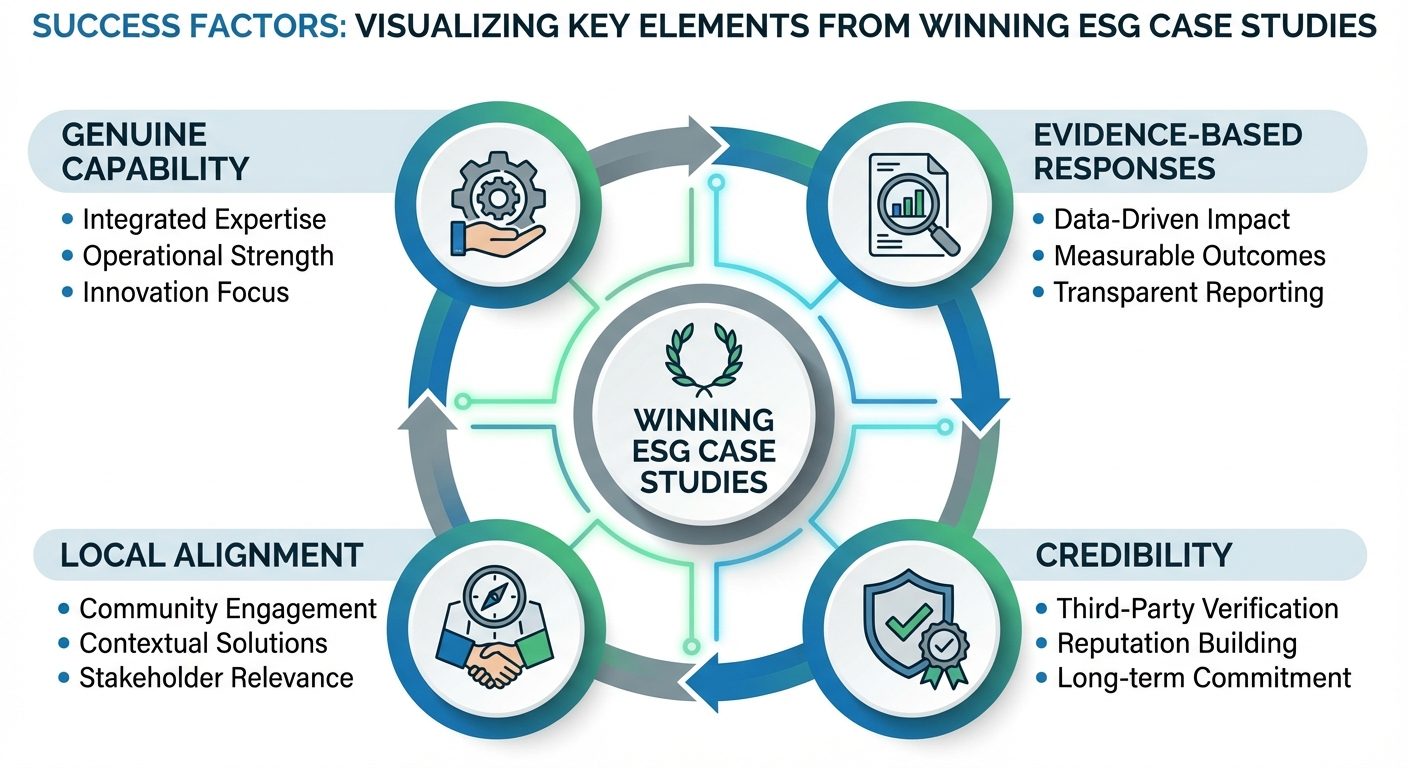
Success factors from ESG-winning case studies
These case studies demonstrate common success factors: genuine ESG capability rather than rhetoric, evidence-based responses with quantified commitments, tailoring to specific client priorities and local context, proportionate ambition balanced with credibility, and integration of ESG into technical approach rather than treating sustainability as separate add-on. Organisations that invest in authentic ESG capabilities consistently outperform those attempting to retrospectively construct ESG responses for individual tenders.
Future Trends: Where ESG Requirements Are Heading
Understanding emerging ESG trends allows organisations to anticipate future requirements and invest strategically in capabilities that will deliver competitive advantage.
Scope 3 Becomes Central
Carbon accounting is expanding from organisational boundaries (Scope 1 and 2) to comprehensive value chain emissions (Scope 3). Supply chain emissions typically comprise 70-90% of total carbon footprint for most organisations, making Scope 3 the critical frontier.
Future tenders will increasingly require Scope 3 measurement, supplier-specific emissions data rather than industry averages, and evidence of supply chain engagement driving emission reductions. Organisations without Scope 3 capabilities will struggle to demonstrate credible net zero pathways. Investment in supply chain carbon data collection systems and supplier engagement programmes represents essential preparation.
Nature and Biodiversity Join Climate
While climate dominates current environmental requirements, biodiversity and nature recovery are rapidly gaining prominence following the Kunming-Montreal Global Biodiversity Framework and UK Environment Act. Future requirements will likely include:
Nature-positive commitments: Analogous to net zero for carbon, nature-positive means leaving biodiversity in better condition than before activities. This extends beyond no-net-loss to actively contributing to nature recovery. Nature-related financial disclosure: The Taskforce on Nature-related Financial Disclosures (TNFD) framework, launched 2023, provides standardised approach to assessing and disclosing nature-related risks and opportunities. Expect future tenders to request TNFD-aligned disclosure alongside TCFD climate disclosures. Supply chain deforestation: Regulations prohibiting deforestation-linked commodities will expand due diligence requirements beyond forest-risk commodities to broader environmental impact across supply chains.Social Requirements Become More Sophisticated
Social value requirements are evolving from simple metrics (apprenticeships, volunteering hours) toward outcomes-focused evaluation.
Impact measurement and verification: Rather than accepting activity promises (we will create 5 apprenticeships), procurement teams will demand outcome measurement (apprentices will achieve qualifications and sustain employment for 12+ months). Third-party verification of social outcomes will become standard. Inequality and inclusion metrics: Requirements will extend beyond representation toward outcome equity. This includes measuring not just workforce diversity but also pay equity, progression rates for underrepresented groups, and inclusive workplace culture indicators. Living hours and security: Beyond living wage, requirements will address employment security (minimising zero-hours contracts), working hour reasonableness, and work-life balance. Pressure for fair work standards throughout supply chains will increase. Community wealth building: Some progressive public authorities are adopting community wealth building approaches that actively reshape local economies. This includes requirements for local supply chain development, worker cooperatives, community ownership models, and democratic business structures. While currently niche, these requirements may expand.Technology and Transparency
Digital technologies will transform ESG compliance, verification, and transparency.
Digital product passports: Technology enabling tracking of products' environmental and social attributes throughout life cycles will support circular economy requirements. Expect requirements for transparency about material origin, carbon footprint, repair potential, and end-of-life recycling. Blockchain for supply chain traceability: Distributed ledger technologies enable verified supply chain transparency, addressing modern slavery, conflict minerals, and environmental compliance. While currently emerging, blockchain-based compliance verification may become mainstream for high-risk commodities. Real-time ESG data: Static annual sustainability reports will give way to continuous, real-time data provision. Contract management systems will integrate ESG key performance indicators alongside financial and operational metrics, enabling ongoing performance monitoring. AI-powered verification: Artificial intelligence will increasingly enable automated verification of ESG claims, comparing self-reported data against satellite imagery, public disclosures, third-party data sources, and past performance. This will make greenwashing significantly more difficult.Integrated Reporting and Materiality
ESG requirements will move toward integrated sustainability assessment rather than separate environmental, social, and governance silos.
Materiality-driven requirements: Procurement teams will tailor ESG requirements to sectors and contracts, focusing on material issues rather than comprehensive but unfocused checklists. Construction tenders will emphasise embodied carbon and biodiversity; IT tenders will focus on supply chain ethics and circular economy; care services will prioritise fair work and wellbeing. Long-term value focus: Evaluation will increasingly consider long-term value creation, resilience, and sustainability rather than short-term cost minimisation. This includes assessing supplier business model sustainability, financial resilience to climate transition, innovation capability, and stakeholder relationships.Just Transition Considerations
As economies decarbonise, ESG requirements will incorporate just transition principles ensuring workers and communities dependent on high-carbon industries receive support and opportunity.
Workforce transition planning: Tenders in transitioning sectors (energy, automotive, heavy industry) will require evidence of worker retraining, redeployment support, and fair redundancy where necessary. Community transition support: For contracts affecting communities economically dependent on declining industries, social value requirements will focus on economic diversification, skills development for new industries, and community investment supporting transition.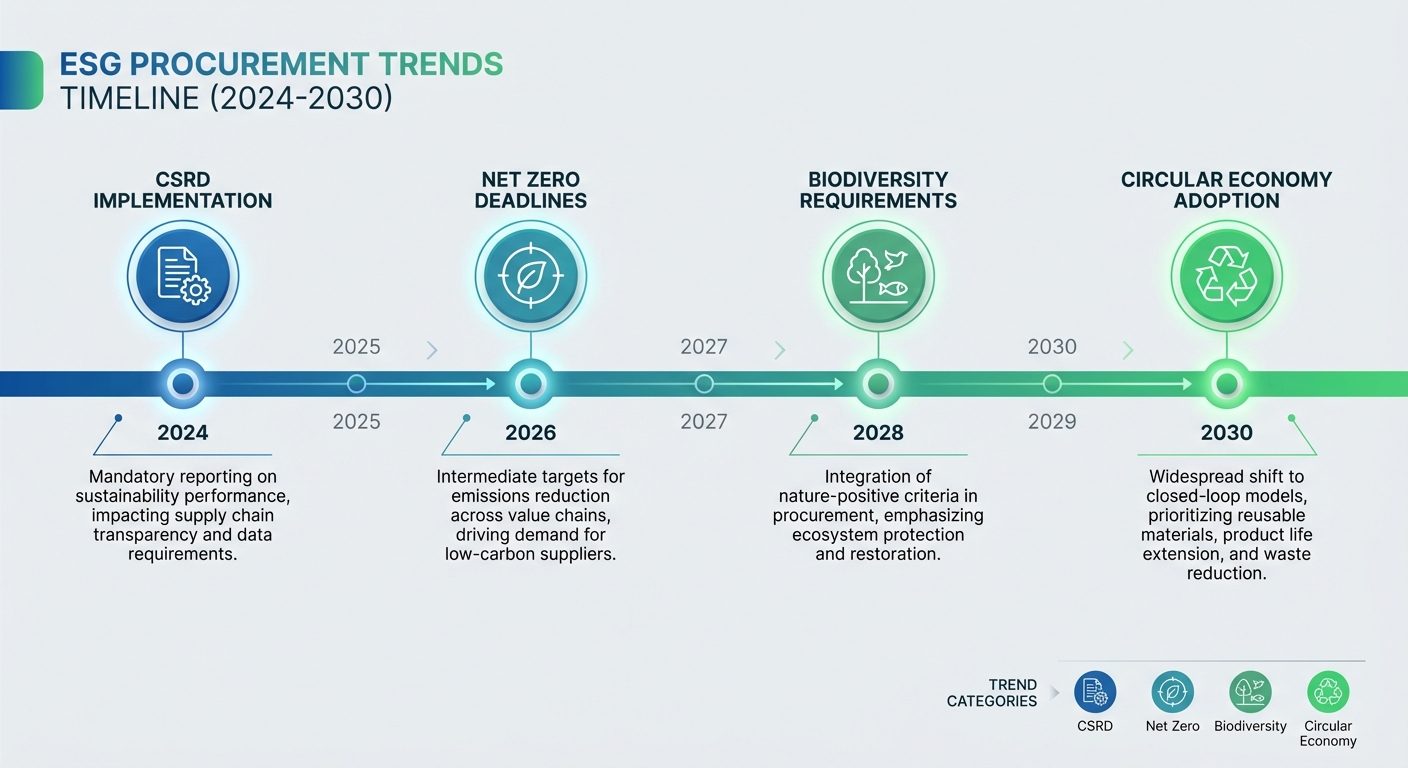
Future ESG trends timeline showing progression of requirements
These trends suggest ESG requirements will become simultaneously broader (covering more dimensions), deeper (requiring more evidence and impact), and more sophisticated (moving from inputs to outcomes, from annual to continuous monitoring, from self-reporting to independent verification). Organisations should invest now in measurement systems, data infrastructure, supply chain engagement, and impact measurement capabilities that will become baseline expectations in coming years.
Conclusion: Making ESG a Competitive Advantage
The transformation of ESG from voluntary initiative to mandatory requirement represents fundamental reorientation of public procurement. Organisations viewing sustainability as compliance burden or marketing exercise will struggle to compete. Those embracing ESG as strategic opportunity for innovation, stakeholder value creation, and long-term resilience will thrive.
Winning in this new landscape requires genuine commitment backed by evidence. Sustainability policies must translate into operational practice, monitored through data and validated by third parties. Social value commitments must deliver measurable community benefits, not vague promises. Governance systems must embed sustainability into strategy, oversight, and accountability.
The organisations succeeding in ESG-focused tenders share common characteristics: they measure what matters, investing in data systems that quantify environmental impacts and social outcomes; they set ambitious but credible targets aligned with science and stakeholder needs; they engage stakeholders authentically, listening to communities, employees, and supply chain partners; they report transparently, acknowledging challenges alongside achievements; they innovate continuously, seeking better approaches to environmental stewardship and social value creation.
For organisations early in ESG journeys, the path forward involves:
Baseline measurement: Understand your current environmental footprint (carbon, waste, water, biodiversity) and social impact (employment, diversity, community investment). Without baseline data, targets and improvements cannot be credibly claimed. Priority setting: Identify material ESG issues most relevant to your sector, stakeholders, and operations. Focus resources on issues where your impact is greatest and where stakeholder expectations are highest. Quick wins for credibility: Achieve accessible certifications (ISO 14001, Living Wage accreditation), establish policies on key issues (carbon, modern slavery, diversity), and document case studies demonstrating ESG in action. These provide immediate tender response material while longer-term programmes develop. Strategic investment: Develop roadmaps for significant ESG improvements requiring time and resources - science-based carbon targets, supply chain transparency systems, social value measurement frameworks. Begin implementation recognising competitive advantage compounds over time. Documentation and evidence management: Create organised repositories of ESG evidence - policies, performance data, case studies, certifications, stakeholder testimonials. Structure content for rapid deployment in tender responses.For organisations with mature ESG programmes, continued leadership requires:
Ambition elevation: As standards rise sector-wide, maintain differentiation through earlier net zero commitments, science-based biodiversity targets, industry-leading social value, and transparent disclosure beyond legal requirements. Scope expansion: Extend ESG excellence beyond direct operations into supply chains. Support suppliers in improvement, collaborate on innovation, and demonstrate responsible value chain stewardship. Outcomes focus: Move beyond activity reporting (we planted 500 trees, trained 100 people) toward impact measurement (biodiversity recovered by X%, employment sustained for Y people over Z years). Outcome evidence provides powerful differentiation. Thought leadership: Contribute to sector evolution through participation in standards development, industry working groups, and public dialogue. Recognised ESG leadership enhances reputation and relationship strength with progressive clients.The future of public sector tendering is clear: ESG excellence will increasingly determine winners. Technology, regulation, and stakeholder expectations continue raising the bar. Price will never become irrelevant, but value assessment will encompass environmental stewardship, social contribution, and governance quality alongside cost.
This transformation represents opportunity for organisations genuinely committed to sustainable value creation. By investing in authentic ESG capabilities, organisations position themselves not only for tender success but for long-term resilience, stakeholder trust, innovation, and purpose-driven growth that attracts talent, satisfies investors, and generates pride among employees.
The question is not whether to embrace ESG requirements but how ambitiously and authentically to do so. Those who lead will shape the sustainable economy emerging from public procurement's transformation. Those who lag will find themselves excluded from opportunities their competitors seize.
The choice, and the opportunity, is yours.
Tags
Ready to Transform Your Tender Writing?
See how MyTender's AI can help you write winning tenders in a fraction of the time.