
ESG in UK Tenders 2026: What Buyers Ask and How to Answer
ESG criteria are no longer optional in public and private sector tenders. Learn how to demonstrate environmental credentials, diversity commitments, and ethical governance to win contracts in 2026.
mytender.io Team
Procurement and Sustainability Specialists
The procurement landscape has fundamentally shifted. ESG (Environmental, Social, and Governance) criteria are no longer differentiators that give you a competitive edge—they're baseline requirements that can disqualify you before evaluators even reach your pricing section. In 2026, organisations bidding for public and private sector contracts face mandatory sustainability reporting, verified carbon data requirements, and rigorous diversity assessments.
This transformation is driven by regulatory pressure, stakeholder expectations, and the urgent need to address climate change. The Corporate Sustainability Reporting Directive (CSRD), UK net zero commitments, and supply chain due diligence legislation have moved ESG from voluntary corporate responsibility initiatives to mandatory compliance frameworks. For bid writers and procurement teams, understanding these requirements is critical to maintaining competitiveness in a market where 68% of contracting authorities now rate ESG criteria as "essential" or "very important" in supplier evaluation.
This comprehensive guide examines the ESG requirements reshaping tender submissions in 2026, providing practical frameworks for demonstrating environmental credentials, diversity commitments, and ethical governance. Whether you're responding to public sector frameworks worth millions or competing for private contracts with sustainability-conscious clients, mastering ESG compliance is no longer optional.
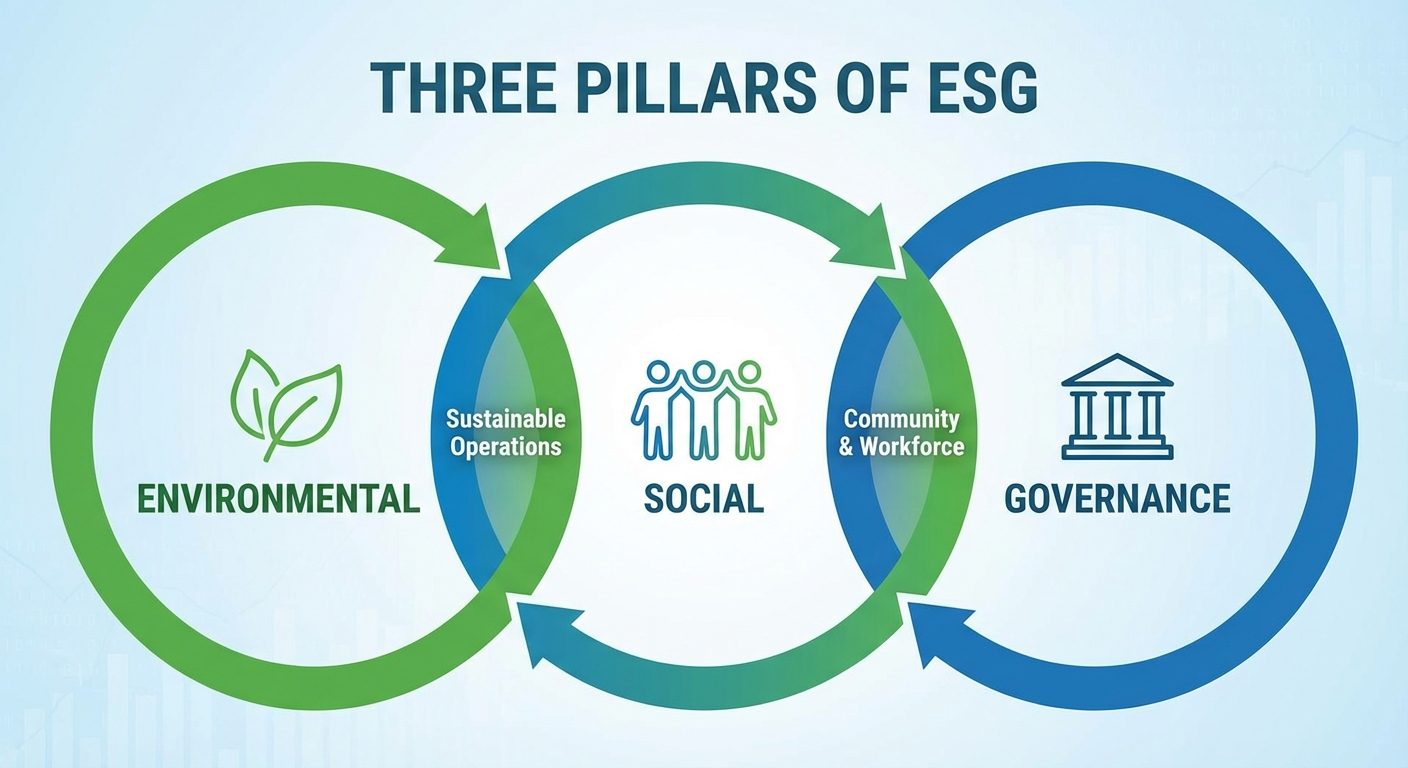
ESG framework showing the three interconnected pillars: Environmental, Social, and Governance
Understanding the ESG Framework in Procurement
ESG encompasses three interconnected pillars that evaluators assess when scoring tender submissions. Each pillar contains specific measurable criteria that suppliers must address with evidence-based responses.
Environmental criteria focus on your organisation's impact on the natural world. This includes carbon emissions across all scopes, resource efficiency, waste management practices, biodiversity protection, and circular economy principles. Evaluators examine both your current environmental performance and your roadmap for improvement. In 2026, expect questions about Scope 3 emissions (your supply chain's carbon footprint), renewable energy usage percentages, and time-bound net zero commitments with interim targets. Social criteria assess how your organisation treats people—employees, communities, and society at large. This encompasses workplace diversity and inclusion, fair labour practices, health and safety records, community engagement, and human rights protection throughout your supply chain. Contracting authorities increasingly require detailed breakdowns of workforce demographics, evidence of living wage policies, and demonstration of social value creation beyond the core contract deliverables. Governance criteria evaluate your organisational structure, decision-making processes, and ethical standards. This includes board diversity, anti-corruption policies, whistleblower protections, data privacy practices, and transparent reporting mechanisms. Strong governance demonstrates that ESG commitments are embedded in your corporate culture rather than superficial marketing claims.The weighting of these pillars varies by sector and contracting authority. Central government contracts typically allocate 10-15% of total evaluation scores to ESG criteria, while local authorities and healthcare organisations often assign 20-25%. Some progressive private sector clients weight ESG factors at 30% or higher, particularly in industries facing significant regulatory scrutiny like construction, energy, and transportation.
The Regulatory Drivers: Why ESG is Now Mandatory
Multiple regulatory frameworks have converged to make ESG compliance mandatory rather than voluntary. Understanding these drivers helps you anticipate future requirements and position your organisation proactively.
The Corporate Sustainability Reporting Directive (CSRD) came into force across the EU in January 2024, with UK equivalents following in 2025. This directive requires organisations meeting specific thresholds to publish detailed sustainability reports covering environmental impact, social responsibility, and governance structures. The CSRD introduces "double materiality"—assessing both how sustainability issues affect your business and how your business affects sustainability. For procurement, this means suppliers to large organisations must provide verifiable ESG data that cascades through supply chains.Large enterprises subject to CSRD reporting now demand ESG data from suppliers to fulfil their own compliance obligations. If you supply to organisations with £40 million+ turnover, 250+ employees, or £20 million+ balance sheet total, expect CSRD-aligned questions in tender documentation. These aren't aspirational—they're regulatory requirements with financial penalties for non-compliance.
UK net zero commitments legally bind the government to achieve net zero carbon emissions by 2050, with interim targets of 68% reduction by 2030 and 78% by 2035 (compared to 1990 levels). Public sector procurement plays a central role in achieving these targets. The Cabinet Office mandates that suppliers to central government commit to net zero by 2050 and publish carbon reduction plans showing how they'll achieve this goal. From 2024 onwards, contracts above £5 million annually require carbon reduction plans as mandatory submission documents. Supply chain due diligence legislation compels organisations to identify, prevent, and mitigate human rights and environmental risks throughout their supply chains. The UK Modern Slavery Act, combined with emerging due diligence requirements, means contracting authorities must verify that suppliers maintain ethical supply chains. This translates to tender questions about supplier auditing processes, subcontractor vetting, and remediation procedures when issues are identified. Social value requirements under the Public Services (Social Value) Act 2012 were strengthened significantly in 2021 with the introduction of Procurement Policy Note 06/20. This mandates that contracting authorities explicitly evaluate social value in public procurement, typically weighted at minimum 10% of total evaluation criteria. Social value themes include fighting climate change, tackling economic inequality, equal opportunity, and wellbeing. Suppliers must demonstrate how contract delivery creates measurable benefits beyond the core service or product.The convergence of these frameworks creates a compliance landscape where ESG evidence must be comprehensive, verifiable, and continuously updated. Procurement teams that treat ESG as a one-time exercise rather than ongoing organisational commitment will find themselves increasingly uncompetitive.
Environmental Credentials: Carbon Reporting and Climate Action
Environmental criteria dominate ESG requirements in 2026, driven by climate urgency and regulatory mandates. Demonstrating robust environmental credentials requires more than aspirational statements—evaluators demand quantified data, verified methodologies, and credible roadmaps.
Carbon footprint reporting forms the foundation of environmental submissions. You must calculate and report emissions across three scopes defined by the Greenhouse Gas Protocol. Scope 1 covers direct emissions from owned or controlled sources (company vehicles, on-site fuel combustion). Scope 2 includes indirect emissions from purchased electricity, heating, and cooling. Scope 3 encompasses all other indirect emissions in your value chain—purchased goods and services, business travel, employee commuting, waste disposal, and use of sold products.
Carbon reporting scopes diagram showing Scope 1, 2, and 3 emissions categories and sources
For most organisations, Scope 3 emissions represent 70-90% of total carbon footprint, yet many suppliers still omit this data from tender responses. In 2026, this omission is increasingly grounds for disqualification. Evaluators want to see comprehensive Scope 3 calculations because your supply chain's emissions become part of the contracting authority's carbon footprint under CSRD double materiality principles.
Use recognised calculation methodologies like the GHG Protocol, ISO 14064, or PAS 2050. State your reporting boundary clearly—which business units, geographical locations, and time periods does your data cover? Provide third-party verification where possible. Carbon Trust certification, ISO 14001 environmental management systems, or independent auditor verification significantly strengthen your submission credibility.
Carbon reduction plans must contain time-bound commitments with interim milestones. A generic statement like "we're committed to reducing emissions" scores zero points. Effective carbon reduction plans include baseline year emissions data, target reduction percentages for specific future dates, and detailed initiatives explaining how you'll achieve these reductions.Structure your carbon reduction plan around the five pillars mandated for central government suppliers: commitment statement, baseline emissions, reduction targets, carbon reduction initiatives, and supply chain engagement. For the commitment statement, include board-level sign-off demonstrating that climate action is embedded in corporate governance. Baseline emissions should cover all three scopes with clear data sources and calculation methodology. Reduction targets must align with climate science—at minimum, a 46% reduction by 2030 and net zero by 2050, consistent with limiting global warming to 1.5°C.
Carbon reduction initiatives require specificity. Rather than stating "we'll improve energy efficiency," detail the specific technologies, processes, or behaviour changes you'll implement. "Installing LED lighting across all facilities (reducing electricity consumption 40%), transitioning company vehicle fleet to EVs by 2028 (eliminating 850 tonnes CO2e annually), and implementing remote-first working policy (reducing commuting emissions 65%)" demonstrates tangible action with measurable impact.
Renewable energy transition receives increasing scrutiny. Report your current renewable energy percentage and trajectory toward 100% renewable power. If you're not yet at 100%, explain your roadmap. Direct renewable electricity purchasing through power purchase agreements (PPAs) scores higher than renewable energy certificates (RECs) because PPAs drive additional renewable generation capacity. On-site renewable generation (solar panels, wind turbines) demonstrates long-term commitment beyond simply purchasing green energy contracts. Resource efficiency and circular economy principles extend environmental assessment beyond carbon. Evaluators examine water consumption, waste generation rates, recycling percentages, and material lifecycle management. Demonstrate how you design out waste, prioritise reuse and refurbishment, and ensure end-of-life product recyclability.Provide quantified metrics: "Our operations divert 94% of waste from landfill through recycling, composting, and energy recovery. Product design follows circular economy principles—modular components enable repair and upgrade, extending average product life from 5 to 12 years. We operate a take-back scheme recovering 78% of products at end-of-life for refurbishment or material recovery."
Biodiversity and nature-based solutions emerge as critical evaluation criteria, particularly for construction, infrastructure, and land management contracts. Describe how your operations avoid or mitigate biodiversity harm. If your work impacts natural habitats, demonstrate net gain commitments—leaving biodiversity in better condition than baseline. Nature-based solutions like green infrastructure, sustainable drainage systems, and habitat creation may contribute to both environmental and social value scoring. Environmental management systems provide structural evidence of environmental commitment. ISO 14001 certification demonstrates systematic environmental risk management, compliance tracking, and continuous improvement processes. Environmental policies should be publicly available, regularly reviewed, and demonstrably implemented rather than existing only on paper.When responding to environmental questions, structure answers using the CAR (Context, Action, Result) framework. Provide context explaining why the issue matters to your organisation, describe specific actions you've taken, and quantify results with credible data. Avoid vague claims and unsubstantiated assertions—every environmental statement should be supportable with documentation if requested during clarification or contract award stages.
Social Criteria: Diversity, Equity, and Fair Employment
Social factors in ESG assessment examine how your organisation treats people and contributes to societal wellbeing. These criteria have expanded significantly beyond basic employment law compliance to encompass diversity metrics, fair pay, social mobility, and community impact.
Workforce diversity and inclusion requires quantified evidence, not aspirational policies. Contracting authorities request demographic breakdowns across protected characteristics: gender, ethnicity, disability, age, and increasingly LGBTQ+ representation. Report diversity data at all organisational levels—overall workforce, management positions, senior leadership, and board composition. Leadership diversity carries particular weight because it demonstrates authentic commitment rather than entry-level diversity targets.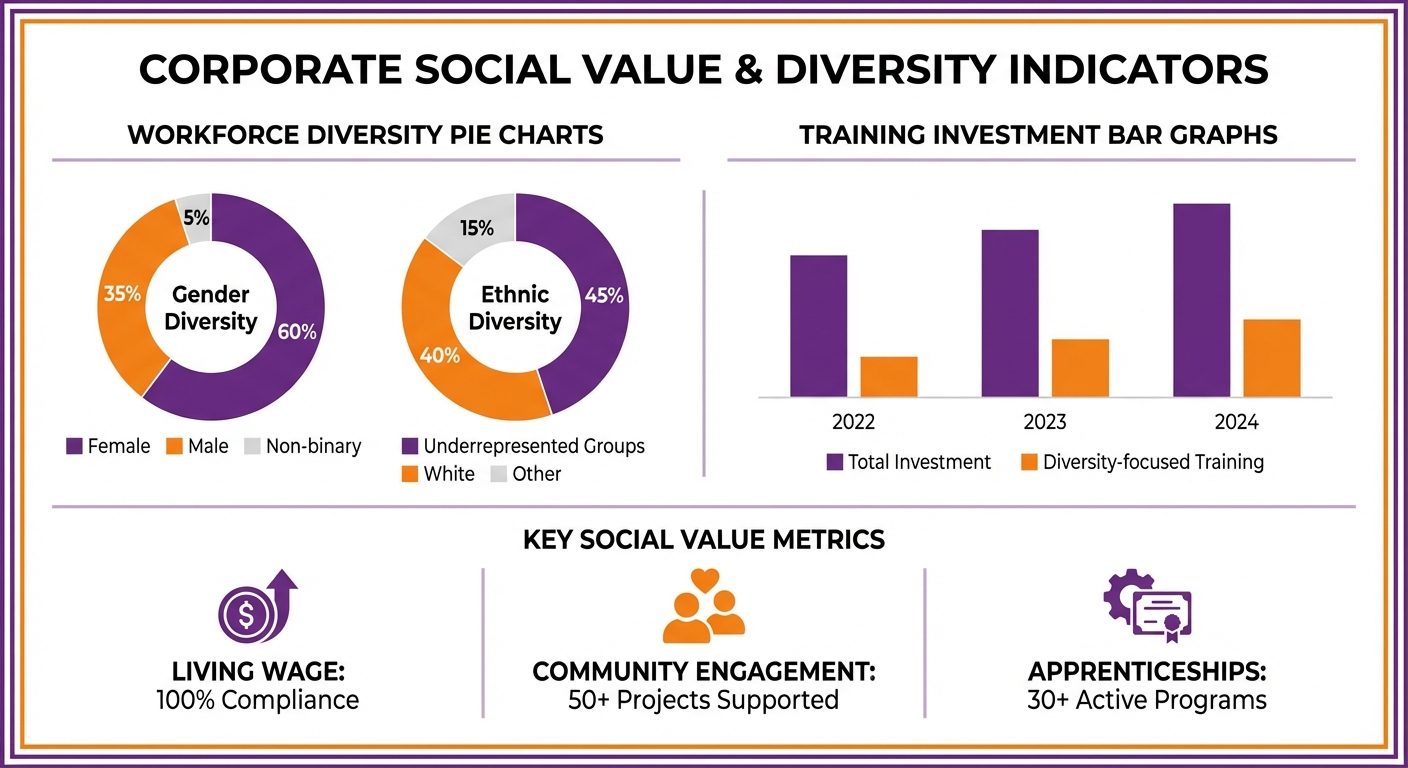
Social value metrics showing diversity indicators, training investment, and community engagement measurements
Provide year-on-year trends showing improvement trajectories. "Our workforce is 38% female overall, up from 31% in 2023. At management level, female representation increased from 24% to 33% over the same period. We've set a target of 40% female representation in senior leadership by 2027, supported by mentorship programmes and inclusive recruitment practices." This response provides baseline data, progress trajectory, and specific future targets with supporting initiatives.
Pay equity and living wage commitments differentiate strong submissions from weak ones. Accreditation as a Living Wage Employer (through the Living Wage Foundation in the UK) demonstrates commitment to fair compensation exceeding minimum wage requirements. Report your gender pay gap annually and explain specific actions to address any disparities. Evidence of equal pay audits, transparent salary bands, and objective promotion criteria strengthens your position. Employee wellbeing and development encompasses health and safety performance, training investment, and career progression opportunities. Report your RIDDOR (Reporting of Injuries, Diseases and Dangerous Occurrences Regulations) incident rates, lost time injury frequency rates, and proactive health and safety initiatives. Low incident rates combined with high reporting rates indicate positive safety culture where employees feel comfortable reporting near-misses and minor incidents.Training investment demonstrates commitment to employee development and adaptability. Report average training hours per employee annually, apprenticeship numbers, and career progression statistics. "We invest average £2,400 per employee annually in professional development. In 2025, 23% of our workforce participated in formal qualifications or accredited training programmes. We employ 18 apprentices (4% of workforce), with 89% of apprentices securing permanent positions upon completion."
Supply chain labour standards extend social responsibility beyond your direct employees. Evaluators assess how you ensure ethical treatment throughout your supply chain, particularly for suppliers in jurisdictions with weaker labour protections. Describe your supplier code of conduct, auditing processes, and remediation procedures when issues arise. Modern slavery statements required under the Modern Slavery Act 2015 should be comprehensive, evidence-based documents demonstrating active risk management rather than generic compliance documents. Social value creation under PAS 2060 and the National TOMs (Themes, Outcomes, Measures) framework requires bidders to identify how contract delivery generates social benefits beyond core requirements. This might include local employment creation, skills training for disadvantaged groups, support for SMEs and VCSEs (Voluntary, Community and Social Enterprises), or community investment.Quantify social value using recognised measurement frameworks. The National TOMs framework provides standardised metrics for social value measurement across categories like jobs created, weeks of employment support, apprenticeships created, local spend, and volunteering hours. When committing to social value outcomes, ensure promises are realistic, measurable, and aligned with the contracting authority's strategic priorities.
Community engagement and local economic impact matter particularly for local authority contracts. Describe how you'll engage with local communities, support local businesses through your supply chain, and contribute to the local economy. Commit to specific local labour percentages, local SME spend targets, and community consultation processes.For construction and infrastructure projects, consider community benefit clauses: employment opportunities for local residents, training and upskilling programmes, support for local schools, or contributions to community facilities. These commitments must be monitored and reported throughout contract delivery—unmet social value commitments damage reputation and may trigger contractual penalties.
Health and wellbeing initiatives extend beyond workplace safety to encompass mental health support, flexible working arrangements, and work-life balance policies. In the post-pandemic landscape, evaluators recognise that employee wellbeing directly impacts service quality, retention, and organisational resilience. Evidence of mental health first aiders, employee assistance programmes, flexible working policies, and wellbeing initiatives demonstrates holistic people management.Structure social responses around evidence and outcomes. Generic policies without implementation evidence score poorly. Instead, demonstrate how policies translate to measurable positive outcomes for employees, supply chain workers, and communities.
Governance: Ethics, Transparency, and Accountability
Governance criteria assess your organisational structures, decision-making processes, and ethical frameworks. Strong governance provides assurance that ESG commitments are embedded in corporate culture and will persist beyond individual contracts or personnel changes.
Board composition and diversity signal organisational values at the highest level. Report board demographics, director expertise, and governance structures. Independent non-executive directors, audit committee functionality, and separation of chair and CEO roles (for larger organisations) demonstrate robust governance. Board diversity across gender, ethnicity, and professional background improves decision-making quality and stakeholder representation.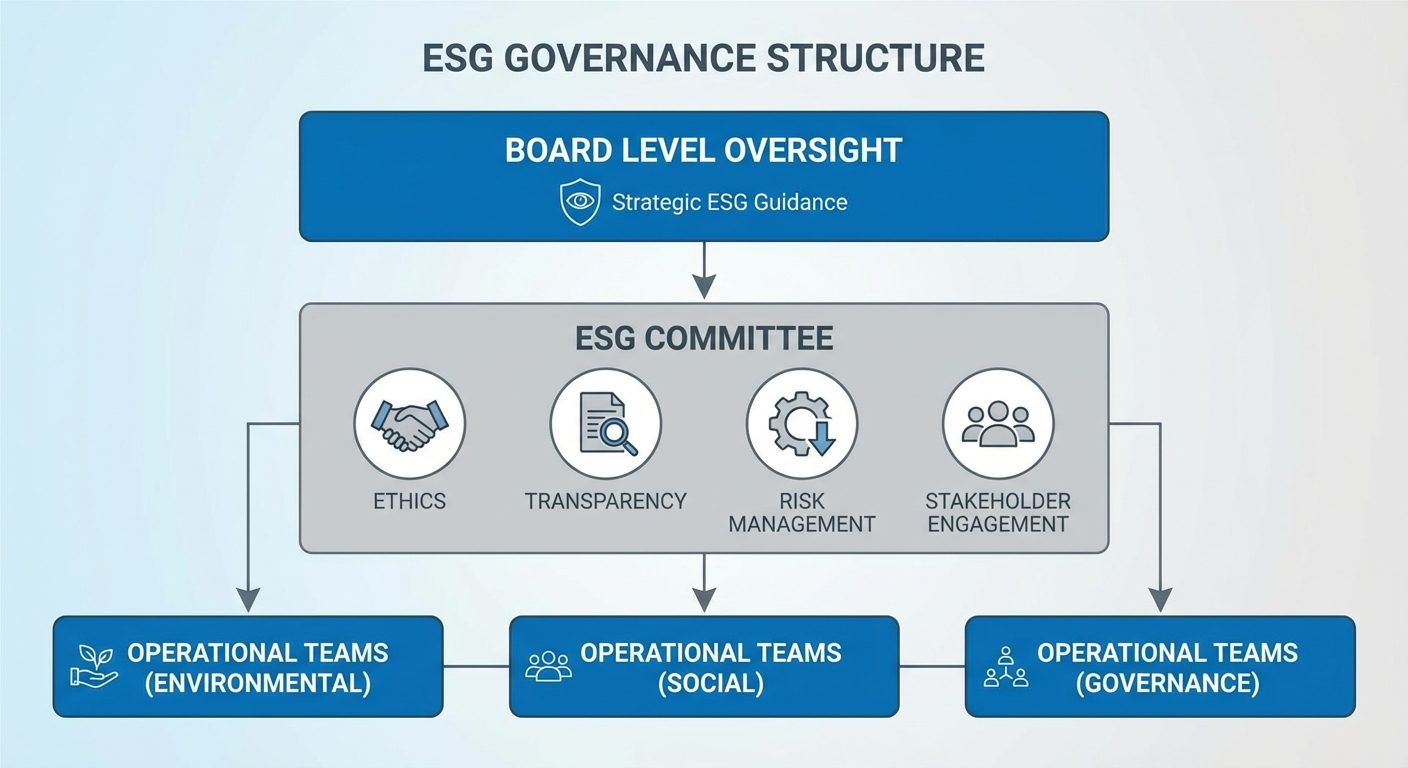
ESG governance structure showing board oversight, ESG committees, and operational accountability
Whistleblower protection policies must provide confidential, independent reporting channels with guarantees against retaliation. Anonymous reporting hotlines operated by third parties demonstrate genuine commitment to uncovering issues. Report the number of ethics-related reports received annually and how they were resolved, demonstrating that reporting mechanisms are actively used and trusted.
Data protection and cybersecurity receive heightened attention as digital transformation increases data handling across contracts. ISO 27001 certification (Information Security Management) provides strong evidence of systematic data protection. Describe your data governance frameworks, privacy by design principles, and incident response procedures. For contracts involving personal or sensitive data, expect detailed questions about encryption, access controls, data retention, breach notification procedures, and GDPR compliance. Transparent reporting and stakeholder engagement demonstrates accountability. Publish annual sustainability reports, gender pay gap data, modern slavery statements, and tax strategies. Third-party assurance of sustainability reporting (equivalent to financial audit for ESG data) significantly enhances credibility. Describe stakeholder engagement processes—how do you consult employees, customers, suppliers, and communities affected by your operations? Risk management frameworks should explicitly incorporate ESG risks alongside financial and operational risks. Describe how your organisation identifies, assesses, and mitigates environmental, social, and governance risks. Climate risk assessment following TCFD (Task Force on Climate-related Financial Disclosures) recommendations demonstrates sophisticated risk management. Identify physical risks (how climate change impacts your operations) and transition risks (how climate policy, technology, and market changes affect your business model). Supply chain governance extends your governance standards throughout your supply chain. Describe supplier selection criteria incorporating ESG factors, monitoring and auditing processes, and capacity building support for smaller suppliers. Tiered approaches recognise that governance requirements may vary by supplier risk level and contract value, but baseline standards should apply across your entire supply chain. Continuous improvement mechanisms demonstrate that governance is dynamic rather than static. Report how you measure governance effectiveness, respond to changing regulations, and incorporate stakeholder feedback. Regular policy reviews, management system audits, and board-level ESG oversight signal mature governance approaches.Structure governance responses to demonstrate that ethical practices are systematically embedded rather than reactive compliance exercises. Evaluators seek assurance that your organisation maintains high standards regardless of regulatory requirements or client monitoring.
Practical Frameworks for Demonstrating ESG Credentials
Moving from understanding ESG requirements to effectively demonstrating credentials in tender submissions requires structured approaches, robust evidence gathering, and strategic response framing.
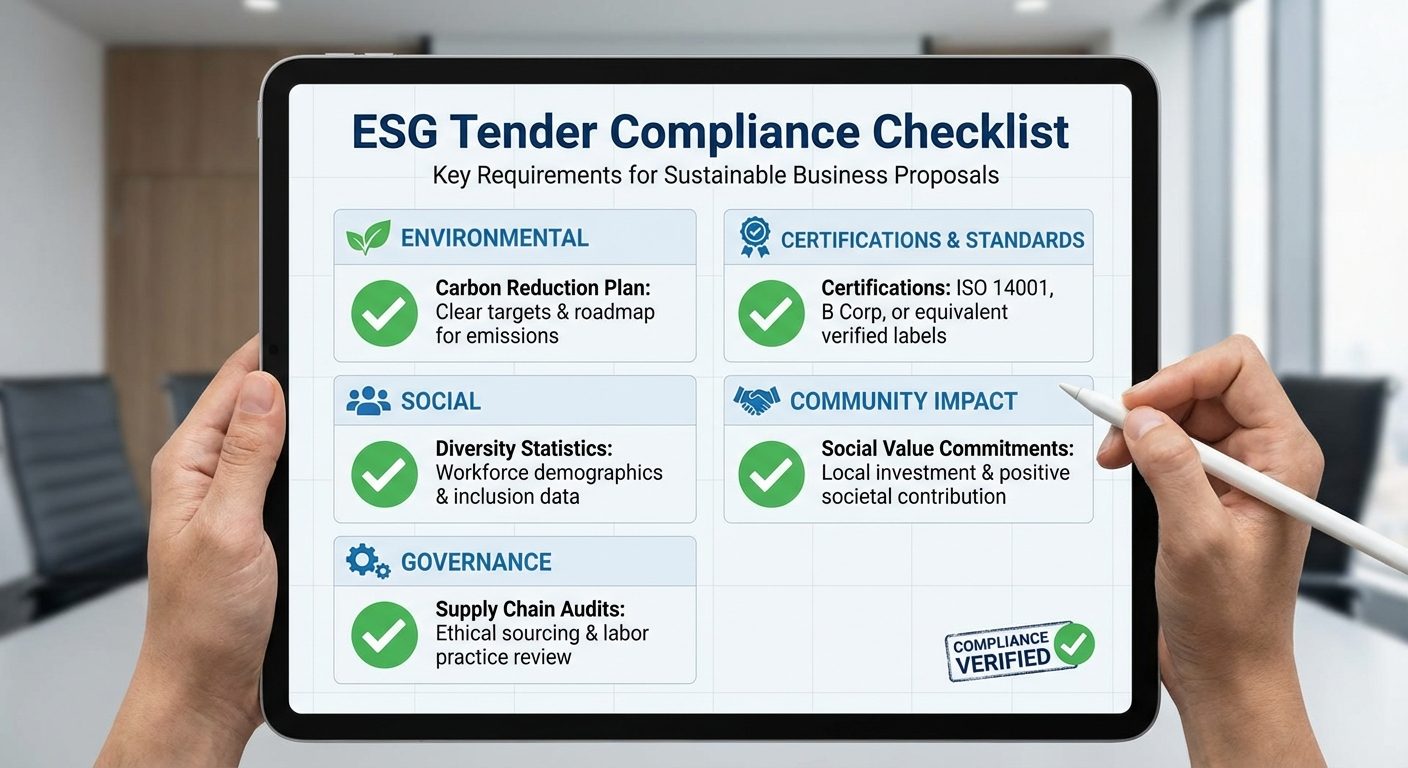
ESG tender compliance checklist showing carbon plans, diversity data, supply chain audits, and certifications
Update this library quarterly at minimum, ensuring data remains current. Assign clear ownership for evidence gathering—typically facilities teams for environmental data, HR for social metrics, and governance teams for ethical frameworks. This distributed ownership combined with central coordination ensures comprehensive evidence gathering without overwhelming single individuals.
Map your evidence to common ESG question types you'll encounter across tenders. PAS 91 (Construction Prequalification Questionnaire) provides standardised ESG questions widely adopted beyond construction. The UK government's Model Services Contract and Crown Commercial Service frameworks contain template ESG questions. By pre-mapping your evidence to these standard question formats, you accelerate response development and ensure consistency across submissions. Create modular response components that can be rapidly customised for specific tenders. A well-structured ESG response library contains: organisation overview emphasising ESG commitment, carbon footprint data with reduction commitments, diversity and inclusion policies with quantified outcomes, health and safety performance data, social value case studies, governance frameworks, and relevant certifications.These modules shouldn't be copied verbatim—they require tailoring to specific tender questions, contracting authority priorities, and contract contexts. However, maintaining pre-written, evidence-rich modules dramatically reduces tender response time while ensuring quality and consistency.
Align responses to evaluation criteria weightings published in tender documents. If environmental factors carry 10% weighting while social value carries 15%, allocate response effort and emphasis accordingly. Identify the specific sub-criteria within each ESG pillar—carbon reduction, diversity, local employment, supply chain ethics—and ensure your response directly addresses each scored element.Use the language and terminology from the tender specification in your responses. If the contracting authority refers to "community wealth building," mirror this terminology rather than using alternative phrases like "local economic development." This demonstrates attention to their specific priorities and ensures evaluators can easily map your response to scoring frameworks.
Quantify ESG commitments with measurable targets wherever possible. Vague commitments like "we're committed to diversity" or "we take environmental responsibility seriously" provide no meaningful information for evaluation. Transform these into: "We've achieved 38% female representation overall and 33% in management roles, targeting 40% management-level representation by 2027 through structured mentorship and inclusive recruitment" or "We've reduced Scope 1 and 2 emissions by 42% since 2020, with verified pathway to 65% reduction by 2030 and net zero by 2048." Provide context for your ESG performance relative to industry benchmarks and sector averages. Absolute numbers require context for meaningful evaluation. A carbon intensity of 180 kgCO2e per £100,000 revenue might be excellent for manufacturing or poor for professional services. Reference industry benchmarks, sector averages, or year-on-year improvements to help evaluators understand the significance of your performance data. Structure ESG responses using the STAR format (Situation, Task, Action, Result) or CAR (Context, Action, Result). These frameworks ensure responses are evidence-based and outcome-focused rather than policy-heavy and generic. For example, when addressing diversity:Context: "Our 2022 gender pay gap analysis revealed 14% median gap, above our sector average of 11%."
Action: "We implemented transparent salary banding, introduced blind CV screening, established reverse mentoring programmes pairing senior leaders with junior female employees, and set management promotion targets requiring diverse shortlists."
Result: "By 2025, median gender pay gap reduced to 7%, below sector average. Female management representation increased from 24% to 33%, and employee engagement scores among female staff improved 18 percentage points."
This structure provides evaluators with complete information: the baseline situation, specific interventions implemented, and measurable outcomes achieved.
Address ESG gaps and challenges honestly with credible improvement plans. Every organisation has ESG weaknesses—pretending otherwise undermines credibility. If asked about areas where you don't yet meet requirements, acknowledge gaps transparently and explain your roadmap for addressing them. "We currently purchase 60% renewable electricity across our operations. We're transitioning remaining sites to renewable contracts by Q3 2026, prioritising power purchase agreements over RECs to support additional renewable generation capacity."This response demonstrates awareness of limitations, specific plans for improvement, and understanding of quality differences in renewable energy procurement. It scores better than claiming 100% renewable energy through questionable offset mechanisms or omitting the information entirely.
Leverage technology to support ESG evidence management and reporting. Sustainability data platforms like Sphera, Enablon, or Workiva centralise environmental data collection, automate carbon calculations, and generate reports aligned with frameworks like CSRD, TCFD, or GRI. For smaller organisations without enterprise sustainability platforms, structured spreadsheets with clear methodologies, data sources, and assumptions provide adequate evidence management. Maintain third-party verification for critical ESG claims. Independent verification by Carbon Trust, EcoVadis, ISO certification bodies, or sustainability assurance providers significantly strengthens submission credibility. While verification costs money, the competitive advantage in high-value tenders typically justifies the investment. Prioritise verification for: carbon footprint calculations, environmental management systems, modern slavery due diligence, and social value measurement.Sector-Specific ESG Requirements
ESG requirements vary significantly by sector, reflecting different environmental impacts, social challenges, and regulatory contexts. Understanding sector-specific expectations ensures responses address the most material issues for particular contracts.
Construction and infrastructure face intensive ESG scrutiny due to high environmental impact and social considerations. Expect detailed questions about: embodied carbon in materials, construction phase emissions, whole-life carbon assessment, sustainable material sourcing, waste diversion rates, biodiversity net gain, local labour requirements, apprenticeship commitments, and fair payment throughout supply chains.Leading practice includes EPD (Environmental Product Declaration) usage for materials, Building Information Modelling (BIM) incorporating sustainability data, off-site construction methods reducing waste and emissions, and social value measurement following National TOMs. The Infrastructure Carbon Review targets drive increasingly ambitious carbon reduction requirements in major infrastructure projects.
Healthcare and social care emphasise social criteria heavily, though environmental factors grow in importance as NHS commits to net zero by 2040. Priority areas include: workforce diversity reflective of communities served, fair pay and terms exceeding statutory minimums, training and development opportunities, service user engagement and co-production, safeguarding policies and practices, supply chain ethics particularly for PPE and medical devices, and environmental impact of medical consumables and pharmaceuticals.Demonstrate understanding of healthcare-specific challenges like recruitment and retention in social care, integration of health and social care services, and prevention approaches reducing demand on acute services. Social value should align with health inequalities reduction and population health improvement.
Transport and logistics face carbon reduction as the dominant ESG theme, given high Scope 1 emissions from vehicle fleets. Address: fleet transition roadmaps to zero-emission vehicles, route optimisation and load efficiency, driver training in eco-driving techniques, telemetry and emissions monitoring, alternative fuels for heavy goods vehicles where electric isn't viable, modal shift strategies prioritising rail over road where appropriate, and urban consolidation centres reducing city centre deliveries.Social factors include driver welfare (facilities, working time compliance, fair payment), apprenticeships and driver training addressing skills shortages, and community impacts like air quality, noise, and road safety. Governance questions focus on supply chain transparency given complex subcontracting in logistics.
Facilities management combines environmental and social factors across diverse services. Environmental priorities include: energy management in buildings, water efficiency, waste management and recycling, sustainable cleaning products and chemicals, grounds maintenance without harmful pesticides, and integrated building management systems optimising resource use.Social value focuses on local employment, living wage commitments for traditionally lower-paid cleaning and security roles, career progression pathways, training and accreditation, and community engagement. Demonstrate understanding of "hidden workforce" challenges—ensuring subcontracted cleaning, security, and maintenance staff receive equal treatment, training, and progression opportunities as direct employees.
Professional services face ESG requirements despite lower direct environmental impact than industrial sectors. Address: business travel emissions and sustainable travel policies, office environmental management, digital infrastructure efficiency, homeworking carbon implications, diversity in professional workforces, inclusive recruitment and progression, pro bono services and knowledge transfer, supply chain ethics for equipment and services, and client confidentiality and data protection.Emphasise knowledge-based social value—thought leadership, research contribution, skills transfer to client organisations, and volunteering professional expertise to charities and community organisations. Environmental credentials increasingly include support for client net zero transitions through advisory services incorporating climate considerations.
How to Answer the Most Common ESG Tender Questions
ESG questions range from simple pass or fail checks to open questions with tight word limits. Most fall into a handful of patterns, and each has a structure that evaluators find easy to score.
Baseline emissions and reduction targets
State your total emissions with a Scope 1, 2 and 3 breakdown, the methodology used (for example the GHG Protocol or ISO 14064) and whether the figures are externally verified. Give your baseline year and explain why you chose it. Set out reduction targets as percentages against that baseline with dated interim milestones, and say whether they are validated by the Science Based Targets initiative. Close with your year on year trend and who is accountable at board level.
What lifts the score: verified data, Scope 3 included, interim milestones rather than a single 2050 date, and evidence that emissions are actually falling.
Carbon footprint of this contract
Estimate the emissions you expect to generate delivering this specific contract: buildings energy, fleet and travel, purchased goods and waste. Show your assumptions. Then list the reduction measures you will apply during delivery, such as fleet electrification, renewable electricity or route optimisation, with a timeline and a commitment to report actual emissions to the buyer.
What lifts the score: transparent calculations, reductions you can genuinely deliver, and a reporting rhythm the contract manager can hold you to. Avoid relying on offsets to claim neutrality.
Climate risk and adaptation
Identify the physical risks (flooding, heat, supply disruption) and transition risks (policy, carbon pricing) that could affect delivery. Rate likelihood and impact, then show the adaptation measures and business continuity arrangements you have in place. The TCFD structure is a useful frame even if you are not required to report against it.
Waste and circular economy
Work down the waste hierarchy: prevent, reduce, reuse, recycle, recover, dispose. Quantify current diversion from landfill, set a target for the contract and explain how segregation, training and monitoring will deliver it. For construction, reference your Site Waste Management Plan. If your model keeps materials in use (take back, refurbishment, product as a service), quantify what that saves the buyer as well as the environment.
Supply chain sustainability
Explain how you assess and monitor the ESG performance of key suppliers and subcontractors, how modern slavery risk is managed, and how your requirements flow down through contracts. One short example of a supplier you helped improve is worth more than a paragraph of policy.
For more on structuring evidence for questions like these, see our guide to tender response evidence matrices and our social value KPI scorecard guide.
Common ESG Pitfalls and How to Avoid Them
Even organisations with strong ESG performance undermine their tender submissions through common presentation and evidence mistakes. Understanding these pitfalls helps you avoid losing marks unnecessarily.
Greenwashing and unsupported claims represent the most serious error. Making ambitious environmental commitments without evidence or clear roadmaps triggers immediate evaluator scepticism. Evaluators are trained to identify greenwashing indicators: vague language without specifics, cherry-picked data presenting only positive aspects, irrelevant certifications, lack of transparency about data sources and methodologies, and ambiguous terms like "eco-friendly" or "sustainable" without defined meanings.Avoid greenwashing by: grounding all claims in verifiable data, providing third-party verification where possible, acknowledging limitations and gaps honestly, using precise terminology with clear definitions, and ensuring commitments are proportionate and realistic given organisational size and resources.
Policy-heavy responses without implementation evidence fail to demonstrate actual ESG performance. Simply attaching policy documents or listing initiatives doesn't prove anything. Evaluators want evidence that policies are implemented and effective: "We have a diversity and inclusion policy" scores near zero. "Our diversity and inclusion policy, implemented in 2022, contributed to female management representation increasing from 24% to 33% by 2025, supported by blind recruitment, reverse mentoring programmes, and inclusive leadership training for all managers" provides evidence of implementation and outcomes.For every policy mentioned, include implementation evidence and measurable outcomes. If you can't demonstrate policy implementation, reconsider whether to reference it—unfulfilled policies damage credibility more than acknowledging areas for improvement.
One-size-fits-all responses ignoring specific tender requirements and contracting authority priorities signal lack of attention and understanding. Generic ESG responses copied between tenders score poorly because they don't address specific questions or demonstrate understanding of the contracting authority's strategic objectives.Tailor every response to the specific tender by: analysing evaluation criteria weightings and emphasising high-weighted areas, incorporating language and terminology from tender documents, referencing the contracting authority's own ESG commitments and strategic priorities, and providing examples relevant to the specific contract sector and services.
Outdated data undermines submission credibility. ESG data ages quickly—carbon footprint calculations from 2021, diversity statistics from 2022, or policy documents last reviewed in 2020 suggest ESG isn't actively managed. Ensure all quantified data covers the most recent complete reporting period (usually previous calendar or financial year) and provide data collection dates for verifiability.If your most recent data is older than 18 months, acknowledge this and explain the context: "Our most recent full carbon audit covered 2023 (published April 2024). We're currently conducting our 2025 audit for publication in Q2 2026. Based on operational data, we project 8% emissions reduction in 2025 through fleet electrification and renewable energy transition, to be verified in our next audit."
Overcommitting on social value creates delivery risks and reputational damage. Social value commitments form contractual obligations—failure to deliver triggers remediation requirements, financial penalties, or contract termination in serious cases. Conservative, achievable commitments that you over-deliver beat ambitious commitments you can't fulfil.Validate social value commitments against delivery capacity: Have you delivered similar commitments on previous contracts? Do you have systems for monitoring and reporting social value outcomes? Have you consulted delivery teams to ensure commitments are realistic given project constraints? If uncertain, commit to lower figures you're confident delivering, with potential to exceed if opportunities arise.
Ignoring supply chain ESG leaves major gaps in your submission. Your ESG performance includes your supply chain, particularly for Scope 3 emissions, labour standards, and ethics. Describing your own performance without addressing supply chain management signals incomplete ESG understanding.Address supply chains by: describing supplier selection criteria incorporating ESG factors, explaining monitoring and auditing processes, providing examples of supplier capacity building support, and demonstrating how you cascade ESG requirements through subcontractors. For significant subcontractors named in your tender, include their relevant ESG credentials and how they align with your standards.
Focusing exclusively on environmental factors while neglecting social and governance elements creates unbalanced submissions. Many organisations with strong environmental credentials have weaker social and governance performance. Evaluators assess all three pillars—excelling in environment while showing minimal diversity, poor supply chain ethics, or weak governance produces mediocre overall ESG scores.Review the specific tender evaluation criteria to understand weighting across environmental, social, and governance factors, and ensure proportionate attention to each area. Where you have genuine weaknesses, acknowledge them with credible improvement plans rather than omitting the information.
How mytender.io Supports ESG Compliance
ESG requirements add significant complexity to tender submissions, requiring cross-functional evidence gathering, technical expertise in sustainability reporting, and sophisticated response framing. mytender.io's AI-powered platform addresses these challenges through intelligent automation and expert guidance.
The platform analyses tender questions to identify ESG requirements across environmental, social, and governance categories. Natural language processing recognises when questions ask for carbon data, diversity statistics, social value commitments, or governance frameworks, even when not explicitly labelled as "ESG questions." This ensures you don't overlook sustainability criteria embedded throughout tender documentation.
mytender.io's knowledge base maintains current understanding of ESG regulations, reporting standards, and best practice frameworks. When you're responding to questions about CSRD compliance, carbon reduction plans, or social value measurement, the system provides guidance on current requirements, suggests appropriate frameworks (GHG Protocol, National TOMs, ISO standards), and recommends evidence types that strengthen responses.
The platform's evidence library functionality enables systematic ESG data management. Store environmental reports, carbon calculations, diversity statistics, policies, certifications, and case studies in structured formats. When responding to tenders, the system suggests relevant evidence from your library based on question analysis, accelerating response development while ensuring consistency across submissions.
For organisations developing ESG capabilities, mytender.io identifies gaps between your current evidence and typical tender requirements. This gap analysis helps prioritise ESG investments—pursuing certifications, implementing policies, or gathering data that will strengthen future submissions. Rather than reactive gap-filling during tender deadlines, you can build ESG capabilities strategically based on patterns across your target opportunities.
The response quality checking analyses draft ESG answers against evaluation criteria, identifying: vague claims lacking quantification, policies without implementation evidence, missing third-party verification, outdated data, and insufficient alignment to specific evaluation criteria. This automated review catches common ESG pitfalls before submission, improving scores and reducing wasted effort on weak responses.
mytender.io helps you balance ESG ambition with realistic deliverability. When committing to social value outcomes, carbon reduction targets, or diversity improvements, the system flags commitments that appear unrealistic compared to benchmarks and your baseline performance. This prevents overcommitting—a significant risk given that unmet ESG commitments carry reputational and sometimes contractual consequences.
For organisations managing tender pipelines across multiple sectors, the platform maintains sector-specific ESG guidance. Construction tenders emphasise different factors than healthcare or professional services contracts. mytender.io adapts recommendations based on tender classification, ensuring responses address the most material ESG issues for each opportunity.
The collaborative features support cross-functional ESG response development. Environmental, HR, and governance teams contribute their specialist expertise, while bid coordinators maintain overall response quality and submission management. Role-based access ensures appropriate visibility—commercially sensitive information remains controlled while ESG evidence is accessible to response teams.
As ESG requirements evolve—new regulations, updated standards, emerging best practices—mytender.io's AI engine adapts based on analysis of successful submissions and regulatory updates. You benefit from continuous improvement in ESG guidance without manual research or policy tracking. The platform learns what works in evaluation and what evaluators reward, helping your responses stay current with evolving expectations.
Measuring and Improving ESG Performance Over Time
Strong ESG performance in tenders requires continuous improvement rather than static compliance. Organisations that treat ESG as an ongoing journey rather than a checklist consistently outperform competitors in tender evaluation and contract delivery.
Establish baseline metrics across all three ESG pillars. You can't demonstrate improvement without knowing your starting point. Conduct comprehensive assessments covering: carbon footprint across all scopes, resource consumption (energy, water, materials), waste generation and diversion rates, workforce diversity across organisational levels, pay equity analysis, health and safety performance, training investment per employee, supply chain audit coverage, governance structures and policies, and stakeholder engagement mechanisms.Document methodologies, data sources, assumptions, and uncertainties for baseline calculations. This documentation enables consistent year-on-year measurement and provides credibility when presenting improvement trajectories in tenders.
Set time-bound improvement targets aligned with regulatory requirements, industry standards, and stakeholder expectations. Targets should be ambitious yet achievable, driving genuine improvement without creating delivery risks. Structure targets hierarchically: long-term aspirational goals (net zero by 2048), medium-term milestones (50% emissions reduction by 2030), and short-term operational objectives (20% reduction in business travel emissions next year).Science-based targets provide credible frameworks for environmental goals. The Science Based Targets initiative (SBTi) validates corporate climate commitments against Paris Agreement goals, providing third-party assurance that targets represent meaningful climate action rather than greenwashing. SBTi validation strengthens tender responses significantly, demonstrating externally verified commitment rather than self-assessed targets.
Monitor progress systematically through regular reporting cycles. Quarterly reviews enable timely intervention when performance deviates from trajectories, while annual reporting provides formal documentation for tender submissions. Assign clear ownership for data collection and progress tracking across different ESG metrics. Dashboard visualisations help leadership and operational teams understand performance trends and identify areas requiring focus. Benchmark against peers and industry standards to contextualise your performance. Sector-specific benchmarking provides realistic comparison—your carbon intensity should be assessed against similar organisations, not entirely different industries. Industry associations, sustainability reporting platforms, and government statistics provide benchmarking data. Understanding how your performance compares guides prioritisation and helps frame tender responses effectively. Engage employees in ESG initiatives to embed sustainability throughout organisational culture. Employee-led green teams, sustainability ambassadors, and cross-functional ESG working groups generate improvement ideas, support implementation, and build widespread commitment. Employees closest to operations often identify practical improvement opportunities that leadership overlooks. Employee engagement also strengthens tender responses—demonstrating grassroots ESG commitment signals cultural embedding rather than top-down compliance exercise. Integrate ESG into core business processes rather than treating it as separate function. Environmental considerations in procurement decisions, social impact assessment in strategic planning, and governance standards in operational procedures ensure ESG shapes day-to-day activities. This integration produces more significant improvement than dedicated ESG initiatives running parallel to business-as-usual. Invest in capability building to deepen ESG expertise across your organisation. Training in carbon accounting, sustainability reporting, diversity and inclusion, and ethical governance builds internal capability, reducing reliance on external consultants and strengthening evidence quality. Professional certifications like IEMA (Institute of Environmental Management & Assessment), CIPD (Chartered Institute of Personnel and Development), or IIA (Institute of Internal Auditors) provide structured learning pathways. Pursue external verification and certification strategically based on tender market expectations. ISO 14001 (environmental management), ISO 45001 (occupational health and safety), ISO 27001 (information security), and Living Wage Employer accreditation are widely recognised and frequently required or highly valued in tender evaluation. These certifications provide structured improvement frameworks and independent verification of performance.B Corp certification offers comprehensive assessment across environment, workers, community, governance, and customers, providing holistic ESG credibility. While B Corp isn't universally recognised in public procurement, it signals commitment to stakeholders beyond shareholders and differentiates organisations in private sector tenders.
Communicate ESG progress transparently through annual sustainability reports, website updates, and stakeholder engagement. Transparency builds trust and demonstrates accountability. Even when progress falls short of targets, honest communication about challenges and responses maintains credibility. Stakeholders recognise that ESG transformation involves setbacks and learning—attempting to hide underperformance damages trust more than acknowledging difficulties openly. Learn from tender feedback to identify ESG improvement priorities. When you lose tenders where ESG criteria carried significant weight, request feedback on your ESG responses specifically. Evaluator feedback reveals which evidence types carry most weight, which areas of weakness cost you marks, and how your performance compares to successful bidders. This intelligence guides your ESG improvement roadmap more effectively than generic best practice guidance.The Future of ESG in Procurement: 2026 and Beyond
ESG requirements in procurement continue intensifying, driven by regulatory expansion, investor pressure, and societal expectations. Understanding emerging trends helps you position your organisation proactively rather than reactively addressing requirements as they arise.
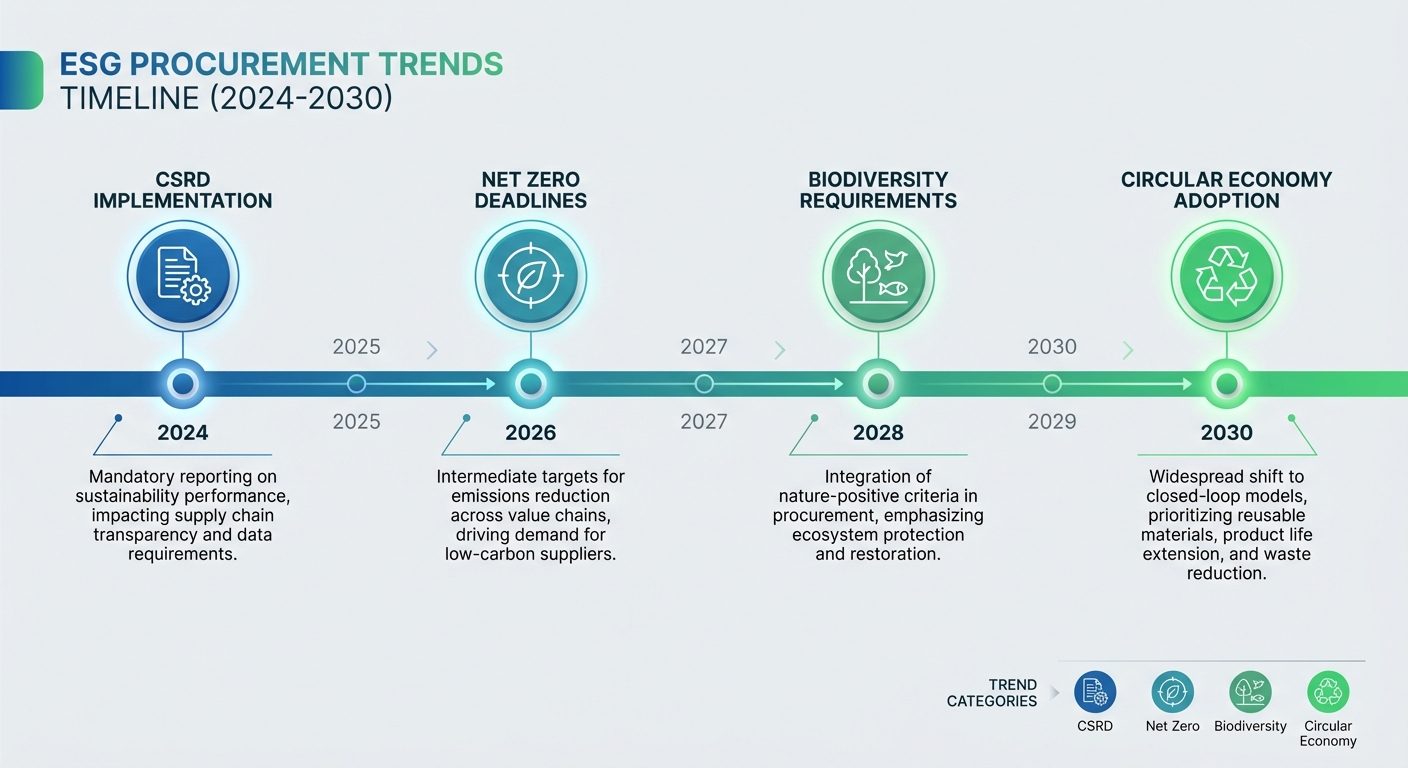
Timeline of ESG procurement trends showing CSRD, net zero commitments, biodiversity requirements, and circular economy adoption from 2024-2030
Positioning your organisation for these emerging requirements requires strategic ESG investment today. Organisations treating ESG as compliance burden will struggle against competitors embedding sustainability as competitive advantage. The tender market increasingly rewards organisations demonstrating authentic ESG commitment through credible evidence, third-party verification, and continuous improvement trajectories.
Conclusion: ESG as Competitive Advantage, Not Compliance Burden
The transformation of ESG from voluntary corporate responsibility to mandatory tender requirements represents both challenge and opportunity. Organisations viewing ESG through a compliance lens see regulatory burden, increased costs, and bureaucratic complexity. Those embracing ESG strategically recognise competitive differentiation, risk mitigation, operational efficiency, and stakeholder value creation.
Strong ESG performance correlates with operational excellence across multiple dimensions. Organisations with low carbon emissions often have better energy efficiency and cost control. Those with diverse, engaged workforces demonstrate higher innovation and lower turnover. Entities with robust governance structures manage risks more effectively and maintain stakeholder trust. ESG requirements in tenders simply surface these fundamental organisational strengths that already drive business performance.
The tender market rewards authentic ESG commitment over superficial compliance. Evaluators distinguish between organisations with embedded sustainability throughout operations and those retrofitting ESG narratives onto unchanged business models. Building genuine ESG capability—measurement systems, improvement processes, stakeholder engagement, governance integration—creates competitive advantage that compounds over time as requirements intensify and competitors struggle to catch up.
Investment in ESG capabilities pays dividends beyond individual tender wins. Regulatory compliance becomes simpler when robust ESG management systems are already operational. Investor relations benefit from credible sustainability reporting. Employee attraction and retention improve when ESG commitment is demonstrable rather than aspirational. Customer loyalty strengthens as environmental and social consciousness influences purchasing decisions across consumer and business markets.
For organisations at the beginning of their ESG journey, the breadth of requirements can feel overwhelming. Prioritise based on materiality—which environmental, social, and governance factors most significantly impact your operations and stakeholders? Focus initial efforts on material issues where improvement creates genuine value, rather than pursuing every ESG metric regardless of relevance.
Start with foundational steps that build capability systematically: measure your baseline performance across key ESG metrics, identify gaps against tender market expectations, set realistic improvement targets with clear timelines, implement monitoring systems to track progress, and document everything comprehensively. This evidence foundation enables credible tender responses while driving operational improvement.
As ESG requirements continue evolving, maintaining current understanding of regulatory frameworks, reporting standards, and market expectations requires ongoing attention. Leverage technology platforms like mytender.io to automate evidence management, stay current with changing requirements, and translate ESG performance into compelling tender responses that win contracts.
The procurement landscape has fundamentally shifted—ESG is no longer optional. Organisations that embrace this shift strategically will thrive in the 2026 tender market and beyond, while those resisting change will find themselves increasingly uncompetitive. Your ESG journey starts now, and every improvement strengthens both your tender competitiveness and your long-term organisational resilience.
Tags
Ready to Transform Your Tender Writing?
See how MyTender's AI can help you write winning tenders in a fraction of the time.