

Contract Management in Tender Responses: How to Prove You Can Deliver After Award
A practical guide to writing stronger contract management sections in UK tenders, from governance and mobilisation to KPIs, reporting, risk, payment discipline and continuous improvement.
mytender.io Research Team
Bid Management Specialists
A contract management answer is where evaluators ask the quiet question behind the whole tender: will this supplier still be good six months after award?
Most bidders treat it like admin. They talk about monthly meetings, named account managers and escalation routes. Fine. Necessary. Also forgettable.
A stronger answer proves something bigger. It shows the buyer how you will protect service quality, spot problems early, keep promises visible and make the contract easier to manage than the incumbent ever did.
That matters more in 2026. The Procurement Act has pushed public procurement towards transparency, performance reporting and longer-term accountability. Buyers aren't just scoring the written bid. They're thinking about the notices, KPIs, payment records and supplier performance conversations that come after award.

Contract manager reviewing a live public sector service dashboard with KPI and risk indicators
Why contract management sections are getting harder to bluff
For years, suppliers could get away with a fairly generic contract management response.
You know the template:
- monthly contract review meetings
- quarterly strategic reviews
- a dedicated contract manager
- risk register maintained throughout delivery
- continuous improvement log
- escalation route to senior leadership
None of that is wrong. The problem is that almost every bidder says the same thing.
Under the Procurement Act 2023, the direction of travel is obvious: more visibility, more published performance information and more scrutiny of whether suppliers do what they promised. Large public contracts can now involve published KPI performance notices. Authorities are also under pressure to publish more information about payments, contract performance and supplier behaviour.
That changes how evaluators read your response.
They don't want ceremonial governance. They want confidence that your contract will not become their next weekly headache.
The SEO-friendly truth: contract management is a win-rate lever
Search for “contract management tender response” and you'll find plenty of legal definitions. What bid teams need is more practical.
A good contract management section helps you win because it answers five evaluator fears:
- Will mobilisation drift?
- Will service standards drop after the first month?
- Will we have to chase for reports, invoices and actions?
- Will risks be hidden until they become complaints?
- Will the supplier improve the contract, or just defend the baseline?
If your answer doesn't tackle those fears directly, it will feel thin.
The best responses make contract management tangible. They show named forums, decision rights, data flows, reporting rhythms, issue ownership and examples of what happens when performance moves off track.
Start with the buyer's operating reality
Before writing the section, ask what the contract will feel like for the buyer.
A facilities management contract may involve estates teams, school heads, site managers, cleaners, engineers, helpdesk staff and end users who never read the specification but will complain when the toilets flood.
A construction contract may involve project boards, resident liaison, programme risk, design sign-offs, health and safety reporting, commercial change control and a client who needs confidence before every gateway.
A waste contract may involve crews, depots, missed collections, seasonal tonnage swings, contamination rates, vehicle availability, councillor enquiries and resident complaints by 8:30am.
The contract management answer should reflect that world.
Bad response: “We will hold monthly contract meetings and provide performance reports.”
Better response: “We will operate three linked governance layers: a weekly operational huddle for live service issues, a monthly performance review focused on KPIs and corrective actions, and a quarterly strategic board reviewing demand trends, savings, innovation and resident feedback.”
The second answer gives the buyer a picture. It has rhythm. It separates noise from strategy.
Build the answer around a clear governance model
Governance is not a meeting schedule. It's the structure that decides what gets noticed, who acts and when senior people step in.
A strong tender response usually needs four layers.
1. Operational control
This is the day-to-day layer.
It covers service delivery, helpdesk tickets, staffing, rota gaps, site issues, missed tasks, programme updates and short-term risks. The buyer wants to know that small problems won't sit untouched until the monthly meeting.
Explain:
- who owns daily performance
- what data they review
- how often they review it
- how actions are logged
- what triggers escalation
Keep it specific. “Daily monitoring” means nothing unless you say what is monitored.
2. Contract performance review
This is the formal layer most tenders expect.
It usually covers KPIs, service credits, improvement actions, complaints, risk, health and safety, social value, sustainability, invoicing and change control.
Don't just list agenda items. Explain how the review improves the service.
For example: “The monthly performance review will not be a backward-looking report pack. It will close with a signed action tracker showing owner, due date, dependency and RAG status. Any red action for two consecutive cycles moves automatically to senior escalation.”
That sentence does more work than a page of governance waffle.
3. Strategic review
This is where many bids lose marks.
Buyers want to know that the supplier can think beyond compliance. Strategic reviews are where you discuss demand, innovation, value for money, contract changes, policy shifts, stakeholder satisfaction and long-term risk.
For public sector contracts in 2026, this can include:
- social value delivery
- carbon and ESG commitments
- supply chain resilience
- workforce development
- technology adoption
- savings opportunities
- upcoming Procurement Act reporting requirements
This is where the account becomes a partnership rather than a service line.
4. Executive escalation
Senior escalation should not sound like a panic button.
It should be a controlled route for decisions that the operational team cannot resolve. That might include chronic KPI failure, major complaints, contract variation, repeated payment disputes, serious health and safety concerns or risks to statutory service continuity.
Name the role, not just the concept. “Operations Director” is stronger than “senior management”.
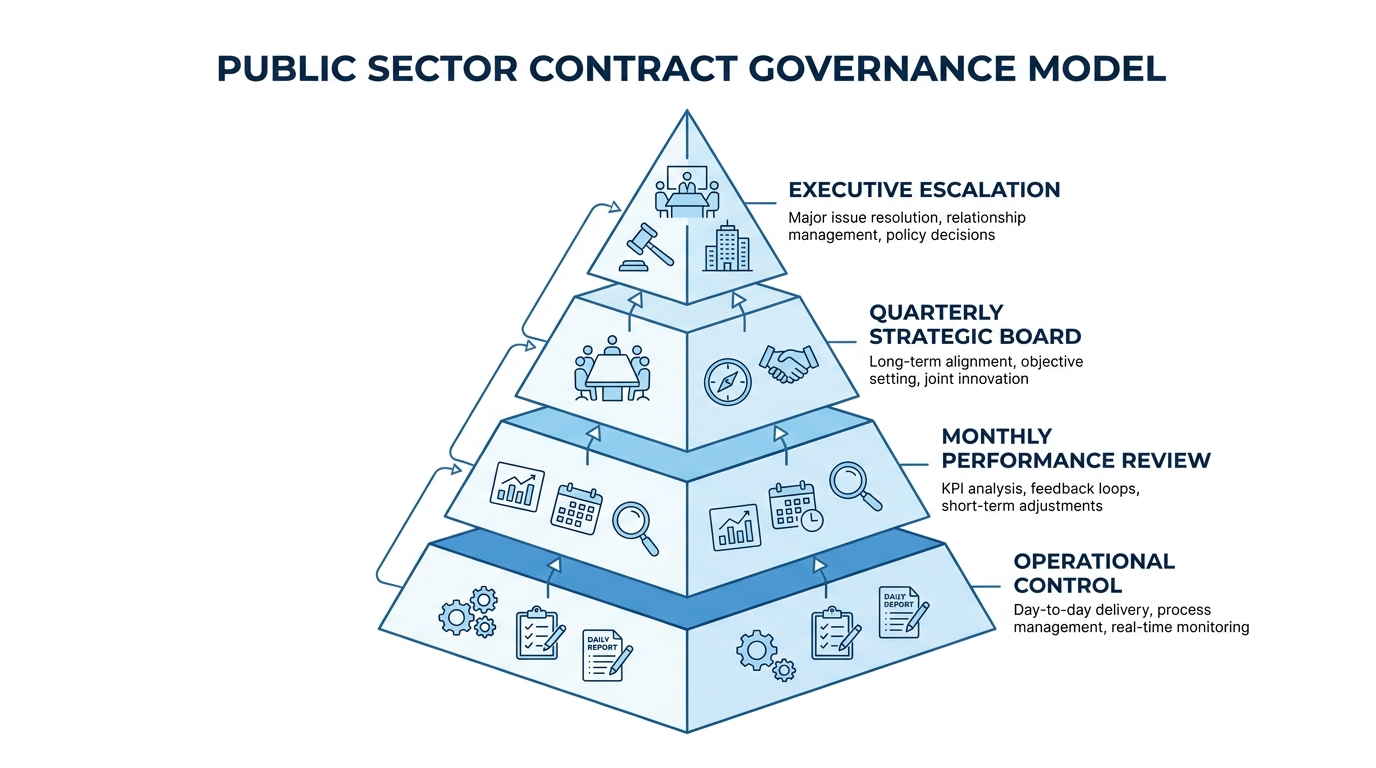
Layered contract governance model from operational control to executive escalation
Make KPIs feel managed, not merely reported
KPI sections often read like the supplier copied the contract schedule back to the buyer.
That doesn't score well.
The buyer already knows the KPI list. They wrote it. What they need from you is your management method.
A strong KPI answer covers the full cycle:
- Define the metric and data source.
- Capture performance consistently.
- Validate the numbers before reporting.
- Analyse trend, root cause and service impact.
- Act through corrective actions.
- Review whether the action worked.
That final step is often missing.
If a missed-cleaning KPI improves for one month and then drops again, you haven't solved the issue. You've paused it. Evaluators know the difference.
Use examples where possible.
Instead of saying “we use dashboards to monitor performance”, write: “If first-time fix rate falls below target for two consecutive weeks, the contract manager reviews job category, parts availability, engineer allocation and repeat visits before agreeing a corrective action with the client.”
That's a contract management method. It shows judgement.
Connect contract management to mobilisation
Mobilisation and contract management are often scored separately, but the buyer experiences them as one continuous handover.
The first 90 days decide whether the contract feels safe.
Your response should show how mobilisation data becomes live contract control. Don't let the mobilisation plan vanish at go-live.
Explain how you will transfer:
- asset registers
- stakeholder maps
- risk logs
- TUPE or workforce assumptions
- implementation actions
- service baseline data
- early KPI trends
- unresolved mobilisation issues
A useful line is: “The mobilisation tracker becomes the live contract action log at go-live, so no open issue is lost between implementation and business-as-usual delivery.”
That tells the evaluator you've seen real handovers before.
Show your reporting pack before they ask for it
Public sector buyers are tired of beautiful promises and useless reports.
A strong contract management response describes the reporting pack in plain English.
Include the sections you will report, the source of truth and the decision it supports.
For example:
- KPI summary: confirms whether contractual standards are being met.
- Exception report: highlights missed targets, root cause and corrective actions.
- Risk register: shows live threats, owners and mitigation progress.
- Complaints and compliments: captures stakeholder experience, not just hard metrics.
- Social value tracker: reports commitments, evidence and outcomes.
- Sustainability dashboard: tracks carbon, waste, energy or fleet measures where relevant.
- Commercial summary: tracks invoicing, variations, credits and savings.
- Forward look: flags decisions needed in the next period.
This is much better than “we will provide regular reports”.
It tells the buyer what they will actually receive.

Public sector contract review meeting with performance reports and action tracker on screen
Deal with underperformance directly
Many bidders are weirdly afraid to mention failure.
That's a mistake. Evaluators know every contract has problems. The question is whether you spot and fix them before the buyer loses trust.
Your answer should explain what happens when performance dips.
Use a simple escalation ladder:
- Amber trigger: early warning, local corrective action, monitored by contract manager.
- Red trigger: formal recovery plan, senior sponsor notified, client agrees milestones.
- Critical trigger: executive escalation, additional resource, daily recovery reporting where needed.
Then explain what a recovery plan includes:
- root cause
- immediate containment
- corrective action
- owner
- deadline
- evidence required
- client communication plan
- follow-up review date
This is not negative. It is reassuring.
A bidder who pretends nothing will ever go wrong sounds naïve. A bidder who calmly explains how they recover control sounds credible.
Bring risk management into the contract, not just the bid
Tender responses often include a risk register during mobilisation and then forget what happens next.
For contract management, risk needs to be live.
That means:
- new risks can be raised by either party
- each risk has an owner and mitigation
- risks are reviewed at the right governance layer
- high-impact risks have contingency plans
- risks link to actions, not just descriptions
Give examples relevant to the sector.
For FM, risks might include labour shortages, parts availability, statutory compliance, lone working or building access constraints.
For construction, think design delays, resident disruption, CDM compliance, programme slippage, materials lead times and subcontractor capacity.
For waste, think vehicle downtime, depot constraints, contamination, adverse weather, route changes and missed collections.
Specificity proves you understand the contract.
Don't ignore payment discipline
Payment performance is becoming more visible in public procurement.
Under the Procurement Act, public bodies have new reporting obligations around prompt payment and significant payments. Buyers are more alert to payment flow, especially where SMEs and subcontractors sit in the supply chain.
If your delivery model uses subcontractors, your contract management answer should explain how you manage payment fairness.
That might include:
- clear invoice validation routes
- dispute resolution timescales
- subcontractor payment tracking
- prompt payment obligations flowed down the supply chain
- payment performance reviewed in governance meetings
This is especially useful for construction, FM and waste contracts with specialist subcontractors.
Don't overclaim. Just show that commercial discipline is part of contract control.
Make continuous improvement measurable
“Continuous improvement” is one of the most abused phrases in tender writing.
Everyone says it. Few define it.
A better answer explains how improvement ideas are captured, assessed, prioritised and delivered.
Use a simple improvement pipeline:
- Identify ideas from data, staff, client feedback and complaints.
- Assess impact, cost, risk and client benefit.
- Pilot the change where sensible.
- Measure the result.
- Adopt into business-as-usual if it works.
Then give examples.
In FM, that might be changing planned maintenance timing to reduce disruption. In waste, it might be altering communications in contamination hot spots. In construction, it might be using resident feedback to adjust phasing.
The key is evidence. Improvement is not a suggestion box. It is a managed process.
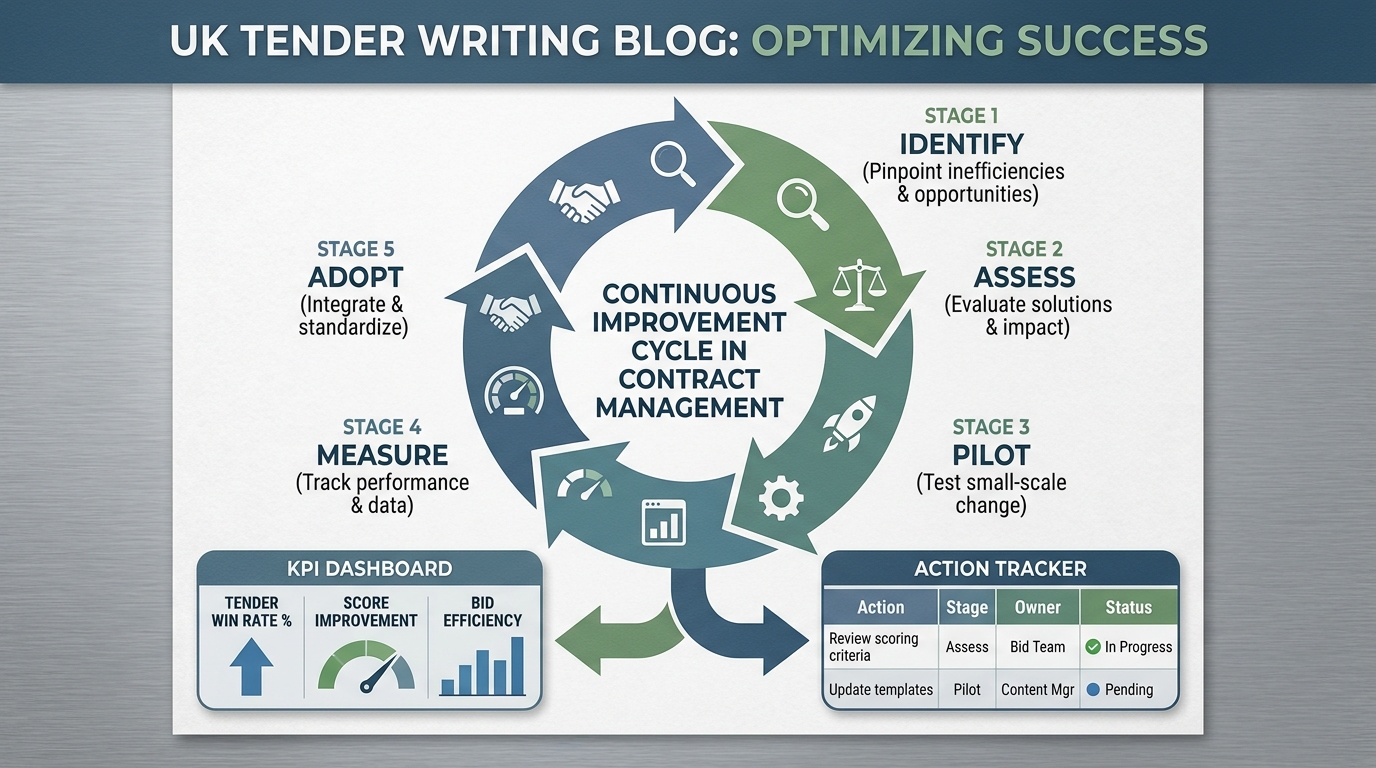
Continuous improvement cycle for tender contract management showing identify, assess, pilot, measure and adopt
Write the relationship management section like a grown-up
Some responses overdo the partnership language.
“Open and transparent relationship” is fine, but it doesn't tell the buyer what you'll do on a wet Tuesday when a depot manager is angry and the KPI report is red.
Relationship management should cover behaviours and mechanisms.
Include:
- named points of contact
- stakeholder mapping
- communication channels
- meeting cadence
- issue ownership
- escalation etiquette
- feedback loops
- how you handle disagreement
The last point is underrated.
Contracts go wrong when disagreements become personal, vague or delayed. A mature answer explains how you separate facts, contractual obligations and service impact.
For example: “Where a dispute arises, we will agree the facts first, record the contractual position separately, identify any immediate service risk, and continue delivery while the commercial issue is resolved.”
That sounds like someone who has managed a real contract.
Use evidence from past contracts carefully
Contract management sections are easy to overgeneralise. Evidence fixes that.
Use short examples from previous contracts, but keep them relevant.
A good example includes:
- the problem
- the action
- the result
- what you changed afterwards
For instance: “On a multi-site FM contract, helpdesk response dipped during winter because call volumes rose 28%. We introduced temporary triage support, changed engineer allocation rules and gave the client a weekly exception report until the backlog cleared. Response performance returned above target within four weeks.”
That is much stronger than “we have extensive experience managing complex contracts”.
If you don't have permission to name the client, anonymise it. Just keep the facts sharp.
Common mistakes in contract management tender responses
Most weak responses fail for one of six reasons.
Mistake 1: describing meetings instead of management
Meetings are not management. Decisions, actions and follow-up are management.
Mistake 2: using the same answer for every sector
A school cleaning contract, a highways maintenance framework and a waste collection contract do not need the same governance model.
Mistake 3: reporting KPIs without explaining intervention
The buyer wants to know what you do when numbers move.
Mistake 4: hiding from failure
A credible recovery process scores better than pretending all KPIs will be green forever.
Mistake 5: treating continuous improvement as a slogan
Show the pipeline, the ownership and the evidence.
Mistake 6: forgetting the buyer's admin burden
A brilliant contract manager makes the buyer's life easier. Your answer should prove it.
A practical structure you can use
If the tender asks for a “contract management plan” or “contract management methodology”, use this structure.
1. Opening promise
One short paragraph explaining the outcome your model creates.
Example: “Our contract management model gives the Council clear visibility of performance, fast issue resolution and a structured route for continuous improvement from mobilisation through to contract close.”
2. Governance model
Set out operational, monthly, strategic and escalation layers.
3. Roles and responsibilities
Name the roles involved and explain decision rights.
Don't just provide an organogram. Explain who can approve actions, variations, recovery plans and escalations.
4. Performance management
Cover KPIs, data capture, validation, analysis, reporting and corrective action.
5. Risk and issue management
Explain how risks are raised, reviewed, escalated and closed.
6. Reporting and communication
Describe the reporting pack, meeting cadence and stakeholder communication.
7. Underperformance and recovery
Show triggers, recovery planning and senior oversight.
8. Continuous improvement
Explain how ideas become measured changes.
9. Contract close or extension planning
If relevant, cover exit management, demobilisation, knowledge transfer and extension readiness.
That final point is often forgotten. Buyers like suppliers who think about the whole lifecycle.
Mini template: a stronger opening paragraph
Use this as a starting point, not a copy-and-paste answer.
“Our contract management approach is designed to give [Authority] clear visibility, fast decision-making and controlled improvement throughout the contract. We will combine daily operational monitoring with monthly performance reviews and quarterly strategic boards, supported by live action tracking, KPI trend analysis and clear escalation triggers. This ensures issues are resolved at the lowest appropriate level, while recurring risks and improvement opportunities receive senior attention before they affect service users.”
It's not flashy. It is clear.
How AI can help without making the answer generic
AI can make contract management answers better. It can also make them painfully bland.
The trick is to use AI for structure and evidence retrieval, not empty polish.
A good bid platform should help you:
- pull proven governance wording from similar contracts
- find relevant case studies and recovery examples
- map tender KPIs to your internal reporting model
- check whether the answer addresses every sub-question
- adapt the response to the buyer's sector and service risk
- maintain a reusable contract management answer in your bid library
That's where mytender.io can help. The value is not “write me a contract management section”. The value is finding the right evidence, shaping it to the question and checking that the response proves delivery rather than reciting process.
Final thought: evaluators buy confidence
A contract management section does not need to be dramatic.
It needs to be controlled.
Show the buyer what will happen after award. Show how performance is measured, how issues are handled, how decisions are made and how improvement is delivered. Make it easy for them to imagine you running the contract without constant chasing.
That's the point.
If you want to see live public sector opportunities where contract management, KPI reporting and delivery confidence are likely to matter, the mytender.io Tender Finder is free to use.
Tags
Ready to Transform Your Tender Writing?
See how MyTender's AI can help you write winning tenders in a fraction of the time.