
Contract Management Evidence in Tenders: How to Prove You Can Deliver Under the Procurement Act in 2026
A practical guide for suppliers on writing stronger contract management, KPI, performance and governance responses in public sector tenders under the Procurement Act 2023.
mytender.io Research Team
Tender Writing & Bid Management Specialists
Contract Management Evidence in Tenders: How to Prove You Can Deliver Under the Procurement Act in 2026
The contract management section used to be one of the easier parts of a tender response.
This article is part of our Procurement Act series. For an overview of what changed and links to every guide in the series, see our Procurement Act 2023 supplier's guide.
Bid teams could describe monthly meetings, escalation routes, service reviews, risk registers, KPI dashboards and continuous improvement plans. Most suppliers had a version of the same answer. It sounded professional. It ticked the obvious governance boxes. It rarely decided the outcome on its own.
That has changed.
In 2026, contract management is not just an operational afterthought. It is part of the buyer's risk assessment. Public sector buyers are under pressure to show that contracts are being managed properly after award, not simply competed properly before award. Under the Procurement Act 2023, performance information, key performance indicators, payment compliance and poor performance notices have become more visible parts of the public contract lifecycle. For suppliers, that means contract management promises now carry more weight.

Bid team reviewing a public sector contract management evidence dashboard with KPIs and governance notes
A weak contract management answer tells the buyer that the supplier can write a bid but may struggle to run the contract. A strong answer does the opposite. It shows how the supplier will turn the written proposal into a controlled service, how performance will be measured, how problems will be escalated, how the buyer will have confidence, and how the supplier will protect its own public performance record.
This is especially important for facilities management, construction, healthcare, technology, waste, transport, professional services and any other sector where contracts are complex, multi-year and operationally visible. If the buyer is awarding a contract above the key public reporting thresholds, or a contract where poor performance could be politically or reputationally damaging, they are not looking for a generic account management diagram. They want proof.
This guide explains how to write a stronger contract management tender response in 2026, what evidence evaluators are looking for, how to connect the answer to Procurement Act performance expectations, and how mytender.io helps bid teams build responses that are traceable, buyer-specific and credible.
Why contract management evidence matters more now
The Procurement Act 2023 has shifted attention from procurement as a one-off competition to procurement as a full lifecycle discipline. Buyers still need fair, transparent and well-run tender processes, but they also need contracts that perform after award. That changes the way suppliers should think about bid writing.
A tender response is not just a sales document. It is the first version of the contract delivery story.
For higher-value public contracts, buyers may need to set and publish material KPIs. They may need to report performance during the life of the contract. Contract performance notices can make supplier delivery visible beyond the immediate buyer. Poor performance can influence future procurement decisions. Payment compliance and transparency notices are also part of the broader environment in which suppliers are being assessed.
This does not mean every tender response should turn into a legal essay. It does mean that suppliers should stop treating contract management as boilerplate.
When an evaluator reads your answer, they are often asking four questions at once.
First, can this supplier deliver what it has promised? Second, will the buyer be able to see what is happening during the contract? Third, will problems be handled early rather than hidden until they become disputes? Fourth, does this supplier understand that public performance now follows them into future opportunities?
A strong contract management answer makes those questions easy to answer. It gives the buyer confidence that governance is not decorative. It shows that the supplier knows which commitments matter, who owns them, how they will be measured, what data will be used, and what happens if performance slips.
That is the gap many bids still miss. They describe meetings but not decisions. They mention dashboards but not data quality. They promise continuous improvement but do not explain how improvements are identified, funded or agreed. They list escalation routes but do not show what triggers escalation. They talk about partnership but avoid difficult performance conversations.
In 2026, that is too thin.
The buyer is not scoring the organogram
Many contract management responses start with structure. They introduce the account director, contract manager, operational leads, helpdesk, commercial lead and senior sponsor. Structure matters, but it is not the answer.
The evaluator is not scoring the organogram. They are scoring confidence.
A named team is useful only if the response explains what each role controls, what decisions they can make, how they interact with the buyer, and how quickly they can resolve issues. An escalation chart is useful only if it shows practical triggers. A governance calendar is useful only if it connects meetings to evidence, actions and outcomes.
A poor answer says: we will hold monthly contract review meetings attended by the contract manager and client representative.
A better answer says: the monthly contract review will make three decisions: whether KPI performance is on track, whether agreed improvement actions are progressing, and whether any risks require escalation before they affect service delivery. The contract manager owns the pack, the operations lead owns service data, and the senior sponsor attends quarterly or earlier if a red-rated item remains unresolved for more than ten working days.
The second answer is stronger because it tells the buyer how governance works. It shows purpose, ownership and decision rhythm. It also gives the evaluator something measurable.
Contract management evidence should answer these practical questions:
- What information will the buyer receive?
- How often will they receive it?
- Who checks that the information is accurate?
- What decisions are made at each meeting?
- Which issues are resolved locally and which are escalated?
- How are actions tracked to closure?
- How will performance commitments from the tender become contract controls?
- How will the supplier evidence improvement, not just activity?
If the response cannot answer those questions, it is probably still generic.
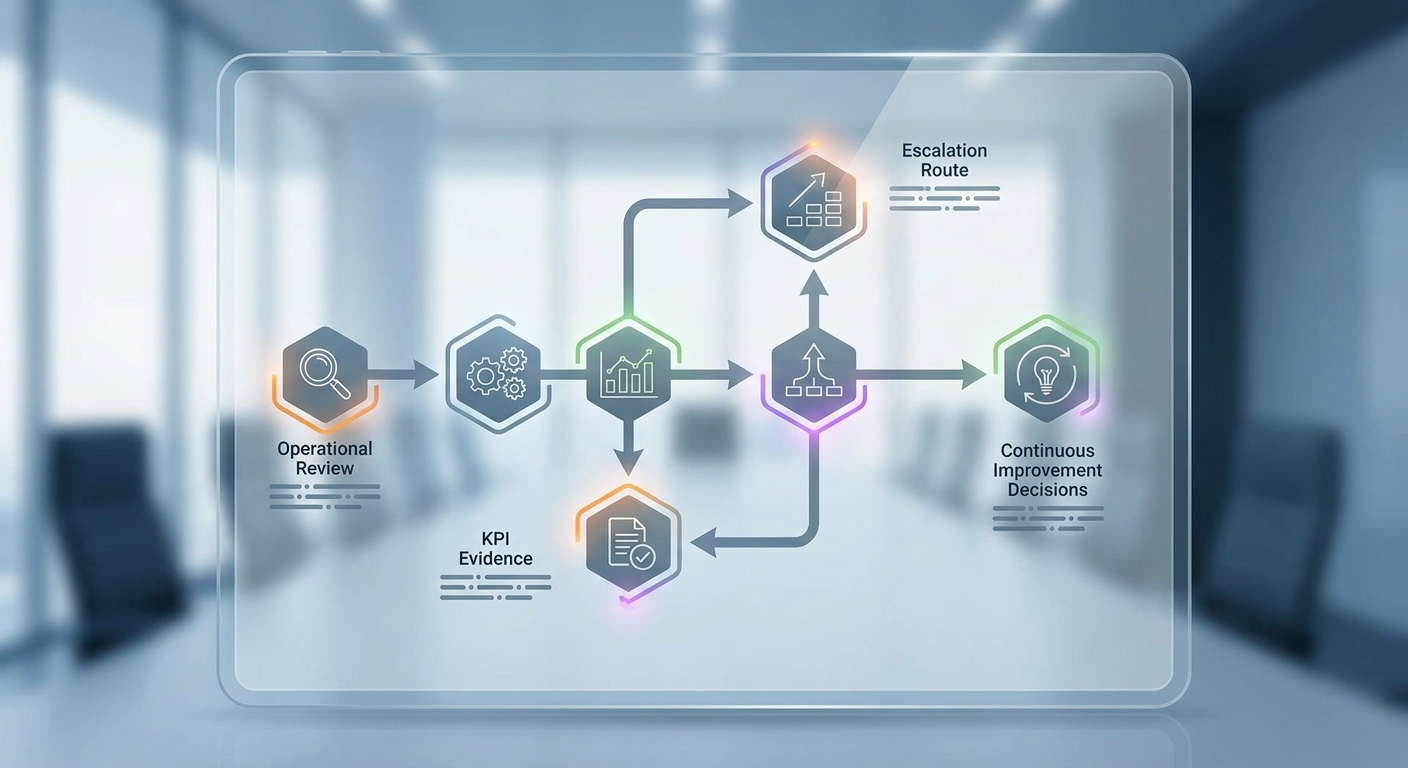
Contract governance model showing operational reviews, KPI evidence, escalation routes and continuous improvement decisions
Start with the commitments made in the bid
The best contract management answers start by looking backwards.
Before describing governance, review the commitments made elsewhere in the tender. The mobilisation section may promise a transition plan. The quality section may promise inspection regimes. The social value section may promise apprenticeships, local spend or volunteering. The sustainability section may promise carbon reporting. The technical method may promise response times, asset uptime, user satisfaction or service continuity.
Contract management is the mechanism that turns those promises into controlled delivery.
This is where many bids lose marks. The contract management section is written separately from the rest of the response, so it feels detached. It says the supplier will manage KPIs, but it does not refer to the KPIs that matter in this tender. It says risks will be tracked, but it does not mention the risks raised in the specification. It says the buyer will receive reports, but it does not explain which tender commitments will appear in those reports.
A stronger method is to build a commitment-to-control map.
For each major promise in the bid, identify the contract management control that will keep it honest. For example:
- A mobilisation deadline should connect to a mobilisation readiness tracker, named workstream owners and gate reviews.
- A customer service promise should connect to response-time data, complaint themes, root cause analysis and service recovery actions.
- A social value promise should connect to baseline data, named delivery partners, milestone dates and evidence packs.
- A sustainability promise should connect to measurement boundaries, reporting frequency and improvement actions.
- A staffing promise should connect to rota compliance, vacancy tracking, training records and contingency arrangements.
- A technology promise should connect to adoption data, incident reporting, cyber governance and user feedback.
This approach reassures the buyer because it shows the bid has not been written in fragments. It also protects the supplier. If a commitment cannot be controlled after award, it should be challenged before submission.
That is one of the most valuable uses of AI in bid writing. A platform like mytender.io can help analyse the tender pack, surface repeated requirements, draft from approved source material and identify where commitments need stronger evidence. The human bid team still decides the delivery model, but the technology makes it much easier to trace the line from requirement to answer to contract management control.
Write KPIs as a delivery system, not a list
KPI sections are often written badly because suppliers confuse measurement with management.
A KPI is not useful simply because it exists. It is useful when it changes behaviour. Buyers know this. They have seen contracts with large KPI schedules and weak performance discipline. They have seen dashboards that report failure after the fact rather than helping prevent it. They have seen suppliers focus on the metrics that are easiest to hit while ignoring the outcomes that matter.
Under the current public procurement environment, KPI credibility is becoming even more important. For certain higher-value public contracts, authorities must set and publish key performance indicators and assess performance during the contract lifecycle. Even where formal publication duties do not apply, buyers are increasingly thinking in the same way: if this supplier wins, how will we know whether the contract is working?
Your tender response should show that you understand the difference between a metric, a target and a management action.
A useful KPI answer normally includes six parts.
The first is the measure. What exactly will be tracked? Avoid vague phrases like service quality or stakeholder satisfaction unless you define them.
The second is the source. Where does the data come from? Helpdesk logs, inspection records, system reports, payment data, training records, audit findings, customer surveys and contract review actions all have different reliability issues.
The third is the target. What is acceptable performance? If the buyer has already specified the target, confirm how you will meet it. If the supplier is proposing targets, explain why they are realistic.
The fourth is the review rhythm. Will the KPI be reviewed daily, weekly, monthly or quarterly? Operational indicators may need frequent review even if formal reporting is monthly.
The fifth is the owner. Who is responsible for improving performance if the result is off track?
The sixth is the intervention. What happens when performance slips? A KPI without an intervention is just a delayed warning light.
A strong answer might say that priority-one incidents will be reviewed in real time by the service desk and operations lead, summarised weekly for the contract manager, and reported monthly to the buyer with root cause analysis for any missed target. If two similar failures occur in a month, the supplier will raise a corrective action plan covering cause, owner, deadline and verification method. If the corrective action remains open after the agreed date, it moves to the joint risk register and is reviewed at senior sponsor level.
That is much stronger than saying performance will be monitored through KPIs.

KPI evidence workflow from source data to dashboard, review meeting, corrective action and buyer assurance
Show how poor performance will be handled
This is the uncomfortable part, which is why many suppliers avoid it.
Tender responses often talk confidently about high performance, but buyers also want to know how the supplier behaves when something goes wrong. That is not negative. It is mature.
Every meaningful contract has issues. Staff absence happens. Asset data is incomplete. A subcontractor misses a deadline. Demand spikes. A mobilisation assumption proves wrong. A reporting feed breaks. A complaint escalates. A buyer stakeholder changes priorities. A supplier that pretends none of this will happen looks less credible, not more.
The contract management answer should explain how underperformance is identified, contained, corrected and learned from.
The strongest responses are calm and specific. They do not dramatise failure, and they do not hide it behind vague assurance language. They explain the operating discipline.
A practical model is:
- Detect the issue through live operational data, inspection, buyer feedback, audit, helpdesk trend or contract review.
- Classify the issue by impact, urgency and contractual significance.
- Assign an owner who has authority to fix it.
- Agree immediate containment where service continuity is at risk.
- Complete root cause analysis for repeated or material issues.
- Track corrective actions to closure.
- Verify that the fix worked.
- Share learning through the governance forum and update the method if needed.
This is useful because it shows the buyer that performance management is active. It also aligns with the reality of public contract oversight. Where poor performance is serious or persistent, buyers may have formal reporting duties or future procurement implications. A supplier that can show early warning discipline gives the buyer more comfort.
The tone matters. Do not write as if the buyer is looking for perfection. They are looking for control.
For example, rather than saying we guarantee no service disruption, say we reduce disruption risk through early warning indicators, named escalation owners and a service recovery process that brings buyer and supplier data into the same review. That is more credible and easier to evidence.
Evidence beats adjectives
Words like robust, proactive, transparent, collaborative and proven appear in almost every contract management response. They are not banned, but they do not score much on their own.
Evaluators need evidence.
Good evidence for contract management can include:
- A sample governance calendar adapted to the buyer's contract.
- A redacted KPI dashboard from a comparable service.
- A case study showing how a performance issue was corrected.
- A mobilisation readiness tracker.
- A continuous improvement log with before-and-after outcomes.
- A social value reporting template.
- A customer satisfaction trend and action plan.
- A risk register extract showing ownership and review dates.
- A contract review pack contents list.
- A lessons learned example from a similar contract.
- A description of systems used to capture service and performance data.
- Named roles with authority levels, not just job titles.
The evidence does not always need to be attached as an appendix. Sometimes a well-written summary is enough. The key is specificity.
A generic answer says: we have a proven continuous improvement process.
A stronger answer says: on a comparable multi-site contract, our monthly trend review identified repeat callouts linked to inconsistent first-fix parts availability. We changed van stock profiles, introduced a weekly exception report and reduced repeat visits over the next quarter. The same mechanism will be used here, with the first trend review at month two once baseline data is stable.
That is not just better writing. It is better scoring. It shows the evaluator what the supplier actually does.
mytender.io is built around this problem. Bid teams often have strong evidence scattered across previous bids, contract reviews, SharePoint folders, case studies, policies and delivery notes. The difficulty is finding it quickly and using it safely. A purpose-built AI tender writing platform can help retrieve relevant evidence, organise it against the buyer's question and produce a first draft that the bid team can then verify. That saves time, but it also improves quality because the response becomes evidence-led rather than adjective-led.
Make the answer buyer-specific
Contract management is highly context dependent.
A healthcare contract may need clinical governance, patient safety reporting, infection control escalation and strict stakeholder communication. A facilities management contract may need asset data quality, statutory compliance, helpdesk performance, planned preventative maintenance and site-level escalation. A construction contract may need programme controls, design coordination, change control, health and safety reporting and resident or user communication. A waste contract may need route performance, missed collection handling, contamination reporting and depot resilience. A technology contract may need service credits, incident severity, cyber governance, data protection and change advisory control.
If the contract management response could be copied into any of those tenders without changing much, it is too generic.
Buyer-specific writing does not mean adding the buyer's name in every paragraph. It means reflecting the operational reality of the contract.
Look for clues in the tender pack. Does the specification repeatedly mention mobilisation risk? Are there strict reporting deadlines? Are there named stakeholders with different priorities? Is the buyer worried about public complaints, statutory compliance, estate disruption, data security, resident impact, service continuity, carbon reporting, local employment or cost control? Has the buyer included detailed KPIs, or are they asking suppliers to propose them? Are there contract change mechanisms that suggest the service may evolve?
Those clues should shape the answer.
For example, if the buyer has a dispersed estate, explain how site-level performance data rolls up into contract-level reporting without hiding local issues. If the buyer has a high-profile public-facing service, explain complaint escalation and communication discipline. If the buyer has inherited poor asset data, explain how the first 90 days will validate the baseline before performance reporting becomes fully reliable. If the buyer has ambitious social value targets, explain how those commitments will be tracked alongside operational KPIs rather than treated as a separate marketing exercise.
This is where narrative matters. The best contract management answers make the evaluator feel that the supplier has already imagined running their contract.

Public sector contract manager and supplier reviewing buyer-specific risks, site data and improvement actions
Connect mobilisation to contract management
Mobilisation and contract management are often scored separately, but they should read like one story.
Mobilisation creates the baseline. Contract management protects it.
The handover between the two is critical. If a supplier writes a brilliant mobilisation plan but does not explain how mobilisation outputs become live contract controls, the buyer may worry that early activity will fade after go-live. The contract management response should therefore refer to mobilisation outputs such as asset registers, staffing plans, stakeholder maps, training records, risk logs, communication plans, data validation findings and first-month service priorities.
A strong response explains what happens at the mobilisation-to-live-service gate.
For example, the supplier might hold a readiness review before service commencement. At that review, each mobilisation workstream confirms whether required evidence is complete. Any amber or red item becomes a live contract risk with an owner and mitigation date. The first contract review then focuses on stabilisation: early KPI trends, stakeholder feedback, open risks, service requests, data quality and any assumptions that need correction.
That kind of detail reassures the buyer because it shows continuity. It also helps the supplier avoid the common post-award problem where the bid team disappears and the delivery team inherits commitments without context.
If AI has helped draft the tender, this handover becomes even more important. The delivery team must understand the commitments made in the written response. mytender.io helps by keeping bid content connected to source material and requirement analysis, so teams can review what was promised and why it was promised. That makes the transition from bid to delivery less fragile.
Be honest about data quality
Performance management depends on data, and data is rarely perfect on day one.
Many tenders assume clean baselines. In reality, asset registers may be incomplete, incumbent data may be inconsistent, historical complaint categories may not match the new reporting model, social value baselines may be unclear, and system access may not be ready during mobilisation. If the supplier pretends all performance reporting will be perfect immediately, the buyer may not believe them.
A better answer is honest but controlled.
Explain how data will be validated, what will be reported from day one, what needs a baseline period, and how the buyer will be kept informed. If a KPI depends on data that must be cleansed during mobilisation, say so. If the first month will use enhanced manual checks while integrations are stabilised, explain that. If baseline performance will be agreed after an initial discovery period, make the governance clear.
This is especially important when proposing ambitious targets. A target that looks impressive but has no reliable data source can become a future dispute. Evaluators know this. They may reward a supplier that shows practical data discipline over a supplier that simply promises perfect dashboards.
A useful phrase is: measure what matters, but verify what you measure.
That principle should run through the contract management section. Dashboards are only as strong as the data behind them. Reports are only useful if they lead to action. Buyer assurance comes from traceability, not decoration.
Show senior attention without overpromising
Many suppliers include a senior sponsor in the governance model. That is sensible, but it is often badly explained.
A senior sponsor who appears at one annual review is not meaningful assurance. A senior sponsor who promises to attend every routine meeting may not be credible. The response should explain exactly when senior involvement happens and what authority it brings.
A good senior sponsor model might include quarterly strategic reviews, attendance at mobilisation gateway meetings, escalation for unresolved red risks, annual value-for-money reviews and executive ownership of any serious performance recovery plan. It should also explain how the senior sponsor stays informed between meetings.
This matters because buyers want reassurance that the contract will not be left to an underpowered account team if things get difficult. They want access to decision-makers when the issue requires commercial, operational or strategic authority.
The key is not to overstate it. Do not promise board-level attention for routine matters unless that is actually how the business works. Evaluators are good at spotting fantasy governance. Be specific, proportionate and credible.
Write continuous improvement as a mechanism
Continuous improvement is one of the most overused and under-evidenced phrases in tender writing.
To make it credible, describe the mechanism.
Where do improvement ideas come from? KPI trends, frontline staff, buyer feedback, complaints, audits, technology reviews, benchmark data, contract review actions, social value progress, sustainability reporting and lessons learned can all generate ideas. How are ideas assessed? Cost, benefit, risk, operational disruption, buyer priority and contractual impact all matter. Who approves them? Some changes may be supplier-led, while others require buyer agreement or commercial variation. How are results measured? Without a before-and-after view, improvement becomes anecdotal.
A strong continuous improvement answer might describe a quarterly improvement pipeline. Ideas are logged throughout the month, reviewed by the contract manager, grouped by theme, scored for impact and effort, and discussed with the buyer. Approved actions receive an owner, due date and benefit measure. Completed actions are reviewed after implementation to confirm whether the intended benefit was achieved.
That is a mechanism. It is much stronger than saying the supplier will seek continuous improvement throughout the contract.
It also connects neatly to the Procurement Act environment because public buyers increasingly need evidence that contracts are delivering value over time. A continuous improvement log can support contract reviews, future extensions, value-for-money assessments and lessons learned.
Avoid the seven common mistakes
There are seven mistakes that weaken contract management tender responses.
The first is writing a generic governance model with no link to the buyer's requirement. If the answer does not mention the specific service risks, stakeholders or KPIs in the tender, it will feel copied.
The second is confusing reporting with management. Sending a monthly report is not the same as managing performance. The answer must explain decisions, actions and escalation.
The third is hiding underperformance. Buyers trust suppliers who explain how issues are handled. They do not trust suppliers who imply nothing will ever go wrong.
The fourth is proposing KPIs without data sources. If you cannot say where the number comes from, who verifies it and what happens when it moves, the KPI is weak.
The fifth is separating social value, sustainability and operational performance. Contract management should show how all material commitments are tracked together.
The sixth is overpromising senior involvement. Governance needs real authority, not decorative names.
The seventh is failing to connect the bid to delivery. If the delivery team cannot recognise and own the commitments in the tender, the contract is already at risk.
Fixing these mistakes does not require longer answers. It requires sharper answers.
A practical structure for the tender response
A strong contract management section can follow a simple structure.
Start with the buyer's risk. Open by showing that you understand what the contract needs to control. This might be service continuity, statutory compliance, stakeholder confidence, mobilisation stability, data quality, social value delivery, public-facing performance or cost control.
Then describe the governance model. Explain meeting rhythm, roles, decision rights, reporting packs and escalation triggers. Keep it practical.
Then explain KPI management. Cover data source, target, review rhythm, owner and intervention. Show how KPIs connect to the buyer's outcomes.
Then explain issue management and recovery. Show how problems are detected, classified, corrected and learned from.
Then describe continuous improvement. Make it a pipeline, not a promise.
Then connect mobilisation to live service. Explain how mobilisation outputs become contract controls.
Then provide evidence. Use a comparable example, dashboard description, case study, lesson learned or source document reference.
Finally, close with buyer assurance. Summarise how the approach gives the buyer visibility, control and confidence throughout the contract lifecycle.
That structure works because it mirrors the evaluator's concerns. It moves from understanding to control to evidence.
How mytender.io helps bid teams write stronger contract management responses
The hardest part of writing contract management responses is not knowing that governance matters. Bid teams already know that. The hard part is assembling the right evidence quickly, tailoring it to the buyer and keeping the answer consistent with the rest of the bid.
That is where mytender.io helps.
The platform analyses tender requirements, breaks down specifications, identifies compliance needs and helps teams draft from approved knowledge rather than starting from a blank page. Instead of hunting through old documents for a contract review example or KPI description, teams can use their own content library to retrieve relevant material and adapt it to the current buyer.
More importantly, mytender.io helps bid teams keep answers grounded. AI should not invent contract management evidence. It should help find, structure and improve the evidence the business already has. The strongest tender responses still need human judgement, operational sign-off and buyer-specific thinking.
For a contract management section, that means using AI to accelerate the first draft, map requirements, identify gaps, suggest structure and surface relevant examples. The bid team then verifies the commitments, checks the governance model with delivery colleagues and sharpens the response around the scoring criteria.
The result is a better answer in less time: more specific, more evidence-led and easier for the delivery team to stand behind.
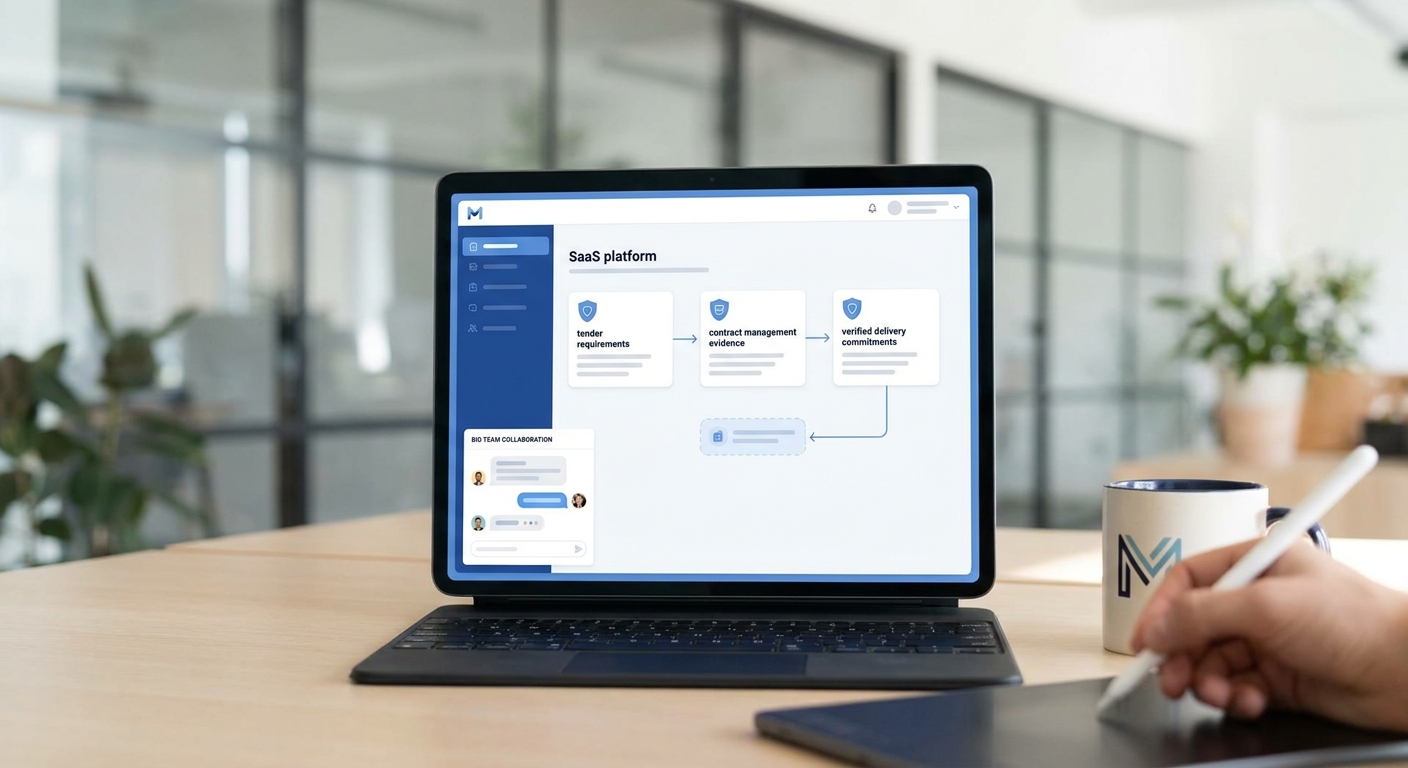
AI-supported bid workspace connecting tender requirements, contract management evidence and verified delivery commitments
The bottom line
Contract management is no longer a safe boilerplate section.
In 2026, buyers are thinking harder about performance, transparency, KPIs and supplier accountability. They want confidence that the supplier can deliver what it has written, manage issues honestly, report accurately and improve the contract over time. They also know that polished AI-assisted bid writing is becoming common, so they will look for evidence that the answer is real.
The suppliers that win will be the ones that connect bid promises to contract controls. They will show how KPIs are measured and acted on. They will explain how underperformance is corrected. They will make governance buyer-specific. They will use evidence instead of adjectives. They will treat contract management as part of the winning strategy, not a formality after the method statement.
That is the standard worth aiming for.
If your team wants to produce stronger contract management responses without spending days hunting through old files, mytender.io can help you turn your existing knowledge into structured, evidence-led tender answers faster. First drafts in minutes, better compliance checks, and a clearer line from requirement to response to delivery.
Because the best tender response is not just the one that reads well. It is the one your team can actually deliver.
Tags
Ready to Transform Your Tender Writing?
See how MyTender's AI can help you write winning tenders in a fraction of the time.